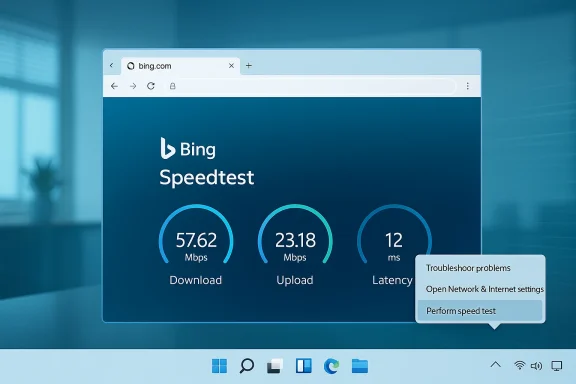
Microsoft’s new one‑click internet speed test on the Windows 11 Taskbar is not a native diagnostic at all — it simply launches your default browser and opens Bing’s speed‑test widget (which, in practice, delegates measurement work to the Speedtest/Ookla backend), a convenience‑first design that raises practical questions about accuracy, privacy, and enterprise manageability.
Microsoft shipped the Taskbar shortcut as part of the February 2026 optional preview update KB5077241 (preview builds in the 26100–26200 family), and the broader staged rollout began with the March 10, 2026 Patch Tuesday servicing wave. The change places a Perform speed test (or localized variant) control in two obvious places: the right‑click context menu for the network icon in the system tray and as a button inside the Wi‑Fi/Cellular Quick Settings flyout. Clicking it opens the default browser and navigates to Bing with a ready‑to‑run speed test.
This is not Microsoft inventing a new in‑OS measurement engine. Instead, the company chose a browser‑hosted approach — a short, discoverable launcher that funnels users to an already‑available web tool. The Bing page then runs the download/upload/latency measurements, producing the familiar metrics most people expect when they “run a speed test.” Multiple independent previews and hands‑on reports from Insider builds confirm this flow.
Recommendations:
In short: Windows 11’s new Taskbar speed test solves a common friction point with a single click, but it is a web shortcut, not a native improvement — and that matters whether you care about accuracy, privacy, or manageability.
Source: FilmoGaz Windows 11 Taskbar’s Internet Speed Test Links Directly to Bing, Not Native
 Background
Microsoft shipped the Taskbar shortcut as part of the February 2026 optional preview update KB5077241 (preview builds in the 26100–26200 family), and the broader staged rollout began with the March 10, 2026 Patch Tuesday servicing wave. The change places a Perform speed test (or localized variant) control in two obvious places: the right‑click context menu for the network icon in the system tray and as a button inside the Wi‑Fi/Cellular Quick Settings flyout. Clicking it opens the default browser and navigates to Bing with a ready‑to‑run speed test.This is not Microsoft inventing a new in‑OS measurement engine. Instead, the company chose a browser‑hosted approach — a short, discoverable launcher that funnels users to an already‑available web tool. The Bing page then runs the download/upload/latency measurements, producing the familiar metrics most people expect when they “run a speed test.” Multiple independent previews and hands‑on reports from Insider builds confirm this flow.
What Microsoft shipped (technical overview)
Where you’ll find the control
- Right‑click the network icon in the system tray and look for Perform speed test.
- Left‑click the network icon, open the Wi‑Fi quick settings flyout, and look for a Test internet speed button near the other quick actions.
What happens when you click
- Windows opens your default browser (Edge, Chrome, Firefox, etc.) — the shortcut respects your default browser settings.
- The browser navigates to Bing’s speed‑test widget (the page is prepopulated and ready to run).
- The web widget performs file upload/download exchanges with a selected test server to measure latency, download throughput, and upload throughput.
- Results are shown on the page; the browser context and any installed extensions influence the experience.
Verification and provenance
I verified the key technical claims across multiple independent outlets and primary sources:- The KB5077241 preview update and its release window are documented in Microsoft’s preview release materials and were covered in detail by Windows‑focused outlets reporting the Feb. 24, 2026 optional preview and the March 10, 2026 staged servicing plan. These references confirm the update packaging and build numbers where testers first saw the feature.
- Multiple hands‑on articles and Insider captures show the Taskbar control opens Bing’s web speed test rather than running a native measurement. That behavior was observed across Release Preview builds and described consistently by outlets that tested it.
- The web widget exposed by Bing aligns with Speedtest (Ookla)‑style measurements. Independent reporting over time — and the widget’s behavior and outputs — point to Speedtest/Ookla backends being used for the measurements that Bing surface. Those observations were consistent across tests and technical write‑ups.
- Historical context is important: Microsoft previously published a native “Network Speed Test” app back in 2013 via Microsoft Research for Windows 8 and Windows Phone, which included connection type, network name display, and a local history of results. That older app shows Microsoft has shipped native speed‑testing tools in the past.
Why Microsoft likely chose a browser‑hosted approach
There are practical engineering and product reasons this design is defensible:- Low maintenance, fast updates. A web widget can be updated server‑side without shipping OS updates. That lets measurement UI, wording, and back‑end endpoints evolve quickly without waiting for Windows servicing cycles.
- Reuses existing infrastructure. Bing already exposes a speed tester; Microsoft avoids duplicating server‑side measurement endpoints and the operational complexity of running a global server fleet.
- Discoverability for non‑technical users. Putting a one‑click check in the Taskbar removes friction for everyday users who only need a quick sanity check.
- Smaller local footprint. There’s no extra native code surface area to maintain or secure inside Windows.
Notable strengths (what works)
- Immediate accessibility. The Taskbar is the logical place to check connectivity; surfacing the test there reduces steps and the cognitive load of remembering a URL or installing a third‑party tool.
- Consistent, familiar metrics. The Bing/Speedtest widget displays the same trio of metrics most users want: ping (latency), download, and upload speeds. That familiarity reduces support friction for help desks and households alike.
- Centralized updates. Bug fixes and UI tweaks to the test can be performed server‑side, keeping the OS lean and minimizing update churn for Windows servicing teams.
Material risks and shortcomings
1) Measurement accuracy and comparability
Browser‑hosted tests are convenient, but they introduce variables that can distort numbers:- Browser extensions, tab activity, and client‑side throttling can affect results.
- HTML5/browser timing and socket behavior differ from native clients, meaning results may not match a native Speedtest desktop client or iperf3 measurement.
- Test server selection and routing policies used by the web widget may change independently of Windows, producing differences across runs.
2) Privacy and telemetry concerns
Because the taskbar flow opens a web page, data collected during the test is governed by the Bing and Speedtest/Ookla privacy policies and your browser’s behavior (cookies, local storage, extensions). That raises questions for:- Privacy‑conscious consumers who prefer local diagnostics that avoid third‑party telemetry.
- Regulated organizations that must control external data flows and audit telemetry capture.
3) Manageability for enterprises
At the time of reporting there is no documented Group Policy or MDM control specifically to remove or redirect the Perform speed test menu entry. That makes it harder for IT administrators to block the behavior inside locked‑down images or to redirect the action to an approved internal diagnostics page. Enterprises can mitigate by delaying the optional preview update (KB5077241) or controlling the browser’s ability to reach the target pages via network policies, but those are blunt instruments.4) Third‑party dependency and commercial risk
The tool ultimately relies on Speedtest infrastructure (now part of the larger corporate moves in the measurement ecosystem). In March 2026, Ookla and its Speedtest assets were reported acquired by Accenture, which reshapes who controls the back‑end infrastructure many users rely on. Dependency on third parties means changes in ownership, licensing, or pricing could alter the user experience or the cost model for commercial integrations.5) UX regression relative to historical native tools
Microsoft shipped a fuller native experience in the past (the Network Speed Test app published by Microsoft Research in 2013 included connection type, network name display, and a history of results). The current shortcut does not preserve these features, and some users see the change as a regression away from richer local tools. If Microsoft wants to satisfy power users and network teams, a hybrid approach (lightweight launcher plus optional native diagnostics module) would be superior.Practical guidance — what Windows users and admins should know
For everyday users
- Expect the Taskbar option to open whatever browser you’ve set as default and then launch Bing’s web test. Use it for quick sanity checks (e.g., is my connection obviously slow right now?).
- For reproducible measurements, use a native client (Speedtest desktop, Speedtest CLI) or a command‑line tool like iperf3 if you’re comfortable with it.
- If you’re privacy‑conscious, run the test in a private browser window with extensions disabled, or use a native tool that doesn’t involve third‑party web scripts.
For power users and IT professionals
- Don’t rely on the Taskbar shortcut for forensics or SLA validation. Use scripted, repeatable tools instead:
- Speedtest CLI (Ookla)
- iperf3 for internal path testing
- PowerToys wrappers that call the Speedtest CLI for automation
- If you need to prevent exposure to the web widget in managed images:
- Delay or block the optional KB5077241 preview update in your servicing pipeline until Microsoft provides explicit policies.
- Use browser/URL filtering to block or redirect the Bing speed‑test endpoint in managed networks.
- Watch Microsoft’s enterprise guidance and policy catalog for a dedicated Group Policy or MDM control to hide the menu entry; historically Microsoft adds such controls when an OS surface becomes a common enterprise pain point.
Alternatives and workarounds
- Use the Speedtest desktop client or Speedtest CLI for more consistent measurements and scripting abilities.
- Use iperf3 for controlled, point‑to‑point throughput tests inside your own network.
- Use browser‑based alternatives (Fast.com, Cloudflare speed test) when you want to compare different measurement engines.
- PowerToys or other third‑party utilities: Tools in the PowerToys ecosystem have begun wrapping Speedtest CLI for convenience and scriptability, which can be useful in both consumer and enterprise deployments.
What Microsoft should (and could) do next
- Expose management controls: Add Group Policy and MDM settings to:
- Hide the Perform speed test control.
- Redirect the action to a customizable URL (e.g., an enterprise diagnostics page).
- Allow disabling of the launcher entirely in managed images.
- Offer a native optional diagnostics module: Provide an optional, lightweight native tool for users who want local logging, exportable results, and a history of tests. This could run in the background and feed into Windows diagnostic logs without shipping a heavy native server footprint.
- Document privacy and telemetry: Publish a short, clear privacy note describing what the Taskbar launcher does and what data the web widget will see so users and admins can make informed choices.
- Allow provider choice: Let users or organizations choose the default speed‑test provider (Bing/Speedtest, Fast.com, ISP tool, or a custom URL).
Bigger picture: platform design trends and the web‑first OS
This Taskbar change is a clear example of Microsoft’s broader product posture in recent years: prioritize discoverable, lightweight conveniences in the shell while delegating richer experiences to web or cloud services. That pattern has trade‑offs:- Pros: Faster iteration, smaller OS surface, and unified experiences across platforms.
- Cons: Reduced offline capability, greater reliance on third‑party services and corporate relationships, and an erosion of some traditional “native” functionality.
Final assessment and recommendations
Microsoft’s Taskbar internet speed test is a practical convenience designed for the mainstream Windows user: it is discoverable, frictionless, and leverages existing web infrastructure so Microsoft doesn’t need to run global measurement servers inside Windows. That design decision explains the architecture — but it does not excuse the lack of immediate enterprise controls, the privacy ambiguity for regulated environments, or the loss of a richer local experience some users remember from earlier Microsoft tools.Recommendations:
- If you are an everyday user: use the Taskbar shortcut for quick checks but rely on a native client for any evidence you’ll share with support or an ISP.
- If you are an enterprise admin: delay optional preview updates until policy support appears; use browser filtering and internal diagnostics tools for managed verification.
- If you are a power user or network engineer: continue using scripted, native tools (Speedtest CLI, iperf3) for repeatable results, and ask Microsoft to offer an optional local diagnostics module or management policies.
In short: Windows 11’s new Taskbar speed test solves a common friction point with a single click, but it is a web shortcut, not a native improvement — and that matters whether you care about accuracy, privacy, or manageability.
Source: FilmoGaz Windows 11 Taskbar’s Internet Speed Test Links Directly to Bing, Not Native