

Microsoft’s long-neglected desktop has, shockingly to some and unsurprisingly to others, begun to show signs of life: the company that many argued had turned Windows into a legacy cash cow amid an AI-and-cloud renaissance is now publicly re-prioritizing the platform, reorganizing leadership, and rolling out security and consent changes that materially reshape how Windows behaves by default. This isn’t a press release dressed as progress; it’s a sequence of tactical moves and public commitments that—taken together—amount to a defensible attempt to restore reliability, trust, and enterprise-grade stewardship to an operating system that powers billions of devices.
That said, the credibility gap is real. Microsoft must consistently demonstrate measurable improvements in platform stability, reduce the frequency and blast radius of emergency updates, deliver migration tooling for developers and OEMs, and show that agentic features can coexist with enterprise-grade governance. Words and posts on social media won’t restore trust; predictable, observable outcomes will.
If Microsoft executes, Windows could re-emerge as a platform that both embraces useful on-device AI and protects enterprises and end users by default. If it fails, the company will have demonstrated that scale and ambition can outpace the discipline required to maintain legibility and trust. For now, something happened—and it is the right kind of something. The follow-through, not the announcement, will decide whether Windows regains the respect it once commanded.
Source: Thurrott.com Something Happened
 Background
Why Windows felt second-class
For much of the post–Windows 8 era, Windows has been squeezed between two tectonic shifts: the consumer pivot to mobile devices, and Microsoft’s pivot to cloud and, later, AI. That corporate realignment left Windows in a maintenance-heavy posture—profitable, yes, but not the company’s center of gravity. Engineering talent and senior attention flowed toward Azure and generative AI initiatives, leaving the OS to be maintained by smaller teams often labeled by users as “B‑teamers.” The result was a steady accrual of user frustrations: quality regressions, controversial UX decisions, and a sense that Windows served Microsoft’s broader strategic story rather than its own long-term users.The scale problem: why quality matters more now
Windows is not a niche product. Microsoft has repeatedly underscored the platform’s scale in recent communications—claims about a billion-plus devices have been part of the company’s narrative—and that installed base both magnifies and multiplies the consequences of regressions. When a cumulative update breaks a fraction of a percent of machines, that fraction still represents millions of users, IT helpdesks, and critical business operations. That scale alone makes reliability not merely a product metric but a corporate risk.Something changed: organizational and product signs of life
Leadership and reorg: Pavan Davuluri’s new mandate
In mid-to-late 2025 Microsoft elevated Pavan Davuluri to lead the reunited Windows + Devices organization, consolidating Windows client, server, Core OS, security, and platform engineering under one senior executive. That reorganization—explicitly aimed at reducing cross-group friction—signals that Microsoft now wants tighter end-to-end control over the engineering vectors required to deliver deeper platform work, particularly on-device and hybrid AI features. The structural move is itself an acknowledgment: Windows needs fewer handoffs and more senior stewardship.New top-level priorities: quality and security reporting to the CEO
More recently, Microsoft created two top-level positions focused on engineering quality and security, both reporting directly to the CEO. That’s not bureaucratic theater—those reporting lines are a governance-level commitment that elevates day-to-day reliability and platform hardening to the same plane as business strategy and AI investments. This organizational emphasis gives Windows a clearer path to resources and faster escalations when the platform fails.Product moves: BSM and consent-first UX
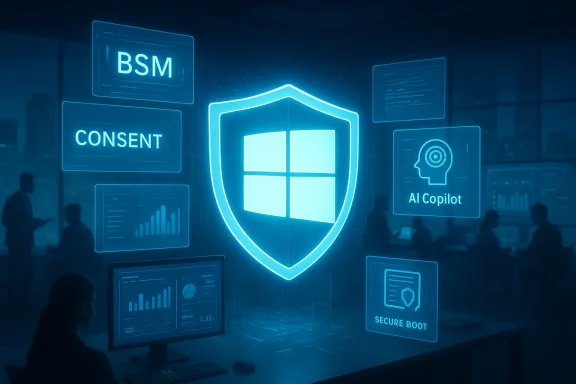
The most tangible product developments are the Windows Baseline Security Mode (BSM) and the User Transparency and Consent model. BSM moves Windows from a permissive-by-default model toward a default-deny runtime posture, where only properly signed apps, drivers, and services are allowed to run unless explicitly authorized. Paired with mobile-style permission prompts and audit trails, the package reframes Windows as a platform that defaults to secure-by-default while preserving migration paths for legacy scenarios. For enterprise and security-conscious customers, this is a strategic shift: the OS now promises auditable, centralized controls rather than optional hardening toggles scattered across disparate features.What’s behind the move: incentives, pressure points, and AI
The business pressure that finally matters
Individual power users leaving Windows are noise to a $400+ billion company; enterprise customers are not. Two things changed the incentives for Microsoft: the regulatory spotlight on cloud and platform bundling, and enterprise discomfort with AI’s security surface. Microsoft’s core customers—Fortune 500 orgs and large IT buyers—have the ability to vote with their procurement. When enterprise customers raise concerns about update reliability, supply-chain risks, or how agentic AI might leak corporate secrets, Microsoft faces real commercial and reputational consequences. The company’s recent security and quality posture adjustments appear driven first and foremost by these enterprise incentives.AI: the accelerant and the problem
AI is both the reason Windows needs more engineering attention and a source of the very risk Microsoft is trying to manage. On the one hand, integrating capable on-device agents and multimodal assistants can unlock productivity gains that justify new Windows concepts like Copilot+ PCs. On the other hand, agentic behavior—where an OS or an agent can act on behalf of a user with permissions—creates new attack surfaces, privacy considerations, and compliance headaches for IT. Microsoft’s dual strategy—push agentic capabilities while hardening the platform with consent and integrity primitives—reflects an attempt to thread this needle. Whether it succeeds will depend on measurable security outcomes, not slogans.Technical and product details that matter
Windows Baseline Security Mode: what it technically enforces
BSM consolidates a suite of existing integrity technologies into a single, auditable default posture. Practically, that means:- Only signed and policy‑approved binaries, drivers, and services can execute by default.
- Administrators can pre-authorize exceptions across fleets and audit exception usage.
- APIs allow developers to detect whether the baseline protections are active, enabling graceful degradation or remediation guidance.
User Transparency and Consent: desktop permissions that look like mobile
The consent model will surface human-readable prompts whenever apps or agents access sensitive resources: files, camera, microphone, and the ability to install additional software. Key UX choices include:- Time-boxed permissions (temporary grants that expire on app close).
- Clear, auditable logs for administrators to review.
- Distinct identity and permissions for AI agents so actions they take are attributable.
Reliability engineering: “swarming,” device gating, and rolling fixes
Microsoft’s operational response to high-impact regressions has shifted to a “swarming” model: concentrated, cross-disciplinary teams focused on high-priority reliability problems until they’re resolved. The company is also experimenting with tighter device gating for feature rollouts and greater reliance on Insider telemetry to detect regressions earlier. This operational posture is intended to make emergency out-of-band fixes the exception instead of the norm. Early signals indicate a sincere shift in process, but the proof will be in fewer emergency patches and a reduced blast radius of updates.The AI angle: Copilot, adoption, and perception
Copilot’s reality check
Microsoft has pushed Copilot widely across Windows and Microsoft 365, but commercial uptake on the paid Copilot SKU has been modest compared with public expectations. Enterprises have shown preference for third-party models and services in many cases, and some large customers continue to see Copilot as weaker than competing offerings. That reality—low adoption in paid tiers—has implications: if Copilot isn’t sticky with business buyers, Microsoft cannot rely on it alone to justify agentic Windows features at scale. This is an area where independent performance and trust metrics will decide the strategy’s viability. Note: publicly reported adoption numbers vary by source; some claims are network-sourced and should be treated cautiously until Microsoft releases authoritative figures.Security anxiety: enterprises worry about data leakage and agent behavior
Even if Copilot were technically comparable to other models, enterprises worry about data governance: where prompts, context, and outputs travel, and who can access logs. Agentic features, particularly when they act across apps or the cloud, raise questions about provenance, retention, and how to prevent model-mediated data exfiltration. Microsoft’s BSM and User Transparency initiatives directly address this by creating auditable controls and consent windows for agent actions; those controls must be demonstrably enforceable in enterprise environments.Quality, updates, and the trust deficit
January 2026: a case study in update fragility
Patch cycles are the lifeblood of platform security—but January 2026 Patch Tuesday produced a cascade of regressions that underlined systemic validation gaps. Users reported machine boot issues, Remote Desktop regressions, and file I/O problems. Microsoft issued multiple emergency out‑of‑band patches to contain the fallout—an outcome that dramatized the need for stronger pre-release validation, narrower rollout gating, and a renewed emphasis on rollback safety. These operational failures are the proximate cause of Microsoft’s current “repair the basics” posture.The thin line between progress and “Microslop”
Microsoft’s rapid feature cadence—particularly for AI-first UI elements—created the perception of “feature-first” development at the expense of polish. The community coined a term for this: Microslop—well-meaning innovations shipped at speed without adequate validation. The company has acknowledged the problem and is promising corrective engineering. The substantive question is whether the company can sustain both innovation and the deeper, slower work that reliability demands.Ecosystem, developer, and enterprise impacts
For developers and ISVs
BSM implies changes to build, signing, and deployment workflows. Developers of native applications and drivers will need clearer guidance and tooling to detect BSM environments and provide graceful fallbacks or install-time remediation. Microsoft has indicated APIs and simulation tooling will be provided, but independent vendors will need migration paths and realistic timelines to avoid breaking enterprise applications. Without that runway, help desks and integrators will bear the burden of compatibility friction.For OEMs and hardware partners
OEMs will be expected to ship devices with updated Secure Boot certificates and tested firmware to support the new baseline. Microsoft’s recent partnership with PC makers to deploy new Secure Boot certificates for older machines shows recognition that hardware ecosystems must be part of the migration plan. This is important: a security posture enforced in software but incompatible with legacy firmware will break many supply chains if not handled by coordinated industry efforts.For enterprises and IT
Enterprise IT has historically had tools to lock down user experiences—group policies, WDAC, and MDM controls—that mitigate many consumer-facing changes. However, the new defaults (BSM and consent UX) change baseline expectations and require testing across complex application matrices. IT teams will need enhanced visibility, exception management processes, and planning. If Microsoft delivers reliable APIs, audit logs, and centralized exception controls, this could materially reduce incident surface area; if not, the migration will be costly and chaotic.Risks, unknowns, and what to watch
Risks
- Compatibility debt: BSM’s default-deny model risks breaking legacy installers, drivers, and specialized enterprise tooling unless Microsoft provides robust migration tooling and grace periods.
- UX overload: Consent prompts must be designed to inform, not annoy. Over-prompting will erode trust and encourage careless acceptance.
- Execution vs. rhetoric: Organizational changes mean little without measurable outcomes—fewer emergency fixes, better SLOs for responsiveness, and demonstrable reduction in surface-area exploits.
Unknowns
- Exact Copilot adoption and real-world agent reliability across large fleets remain opaque in public reporting, and some adoption figures cited in commentary cannot be independently verified without Microsoft’s official disclosures. Treat adoption claims with caution.
- The timeline for rolling BSM to broad audiences and the granularity of exception APIs will determine whether this shift is a gentle migration or a painful breaking point for enterprises and ISVs.
What to watch next (practical checklist)
- Fewer emergency out‑of‑band patches after Patch Tuesday—measure whether the January 2026 pattern repeats.
- Insider channel builds that demonstrate BSM in simulation mode with developer toolchains and clear migration docs.
- Concrete metrics from Microsoft on Copilot adoption and agent telemetry handling in enterprise contracts—look for contractual guarantees around data governance.
- OEM firmware and Secure Boot certificate rollouts to older PCs—this will indicate how Microsoft expects broad compatibility to be maintained.
The balanced verdict: real change, but the proof is operational
The sequence of moves—leadership realignment, elevated reporting for quality and security, the introduction of BSM and a consent-first UX, and operational "swarming"—is meaningful. Collectively, these are not incremental gestures; they are structural choices that change incentives for engineering, OEM partners, ISVs, and enterprise IT. For many long-suffering Windows enthusiasts and administrators, this represents a clear pivot away from “feature spectacle” toward stewardship.That said, the credibility gap is real. Microsoft must consistently demonstrate measurable improvements in platform stability, reduce the frequency and blast radius of emergency updates, deliver migration tooling for developers and OEMs, and show that agentic features can coexist with enterprise-grade governance. Words and posts on social media won’t restore trust; predictable, observable outcomes will.
If Microsoft executes, Windows could re-emerge as a platform that both embraces useful on-device AI and protects enterprises and end users by default. If it fails, the company will have demonstrated that scale and ambition can outpace the discipline required to maintain legibility and trust. For now, something happened—and it is the right kind of something. The follow-through, not the announcement, will decide whether Windows regains the respect it once commanded.
Source: Thurrott.com Something Happened
