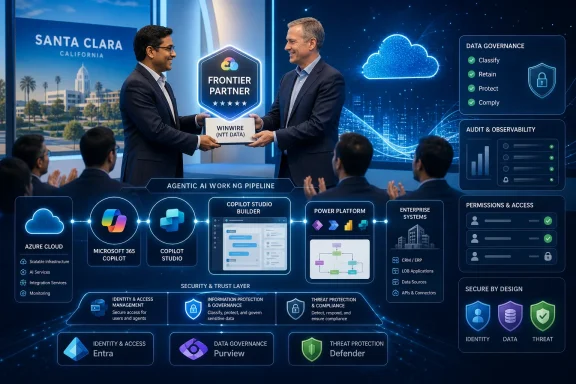
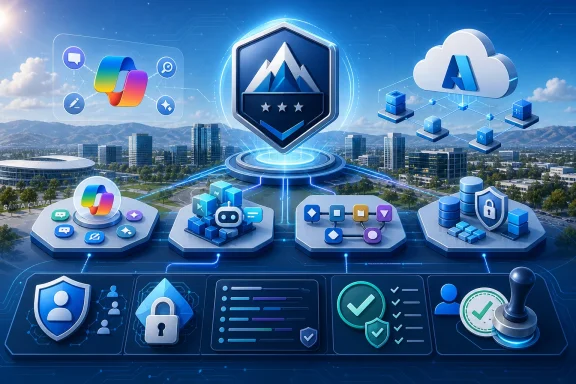
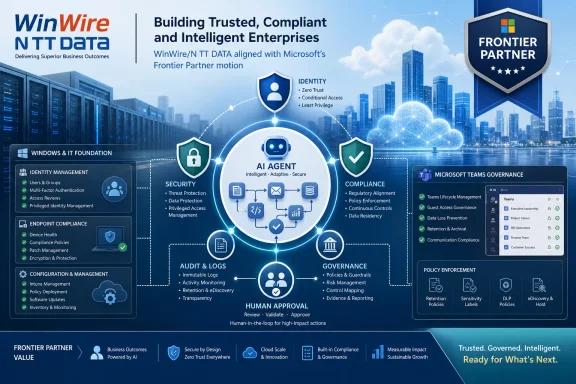
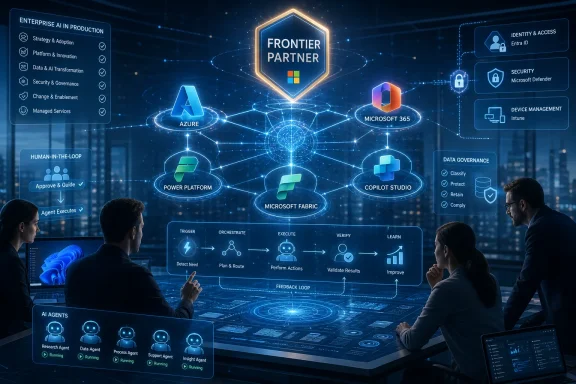
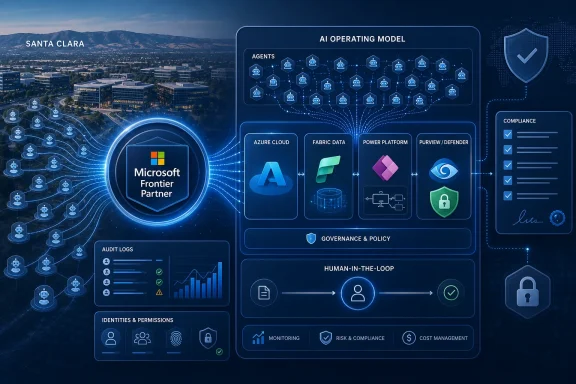
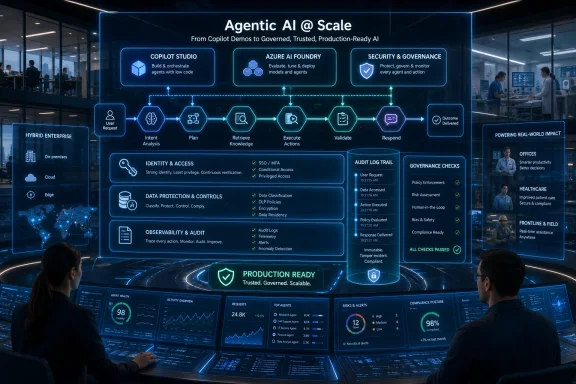
WinWire said on June 25, 2026, that it has earned Microsoft’s Frontier Partner badge within the Microsoft AI Cloud Partner Program, positioning the Santa Clara-based NTT DATA company as a validated services partner for enterprise AI, agentic AI, Azure, Copilot, Power Platform, data engineering, cloud-native development, and security work. The announcement is not just another channel trophy for a partner website. It is a small but telling marker in Microsoft’s larger campaign to turn generative AI from a licensing event into an enterprise operating model. For customers, the badge matters less as decoration than as a signal of where Microsoft wants the consulting market to go next: away from pilots, toward governed production systems.
Microsoft’s partner ecosystem has always been part sales channel, part implementation army, and part credibility machine. In the Windows Server and Exchange era, certifications told customers who could install, migrate, and support the stack. In the Azure era, designations became a way to sort firms that could move workloads into the cloud from firms that merely knew how to resell consumption.
The Frontier Partner badge belongs to a different moment. Microsoft is not merely asking partners to know a product family; it is asking them to demonstrate they can deliver AI transformation across a stack that now includes Microsoft 365 Copilot, Copilot Studio, Azure AI Foundry, Microsoft Fabric, Power Platform, security tooling, and the governance patterns needed to keep all of it from becoming an expensive experiment.
That distinction matters because most enterprise AI programs are not blocked by a lack of demos. They are blocked by data readiness, identity boundaries, legal uncertainty, unclear ownership, and the gap between a chatbot that impresses executives in a conference room and an agent that safely touches production workflows. The Frontier badge is Microsoft’s attempt to identify partners that can operate in that messy middle.
WinWire’s announcement leans directly into that theme. The company describes its work around Agentic AI, data engineering, and cloud-native development, but the key phrase is “AI @ Scale.” That is vendor language, certainly, but it also captures the problem customers are confronting: the easy part of generative AI was procurement; the hard part is deployment with accountability.
The company says it earned the Frontier Partner badge by meeting multiple Microsoft Solutions Partner designations and advanced specializations. The listed designations include Modern Work, Digital and App Innovation, Infrastructure, Data and AI, and Security. Its advanced specializations include Microsoft Copilot, AI Application and Platform Innovation, and Data Security.
That combination tells us what Microsoft is rewarding. A partner that can talk about AI but lacks security credibility is not enough. A partner that can modernize infrastructure but cannot build Copilot-era workflows is not enough. A partner that can build a slick AI app but cannot deal with data estates is not enough.
The badge, in other words, favors firms that can stitch together the whole Microsoft Cloud story. That is exactly the kind of bundling Microsoft wants customers to internalize. AI adoption becomes an argument for Azure, Microsoft 365, Fabric, Entra, Purview, Defender, Power Platform, GitHub, and Copilot tooling all at once.
For WindowsForum readers, that should sound familiar. Microsoft rarely sells a single product transformation when it can sell an ecosystem transformation. The Frontier badge is a partner-program expression of that same strategy.
The first wave of generative AI inside companies centered on assistants: draft this email, summarize this meeting, rewrite this document, search this knowledge base. The next wave is about agents, or at least systems marketed as agents: software that can reason over context, call tools, interact with business systems, and complete multi-step tasks with some degree of autonomy.
That ambition is both promising and dangerous. The value proposition is obvious: automate handoffs, compress workflows, and let employees spend less time navigating systems. But the operational risks are also obvious: bad data, excessive permissions, prompt injection, hallucinated actions, unlogged decisions, unclear accountability, and workflows that break in ways nobody immediately understands.
This is where services partners become central to Microsoft’s AI strategy. Microsoft can build Copilot Studio, Azure AI Foundry, and Microsoft 365 Copilot, but enterprises still need someone to map business processes, identify safe automation boundaries, build connectors, enforce identity controls, monitor outputs, and convince skeptical business units that the system is not just another executive-sponsored toy.
WinWire’s announcement says its capabilities include building and deploying AI agents for business functions using Microsoft Foundry, Copilot Studio, and Microsoft 365 Copilot. It also points to AI frameworks and accelerators intended to move from pilot to production. The practical issue is whether those frameworks can withstand the realities of enterprise IT: fragmented data, aging applications, risk committees, procurement friction, and users who will quietly abandon tools that add complexity.
In Microsoft’s telling, a frontier organization is AI-first but human-led. That framing is designed to reassure both executives and workers. AI is not replacing the enterprise; it is extending it. Agents are not rogue automation; they are managed participants in a governed environment.
The framing also does something more strategic. It places Microsoft at the center of the enterprise AI control plane. If agents are built in Copilot Studio, grounded in Microsoft 365 data, deployed through Azure AI Foundry, secured by Microsoft identity and compliance tools, and managed by Microsoft-trained partners, then the enterprise AI stack becomes deeply Microsoft-shaped.
That may be attractive to many IT departments. Microsoft already owns the productivity layer in countless organizations, and its identity, endpoint, collaboration, and cloud services are already entangled with daily operations. For customers that have standardized on Microsoft 365 and Azure, a Microsoft-first AI architecture may feel less risky than stitching together a collection of standalone AI vendors.
But it also raises the stakes of partner selection. A partner delivering agentic AI is not merely installing software. It may be designing the automation layer that sits across documents, email, CRM records, clinical workflows, engineering systems, finance data, and customer support queues. That is not work customers should award based on a badge alone.
This is especially true for agentic AI. Traditional cloud migrations had their own complexities, but success was often easier to define: move the workload, improve resilience, reduce technical debt, optimize cost. AI deployments involve fuzzier measurements. Did productivity improve? Did employees trust the outputs? Did the system reduce cycle time without increasing error rates? Did it create new compliance exposure? Did automation shift work or merely hide work?
WinWire’s announcement claims a track record in Healthcare & Life Sciences and Software and Digital Platforms. Those are meaningful areas because they involve both data intensity and operational sensitivity. Healthcare and life sciences customers, in particular, will care deeply about governance, auditability, privacy, and validation. A badly governed AI assistant in a low-risk department is embarrassing; a badly governed AI workflow in a regulated setting can be a board-level problem.
The company’s emphasis on Responsible AI principles and governance guardrails is therefore not ornamental. It is table stakes. The more agents are embedded into enterprise workflows, the more governance becomes a product requirement rather than a policy document.
That is where partners like WinWire enter the story. A generic Copilot deployment can help users summarize meetings and draft documents. A more ambitious deployment tries to connect Copilot experiences to business-specific workflows: sales operations, patient services, claims handling, software engineering, employee onboarding, financial analysis, and internal support.
The technical plumbing quickly becomes nontrivial. Organizations need clean permissions, secure connectors, information lifecycle controls, sensitivity labels, data loss prevention, and monitoring. They also need business owners willing to decide what an AI system is allowed to do and what must remain under human approval.
For Windows and Microsoft 365 administrators, the lesson is straightforward: Copilot adoption is not just a licensing project. It is an identity, data, compliance, endpoint, and change-management project. The Frontier badge exists because Microsoft knows customers need help crossing that gap.
The old partner economy rewarded implementation capacity and resale reach. The cloud partner economy rewarded migration skill and consumption growth. The AI partner economy rewards the ability to produce business outcomes from a platform whose value is not always obvious on day one.
That shift changes what customers should expect from a Microsoft partner. It is no longer enough for a firm to say it can deploy Azure resources or manage Microsoft 365 tenants. The stronger claim is that it can help redesign work itself around AI systems without breaking security, compliance, or trust.
WinWire’s badge announcement should be read in that context. Microsoft is not simply handing out a new emblem. It is curating a class of partners that can help normalize agentic AI as an enterprise practice. The “frontier” language may sound inflated, but the program logic is concrete: Microsoft needs trusted intermediaries to convert its AI roadmap into customer adoption.
This also helps Microsoft’s field sales organization. When every services firm claims AI expertise, badges and specializations give sellers a sorting mechanism. They help Microsoft point customers toward partners that align with its current product priorities and delivery patterns.
WinWire’s emphasis on data estate modernization is therefore more significant than the branding around autonomous systems. An agent is only as useful as the data and tools it can safely reach. If an organization has inconsistent permissions, stale SharePoint sites, overexposed Teams content, poorly classified documents, and brittle integrations, AI will surface those problems faster than it solves them.
This is one of the underappreciated consequences of Copilot and agent deployments. They can act like an X-ray for information governance. Suddenly, data that was technically accessible but socially invisible becomes queryable. Suddenly, old access decisions matter. Suddenly, “we’ll clean that up later” becomes an AI adoption blocker.
Security teams should welcome the attention but resist the rush. The right response is not to freeze AI adoption indefinitely. It is to tie AI rollout to concrete governance work: least-privilege access, data classification, audit logging, retention policies, connector review, red-team testing, and incident response planning.
In 2023 and 2024, many organizations felt pressure to launch pilots because boards, investors, and executives wanted visible AI motion. By 2026, the question is harder: which AI projects actually reduce cost, increase revenue, accelerate delivery, improve customer experience, or reduce risk? A proof of concept is no longer enough.
Microsoft has the same problem at platform scale. It needs customers to see AI as more than a premium SKU attached to existing productivity subscriptions. It needs Copilot, Azure AI Foundry, Fabric, and Power Platform to become part of a durable operating model. Partners that can produce measurable customer outcomes are therefore strategically valuable.
The challenge is measurement. AI ROI can be slippery because productivity gains are often distributed across small time savings, improved search, faster drafting, shorter development cycles, or reduced manual triage. Those gains are real only if they change behavior and process. Saving ten minutes on a task does not matter if the organization simply fills the gap with more coordination overhead.
A credible partner should therefore be able to define success before deployment. That means baseline metrics, pilot boundaries, adoption tracking, quality controls, and post-deployment review. The badge may help identify candidates, but the contract should still demand evidence.
In healthcare-adjacent environments, the promise of AI is enormous: documentation support, research acceleration, patient engagement, operational triage, knowledge retrieval, and administrative automation. But so are the risks. Data privacy, clinical safety, regulatory compliance, and model reliability are not optional considerations.
In software and digital platform companies, the pressure often comes from speed. Teams want AI-assisted development, automated support, better analytics, and workflow agents that reduce friction across engineering and customer operations. Here the risk is less about whether AI can be used and more about whether it can be governed while moving quickly.
A partner that works across both kinds of environments needs more than prompt engineering expertise. It needs architecture discipline, domain awareness, secure development practices, and a mature view of change management. That is the actual frontier: not building a chatbot, but embedding AI into work without losing control of the work.
For Windows administrators, endpoint posture matters because AI adoption widens the blast radius of compromised accounts and poorly managed devices. If an AI assistant can reason across sensitive data, the identity behind that assistant becomes more valuable. Conditional access, device compliance, phishing resistance, and privilege management become even more central.
For Microsoft 365 administrators, information architecture matters because Copilot and agents inherit the permissions and content sprawl that already exist. A tenant full of overshared files and abandoned workspaces is not AI-ready simply because licenses have been assigned. The AI layer makes old governance debt more visible.
For developers, the shift means more pressure to build applications that expose capabilities safely to AI agents. APIs, event models, permissions, telemetry, and human approval flows become part of the AI-readiness conversation. The application that cannot be safely called by an agent may become a bottleneck in an automation-first enterprise.
That does not make the strategy wrong. Many enterprises will prefer a consolidated vendor stack over a fragmented AI architecture assembled from startups and open-source components. Microsoft can plausibly argue that its identity, compliance, and productivity footprint gives it an advantage in deploying AI responsibly at scale.
Still, customers should be clear-eyed. The more agentic workflows are built around Copilot Studio, Microsoft 365 data, Azure AI Foundry, Fabric, and Power Platform, the harder it may be to move those workflows elsewhere. The cost is not just licensing. It is process design, user training, integration logic, governance models, and operational muscle memory.
This is where partner incentives deserve attention. A Microsoft Frontier Partner is, by definition, aligned with Microsoft’s stack. That can be a strength when the customer has already made a Microsoft-first strategic decision. It can be a limitation if the customer needs a more heterogeneous architecture or wants to preserve optionality across AI platforms.
The difference will show up in the questions partners ask. A serious partner will ask about data classification, business process ownership, risk tolerance, permissions, integration constraints, adoption metrics, and rollback plans. A superficial partner will rush to demos.
The same applies to accelerators. Every services firm now has frameworks, templates, and reusable assets. Those can be useful, especially when they encode lessons from previous deployments. But accelerators are only valuable if they adapt to the customer’s reality rather than forcing a generic operating model onto a complex organization.
WinWire’s announcement makes the right claims: secure, scalable, AI-first, governed, and outcome-driven. The real test, as always, will be customer delivery over time. Microsoft’s badge can open the door; it cannot guarantee what happens after the statement of work is signed.
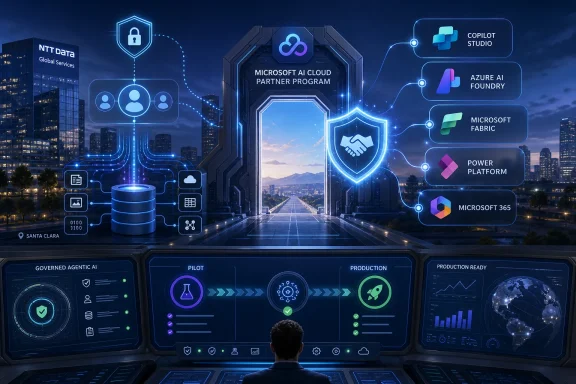 Microsoft Turns Partner Badges Into AI Market Infrastructure
Microsoft’s partner ecosystem has always been part sales channel, part implementation army, and part credibility machine. In the Windows Server and Exchange era, certifications told customers who could install, migrate, and support the stack. In the Azure era, designations became a way to sort firms that could move workloads into the cloud from firms that merely knew how to resell consumption.The Frontier Partner badge belongs to a different moment. Microsoft is not merely asking partners to know a product family; it is asking them to demonstrate they can deliver AI transformation across a stack that now includes Microsoft 365 Copilot, Copilot Studio, Azure AI Foundry, Microsoft Fabric, Power Platform, security tooling, and the governance patterns needed to keep all of it from becoming an expensive experiment.
That distinction matters because most enterprise AI programs are not blocked by a lack of demos. They are blocked by data readiness, identity boundaries, legal uncertainty, unclear ownership, and the gap between a chatbot that impresses executives in a conference room and an agent that safely touches production workflows. The Frontier badge is Microsoft’s attempt to identify partners that can operate in that messy middle.
WinWire’s announcement leans directly into that theme. The company describes its work around Agentic AI, data engineering, and cloud-native development, but the key phrase is “AI @ Scale.” That is vendor language, certainly, but it also captures the problem customers are confronting: the easy part of generative AI was procurement; the hard part is deployment with accountability.
WinWire’s Badge Is a Channel Story With Enterprise Consequences
WinWire is not a household name for most Windows users, but it occupies a familiar position in the Microsoft ecosystem. It is a services partner that helps enterprises turn Microsoft’s platform ambitions into actual deployed systems, especially in regulated or complex verticals. Its ownership by NTT DATA gives the announcement a larger global services context, but the press release emphasizes WinWire’s own specialization in agentic AI, data engineering, and cloud-native application work.The company says it earned the Frontier Partner badge by meeting multiple Microsoft Solutions Partner designations and advanced specializations. The listed designations include Modern Work, Digital and App Innovation, Infrastructure, Data and AI, and Security. Its advanced specializations include Microsoft Copilot, AI Application and Platform Innovation, and Data Security.
That combination tells us what Microsoft is rewarding. A partner that can talk about AI but lacks security credibility is not enough. A partner that can modernize infrastructure but cannot build Copilot-era workflows is not enough. A partner that can build a slick AI app but cannot deal with data estates is not enough.
The badge, in other words, favors firms that can stitch together the whole Microsoft Cloud story. That is exactly the kind of bundling Microsoft wants customers to internalize. AI adoption becomes an argument for Azure, Microsoft 365, Fabric, Entra, Purview, Defender, Power Platform, GitHub, and Copilot tooling all at once.
For WindowsForum readers, that should sound familiar. Microsoft rarely sells a single product transformation when it can sell an ecosystem transformation. The Frontier badge is a partner-program expression of that same strategy.
The Agentic AI Pitch Moves Beyond the Demo Stage
The most important phrase in WinWire’s announcement is not “Frontier Partner.” It is “Agentic AI @ Scale.” That phrase is doing heavy marketing work, but it reflects a genuine shift in how vendors are selling enterprise AI.The first wave of generative AI inside companies centered on assistants: draft this email, summarize this meeting, rewrite this document, search this knowledge base. The next wave is about agents, or at least systems marketed as agents: software that can reason over context, call tools, interact with business systems, and complete multi-step tasks with some degree of autonomy.
That ambition is both promising and dangerous. The value proposition is obvious: automate handoffs, compress workflows, and let employees spend less time navigating systems. But the operational risks are also obvious: bad data, excessive permissions, prompt injection, hallucinated actions, unlogged decisions, unclear accountability, and workflows that break in ways nobody immediately understands.
This is where services partners become central to Microsoft’s AI strategy. Microsoft can build Copilot Studio, Azure AI Foundry, and Microsoft 365 Copilot, but enterprises still need someone to map business processes, identify safe automation boundaries, build connectors, enforce identity controls, monitor outputs, and convince skeptical business units that the system is not just another executive-sponsored toy.
WinWire’s announcement says its capabilities include building and deploying AI agents for business functions using Microsoft Foundry, Copilot Studio, and Microsoft 365 Copilot. It also points to AI frameworks and accelerators intended to move from pilot to production. The practical issue is whether those frameworks can withstand the realities of enterprise IT: fragmented data, aging applications, risk committees, procurement friction, and users who will quietly abandon tools that add complexity.
Microsoft’s “Frontier” Language Is Really About Control
Microsoft’s use of the word “Frontier” is not accidental. It evokes speed, leadership, and a new competitive boundary. It also gives Microsoft a way to define what advanced AI adoption should look like before the market settles on its own definitions.In Microsoft’s telling, a frontier organization is AI-first but human-led. That framing is designed to reassure both executives and workers. AI is not replacing the enterprise; it is extending it. Agents are not rogue automation; they are managed participants in a governed environment.
The framing also does something more strategic. It places Microsoft at the center of the enterprise AI control plane. If agents are built in Copilot Studio, grounded in Microsoft 365 data, deployed through Azure AI Foundry, secured by Microsoft identity and compliance tools, and managed by Microsoft-trained partners, then the enterprise AI stack becomes deeply Microsoft-shaped.
That may be attractive to many IT departments. Microsoft already owns the productivity layer in countless organizations, and its identity, endpoint, collaboration, and cloud services are already entangled with daily operations. For customers that have standardized on Microsoft 365 and Azure, a Microsoft-first AI architecture may feel less risky than stitching together a collection of standalone AI vendors.
But it also raises the stakes of partner selection. A partner delivering agentic AI is not merely installing software. It may be designing the automation layer that sits across documents, email, CRM records, clinical workflows, engineering systems, finance data, and customer support queues. That is not work customers should award based on a badge alone.
The Badge Is a Signal, Not a Substitute for Due Diligence
Microsoft’s partner badges matter because they represent validated capability, but they do not eliminate the need for customer scrutiny. A badge can tell an enterprise that a partner has met Microsoft’s program criteria at a point in time. It cannot tell the enterprise whether that partner understands its regulatory obligations, internal politics, data quality problems, or appetite for automation risk.This is especially true for agentic AI. Traditional cloud migrations had their own complexities, but success was often easier to define: move the workload, improve resilience, reduce technical debt, optimize cost. AI deployments involve fuzzier measurements. Did productivity improve? Did employees trust the outputs? Did the system reduce cycle time without increasing error rates? Did it create new compliance exposure? Did automation shift work or merely hide work?
WinWire’s announcement claims a track record in Healthcare & Life Sciences and Software and Digital Platforms. Those are meaningful areas because they involve both data intensity and operational sensitivity. Healthcare and life sciences customers, in particular, will care deeply about governance, auditability, privacy, and validation. A badly governed AI assistant in a low-risk department is embarrassing; a badly governed AI workflow in a regulated setting can be a board-level problem.
The company’s emphasis on Responsible AI principles and governance guardrails is therefore not ornamental. It is table stakes. The more agents are embedded into enterprise workflows, the more governance becomes a product requirement rather than a policy document.
Copilot Is Becoming the Front Door to the Microsoft Stack
Microsoft 365 Copilot began as an assistant layered over familiar productivity tools, but Microsoft’s partner messaging increasingly treats Copilot as an entry point into broader business transformation. That is a logical progression. Once a company pays for Copilot licenses, the next question is whether those licenses produce measurable value. The answer often depends on data access, process redesign, custom agents, and integrations with line-of-business systems.That is where partners like WinWire enter the story. A generic Copilot deployment can help users summarize meetings and draft documents. A more ambitious deployment tries to connect Copilot experiences to business-specific workflows: sales operations, patient services, claims handling, software engineering, employee onboarding, financial analysis, and internal support.
The technical plumbing quickly becomes nontrivial. Organizations need clean permissions, secure connectors, information lifecycle controls, sensitivity labels, data loss prevention, and monitoring. They also need business owners willing to decide what an AI system is allowed to do and what must remain under human approval.
For Windows and Microsoft 365 administrators, the lesson is straightforward: Copilot adoption is not just a licensing project. It is an identity, data, compliance, endpoint, and change-management project. The Frontier badge exists because Microsoft knows customers need help crossing that gap.
The Channel Is Being Rebuilt Around AI Readiness
Microsoft has been reshaping its partner program for years, moving from the old Microsoft Partner Network identity toward the Microsoft Cloud Partner Program and then the Microsoft AI Cloud Partner Program. The names are not just branding churn. They reflect the center of gravity in Microsoft’s business.The old partner economy rewarded implementation capacity and resale reach. The cloud partner economy rewarded migration skill and consumption growth. The AI partner economy rewards the ability to produce business outcomes from a platform whose value is not always obvious on day one.
That shift changes what customers should expect from a Microsoft partner. It is no longer enough for a firm to say it can deploy Azure resources or manage Microsoft 365 tenants. The stronger claim is that it can help redesign work itself around AI systems without breaking security, compliance, or trust.
WinWire’s badge announcement should be read in that context. Microsoft is not simply handing out a new emblem. It is curating a class of partners that can help normalize agentic AI as an enterprise practice. The “frontier” language may sound inflated, but the program logic is concrete: Microsoft needs trusted intermediaries to convert its AI roadmap into customer adoption.
This also helps Microsoft’s field sales organization. When every services firm claims AI expertise, badges and specializations give sellers a sorting mechanism. They help Microsoft point customers toward partners that align with its current product priorities and delivery patterns.
Enterprise AI Needs Boring Foundations More Than Flashy Agents
The irony of the agentic AI boom is that the most important work often looks boring. Before an enterprise can safely deploy agents, it needs to understand where its data lives, who can access it, how identities are managed, which systems are authoritative, and what compliance rules apply. Those foundations are not glamorous, but they determine whether AI adoption becomes scalable or chaotic.WinWire’s emphasis on data estate modernization is therefore more significant than the branding around autonomous systems. An agent is only as useful as the data and tools it can safely reach. If an organization has inconsistent permissions, stale SharePoint sites, overexposed Teams content, poorly classified documents, and brittle integrations, AI will surface those problems faster than it solves them.
This is one of the underappreciated consequences of Copilot and agent deployments. They can act like an X-ray for information governance. Suddenly, data that was technically accessible but socially invisible becomes queryable. Suddenly, old access decisions matter. Suddenly, “we’ll clean that up later” becomes an AI adoption blocker.
Security teams should welcome the attention but resist the rush. The right response is not to freeze AI adoption indefinitely. It is to tie AI rollout to concrete governance work: least-privilege access, data classification, audit logging, retention policies, connector review, red-team testing, and incident response planning.
The ROI Argument Is Getting Sharper Because Budgets Are Getting Less Patient
WinWire CEO Ashu Goel framed the badge as evidence that the company helps organizations deploy AI at scale to drive business outcomes rather than experimentation. That distinction is becoming increasingly important as enterprises move beyond the first wave of generative AI enthusiasm.In 2023 and 2024, many organizations felt pressure to launch pilots because boards, investors, and executives wanted visible AI motion. By 2026, the question is harder: which AI projects actually reduce cost, increase revenue, accelerate delivery, improve customer experience, or reduce risk? A proof of concept is no longer enough.
Microsoft has the same problem at platform scale. It needs customers to see AI as more than a premium SKU attached to existing productivity subscriptions. It needs Copilot, Azure AI Foundry, Fabric, and Power Platform to become part of a durable operating model. Partners that can produce measurable customer outcomes are therefore strategically valuable.
The challenge is measurement. AI ROI can be slippery because productivity gains are often distributed across small time savings, improved search, faster drafting, shorter development cycles, or reduced manual triage. Those gains are real only if they change behavior and process. Saving ten minutes on a task does not matter if the organization simply fills the gap with more coordination overhead.
A credible partner should therefore be able to define success before deployment. That means baseline metrics, pilot boundaries, adoption tracking, quality controls, and post-deployment review. The badge may help identify candidates, but the contract should still demand evidence.
Healthcare and Software Customers Show Where the Pressure Is Highest
WinWire’s claimed strength in Healthcare & Life Sciences and Software and Digital Platforms is revealing because those sectors illustrate two different faces of enterprise AI adoption. Healthcare and life sciences are cautious, regulated, and data-rich. Software and digital platform companies are faster-moving, automation-hungry, and often more comfortable with developer-centric AI tools.In healthcare-adjacent environments, the promise of AI is enormous: documentation support, research acceleration, patient engagement, operational triage, knowledge retrieval, and administrative automation. But so are the risks. Data privacy, clinical safety, regulatory compliance, and model reliability are not optional considerations.
In software and digital platform companies, the pressure often comes from speed. Teams want AI-assisted development, automated support, better analytics, and workflow agents that reduce friction across engineering and customer operations. Here the risk is less about whether AI can be used and more about whether it can be governed while moving quickly.
A partner that works across both kinds of environments needs more than prompt engineering expertise. It needs architecture discipline, domain awareness, secure development practices, and a mature view of change management. That is the actual frontier: not building a chatbot, but embedding AI into work without losing control of the work.
Windows Admins Will Feel This in Identity, Endpoints, and Data Hygiene
Although WinWire’s announcement is aimed at enterprise buyers, the consequences will land on the desks of administrators. Every serious AI rollout eventually becomes an IT operations story. Someone has to decide which users get access, which data sources are connected, which devices are trusted, which logs are retained, and which exceptions are allowed.For Windows administrators, endpoint posture matters because AI adoption widens the blast radius of compromised accounts and poorly managed devices. If an AI assistant can reason across sensitive data, the identity behind that assistant becomes more valuable. Conditional access, device compliance, phishing resistance, and privilege management become even more central.
For Microsoft 365 administrators, information architecture matters because Copilot and agents inherit the permissions and content sprawl that already exist. A tenant full of overshared files and abandoned workspaces is not AI-ready simply because licenses have been assigned. The AI layer makes old governance debt more visible.
For developers, the shift means more pressure to build applications that expose capabilities safely to AI agents. APIs, event models, permissions, telemetry, and human approval flows become part of the AI-readiness conversation. The application that cannot be safely called by an agent may become a bottleneck in an automation-first enterprise.
Microsoft’s Partner Strategy Has a Familiar Lock-In Shape
It would be naive to discuss the Frontier badge without discussing lock-in. Microsoft’s AI strategy is built around convenience, integration, and trust. Those are legitimate advantages, but they also encourage customers to put more workflows, data, and automation logic inside Microsoft’s ecosystem.That does not make the strategy wrong. Many enterprises will prefer a consolidated vendor stack over a fragmented AI architecture assembled from startups and open-source components. Microsoft can plausibly argue that its identity, compliance, and productivity footprint gives it an advantage in deploying AI responsibly at scale.
Still, customers should be clear-eyed. The more agentic workflows are built around Copilot Studio, Microsoft 365 data, Azure AI Foundry, Fabric, and Power Platform, the harder it may be to move those workflows elsewhere. The cost is not just licensing. It is process design, user training, integration logic, governance models, and operational muscle memory.
This is where partner incentives deserve attention. A Microsoft Frontier Partner is, by definition, aligned with Microsoft’s stack. That can be a strength when the customer has already made a Microsoft-first strategic decision. It can be a limitation if the customer needs a more heterogeneous architecture or wants to preserve optionality across AI platforms.
The Badge Race Will Separate Real Delivery From AI Theater
As more firms announce Frontier Partner status or similar AI credentials, customers will need to distinguish substance from theater. The market is already crowded with claims about AI transformation, agentic workflows, responsible AI, and production-scale deployment. Some of those claims are backed by real delivery experience. Others are polished vocabulary attached to thin offerings.The difference will show up in the questions partners ask. A serious partner will ask about data classification, business process ownership, risk tolerance, permissions, integration constraints, adoption metrics, and rollback plans. A superficial partner will rush to demos.
The same applies to accelerators. Every services firm now has frameworks, templates, and reusable assets. Those can be useful, especially when they encode lessons from previous deployments. But accelerators are only valuable if they adapt to the customer’s reality rather than forcing a generic operating model onto a complex organization.
WinWire’s announcement makes the right claims: secure, scalable, AI-first, governed, and outcome-driven. The real test, as always, will be customer delivery over time. Microsoft’s badge can open the door; it cannot guarantee what happens after the statement of work is signed.
The Real Frontier Is Governance at Production Speed
The concrete readout from WinWire’s announcement is not that one more Microsoft partner has earned a badge. It is that the AI services market is hardening around production delivery, and Microsoft is building the partner hierarchy to match.- WinWire announced on June 25, 2026, that it earned Microsoft’s Frontier Partner badge within the Microsoft AI Cloud Partner Program.
- The badge aligns WinWire with Microsoft’s current push around agentic AI, Copilot, Azure AI Foundry, Power Platform, data modernization, and security-led deployment.
- The recognition is based on Microsoft partner designations and specializations, including Modern Work, Digital and App Innovation, Infrastructure, Data and AI, Security, Microsoft Copilot, AI Application and Platform Innovation, and Data Security.
- The practical value for customers is not the badge itself but the indication that WinWire has been validated against Microsoft’s preferred model for enterprise AI delivery.
- IT teams should treat any agentic AI project as a governance, identity, data, and workflow redesign effort rather than a conventional software rollout.
- The strongest AI partners will be judged less by demos than by measurable production outcomes, defensible security controls, and the ability to move beyond pilots without creating new operational risk.
References
- Primary source: Morningstar
Published: 2026-06-25T14:00:08.679901
- Official source: blogs.microsoft.com
Accelerating Frontier Transformation with Microsoft partners - The Official Microsoft Blog
AI has moved quickly from experimentation to production. Customers want measurable business outcomes, along with security, governance and responsible AI built in from day one. Microsoft partners are a meaningful differentiator to deliver these objectives. They turn ideas into deployable...blogs.microsoft.com - Related coverage: avanade.com
Avanade and Accenture Earn the Microsoft Frontier Partner Badge | Avanade United States
Avanade and Accenture, Microsoft partners today announced they have earned the Frontier Partner badge within the Microsoft AI Cloud Partner Program.www.avanade.com
- Related coverage: newswire.ca
WinWire Earns Microsoft Frontier Partner Status, Strengthening Its Position as a Leader in Enterprise AI Adoption
/CNW/ -- WinWire (part of NTT DATA), a Microsoft partner specializing in Agentic AI, data engineering, and cloud-native development, today announced it has... www.newswire.ca
- Official source: learn.microsoft.com
Create a partner logo, certified letter, or award - Partner Center | Microsoft Learn
Learn how to generate a custom logo for your company, or request a customized certified letter of verification using the Logo Builder tool in Partner Center.learn.microsoft.com - Official source: partner.microsoft.com
Differentiate your capabilities with Solutions Partner designations
Attain a Solutions Partner designation and drive success with badging and benefits that help you stand out to customers.partner.microsoft.com
- Official source: microsoft.com
Your request has been blocked. This could be due to several reasons.
www.microsoft.com
- Related coverage: slalom.com
Slalom Earns Microsoft Frontier Partner Badge | Slalom CA
The Microsoft Frontier Partner badge recognizes partners that demonstrate advanced AI driven capabilities and meet rigorous badge requirements.www.slalom.com - Official source: fpc.microsoft.com
- Official source: cdn-dynmedia-1.microsoft.com
- Related coverage: s21.q4cdn.com
TD SYNNEX Achieves Microsofts Newly Established Frontier Distributor Designation 2026
PDF documents21.q4cdn.com
- Related coverage: tdsynnex.com
- Related coverage: experteach.eu