

Wiresoft’s announcement that it is moving into the Kingdom of Saudi Arabia marks a bold push by a European secondary-market software retailer into one of the Middle East’s fastest-growing IT markets, but the headlines hide important legal, technical, and procurement subtleties that every Saudi IT decision-maker should understand before clicking “buy.”
Wiresoft, founded in 2010 as a download-focused software retailer, has built its brand on reselling previously purchased licences—so-called “used software”—to businesses and consumers at prices well below new, manufacturer-sold alternatives. The company’s recent press release (late February 2026) states that it is expanding operations into Saudi Arabia and offering a full catalogue of mainstream Microsoft perpetual and server products, along with CALs and a selection of non‑Microsoft enterprise software.
On the face of it, the proposition is straightforward: access perpetual licences (Office suites, Windows client editions, Windows Server 2025, SQL Server 2025, Exchange server products, Visual Studio, Project, Visio, VMware, Autodesk, Oracle, and antivirus suites) at lower up‑front cost than subscription models. Wiresoft emphasizes three pillars for customers: legal compliance, security of transactions, and post‑sale technical support, and the release frames the expansion as a way for Saudi businesses to avoid subscription costs while keeping software deployment flexible.
That framing will appeal to procurement teams focused on short‑term capital savings and to organizations with legacy on‑premises requirements. But the legal and operational reality of buying secondary‑market licences across jurisdictions is complex. Below I unpack the product claims, the legal context, activation and operational risks, and a practical due‑diligence checklist for Saudi buyers evaluating Wiresoft or any reseller of second‑hand licences.
But two critical points follow:
Practical implication: legal defensibility of a purchased licence in Saudi Arabia is not automatic simply because it is sold legally in Europe. Buyers in the Kingdom should assume that evidence of provenance, transfer documentation, and a clear chain of custody will be required to satisfy auditors and regulators.
Remote Desktop Services CALs and other user/device CALs can be particularly tricky: they must match the server version and the licensing model being used, and some CALs do not transfer or may be invalid across different licensing programmes.
Operational problems reported in secondary markets include:
That said, there is a genuine market for lower‑cost perpetual licences among smaller firms and scenarios where cloud migration is not an option. Secondary‑market sellers may provide viable outcomes there—but only when the buyer performs the rigorous due diligence above.
However, software reuse is primarily a digital economic argument rather than a direct emissions‑reduction guarantee. The environmental benefit depends on broader lifecycle practices, and digital licence reuse alone does not substitute for proper hardware lifecycle management, energy efficiency investments, or supplier emissions reductions. Treat sustainability claims as a complementary benefit, not the core business case.
However, the key takeaway for procurement and IT leaders is this: cost advantage alone is not a sufficient procurement rationale. Cross‑border resale of software licences carries legal, activation, and compliance risks that vary greatly by licence type and by the buyer’s jurisdiction. Saudi Arabia’s intensifying IP enforcement and an updated copyright regime heighten the need for rigorous provenance, written warranties, and legal review.
For buyers who proceed, a conservative, test‑first approach combined with documented audit support and activation guarantees will reduce risk. For buyers who prioritize certainty, long‑term support, integration with Microsoft’s cloud services, or eligibility for procurement and public contracts, an authorized local Microsoft partner or CSP remains the safer route—even if it costs more initially.
Wiresoft’s expansion is a market event worth noting, but Saudi organizations should treat it as one option among several—and not as a turnkey substitute for careful licensing governance and legal assurance.
Source: Digital Journal Professional Software Expert Wiresoft Announces Strategic Expansion into Saudi Arabia as the Premier Software Solutions Pioneer
 Background / Overview
Wiresoft, founded in 2010 as a download-focused software retailer, has built its brand on reselling previously purchased licences—so-called “used software”—to businesses and consumers at prices well below new, manufacturer-sold alternatives. The company’s recent press release (late February 2026) states that it is expanding operations into Saudi Arabia and offering a full catalogue of mainstream Microsoft perpetual and server products, along with CALs and a selection of non‑Microsoft enterprise software.On the face of it, the proposition is straightforward: access perpetual licences (Office suites, Windows client editions, Windows Server 2025, SQL Server 2025, Exchange server products, Visual Studio, Project, Visio, VMware, Autodesk, Oracle, and antivirus suites) at lower up‑front cost than subscription models. Wiresoft emphasizes three pillars for customers: legal compliance, security of transactions, and post‑sale technical support, and the release frames the expansion as a way for Saudi businesses to avoid subscription costs while keeping software deployment flexible.
That framing will appeal to procurement teams focused on short‑term capital savings and to organizations with legacy on‑premises requirements. But the legal and operational reality of buying secondary‑market licences across jurisdictions is complex. Below I unpack the product claims, the legal context, activation and operational risks, and a practical due‑diligence checklist for Saudi buyers evaluating Wiresoft or any reseller of second‑hand licences.
Wiresoft’s product and service claims — what’s verifiable and what isn’t
What Wiresoft is offering, in plain terms
- Perpetual Microsoft client suites: Microsoft Office 2024, Office 2021, Office 2019, and references to Microsoft 365 Enterprise among subscription/enterprise offerings.
- Microsoft client OS: Windows 11 and Windows 10 business editions.
- On‑premises server products: Windows Server 2025, SQL Server 2025, Exchange Server (and CALs for these products including Remote Desktop Services CALs).
- Development and productivity tools: Visual Studio, Microsoft Project, Microsoft Visio.
- Non‑Microsoft enterprise software: VMware, Autodesk, Oracle database products, and major antivirus brands.
- Services and assurances: SSL‑secured transactions, instant digital downloads, a money‑back guarantee, and “free first‑class technical support.”
Claims that require extra scrutiny
- “Operates in more than 33 countries” and “more than a million happy customers” are promotional metrics supplied in the release. Wiresoft’s corporate pages describe international activity, but the precise count of countries and customer totals is a vendor claim that was not independently corroborated in public registries or by authoritative third‑party market auditors at the time of the announcement.
- “A perfect 5.00 ‘Excellent’ rating from Trusted Shops’ buyer protection” — this specific numerical rating is very promotional. Independent review platforms show mixed customer feedback for Wiresoft across Trustpilot and other aggregators; the exact Trusted Shops badge and a universal 5.00 score should be verified directly on Trusted Shops and in the vendor’s buyer‑protection documentation before relying on it as a deciding factor.
- Absolute guarantees such as “every license bought by a business is completely safe from audits” are, in practice, overstated. No reseller can offer a blanket audit immunity guarantee that removes legal or regulatory exposure: audit defensibility depends on the origin of the licence, the licence type (retail, OEM, volume), transfer documentation, and the laws of the buyer’s jurisdiction.
The legal framework you must understand before buying used licences
The EU rule that enables secondary markets — and its limits
European jurisprudence—most notably the European Court of Justice decision often cited in used‑software debates—established the principle of exhaustion for distribution rights in the EU. That ruling allows the resale of legally acquired software licences in many scenarios and underpins the European secondary market for perpetual licences. In short: within the EU legal ecosystem, a lawful first sale can exhaust the vendor’s exclusive distribution right, enabling resale under certain conditions.But two critical points follow:
- That European legal doctrine is jurisdictionally limited. It applies within the EU/EEA legal framework and to situations where the licence transfer complies with the ruling’s requirements (e.g., the original user removes their copies and transfers all rights).
- The ECJ precedent does not automatically immunize cross‑border sales into third countries that have different IP, licensing or procurement rules. A licence sold under EU principles may still raise compliance questions when used in another country.
Saudi legal environment — higher enforcement and a tightening IP regime
Saudi Arabia has been strengthening IP enforcement for years, and the country has specific copyright and enforcement regimes governing software. In 2026 the Kingdom introduced an updated Copyright Law (effective implementation timeline includes transition periods), and the Saudi Authority for Intellectual Property (SAIP) actively conducts enforcement actions, takedowns, and seizures against piracy and unlicensed distribution. Penalties for copyright infringement in Saudi can be significant and include fines, possible confiscation, and other sanctions.Practical implication: legal defensibility of a purchased licence in Saudi Arabia is not automatic simply because it is sold legally in Europe. Buyers in the Kingdom should assume that evidence of provenance, transfer documentation, and a clear chain of custody will be required to satisfy auditors and regulators.
Licence types, activation realities, and common operational pitfalls
Understanding licence type is the most important technical step in any purchase. Microsoft’s licensing universe includes several mutually exclusive categories, and each behaves differently on transferability and activation.- Retail licences — Generally transferable, but may be linked to a Microsoft Account; activation may require Microsoft support to move from one tenant/account/machine to another.
- OEM licences — Sold tied to specific hardware at time of manufacture; usually not transferable off that hardware.
- Volume licences (enterprise agreements, Open/MLs, etc.) — Often the pool is transferable under specific rules, but splitting a volume licence can be restricted by the original agreement; documentation proving the seats being sold are legitimately released from the original environment is essential.
- CSP (Cloud Solution Provider) and subscription‑based licences — These are not perpetual licences in the same sense and are tied to portal/tenant relationships; purchase of “used” subscription seats is not typically meaningful.
- a Microsoft Account,
- an Azure AD tenant,
- hardware IDs (for OEM),
- or a combination of these.
Remote Desktop Services CALs and other user/device CALs can be particularly tricky: they must match the server version and the licensing model being used, and some CALs do not transfer or may be invalid across different licensing programmes.
Operational problems reported in secondary markets include:
- Keys that are region‑restricted, edition‑mismatched, or already in active use.
- Licences that purport to include upgrade rights, Software Assurance, or maintenance that are non‑transferable by the original agreements.
- Incomplete purchase documentation that fails to show proof the prior user decommissioned their installations.
Saudi procurement realities: when short‑term savings create long‑term headaches
For Saudi enterprises—especially those in regulated sectors, public procurement, and organizations that must demonstrate compliance—there are practical reasons to be cautious.- Public tenders and many corporate procurement policies require proof of authorized licensing or purchase from an authorised local reseller. Using the secondary market could complicate tender compliance.
- Local Microsoft partners, CSPs and authorized resellers (many Saudi and Gulf vendors hold Microsoft partner status and provide local support, warranties, and billing in‑country) will typically include direct Microsoft support channels, easier entitlement verification, and clear licensing paperwork that aligns to local contract expectations.
- For organizations that need ongoing vendor support, Software Assurance, Azure integration, or enrollment in Microsoft’s partner ecosystems, primary‑market channels may offer operational benefits that outweigh the lower upfront price of second‑hand licences.
- SAIP’s enforcement posture and the new copyright law (with implementation steps through 2026) make thorough documentation non‑negotiable. Lack of clear origin documentation could trigger audits or enforcement action.
Due‑diligence checklist for IT and procurement teams in Saudi Arabia
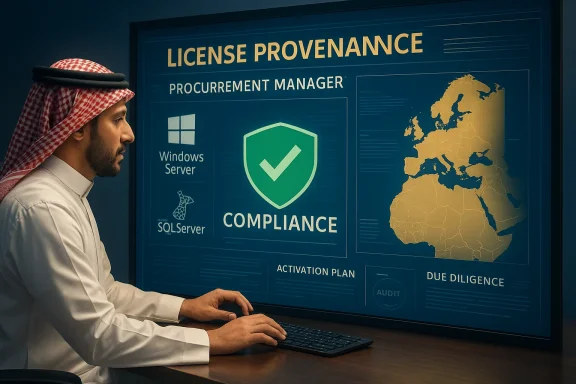
If you’re evaluating Wiresoft (or any secondary‑market seller), insist on the following before purchase—and document everything:- Licence provenance packet: original invoice(s), seller’s acquisition documents, and explicit statements proving the original user decommissioned installations (if required).
- Licence type confirmation: clear, written statement whether each licence is retail, OEM, or volume; OEM licences should be excluded for transfer scenarios.
- Activation plan: step‑by‑step activation and reactivation instructions for your environment, and a commitment from the reseller to assist with activation escalations.
- Refund and warranty terms in writing: time windows, conditions for refunds, and jurisdiction of any disputes.
- Audit support: written warranty that the reseller will support you during vendor audits, with defined SLAs and responsibilities.
- Test purchase: for critical server products, buy a single licence first and validate activation, manageability, update access, and Microsoft‑side support before bulk purchasing.
- Legal review: have legal counsel review transfer documents and confirm compliance with Saudi IP and procurement rules.
- Region and edition checks: confirm the licences are valid for installation and activation in Saudi Arabia and match the editions you require.
- Patch and update eligibility: confirm that the licences will receive security updates and that Microsoft will not block updates because of activation origin.
- Local partner comparison: price and service compare with accredited Microsoft partners and CSPs in KSA to assess total cost of ownership, including support and compliance risk.
Where the market stands in Saudi Arabia — partners, resellers, and local alternatives
Saudi Arabia’s IT market is well served by local systems integrators and authorized Microsoft solution providers—Cloud Solution Providers (CSPs), Gold Partners, and tier‑1 managed service vendors who sell subscription and perpetual licensing with local billing, in‑country support, and partner agreements. For many enterprises, the combination of local SLA, easier procurement, and Microsoft channel relationships outweighs the savings from a secondary licence purchase.That said, there is a genuine market for lower‑cost perpetual licences among smaller firms and scenarios where cloud migration is not an option. Secondary‑market sellers may provide viable outcomes there—but only when the buyer performs the rigorous due diligence above.
The environmental and sustainability angle — valid but limited
Wiresoft’s press messaging includes a sustainability narrative: re‑using software licences reduces waste and lowers environmental footprint by deferring device refresh and helping organizations extract more life from existing hardware. That is a reasonable claim in principle—extending the useful life of devices and avoiding unnecessary hardware churn can reduce environmental impact.However, software reuse is primarily a digital economic argument rather than a direct emissions‑reduction guarantee. The environmental benefit depends on broader lifecycle practices, and digital licence reuse alone does not substitute for proper hardware lifecycle management, energy efficiency investments, or supplier emissions reductions. Treat sustainability claims as a complementary benefit, not the core business case.
Practical scenarios and recommendations for Saudi IT leaders
- If you run a tight, cost‑sensitive SME with legacy on‑premises needs and you can accept activation support risk, a carefully documented purchase from a secondary seller may be appropriate—but start small and test first.
- If you are a public purchaser, a regulated industry, or an organization participating in tenders, prioritize authorized Microsoft partners, local CSPs, and reseller channels that produce clear provenance and match procurement rules.
- For server and database deployments (Windows Server 2025, SQL Server 2025, Exchange), prefer channels that can supply Software Assurance or managed service equivalents if you require ongoing vendor support, hotpatching, and integration with Azure Arc or System Center.
- Always insist on demonstrable audit support and legal warranties. No reseller should refuse to put those commitments in writing.
- Maintain an internal licence register and retain all purchase and transfer documentation in case SAIP or another authority requests proof of lawful entitlement.
Final assessment — opportunity with caveats
Wiresoft’s entry into the Saudi market will likely attract attention: perpetual, lower‑cost licences are a strong commercial hook for firms that are subscription‑averse or that require on‑premises server architectures. Microsoft’s on‑premises product roadmap (Windows Server 2025, SQL Server 2025, Exchange Server evolutions) means customers still have legitimate needs for perpetual licences.However, the key takeaway for procurement and IT leaders is this: cost advantage alone is not a sufficient procurement rationale. Cross‑border resale of software licences carries legal, activation, and compliance risks that vary greatly by licence type and by the buyer’s jurisdiction. Saudi Arabia’s intensifying IP enforcement and an updated copyright regime heighten the need for rigorous provenance, written warranties, and legal review.
For buyers who proceed, a conservative, test‑first approach combined with documented audit support and activation guarantees will reduce risk. For buyers who prioritize certainty, long‑term support, integration with Microsoft’s cloud services, or eligibility for procurement and public contracts, an authorized local Microsoft partner or CSP remains the safer route—even if it costs more initially.
Wiresoft’s expansion is a market event worth noting, but Saudi organizations should treat it as one option among several—and not as a turnkey substitute for careful licensing governance and legal assurance.
Source: Digital Journal Professional Software Expert Wiresoft Announces Strategic Expansion into Saudi Arabia as the Premier Software Solutions Pioneer
