

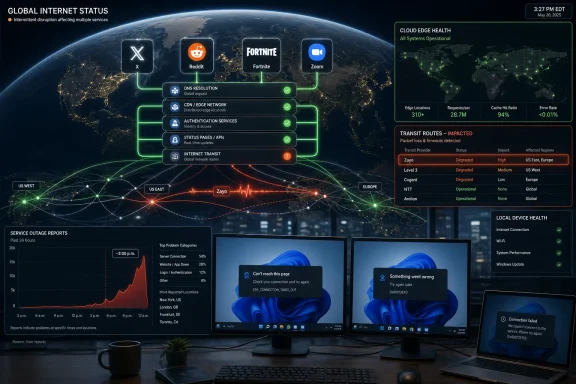
Thousands of users reported trouble accessing X, Reddit, Fortnite, Zoom and related services on Monday, June 22, 2026, after outage reports spiked shortly before 3 p.m., while Cloudflare said it saw no global failure and pointed instead to a Zayo network routing outage. That distinction matters, because this was less a clean “one company broke the internet” story than another reminder that modern online life is balanced on a stack of cloud, transit, DNS, edge, authentication, and status-page dependencies most users never see. The public symptom was simple: apps were slow, inaccessible, or throwing errors. The infrastructure lesson is more uncomfortable: even when the cloud is not technically “down,” the internet can still feel broken.
The first hour of a large consumer outage now follows a familiar script. Users open an app, retry, switch from Wi-Fi to mobile data, blame their router, check another service, and then discover that the problem is larger than their device. Downdetector graphs start climbing, social platforms fill with “is it down?” posts, and the names Cloudflare and AWS appear almost immediately whether or not either provider is the root cause.
That happened again on June 22. Reports clustered around X, Reddit, Fortnite, Zoom, and infrastructure names such as Cloudflare and AWS. LADbible reported that issues began shortly after 2:30 p.m. and spiked before 3 p.m., with users describing services as slow, inaccessible, or returning errors across web and mobile clients.
The tempting headline is that “Cloudflare and AWS went down.” The more precise reading is messier. Cloudflare’s statement said it was not seeing a global Cloudflare outage and instead identified Zayo, a network provider, as suffering an outage on some network routes. If a service depends on a path that traverses a troubled network provider, users can experience a real outage even when the CDN, the cloud region, and the application servers are all nominally healthy.
That is why the incident is worth more than a quick outage post. The same symptom can be caused by very different failures. A web app may be unreachable because its origin is down, because a CDN edge is misbehaving, because DNS resolution failed, because a cloud identity service is degraded, because traffic is taking a bad route, or because a downstream API is timing out. To the user, all of those scenarios collapse into the same red error box.
From the provider’s point of view, this distinction is fair. Cloudflare can operate its edge network correctly while a transit provider’s routing issue makes some paths unreliable. A cloud platform can report green dashboards while customers in certain regions, networks, or autonomous systems cannot reach a service consistently. Internet reachability is not binary; it is probabilistic, regional, and deeply dependent on who is trying to reach what from where.
But from the user’s point of view, the distinction feels academic. If X will not load, Reddit throws errors, Fortnite login fails, and Zoom behaves erratically, the internet is down enough. People do not experience BGP, peering, route propagation, CDN failover, and cloud control planes as separate systems. They experience a work meeting failing, a game session refusing to authenticate, or a social feed that suddenly cannot refresh.
That tension is why status messaging matters. “We are operational” may be technically accurate for the provider and practically useless for the affected user. A more useful framing is not merely whether a vendor’s own platform is globally down, but whether users on specific networks or routes are seeing degraded reachability to customers that depend on that vendor’s ecosystem.
When a small company’s on-premises server failed in 2006, a small company’s website went dark. When a regional ISP misrouted traffic, a subset of customers noticed. When a major cloud region, CDN, DNS resolver, or transit path hiccups in 2026, the failure pattern can map across consumer apps, workplace tools, game platforms, banking services, and the monitoring sites people use to confirm the failure.
That is why outages now feel larger even when the technical blast radius is narrower than the public panic suggests. A network route issue does not have to hit everyone to trend globally. It only has to hit enough users of enough recognizable apps at the same time. Once X, Reddit, Fortnite, and Zoom appear in the same sentence, the story becomes “the internet is down,” not “some network paths are degraded.”
This is partly a triumph of scale. The same infrastructure that lets a game patch reach millions of players, a video call span continents, and a social platform absorb real-time news also means those services share common layers. The stack works beautifully until one of those layers behaves badly, and then unrelated brands suddenly look suspiciously related.
A live-service game may fail at login while gameplay servers remain healthy. A social network may load old cached content while posting fails. A meeting app may connect some participants while leaving others in a loop of reconnect attempts. A forum or feed may work on mobile data but not on a particular broadband provider. Those differences are clues, but they rarely survive the first wave of public reporting.
This is especially true when the visible failures involve authentication, edge routing, or API gateways. If the first handshake fails, the user never reaches the more resilient parts of the service. For Fortnite, a login error feels like the whole game is down. For Zoom, a failed meeting join flow is the product failing at the moment it matters. For Reddit or X, a feed that cannot refresh might as well be a blank screen.
Windows users and administrators should care because this is the same dependency model that now governs enterprise software. Microsoft 365, Teams, Entra ID, Intune, endpoint management, remote access gateways, EDR consoles, SaaS admin panels, and line-of-business apps all sit in the same cloudy mesh. When the consumer internet has a bad routing afternoon, it is often a preview of the enterprise help desk’s next bad morning.
This distinction is not pedantry. In the first minutes of an outage, public dashboards often lag reality, especially when the failing component affects monitoring, logging, customer support, or the dashboard itself. User reports may be the earliest signal. But user reports also include panic, misclassification, copycat reporting, and people clicking whatever infrastructure provider they have heard of.
A serious reading combines both. Downdetector can show the shape and timing of user pain. Vendor status pages can confirm operational impact once engineers isolate the fault. Network operators can identify routing and transit failures that neither an app vendor nor a cloud provider fully controls. The truth often arrives in layers, which is why early outage coverage should be written with restraint.
The June 22 incident is a good case study. The public saw many services stumble at once. Cloudflare said it did not see a global outage and pointed to Zayo routes. AWS issues were reportedly being mentioned by users, but that does not automatically make AWS the causal center of the event. The responsible conclusion is that a broad reachability problem affected users across multiple services, with at least one identified network-provider issue in the mix.
The best status pages do not merely say “operational” or “degraded.” They describe affected regions, services, customer actions, and expected update cadence. They separate user-facing symptoms from internal cause. They admit uncertainty early and narrow it over time. They also avoid the classic trap of equating “our monitors are green” with “users are fine.”
This is particularly important for edge and network companies. If a transit provider’s route leak, fiber cut, peering dispute, or packet loss event affects customer traffic, the platform may be functioning as designed while users still cannot reach applications reliably. A status page that only reflects internal component health misses the operational reality customers are paying to understand.
For sysadmins, the lesson is blunt: do not let a vendor dashboard be your only signal. Synthetic monitoring from multiple regions, last-mile networks, and DNS resolvers is no longer a luxury. If the CFO cannot join Zoom, the question is not whether Zoom’s status page is green. The question is whether your organization can prove where the path is breaking.
That dependency may be a cloud region, a CDN, a DNS provider, an identity platform, a certificate authority, a transit provider, a Web Application Firewall rule engine, or a JavaScript tag that loads before the page becomes usable. It may be reliable enough to disappear from risk registers. Then it fails, and the business discovers that “multi-cloud” did not help because the login provider, edge layer, or network path was still common.
The June 22 reports are a consumer-facing illustration of that enterprise problem. X, Reddit, Fortnite, and Zoom do not need to share one origin server to fail together. They only need to share enough invisible infrastructure categories that a route or edge problem creates overlapping symptoms. The same pattern can hit payroll, CRM, collaboration, support, and endpoint security in a corporate environment.
This is where resilience planning often goes wrong. Teams buy redundancy at the application layer while leaving identity, DNS, monitoring, and communications brittle. They deploy apps across multiple availability zones while using one status tool, one SSO provider, one CDN configuration, and one incident chat platform. Then an outage hits the very service they need to coordinate the response.
A Windows 11 laptop may be healthy, patched, and connected to a functioning Wi-Fi network, yet Teams, Zoom, Xbox services, game launchers, web apps, identity prompts, widgets, cloud-synced files, and browser sessions can all behave erratically if upstream services degrade. The operating system increasingly mediates cloud experiences rather than simply running local software. That makes outages feel like device problems even when the device is innocent.
This is why troubleshooting habits need to evolve. Rebooting remains the folk medicine of computing, and sometimes it works. But during a broad service event, repeated reboots, driver reinstallations, DNS cache flushes, and router resets can waste time and introduce new problems. The first diagnostic question should be whether the failure is local, network-specific, account-specific, or broadly external.
A practical Windows-side check is simple. Test another device on the same network, then test the same service from mobile data, then test unrelated services, then check vendor and independent outage signals. If only one PC fails, investigate Windows. If multiple devices fail on one ISP but not mobile data, suspect routing or DNS. If reports are spiking globally, stop blaming your NIC.
That structure is not unique to Epic. The same pattern governs Xbox services, Steam, PlayStation Network, Battle.net, Riot’s platforms, and most large free-to-play ecosystems. A game can have healthy servers and still be unplayable because players cannot authenticate, fetch profiles, validate purchases, or establish matchmaking sessions. “The servers are up” is not the same thing as “players can play.”
For users, that means outage reports around games should be read carefully. A login error, matchmaking failure, and mid-match disconnect are different symptoms. They point to different parts of the stack. For administrators managing school, café, esports, or enterprise networks where gaming traffic is relevant, those distinctions can help separate local filtering issues from global platform problems.
It also underscores a broader truth about software as a service. Access is the product. If a service cannot prove who you are, route you to the right place, and maintain session state, the underlying feature set might as well not exist.
This matters because outages are not only technical events; they are communication events. Users want to know whether they are alone, whether accounts are safe, whether data is lost, and when service will return. If the official communication channel is hosted on a platform caught in the same incident, the response can look slower than it is.
Organizations should treat this as a design problem. A serious incident communications plan cannot rely on one social media account. It needs a vendor-controlled status page, email or SMS alerting for customers, in-product messaging where possible, and a fallback channel that does not depend on the same infrastructure stack. The goal is not perfect reach. The goal is not going silent when the obvious channel fails.
For WindowsForum readers who run communities, small businesses, or IT departments, this lesson scales down nicely. If your users can only learn about an outage through the system that is down, your communications plan is circular. Break the loop before the outage does it for you.
Cloudflare in particular occupies a strange public role. It is a CDN, DNS provider, security layer, reverse proxy, developer platform, Zero Trust vendor, and edge computing company. When anything behind orange-clouded infrastructure fails, Cloudflare may be accused even if the origin, route, customer configuration, or third-party network is responsible. AWS faces a similar problem at cloud scale: it is so foundational that many people assume it is the culprit whenever multiple services stumble.
That reflex is not entirely unfair. Infrastructure giants sell resilience, performance, and abstraction. They ask customers to put critical traffic behind their systems. When failures happen nearby, they inherit suspicion. But suspicion is not diagnosis, and conflating every outage with the most famous provider can obscure the actual weak link.
The better public vocabulary is not “Cloudflare is down” or “AWS is down” unless the evidence supports it. It is “users are reporting degraded access to services that may depend on cloud, CDN, or network providers, and vendors are investigating.” That phrasing is less viral, but it is closer to how the internet actually breaks.
Running workloads across AWS and Azure, or across multiple regions, can help if one cloud region fails and the application was designed for failover. It does little if the outage is in DNS, identity, deployment pipelines, observability, a shared CDN, or the client-side network path. It can even make recovery harder if teams do not routinely test failover and understand where state, credentials, and dependencies live.
The same applies to consumers in miniature. Having both Wi-Fi and mobile data helps. Having more than one browser helps. Keeping offline copies of critical documents helps. But if the service you need depends on a broken authentication flow or an unreachable API, your local redundancy has limits. The cloud moved the failure domain outward.
For enterprises, the mature response is dependency mapping. Know which services depend on which providers, regions, identity flows, DNS zones, certificates, and network paths. Know what fails closed and what fails open. Know which business processes can continue without SaaS access for one hour, four hours, or a full day. The next outage should not be the first time anyone draws the map.
But it would also be a mistake to dismiss it. Short-lived incidents are the ones that reveal whether monitoring, communication, and user expectations are realistic. If thousands of users can experience simultaneous failure while major status pages remain nuanced or green, the gap between provider telemetry and user reality deserves attention.
For sysadmins, the event is a reminder to monitor from the outside. For developers, it is a reminder to design graceful degradation instead of blank failure states. For security teams, it is a reminder that availability is part of trust. For users, it is a reminder that a local device can be fine even when every app on it seems cursed.
The industry likes to describe resilience in percentages: three nines, four nines, five nines. Users experience it in moments. The meeting starts now. The match starts now. The post needs to go out now. The support ticket must be filed now. Availability is not an annualized abstraction when the thing you need is unavailable.
 The Internet Did Not Fail in One Place, but It Failed in One Way
The first hour of a large consumer outage now follows a familiar script. Users open an app, retry, switch from Wi-Fi to mobile data, blame their router, check another service, and then discover that the problem is larger than their device. Downdetector graphs start climbing, social platforms fill with “is it down?” posts, and the names Cloudflare and AWS appear almost immediately whether or not either provider is the root cause.That happened again on June 22. Reports clustered around X, Reddit, Fortnite, Zoom, and infrastructure names such as Cloudflare and AWS. LADbible reported that issues began shortly after 2:30 p.m. and spiked before 3 p.m., with users describing services as slow, inaccessible, or returning errors across web and mobile clients.
The tempting headline is that “Cloudflare and AWS went down.” The more precise reading is messier. Cloudflare’s statement said it was not seeing a global Cloudflare outage and instead identified Zayo, a network provider, as suffering an outage on some network routes. If a service depends on a path that traverses a troubled network provider, users can experience a real outage even when the CDN, the cloud region, and the application servers are all nominally healthy.
That is why the incident is worth more than a quick outage post. The same symptom can be caused by very different failures. A web app may be unreachable because its origin is down, because a CDN edge is misbehaving, because DNS resolution failed, because a cloud identity service is degraded, because traffic is taking a bad route, or because a downstream API is timing out. To the user, all of those scenarios collapse into the same red error box.
Cloudflare’s Denial Was the Most Important Detail
Cloudflare’s response was carefully worded and revealing. It did not say users were imagining the problem. It said the company did not see a global Cloudflare outage and was aware of Zayo having an outage on some network routes. That is the kind of distinction infrastructure companies care deeply about, and users tend to hate.From the provider’s point of view, this distinction is fair. Cloudflare can operate its edge network correctly while a transit provider’s routing issue makes some paths unreliable. A cloud platform can report green dashboards while customers in certain regions, networks, or autonomous systems cannot reach a service consistently. Internet reachability is not binary; it is probabilistic, regional, and deeply dependent on who is trying to reach what from where.
But from the user’s point of view, the distinction feels academic. If X will not load, Reddit throws errors, Fortnite login fails, and Zoom behaves erratically, the internet is down enough. People do not experience BGP, peering, route propagation, CDN failover, and cloud control planes as separate systems. They experience a work meeting failing, a game session refusing to authenticate, or a social feed that suddenly cannot refresh.
That tension is why status messaging matters. “We are operational” may be technically accurate for the provider and practically useless for the affected user. A more useful framing is not merely whether a vendor’s own platform is globally down, but whether users on specific networks or routes are seeing degraded reachability to customers that depend on that vendor’s ecosystem.
The Cloud Has Made Outages More Visible, Not Less Common
For more than a decade, cloud architecture has been sold as a way to reduce fragility. That promise is not false. Most organizations could not build infrastructure as globally redundant, physically secure, and operationally mature as AWS, Cloudflare, Microsoft Azure, Google Cloud, or the major backbone providers. The problem is that the cloud did not eliminate failure; it concentrated and standardized it.When a small company’s on-premises server failed in 2006, a small company’s website went dark. When a regional ISP misrouted traffic, a subset of customers noticed. When a major cloud region, CDN, DNS resolver, or transit path hiccups in 2026, the failure pattern can map across consumer apps, workplace tools, game platforms, banking services, and the monitoring sites people use to confirm the failure.
That is why outages now feel larger even when the technical blast radius is narrower than the public panic suggests. A network route issue does not have to hit everyone to trend globally. It only has to hit enough users of enough recognizable apps at the same time. Once X, Reddit, Fortnite, and Zoom appear in the same sentence, the story becomes “the internet is down,” not “some network paths are degraded.”
This is partly a triumph of scale. The same infrastructure that lets a game patch reach millions of players, a video call span continents, and a social platform absorb real-time news also means those services share common layers. The stack works beautifully until one of those layers behaves badly, and then unrelated brands suddenly look suspiciously related.
X, Reddit, Fortnite, and Zoom Are Different Products with Similar Dependency Shapes
The affected services named in the reports are not interchangeable. X is a real-time social platform, Reddit is a discussion and content network, Fortnite is a live-service game, and Zoom is a communications platform. Their architectures differ, their vendors differ, and their operational priorities differ. Yet the outage reports clustered because modern services increasingly depend on similar categories of infrastructure.A live-service game may fail at login while gameplay servers remain healthy. A social network may load old cached content while posting fails. A meeting app may connect some participants while leaving others in a loop of reconnect attempts. A forum or feed may work on mobile data but not on a particular broadband provider. Those differences are clues, but they rarely survive the first wave of public reporting.
This is especially true when the visible failures involve authentication, edge routing, or API gateways. If the first handshake fails, the user never reaches the more resilient parts of the service. For Fortnite, a login error feels like the whole game is down. For Zoom, a failed meeting join flow is the product failing at the moment it matters. For Reddit or X, a feed that cannot refresh might as well be a blank screen.
Windows users and administrators should care because this is the same dependency model that now governs enterprise software. Microsoft 365, Teams, Entra ID, Intune, endpoint management, remote access gateways, EDR consoles, SaaS admin panels, and line-of-business apps all sit in the same cloudy mesh. When the consumer internet has a bad routing afternoon, it is often a preview of the enterprise help desk’s next bad morning.
Downdetector Is a Smoke Alarm, Not a Root-Cause Tool
Downdetector and similar services are useful because they capture the user experience before vendors finish writing incident updates. They are also dangerous because they can make correlation look like causation. A spike in reports for Cloudflare, AWS, X, Reddit, Fortnite, and Zoom tells us that users are experiencing simultaneous trouble. It does not prove that Cloudflare broke, AWS broke, or that all affected apps share the same failing component.This distinction is not pedantry. In the first minutes of an outage, public dashboards often lag reality, especially when the failing component affects monitoring, logging, customer support, or the dashboard itself. User reports may be the earliest signal. But user reports also include panic, misclassification, copycat reporting, and people clicking whatever infrastructure provider they have heard of.
A serious reading combines both. Downdetector can show the shape and timing of user pain. Vendor status pages can confirm operational impact once engineers isolate the fault. Network operators can identify routing and transit failures that neither an app vendor nor a cloud provider fully controls. The truth often arrives in layers, which is why early outage coverage should be written with restraint.
The June 22 incident is a good case study. The public saw many services stumble at once. Cloudflare said it did not see a global outage and pointed to Zayo routes. AWS issues were reportedly being mentioned by users, but that does not automatically make AWS the causal center of the event. The responsible conclusion is that a broad reachability problem affected users across multiple services, with at least one identified network-provider issue in the mix.
The Status Page Has Become Part of the Product
There was a time when a status page was a courtesy. Now it is operational infrastructure. Customers use it to decide whether to fail over, whether to open incident bridges, whether to notify executives, whether to roll back releases, and whether to tell users the problem is internal or external. A vague green dashboard during a visible outage is not reassuring; it is corrosive.The best status pages do not merely say “operational” or “degraded.” They describe affected regions, services, customer actions, and expected update cadence. They separate user-facing symptoms from internal cause. They admit uncertainty early and narrow it over time. They also avoid the classic trap of equating “our monitors are green” with “users are fine.”
This is particularly important for edge and network companies. If a transit provider’s route leak, fiber cut, peering dispute, or packet loss event affects customer traffic, the platform may be functioning as designed while users still cannot reach applications reliably. A status page that only reflects internal component health misses the operational reality customers are paying to understand.
For sysadmins, the lesson is blunt: do not let a vendor dashboard be your only signal. Synthetic monitoring from multiple regions, last-mile networks, and DNS resolvers is no longer a luxury. If the CFO cannot join Zoom, the question is not whether Zoom’s status page is green. The question is whether your organization can prove where the path is breaking.
The Old Single Point of Failure Has Become a Shared Point of Failure
Enterprise IT used to fear the obvious single point of failure: one server, one switch, one storage array, one office internet circuit. The cloud era changed the geometry. The new risk is not always a single box. It is a shared dependency that appears in dozens of workflows but is owned by someone else.That dependency may be a cloud region, a CDN, a DNS provider, an identity platform, a certificate authority, a transit provider, a Web Application Firewall rule engine, or a JavaScript tag that loads before the page becomes usable. It may be reliable enough to disappear from risk registers. Then it fails, and the business discovers that “multi-cloud” did not help because the login provider, edge layer, or network path was still common.
The June 22 reports are a consumer-facing illustration of that enterprise problem. X, Reddit, Fortnite, and Zoom do not need to share one origin server to fail together. They only need to share enough invisible infrastructure categories that a route or edge problem creates overlapping symptoms. The same pattern can hit payroll, CRM, collaboration, support, and endpoint security in a corporate environment.
This is where resilience planning often goes wrong. Teams buy redundancy at the application layer while leaving identity, DNS, monitoring, and communications brittle. They deploy apps across multiple availability zones while using one status tool, one SSO provider, one CDN configuration, and one incident chat platform. Then an outage hits the very service they need to coordinate the response.
Windows Users Feel the Outage Through Apps, Not Infrastructure
For most WindowsForum readers, the interesting question is not whether BGP misbehaved in a way that would satisfy a network engineer. It is why a Windows PC can feel unreliable when the local machine is perfectly fine. The answer is that Windows has become the endpoint for a vast set of remote dependencies.A Windows 11 laptop may be healthy, patched, and connected to a functioning Wi-Fi network, yet Teams, Zoom, Xbox services, game launchers, web apps, identity prompts, widgets, cloud-synced files, and browser sessions can all behave erratically if upstream services degrade. The operating system increasingly mediates cloud experiences rather than simply running local software. That makes outages feel like device problems even when the device is innocent.
This is why troubleshooting habits need to evolve. Rebooting remains the folk medicine of computing, and sometimes it works. But during a broad service event, repeated reboots, driver reinstallations, DNS cache flushes, and router resets can waste time and introduce new problems. The first diagnostic question should be whether the failure is local, network-specific, account-specific, or broadly external.
A practical Windows-side check is simple. Test another device on the same network, then test the same service from mobile data, then test unrelated services, then check vendor and independent outage signals. If only one PC fails, investigate Windows. If multiple devices fail on one ISP but not mobile data, suspect routing or DNS. If reports are spiking globally, stop blaming your NIC.
Gaming Outages Expose the Authentication Bottleneck
Fortnite’s presence in the reported outage mix is not surprising. Modern games are no longer products you simply launch; they are distributed services with authentication, entitlement checks, matchmaking, telemetry, anti-cheat, content delivery, party systems, storefronts, and social layers. A problem in any early-stage dependency can make the game feel entirely offline.That structure is not unique to Epic. The same pattern governs Xbox services, Steam, PlayStation Network, Battle.net, Riot’s platforms, and most large free-to-play ecosystems. A game can have healthy servers and still be unplayable because players cannot authenticate, fetch profiles, validate purchases, or establish matchmaking sessions. “The servers are up” is not the same thing as “players can play.”
For users, that means outage reports around games should be read carefully. A login error, matchmaking failure, and mid-match disconnect are different symptoms. They point to different parts of the stack. For administrators managing school, café, esports, or enterprise networks where gaming traffic is relevant, those distinctions can help separate local filtering issues from global platform problems.
It also underscores a broader truth about software as a service. Access is the product. If a service cannot prove who you are, route you to the right place, and maintain session state, the underlying feature set might as well not exist.
Social Platforms Are Poor Emergency Broadcast Systems
There is a small irony in users turning to X to report that X is down. Social platforms have become the public square for outage confirmation, but they are themselves part of the same fragile ecosystem. When X is affected, users move to Reddit. When Reddit is affected, they move to Discord, Bluesky, Mastodon, status pages, or news sites. When multiple platforms are affected, the public information layer fragments quickly.This matters because outages are not only technical events; they are communication events. Users want to know whether they are alone, whether accounts are safe, whether data is lost, and when service will return. If the official communication channel is hosted on a platform caught in the same incident, the response can look slower than it is.
Organizations should treat this as a design problem. A serious incident communications plan cannot rely on one social media account. It needs a vendor-controlled status page, email or SMS alerting for customers, in-product messaging where possible, and a fallback channel that does not depend on the same infrastructure stack. The goal is not perfect reach. The goal is not going silent when the obvious channel fails.
For WindowsForum readers who run communities, small businesses, or IT departments, this lesson scales down nicely. If your users can only learn about an outage through the system that is down, your communications plan is circular. Break the loop before the outage does it for you.
The Cloudflare and AWS Reflex Shows How Infrastructure Brands Became Household Names
A decade ago, only IT professionals blamed Akamai, Level 3, Route 53, or a cloud region when websites failed. Today, ordinary users invoke Cloudflare and AWS because those brands have become shorthand for the hidden machinery of the web. That is a remarkable branding achievement and a reputational hazard.Cloudflare in particular occupies a strange public role. It is a CDN, DNS provider, security layer, reverse proxy, developer platform, Zero Trust vendor, and edge computing company. When anything behind orange-clouded infrastructure fails, Cloudflare may be accused even if the origin, route, customer configuration, or third-party network is responsible. AWS faces a similar problem at cloud scale: it is so foundational that many people assume it is the culprit whenever multiple services stumble.
That reflex is not entirely unfair. Infrastructure giants sell resilience, performance, and abstraction. They ask customers to put critical traffic behind their systems. When failures happen nearby, they inherit suspicion. But suspicion is not diagnosis, and conflating every outage with the most famous provider can obscure the actual weak link.
The better public vocabulary is not “Cloudflare is down” or “AWS is down” unless the evidence supports it. It is “users are reporting degraded access to services that may depend on cloud, CDN, or network providers, and vendors are investigating.” That phrasing is less viral, but it is closer to how the internet actually breaks.
Multi-Cloud Is Not a Magic Spell
Every large outage revives the same boardroom question: why not just use multiple clouds? The answer is that multi-cloud can reduce some risks while creating others. It is a strategy, not an amulet.Running workloads across AWS and Azure, or across multiple regions, can help if one cloud region fails and the application was designed for failover. It does little if the outage is in DNS, identity, deployment pipelines, observability, a shared CDN, or the client-side network path. It can even make recovery harder if teams do not routinely test failover and understand where state, credentials, and dependencies live.
The same applies to consumers in miniature. Having both Wi-Fi and mobile data helps. Having more than one browser helps. Keeping offline copies of critical documents helps. But if the service you need depends on a broken authentication flow or an unreachable API, your local redundancy has limits. The cloud moved the failure domain outward.
For enterprises, the mature response is dependency mapping. Know which services depend on which providers, regions, identity flows, DNS zones, certificates, and network paths. Know what fails closed and what fails open. Know which business processes can continue without SaaS access for one hour, four hours, or a full day. The next outage should not be the first time anyone draws the map.
The June 22 Lesson Is Smaller Than Panic and Bigger Than a Blip
It would be easy to overstate the June 22 incident. The available reporting does not prove a global Cloudflare outage, and Cloudflare explicitly said it did not see one. It does not establish AWS as the root cause. It does not mean X, Reddit, Fortnite, and Zoom all failed for the same internal reason. In internet terms, this may ultimately be remembered as a short-lived routing disruption amplified by the visibility of popular services.But it would also be a mistake to dismiss it. Short-lived incidents are the ones that reveal whether monitoring, communication, and user expectations are realistic. If thousands of users can experience simultaneous failure while major status pages remain nuanced or green, the gap between provider telemetry and user reality deserves attention.
For sysadmins, the event is a reminder to monitor from the outside. For developers, it is a reminder to design graceful degradation instead of blank failure states. For security teams, it is a reminder that availability is part of trust. For users, it is a reminder that a local device can be fine even when every app on it seems cursed.
The industry likes to describe resilience in percentages: three nines, four nines, five nines. Users experience it in moments. The meeting starts now. The match starts now. The post needs to go out now. The support ticket must be filed now. Availability is not an annualized abstraction when the thing you need is unavailable.
The Practical Read for WindowsForum Readers
The useful takeaway is not that everyone should panic every time Downdetector lights up. It is that broad app failures should be treated as dependency incidents until proven otherwise. The faster users and administrators stop assuming the endpoint is broken, the faster they can preserve evidence, communicate clearly, and avoid counterproductive fixes.- A simultaneous spike across X, Reddit, Fortnite, Zoom, Cloudflare, and AWS reports is evidence of broad user pain, not automatic proof that any one named provider caused the incident.
- Cloudflare said it was not seeing a global Cloudflare outage and identified Zayo route problems as a known issue, which makes network reachability a central part of the June 22 story.
- Windows users should compare the same service across devices, networks, and browsers before reinstalling apps, resetting routers, or changing system settings.
- Administrators should maintain external monitoring from multiple regions and networks because vendor dashboards may not reflect every user-visible path failure.
- Organizations should not rely on one social platform or one SaaS channel for incident communication, especially when that channel may be caught in the same outage.
- Resilience planning should include DNS, identity, CDN, transit, observability, and communications dependencies, not just application servers and cloud regions.
References
- Primary source: LADbible
Published: 2026-06-22T21:42:12.908063
X, Reddit, Fortnite and Zoom down for thousands, Cloudflare and AWS issues reported
The app formerly known as Twitter is experiencing outages according to DownDetector, alongside the likes of Canva and Microsoft Teamswww.ladbible.com - Related coverage: isdown.app
- Related coverage: statusgator.com
Cloudflare Status. Check if Cloudflare is down or having an outage. | StatusGator
Cloudflare down? Check the current Cloudflare status right now, learn about outages, downtime, incidents, and issues.statusgator.com - Related coverage: tomshardware.com
Colossal AWS outage breaks the internet — Roblox, Fortnite, Zoom, Snapchat, and beyond all crippled | Tom's Hardware
An ongoing issuewww.tomshardware.com - Related coverage: windowscentral.com
Reddit is broken as Amazon's AWS outages affect the web | Windows Central
Amazon Web Services downtime affected a chunk of the Internet, and social media platform Reddit is still suffering from bugs.www.windowscentral.com - Related coverage: cloudflare.statuspage.io
Cloudflare Status
Welcome to Cloudflare's home for real-time and historical data on system performance.cloudflare.statuspage.io
- Related coverage: outage.report

Cloudflare down? Outage map, service status, incidents history
See if Cloudflare is down or it's just you. Check current status and outage map. Post yours and see other's reports and complaints
outage.report
- Related coverage: livemint.com
Are Cloudflare and AWS back online? Here is what the official status pages say | Mint
Cloudflare is experiencing ongoing service disruptions on Thursday, across multiple regions as scheduled maintenance and network issues trigger widespread outages. Downdetector reports rising complaints, with major platforms, games, and even AWS users facing connectivity problems. www.livemint.com
- Related coverage: blog.cloudflare.com
Shutdowns, power outages, and conflict: a review of Q1 2026 Internet disruptions
The first quarter of 2026 saw a surge in Internet disruptions, from nationwide shutdowns in Uganda and Iran to unprecedented drone strikes on cloud infrastructure. We explore the data behind these events using Cloudflare Radar.blog.cloudflare.com - Related coverage: radar.cloudflare.com
Outage Center | Cloudflare Radar
Explore the latest Internet traffic anomalies and verified outages.radar.cloudflare.com - Related coverage: status.cloudkite.io
- Related coverage: cf-assets.www.cloudflare.com
