

Yale Digital Ethics Center researchers proposed on June 15, 2026, a Contextual Copyleft AI license that would require generative AI models trained on open-source code to disclose key architecture and training materials rather than converting community work into closed commercial systems. The idea is not merely a licensing tweak; it is a bid to move the open-source fight from moral complaint to enforceable leverage. If it works, it could redraw the bargain between volunteer maintainers, enterprise software vendors, and AI companies whose products increasingly sit inside developer workflows on Windows, Linux, and the cloud. If it fails, the episode will still expose the unresolved contradiction at the center of “open” AI: models can be built on open code while remaining functionally opaque.
The Yale proposal arrives at a moment when open-source developers have a familiar grievance but an unfamiliar target. For decades, the fight was about whether companies could take community code, embed it in commercial products, and avoid giving improvements back. Copyleft licenses such as the GPL answered that problem by attaching reciprocity obligations to derivative software.
Generative AI complicates that settlement because the extraction is no longer always a copied file or linked library. It may be statistical absorption: a model trained on millions of repositories, later emitting suggestions, patterns, APIs, and sometimes suspiciously familiar snippets. The developer who wrote the original code may never know whether it was used, how heavily it mattered, or whether the resulting model can generate work that competes with the original project.
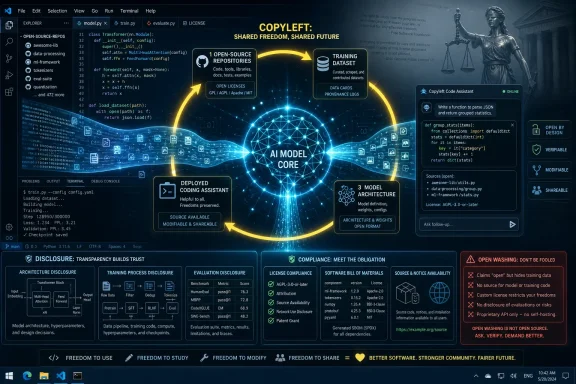
Yale’s proposed Contextual Copyleft AI license, or CCAI, tries to make the model itself part of the licensing chain. The researchers argue that a generative model trained on copylefted open-source code should be treated as a kind of derivative work, with obligations flowing forward into the resulting AI system. That would mean disclosure not just of a slogan like “open weights,” but of enough architecture, training data, and process information to let others inspect and reuse the system.
That is a much stronger claim than the current industry norm. Many AI vendors use the language of openness while releasing only selected pieces: weights without data, APIs without training recipes, permissive demos without reproducibility. Yale’s intervention is important because it names that gap as a licensing failure, not just a branding problem.
AI training strains that bargain. A model builder can benefit from decades of community code without becoming a contributor to any particular project. It can ingest permissively licensed code, copyleft code, documentation, issue threads, and examples, then sell the resulting capability as a subscription layer over the developer’s editor.
That is why the GitHub Copilot debate became a proxy war for something bigger than one product. Developers were not only asking whether Copilot could regurgitate code verbatim. They were asking whether the open-source commons had become a one-way quarry for proprietary AI systems. The legal answer remains contested, but the practical feeling inside many communities is already clear: the old license categories were not designed for this extraction pattern.
The Yale proposal is therefore less radical than it first sounds. It does not invent the desire for reciprocity; it updates the mechanism. Copyleft was created because unrestricted copying could allow free software to be folded into closed systems. Generative AI presents a version of the same enclosure problem, only with training pipelines standing where compilers and distributors used to stand.
In traditional software, source availability is the foundation. In AI, a model’s weights are important, but they are not the whole artifact. Without training code, data provenance, evaluation methods, filtering decisions, and documentation, a released model may be usable without being meaningfully auditable.
That distinction matters to WindowsForum readers because AI is no longer confined to research labs. It is in Visual Studio Code, GitHub, Windows developer workflows, cloud deployment tools, security products, help desks, and admin scripts. A model that writes PowerShell, suggests registry edits, explains Group Policy, or generates C# boilerplate is not merely a chatbot; it is part of the software supply chain.
The phrase open washing captures the risk. A vendor can claim alignment with open-source values while keeping the decisive parts of the system closed. Yale’s CCAI license would make that harder by tying the use of open-source training material to a requirement that the resulting model be open in a fuller sense.
Yale’s researchers appear to understand that uncertainty. Their argument is not that the law has already delivered a clean answer. It is that current copyright doctrine leaves enough room for a licensing architecture that treats AI training as legally meaningful, especially when the output system draws value from structured corpora of human-created code.
That is where this debate differs from the simplistic “AI steals code” framing. The issue is not always literal copying. It is whether large-scale model training can convert protected expression, project structure, and implementation choices into commercial capability without honoring the license terms attached to the original work.
For enterprise IT, that distinction is not academic. Compliance teams have spent years building processes around software bills of materials, license scanning, approved repositories, and developer certificates of origin. AI-generated code threatens to bypass those controls by introducing code-like output whose provenance is difficult to prove. A license that follows training data into the model would not solve every problem, but it would give compliance officers a clearer handle than today’s fog of vendor assurances.
That said, any new licensing regime has to survive contact with developer reality. Programmers want tools that work. Many already use AI assistants because they reduce friction, generate tests, explain unfamiliar codebases, and accelerate routine tasks. A licensing approach that simply tells developers to avoid AI will not hold.
The more practical version of the Yale argument is not anti-AI. It is anti-asymmetry. If a company trains on open code, sells the resulting model, and reveals little about the ingredients or method, the community absorbs the risk while the vendor captures the value. If the same company has to disclose training materials, architecture, and enough process detail for scrutiny, the exchange becomes less one-sided.
This is why the proposal should interest even developers who are not ideological about free software. Transparency is not just a philosophical good. It affects debugging, security review, reproducibility, model evaluation, and the ability to understand why a tool behaves the way it does. In an era of AI-assisted programming, where did this suggestion come from? is becoming a supply-chain question.
A Windows shop using GitHub Copilot, ChatGPT Enterprise, Visual Studio integrations, or third-party coding assistants already has to think about data leakage, code ownership, and license contamination. Add contextual copyleft to the mix, and the question becomes sharper: was this model trained on materials whose licenses impose downstream obligations? If so, does using its output create risk for proprietary codebases?
There is a tendency to treat AI coding tools as smarter autocomplete. That framing is comforting, but incomplete. Modern assistants can generate whole functions, migrate APIs, write unit tests, draft deployment scripts, and produce infrastructure-as-code templates. In some workflows, they are effectively junior developers with unknown training histories and unusually confident delivery.
Security teams should also care. Yale’s researchers note that open generative models have a higher risk profile than ordinary open-source packages because they can be used directly to generate harmful or deceptive content. That includes phishing emails, exploit scaffolding, malicious scripts, and social engineering material. The answer cannot simply be “close everything,” because closed systems can hide flaws just as effectively as they hide methods. But a serious open AI regime needs governance around misuse, not just ideals about access.
The European Union’s AI Act has already pushed the global discussion toward risk categories, transparency duties, and obligations for general-purpose AI providers. Whether one likes the EU approach or not, it recognizes a point the software industry often resists: models are not just products; they are infrastructure with social consequences.
Contextual copyleft would sit at a different layer. It would not decide whether a model is too dangerous to release, whether a deployment is discriminatory, or whether a provider has adequate cybersecurity controls. Instead, it would change the terms under which open-source code can be transformed into AI capability.
That layered approach is promising. Use licenses to preserve reciprocity in the software commons. Use regulation to address public harms that licenses cannot reach. Use enterprise policy to decide which tools are acceptable in particular environments. The hard part is that all three layers are evolving at once, and most organizations are still pretending the AI assistant in the IDE is merely a productivity feature.
There is also a risk of fragmentation. Open source already has a license compatibility problem. Adding AI-specific copyleft terms could create new uncertainty around which repositories may be used for training, which models may be distributed, and how obligations attach to downstream fine-tunes. Developers might respond by avoiding projects with unfamiliar licenses, weakening the commons the license is meant to protect.
Another concern is that treating models as derivative works may be too blunt. Training is not identical to copying a library into an application. Models encode patterns, probabilities, and representations that may reflect many sources at once. A rule that forces full disclosure whenever any covered code appears in training data could be hard to administer and might discourage legitimate research.
These objections deserve attention because open-source licensing succeeds only when it is legible enough for ordinary developers and companies to follow. The GPL worked not because every edge case was simple, but because the core obligation was understandable: if you distribute modified copyleft software, you share the source under compatible terms. CCAI needs an equally graspable trigger and remedy, or it risks becoming a manifesto rather than an operating license.
For software, source code is the canonical artifact because it lets others inspect, modify, build, and verify. For AI, the equivalent bundle is messier: data, code, architecture, hyperparameters, filtering decisions, evaluation results, and training environment. That is why open-source AI debates feel so slippery. The object being opened is not one thing.
Reproducibility is where enterprise buyers and open-source idealists briefly share the same interest. A sysadmin does not need to romanticize the commons to want auditable systems. A bank, hospital, school district, or software vendor does not need to love copyleft to understand that black-box code generation can create compliance and security headaches.
If CCAI pushes the market toward stronger documentation of how models are built, it may succeed even before it wins in court. Licensing can be a signaling mechanism. Projects adopting such terms would tell AI vendors: you may use this work, but not invisibly. That alone could change dataset curation, vendor disclosures, and procurement questionnaires.
That dual role creates tension. Microsoft has spent years presenting itself as a friend of open source, a position that is broadly more credible today than it was in the Ballmer era. But AI reopens old suspicions in a new form. If the world’s largest developer platform becomes a pipeline from community repositories to proprietary AI subscriptions, the optics are difficult even when the legal footing is defensible.
For Windows developers, the issue is practical rather than tribal. Visual Studio, VS Code, GitHub Actions, Azure DevOps, NuGet, PowerShell Gallery, Windows Subsystem for Linux, and countless GitHub-hosted projects form a shared toolchain. AI features are being threaded through that chain at speed. The question is whether the licensing and provenance systems can keep up.
Microsoft and its peers would probably prefer voluntary standards, model cards, indemnity promises, and enterprise controls to a wave of new copyleft obligations. But if the open-source community concludes that voluntary transparency is insufficient, Yale’s proposal gives that frustration a legal vocabulary.
The Yale proposal is valuable because it refuses to settle for gratitude. It asks whether open-source developers can retain agency after their code becomes training data. That is the right question, even if CCAI is not the final answer.
A healthier bargain would not require every AI company to open every secret. Some models will remain proprietary. Some datasets cannot be fully disclosed because of privacy, security, or contractual limits. But companies that build on open-source software should not get to invoke openness only when it improves recruitment, marketing, or ecosystem adoption.
The deeper issue is sustainability. If developers believe that open publication simply feeds closed AI systems, more projects will restrict contributions, ban AI-generated patches, or move sensitive work out of public view. That would be bad for everyone, including the companies now benefiting from the commons.
 Yale Wants Copyleft to Follow the Code Into the Model
The Yale proposal arrives at a moment when open-source developers have a familiar grievance but an unfamiliar target. For decades, the fight was about whether companies could take community code, embed it in commercial products, and avoid giving improvements back. Copyleft licenses such as the GPL answered that problem by attaching reciprocity obligations to derivative software.Generative AI complicates that settlement because the extraction is no longer always a copied file or linked library. It may be statistical absorption: a model trained on millions of repositories, later emitting suggestions, patterns, APIs, and sometimes suspiciously familiar snippets. The developer who wrote the original code may never know whether it was used, how heavily it mattered, or whether the resulting model can generate work that competes with the original project.
Yale’s proposed Contextual Copyleft AI license, or CCAI, tries to make the model itself part of the licensing chain. The researchers argue that a generative model trained on copylefted open-source code should be treated as a kind of derivative work, with obligations flowing forward into the resulting AI system. That would mean disclosure not just of a slogan like “open weights,” but of enough architecture, training data, and process information to let others inspect and reuse the system.
That is a much stronger claim than the current industry norm. Many AI vendors use the language of openness while releasing only selected pieces: weights without data, APIs without training recipes, permissive demos without reproducibility. Yale’s intervention is important because it names that gap as a licensing failure, not just a branding problem.
The Old Open-Source Deal Is Being Rewritten Without Consent
Open source has always depended on a social contract that is more delicate than its lawyers sometimes admit. Developers contribute code because they want useful software to exist, because reputation matters, because shared infrastructure lowers everyone’s costs, and because licensing gives them at least some confidence that free work will not simply be enclosed. The code may be free, but the norms around it are not weightless.AI training strains that bargain. A model builder can benefit from decades of community code without becoming a contributor to any particular project. It can ingest permissively licensed code, copyleft code, documentation, issue threads, and examples, then sell the resulting capability as a subscription layer over the developer’s editor.
That is why the GitHub Copilot debate became a proxy war for something bigger than one product. Developers were not only asking whether Copilot could regurgitate code verbatim. They were asking whether the open-source commons had become a one-way quarry for proprietary AI systems. The legal answer remains contested, but the practical feeling inside many communities is already clear: the old license categories were not designed for this extraction pattern.
The Yale proposal is therefore less radical than it first sounds. It does not invent the desire for reciprocity; it updates the mechanism. Copyleft was created because unrestricted copying could allow free software to be folded into closed systems. Generative AI presents a version of the same enclosure problem, only with training pipelines standing where compilers and distributors used to stand.
“Open AI” Has Become a Marketing Term Before It Became a Standard
The open-source community has spent the last two years trying to stop “open” from becoming meaningless in AI. The Open Source Initiative released its Open Source AI Definition in 2024, pushing the industry toward a more complete view of openness that includes information about data, code, and the ability to study, modify, and share a system. That effort mattered because the AI market had already begun stretching the term beyond recognition.In traditional software, source availability is the foundation. In AI, a model’s weights are important, but they are not the whole artifact. Without training code, data provenance, evaluation methods, filtering decisions, and documentation, a released model may be usable without being meaningfully auditable.
That distinction matters to WindowsForum readers because AI is no longer confined to research labs. It is in Visual Studio Code, GitHub, Windows developer workflows, cloud deployment tools, security products, help desks, and admin scripts. A model that writes PowerShell, suggests registry edits, explains Group Policy, or generates C# boilerplate is not merely a chatbot; it is part of the software supply chain.
The phrase open washing captures the risk. A vendor can claim alignment with open-source values while keeping the decisive parts of the system closed. Yale’s CCAI license would make that harder by tying the use of open-source training material to a requirement that the resulting model be open in a fuller sense.
The Legal Bet Is Powerful Because It Is Unsettled
The proposal’s most fragile point is also its most interesting: it depends on whether training an AI model on copyrighted open-source code can trigger copyright-based obligations. If courts ultimately decide that such training is broadly fair use, or otherwise not the kind of activity that creates a derivative work, a copyleft-for-AI license may have limited force. If courts decide that training can implicate rights in the original code, then the leverage changes dramatically.Yale’s researchers appear to understand that uncertainty. Their argument is not that the law has already delivered a clean answer. It is that current copyright doctrine leaves enough room for a licensing architecture that treats AI training as legally meaningful, especially when the output system draws value from structured corpora of human-created code.
That is where this debate differs from the simplistic “AI steals code” framing. The issue is not always literal copying. It is whether large-scale model training can convert protected expression, project structure, and implementation choices into commercial capability without honoring the license terms attached to the original work.
For enterprise IT, that distinction is not academic. Compliance teams have spent years building processes around software bills of materials, license scanning, approved repositories, and developer certificates of origin. AI-generated code threatens to bypass those controls by introducing code-like output whose provenance is difficult to prove. A license that follows training data into the model would not solve every problem, but it would give compliance officers a clearer handle than today’s fog of vendor assurances.
Developers Need Control, But They Also Need Usable Tools
The strongest argument for Yale’s proposal is developer control. Open-source maintainers should have more than two options: publish code into a commons that AI companies may exploit without reciprocation, or retreat into private repositories and restrictive licenses that undermine collaboration. Contextual copyleft offers a third route: remain open, but demand openness downstream.That said, any new licensing regime has to survive contact with developer reality. Programmers want tools that work. Many already use AI assistants because they reduce friction, generate tests, explain unfamiliar codebases, and accelerate routine tasks. A licensing approach that simply tells developers to avoid AI will not hold.
The more practical version of the Yale argument is not anti-AI. It is anti-asymmetry. If a company trains on open code, sells the resulting model, and reveals little about the ingredients or method, the community absorbs the risk while the vendor captures the value. If the same company has to disclose training materials, architecture, and enough process detail for scrutiny, the exchange becomes less one-sided.
This is why the proposal should interest even developers who are not ideological about free software. Transparency is not just a philosophical good. It affects debugging, security review, reproducibility, model evaluation, and the ability to understand why a tool behaves the way it does. In an era of AI-assisted programming, where did this suggestion come from? is becoming a supply-chain question.
Windows Shops Will Feel This Through the Toolchain First
For Windows administrators and enterprise developers, the Yale proposal may sound distant from daily work. It is not. The first impact of AI licensing fights will not be a courtroom drama; it will be procurement language, internal policy, and restrictions on developer tooling.A Windows shop using GitHub Copilot, ChatGPT Enterprise, Visual Studio integrations, or third-party coding assistants already has to think about data leakage, code ownership, and license contamination. Add contextual copyleft to the mix, and the question becomes sharper: was this model trained on materials whose licenses impose downstream obligations? If so, does using its output create risk for proprietary codebases?
There is a tendency to treat AI coding tools as smarter autocomplete. That framing is comforting, but incomplete. Modern assistants can generate whole functions, migrate APIs, write unit tests, draft deployment scripts, and produce infrastructure-as-code templates. In some workflows, they are effectively junior developers with unknown training histories and unusually confident delivery.
Security teams should also care. Yale’s researchers note that open generative models have a higher risk profile than ordinary open-source packages because they can be used directly to generate harmful or deceptive content. That includes phishing emails, exploit scaffolding, malicious scripts, and social engineering material. The answer cannot simply be “close everything,” because closed systems can hide flaws just as effectively as they hide methods. But a serious open AI regime needs governance around misuse, not just ideals about access.
The EU AI Act Shows Why Licensing Alone Cannot Carry the Load
Yale’s researchers point toward regulation as a necessary complement, and that is the right instinct. Licensing can shape the relationship between code authors and model builders, but it cannot by itself solve questions of manipulation, safety, privacy, or malicious deployment. A transparent model can still be abused. A closed model can still be unsafe.The European Union’s AI Act has already pushed the global discussion toward risk categories, transparency duties, and obligations for general-purpose AI providers. Whether one likes the EU approach or not, it recognizes a point the software industry often resists: models are not just products; they are infrastructure with social consequences.
Contextual copyleft would sit at a different layer. It would not decide whether a model is too dangerous to release, whether a deployment is discriminatory, or whether a provider has adequate cybersecurity controls. Instead, it would change the terms under which open-source code can be transformed into AI capability.
That layered approach is promising. Use licenses to preserve reciprocity in the software commons. Use regulation to address public harms that licenses cannot reach. Use enterprise policy to decide which tools are acceptable in particular environments. The hard part is that all three layers are evolving at once, and most organizations are still pretending the AI assistant in the IDE is merely a productivity feature.
The Case Against CCAI Is Not Frivolous
The obvious criticism of Yale’s proposal is that it may be difficult to enforce. AI training pipelines are opaque, datasets are enormous, and proving that a particular model used particular code may be challenging without discovery or whistleblowers. Even if a license is theoretically valid, small maintainers may not have the resources to litigate against trillion-dollar platform companies.There is also a risk of fragmentation. Open source already has a license compatibility problem. Adding AI-specific copyleft terms could create new uncertainty around which repositories may be used for training, which models may be distributed, and how obligations attach to downstream fine-tunes. Developers might respond by avoiding projects with unfamiliar licenses, weakening the commons the license is meant to protect.
Another concern is that treating models as derivative works may be too blunt. Training is not identical to copying a library into an application. Models encode patterns, probabilities, and representations that may reflect many sources at once. A rule that forces full disclosure whenever any covered code appears in training data could be hard to administer and might discourage legitimate research.
These objections deserve attention because open-source licensing succeeds only when it is legible enough for ordinary developers and companies to follow. The GPL worked not because every edge case was simple, but because the core obligation was understandable: if you distribute modified copyleft software, you share the source under compatible terms. CCAI needs an equally graspable trigger and remedy, or it risks becoming a manifesto rather than an operating license.
The Real Fight Is Over Reproducibility
The Yale proposal’s most durable contribution may be its insistence that openness in AI has to mean reproducibility, not mere availability. Releasing weights is useful. Releasing a polished model card is useful. But neither lets outsiders fully understand the construction of the system.For software, source code is the canonical artifact because it lets others inspect, modify, build, and verify. For AI, the equivalent bundle is messier: data, code, architecture, hyperparameters, filtering decisions, evaluation results, and training environment. That is why open-source AI debates feel so slippery. The object being opened is not one thing.
Reproducibility is where enterprise buyers and open-source idealists briefly share the same interest. A sysadmin does not need to romanticize the commons to want auditable systems. A bank, hospital, school district, or software vendor does not need to love copyleft to understand that black-box code generation can create compliance and security headaches.
If CCAI pushes the market toward stronger documentation of how models are built, it may succeed even before it wins in court. Licensing can be a signaling mechanism. Projects adopting such terms would tell AI vendors: you may use this work, but not invisibly. That alone could change dataset curation, vendor disclosures, and procurement questionnaires.
Microsoft’s Developer Empire Sits Right in the Blast Radius
No company is more exposed to this debate than Microsoft, even when it is not the named subject of the Yale article. Microsoft owns GitHub, sells Copilot, ships Windows, operates Azure, and courts developers across every major stack. It is both steward of enormous open-source infrastructure and seller of AI systems trained in an ecosystem shaped by that infrastructure.That dual role creates tension. Microsoft has spent years presenting itself as a friend of open source, a position that is broadly more credible today than it was in the Ballmer era. But AI reopens old suspicions in a new form. If the world’s largest developer platform becomes a pipeline from community repositories to proprietary AI subscriptions, the optics are difficult even when the legal footing is defensible.
For Windows developers, the issue is practical rather than tribal. Visual Studio, VS Code, GitHub Actions, Azure DevOps, NuGet, PowerShell Gallery, Windows Subsystem for Linux, and countless GitHub-hosted projects form a shared toolchain. AI features are being threaded through that chain at speed. The question is whether the licensing and provenance systems can keep up.
Microsoft and its peers would probably prefer voluntary standards, model cards, indemnity promises, and enterprise controls to a wave of new copyleft obligations. But if the open-source community concludes that voluntary transparency is insufficient, Yale’s proposal gives that frustration a legal vocabulary.
The Commons Needs Leverage More Than Sympathy
Open-source maintainers are used to praise that does not pay hosting bills, triage bug reports, or clean up security vulnerabilities. The industry calls open source critical infrastructure, then often treats it as free raw material. AI raises the stakes because it can turn that raw material into a product that competes for the same developer attention and budget.The Yale proposal is valuable because it refuses to settle for gratitude. It asks whether open-source developers can retain agency after their code becomes training data. That is the right question, even if CCAI is not the final answer.
A healthier bargain would not require every AI company to open every secret. Some models will remain proprietary. Some datasets cannot be fully disclosed because of privacy, security, or contractual limits. But companies that build on open-source software should not get to invoke openness only when it improves recruitment, marketing, or ecosystem adoption.
The deeper issue is sustainability. If developers believe that open publication simply feeds closed AI systems, more projects will restrict contributions, ban AI-generated patches, or move sensitive work out of public view. That would be bad for everyone, including the companies now benefiting from the commons.
The New License Fight Will Reach Your IDE Before It Reaches the Supreme Court
The practical lesson is that AI licensing is becoming a software supply-chain issue, not an abstract copyright seminar. Organizations that wait for perfect legal clarity will discover that their developers, vendors, and auditors have already made choices for them.- Yale’s proposal would require generative AI models trained on covered open-source code to remain meaningfully transparent rather than merely releasing selected artifacts.
- The plan depends on unsettled copyright questions, especially whether AI training can trigger obligations attached to the original code.
- Open-source AI cannot be reduced to open weights because training data, code, architecture, and reproducibility determine whether outsiders can truly inspect and modify a system.
- Windows developers and administrators will encounter this fight through coding assistants, procurement reviews, internal AI policies, and software supply-chain compliance.
- Licensing will not solve AI misuse by itself, so copyleft-style rules would need to coexist with regulation, security controls, and enterprise governance.
- The biggest near-term effect may be cultural: open-source projects now have a clearer way to say that AI companies may use community code only if they preserve the community’s right to see how it was used.
References
- Primary source: Happy Mag
Published: Tue, 16 Jun 2026 06:46:33 GMT
Yale researchers propose solution to AI’s open-source problem -
Yale researchers believe copyleft licences could help open-source developers regain control over how AI companies use code.happymag.tv - Independent coverage: YaleNews
Published: Mon, 15 Jun 2026 18:53:14 GMT
Yale researchers propose ‘copyleft’ rules for generative AI
A new study by Yale’s Digital Ethics Center proposes a novel “copyleft” licensing framework that would require AI models trained on open-source software to remain fully transparent.news.yale.edu - Related coverage: library.yale.edu
- Related coverage: law.yale.edu
“AI and Social Media: Global Perils and Governance Possibilities,” John Wihbey, Northeastern
John P. Wihbey is director of the AI-Media Strategies Lab (AIMES Lab) at Northeastern University and an associate professor of journalism and media innovation in the College of Arts, Media, and Design.law.yale.edu
- Related coverage: happy.engineering
- Related coverage: insights.som.yale.edu
AI | Yale Insights
insights.som.yale.edu
- Related coverage: lesi.org
- Related coverage: som.yale.edu
- Related coverage: opensource.org
The Open Source Initiative Announces the Release of the Industry’s First Open Source AI Definition – Open Source Initiative
Open and public co-design process culminates in a stable version of Open Source AI Definition, ensures freedoms to use, study, share and modify AI systems.opensource.org - Related coverage: techcrunch.com
We finally have an 'official' definition for open source AI | TechCrunch
The OSI, the self-appointed arbiter of all things open source, has released its first definition of 'open source' AI.techcrunch.com - Related coverage: techtarget.com
Does AI-generated code violate open source licenses? | TechTarget
Gen AI open source licensing is a growing legal concern. Learn how developers and businesses are handling the risks of AI models trained on public code.www.techtarget.com - Related coverage: systemshardening.com
AI-Generated Code and Open Source License Compliance: The Copilot Copyright Problem
GitHub Copilot, Cursor, and Claude Code generate code trained on GPL, LGPL, and AGPL repositories. The legal risk of shipping AI-generated code in commercial products is unresolved. Separately, AI-generated code creates SBOM gaps: when an LLM inlines functionality previously provided by a...www.systemshardening.com - Related coverage: infoq.com
OSI Releases New Definition for Open Source AI, Setting Standards for Transparency and Accessibility - InfoQ
The Open Source Initiative (OSI) released Version 1.0 of its Open Source AI Definition (OSAID) after two years of development with contributions from global experts. The OSAID sets criteria defining owww.infoq.com
- Related coverage: intel.com
- Related coverage: tomshardware.com
Linux lays down the law on AI-generated code, says yes to Copilot, no to AI slop, and humans take the fall for mistakes — after months of fierce debate, Torvalds and maintainers come to an agreement | Tom's Hardware
After months of fierce debate, Linus Torvalds and the Linux kernel maintainers have laid down the law on AI-generated code.www.tomshardware.com - Related coverage: spectrum.ieee.org
Ownership of AI-Generated Code Hotly Disputed
A class-action lawsuit filed against GitHub Copilot, Microsoft, and OpenAI claims software piracy and violations of open-source licenses. The lawsuit states, among other complaints, that code generated by Copilot does not include any attribution of the code's original author.spectrum.ieee.org - Related coverage: getactready.com
Does the EU AI Act Apply to Open-Source AI? What's Exempt and What's Not | ActReady
Open-source AI models get limited exemptions under the EU AI Act — but far less than most developers think. Here's what's actually exempt, what's not, and what open-source providers still need to do.getactready.com - Related coverage: regumatrix.eu
Open-Source AI Compliance: EU AI Act Exemptions Explained | Regumatrix | Regumatrix
Article 53(2) gives open-source GPAI model providers a partial exemption — no technical documentation, no downstream information package. But the exemption only holds if four strict conditions are met, two obligations never go away, and the entire exemption disappears for models with systemic...regumatrix.eu
- Related coverage: axios.com
Meta, OSI tussle over definition of open source AI
A new standard would disqualify the Llama models because Meta doesn't fully share their training data.www.axios.com
- Related coverage: windowscentral.com
"This could cost people their jobs": VS Code added Copilot as co-author without permission or notice | Windows Central
VS Code briefly added Copilot as a co‑author on Git commits even when AI features were disabled.www.windowscentral.com - Related coverage: time.com
The Gap Between Open and Closed AI Models Might Be Shrinking
A new report by research organization Epoch AI found that open models available today are about a year behind the top closed models.time.com - Related coverage: consilium.europa.eu
Artificial Intelligence: Council and Parliament agree to simplify and streamline rules
PDF documentwww.consilium.europa.eu
