

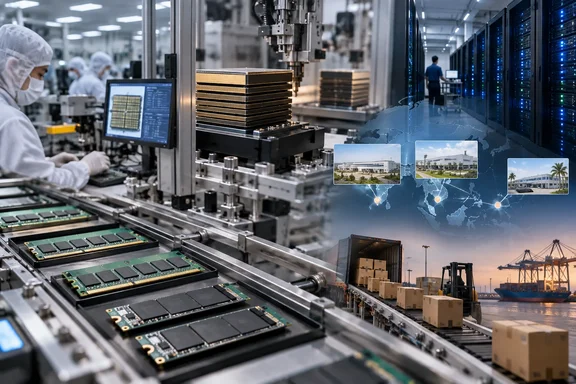
The move was first reported by The Elec and relayed by TechRadar, which said Samsung has asked partners including Dreamtech, Hanyang Digitech, and SFA Semicon to expand DDR5 and SSD capacity. Separate reporting from South Korea’s eDaily earlier this month supports the narrower part of that account: it said Samsung’s restructuring of its Onyang site to secure HBM back-end lines was already producing an increase in outsourced DDR5 work.
Samsung has not publicly confirmed the supplier arrangements, the share of its present DDR5 or SSD output affected, or which retail and enterprise product lines will move first. That absence matters. A decision to outsource additional module volume is materially different from ending Samsung’s own module assembly, and the reporting available so far supports the former, not the latter.
Samsung’s bottleneck is packaging capacity, not memory demand
HBM is a stacked memory product built for AI accelerators, and its manufacturing path puts unusual pressure on testing, assembly, stacking, and package integration. Conventional DDR5 DIMMs and M.2 SSDs also need back-end work, but their assembly is comparatively standardized: chips are mounted to a printed circuit board, tested, programmed where necessary, and packaged for the customer.
Samsung’s own public investment disclosures explain why that distinction has become strategically valuable. In June, the company identified construction of an HBM fab in Onyang, Cheonan as part of its longer-term semiconductor investment plan. Samsung Semiconductor has also said it expects 2026 HBM revenue to more than triple from 2025 as it expands HBM4 production capacity.
That public direction does not independently confirm the outsourcing contracts. It does, however, corroborate the premise behind them: Samsung has a strong commercial reason to protect advanced packaging capacity for HBM rather than consume it with products that qualified outside assembly partners can build.
For buyers, the immediate implication is not that Samsung-branded DDR5 or SSDs will vanish. It is that Samsung is treating conventional module assembly as a capacity-management problem while it keeps its internal manufacturing attention on parts of the AI-memory chain that carry higher technical barriers and, likely, better margins.
“Outsourcing DDR5” does not mean Samsung stops making DDR5 chips
The broad wording around this story risks creating a false picture of what is changing. DDR5 refers both to DRAM chips and to the DIMMs that hold those chips. An SSD is an even more layered product, combining NAND flash, a controller, firmware, a circuit board, and final validation. A contractor can assemble or test a finished module without owning the memory technology, making the chips, setting firmware policy, or controlling qualification for major PC and server OEMs.
The reporting describes external partners taking on DDR5 module and SSD production increases, alongside equipment transfers and capacity expansion. It does not say Samsung is outsourcing DRAM wafer fabrication, NAND fabrication, core memory design, HBM assembly, controller design, or the qualification decisions that determine whether a particular drive or DIMM enters an OEM platform.
That is why this should be read as a back-end manufacturing reallocation, not an exit from PC memory or storage. Samsung remains responsible for the parts of the chain that determine the silicon supply available to the contractors. If chip availability tightens, shifting board-level assembly to India, Vietnam, or the Philippines will not by itself create extra DRAM or NAND.
The reported partner plans make that practical limit clear. TechRadar, citing The Elec, said Dreamtech began DDR5 module mass production in India last November and is targeting annual capacity above 50 million units at its Noida operation. It also reported that Hanyang Digitech is automating a Vietnamese module plant, while SFA Semicon is preparing to move DDR5 testing and assembly equipment from Samsung’s Onyang campus to the Philippines, with an initial transition due to begin in November and a second phase planned for the second quarter of 2027.
Those projects can relieve an assembly constraint. They do not change the number of Samsung memory dies leaving a fabrication plant.
The timing matters more for availability than for performance
There is no evidence in the reporting that a Samsung DDR5 DIMM or SSD assembled by a contractor will perform differently simply because its final assembly moves outside Samsung. Mature contract manufacturing is routine across the PC industry, and OEMs generally care about qualified components, firmware revisions, validation status, endurance ratings, and sustained supply—not the corporate ownership of the line where a board was assembled.
The risk is operational rather than architectural. More external manufacturing adds handoffs between Samsung’s component supply, packaging partners, test operations, regional logistics, and final OEM or retail distribution. That can work well at scale, but it gives procurement teams more places to watch for qualification delays, component substitutions, firmware-tracking problems, or regional disruptions.
The transition may also create uneven availability during the handover. SFA Semicon’s reported equipment move from Onyang to the Philippines is a particularly concrete example: an equipment transfer can add capacity after it is installed and qualified, but it also requires the old and new sites to maintain output through the change. Samsung has not published a product-by-product migration plan, so there is no basis yet for claiming that particular Samsung SSD families, retail DIMMs, or OEM notebook configurations will be affected.
For Windows PC enthusiasts, this is a reason to watch exact model numbers and specifications rather than assume a Samsung label guarantees identical internals forever. That advice is already sound for SSD shopping, where controller, NAND generation, firmware, and DRAM-cache configuration can matter far more than brand identity. The outsourcing report makes documentation and qualification discipline more important, not less.
Micron’s consumer retreat is related, but it is not the same decision
The comparison with Micron needs care. Micron’s recent strategy has included a much more visible shift away from the Crucial consumer brand and toward data-center, enterprise, and AI-oriented products. It has continued to market DDR5, HBM, data-center memory, and enterprise SSDs under its own portfolio, but the consumer-channel pullback directly changed what PC buyers could purchase under the Crucial name.
Samsung’s reported decision is different in kind. It is a proposal to route incremental physical production through outside assembly partners while maintaining Samsung-branded memory and storage products. The reporting contains no indication that Samsung plans to discontinue retail SSDs, consumer DDR5 modules, or OEM client-storage supply.
The overlap is economic. Both companies are responding to an AI infrastructure market where HBM and high-capacity enterprise storage can justify large investments, while traditional PC components compete for the same broad pool of memory, NAND, test, and packaging resources. The result may be a tighter link between AI-server demand and ordinary PC component supply, even where the underlying products have little in common.
That linkage does not guarantee consumer DDR5 or SSD price increases. Module and drive prices depend on wafer output, NAND and DRAM contract pricing, inventory, OEM demand, controller supply, channel behavior, and the pace at which outsourced sites reach stable yields. The current reporting establishes a capacity shift, not a retail pricing forecast.
SanDisk has little reason to copy Samsung’s exact playbook
The suggestion that SanDisk could follow Samsung should be treated as speculation, not an emerging corporate plan. SanDisk has announced an enterprise and AI-storage growth strategy, emphasizing higher-performance NAND, enterprise SSDs, and what it calls capital-efficient manufacturing. But its public materials also underline a major difference from Samsung: SanDisk’s manufacturing and technology roadmap is closely intertwined with Kioxia, its strategic NAND partner.
Samsung is reallocating back-end space within a vertically integrated memory manufacturer that also has major HBM ambitions. SanDisk is a NAND and storage specialist whose public strategy is already centered on partnerships, long-term customer agreements, and a portfolio spanning consumer, enterprise, cloud, and AI infrastructure. It does not make HBM, so it lacks the central packaging conflict reported at Samsung.
SanDisk may prioritize enterprise SSDs as AI inference expands, and the company has explicitly told investors it sees enterprise data-center flash as a major growth opportunity. But no public SanDisk announcement or independent report cited here says it intends to outsource additional consumer SSD assembly, reduce its retail business, or copy Samsung’s reported DDR5-and-SSD capacity model.
Samsung’s reported plan is therefore a sharper signal about an increasingly scarce resource: advanced packaging and test capacity. Its near-term consequence for the PC market is not a new type of DDR5 or SSD, but a more fragmented manufacturing path for conventional products while Samsung reserves its own back-end lines for HBM.