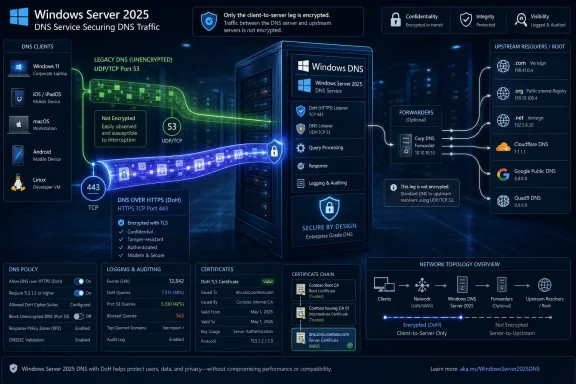
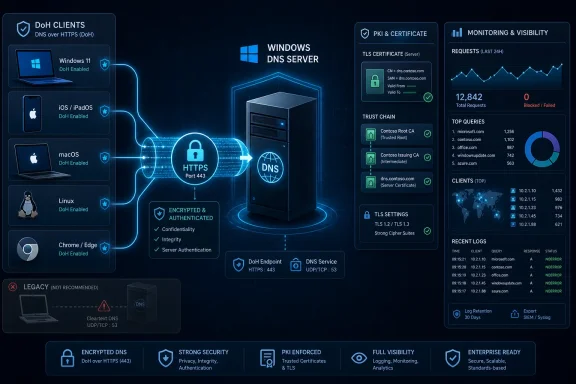
Microsoft has made DNS over HTTPS support generally available for Windows DNS Server in Windows Server 2025 with the latest June 2026 Patch Tuesday updates, giving enterprise networks a Microsoft-supported way to encrypt DNS traffic between DoH-capable clients and their internal resolvers. The change moves a feature Microsoft had been previewing for months into production territory. It is not a glamorous server feature, but it is the kind of plumbing change that quietly rewrites the security assumptions underneath almost every enterprise application. DNS has always been where trust begins; Microsoft is now trying to make cleartext DNS look like a legacy exception rather than the default.
DNS is often described as the internet’s phone book, which is accurate enough for civilians and too gentle for administrators. In a corporate network, DNS is more like directory assistance, traffic cop, security witness, and application dependency map rolled into one. Every authentication flow, SaaS session, software update, intranet lookup, and telemetry call tends to leave a DNS footprint before anything else happens.
That is why Microsoft’s Windows Server DoH release matters beyond the checkbox. Windows clients have supported DNS over HTTPS for years, but the server side was the missing enterprise piece. Without a Windows DNS Server endpoint that could terminate DoH, organizations using Microsoft’s built-in DNS role had to choose between sending encrypted queries to outside resolvers, deploying intermediary infrastructure, or staying with conventional DNS on port 53.
General availability changes the deployment conversation. It tells administrators that Microsoft considers the feature stable enough for production use, not merely lab evaluation. It also gives security teams a cleaner way to argue that internal DNS traffic should be treated with the same confidentiality expectations as web traffic, API calls, and identity requests.
The irony is that DNS was never designed with modern enterprise paranoia in mind. It was designed for reachability, speed, and interoperability. The zero-trust era has been forcing old assumptions through new threat models, and plaintext DNS is one of the more obvious leftovers.
That distinction matters because enterprise DNS is full of sensitive signals. Internal hostnames can reveal business units, infrastructure patterns, software vendors, domain relationships, and administrative habits. Even when the DNS response itself is not secret, the pattern of queries can be intelligence.
Microsoft’s implementation encrypts communication between capable clients and Windows DNS Server using HTTPS. That means clients can authenticate the server using TLS certificates and send queries through an encrypted channel rather than cleartext UDP or TCP DNS. In plain English: the client is no longer shouting its DNS requests across the local network and hoping nobody nearby is listening or interfering.
This is why Microsoft frames the feature in zero-trust language. Zero trust is not magic dust, and vendors abuse the phrase constantly, but the underlying principle fits here. If the network is no longer presumed trustworthy merely because it is internal, then name resolution cannot remain a soft, unauthenticated conversation by default.
Microsoft’s documentation still makes clear that this is a Windows Server 2025 story with current security updates applied. That narrows the practical audience. Many enterprise DNS estates are not greenfield Windows Server 2025 deployments; they are layered, inherited, politically sensitive systems where domain controllers, DNS zones, DHCP options, certificate authorities, and firewall rules have years of sediment built up around them.
That means DoH will not arrive everywhere overnight. It will appear first in organizations already moving aggressively on Windows Server 2025, regulated environments with pressure to reduce plaintext protocols, and security-forward shops where DNS has become part of detection and response strategy. The rest will wait for refresh cycles, proof from early adopters, and a few hard lessons from pilot deployments.
Still, GA changes the default objection. Administrators can no longer dismiss Windows DNS Server DoH as an interesting preview. They now have to decide whether the risk of changing DNS is greater than the risk of leaving internal name resolution readable and spoofable.
A Windows DNS Server acting as a DoH endpoint needs a certificate that clients trust and that matches the configured DoH URI. That sounds routine until it collides with internal naming practices, split-horizon DNS, legacy clients, certificate template governance, and servers doing double duty as domain controllers. If the certificate story is weak, DoH does not strengthen trust; it adds another brittle dependency to a service that must be boring to be successful.
The use of HTTPS also moves DNS into familiar security territory. Port 443 is well understood, heavily monitored, and often allowed through internal firewalls. But that familiarity cuts both ways. Security teams will need to distinguish legitimate DoH traffic to sanctioned internal resolvers from applications or malware trying to tunnel around policy by using their own encrypted DNS paths.
This is the enterprise paradox of encrypted DNS. Encryption reduces passive exposure, but it can also reduce visibility if organizations do not update their monitoring strategy. The answer is not to reject DoH; it is to make resolver policy, endpoint policy, logging, and network inspection agree on what sanctioned DNS looks like.
Parallel operation gives administrators a migration path. They can enable DoH on selected servers, configure test clients, monitor behavior, and keep conventional DNS available while they determine which systems can move. That is not just convenience; it is the difference between a practical security upgrade and a heroic all-or-nothing weekend project.
It also reflects an important truth about enterprise Windows environments: not every endpoint will be ready at the same time. Modern Windows clients can participate, but mixed estates include appliances, printers, Linux systems, embedded devices, old servers, network gear, and applications whose DNS behavior nobody has documented since installation. A clean DoH architecture has to account for the messy edges.
The feature’s ability to coexist with legacy DNS also creates a governance challenge. If standard DNS remains available forever, DoH risks becoming an optional improvement rather than a security boundary. The organizations that get the most value will be those that treat coexistence as a migration phase, not a permanent compromise.
That distinction should not be glossed over. If a Windows DNS Server receives encrypted queries from clients but then forwards upstream queries in cleartext, the organization has protected one segment of the path while leaving another exposed. In many enterprise designs, that may still be a meaningful improvement, especially where the internal LAN is the bigger concern. But it is not the same thing as end-to-end encrypted DNS resolution.
For internal authoritative zones, the client-to-resolver protection may be the most important part. Queries for domain controllers, internal apps, management endpoints, and private services often do not need to leave the organization’s DNS infrastructure. For internet-bound lookups, however, the upstream path remains part of the threat model.
This is where Microsoft’s staged delivery makes sense technically but complicates the security story. The company has shipped the part that lets Windows DNS Server become a DoH endpoint for clients. The next credibility test is whether Microsoft completes the chain in a way that fits enterprise forwarding, conditional forwarding, and hybrid DNS designs without forcing administrators into awkward workarounds.
The answer is architectural discipline. Enterprises should not allow every application to choose its own resolver, its own DoH endpoint, and its own policy. They should centralize encrypted DNS through managed resolvers, enforce resolver configuration on endpoints, and collect logs from the DNS service itself rather than depending only on packet visibility.
In that model, DoH does not blind defenders. It moves visibility from the wire to the resolver and endpoint management layers. That is consistent with the broader direction of enterprise security, where identity, policy, and telemetry increasingly live above raw network inspection.
The danger is a half-migration. If some clients use internal DoH, some use classic DNS, browsers use their own encrypted resolver settings, and unmanaged devices do whatever they want, the organization gets complexity without a clean security gain. DoH should be deployed as policy, not as a preference.
But this also means DoH may become one more argument in the Windows Server 2025 upgrade file. For organizations still standardizing on Windows Server 2019 or 2022, server-side DoH is not simply a feature toggle; it is part of a platform decision. That makes adoption slower, but it may also make deployments cleaner when they arrive.
Windows Server 2025 has already been positioned around modernization themes: security hardening, hybrid management, identity improvements, and platform refresh. DNS over HTTPS fits that narrative because it upgrades an old core service without asking organizations to abandon the Windows DNS role. Microsoft is not telling enterprises to redesign name resolution around a third-party resolver. It is saying the resolver they already run can now speak a modern encrypted protocol.
That is strategically important. Many enterprises would like stronger DNS security but do not want a new resolver architecture unless forced. Microsoft’s pitch is that encrypted DNS can be an incremental modernization rather than a rip-and-replace project.
That distinction is important because DNS attacks rarely arrive wearing only one costume. Attackers can poison, redirect, tamper, tunnel, enumerate, and abuse DNS in different ways. Encrypting the transport solves a transport problem. It does not solve every name-resolution problem.
Still, transport security is not trivial. Cleartext DNS has survived partly because it was ubiquitous and convenient, not because it was defensible. In a world where organizations encrypt administrative portals, APIs, authentication flows, mail transport, file sync, and remote access, leaving DNS queries exposed increasingly looks like an inconsistency.
The best way to view Windows Server DoH is as a foundational control. It raises the floor. It makes certain passive and local-network attacks harder. It gives clients a way to verify the resolver they are talking to. But it does not absolve administrators from designing DNS as a security-sensitive service.
Administrators also need to think about naming. The DoH URI must be stable and match certificate expectations. If an organization has historically treated internal DNS server names as infrastructure trivia, DoH turns that name into part of the trust contract.
Firewall teams have work too. DoH commonly uses TCP 443, but that does not mean every path should be opened blindly. Internal clients should reach approved internal resolvers. Approved resolvers should be monitored. Unapproved encrypted DNS destinations should be blocked or at least investigated.
The change management plan should include user impact, even if users never hear the acronym. DNS failures look like application failures. Help desks need enough context to recognize when a wave of “the internet is broken” tickets might actually be a resolver policy or certificate issue.
That matters because hybrid networks are increasingly complicated. Enterprises may use on-premises Active Directory, Azure services, private endpoints, conditional forwarders, branch networks, VPN clients, and cloud security gateways at the same time. DNS sits underneath all of it, and every layer adds another opportunity for leakage or misconfiguration.
If Microsoft can extend encrypted DNS upstream while preserving the management model Windows administrators expect, it will have a stronger answer to third-party DNS security platforms. If it cannot, Windows DNS Server DoH may remain useful but incomplete, a client-facing shield rather than a full resolver modernization.
For now, the direction is clear enough: Microsoft wants encrypted DNS to become a normal Windows Server capability. That is a meaningful change for a service that has often evolved conservatively because breaking DNS is one of the fastest ways to ruin an administrator’s week.
 Microsoft Is Finally Encrypting the Directory Assistance Desk of the Network
DNS is often described as the internet’s phone book, which is accurate enough for civilians and too gentle for administrators. In a corporate network, DNS is more like directory assistance, traffic cop, security witness, and application dependency map rolled into one. Every authentication flow, SaaS session, software update, intranet lookup, and telemetry call tends to leave a DNS footprint before anything else happens.That is why Microsoft’s Windows Server DoH release matters beyond the checkbox. Windows clients have supported DNS over HTTPS for years, but the server side was the missing enterprise piece. Without a Windows DNS Server endpoint that could terminate DoH, organizations using Microsoft’s built-in DNS role had to choose between sending encrypted queries to outside resolvers, deploying intermediary infrastructure, or staying with conventional DNS on port 53.
General availability changes the deployment conversation. It tells administrators that Microsoft considers the feature stable enough for production use, not merely lab evaluation. It also gives security teams a cleaner way to argue that internal DNS traffic should be treated with the same confidentiality expectations as web traffic, API calls, and identity requests.
The irony is that DNS was never designed with modern enterprise paranoia in mind. It was designed for reachability, speed, and interoperability. The zero-trust era has been forcing old assumptions through new threat models, and plaintext DNS is one of the more obvious leftovers.
The Real Upgrade Is Not Privacy, It Is Control
Consumer debates about DoH often focus on privacy from internet providers or coffee-shop attackers. Enterprise DoH is different. The prize is not hiding a user’s browsing from a broadband company; it is reducing the number of places where attackers, malware, compromised network devices, or careless observers can read or tamper with name resolution inside an organization.That distinction matters because enterprise DNS is full of sensitive signals. Internal hostnames can reveal business units, infrastructure patterns, software vendors, domain relationships, and administrative habits. Even when the DNS response itself is not secret, the pattern of queries can be intelligence.
Microsoft’s implementation encrypts communication between capable clients and Windows DNS Server using HTTPS. That means clients can authenticate the server using TLS certificates and send queries through an encrypted channel rather than cleartext UDP or TCP DNS. In plain English: the client is no longer shouting its DNS requests across the local network and hoping nobody nearby is listening or interfering.
This is why Microsoft frames the feature in zero-trust language. Zero trust is not magic dust, and vendors abuse the phrase constantly, but the underlying principle fits here. If the network is no longer presumed trustworthy merely because it is internal, then name resolution cannot remain a soft, unauthenticated conversation by default.
General Availability Makes DoH a Deployment Problem, Not a Research Project
The move from preview to GA is less about the protocol and more about accountability. Preview features invite experimentation. GA features invite change tickets, architecture reviews, audit questions, and eventually baseline policy.Microsoft’s documentation still makes clear that this is a Windows Server 2025 story with current security updates applied. That narrows the practical audience. Many enterprise DNS estates are not greenfield Windows Server 2025 deployments; they are layered, inherited, politically sensitive systems where domain controllers, DNS zones, DHCP options, certificate authorities, and firewall rules have years of sediment built up around them.
That means DoH will not arrive everywhere overnight. It will appear first in organizations already moving aggressively on Windows Server 2025, regulated environments with pressure to reduce plaintext protocols, and security-forward shops where DNS has become part of detection and response strategy. The rest will wait for refresh cycles, proof from early adopters, and a few hard lessons from pilot deployments.
Still, GA changes the default objection. Administrators can no longer dismiss Windows DNS Server DoH as an interesting preview. They now have to decide whether the risk of changing DNS is greater than the risk of leaving internal name resolution readable and spoofable.
Certificates Are Where the Clean Story Gets Messy
The marketing version of DoH is simple: encrypt DNS with HTTPS. The operational version begins with certificates, trust chains, subject alternative names, firewall paths, service bindings, client configuration, monitoring, and rollback plans. That is where many supposedly straightforward security upgrades become real work.A Windows DNS Server acting as a DoH endpoint needs a certificate that clients trust and that matches the configured DoH URI. That sounds routine until it collides with internal naming practices, split-horizon DNS, legacy clients, certificate template governance, and servers doing double duty as domain controllers. If the certificate story is weak, DoH does not strengthen trust; it adds another brittle dependency to a service that must be boring to be successful.
The use of HTTPS also moves DNS into familiar security territory. Port 443 is well understood, heavily monitored, and often allowed through internal firewalls. But that familiarity cuts both ways. Security teams will need to distinguish legitimate DoH traffic to sanctioned internal resolvers from applications or malware trying to tunnel around policy by using their own encrypted DNS paths.
This is the enterprise paradox of encrypted DNS. Encryption reduces passive exposure, but it can also reduce visibility if organizations do not update their monitoring strategy. The answer is not to reject DoH; it is to make resolver policy, endpoint policy, logging, and network inspection agree on what sanctioned DNS looks like.
Parallel Operation Is the Escape Hatch Microsoft Needed
One of the smarter parts of Microsoft’s approach is that DoH can run alongside traditional DNS. That matters because DNS migrations are among the least forgiving changes in IT. A botched DNS change does not create one clean outage; it creates a fog of authentication failures, application timeouts, unreachable services, broken updates, and angry users describing symptoms that do not mention DNS at all.Parallel operation gives administrators a migration path. They can enable DoH on selected servers, configure test clients, monitor behavior, and keep conventional DNS available while they determine which systems can move. That is not just convenience; it is the difference between a practical security upgrade and a heroic all-or-nothing weekend project.
It also reflects an important truth about enterprise Windows environments: not every endpoint will be ready at the same time. Modern Windows clients can participate, but mixed estates include appliances, printers, Linux systems, embedded devices, old servers, network gear, and applications whose DNS behavior nobody has documented since installation. A clean DoH architecture has to account for the messy edges.
The feature’s ability to coexist with legacy DNS also creates a governance challenge. If standard DNS remains available forever, DoH risks becoming an optional improvement rather than a security boundary. The organizations that get the most value will be those that treat coexistence as a migration phase, not a permanent compromise.
The Missing Upstream Piece Keeps This From Being End-to-End
Microsoft’s first GA release focuses on encrypting client-to-resolver communication. That is a big step, but it is not the whole chain. Microsoft has also indicated that encrypted communication between Windows DNS Server and upstream DNS resolvers is planned for a future update.That distinction should not be glossed over. If a Windows DNS Server receives encrypted queries from clients but then forwards upstream queries in cleartext, the organization has protected one segment of the path while leaving another exposed. In many enterprise designs, that may still be a meaningful improvement, especially where the internal LAN is the bigger concern. But it is not the same thing as end-to-end encrypted DNS resolution.
For internal authoritative zones, the client-to-resolver protection may be the most important part. Queries for domain controllers, internal apps, management endpoints, and private services often do not need to leave the organization’s DNS infrastructure. For internet-bound lookups, however, the upstream path remains part of the threat model.
This is where Microsoft’s staged delivery makes sense technically but complicates the security story. The company has shipped the part that lets Windows DNS Server become a DoH endpoint for clients. The next credibility test is whether Microsoft completes the chain in a way that fits enterprise forwarding, conditional forwarding, and hybrid DNS designs without forcing administrators into awkward workarounds.
Zero Trust Does Not Mean Zero Visibility
DoH has always made some network defenders uneasy. If DNS queries become encrypted, what happens to the security tools that rely on seeing DNS traffic? That concern is legitimate, but it is also sometimes used to defend a status quo that was never especially secure.The answer is architectural discipline. Enterprises should not allow every application to choose its own resolver, its own DoH endpoint, and its own policy. They should centralize encrypted DNS through managed resolvers, enforce resolver configuration on endpoints, and collect logs from the DNS service itself rather than depending only on packet visibility.
In that model, DoH does not blind defenders. It moves visibility from the wire to the resolver and endpoint management layers. That is consistent with the broader direction of enterprise security, where identity, policy, and telemetry increasingly live above raw network inspection.
The danger is a half-migration. If some clients use internal DoH, some use classic DNS, browsers use their own encrypted resolver settings, and unmanaged devices do whatever they want, the organization gets complexity without a clean security gain. DoH should be deployed as policy, not as a preference.
Windows Server 2025 Becomes the Forcing Function
By tying the server-side feature to Windows Server 2025 and current cumulative updates, Microsoft is using the new server platform as the place where DNS modernization happens. That is understandable. Microsoft rarely wants to retrofit major network-service changes across every supported server generation, especially when TLS handling, PowerShell management, service behavior, and support boundaries are involved.But this also means DoH may become one more argument in the Windows Server 2025 upgrade file. For organizations still standardizing on Windows Server 2019 or 2022, server-side DoH is not simply a feature toggle; it is part of a platform decision. That makes adoption slower, but it may also make deployments cleaner when they arrive.
Windows Server 2025 has already been positioned around modernization themes: security hardening, hybrid management, identity improvements, and platform refresh. DNS over HTTPS fits that narrative because it upgrades an old core service without asking organizations to abandon the Windows DNS role. Microsoft is not telling enterprises to redesign name resolution around a third-party resolver. It is saying the resolver they already run can now speak a modern encrypted protocol.
That is strategically important. Many enterprises would like stronger DNS security but do not want a new resolver architecture unless forced. Microsoft’s pitch is that encrypted DNS can be an incremental modernization rather than a rip-and-replace project.
The Security Gain Is Real, but It Is Easy to Oversell
DoH reduces exposure to eavesdropping, interception, and spoofing between clients and DNS servers. It does not make DNS inherently trustworthy. It does not validate that every DNS answer is correct. It does not replace DNSSEC, endpoint security, resolver logging, secure update policies, or careful Active Directory hygiene.That distinction is important because DNS attacks rarely arrive wearing only one costume. Attackers can poison, redirect, tamper, tunnel, enumerate, and abuse DNS in different ways. Encrypting the transport solves a transport problem. It does not solve every name-resolution problem.
Still, transport security is not trivial. Cleartext DNS has survived partly because it was ubiquitous and convenient, not because it was defensible. In a world where organizations encrypt administrative portals, APIs, authentication flows, mail transport, file sync, and remote access, leaving DNS queries exposed increasingly looks like an inconsistency.
The best way to view Windows Server DoH is as a foundational control. It raises the floor. It makes certain passive and local-network attacks harder. It gives clients a way to verify the resolver they are talking to. But it does not absolve administrators from designing DNS as a security-sensitive service.
Administrators Should Treat This as a DNS Project With a PKI Dependency
The first deployments should be boring on purpose. Pick controlled client groups, use a well-understood DNS server, verify certificate trust, confirm logging, and test fallback behavior. The goal is not to show that DoH works in a demo; the goal is to prove that it fails predictably when something is misconfigured.Administrators also need to think about naming. The DoH URI must be stable and match certificate expectations. If an organization has historically treated internal DNS server names as infrastructure trivia, DoH turns that name into part of the trust contract.
Firewall teams have work too. DoH commonly uses TCP 443, but that does not mean every path should be opened blindly. Internal clients should reach approved internal resolvers. Approved resolvers should be monitored. Unapproved encrypted DNS destinations should be blocked or at least investigated.
The change management plan should include user impact, even if users never hear the acronym. DNS failures look like application failures. Help desks need enough context to recognize when a wave of “the internet is broken” tickets might actually be a resolver policy or certificate issue.
The Windows DNS Roadmap Now Has a Clear Direction
Microsoft’s statement that upstream encrypted resolver communication is planned gives this release a sense of direction. The company is not presenting client-to-resolver encryption as the final form. It is the first production step in making Windows DNS Server fit into encrypted DNS architectures more completely.That matters because hybrid networks are increasingly complicated. Enterprises may use on-premises Active Directory, Azure services, private endpoints, conditional forwarders, branch networks, VPN clients, and cloud security gateways at the same time. DNS sits underneath all of it, and every layer adds another opportunity for leakage or misconfiguration.
If Microsoft can extend encrypted DNS upstream while preserving the management model Windows administrators expect, it will have a stronger answer to third-party DNS security platforms. If it cannot, Windows DNS Server DoH may remain useful but incomplete, a client-facing shield rather than a full resolver modernization.
For now, the direction is clear enough: Microsoft wants encrypted DNS to become a normal Windows Server capability. That is a meaningful change for a service that has often evolved conservatively because breaking DNS is one of the fastest ways to ruin an administrator’s week.
The Practical Reading for Windows Shops
This release is not a reason to rush a Friday afternoon change into production. It is a reason to start treating encrypted internal DNS as a near-term planning item rather than a speculative future control. The organizations that benefit most will be those that approach DoH as part of a broader DNS security program.- Windows Server DoH is now a production feature for Windows Server 2025 systems with the latest relevant security updates installed.
- The first GA release encrypts traffic between DoH-capable clients and Windows DNS Server, not the full upstream resolver path.
- Successful deployment depends on certificate management, trusted names, firewall policy, client configuration, and resolver logging.
- Parallel operation with traditional DNS makes phased migration possible, but leaving both paths open forever weakens the security outcome.
- Administrators should align browser, operating system, network, and security-tool policies so encrypted DNS does not become fragmented across the estate.
- Microsoft’s planned upstream encryption support will determine whether Windows DNS Server becomes a complete encrypted resolver platform or mainly a client-facing DoH endpoint.
References
- Primary source: Neowin
Published: Fri, 12 Jun 2026 08:44:00 GMT
Windows Server gets DNS over HTTPS (DoH) support - Neowin
After months in preview, Microsoft's DNS over HTTPS feature is now production-ready, promising stronger protection without major network changes. www.neowin.net
- Official source: learn.microsoft.com
Enable DNS over HTTPS in DNS Server on Windows Server | Microsoft Learn
Secure DNS traffic with DNS over HTTPS (DoH) for DNS Server on Windows Server. Learn how to configure and verify DoH in this guide.learn.microsoft.com - Official source: support.microsoft.com
9. Juni 2026 – KB5094125 (Betriebssystembuild 26100.32995) - Microsoft-Support
 support.microsoft.com
- Related coverage: tomshardware.com
Microsoft's April patch puts Windows domain controllers into reboot loops — third known issue from KB5082063 is affecting Windows Server 2016 through 2025 | Tom's Hardware
Microsoft has confirmed the issuewww.tomshardware.com - Related coverage: techspot.com
Windows 10 gets DNS over HTTPS support for Windows Insiders | TechSpot
Microsoft is adding support for DNS over HTTPS (DoH) protocol for Windows Insiders in the Fast Ring. This is the highly experimental version of Windows that allows...www.techspot.com - Related coverage: newroman.net
- Related coverage: der-windows-papst.de