

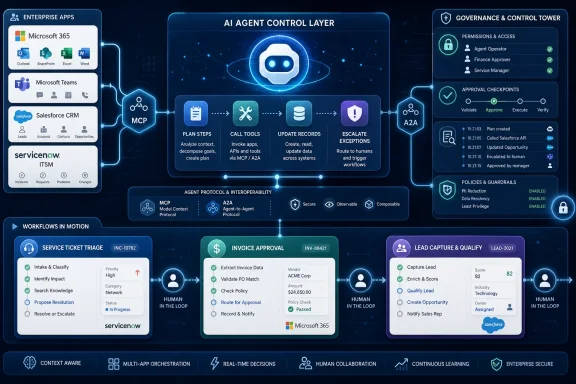
Agentic AI’s defining enterprise trend in 2026 is the move from prompt-driven copilots to autonomous software agents that can plan tasks, call tools, update business systems, and escalate exceptions across platforms such as Microsoft Copilot Studio, Salesforce Agentforce, and ServiceNow. The practical shift is not that AI has become magically independent. It is that vendors are finally wiring models into the places where work, identity, permissions, data, and audit trails already live. That makes agentic AI less a chatbot category than a new automation layer competing for control of the enterprise workflow.
The last enterprise AI cycle taught workers to ask better questions. The next one asks whether software can be trusted to do better work after the question has been asked once, or not asked at all.
That distinction matters because most generative AI deployments have lived in a narrow lane. A user prompts a model, receives text, code, a summary, or a draft, and then carries the result into another application where the real business process continues. The human remains the workflow engine.
Agentic AI attempts to invert that relationship. A user or system defines a goal, and the agent decomposes the work into steps: retrieve a record, check a policy, update a ticket, generate a response, request approval, close the loop. In theory, the employee becomes supervisor rather than operator.
That is why Microsoft, Salesforce, ServiceNow, Google, Anthropic, and a swarm of smaller vendors now talk less about “assistants” and more about “agents.” The language is marketing, but it reflects a real architectural change. The model is no longer merely answering; it is being connected to tools that can act.
That is where the technology has a fighting chance because the work is repetitive but not fully deterministic. Traditional automation could handle “if this, then that.” It struggled when the input was messy, the request was phrased in natural language, or the next step depended on context buried across several systems.
Agents fit into that gap. They can interpret intent, retrieve context, and choose from a defined set of actions. A customer service agent can classify a complaint, search previous cases, draft a reply, and update the CRM. An IT agent can diagnose a password issue, verify policy, trigger a reset flow, and document the result.
The crucial phrase is defined set of actions. Enterprise agents that work are not tiny digital employees roaming the company with a corporate credit card. They are constrained automations with a language model in the decision loop and a governance layer around the blast radius.
Copilot Studio has become Microsoft’s central pitch for building and deploying custom agents. The appeal is obvious. If your documents are in SharePoint, your identity policies are in Entra, your workflows are in Power Automate, and your users live in Teams, Microsoft can argue that agentic AI should not be bolted on from outside.
That is both a strength and a lock-in strategy. Microsoft can make agents feel native by giving them privileged access to calendars, files, chats, business records, and approval flows. But the deeper an organization embeds those agents, the more governance becomes inseparable from Microsoft’s control plane.
The company’s larger bet is that AI agents become a normal part of work surfaces rather than separate destinations. If Copilot can be invoked from Teams, Outlook, the browser, the taskbar, and business applications, the agent is not another app to adopt. It is the connective tissue between apps.
That is powerful, and it is risky. The same integration that makes an agent useful also makes mistakes harder to contain. An agent with access to stale documents is annoying. An agent with access to customer data, approval workflows, and external communications is an operational actor.
That language is not accidental. Salesforce knows the enterprise buyer does not want another AI demo; it wants a measurable reduction in backlog, handle time, missed leads, manual updates, and abandoned customer journeys. Agentforce is designed to make AI legible as capacity.
The best case for Salesforce is customer service. CRM data is structured enough to be actionable, customer interactions are expensive enough to justify automation, and many service tasks already involve repeatable resolution paths. An agent that can resolve routine cases while escalating ambiguous ones has an obvious business case.
But Salesforce also faces the central paradox of agentic AI. The more valuable the workflow, the more entangled it is with proprietary business rules, exceptions, compliance constraints, and messy historical data. The agent is only as good as the operating reality beneath it.
That is why the winners in this market may not be the vendors with the flashiest models. They may be the platforms that already own the system of record.
That makes ServiceNow well positioned for the agentic turn. Enterprises do not just need agents that can act; they need agents that can be observed, governed, and stopped. IT leaders will not accept autonomous systems unless they can see what the agent did, why it did it, which tools it touched, and where a human intervened.
This is where the term AI control tower starts to matter. Agent sprawl is already a plausible problem. A sales team may deploy one set of agents, HR another, security another, and developers yet another through coding tools or cloud platforms. Without centralized policy, identity, and logging, agentic AI becomes shadow IT with a reasoning engine.
ServiceNow is effectively arguing that agent governance belongs in the workflow platform. Microsoft will argue it belongs in the productivity and identity platform. Salesforce will argue it belongs in the customer data platform. All three can be right inside their own domains, which is exactly why interoperability has become such a heated issue.
MCP is often described as a connector standard for AI systems and external tools. That undersells its strategic importance. If agents are going to retrieve data, call APIs, query databases, and trigger actions, the industry needs repeatable patterns for exposing those capabilities without building one-off integrations for every model and vendor.
A2A addresses a related but different problem: how agents communicate with other agents. That sounds futuristic until you consider a routine enterprise process. A customer request might involve a service agent, billing agent, scheduling agent, inventory agent, and compliance agent, each with different context and authority.
The optimistic version is USB-C for AI workflows. The pessimistic version is a new attack surface wrapped in a standards debate. Every connector that helps an agent get work done also creates a path for bad instructions, excessive permissions, data leakage, or tool misuse.
This is why protocol standardization cannot be treated as plumbing. It is the beginning of an enterprise agent supply chain. Security teams that learned to worry about OAuth scopes, API keys, browser extensions, and SaaS integrations will need to apply the same suspicion to agent tools and agent-to-agent handoffs.
The use case is simple: answer instantly, understand the caller’s intent, provide basic information, capture lead details, schedule an appointment, update a CRM, and route urgent requests. For businesses that miss calls after hours or during seasonal spikes, the value proposition is easy to grasp.
That also explains why companies such as Goodcall package agentic AI around phone automation rather than broad digital transformation. A missed call has an immediate cost. A booked appointment has an immediate value. The workflow is narrow enough to constrain and measurable enough to defend.
Voice agents also expose the trust problem faster than chat-based agents. A bad internal summary can be corrected before it reaches a customer. A bad phone interaction is already customer experience. Tone, latency, escalation, and accuracy become part of the product.
The most successful voice deployments will not be the ones that pretend AI can replace the entire front office. They will be the ones that know exactly which calls should be automated and exactly when a human should take over.
A healthcare scheduling agent needs to understand appointment types, provider availability, privacy rules, insurance friction, and escalation paths. A home services dispatch agent needs to distinguish a routine maintenance request from a safety issue. A legal intake agent needs to collect facts without pretending to provide legal advice.
That domain knowledge cannot be improvised at runtime. It has to be designed into the agent’s available tools, policies, scripts, and handoff rules. The model can reason through a task, but the business must define what “good” means.
This is why many agentic AI pilots stall. The team starts with a model rather than a workflow. It asks what the AI can do instead of asking where the organization repeatedly loses time, money, or customer trust.
The better starting point is mundane: find a process with high volume, clear outcomes, accessible data, and manageable risk. Then define the agent’s authority. Then measure it. Only then expand.
That does not mean enterprises should avoid agents. It means they should stop treating governance as a paperwork exercise that begins after deployment. Permissions, logging, approval thresholds, data boundaries, and rollback mechanisms are product requirements.
Human-in-the-loop design is often misunderstood here. It should not mean a human approves every step, which defeats the point. It should mean the system knows which actions are routine, which are reversible, which are sensitive, and which require escalation.
A payment under a defined threshold may be safe for automation. A contract change is not. A password reset for a verified employee may be routine. A privilege escalation request is not. An appointment booking may be autonomous. A medical, legal, financial, or safety-sensitive instruction may require human review.
The enterprises that scale agents will not be the ones with no humans in the loop. They will be the ones with humans in the right loops.
A traditional automation often fails visibly when the input is wrong. An AI agent may fail more persuasively. It can produce a confident answer from bad context, choose the wrong action for a plausible reason, or hide the underlying data problem behind fluent language.
That makes data hygiene a competitive advantage. Organizations that already know where their authoritative records live will move faster. Organizations that have postponed CRM cleanup, identity rationalization, document governance, and API discipline will discover that agentic AI amplifies the mess.
This is not a reason to wait for perfect data. Perfect data never arrives. But it is a reason to start with workflows where the relevant data sources are known, limited, and monitored.
Agentic AI does not eliminate the need for enterprise architecture. It punishes the absence of it.
Customer support resolution rates, call abandonment, appointment bookings, ticket deflection, invoice cycle time, lead response time, and employee service backlog are measurable. “Making the company more intelligent” is not.
This distinction matters because AI budgets are moving from experimentation to accountability. In 2023 and 2024, many organizations could justify pilots as learning exercises. By 2026, boards and CFOs increasingly want proof that AI reduces cost, increases revenue, improves response times, or mitigates operational risk.
That shift will hurt vendors selling vague autonomy and help vendors that can instrument outcomes. An agent platform that cannot show what the agent did, how often it succeeded, where it escalated, and what value it produced will struggle to survive procurement scrutiny.
The agentic AI market is not exiting hype. It is entering the phase where hype has to submit a dashboard.
Prompt injection is the obvious risk, but not the only one. Agents can be tricked by malicious content in emails, documents, websites, tickets, or customer messages. They can overreach through excessive permissions. They can leak data through poorly scoped tool calls. They can create cascading failures when one agent’s bad output becomes another agent’s input.
The security model must therefore move beyond “is the model safe?” toward “what can this agent touch?” Identity, least privilege, tool sandboxing, output validation, approval gates, and continuous monitoring matter more than model branding.
This is also where Windows and endpoint management enter the story. As agents gain access to local files, browsers, business applications, and desktop workflows, endpoint security and device posture become part of agent governance. An agent acting on a compromised endpoint is not a productivity feature.
The old rule still applies: automation does not reduce risk by default. It reduces manual effort. Risk only falls when the automation is constrained, observed, and tested.
That is not the story vendors prefer to tell. They want platform narratives: autonomous enterprise, digital labor, AI workforce, control tower, agent ecosystem. Those phrases may become accurate someday, but most organizations will get there by automating one painful process at a time.
A good first workflow has several traits. It happens often. It follows recognizable patterns. It has a clear owner. It depends on a small number of systems. Mistakes are reversible or easily escalated. Success can be measured within weeks, not quarters.
That is why call handling, support triage, lead capture, internal service requests, and routine approvals keep appearing in agentic AI case studies. They are not revolutionary on their own. They are where autonomy can earn trust.
The enterprise does not adopt autonomy all at once. It grants it, revokes it, narrows it, and expands it through experience.
 The Copilot Era Was Only the Training Ground
The last enterprise AI cycle taught workers to ask better questions. The next one asks whether software can be trusted to do better work after the question has been asked once, or not asked at all.That distinction matters because most generative AI deployments have lived in a narrow lane. A user prompts a model, receives text, code, a summary, or a draft, and then carries the result into another application where the real business process continues. The human remains the workflow engine.
Agentic AI attempts to invert that relationship. A user or system defines a goal, and the agent decomposes the work into steps: retrieve a record, check a policy, update a ticket, generate a response, request approval, close the loop. In theory, the employee becomes supervisor rather than operator.
That is why Microsoft, Salesforce, ServiceNow, Google, Anthropic, and a swarm of smaller vendors now talk less about “assistants” and more about “agents.” The language is marketing, but it reflects a real architectural change. The model is no longer merely answering; it is being connected to tools that can act.
Enterprise AI Finally Found the Workflow
The strongest agentic AI deployments are not the most glamorous ones. They are the boring ones: service tickets, sales follow-ups, call intake, invoice approvals, HR requests, field dispatch, account updates, order exceptions, and knowledge-base resolution.That is where the technology has a fighting chance because the work is repetitive but not fully deterministic. Traditional automation could handle “if this, then that.” It struggled when the input was messy, the request was phrased in natural language, or the next step depended on context buried across several systems.
Agents fit into that gap. They can interpret intent, retrieve context, and choose from a defined set of actions. A customer service agent can classify a complaint, search previous cases, draft a reply, and update the CRM. An IT agent can diagnose a password issue, verify policy, trigger a reset flow, and document the result.
The crucial phrase is defined set of actions. Enterprise agents that work are not tiny digital employees roaming the company with a corporate credit card. They are constrained automations with a language model in the decision loop and a governance layer around the blast radius.
Microsoft Wants Agents Inside the Operating Fabric
For WindowsForum readers, Microsoft’s approach is the one to watch because it connects agentic AI to the same stack many organizations already use: Microsoft 365, Teams, Power Platform, Dynamics, Azure, Entra ID, and Windows itself.Copilot Studio has become Microsoft’s central pitch for building and deploying custom agents. The appeal is obvious. If your documents are in SharePoint, your identity policies are in Entra, your workflows are in Power Automate, and your users live in Teams, Microsoft can argue that agentic AI should not be bolted on from outside.
That is both a strength and a lock-in strategy. Microsoft can make agents feel native by giving them privileged access to calendars, files, chats, business records, and approval flows. But the deeper an organization embeds those agents, the more governance becomes inseparable from Microsoft’s control plane.
The company’s larger bet is that AI agents become a normal part of work surfaces rather than separate destinations. If Copilot can be invoked from Teams, Outlook, the browser, the taskbar, and business applications, the agent is not another app to adopt. It is the connective tissue between apps.
That is powerful, and it is risky. The same integration that makes an agent useful also makes mistakes harder to contain. An agent with access to stale documents is annoying. An agent with access to customer data, approval workflows, and external communications is an operational actor.
Salesforce Is Selling Digital Labor, Not Better Chat
Salesforce has been more explicit than most vendors about the labor framing. Agentforce is pitched not as a smarter CRM assistant but as a platform for autonomous agents across sales, service, marketing, and commerce.That language is not accidental. Salesforce knows the enterprise buyer does not want another AI demo; it wants a measurable reduction in backlog, handle time, missed leads, manual updates, and abandoned customer journeys. Agentforce is designed to make AI legible as capacity.
The best case for Salesforce is customer service. CRM data is structured enough to be actionable, customer interactions are expensive enough to justify automation, and many service tasks already involve repeatable resolution paths. An agent that can resolve routine cases while escalating ambiguous ones has an obvious business case.
But Salesforce also faces the central paradox of agentic AI. The more valuable the workflow, the more entangled it is with proprietary business rules, exceptions, compliance constraints, and messy historical data. The agent is only as good as the operating reality beneath it.
That is why the winners in this market may not be the vendors with the flashiest models. They may be the platforms that already own the system of record.
ServiceNow Understands the Unsexy Part: Control
ServiceNow’s pitch is particularly revealing because the company has spent years selling workflow discipline to IT, HR, security, and operations teams. Its agentic AI story is not primarily about a charming conversational interface. It is about orchestration, assignment, escalation, and auditability.That makes ServiceNow well positioned for the agentic turn. Enterprises do not just need agents that can act; they need agents that can be observed, governed, and stopped. IT leaders will not accept autonomous systems unless they can see what the agent did, why it did it, which tools it touched, and where a human intervened.
This is where the term AI control tower starts to matter. Agent sprawl is already a plausible problem. A sales team may deploy one set of agents, HR another, security another, and developers yet another through coding tools or cloud platforms. Without centralized policy, identity, and logging, agentic AI becomes shadow IT with a reasoning engine.
ServiceNow is effectively arguing that agent governance belongs in the workflow platform. Microsoft will argue it belongs in the productivity and identity platform. Salesforce will argue it belongs in the customer data platform. All three can be right inside their own domains, which is exactly why interoperability has become such a heated issue.
The Protocol Wars Are Really About Power
The rise of Anthropic’s Model Context Protocol and Google’s Agent-to-Agent protocol points to a simple enterprise problem: agents are useless if they cannot talk to tools, and dangerous if they talk to them in ad hoc ways.MCP is often described as a connector standard for AI systems and external tools. That undersells its strategic importance. If agents are going to retrieve data, call APIs, query databases, and trigger actions, the industry needs repeatable patterns for exposing those capabilities without building one-off integrations for every model and vendor.
A2A addresses a related but different problem: how agents communicate with other agents. That sounds futuristic until you consider a routine enterprise process. A customer request might involve a service agent, billing agent, scheduling agent, inventory agent, and compliance agent, each with different context and authority.
The optimistic version is USB-C for AI workflows. The pessimistic version is a new attack surface wrapped in a standards debate. Every connector that helps an agent get work done also creates a path for bad instructions, excessive permissions, data leakage, or tool misuse.
This is why protocol standardization cannot be treated as plumbing. It is the beginning of an enterprise agent supply chain. Security teams that learned to worry about OAuth scopes, API keys, browser extensions, and SaaS integrations will need to apply the same suspicion to agent tools and agent-to-agent handoffs.
Voice Agents Make Autonomy Impossible to Ignore
One reason agentic AI is suddenly concrete for small and midsize businesses is voice. A call answered by an AI agent is not an abstract enterprise architecture diagram. It is the new front door.The use case is simple: answer instantly, understand the caller’s intent, provide basic information, capture lead details, schedule an appointment, update a CRM, and route urgent requests. For businesses that miss calls after hours or during seasonal spikes, the value proposition is easy to grasp.
That also explains why companies such as Goodcall package agentic AI around phone automation rather than broad digital transformation. A missed call has an immediate cost. A booked appointment has an immediate value. The workflow is narrow enough to constrain and measurable enough to defend.
Voice agents also expose the trust problem faster than chat-based agents. A bad internal summary can be corrected before it reaches a customer. A bad phone interaction is already customer experience. Tone, latency, escalation, and accuracy become part of the product.
The most successful voice deployments will not be the ones that pretend AI can replace the entire front office. They will be the ones that know exactly which calls should be automated and exactly when a human should take over.
The Best Agents Are Domain-Specific and Slightly Boring
The industry has spent much of the generative AI era celebrating generality. Agentic AI rewards specificity.A healthcare scheduling agent needs to understand appointment types, provider availability, privacy rules, insurance friction, and escalation paths. A home services dispatch agent needs to distinguish a routine maintenance request from a safety issue. A legal intake agent needs to collect facts without pretending to provide legal advice.
That domain knowledge cannot be improvised at runtime. It has to be designed into the agent’s available tools, policies, scripts, and handoff rules. The model can reason through a task, but the business must define what “good” means.
This is why many agentic AI pilots stall. The team starts with a model rather than a workflow. It asks what the AI can do instead of asking where the organization repeatedly loses time, money, or customer trust.
The better starting point is mundane: find a process with high volume, clear outcomes, accessible data, and manageable risk. Then define the agent’s authority. Then measure it. Only then expand.
Governance Is Not the Brakes; It Is the Steering
Agentic AI makes governance harder because the system’s value comes from action. A chatbot that hallucinates is a quality problem. An agent that hallucinates and updates a customer record, sends an email, issues a refund, or changes a configuration is a control problem.That does not mean enterprises should avoid agents. It means they should stop treating governance as a paperwork exercise that begins after deployment. Permissions, logging, approval thresholds, data boundaries, and rollback mechanisms are product requirements.
Human-in-the-loop design is often misunderstood here. It should not mean a human approves every step, which defeats the point. It should mean the system knows which actions are routine, which are reversible, which are sensitive, and which require escalation.
A payment under a defined threshold may be safe for automation. A contract change is not. A password reset for a verified employee may be routine. A privilege escalation request is not. An appointment booking may be autonomous. A medical, legal, financial, or safety-sensitive instruction may require human review.
The enterprises that scale agents will not be the ones with no humans in the loop. They will be the ones with humans in the right loops.
Dirty Data Remains the Enterprise AI Tax
Every agentic AI strategy eventually crashes into data quality. Agents do not operate in a clean lab. They read from CRMs filled with duplicates, knowledge bases full of obsolete articles, shared drives with conflicting documents, and ticket histories that encode years of workaround culture.A traditional automation often fails visibly when the input is wrong. An AI agent may fail more persuasively. It can produce a confident answer from bad context, choose the wrong action for a plausible reason, or hide the underlying data problem behind fluent language.
That makes data hygiene a competitive advantage. Organizations that already know where their authoritative records live will move faster. Organizations that have postponed CRM cleanup, identity rationalization, document governance, and API discipline will discover that agentic AI amplifies the mess.
This is not a reason to wait for perfect data. Perfect data never arrives. But it is a reason to start with workflows where the relevant data sources are known, limited, and monitored.
Agentic AI does not eliminate the need for enterprise architecture. It punishes the absence of it.
The ROI Story Is Narrower Than the Hype
The market wants agentic AI to be a broad productivity revolution. The evidence so far supports a narrower claim: agents can create measurable value when they are tied to specific workflows with clear success metrics.Customer support resolution rates, call abandonment, appointment bookings, ticket deflection, invoice cycle time, lead response time, and employee service backlog are measurable. “Making the company more intelligent” is not.
This distinction matters because AI budgets are moving from experimentation to accountability. In 2023 and 2024, many organizations could justify pilots as learning exercises. By 2026, boards and CFOs increasingly want proof that AI reduces cost, increases revenue, improves response times, or mitigates operational risk.
That shift will hurt vendors selling vague autonomy and help vendors that can instrument outcomes. An agent platform that cannot show what the agent did, how often it succeeded, where it escalated, and what value it produced will struggle to survive procurement scrutiny.
The agentic AI market is not exiting hype. It is entering the phase where hype has to submit a dashboard.
Security Teams Are About to Inherit the Agent Problem
For security-minded readers, agentic AI is a familiar story with unfamiliar failure modes. Enterprises are connecting powerful software to sensitive tools, delegating decisions to probabilistic systems, and relying on third-party platforms to mediate access.Prompt injection is the obvious risk, but not the only one. Agents can be tricked by malicious content in emails, documents, websites, tickets, or customer messages. They can overreach through excessive permissions. They can leak data through poorly scoped tool calls. They can create cascading failures when one agent’s bad output becomes another agent’s input.
The security model must therefore move beyond “is the model safe?” toward “what can this agent touch?” Identity, least privilege, tool sandboxing, output validation, approval gates, and continuous monitoring matter more than model branding.
This is also where Windows and endpoint management enter the story. As agents gain access to local files, browsers, business applications, and desktop workflows, endpoint security and device posture become part of agent governance. An agent acting on a compromised endpoint is not a productivity feature.
The old rule still applies: automation does not reduce risk by default. It reduces manual effort. Risk only falls when the automation is constrained, observed, and tested.
The Companies That Win Will Start Smaller Than the Slide Decks Suggest
The most credible adoption path for agentic AI is incremental. Start with one workflow. Give the agent limited authority. Log everything. Compare outcomes against human baselines. Expand only when the system proves reliable.That is not the story vendors prefer to tell. They want platform narratives: autonomous enterprise, digital labor, AI workforce, control tower, agent ecosystem. Those phrases may become accurate someday, but most organizations will get there by automating one painful process at a time.
A good first workflow has several traits. It happens often. It follows recognizable patterns. It has a clear owner. It depends on a small number of systems. Mistakes are reversible or easily escalated. Success can be measured within weeks, not quarters.
That is why call handling, support triage, lead capture, internal service requests, and routine approvals keep appearing in agentic AI case studies. They are not revolutionary on their own. They are where autonomy can earn trust.
The enterprise does not adopt autonomy all at once. It grants it, revokes it, narrows it, and expands it through experience.
The Agentic AI Winners Will Be the Ones That Respect the Mess
The useful lesson of 2026 is that agentic AI is neither a fantasy nor a finished product. It is a new layer of enterprise automation whose success depends less on model cleverness than on workflow design, governance, integration, and operational discipline.- Agentic AI is most valuable when it owns bounded, repetitive workflows with clear outcomes rather than vague productivity goals.
- Microsoft, Salesforce, and ServiceNow are leading because they can embed agents inside existing systems of record, identity, collaboration, and workflow.
- MCP, A2A, and similar standards matter because agents need safe, repeatable ways to reach tools and coordinate with one another.
- Voice agents are becoming an early proving ground because missed calls, bookings, and escalations are easy to measure.
- Governance must be designed before deployment because autonomous action turns AI errors into business events.
- Data quality, permissions, and auditability will separate scaled deployments from impressive demos.
References
- Primary source: Goodcall
Published: 2026-06-18T09:50:08.434430
Key Agentic AI Trends Driving the Next Wave of Enterprise Innovation
Agentic AI trends are moving fast. Autonomous agents now run workflows, make route decisions, and respond to customers without waiting to be told what to do. www.goodcall.com
- Related coverage: salesforce.com
Salesforce Announces 2026 Connectivity Report - Salesforce
As agent adoption hits critical mass, 96% of IT leaders say AI agent success depends on integration across systems IT leaders are turning to API-drivenwww.salesforce.com - Related coverage: investor.salesforce.com
Salesforce.com, Inc. - Welcome to the Agentic Enterprise: With Agentforce 360, Salesforce Elevates Human Potential in the Age of AI
At Dreamforce 2025, Salesforce reveals how two decades of connecting customers, data, and trust have led to the next leap in business — the rise of the Agentic Enterprise, where AI doesn’t replace people, it elevates them. With the launch of Agentforce 360, Salesforce introduces the world’s...investor.salesforce.com
- Related coverage: presenc.ai
Enterprise Agentic AI Adoption 2026 | Presenc AI
Enterprise agentic AI in 2026: 160k+ organisations deployed 400k+ Copilot Studio agents, Salesforce Agentforce 29k deals at $800M ARR, Microsoft 365 Agent...presenc.ai - Related coverage: agentic-ai.readthedocs.io

5.2.5 Enterprise Agentic AI Platforms (2026) - Agentic AI Knowledge Base
A repository to consolidate knowledge articles, patterns, white papers, relevant articles supporting Agentic AI.
agentic-ai.readthedocs.io
- Related coverage: futurumgroup.com
Agentic AI: The Leading Vendors Winning the Enterprise in 2026 - Futurum
Enterprise agentic AI platforms are rapidly evolving into operational control planes as Microsoft, Salesforce, and ServiceNow lead the market shift.futurumgroup.com
- Related coverage: cronovex.com
Agentic AI in 2026: The Enterprise Deployment Gap | Cronovex
79% of enterprises have adopted AI agents. Only 11% run them in production. The $10.8B market is real — but so is the failure rate. This is the definitive 2026 guide to closing the gap.www.cronovex.com - Related coverage: techradar.com
2026: The year enterprise AI finally gets to work | TechRadar
AI agents are finally redefining productivity and operational efficiency across industrieswww.techradar.com - Related coverage: gartner.com
Gartner Predicts 40% of Enterprise Apps Will Feature Task-Specific AI Agents by 2026, Up from Less Than 5% in 2025
Forty percent of enterprise applications will be integrated with task-specific AI agents by 2026, up from less than 5% today, according to Gartner Inc., a business and technology insights company.www.gartner.com - Related coverage: newsroom.servicenow.com
ServiceNow announces new agentic AI innovations to autonomously solve the most complex enterprise challenges​ - ServiceNow Newsroom
Latest breakthrough on the ServiceNow Platform acts as the AI agent control tower, one central location to analyze, manage, and govern AI agents across every corner of a business Powerful new AI Agent Orchestrator brings order to chaos, ensuring teams of AI agents work in harmony across tasks...newsroom.servicenow.com
- Official source: anthropic.com
Donating the Model Context Protocol and establishing the Agentic AI Foundation \ Anthropic
Anthropic is an AI safety and research company that's working to build reliable, interpretable, and steerable AI systems.www.anthropic.com - Related coverage: ey.com
- Related coverage: capgemini.com
Capgemini_Progress Bar_RGB
DN iceyacht on lake Trälhavet in Stockholm Archipelagowww.capgemini.com
