

Sophos’ June 2, 2026 report, amplified by BleepingComputer the same day, describes an AI-assisted ransomware toolkit that automated Active Directory discovery and EDR evasion testing in a Windows-heavy lab using Cursor and Claude Opus agents across coding, analysis, and revision stages. The immediate action for defenders is not to panic about “AI malware,” but to assume the attacker’s engineering cycle is getting faster and to tighten telemetry, identity controls, EDR tamper protection, and detection for AD reconnaissance. This is a story about industrialized iteration, not magic code generation.
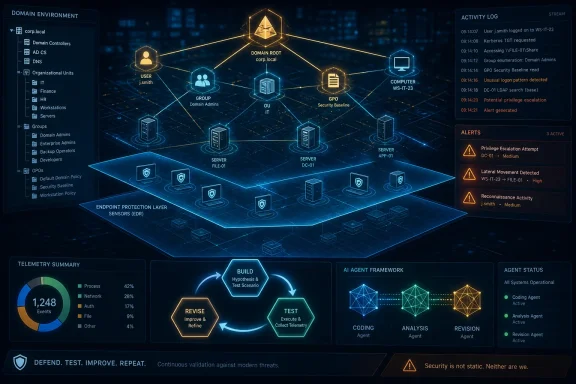
The useful way to read the Sophos findings is not as another entry in the long catalog of ransomware tooling. The reported toolkit matters because it shows attackers using AI systems as an engineering accelerator: build a module, test it against defensive agents, revise it, test again, and fold the successful technique back into a larger framework.
That is a different threat model from the early wave of “AI writes malware” headlines. Code generation is only one step in malware development, and often not the hardest one. The bottleneck is usually the loop between hypothesis and working tradecraft: does this bypass work, does this payload still run, does this discovery routine trigger alarms, does this technique survive contact with a real endpoint stack?
Sophos said researchers found a Git repository with an automated Active Directory discovery panel and a lab that iteratively tested malware against Sophos, CrowdStrike, and Windows Defender EDR agents. That detail should land hard with Windows administrators because it points directly at the terrain most ransomware crews care about: joined endpoints, domain identity, security agents, and the messy reality of enterprise Windows estates.
The reported use of Cursor and Claude Opus agents across coding, analysis, and revision stages is the important part. The story is not that a chatbot can write malicious code. The story is that attackers are beginning to wire AI into the process by which offensive tools are made less noisy, more modular, and more repeatable.
The practical response starts with prioritizing what attackers are trying to learn and break. Active Directory remains the map of the kingdom in many organizations, and EDR remains one of the main obstacles between early intrusion and operational damage. A toolkit that combines AD discovery with EDR evasion testing is not just another payload; it is an attempt to automate the path from foothold to leverage.
Administrators should treat AD reconnaissance as an early warning signal, not a routine background event. That means tuning detections around unusual enumeration, unexpected access to domain objects, abnormal use of built-in Windows administrative pathways, and endpoint behavior that suggests discovery rather than normal management activity. The exact telemetry will vary by stack, but the principle is vendor-neutral: discovery should be visible before encryption is visible.
Security teams should also revisit EDR hardening with a bias toward failure scenarios. Tamper protection, protected service settings, local administrator reduction, application control, and alert routing are not glamorous controls, but they determine whether an evasion attempt becomes a minor alert or an outage. If your response plan assumes EDR will remain fully functional throughout an intrusion, this report is a reason to update that assumption.
For WindowsForum readers following adjacent ransomware coverage, this connects naturally to ongoing discussions about AI-powered EDR evasion, Akira tradecraft, and broader ransomware pressure on Windows environments. The common thread is not one gang, one product, or one bypass. It is the professionalization of the build-and-test machinery behind attacks.
That is arguably more dangerous in the near term. Fully autonomous malware would create obvious reliability, control, and operational-security problems for criminals. AI-assisted engineering, by contrast, fits neatly into how ransomware tooling already evolves: small improvements, repeated testing, shared modules, and opportunistic adaptation to defensive products.
The reported framework used multiple AI agents with distinct roles, and about 80 modules were generated and tested against more than 70 techniques. Even without knowing the full technical contents of those modules, the scale tells us something about the workflow. This was not a one-off prompt producing a novelty script; it was a modular development environment built around experimentation.
That modularity is the point. Ransomware operations have long relied on interchangeable components: loaders, discovery scripts, credential access tools, lateral movement methods, exfiltration utilities, encryptors, and EDR-disabling techniques. AI assistance makes it easier to generate variants, summarize failures, rewrite code paths, and keep an attacker’s lab moving without waiting for a specialist to handcraft every change.
For defenders, this reinforces an uncomfortable truth: endpoint security and identity security are now inseparable. You can buy the best endpoint tooling on the market and still lose if ordinary domain enumeration gives an intruder a clean path to privilege. Conversely, strong identity hygiene can blunt the value of a compromised endpoint by limiting what the attacker can discover and do next.
Sophos’ 2026 Active Adversary Report gives the backdrop: exploitation of vulnerabilities accounted for 16 percent of initial access across 661 incident-response and MDR cases, while median attacker dwell time was compressed to three days. Those numbers do not prove this specific toolkit caused faster attacks, and they should not be read that way. They do show the operating environment into which AI-assisted tooling is arriving: intrusions are already moving fast, and attackers are already efficient enough that slow manual response is a losing bet.
The three-day median dwell time is especially important for Windows shops that still treat ransomware as a long-burn intrusion. The warning signs may still exist, but the window for action is narrower. If AD discovery and EDR evasion are being refined through automated labs, defenders need controls that fire early, not reports that explain the compromise after the fact.
That is why the reported lab environment is more consequential than any single bypass. A lab that tests malware against Sophos, CrowdStrike, and Windows Defender EDR agents represents an attacker thinking like a vendor QA team. The goal is not merely to defeat one product once; it is to create a repeatable way to measure whether a technique survives common enterprise defenses.
This should change how organizations think about validation. Buying EDR is not the end of endpoint security; it is the beginning of an ongoing contest over configuration, coverage, and response. An attacker with a test harness is trying to discover which behaviors are tolerated, which alerts are low priority, and which defensive gaps persist across environments.
Windows Defender is particularly relevant because Microsoft’s endpoint stack is widely present across Windows estates, whether as a primary tool or part of a broader security baseline. But the Sophos finding cuts across vendors. If attackers are testing against multiple EDR agents, the question for defenders is not “which product was named?” It is “what assumptions do our controls make when someone deliberately targets the sensor layer?”
The answer should include independent logging where possible, central alerting that survives local tampering, and response playbooks that do not depend on a single endpoint agent being healthy. It should also include serious review of who can disable, uninstall, exclude, or weaken endpoint protection in practice. The difference between a configured control and an enforceable control is often discovered only during an incident.
Before AI coding assistants became widely available, a criminal team that wanted to test dozens of techniques against several endpoint products needed time, skill, infrastructure, and coordination. Those requirements did not disappear. But AI agents can help with boilerplate, refactoring, error analysis, code translation, documentation digestion, and repetitive modification. That means the same human operator can run more experiments in less time.
This is the same dynamic that has reshaped legitimate software development. Developers are not valuable only because they type syntax; they are valuable because they decide what to build, test assumptions, interpret failures, and ship changes. Attackers can use the same productivity gains for malicious workflows.
The reported use of multiple agents with distinct roles is particularly telling. It suggests an operator separating tasks into functions: one agent might assist with coding, another with analysis, another with revision, another with reading security research. Whether every agent performed well is almost beside the point. The attacker’s ambition was to build an assembly line.
That assembly-line model is where defenders should focus. The risk is not that every low-skill criminal suddenly becomes an elite malware author. The risk is that capable operators become faster, less dependent on scarce specialists, and more able to adapt when defensive products close off one path.
AI-assisted offensive development feeds on that complexity. Every exception, legacy dependency, weak privilege boundary, and inconsistent endpoint policy becomes a variable an attacker can test. The more heterogeneous the environment, the more valuable it is for attackers to automate discovery and refinement.
For sysadmins, the takeaway is not to rip out Windows or pretend Active Directory is obsolete overnight. The takeaway is to reduce attacker optionality. Fewer standing privileges, fewer unmanaged endpoints, fewer broad exclusions, fewer stale accounts, and clearer segmentation all make the automated discovery phase less rewarding.
The same applies to endpoint coverage. A Windows fleet with inconsistent sensor versions, unmanaged lab machines, forgotten virtual desktops, and local admin sprawl is exactly the kind of environment where evasion testing pays off. Attackers do not need to beat the ideal configuration; they need to find the real one.
This is why practical Windows security often looks boring from the outside. Inventory, patching, identity cleanup, logging, least privilege, and tested recovery are not exciting compared with AI agents and malware labs. But those fundamentals determine whether faster attacker tooling translates into faster compromise.
This does not require every organization to build a red-team lab mirroring the reported attacker setup. It does require accepting that security posture is not a static document. If EDR evasion is being tested iteratively, defenders need to test detection and containment iteratively.
The right rhythm is often smaller and more frequent than organizations expect. Validate that tamper protection remains enabled. Confirm that endpoint alerts reach the team after hours. Review whether privileged accounts are still privileged for a reason. Check whether AD discovery-like behavior is visible in logs. Run restore tests often enough that recovery is a muscle memory, not a theory.
The Sophos report also puts pressure on security vendors. If attackers are using AI to generate and test modules, vendors will need to detect behavior rather than chase endless variants. Signature-based thinking was already insufficient for modern ransomware; AI-assisted iteration makes that even more obvious.
For Windows admins, this is where vendor marketing should be interrogated carefully. Claims about AI-powered defense are less important than evidence that the product can survive tampering, expose identity abuse, detect discovery, and provide usable telemetry under pressure. The best tool is the one your team can operate when the attacker is already moving.
AI-assisted tooling increases that pressure not necessarily by creating new initial-access paths, but by speeding the stages after access. Once an attacker is inside, the time to understand the domain, test defensive boundaries, and prepare the next move may shrink. That makes slow internal decision-making part of the attack surface.
This is especially true in organizations where IT and security authority is fragmented. If the endpoint team, identity team, server team, network team, help desk, legal group, and executives cannot move together, the attacker’s automation advantage grows. Ransomware response is no longer just a technical workflow; it is an organizational latency problem.
Windows-heavy shops should make several decisions before they are needed. Who can isolate endpoints at scale? Who can disable accounts? Who can approve emergency password resets or privilege changes? Who can take business systems offline if containment requires it? Those questions sound procedural until the clock is running.
The presence of AI in the attacker workflow does not change the need for judgment. It changes the time available for judgment. That is the management lesson hiding inside the malware story.
What they do show is narrower and more important: an attacker-aligned development environment reportedly used AI tools and agents to accelerate coding, analysis, revision, AD discovery automation, and EDR evasion testing. That is enough to matter.
Security teams should resist both extremes. Dismissing this as ordinary malware with fashionable AI branding ignores the workflow shift. Treating it as unstoppable machine intelligence gives attackers more mystique than they deserve. The right stance is practical concern: AI is making familiar offensive work cheaper to repeat.
That distinction matters for budgets, too. Organizations do not need to buy every AI-branded security product in response. They need to close the gaps that faster attacker iteration exploits: slow detection, weak identity hygiene, fragile endpoint protection, poor visibility, and untested recovery.
The defender’s advantage is still real when environments are well managed. Attackers must navigate constraints, avoid alerts, find privilege, and complete objectives. The trouble is that AI-assisted workflows may help them learn those constraints faster than many organizations can respond.
For WindowsForum’s audience, the operational response is clear:
The next phase of ransomware will not be defined by whether a chatbot can write a payload; that question is already too small. It will be defined by which side learns faster from each failed attempt: attackers refining modules in AI-assisted labs, or defenders hardening Windows estates with enough discipline that faster tooling runs into fewer useful paths.
 The New Ransomware Advantage Is the Feedback Loop
The useful way to read the Sophos findings is not as another entry in the long catalog of ransomware tooling. The reported toolkit matters because it shows attackers using AI systems as an engineering accelerator: build a module, test it against defensive agents, revise it, test again, and fold the successful technique back into a larger framework.That is a different threat model from the early wave of “AI writes malware” headlines. Code generation is only one step in malware development, and often not the hardest one. The bottleneck is usually the loop between hypothesis and working tradecraft: does this bypass work, does this payload still run, does this discovery routine trigger alarms, does this technique survive contact with a real endpoint stack?
Sophos said researchers found a Git repository with an automated Active Directory discovery panel and a lab that iteratively tested malware against Sophos, CrowdStrike, and Windows Defender EDR agents. That detail should land hard with Windows administrators because it points directly at the terrain most ransomware crews care about: joined endpoints, domain identity, security agents, and the messy reality of enterprise Windows estates.
The reported use of Cursor and Claude Opus agents across coding, analysis, and revision stages is the important part. The story is not that a chatbot can write malicious code. The story is that attackers are beginning to wire AI into the process by which offensive tools are made less noisy, more modular, and more repeatable.
What Changed, and What Windows Defenders Should Do Now
The concrete change is that a ransomware-oriented toolkit reportedly automated two high-value phases of post-compromise work: Active Directory discovery and EDR evasion refinement. For IT teams, the short version is brutal: if an attacker lands on one Windows system, the race to map identity relationships and neutralize endpoint defenses may now be compressed by AI-assisted engineering workflows.The practical response starts with prioritizing what attackers are trying to learn and break. Active Directory remains the map of the kingdom in many organizations, and EDR remains one of the main obstacles between early intrusion and operational damage. A toolkit that combines AD discovery with EDR evasion testing is not just another payload; it is an attempt to automate the path from foothold to leverage.
Administrators should treat AD reconnaissance as an early warning signal, not a routine background event. That means tuning detections around unusual enumeration, unexpected access to domain objects, abnormal use of built-in Windows administrative pathways, and endpoint behavior that suggests discovery rather than normal management activity. The exact telemetry will vary by stack, but the principle is vendor-neutral: discovery should be visible before encryption is visible.
Security teams should also revisit EDR hardening with a bias toward failure scenarios. Tamper protection, protected service settings, local administrator reduction, application control, and alert routing are not glamorous controls, but they determine whether an evasion attempt becomes a minor alert or an outage. If your response plan assumes EDR will remain fully functional throughout an intrusion, this report is a reason to update that assumption.
For WindowsForum readers following adjacent ransomware coverage, this connects naturally to ongoing discussions about AI-powered EDR evasion, Akira tradecraft, and broader ransomware pressure on Windows environments. The common thread is not one gang, one product, or one bypass. It is the professionalization of the build-and-test machinery behind attacks.
AI Did Not Replace the Operator; It Made the Operator Faster
One of the more sobering elements in the reporting is that Sophos described the workflow as human-driven despite the AI assistance. That distinction matters. It means we are not looking at autonomous ransomware in the science-fiction sense; we are looking at human operators using AI agents to remove friction from familiar offensive work.That is arguably more dangerous in the near term. Fully autonomous malware would create obvious reliability, control, and operational-security problems for criminals. AI-assisted engineering, by contrast, fits neatly into how ransomware tooling already evolves: small improvements, repeated testing, shared modules, and opportunistic adaptation to defensive products.
The reported framework used multiple AI agents with distinct roles, and about 80 modules were generated and tested against more than 70 techniques. Even without knowing the full technical contents of those modules, the scale tells us something about the workflow. This was not a one-off prompt producing a novelty script; it was a modular development environment built around experimentation.
That modularity is the point. Ransomware operations have long relied on interchangeable components: loaders, discovery scripts, credential access tools, lateral movement methods, exfiltration utilities, encryptors, and EDR-disabling techniques. AI assistance makes it easier to generate variants, summarize failures, rewrite code paths, and keep an attacker’s lab moving without waiting for a specialist to handcraft every change.
Active Directory Remains the Center of Gravity
The inclusion of an automated Active Directory discovery panel is not incidental. In a Windows-heavy organization, AD is still where attackers learn which accounts matter, which systems are valuable, which groups confer power, and which paths can turn a compromised endpoint into broader control. Ransomware does not need to be elegant if it can find the right privileges quickly.For defenders, this reinforces an uncomfortable truth: endpoint security and identity security are now inseparable. You can buy the best endpoint tooling on the market and still lose if ordinary domain enumeration gives an intruder a clean path to privilege. Conversely, strong identity hygiene can blunt the value of a compromised endpoint by limiting what the attacker can discover and do next.
Sophos’ 2026 Active Adversary Report gives the backdrop: exploitation of vulnerabilities accounted for 16 percent of initial access across 661 incident-response and MDR cases, while median attacker dwell time was compressed to three days. Those numbers do not prove this specific toolkit caused faster attacks, and they should not be read that way. They do show the operating environment into which AI-assisted tooling is arriving: intrusions are already moving fast, and attackers are already efficient enough that slow manual response is a losing bet.
The three-day median dwell time is especially important for Windows shops that still treat ransomware as a long-burn intrusion. The warning signs may still exist, but the window for action is narrower. If AD discovery and EDR evasion are being refined through automated labs, defenders need controls that fire early, not reports that explain the compromise after the fact.
EDR Evasion Has Become a Product Discipline
EDR evasion used to be discussed as a bag of tricks. In mature ransomware operations, it increasingly looks like product engineering. Attackers test against specific agents, compare outcomes, revise implementations, and keep what works.That is why the reported lab environment is more consequential than any single bypass. A lab that tests malware against Sophos, CrowdStrike, and Windows Defender EDR agents represents an attacker thinking like a vendor QA team. The goal is not merely to defeat one product once; it is to create a repeatable way to measure whether a technique survives common enterprise defenses.
This should change how organizations think about validation. Buying EDR is not the end of endpoint security; it is the beginning of an ongoing contest over configuration, coverage, and response. An attacker with a test harness is trying to discover which behaviors are tolerated, which alerts are low priority, and which defensive gaps persist across environments.
Windows Defender is particularly relevant because Microsoft’s endpoint stack is widely present across Windows estates, whether as a primary tool or part of a broader security baseline. But the Sophos finding cuts across vendors. If attackers are testing against multiple EDR agents, the question for defenders is not “which product was named?” It is “what assumptions do our controls make when someone deliberately targets the sensor layer?”
The answer should include independent logging where possible, central alerting that survives local tampering, and response playbooks that do not depend on a single endpoint agent being healthy. It should also include serious review of who can disable, uninstall, exclude, or weaken endpoint protection in practice. The difference between a configured control and an enforceable control is often discovered only during an incident.
The AI Part Is Less Exotic Than the Economics
There is a temptation to treat AI-assisted malware as a technical novelty. The more useful lens is economics. AI reduces the cost of iteration, and lower iteration cost changes what attackers can afford to try.Before AI coding assistants became widely available, a criminal team that wanted to test dozens of techniques against several endpoint products needed time, skill, infrastructure, and coordination. Those requirements did not disappear. But AI agents can help with boilerplate, refactoring, error analysis, code translation, documentation digestion, and repetitive modification. That means the same human operator can run more experiments in less time.
This is the same dynamic that has reshaped legitimate software development. Developers are not valuable only because they type syntax; they are valuable because they decide what to build, test assumptions, interpret failures, and ship changes. Attackers can use the same productivity gains for malicious workflows.
The reported use of multiple agents with distinct roles is particularly telling. It suggests an operator separating tasks into functions: one agent might assist with coding, another with analysis, another with revision, another with reading security research. Whether every agent performed well is almost beside the point. The attacker’s ambition was to build an assembly line.
That assembly-line model is where defenders should focus. The risk is not that every low-skill criminal suddenly becomes an elite malware author. The risk is that capable operators become faster, less dependent on scarce specialists, and more able to adapt when defensive products close off one path.
Windows Environments Are the Natural Test Range
The toolkit’s focus on AD discovery and EDR evasion makes sense because ransomware economics still favor Windows-heavy networks. Enterprise Windows estates are large, identity-rich, and operationally valuable. They also contain decades of administrative habit: remote management, shared tooling, legacy privileges, service accounts, and exceptions that made sense at the time.AI-assisted offensive development feeds on that complexity. Every exception, legacy dependency, weak privilege boundary, and inconsistent endpoint policy becomes a variable an attacker can test. The more heterogeneous the environment, the more valuable it is for attackers to automate discovery and refinement.
For sysadmins, the takeaway is not to rip out Windows or pretend Active Directory is obsolete overnight. The takeaway is to reduce attacker optionality. Fewer standing privileges, fewer unmanaged endpoints, fewer broad exclusions, fewer stale accounts, and clearer segmentation all make the automated discovery phase less rewarding.
The same applies to endpoint coverage. A Windows fleet with inconsistent sensor versions, unmanaged lab machines, forgotten virtual desktops, and local admin sprawl is exactly the kind of environment where evasion testing pays off. Attackers do not need to beat the ideal configuration; they need to find the real one.
This is why practical Windows security often looks boring from the outside. Inventory, patching, identity cleanup, logging, least privilege, and tested recovery are not exciting compared with AI agents and malware labs. But those fundamentals determine whether faster attacker tooling translates into faster compromise.
Defenders Need Their Own Build-Test-Refine Cycle
If attackers are adopting faster engineering loops, defenders cannot answer with quarterly control reviews and annual tabletop exercises. The defensive version of the build-test-refine loop is continuous validation: test whether controls fire, whether alerts are routed, whether response actions work, and whether identity exposure has changed.This does not require every organization to build a red-team lab mirroring the reported attacker setup. It does require accepting that security posture is not a static document. If EDR evasion is being tested iteratively, defenders need to test detection and containment iteratively.
The right rhythm is often smaller and more frequent than organizations expect. Validate that tamper protection remains enabled. Confirm that endpoint alerts reach the team after hours. Review whether privileged accounts are still privileged for a reason. Check whether AD discovery-like behavior is visible in logs. Run restore tests often enough that recovery is a muscle memory, not a theory.
The Sophos report also puts pressure on security vendors. If attackers are using AI to generate and test modules, vendors will need to detect behavior rather than chase endless variants. Signature-based thinking was already insufficient for modern ransomware; AI-assisted iteration makes that even more obvious.
For Windows admins, this is where vendor marketing should be interrogated carefully. Claims about AI-powered defense are less important than evidence that the product can survive tampering, expose identity abuse, detect discovery, and provide usable telemetry under pressure. The best tool is the one your team can operate when the attacker is already moving.
The Ransomware Timeline Is Now a Management Problem
The compression of attacker dwell time to a median of three days in Sophos’ 2026 Active Adversary Report should change executive expectations. Many organizations still plan as if detection, investigation, escalation, containment, legal review, communications, and recovery can unfold in neat sequence. In practice, those decisions may overlap under severe time pressure.AI-assisted tooling increases that pressure not necessarily by creating new initial-access paths, but by speeding the stages after access. Once an attacker is inside, the time to understand the domain, test defensive boundaries, and prepare the next move may shrink. That makes slow internal decision-making part of the attack surface.
This is especially true in organizations where IT and security authority is fragmented. If the endpoint team, identity team, server team, network team, help desk, legal group, and executives cannot move together, the attacker’s automation advantage grows. Ransomware response is no longer just a technical workflow; it is an organizational latency problem.
Windows-heavy shops should make several decisions before they are needed. Who can isolate endpoints at scale? Who can disable accounts? Who can approve emergency password resets or privilege changes? Who can take business systems offline if containment requires it? Those questions sound procedural until the clock is running.
The presence of AI in the attacker workflow does not change the need for judgment. It changes the time available for judgment. That is the management lesson hiding inside the malware story.
The Hype Is Loud, but the Signal Is Specific
There is a danger in overstating what this report proves. The public facts do not establish that AI independently created a fully autonomous ransomware operation. They do not prove a universal bypass against named EDR products. They do not give defenders a neat indicator list that solves the problem.What they do show is narrower and more important: an attacker-aligned development environment reportedly used AI tools and agents to accelerate coding, analysis, revision, AD discovery automation, and EDR evasion testing. That is enough to matter.
Security teams should resist both extremes. Dismissing this as ordinary malware with fashionable AI branding ignores the workflow shift. Treating it as unstoppable machine intelligence gives attackers more mystique than they deserve. The right stance is practical concern: AI is making familiar offensive work cheaper to repeat.
That distinction matters for budgets, too. Organizations do not need to buy every AI-branded security product in response. They need to close the gaps that faster attacker iteration exploits: slow detection, weak identity hygiene, fragile endpoint protection, poor visibility, and untested recovery.
The defender’s advantage is still real when environments are well managed. Attackers must navigate constraints, avoid alerts, find privilege, and complete objectives. The trouble is that AI-assisted workflows may help them learn those constraints faster than many organizations can respond.
The WindowsForum Read Is Speed, Not Sorcery
The most concrete lesson from the Sophos findings is that ransomware tooling is becoming more like continuous integration for crime. Modules are generated, tested, revised, and folded into a framework. Defensive products become part of the attacker’s QA matrix.For WindowsForum’s audience, the operational response is clear:
- Treat unusual Active Directory discovery as an early-stage incident signal, not merely administrative noise.
- Review EDR tamper protection, uninstall permissions, exclusions, and alert routing before an attacker tests them for you.
- Assume attackers may iterate against common Windows endpoint defenses and validate your own controls continuously.
- Reduce standing privilege and stale identity exposure so automated discovery produces less useful information.
- Update ransomware response plans for a three-day median dwell-time world, where escalation delays can become technical failures.
- Read AI-assisted malware reports as evidence of workflow acceleration rather than proof of autonomous cybercrime.
The next phase of ransomware will not be defined by whether a chatbot can write a payload; that question is already too small. It will be defined by which side learns faster from each failed attempt: attackers refining modules in AI-assisted labs, or defenders hardening Windows estates with enough discipline that faster tooling runs into fewer useful paths.
References
- Primary source: xeops.ai
Hargos.ai — Vulnerability Scanner for SMBs
External vulnerability scanner for small and medium businesses. Discover vulnerabilities across your domain and all subdomains, automatically.www.xeops.ai - Independent coverage: sophos.com
Sophos XDR - Extended Detection and Response Platform
Sophos' XDR platform defends against active adversaries with comprehensive EDR and XDR tools to stop advanced attacks.www.sophos.com
- Independent coverage: commandzero.ai
Command Zero — Autonomous AI SOC Investigation Platform
AI SOC platform with autonomous and AI-assisted investigation modes. Run the full Tier-1 to Tier-3 lifecycle across identity, endpoint, cloud, and SaaS.www.commandzero.ai - Independent coverage: cyberfuse.net
CyberFuse — The Security Language Model for Enterprise Cybersecurity
CyberFuse is an AI-native security operations platform. Unify SIEM, XDR, and threat intelligence with autonomous SOC agents, real-time correlation, and executive dashboards. www.cyberfuse.net
- Independent coverage: gryphon.istrosec.com

IstroSec GRYPHON
IstroSec GRYPHON is an innovative ransomware protection solution that identifies threats based on their behavioral attributes.
gryphon.istrosec.com
- Independent coverage: llmtary.com
LLMtary - Autonomous AI Penetration Testing
 www.llmtary.com
- Independent coverage: cyrion.ai
Cyrion AI | Next-Gen Penetration Testing
 www.cyrion.ai
- Independent coverage: bleepingcomputer.com
AI-built ransomware toolkit automates EDR evasion, AD discovery
A threat actor is using an AI-built ransomware attack toolkit that automates Active Directory discovery and helps evade endpoint detection and response (EDR) solutions.www.bleepingcomputer.com - Independent coverage: eyersec.com
EyeR Platform — Autonomous MDR & TDIR | EyeR Security
The EyeR platform for sovereign MDR. See auditable detection, investigation, critique, and response workflows with on-premise AI deployment options and the agentic MDR triage pipeline in action.eyersec.com
