

AI backlash is growing in 2026 because public trust, workplace adoption, energy politics, and investor confidence are all colliding at once, as recent polling, data center fights, and increasingly extravagant industry claims expose the gap between Silicon Valley’s promises and ordinary users’ experience. The industry still speaks in the language of inevitability. The public is starting to answer in the language of refusal. For Windows users, enterprise admins, developers, and security teams, the issue is no longer whether AI will be added to everything; it is whether people will tolerate the terms on which it arrives.
The strangest thing about the AI backlash is that it is growing at the same moment the industry’s confidence has become almost theological. At Microsoft Build and Google I/O, the conversation was not merely about better copilots, faster models, or cheaper inference. It was about tokens, agents, superintelligence, AGI, and the suggestion that the next civilizational threshold is somewhere just beyond the next product cycle.
That language matters because it turns normal skepticism into heresy. If artificial general intelligence is “just a few years away,” then every local zoning fight, every cautious IT procurement meeting, every irritated employee who would rather write the email themselves becomes an obstacle to destiny. The pitch is no longer that AI might help with a spreadsheet or summarize a meeting. The pitch is that resistance is irrational because the future has already been scheduled.
But users do not experience AI as a keynote. They experience it as an extra button in Outlook, a nag in Windows, a hallucinated support answer, a chatbot that cannot resolve a billing dispute, a company mandate to use a tool that slows them down, or an electricity project appearing near their town. That is why the vibe shift is not just cultural. It is operational.
The backlash is not proof that AI is useless. It is proof that the market is separating useful automation from compulsory enchantment. People will adopt tools that save time, reduce drudgery, and behave reliably. They are much less willing to applaud when every software vendor, cloud provider, recruiter, school, and boardroom declares that the same unfinished technology must now mediate everything.
Recent polling points in the same direction: Americans are not simply confused about AI, nor are they waiting for better marketing. Many have formed an opinion, and it is cautious to negative. A small share say they are more excited than concerned, while a much larger share say they are worried about the technology’s impact on daily life, employment, privacy, misinformation, and social trust.
That distinction is crucial for Microsoft because Windows is not a novelty platform. It is infrastructure. A bad AI feature in a social app can become a meme; a bad AI feature in Windows, Microsoft 365, Azure, Defender, GitHub, or Teams becomes a risk surface, a compliance question, a help desk ticket, or a training cost.
Microsoft has tried to frame Copilot as the new user interface for work. The company’s strategic wager is clear: if Windows and Office become the place where people encounter AI by default, Microsoft gets to define the next computing layer the way it defined the desktop and productivity suite. But that assumes users want an AI layer between themselves and their work.
In many organizations, that assumption remains unproven. Employees may use AI for isolated tasks, but that does not mean they trust it with workflows, records, source code, customer data, performance reviews, or regulated communications. The gap between “I asked it to rewrite a paragraph” and “my company should restructure work around it” is enormous.
White-collar workers are particularly sensitive to tools that shift accountability without shifting responsibility. If an AI system drafts the wrong answer, the employee still owns the mistake. If it summarizes a meeting incorrectly, the manager still acts on the summary. If it produces flawed code, the developer still debugs it. If it invents a policy, the admin still cleans up the mess.
This is where the agent hype becomes dangerous. The industry is selling systems that can act on behalf of users, but the failures are no longer theoretical. An assistant that drafts a weak paragraph is annoying. An agent that modifies a database, misroutes customer data, pushes broken code, or executes a privileged workflow is a governance problem.
For WindowsForum readers, this is the practical line. AI that helps search logs, explain PowerShell errors, summarize documentation, or spot suspicious behavior can be useful. AI that is wired into administrative action without transparent controls, auditability, rollback, and permission boundaries is a liability wearing a productivity badge.
The current backlash is therefore not anti-technology in the old sense. It is anti-coercion, anti-hype, and anti-unaccountable automation. IT professionals know the pattern: every generation of enterprise software promises fewer clicks, then creates new dashboards, new exception paths, new licensing tiers, and new reasons the help desk gets blamed.
That abstraction is breaking down. AI is becoming visible as construction, grid pressure, water demand, noise complaints, tax incentives, and land-use fights. Once that happens, the debate leaves the keynote stage and enters city councils.
Local opposition to data centers is not new, but AI has changed the scale and politics of the issue. Communities that might tolerate ordinary commercial development are less patient when the project is framed as a massive power-hungry facility that primarily serves remote corporate workloads. The public hears “innovation,” but residents see substations, diesel generators, water use, and uncertain benefits.
This is why blocked and delayed projects matter. They show that backlash now has institutional form. It is not merely people complaining online about AI-generated art or poor chatbot answers. It is voters, councils, activists, landowners, and utility customers contesting the physical footprint of the AI economy.
Kevin O’Leary’s reported retreat on the planned Stratos data center in Utah is emblematic because it punctures the aura of inevitability. The industry’s assumption has been that capital plus urgency can bulldoze objections. But even rich investors eventually discover that local consent is not an API call.
That does not mean every concern is technically precise. Data centers vary widely in water use, power sourcing, grid impact, and local economic contribution. Some are better designed than others. Some bring tax revenue and jobs; others bring surprisingly few permanent roles relative to their footprint.
But politically, nuance only helps if people believe the process is honest. When AI companies and cloud giants speak as if the buildout is unquestionably necessary, they invite suspicion. When local officials offer incentives without clear public accounting, they deepen it. When the same industry warning of near-term superintelligence also asks towns to trust its environmental planning, skepticism becomes rational.
The Windows angle is indirect but real. Microsoft’s AI ambitions run through Azure as much as through Windows. Every Copilot prompt, every model-backed enterprise feature, every developer agent, and every AI-enhanced security product ultimately depends on cloud infrastructure. If the infrastructure becomes politically harder to build, AI economics change.
That could matter more than any benchmark. The future of AI may be constrained not by model architecture but by permitting, power contracts, cooling, grid interconnection queues, and public anger. The industry likes to talk about scaling laws. Voters are discovering zoning laws.
But market confidence is not the same as social legitimacy. Investors can believe in explosive compute demand while workers distrust AI mandates. Analysts can model trillion-dollar opportunities while communities block data centers. Executives can describe agents running businesses while security teams quietly restrict what those agents can touch.
This split creates a fragile politics of AI. If stock prices rise, companies feel pressure to keep spending and integrating. If adoption disappoints, they must push harder to justify the spend. If they push harder, users experience AI as imposition rather than assistance. That feedback loop is how a boom becomes a backlash.
The trillion-dollar IPO talk around OpenAI, Anthropic, and SpaceX only sharpens the contradiction. To justify such valuations, the story cannot be “AI is a useful feature category.” It has to be something larger: a platform shift, a labor market shift, a compute revolution, a new industrial base, perhaps even a route to superintelligence. The bigger the valuation, the more extravagant the narrative must become.
That narrative may be financially useful, but it is politically combustible. People who fear job loss, surveillance, deskilling, higher utility bills, copyright abuse, scams, deepfakes, and corporate dependency are unlikely to be reassured by talk of trillion-dollar exits. The industry is asking society to absorb disruption while investors price in capture of the upside.
When executives say AGI is close, they intend to communicate momentum. But the public hears something else: the people building this technology think it may transform employment, politics, education, security, and human agency within a few years, and they are still asking to move faster. That is not a calming message.
The phrase “humanist superintelligence” is particularly revealing. It tries to make the most extreme ambition sound benevolent. It says, in effect, do not worry about the superintelligence because the humans are still at the center. Yet the very need for that adjective suggests the fear is already understood.
Microsoft has more at stake here than most companies because its customer base includes governments, schools, hospitals, law firms, manufacturers, defense contractors, and regulated enterprises. These customers do not buy metaphysics. They buy support lifecycles, compliance commitments, admin controls, predictable pricing, and documentation.
If AI remains framed as a race to superintelligence, the enterprise buyer will keep asking unromantic questions. Who owns the data? Where are prompts stored? Can the feature be disabled? What happens when the model changes? How are outputs logged? Does this meet retention policy? Can a tenant admin prove what happened after an AI system took an action?
Those questions are not anti-AI. They are the questions mature technology must answer before it becomes infrastructure.
For Windows users, this history matters. Microsoft has a long record of using the operating system as a distribution channel for strategic priorities, from browsers and search to OneDrive, Microsoft accounts, Teams, widgets, ads, and now Copilot. Sometimes those integrations are useful. Sometimes they feel like the desktop has become a billboard for the company’s quarterly narrative.
That is why even good AI features can trigger irritation if they arrive with the wrong posture. A local user who wants a clean Start menu, predictable search, and reliable settings may not appreciate being told that an assistant is the future of computing. A sysadmin managing thousands of machines may see another policy surface to lock down. A developer may see another abstraction that helps until it silently does the wrong thing.
This is not nostalgia for dumb software. It is a demand for agency. Users want AI to be optional, legible, and reversible. Administrators want tenant-level controls. Developers want transparency about generated code and dependencies. Security teams want logs and boundaries. Nobody wants to be told, after the fact, that a preview feature has become part of the default workflow.
Microsoft can still win here, but only if it treats AI as a tool users command rather than a layer users must negotiate with. The difference sounds subtle in a keynote. On a desktop, it is the difference between empowerment and clutter.
But the security argument cuts both ways. Attackers also use AI for phishing, reconnaissance, code generation, translation, social engineering, and vulnerability discovery. The result is not a clean productivity revolution. It is an escalation cycle.
For Windows environments, this means AI will become part of both the attack surface and the defense stack. Microsoft Defender, Sentinel, Intune, Entra, GitHub, and Windows endpoint management all sit in the zone where AI assistance can be genuinely useful. They also sit in the zone where false confidence can be expensive.
The worst version of AI security is a black box that produces fluent explanations without reliable grounding. The best version is a disciplined assistant that shows evidence, cites logs internally, respects permissions, and accelerates human judgment without pretending to replace it. The backlash will be less intense where AI is visibly accountable.
That should be the model for enterprise AI more broadly. The public does not need another prophecy. It needs systems that can be inspected, constrained, and corrected.
The anger is not neatly partisan. Conservatives worry about censorship, surveillance, China, federal overreach, and ideological bias. Progressives worry about labor displacement, monopoly power, discrimination, copyright, energy use, and corporate capture. Local data center fights scramble the map further, because transmission lines and water rights do not care which cable news channel a voter watches.
That creates an unusual opening for regulation. Not necessarily a coherent national AI law, which remains difficult in a polarized Congress, but a patchwork of state rules, procurement restrictions, disclosure mandates, child-safety requirements, labor protections, and infrastructure fights. AI may be governed less by one grand statute than by hundreds of smaller frictions.
For tech companies, that is a nightmare. They prefer broad federal preemption, voluntary standards, and flexible frameworks. For communities and workers, fragmented resistance may be the only available tool.
The danger is that bad regulation and bad deployment reinforce each other. Overbroad rules can freeze beneficial uses, while reckless deployment can provoke panicked laws. The industry’s best defense would be humility: narrower claims, better controls, clear opt-outs, honest cost accounting, and fewer speeches about imminent singularity.
The emerging demand is not “stop all AI.” It is “stop making us absorb the downside while you privatize the upside.” Workers want protection from being measured against tools that may be unreliable or used to justify layoffs. Communities want a say in infrastructure that affects land, water, and power. Artists and publishers want compensation and consent. Users want software that respects their choices. Administrators want controls before defaults.
That is a bargaining position, not a rejection of technology. It says AI may be valuable, but value does not nullify politics. The same was true of railroads, electricity, automobiles, radio, television, social media, and cloud computing. Transformative technologies do not escape governance; they eventually invite it.
The industry’s mistake has been to interpret every objection as delay. In reality, objection is how legitimacy gets negotiated. The faster AI companies move, the more they need trust. The more they inflate their claims, the faster they spend it.
For Microsoft, Google, OpenAI, Anthropic, Nvidia, and the rest of the ecosystem, the next phase will be less about dazzling demos and more about proof. Not proof that a model can pass another benchmark, but proof that AI can be deployed without making work worse, communities poorer, systems less secure, or users less free.
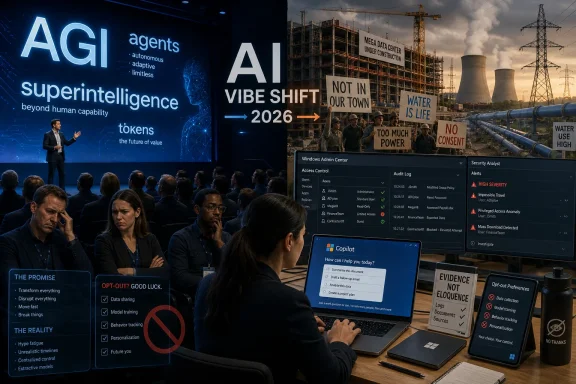 Silicon Valley Is Still Selling Sunrise While Users See the Bill
The strangest thing about the AI backlash is that it is growing at the same moment the industry’s confidence has become almost theological. At Microsoft Build and Google I/O, the conversation was not merely about better copilots, faster models, or cheaper inference. It was about tokens, agents, superintelligence, AGI, and the suggestion that the next civilizational threshold is somewhere just beyond the next product cycle.That language matters because it turns normal skepticism into heresy. If artificial general intelligence is “just a few years away,” then every local zoning fight, every cautious IT procurement meeting, every irritated employee who would rather write the email themselves becomes an obstacle to destiny. The pitch is no longer that AI might help with a spreadsheet or summarize a meeting. The pitch is that resistance is irrational because the future has already been scheduled.
But users do not experience AI as a keynote. They experience it as an extra button in Outlook, a nag in Windows, a hallucinated support answer, a chatbot that cannot resolve a billing dispute, a company mandate to use a tool that slows them down, or an electricity project appearing near their town. That is why the vibe shift is not just cultural. It is operational.
The backlash is not proof that AI is useless. It is proof that the market is separating useful automation from compulsory enchantment. People will adopt tools that save time, reduce drudgery, and behave reliably. They are much less willing to applaud when every software vendor, cloud provider, recruiter, school, and boardroom declares that the same unfinished technology must now mediate everything.
The Industry Mistook Usage for Consent
The tech industry has a bad habit of treating exposure as endorsement. If millions of people touch a chatbot because it is embedded in search, office software, customer support, phones, browsers, and operating systems, that is counted as adoption. But forced proximity is not the same thing as enthusiasm.Recent polling points in the same direction: Americans are not simply confused about AI, nor are they waiting for better marketing. Many have formed an opinion, and it is cautious to negative. A small share say they are more excited than concerned, while a much larger share say they are worried about the technology’s impact on daily life, employment, privacy, misinformation, and social trust.
That distinction is crucial for Microsoft because Windows is not a novelty platform. It is infrastructure. A bad AI feature in a social app can become a meme; a bad AI feature in Windows, Microsoft 365, Azure, Defender, GitHub, or Teams becomes a risk surface, a compliance question, a help desk ticket, or a training cost.
Microsoft has tried to frame Copilot as the new user interface for work. The company’s strategic wager is clear: if Windows and Office become the place where people encounter AI by default, Microsoft gets to define the next computing layer the way it defined the desktop and productivity suite. But that assumes users want an AI layer between themselves and their work.
In many organizations, that assumption remains unproven. Employees may use AI for isolated tasks, but that does not mean they trust it with workflows, records, source code, customer data, performance reviews, or regulated communications. The gap between “I asked it to rewrite a paragraph” and “my company should restructure work around it” is enormous.
Workers Are Not Luddites When They Decline a Bad Workflow
The most revealing part of the backlash is not consumer anxiety. It is workplace resistance. If employees are bypassing mandated AI tools and finishing tasks themselves, that is not a philosophical protest against machine intelligence. It is a judgment about productivity.White-collar workers are particularly sensitive to tools that shift accountability without shifting responsibility. If an AI system drafts the wrong answer, the employee still owns the mistake. If it summarizes a meeting incorrectly, the manager still acts on the summary. If it produces flawed code, the developer still debugs it. If it invents a policy, the admin still cleans up the mess.
This is where the agent hype becomes dangerous. The industry is selling systems that can act on behalf of users, but the failures are no longer theoretical. An assistant that drafts a weak paragraph is annoying. An agent that modifies a database, misroutes customer data, pushes broken code, or executes a privileged workflow is a governance problem.
For WindowsForum readers, this is the practical line. AI that helps search logs, explain PowerShell errors, summarize documentation, or spot suspicious behavior can be useful. AI that is wired into administrative action without transparent controls, auditability, rollback, and permission boundaries is a liability wearing a productivity badge.
The current backlash is therefore not anti-technology in the old sense. It is anti-coercion, anti-hype, and anti-unaccountable automation. IT professionals know the pattern: every generation of enterprise software promises fewer clicks, then creates new dashboards, new exception paths, new licensing tiers, and new reasons the help desk gets blamed.
The Data Center Fight Made AI Physical
For much of the generative AI boom, the industry benefited from abstraction. Models lived in the cloud. Training runs happened somewhere else. Power, water, land, transmission lines, backup generators, and cooling systems were invisible to most users. The product was a chat box; the cost was hidden in the data center.That abstraction is breaking down. AI is becoming visible as construction, grid pressure, water demand, noise complaints, tax incentives, and land-use fights. Once that happens, the debate leaves the keynote stage and enters city councils.
Local opposition to data centers is not new, but AI has changed the scale and politics of the issue. Communities that might tolerate ordinary commercial development are less patient when the project is framed as a massive power-hungry facility that primarily serves remote corporate workloads. The public hears “innovation,” but residents see substations, diesel generators, water use, and uncertain benefits.
This is why blocked and delayed projects matter. They show that backlash now has institutional form. It is not merely people complaining online about AI-generated art or poor chatbot answers. It is voters, councils, activists, landowners, and utility customers contesting the physical footprint of the AI economy.
Kevin O’Leary’s reported retreat on the planned Stratos data center in Utah is emblematic because it punctures the aura of inevitability. The industry’s assumption has been that capital plus urgency can bulldoze objections. But even rich investors eventually discover that local consent is not an API call.
AI’s Energy Problem Is Also a Legitimacy Problem
The data center fight lands hard because it touches a broader credibility issue. The public is being told AI will produce abundance, efficiency, and prosperity. At the same time, communities are being asked to host the infrastructure, utilities are planning for enormous loads, and ratepayers worry that they may subsidize an arms race whose benefits accrue elsewhere.That does not mean every concern is technically precise. Data centers vary widely in water use, power sourcing, grid impact, and local economic contribution. Some are better designed than others. Some bring tax revenue and jobs; others bring surprisingly few permanent roles relative to their footprint.
But politically, nuance only helps if people believe the process is honest. When AI companies and cloud giants speak as if the buildout is unquestionably necessary, they invite suspicion. When local officials offer incentives without clear public accounting, they deepen it. When the same industry warning of near-term superintelligence also asks towns to trust its environmental planning, skepticism becomes rational.
The Windows angle is indirect but real. Microsoft’s AI ambitions run through Azure as much as through Windows. Every Copilot prompt, every model-backed enterprise feature, every developer agent, and every AI-enhanced security product ultimately depends on cloud infrastructure. If the infrastructure becomes politically harder to build, AI economics change.
That could matter more than any benchmark. The future of AI may be constrained not by model architecture but by permitting, power contracts, cooling, grid interconnection queues, and public anger. The industry likes to talk about scaling laws. Voters are discovering zoning laws.
Wall Street Is Not a Stable Substitute for Public Trust
For now, the financial markets still treat AI as the organizing story of the technology sector. Nvidia remains the bellwether because its chips are the picks and shovels of the boom. Microsoft, Google, Amazon, Meta, OpenAI, Anthropic, and xAI are judged in large part by how convincingly they can describe the next layer of AI infrastructure and software.But market confidence is not the same as social legitimacy. Investors can believe in explosive compute demand while workers distrust AI mandates. Analysts can model trillion-dollar opportunities while communities block data centers. Executives can describe agents running businesses while security teams quietly restrict what those agents can touch.
This split creates a fragile politics of AI. If stock prices rise, companies feel pressure to keep spending and integrating. If adoption disappoints, they must push harder to justify the spend. If they push harder, users experience AI as imposition rather than assistance. That feedback loop is how a boom becomes a backlash.
The trillion-dollar IPO talk around OpenAI, Anthropic, and SpaceX only sharpens the contradiction. To justify such valuations, the story cannot be “AI is a useful feature category.” It has to be something larger: a platform shift, a labor market shift, a compute revolution, a new industrial base, perhaps even a route to superintelligence. The bigger the valuation, the more extravagant the narrative must become.
That narrative may be financially useful, but it is politically combustible. People who fear job loss, surveillance, deskilling, higher utility bills, copyright abuse, scams, deepfakes, and corporate dependency are unlikely to be reassured by talk of trillion-dollar exits. The industry is asking society to absorb disruption while investors price in capture of the upside.
The AGI Talk Is Starting to Backfire
There was a time when AGI rhetoric gave AI companies glamour. It suggested ambition, scientific seriousness, and an almost Manhattan Project-like urgency. Now it increasingly sounds like a liability.When executives say AGI is close, they intend to communicate momentum. But the public hears something else: the people building this technology think it may transform employment, politics, education, security, and human agency within a few years, and they are still asking to move faster. That is not a calming message.
The phrase “humanist superintelligence” is particularly revealing. It tries to make the most extreme ambition sound benevolent. It says, in effect, do not worry about the superintelligence because the humans are still at the center. Yet the very need for that adjective suggests the fear is already understood.
Microsoft has more at stake here than most companies because its customer base includes governments, schools, hospitals, law firms, manufacturers, defense contractors, and regulated enterprises. These customers do not buy metaphysics. They buy support lifecycles, compliance commitments, admin controls, predictable pricing, and documentation.
If AI remains framed as a race to superintelligence, the enterprise buyer will keep asking unromantic questions. Who owns the data? Where are prompts stored? Can the feature be disabled? What happens when the model changes? How are outputs logged? Does this meet retention policy? Can a tenant admin prove what happened after an AI system took an action?
Those questions are not anti-AI. They are the questions mature technology must answer before it becomes infrastructure.
Windows Users Have Seen This Movie Before
The AI backlash also reflects a deeper exhaustion with the modern software bargain. Users have spent years watching products become subscriptions, local features become cloud services, settings move around, defaults reset, telemetry expand, and interfaces fill with prompts for services they did not request. AI arrives in that context, not in a vacuum.For Windows users, this history matters. Microsoft has a long record of using the operating system as a distribution channel for strategic priorities, from browsers and search to OneDrive, Microsoft accounts, Teams, widgets, ads, and now Copilot. Sometimes those integrations are useful. Sometimes they feel like the desktop has become a billboard for the company’s quarterly narrative.
That is why even good AI features can trigger irritation if they arrive with the wrong posture. A local user who wants a clean Start menu, predictable search, and reliable settings may not appreciate being told that an assistant is the future of computing. A sysadmin managing thousands of machines may see another policy surface to lock down. A developer may see another abstraction that helps until it silently does the wrong thing.
This is not nostalgia for dumb software. It is a demand for agency. Users want AI to be optional, legible, and reversible. Administrators want tenant-level controls. Developers want transparency about generated code and dependencies. Security teams want logs and boundaries. Nobody wants to be told, after the fact, that a preview feature has become part of the default workflow.
Microsoft can still win here, but only if it treats AI as a tool users command rather than a layer users must negotiate with. The difference sounds subtle in a keynote. On a desktop, it is the difference between empowerment and clutter.
The Security Case for AI Is Stronger Than the Productivity Case
If there is one area where AI may overcome the backlash fastest, it is security. The reason is simple: defenders already face machine-speed threats, sprawling logs, alert fatigue, and a shortage of experienced analysts. A tool that helps triage incidents, correlate signals, explain suspicious scripts, or accelerate response has a clearer value proposition than a chatbot that rewrites meeting notes.But the security argument cuts both ways. Attackers also use AI for phishing, reconnaissance, code generation, translation, social engineering, and vulnerability discovery. The result is not a clean productivity revolution. It is an escalation cycle.
For Windows environments, this means AI will become part of both the attack surface and the defense stack. Microsoft Defender, Sentinel, Intune, Entra, GitHub, and Windows endpoint management all sit in the zone where AI assistance can be genuinely useful. They also sit in the zone where false confidence can be expensive.
The worst version of AI security is a black box that produces fluent explanations without reliable grounding. The best version is a disciplined assistant that shows evidence, cites logs internally, respects permissions, and accelerates human judgment without pretending to replace it. The backlash will be less intense where AI is visibly accountable.
That should be the model for enterprise AI more broadly. The public does not need another prophecy. It needs systems that can be inspected, constrained, and corrected.
Regulators Are Following the Public, Not Leading It
One reason the backlash feels newly real is that politicians are starting to react. For years, AI policy was dominated by abstract hearings, voluntary commitments, executive orders, industry councils, and principles that sounded serious but rarely constrained deployment. Now the politics are getting sharper.The anger is not neatly partisan. Conservatives worry about censorship, surveillance, China, federal overreach, and ideological bias. Progressives worry about labor displacement, monopoly power, discrimination, copyright, energy use, and corporate capture. Local data center fights scramble the map further, because transmission lines and water rights do not care which cable news channel a voter watches.
That creates an unusual opening for regulation. Not necessarily a coherent national AI law, which remains difficult in a polarized Congress, but a patchwork of state rules, procurement restrictions, disclosure mandates, child-safety requirements, labor protections, and infrastructure fights. AI may be governed less by one grand statute than by hundreds of smaller frictions.
For tech companies, that is a nightmare. They prefer broad federal preemption, voluntary standards, and flexible frameworks. For communities and workers, fragmented resistance may be the only available tool.
The danger is that bad regulation and bad deployment reinforce each other. Overbroad rules can freeze beneficial uses, while reckless deployment can provoke panicked laws. The industry’s best defense would be humility: narrower claims, better controls, clear opt-outs, honest cost accounting, and fewer speeches about imminent singularity.
The Backlash Is a Demand for a Different Bargain
The AI debate is often framed as accelerationists versus doomers, builders versus blockers, optimists versus pessimists. That framing is convenient for the industry because it makes critics look emotional and supporters look practical. It also misses what many people are actually saying.The emerging demand is not “stop all AI.” It is “stop making us absorb the downside while you privatize the upside.” Workers want protection from being measured against tools that may be unreliable or used to justify layoffs. Communities want a say in infrastructure that affects land, water, and power. Artists and publishers want compensation and consent. Users want software that respects their choices. Administrators want controls before defaults.
That is a bargaining position, not a rejection of technology. It says AI may be valuable, but value does not nullify politics. The same was true of railroads, electricity, automobiles, radio, television, social media, and cloud computing. Transformative technologies do not escape governance; they eventually invite it.
The industry’s mistake has been to interpret every objection as delay. In reality, objection is how legitimacy gets negotiated. The faster AI companies move, the more they need trust. The more they inflate their claims, the faster they spend it.
For Microsoft, Google, OpenAI, Anthropic, Nvidia, and the rest of the ecosystem, the next phase will be less about dazzling demos and more about proof. Not proof that a model can pass another benchmark, but proof that AI can be deployed without making work worse, communities poorer, systems less secure, or users less free.
The AI Boom Now Has to Survive Contact With the People Using It
The concrete lesson of the backlash is that AI has left the demo stage and entered the accountability stage. Once a technology is embedded in operating systems, office suites, classrooms, call centers, hospitals, legal workflows, code repositories, and public infrastructure, the standard changes. The question is no longer whether it is impressive; the question is whether it is worth the disruption.- AI enthusiasm inside the industry is running ahead of public consent, especially when executives frame AGI and superintelligence as near-term inevitabilities.
- Workplace resistance suggests many employees judge current AI mandates by practical usefulness, not by the industry’s productivity narrative.
- Data center opposition has turned AI from an abstract software debate into a local fight over power, water, land, noise, and public benefit.
- Microsoft’s AI strategy is unusually exposed because Windows, Microsoft 365, Azure, GitHub, and Defender make the company both a consumer AI vendor and an enterprise infrastructure provider.
- The strongest path forward for AI in Windows and enterprise environments is not more aggressive default integration, but clearer controls, auditability, opt-outs, and evidence-backed usefulness.
- The backlash will keep growing if companies continue to sell speculative abundance while users experience cost, coercion, unreliability, and loss of agency.
References
- Primary source: Dailyhunt
Published: 2026-06-07T07:50:08.498500
The AI vibe shift is real: Why the backlash is growing | Dailyhunt
You've heard of AI vibe coding, one dictionary's phrase of the year for 2025. As of this week, 2026 is shaping up to be the year of the AI vibe shift.m.dailyhunt.in - Related coverage: lemonde.fr
'AI faces a growing backlash from the American public' due to its energy consumption and impact on jobs
COLUMN. In the United States, protests from both Democrats and Republicans have risen against planned data centers required for artificial intelligence, explains Le Monde's Alexandre Piquard in his column.www.lemonde.fr
