

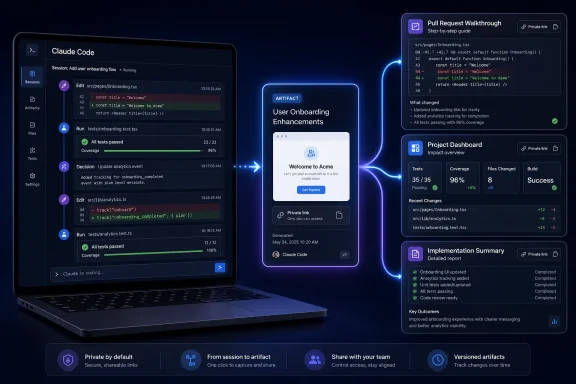
Anthropic added Artifacts to Claude Code on June 18, 2026, as a beta feature for Team and Enterprise customers, letting engineering teams turn active coding sessions into interactive pages such as pull request walkthroughs, project dashboards, and implementation summaries shared through private links. The move is not just another convenience button in the AI coding race. It is Anthropic’s clearest admission that the hardest part of AI-assisted development is no longer producing code, but preserving the reasoning around it. If Claude Code is going to become a daily tool for serious software teams, it has to stop behaving like a brilliant private conversation and start behaving like a system of record.
The headline feature sounds deceptively simple: Claude Code can now produce an Artifact from a session. In practice, that means the tool can transform the trail of decisions, edits, tests, and explanations generated during development into a shareable page that colleagues can inspect without replaying the entire conversation.
That matters because modern AI coding work is increasingly conversational. A developer asks Claude to investigate a bug, compare approaches, modify a module, write tests, explain a failure, and prepare a summary. The resulting code may end up in Git, but the reasoning often remains buried in a chat window.
For a solo developer, that may be acceptable. For an engineering organization, it is a governance problem wearing a productivity costume. The team needs to know not merely what changed, but why it changed, what alternatives were considered, what risks remain, and whether the tests actually support the claimed behavior.
Artifacts are Anthropic’s attempt to export that context into a durable, readable, interactive form. The feature’s initial examples — PR walkthroughs and living project dashboards — are not accidental. Those are exactly the places where engineering teams already spend hours turning work into explanation.
But the organizational bottleneck was always downstream. Once an AI-assisted session produced something useful, a human still had to translate that work into the language of the team: a pull request description, an architecture note, a migration plan, a status update, or a debugging write-up.
That translation step is tedious but important. It is also where teams discover whether the AI’s output was robust or merely plausible. If the explanation is vague, reviewers slow down. If the PR description omits tradeoffs, maintainers ask questions. If the deployment note is missing, operations inherits the surprise.
Artifacts aim to collapse that handoff. Instead of treating the chat transcript as disposable scaffolding, Claude Code can turn it into a structured artifact of work. That is a subtle but consequential shift: the AI assistant is no longer just helping write software; it is helping package software work for human review.
A good PR tells a story. It explains the motivation, summarizes the implementation, identifies risky areas, documents test coverage, and flags anything the reviewer should inspect closely. A bad PR dumps a diff on the reviewer and hopes the commit history is self-explanatory.
AI-generated code makes this problem sharper. If a developer used Claude Code to explore the codebase, make changes across several files, add tests, and clean up edge cases, the reviewer needs the session context almost as much as the diff. Otherwise, the review becomes archaeology.
Artifacts could give reviewers a guided map of the work. The page can explain the intent, call out important files, show how components relate, and surface remaining uncertainties. The reviewer still needs to inspect the code; no interactive summary should become a substitute for judgment. But if the Artifact reduces the time spent merely understanding the shape of the change, that is real productivity.
The risk is that teams confuse fluency with correctness. Claude can generate a confident walkthrough of a flawed change just as easily as it can generate a helpful explanation of a good one. The value of Artifacts will depend on whether they make review more rigorous, not just more comfortable.
Claude Code Artifacts promise a dashboard born closer to the work itself. If a coding session captures implementation progress, blockers, decisions, tests, and next steps, then the dashboard can be generated from the activity rather than reconstructed after the fact.
That is appealing to engineering managers and project leads because it reduces status latency. The best project information is usually in the heads of the people doing the work, or in the messy local context of branches, commands, logs, and discussions. By the time it is polished for stakeholders, it may already be stale.
A live Artifact that refreshes as the session continues could narrow that gap. It could show what has changed, what is still unresolved, and what the developer or agent intends to do next. For teams with distributed contributors, multiple time zones, or high review volume, that kind of context transfer is not decoration. It is operational infrastructure.
Still, the phrase “living dashboard” should make experienced IT pros a little wary. Living documents often become dead documents with better branding. The test will be whether Claude Code can keep Artifacts aligned with actual repository state, issue state, and deployment reality — not merely with the last thing the model believed during a session.
AI coding sessions contain the raw material for better documentation. They include the questions asked, the constraints discovered, the errors encountered, the design alternatives considered, and the rationale behind implementation details. In many teams, that information disappears once the branch is merged.
Artifacts could turn that byproduct into durable knowledge. A debugging session can become a postmortem seed. A refactor can become an architecture note. A feature implementation can become a technical specification. A deployment task can become a runbook.
This is not the same as saying AI should automatically document everything. Bad documentation at scale is its own tax. But AI-generated documentation that is grounded in actual development activity has a better chance of being useful than generic prose written after the team has mentally moved on.
For WindowsForum’s sysadmin-heavy readership, the analogy is familiar. The best operational notes are often written during the outage, while the commands, symptoms, and fixes are still fresh. The worst are written two weeks later, when everyone remembers the incident as “DNS, probably.”
That emphasis matters because AI coding tools operate near sensitive material. A useful coding assistant may inspect internal APIs, customer data handling paths, authentication logic, deployment scripts, or roadmap-adjacent feature branches. If it produces a shareable representation of that work, organizations need to know who can see it, how it is shared, and whether it can leak beyond the intended audience.
Private links are a start, but enterprise IT will want more than “not public by default.” They will ask about identity integration, revocation, retention, workspace boundaries, logging, export controls, and admin policy. They will also ask whether Artifacts can include secrets, snippets, or inferred details that should not be broadly visible even inside the company.
The broader lesson is that collaboration features inherit the sensitivity of the work they summarize. A PR walkthrough for a payment system is not just a note. A dashboard for an unreleased product is not just a dashboard. If Anthropic wants Artifacts to become part of enterprise development workflows, administrative control cannot remain an afterthought.
Claude Code Artifacts point toward a future in which AI-generated development context becomes another workplace object. Today that object might be a private Anthropic-hosted page. Tomorrow, customers will expect it to plug into GitHub pull requests, Azure Boards, Teams channels, Confluence pages, ServiceNow workflows, and security review systems.
That expectation will shape competition. Microsoft can lean on GitHub Copilot’s proximity to the repository and developer platform. OpenAI can push agentic workflows through its developer ecosystem. Anthropic is trying to differentiate with strong coding performance and team-oriented context packaging.
For IT departments, the question is not which assistant writes the slickest function. It is which assistant fits the organization’s review, security, documentation, and compliance model with the least friction. Artifacts are interesting because they attack the messy connective tissue around code, not just the code itself.
A generated PR walkthrough can omit a fragile assumption. A dashboard can overstate progress. A technical summary can flatten disagreement into consensus. A deployment note can sound complete while missing the one environment-specific command that matters.
These are not reasons to reject the feature. They are reasons to treat Artifacts as review aids rather than truth machines. The best use of AI-generated collaboration pages will be to accelerate human verification, not replace it.
Teams adopting the beta should establish norms early. Developers should mark generated Artifacts as AI-assisted. Reviewers should compare claims against the diff and tests. Project dashboards should be tied back to source control and issue trackers where possible. Security-sensitive teams should assume that anything summarized from a coding session may need the same handling as the underlying code.
The danger is not that Artifacts will be useless. The danger is that they will be useful enough to become trusted before teams have built the habits to verify them.
The enterprise market rewards tools that create organizational leverage. A model that helps one developer move faster is valuable. A system that helps a whole engineering team understand, review, document, and govern AI-assisted work is easier to justify at Team and Enterprise pricing.
That is why Artifacts feel more important than their surface description. “Share an interactive page” sounds modest. “Turn an AI coding session into reusable organizational knowledge” sounds like the product strategy.
Anthropic is also responding to a practical reality of agentic development: as models do more work, humans need better ways to inspect what happened. The transcript is too long. The diff is too narrow. The ticket is too abstract. An Artifact sits somewhere in the middle — a narrative interface for software work.
Teams should expect rough edges. The generated pages may need editing. The summaries may be uneven. The interactive elements may not map cleanly to every workflow. Integration with existing review systems may be limited at first. Security and administrative controls may evolve as customers pressure-test the feature.
That does not make the launch unimportant. In fact, beta is the right stage for this category of capability because the correct behavior depends heavily on how real teams work. A two-person startup, a regulated financial institution, and an internal platform team at a Fortune 500 company will all want different defaults.
The most useful feedback Anthropic receives will probably not be about whether Artifacts look polished. It will be about whether they reduce review time, prevent context loss, improve handoffs, and survive contact with compliance-minded administrators.
 Anthropic Is Selling the Memory Around the Code
The headline feature sounds deceptively simple: Claude Code can now produce an Artifact from a session. In practice, that means the tool can transform the trail of decisions, edits, tests, and explanations generated during development into a shareable page that colleagues can inspect without replaying the entire conversation.That matters because modern AI coding work is increasingly conversational. A developer asks Claude to investigate a bug, compare approaches, modify a module, write tests, explain a failure, and prepare a summary. The resulting code may end up in Git, but the reasoning often remains buried in a chat window.
For a solo developer, that may be acceptable. For an engineering organization, it is a governance problem wearing a productivity costume. The team needs to know not merely what changed, but why it changed, what alternatives were considered, what risks remain, and whether the tests actually support the claimed behavior.
Artifacts are Anthropic’s attempt to export that context into a durable, readable, interactive form. The feature’s initial examples — PR walkthroughs and living project dashboards — are not accidental. Those are exactly the places where engineering teams already spend hours turning work into explanation.
The Coding Assistant Is Becoming a Collaboration Layer
AI coding tools began as accelerators for individual developers. GitHub Copilot suggested completions. Chat-based tools generated functions, tests, scripts, or refactors. Claude Code, Cursor, Codex-style agents, and similar systems pushed further into multi-step development, where the assistant can reason across files, run commands, and iterate on a task.But the organizational bottleneck was always downstream. Once an AI-assisted session produced something useful, a human still had to translate that work into the language of the team: a pull request description, an architecture note, a migration plan, a status update, or a debugging write-up.
That translation step is tedious but important. It is also where teams discover whether the AI’s output was robust or merely plausible. If the explanation is vague, reviewers slow down. If the PR description omits tradeoffs, maintainers ask questions. If the deployment note is missing, operations inherits the surprise.
Artifacts aim to collapse that handoff. Instead of treating the chat transcript as disposable scaffolding, Claude Code can turn it into a structured artifact of work. That is a subtle but consequential shift: the AI assistant is no longer just helping write software; it is helping package software work for human review.
Pull Requests Were Always a Communications Problem
The most obvious use case is the pull request walkthrough, and for good reason. Large PRs are one of software engineering’s recurring sins. They are hard to review, easy to misunderstand, and often justified by deadlines rather than design hygiene.A good PR tells a story. It explains the motivation, summarizes the implementation, identifies risky areas, documents test coverage, and flags anything the reviewer should inspect closely. A bad PR dumps a diff on the reviewer and hopes the commit history is self-explanatory.
AI-generated code makes this problem sharper. If a developer used Claude Code to explore the codebase, make changes across several files, add tests, and clean up edge cases, the reviewer needs the session context almost as much as the diff. Otherwise, the review becomes archaeology.
Artifacts could give reviewers a guided map of the work. The page can explain the intent, call out important files, show how components relate, and surface remaining uncertainties. The reviewer still needs to inspect the code; no interactive summary should become a substitute for judgment. But if the Artifact reduces the time spent merely understanding the shape of the change, that is real productivity.
The risk is that teams confuse fluency with correctness. Claude can generate a confident walkthrough of a flawed change just as easily as it can generate a helpful explanation of a good one. The value of Artifacts will depend on whether they make review more rigorous, not just more comfortable.
The Dashboard Pitch Is Really About Engineering Visibility
Anthropic’s second flagship example — the living project dashboard — points at a larger enterprise ambition. Software teams already drown in status tools: Jira tickets, GitHub issues, Slack threads, Notion pages, Confluence spaces, stand-up notes, spreadsheets, and internal dashboards. The problem is not the absence of places to put updates. The problem is that most of them are manually maintained abstractions of work happening elsewhere.Claude Code Artifacts promise a dashboard born closer to the work itself. If a coding session captures implementation progress, blockers, decisions, tests, and next steps, then the dashboard can be generated from the activity rather than reconstructed after the fact.
That is appealing to engineering managers and project leads because it reduces status latency. The best project information is usually in the heads of the people doing the work, or in the messy local context of branches, commands, logs, and discussions. By the time it is polished for stakeholders, it may already be stale.
A live Artifact that refreshes as the session continues could narrow that gap. It could show what has changed, what is still unresolved, and what the developer or agent intends to do next. For teams with distributed contributors, multiple time zones, or high review volume, that kind of context transfer is not decoration. It is operational infrastructure.
Still, the phrase “living dashboard” should make experienced IT pros a little wary. Living documents often become dead documents with better branding. The test will be whether Claude Code can keep Artifacts aligned with actual repository state, issue state, and deployment reality — not merely with the last thing the model believed during a session.
Documentation Is the Killer App Nobody Wants to Write
Documentation is where Artifacts may deliver their most quietly useful win. Developers routinely under-document because the incentives are backwards. Coding produces immediate progress. Documentation produces future gratitude, which is rarely visible on the sprint board.AI coding sessions contain the raw material for better documentation. They include the questions asked, the constraints discovered, the errors encountered, the design alternatives considered, and the rationale behind implementation details. In many teams, that information disappears once the branch is merged.
Artifacts could turn that byproduct into durable knowledge. A debugging session can become a postmortem seed. A refactor can become an architecture note. A feature implementation can become a technical specification. A deployment task can become a runbook.
This is not the same as saying AI should automatically document everything. Bad documentation at scale is its own tax. But AI-generated documentation that is grounded in actual development activity has a better chance of being useful than generic prose written after the team has mentally moved on.
For WindowsForum’s sysadmin-heavy readership, the analogy is familiar. The best operational notes are often written during the outage, while the commands, symptoms, and fixes are still fresh. The worst are written two weeks later, when everyone remembers the incident as “DNS, probably.”
Private Links Are a Product Decision, Not a Footnote
Anthropic is positioning Claude Code Artifacts as a Team and Enterprise beta, and the private-link sharing model is central to that positioning. This is not a consumer creativity feature being casually extended into coding. It is a collaboration feature aimed at organizations that care about access control, proprietary code, internal architecture, and auditability.That emphasis matters because AI coding tools operate near sensitive material. A useful coding assistant may inspect internal APIs, customer data handling paths, authentication logic, deployment scripts, or roadmap-adjacent feature branches. If it produces a shareable representation of that work, organizations need to know who can see it, how it is shared, and whether it can leak beyond the intended audience.
Private links are a start, but enterprise IT will want more than “not public by default.” They will ask about identity integration, revocation, retention, workspace boundaries, logging, export controls, and admin policy. They will also ask whether Artifacts can include secrets, snippets, or inferred details that should not be broadly visible even inside the company.
The broader lesson is that collaboration features inherit the sensitivity of the work they summarize. A PR walkthrough for a payment system is not just a note. A dashboard for an unreleased product is not just a dashboard. If Anthropic wants Artifacts to become part of enterprise development workflows, administrative control cannot remain an afterthought.
Microsoft Shops Should Read This as a Workflow Signal
This is not a Microsoft product story, but it is very much a WindowsForum story. Many enterprise developers live in Microsoft-heavy environments: Windows desktops, Visual Studio Code, GitHub, Azure DevOps, Entra ID, Teams, SharePoint, and internal compliance processes stitched together by policy and habit. Any serious AI coding tool has to fit into that world or risk being treated as a side channel.Claude Code Artifacts point toward a future in which AI-generated development context becomes another workplace object. Today that object might be a private Anthropic-hosted page. Tomorrow, customers will expect it to plug into GitHub pull requests, Azure Boards, Teams channels, Confluence pages, ServiceNow workflows, and security review systems.
That expectation will shape competition. Microsoft can lean on GitHub Copilot’s proximity to the repository and developer platform. OpenAI can push agentic workflows through its developer ecosystem. Anthropic is trying to differentiate with strong coding performance and team-oriented context packaging.
For IT departments, the question is not which assistant writes the slickest function. It is which assistant fits the organization’s review, security, documentation, and compliance model with the least friction. Artifacts are interesting because they attack the messy connective tissue around code, not just the code itself.
The Feature Also Exposes a New Failure Mode
The optimistic reading of Artifacts is that they preserve context. The skeptical reading is that they may preserve model-authored interpretations of context, which is not always the same thing.A generated PR walkthrough can omit a fragile assumption. A dashboard can overstate progress. A technical summary can flatten disagreement into consensus. A deployment note can sound complete while missing the one environment-specific command that matters.
These are not reasons to reject the feature. They are reasons to treat Artifacts as review aids rather than truth machines. The best use of AI-generated collaboration pages will be to accelerate human verification, not replace it.
Teams adopting the beta should establish norms early. Developers should mark generated Artifacts as AI-assisted. Reviewers should compare claims against the diff and tests. Project dashboards should be tied back to source control and issue trackers where possible. Security-sensitive teams should assume that anything summarized from a coding session may need the same handling as the underlying code.
The danger is not that Artifacts will be useless. The danger is that they will be useful enough to become trusted before teams have built the habits to verify them.
Anthropic Is Moving Up the Stack
Claude Code Artifacts also fit a larger pattern in Anthropic’s strategy. The company has increasingly framed Claude not only as a chatbot or model API, but as an agentic work platform for enterprises. Claude Code, Claude for Work, security-oriented features, and now shareable coding-session outputs all point in the same direction.The enterprise market rewards tools that create organizational leverage. A model that helps one developer move faster is valuable. A system that helps a whole engineering team understand, review, document, and govern AI-assisted work is easier to justify at Team and Enterprise pricing.
That is why Artifacts feel more important than their surface description. “Share an interactive page” sounds modest. “Turn an AI coding session into reusable organizational knowledge” sounds like the product strategy.
Anthropic is also responding to a practical reality of agentic development: as models do more work, humans need better ways to inspect what happened. The transcript is too long. The diff is too narrow. The ticket is too abstract. An Artifact sits somewhere in the middle — a narrative interface for software work.
The Beta Label Is Doing Real Work
It is worth taking the beta designation seriously. A feature like this touches collaboration, permissions, generated content, code context, and possibly live updates. That is a lot of surface area for weird edge cases.Teams should expect rough edges. The generated pages may need editing. The summaries may be uneven. The interactive elements may not map cleanly to every workflow. Integration with existing review systems may be limited at first. Security and administrative controls may evolve as customers pressure-test the feature.
That does not make the launch unimportant. In fact, beta is the right stage for this category of capability because the correct behavior depends heavily on how real teams work. A two-person startup, a regulated financial institution, and an internal platform team at a Fortune 500 company will all want different defaults.
The most useful feedback Anthropic receives will probably not be about whether Artifacts look polished. It will be about whether they reduce review time, prevent context loss, improve handoffs, and survive contact with compliance-minded administrators.
The Claude Code Artifact Is Small, but the Workflow Shift Is Not
The concrete details are straightforward, but the implications are larger than the release note suggests.- Claude Code Artifacts are available in beta for Team and Enterprise plans, which signals that Anthropic sees the feature primarily as a professional collaboration tool.
- The feature turns coding sessions into interactive pages that can serve as PR walkthroughs, project dashboards, implementation summaries, and documentation.
- Private-link sharing makes the feature useful for teams, but enterprise customers will still need strong controls around access, retention, revocation, and sensitive content.
- The most immediate productivity gain is likely to come from code review, where generated context can help reviewers understand large or complex changes faster.
- The biggest long-term value may be documentation, because Artifacts can preserve decisions and discoveries that normally vanish after a coding session ends.
- Teams should treat Artifacts as AI-generated work products that require verification, not as authoritative records simply because they are polished and shareable.
References
- Primary source: thewincentral.com
Published: 2026-06-18T18:20:19.697991
Claude Code Artifacts Launch in Beta for Teams - WinCentral
Claude Code Artifacts turns coding sessions into shareable dashboards, PR walkthroughs, and interactive team pages. - Read in AI News on WinCentral thewincentral.com
- Official source: support.claude.com
What are artifacts and how do I use them? | Claude Help Center
support.claude.com
- Related coverage: infoq.com
Anthropic's Code with Claude Announces Managed Agents, Proactive Workflows, Capability Curve - InfoQ
Anthropic hosted "Code with Claude 2026" in San Francisco, featuring livestream sessions focused on Claude Code, the Claude API platform, and other projects. Key topics included developer experience,www.infoq.com
- Related coverage: claudeainews.com
Claude's Artifacts, Styles, and File Search Move to VM Execution by June 15 | ClaudeAINews
Anthropic is retiring legacy Artifacts, custom Styles, and Project file upload search by June 15, replacing each with VM-based equivalents. Code execution must be enabled or the features stop working.www.claudeainews.com - Related coverage: business-standard.com
- Official source: support.anthropic.com
Publish and share artifacts | Claude Help Center
- Official source: usingclaude.com
- Related coverage: itpro.com
Anthropic reveals Claude Opus 4.6, an enterprise-focused model with 1 million token context window for extended code capabilities | IT Pro
The AI developer highlighted financial and legal tasks, as well as agent tool use, as particular strengths for the new modelwww.itpro.com - Related coverage: releasebot.io

Claude Code Updates by Anthropic - June 2026 - Releasebot
Browse a full list of updates made to Claude Code by Anthropic. Follow to get all release notes by email, RSS, and more.
releasebot.io
- Related coverage: axios.com
Anthropic bolsters enterprise offerings with Cowork plugins
Tools like these will enable AI to be treated more like a full-time coworker, rather than a one-off tech fix.www.axios.com
