Atos Autonomous Data & AI Engineer on Azure: Agentic DataOps for Databricks and Snowflake

  • Thread Author
Atos’ new Autonomous Data & AI Engineer promises to offload multistep data engineering work to agentic AI running on Microsoft Azure — a bold, practical play in the rapidly heating race to put autonomous agents into enterprise data workflows. The offering, powered by the Atos Polaris AI Platform and marketed for both Azure Databricks and Snowflake on Azure, is being positioned as a ready-to-deploy “agentic” solution that can ingest, transform and create analytics-ready data views autonomously, and expose further AI and visualization agents for insight discovery. The announcement and product listings emphasize faster time-to-value and measurable operational savings, while Atos and Microsoft materials show deliberate alignment with Azure’s emerging agent standards and governance primitives.

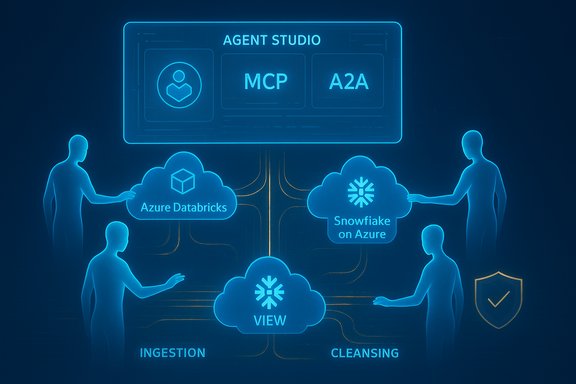
Neon blue diagram showing Agent Studio coordinating an Azure data pipeline between Azure Databricks and Snowflake on Azure.Background / Overview​

What Atos announced​

Atos is making its Autonomous Data & AI Engineer available on Microsoft Azure as a productized agentic solution built on the Atos Polaris AI Platform. The product is listed in the Microsoft Marketplace as specialized consulting/solution packages for both Azure Databricks and Snowflake on Azure and was demonstrated at Microsoft Ignite (Moscone Center, November 18–21) as part of Atos’ Polaris showcase. The vendor materials state the solution can autonomously ingest structured and unstructured sources, enforce data quality and transformation rules, create curated data views, and hand off to visualization or conversational agents for business analysis.

Why this matters now​

Enterprises are moving beyond single-query LLM helpers toward multi-step, goal-driven agents that can operate across tools, pipelines and cloud services. Data engineering remains a major bottleneck for analytics and model-based initiatives — anything that safely reduces the manpower and time to create reliable, governed datasets is commercially attractive. Atos is pitching this as a pragmatic “Services-as-Software” offering that embeds automation into the data lifecycle, tightly integrated with Azure services and industry agent standards. The timing aligns with Microsoft’s wider push for agentic tooling in Azure (Copilot Studio, Azure AI Foundry, and Model Context Protocol support), making the offering contextually relevant for Azure-first shops.

What the Autonomous Data & AI Engineer actually does​

Core capabilities (vendor-stated)​

  • Autonomous ingestion from external platforms and file stores into Azure Databricks or Snowflake on Azure.
  • Automated data quality checks, transformations and generation of analytical views suitable for business consumption and visualization.
  • Integration with the Atos Polaris Agent Studio — a no-code orchestration surface that lets technical and non-technical users compose, configure and coordinate multi-agent workflows.
  • Connectivity to Large Language Models and tools using open standards and agent protocols (vendors highlight Model Context Protocol (MCP) and Agent-to-Agent patterns for cross-agent cooperation).

Claimed business outcomes (vendor numbers)​

  • Up to 60% reduction in development and deployment time for data operations (Atos materials vary between a 30–60% range depending on the scenario).
  • Up to 35% reduction in operational costs through DataOps agents that cut average ticket-handling time.
Caveat: these are vendor-reported performance figures. They are plausible for well-scoped automation on repeatable tasks but require proof-of-value through customer pilots and benchmarked POCs; treat the percentages as supplier claims until validated in your environment.

How it integrates with Microsoft Azure (technical validation)​

Platform fit: Databricks and Snowflake on Azure​

Atos has published marketplace entries specifically for:
  • Autonomous Data & AI Engineer for Azure Databricks, and
  • Autonomous Data & AI Engineer for Snowflake on Azure.
Both listings describe prebuilt connectors and references to Azure Data Factory, Power BI, and Azure AI services as integration points. That confirms Atos’ go-to-market packaging targets the two most common cloud analytics platforms used on Azure and indicates pre-engineered connectors rather than a purely bespoke consultancy engagement.

Standards and interoperability: MCP and A2A​

Microsoft and the agent community have converged on interoperability patterns that Atos references in its product messaging. The relevant pieces to know:
  • Model Context Protocol (MCP): an emerging JSON-RPC based standard that lets agents call tools and grounding services in a structured, machine-readable way. Microsoft’s Copilot Studio and Azure AI Foundry provide MCP support and tool onboarding; documentation shows how enterprises can bring MCP servers into agent flows. This is central to connecting LLM-based agents to external data APIs and guarded toolsets.
  • Agent-to-Agent (A2A) / Agent Communication Protocols: A2A-style approaches allow agents to discover and delegate to one another with machine-readable Agent Cards and lifecycle-managed tasks. Atos’ description of orchestration and multi-agent patterns is consistent with these industry initiatives (A2A/ACP), which Microsoft and other platform vendors are actively supporting. Use of MCP for tool access and A2A for peer collaboration is the current industry best practice.

Governance and Responsible AI​

Atos states the solution is grounded in Microsoft Responsible AI principles and runs under Azure governance primitives. Microsoft’s stack offers identity-based agent principals (Entra), policy enforcement (Azure Policy/Purview) and audit/observability through portal-integrated logging — capabilities enterprises need to make agents auditable and controllable. Those Microsoft primitives (and the Model Context Protocol tooling) are widely available and documented; integrating them into Atos’ agent workflows would be a necessary design requirement for any production deployment.

Strengths: Where this can move the needle for organizations​

  • Operational acceleration for data teams. Automating repeatable ingestion/cleansing/transformation steps removes a common bottleneck for analytics and ML pipelines; if implemented safely, this can cut project lead times and increase data platform throughput. Atos’ packaging for Databricks and Snowflake reduces integration friction for Azure customers.
  • Enterprise-grade ecosystem fit. The solution is explicitly built to work inside Microsoft’s agent ecosystem and adopts MCP/A2A patterns, which helps with portability and governance when combined with Azure’s identity and auditing features. That alignment reduces the engineering debt of bespoke agent integrations.
  • No-code orchestration surface. A no-code Agent Studio lowers the bar for business teams to compose and tune agent workflows, enabling faster experimentation and potentially better collaboration between domain experts and data engineers.
  • Packaged marketplace delivery. Being available in the Microsoft Marketplace (Databricks and Snowflake listings) enables a repeatable procurement and deployment path, which is politically and operationally useful for enterprise buyers.

Risks, caveats and what to validate in pilots​

Vendor metrics need independent validation​

Claims of “up to 60% faster” development and “up to 35% lower costs” are common in vendor materials. These are directional and attractive; however:
  • Performance depends heavily on the quality of the source data, schema stability, and the maturity of an organization’s data governance.
  • The baseline matters: improvement over a highly manual process gives larger percentage improvement than optimization from an already-automated pipeline.
    Run an A/B pilot with measurable KPIs (MTTD/MTTR for data incidents, ticket-handling time, time-to-deliver views, downstream model-quality impacts) before accepting blanket ROI figures.

Security and data governance risks​

Agentic systems change the threat model: agents that can act autonomously must be strictly scoped:
  • Ensure least-privilege identities and short-lived credentials for agents (Entra principles).
  • Validate data residency and telemetry retention policies for any services agents access.
  • Enforce guardrails at the infrastructure layer; do not rely on model prompt structure alone to enforce access boundaries (prompt-based controls are brittle). Independent guidance on securing MCP/A2A interactions emphasizes treating the model as untrusted and enforcing execution boundaries outside the LLM.

Observability and human-in-the-loop design​

Agents that take actions must leave complete, auditable trails and support quick rollback. Teams must design for:
  • Action logs and full provenance of data modifications.
  • Human approval gates for high-risk actions.
  • Testing and staged rollouts (shadow mode → gated execution → autonomous low-risk tasks). Microsoft and partners have published operational playbooks for moving agents from pilot to production; follow those steps.

Model and tool reliability​

Agents combine LLM reasoning with tool invocation. Two failure modes matter:
  • Incorrect tool invocation (semantic mismatch between a model’s intent and the tool contract).
  • Data-transform errors that silently degrade downstream models and reporting.
    Mitigate with schema checks, unit tests for agent plans, and strong QA on transformation rules.

Practical implementation checklist for IT leaders​

  • Define a narrowly scoped pilot:
  • Select a single high-value ingestion source and an analytics consumer (e.g., finance reporting, product analytics).
  • Define baseline metrics (time to ingest + clean, ticket-handling time, quality gates).
  • Validate governance hooks:
  • Ensure agents have Entra identity, RBAC-limited permissions, and audit logging enabled.
  • Map data residency, retention, and Purview classifications.
  • Test integration and interoperability:
  • Connect the Atos Agent Studio agent to your MCP servers or Azure tool endpoints in Copilot Studio; exercise fail-open and fail-closed behaviors.
  • Run shadow mode:
  • Let agents propose actions while humans approve; collect accuracy and false-positive rates.
  • Measure business outcomes:
  • Track developer hours saved, time-to-insight, cost delta, and any impact on downstream ML model performance.
  • Harden production readiness:
  • Add human-in-loop for high-risk automation, sandbox agent runs, and contract clause SLAs for vendor support.

Governance, compliance and vendor management​

  • Audit & traceability: Require machine-readable action logs, immutable provenance of data changes, and integration with SIEM/SOAR tools for incident analysis.
  • SLA and support commitments: Include measurable success criteria in procurement (e.g., reproducible throughput on representative datasets, proof of MCP/A2A interoperability).
  • Third-party verification: Insist on runbooks and reproducible benchmarks; independent benchmarking or a joint pilot that includes a third-party auditor dramatically reduces procurement risk.
  • Contractual guardrails: Define explicit data residency, incident response, and indemnity clauses for agent-driven actions that modify production systems.

The market context and competitive takeaways​

Atos is not alone: platform vendors and integrators are racing to productize agentic stacks (model + tool + orchestration + governance). The differentiator for buyers will not be who uses the term “agentic” first, but who offers:
  • Clear governance integrated into the runtime,
  • Transparent, measurable outcomes in pilots, and
  • Portable standards-based interoperability (MCP / A2A) rather than brittle point integrations.
Atos’ strategy — packaging on the Microsoft ecosystem and listing on the Microsoft Marketplace — targets organizations that want a single vendor to deliver both integration and managed operational support. That is attractive for regulated sectors but also raises the usual vendor-lock and SLAs questions that enterprise procurement must address.

Short technical note on MCP / A2A security (practical advice)​

  • Treat MCP definitions as advisory metadata that instruct tool routing, but enforce tool execution privileges in the network and execution layer (do not trust the model to self-regulate).
  • Agent-to-Agent communications must be authenticated, scoped and monitored. Adopt agent identity lifecycle management (enrolment, rotation, deprovisioning) and include agents in identity reviews.

Final assessment: who should evaluate Atos’ Autonomous Data & AI Engineer?​

  • Azure-first enterprises using Databricks or Snowflake that need to accelerate integration, reduce data engineering backlog and are comfortable piloting new agentic paradigms should evaluate this offering. Marketplace availability makes procurement and deployment straightforward for proof-of-concept work.
  • Regulated organizations (finance, healthcare, public sector) should proceed cautiously: evaluate the product in shadow mode, insist on tight identity and data controls, and require legal/contractual protections for agent-driven modifications.
  • Platform and data engineering teams should view this as an accelerator, not a drop-in replacement for robust DataOps and MLOps practices. Agents can reduce repetitive toil, but strong tests, telemetry and rollback controls are prerequisites for safe production use.

Conclusion​

Atos’ Autonomous Data & AI Engineer — powered by the Atos Polaris AI Platform and released into the Microsoft Azure ecosystem — is a credible, standards-conscious entrant in the agentic data automation market. The product’s marketplace listings and Atos’ Polaris positioning validate that the company has packaged multi-agent orchestration specifically for Azure Databricks and Snowflake on Azure, and that it intends to leverage open interoperability patterns such as MCP and A2A to integrate agents with tools and with one another. That said, the most important next step for any buyer is measured validation: run a short, instrumented pilot; verify vendor claims against your data shapes and compliance rules; and require auditable human-in-the-loop designs before granting agents authority to change production data. Vendor ROI figures are promising, but the real value will be proven by reproducible POCs that show safe automation and measurable business impact in the buyer’s environment.


Source: The Manila Times Atos Announces the Availability of Autonomous Data & AI Engineer, an Agentic AI Solution on Microsoft Azure, Powered by the Atos Polaris AI Platform
 

Atos has begun shipping a new agentic AI product for Azure customers: Autonomous Data & AI Engineer, a turnkey, multi‑agent DataOps solution built on the company’s Atos Polaris AI Platform and packaged for Azure Databricks and Snowflake on Azure. Announced during Microsoft Ignite, the offering promises to automate end‑to‑end data engineering workflows — from ingestion and quality checks through transformation and curation — and to hand off results to visualization and query‑agents for business users. The pitch is clear: replace repetitive manual data engineering tasks with coordinated AI agents to accelerate time‑to‑insight and lower operating costs. This article explains what the product actually does, how it is designed, which claims are vendor‑stated versus independently verifiable, the technical and compliance implications for Azure customers, and practical guidance for enterprise teams evaluating agentic DataOps today.

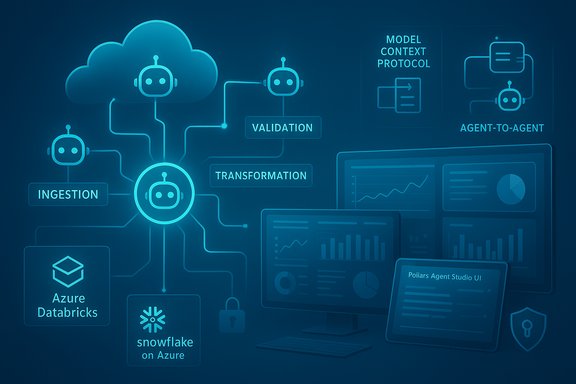
Blue schematic of an AI data pipeline with agents, cloud, and analytics dashboards.Background / Overview​

Agentic AI — collections of specialized, goal‑oriented agents that communicate and cooperate to accomplish multi‑step objectives — has moved from research labs into commercial products over the past year. Microsoft’s platform work around agent standards and protocols has accelerated that shift by defining interoperability primitives for agents and cloud services. Atos Polaris positions itself as a full‑stack agent orchestration layer that enterprises can deploy across cloud marketplaces. The Autonomous Data & AI Engineer is the first broadly announced Polaris productized solution for Azure and specifically targets two of the most common enterprise data platforms: Azure Databricks and Snowflake on Azure.
Atos positions the solution as:
  • A set of purpose‑built DataOps agents that can autonomously ingest, validate and transform structured and unstructured data.
  • A no‑code/low‑code Atos Polaris Agent Studio for composing, testing and orchestrating multi‑agent workflows.
  • A bridge to models and tools using open agent orchestration standards (Model Context Protocol and Agent‑to‑Agent patterns) and native Azure integrations (Data Factory, Power BI, Azure AI services).
  • A marketplace‑packaged solution designed to simplify procurement and PoC deployment for Azure customers.
Those high‑level claims align with a broader market move: enterprises want automation that reduces manual ETL/ELT toil, speeds dataset creation for analytics or ML, and fits within existing governance and cloud ecosystems.

What Autonomous Data & AI Engineer actually does​

Core capabilities (product description)​

The product focuses on automating repeatable data engineering and data operations tasks via specialized agents. Key vendor‑described capabilities include:
  • Autonomous ingestion: agents connect to external data sources and file stores, pulling data into Azure Databricks or Snowflake on Azure.
  • Data quality and transformation: agents apply rules and transformations, run quality checks, and prepare curated analytical views.
  • Support for structured and unstructured content: agents can handle files, tables and free‑text sources as part of ingestion and enrichment.
  • Orchestration and no‑code composition: the Polaris Agent Studio allows technical and non‑technical users to assemble multi‑step agent workflows, configure triggers and define business rules.
  • Downstream handoffs: once curated, data can be surfaced to visualization or conversational agents for interactive query and insight extraction.
The solution is marketed as an end‑to‑end “DataOps as a service‑style” capability that reduces manual effort across the data lifecycle.

Integration surface and runtime​

Autonomous Data & AI Engineer is delivered as Azure marketplace artifacts for Databricks and Snowflake. It explicitly integrates with:
  • Azure Databricks or Snowflake on Azure for data storage and processing.
  • Azure Data Factory (for orchestration/ingestion), Power BI (for visualization), and Azure AI Services (for LLM connectivity and model hosting).
  • Atos Polaris Agent Studio for agent composition, AgentOps for policy, reliability and cost controls, and open protocols (Model Context Protocol and Agent‑to‑Agent) to connect agents to models and other tooling.
These integration points create practical pathways for agents to access canonical enterprise data, transform it in recognized execution environments, and output results to dashboards or conversational surfaces.

Claimed business outcomes — treat with caution​

Atos promotes specific ROI figures: reductions in development and deployment time "up to 60%" and operational cost savings "up to 35%" in their marketing materials. Those numbers appear consistently across the Atos announcement and its Azure Marketplace listings. They are vendor‑stated performance claims and should be treated as directional estimates rather than independently validated results. Enterprises should require PoC metrics using their own data and SLAs before accepting those percentages as achievable outcomes.

The technical architecture and standards posture​

Polaris as the agent orchestrator​

Polaris is described as a full‑stack agent framework with these components:
  • Agent Studio: no‑code/low‑code composition and testing environment for building agent workflows.
  • Pre‑built agent templates: common DataOps, IT support and QA workflows to accelerate adoption.
  • AgentOps: runtime features for monitoring, cost management, governance, and compliance.
  • Open standards support: adherence to emerging agent standards and interoperability protocols so agents can connect to external LLMs and services.
The goal is to move beyond monolithic automation scripts and toward observable, modular agent networks where each agent has a defined capability, lifecycle and interfaces.

Model and agent connectivity: MCP and A2A​

Atos surfaces support for modern agent interop primitives: Model Context Protocol (MCP) and Agent‑to‑Agent (A2A) messaging patterns. Those standards define how agents advertise capabilities (agent cards), exchange tasks and artifacts, and stream state updates securely across components. Using these public patterns increases the chance that agent workflows can interoperate with Microsoft Copilot components and other agent ecosystems rather than being locked to a single vendor implementation.

Security and enterprise controls​

Atos states the product is grounded in Microsoft Responsible AI principles, and the underlying Azure agent ecosystem typically uses identity and network primitives such as Entra ID, mutual TLS and content‑safety services for protection. Enterprises should expect integration points for:
  • Role‑based access control (RBAC) and SSO via Microsoft Entra.
  • Secure communication channels and mTLS for agent messaging.
  • Data encryption in transit and at rest using Azure platform services.
  • Audit trails and logging to support compliance and explainability of agent actions.
While Atos highlights these aspects, customers must validate the exact configuration of encryption keys, log retention, and access controls during procurement and deployment.

Strengths and immediate benefits for Azure customers​

  • Market‑ready packaging for Azure: Marketplace listings for Databricks and Snowflake lower procurement friction and accelerate PoC deployment for Azure customers who already standardize on those platforms.
  • End‑to‑end automation narrative: Atos bundles ingestion, transformation, curation and downstream hand‑offs into one stack, reducing the integration burden on internal teams who would otherwise stitch multiple tools together.
  • No‑code orchestration surface: Polaris Agent Studio potentially democratizes agent composition, enabling business analysts or product owners to assemble flows without deep engineering.
  • Standards orientation: Support for MCP and A2A increases the likelihood of portability and auditability versus proprietary agent meshes.
  • Partner alignment with Microsoft: Atos’ Frontier partnership and marketplace presence may translate to tighter platform integration and co‑engineering with Azure services — a practical plus for enterprise buyers prioritizing validated stacks.
These factors make the offering attractive to organizations that want to pilot agentic automation without a heavy internal engineering lift.

Risks, limitations and governance concerns​

Vendor‑stated performance vs. real‑world results​

The advertised efficiency gains (e.g., “up to 60%” time reduction) are plausible in narrow, repeatable tasks but are vendor claims that depend heavily on the customer’s data complexity, quality, and downstream integration needs. Treat headline ROI figures as marketing benchmarks: run side‑by‑side PoCs with production‑representative datasets.

Model behavior and hallucinations​

Agentic workflows that rely on LLMs to make decisions or apply transformations risk generating incorrect or inconsistent outputs (hallucinations). For data engineering tasks, this can manifest as:
  • Incorrect join logic or transformation rules inferred from ambiguous schema.
  • Automated data labeling or mapping mistakes that propagate to analytics.
  • Inadequate handling of edge cases or rare data distributions.
Mitigation steps must be explicit: guardrails, verification agents, human‑in‑the‑loop (HITL) checkpoints, and deterministic transformation libraries where possible.

Data privacy, sovereignty and compliance​

Automating the movement and transformation of sensitive data raises compliance concerns:
  • Data residency requirements must be validated for any cross‑region transfers.
  • Automated connectors and LLM calls must not inadvertently expose PII to third‑party model endpoints.
  • Regulatory logging and explainability must be enforceable for agent actions used to make business decisions.
Customers with strict regulatory environments (healthcare, finance, public sector) will need careful configuration, likely requiring private model hosting or isolated compute and audit capabilities.

Cost surprises and runaway compute​

Agentic systems can inadvertently spawn many parallel tasks or retrain models; without guardrails this can lead to unexpected consumption and Azure bill shock. AgentOps features that include cost budgeting, per‑agent quotas and throttling are essential to prevent runaway costs.

Observability and traceability​

Multi‑agent workflows increase system complexity. Enterprises must demand:
  • Fine‑grained audit trails tying agent actions to input artifacts, model versions and final outputs.
  • Provenance of dataset versions and lineage visualizations.
  • Retraceable decision logs suitable for internal review and regulatory inspection.

Practical implementation and evaluation checklist​

For WindowsForum readers and enterprise data teams considering Autonomous Data & AI Engineer, here is a practical checklist and phased approach to evaluation and deployment.

Phase 1 — Prepare and assess readiness​

  • Inventory existing data platforms and pipelines (Databricks, Snowflake, Data Factory, ADF pipelines).
  • Identify a small number (1–3) of high‑value, repeatable data engineering tasks suitable for automation (ingestion from known sources, standard transformations, routine quality checks).
  • Assign stakeholders: data engineers, security/compliance, cost owners and a business sponsor.

Phase 2 — Run a focused PoC​

  • Procure the marketplace package for the relevant platform (Databricks or Snowflake).
  • Define success metrics: time to curated dataset, error rates, manual effort hours saved, and cost delta.
  • Constrain scope tightly: limit agents to non‑sensitive datasets or use masked/synthetic data for initial runs.
  • Enable AgentOps and cost controls; set quotas and alerts to minimize bill surprises.
  • Measure outcomes against the success metrics for at least two production‑like data flows.

Phase 3 — Validate governance and reliability​

  • Validate identity and access controls: ensure RBAC, Entra SSO and least privilege are enforced for agent actions.
  • Confirm encryption and data residency: ensure keys, regions and logs meet compliance requirements.
  • Test failure modes: agent errors, model downtimes and recovery; ensure there’s a human escalation path.
  • Review audit logs and lineage: confirm that each automated dataset has clear provenance and traceability.

Phase 4 — Scale with controls​

  • Expand to more pipelines only after meeting PoC targets and defining guardrails.
  • Put formal change control and monitoring in place: model versioning, continuous testing, and red‑team exercises for agent outputs.
  • Create a cost governance plan: agent quotas, budget limits, and monthly reviews.

Operational and security best practices (detailed)​

  • Enforce strict segregation of duties: separate privileges for agent authors, runtime administrators and data owners.
  • Use private or enterprise‑hosted LLMs for high‑sensitivity data to remove dependencies on public endpoints.
  • Introduce automated verification agents that re‑run deterministic checks on agent outputs before promoting data to production.
  • Maintain a model and agent inventory with versioned releases and rollback capability.
  • Integrate agent logs into centralized SIEM and observability tooling for alerting and forensic analysis.
  • Implement rate limits and retry policies for external connectors to avoid cascading failures.
  • Apply data masking or synthetic test data for development and PoC phases to reduce exposure.

Market context and what this means for Azure customers​

Atos’ announcement reflects two simultaneous market dynamics: (1) a race to productize agentic AI into enterprise workflows, and (2) platform vendors and integrators converting consultancy skills into packaged, marketplace‑deployable offerings. For Azure customers, the availability of a packaged solution targeted specifically at Databricks and Snowflake lowers the barrier to trial; it also signals that major systems integrators are betting on agentic automation as a key enterprise adoption vector.
Atos has complemented this Azure offering with other product moves (for example, hybrid and OpenShift‑based AI platform options), indicating a multi‑front strategy for offering both cloud‑native and hybrid agent ecosystems. Enterprises should consider how agentic solutions fit into their longer‑term data platform strategy, especially around multi‑cloud and hybrid scenarios.

Realistic adoption timeline and expectations​

  • Short term (0–3 months): pilot selected ingestion and data quality tasks with strict guardrails and synthetic data.
  • Medium term (3–12 months): expand automation to routine transformation pipelines, integrate with BI and conversational agents, and measure operational savings.
  • Longer term (12+ months): formalize AgentOps, integrate agentic flows into CI/CD for data pipelines, and migrate sensitive workloads to private models or dedicated compute as needed.
Expect the most immediate wins in routine, high‑volume, low‑variation tasks. More complex semantic transformations or ambiguous mapping tasks will require careful human oversight and incremental deployments.

Final verdict: who should consider Atos' offering​

  • Enterprise data teams with existing Azure Databricks or Snowflake investments who want to accelerate DataOps and reduce time to curated datasets.
  • Organizations that prioritize marketplace‑packaged solutions to reduce procurement friction and require vendor support for rapid PoCs.
  • Teams willing to invest in governance, AgentOps and observability to mitigate the intrinsic risks of automating critical data pipelines.
What this offering is not ideal for (without substantial additional work):
  • Organizations that must process highly regulated or extremely sensitive datasets on public LLM endpoints without a hardened private model or strict isolation.
  • Teams expecting plug‑and‑play, zero‑touch automation for complex, business‑specific transformations; these still require domain knowledge and human validation.

Conclusion​

Atos’ Autonomous Data & AI Engineer is a notable, pragmatic entry into the agentic DataOps market: a packaged, Azure‑marketplace solution that surfaces curated automation for Databricks and Snowflake users. It brings clear strengths — marketplace packaging, no‑code composition, and standards alignment — that make it easier for enterprises to trial agentic automation. However, the offering also brings the familiar caveats of modern AI automation: vendor‑stated ROI must be validated in‑house, governance and observability are non‑negotiable, and security and compliance demand careful architectural choices.
For WindowsForum readers and enterprise data teams, the sensible path is measured experimentation: start with low‑risk PoCs, insist on clear metrics and auditability, and only scale once AgentOps, cost controls and human‑in‑the‑loop verification are proven. Agentic automation promises to dramatically reduce data engineering toil — but only when it is deployed with the same rigor and controls enterprise IT applies to any infrastructure that touches production data.

Source: ePressi Atos Announces the Availability of Autonomous Data & AI Engineer, an Agentic AI Solution on Microsoft Azure, Powered by the Atos Polaris AI Platform
 

Atos’ new Autonomous Data & AI Engineer — an agentic DataOps solution built on the Atos Polaris AI Platform and now available on Microsoft Azure — promises to offload multistep data engineering work to coordinated AI agents, packaged for rapid deployment with Azure Databricks and Snowflake on Azure and marketed with headline efficiency gains that warrant careful technical and governance scrutiny.

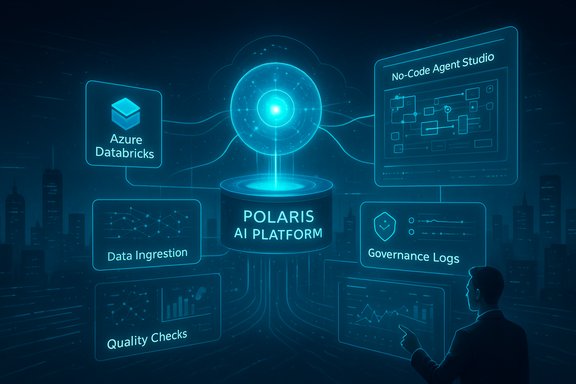
Polaris AI Platform hub linking Azure Databricks, No-Code Studio, data ingestion, and governance logs.Background​

Agentic AI — networks of specialized, goal-oriented agents that plan, act and coordinate to complete multi-step objectives — moved fast from research prototypes into vendor products in 2025. Atos launched the Atos Polaris AI Platform earlier in the year as its orchestration layer for agentic workflows, and the Autonomous Data & AI Engineer is the first clearly productized DataOps solution the company has packaged for the Azure ecosystem. Atos is positioning Polaris and its Autonomous Data & AI Engineer as a new “Services‑as‑Software” delivery model: a set of pre‑built agents plus a no‑code Agent Studio that lets technical and non‑technical users compose, test and run multi‑agent DataOps pipelines. The offering is available in the Azure Marketplace with separate packages optimized for Databricks and Snowflake on Azure, and Atos demonstrated the solution at Microsoft Ignite in San Francisco in November 2025.

What Atos is shipping: capabilities and packaging​

Core capabilities (vendor-stated)​

Atos advertises a tightly focused set of features aimed at the perennial pain points of enterprise data engineering:
  • Autonomous ingestion of structured and unstructured sources into Azure Databricks or Snowflake on Azure.
  • Automated data quality checks including schema reconciliation, transformation rules and curation into analytics‑ready views.
  • No‑code/low‑code orchestration via the Atos Polaris AI Agent Studio for composing agent networks, triggers and business rules.
  • LLM and tool integration through open agent standards such as the Model Context Protocol (MCP) and Agent‑to‑Agent (A2A) patterns.
  • Downstream handoffs to visualization or conversational agents so business users can query curated datasets or generate insights interactively.
These features are delivered as marketplace artifacts that include pre‑built connectors and deployment templates for Azure Data Factory, Power BI, Databricks and Snowflake, enabling sandbox and pilot deployments that are meant to reduce procurement friction.

Vendor ROI claims — inspect with care​

Atos’ public materials repeatedly cite two headline outcomes: up to 60% reduction in development and deployment time for data operations, and up to 35% reduction in operational costs through DataOps agents that shorten average ticket‑handling time. These exact figures appear in Atos’ press release and in its Azure Marketplace pages. They are vendor‑reported and presented as aspirational performance outcomes rather than independently validated benchmarks. Buyers should treat them as directional targets and require measurable proof during a scoped proof‑of‑concept (PoC).

Technical architecture and standards posture​

Polaris as the orchestration layer​

At the center of the offering is the Atos Polaris AI Platform, introduced in July 2025 as a full‑stack agent orchestration framework that provides:
  • An Agent Studio (no‑code environment) for composing, testing and simulating agent workflows.
  • Pre‑built agent templates (DataOps, QA, IT support, etc. to accelerate adoption.
  • AgentOps features for monitoring, cost control and policy management.
Polaris is designed to act as the runtime and lifecycle manager for agents: it assigns identities, manages tool access, schedules tasks and collects observability signals. Atos has made Polaris available in multiple cloud marketplaces (AWS earlier in 2025 and now Azure), signaling a multi‑cloud packaging intent even when productized solutions target a specific cloud stack.

Open agent protocols: MCP and A2A​

A notable engineering choice is the stated use of open agent interop patterns such as the Model Context Protocol (MCP) and Agent‑to‑Agent (A2A) messaging. MCP is an emerging standard to let LLMs and agents call tools, grounding services or data endpoints in a structured, machine‑readable way; A2A patterns support discovery, delegation and lifecycle management among agents. These primitives are actively being adopted in the broader Azure agent ecosystem (Copilot Studio, Azure AI Foundry), which makes Atos’ standards orientation significant for portability and governance. Using open protocols reduces vendor lock‑in risk compared with proprietary agent meshes and makes it easier to integrate guarded tools and enterprise credentials — provided the implementation wires Azure’s identity and policy primitives into agent runtime correctly.

Integration with Azure Databricks and Snowflake on Azure​

Atos has packaged the Autonomous Data & AI Engineer with specific adaptors and templates for both Azure Databricks and Snowflake on Azure — two dominant backends for lakehouse and cloud data warehouse workloads. Marketplace entries confirm dedicated implementations optimized for each platform, which implies pre‑engineered connectors and deployment playbooks rather than bespoke services only. That packaging is a practical win for enterprises that have standardized on these platforms because it reduces integration lift and accelerates PoCs. Operationally, the agents are described as able to ingest files and streams, apply transformation and quality rules inside Databricks or Snowflake, and produce curated data views that other agents or BI tools can query. The runtime integration points called out include Azure Data Factory for ingestion orchestration, Power BI for visualization and Azure AI Services for LLM hosting and model execution.

Strengths: where Atos’ offering can genuinely move the needle​

  • Practical platform fit: Targeting Databricks and Snowflake via marketplace packages meets enterprises where they already run analytics workloads, reducing time spent on connector plumbing.
  • No‑code composition: The Polaris Agent Studio lowers the barrier for business and domain experts to compose workflows, shortening the gap between data discovery and delivery.
  • Standards orientation: Support for MCP and A2A increases the chance that agent workflows will interoperate with Microsoft’s tooling and future agent ecosystems, improving portability and long‑term maintainability.
  • Marketplace delivery: Azure Marketplace packaging simplifies procurement and allows rapid sandboxing, which is critical for high‑velocity pilot programs.
  • Operational observability: Polaris’ AgentOps capabilities are pitched as necessary for enterprise adoption — monitoring, cost controls and policy enforcement are non‑negotiable for production agent deployments.

Risks, gaps and governance challenges​

Agentic DataOps raises a set of practical and safety risks that buyers must address before production rollout.

1) Vendor‑stated ROI needs validation​

The “up to 60%” and “up to 35%” figures are vendor claims present in Atos’ press materials and Marketplace pages; they are plausible in highly repeatable automation scenarios but must be validated with reproducible PoC metrics on the buyer’s own data and SLAs. Procurement should demand measurable benchmarks with data‑set‑specific baselines.

2) Surface area for prompt injection and MCP risks​

MCP makes tool integration easier, but researchers and security analysts have already flagged risks such as prompt injection and misconfigured MCP servers that can carry malicious instructions or exfiltrate data. Early reviews and security testing show that an MCP‑based ecosystem requires hardened server configs, strict authentication and careful input sanitization. Enterprises must insist on independent red‑team testing and architectural review of the MCP and A2A layers before enabling agents against sensitive systems.

3) Agent identity, least privilege and auditability​

Agents must be first‑class principals in identity systems (Microsoft Entra) with least‑privilege permissions, credential rotation and immutable action logs. Atos cites Microsoft Responsible AI principles, but the existence of Azure primitives (Entra, Azure Policy, Purview, Azure Monitor) does not guarantee correct runtime wiring. Buyers must request architecture diagrams and evidence that Polaris enforces RBAC, produces immutable provenance logs, and supports human‑in‑the‑loop controls and circuit breakers for high‑impact operations.

4) Data governance and compliance​

Agentic automation that writes transformations or materializes curated views can inadvertently hide sensitive data or modify lineage information. Enterprises operating under strict regulatory regimes must require lineage retention, explainable transformation steps, and versioned datasets (dataset registries) so audits can reconstruct agent decisions. Integration with data governance tools like Azure Purview or equivalent must be proven during procurement.

5) Operational and cost management​

Agent networks can multiply downstream compute and storage consumption if not monitored carefully. Polaris’ AgentOps features promise cost management, but procurement should demand rate limiting, quota controls, and predictable fail‑open/closed behaviors to avoid runaway jobs or unplanned cloud bills. Billing alerts and consumption dashboards are a must for any pilot.

Competitive and market context​

The Atos announcement arrives in a crowded but fast‑maturing market. Microsoft’s own work on agent frameworks, Copilot Studio and Azure AI Foundry, plus open standards like MCP, has catalyzed partner solutions that can plug into Azure’s identity and governance stacks. Atos’ differentiators are its Polaris orchestration layer, no‑code Agent Studio, and packaged marketplace artifacts for Databricks and Snowflake — a pragmatic, go‑to‑market play that reduces integration friction for Azure customers. Large systems integrators and cloud ISVs are now racing to productize common agent patterns (DataOps, IT support, compliance automation). Buyers should compare:
  • Native Azure agent frameworks versus partner stacks for operational control and feature parity.
  • Vendor packaging and pre‑built connectors for their chosen data backends.
  • Security and compliance evidence: independent audits, penetration tests, and architecture attestations.

Practical procurement and PoC checklist​

Enterprises evaluating Atos’ Autonomous Data & AI Engineer should include the following in any pilot or procurement process:
  • Define baseline metrics for time‑to‑dataset, ticket resolution time and operational cost to validate the “up to 60% / up to 35%” claims.
  • Request a technical architecture diagram showing how Polaris manages agent identity, secrets, and tool bindings; verify Entra integration and RBAC boundaries.
  • Require immutable audit logs that capture agent plans, tool calls, inputs, outputs and transformation steps for provenance and regulatory compliance.
  • Insist on a security assessment of MCP/A2A endpoints (prompt injection testing, misconfiguration checks, network segmentation).
  • Validate dataset lineage and retention policies; ensure integration with Purview or equivalent.
  • Confirm AgentOps controls: rate limits, quotas, cost dashboards and alerting; ensure human‑in‑the‑loop overrides on write operations.
  • Scope the pilot with representative datasets and transformation workloads; measure reproducible outcomes against the predefined baselines.
  • Ensure contractual portability and exit terms for agent definitions, connectors and any model artifacts produced during the engagement.

Use cases where the Autonomous Data & AI Engineer is most likely to succeed​

  • Organizations with a stable set of repeatable ingestion and transformation patterns (e.g., recurring file feeds, standardized telemetry) where automation can be well‑scoped and safely supervised.
  • Enterprises already standardized on Databricks or Snowflake on Azure that want fast pilots without heavy engineering lift.
  • Teams aiming to democratize dataset creation for business analysts by coupling a no‑code orchestration surface with governed agent execution.
  • Scenarios where faster dataset production accelerates ML model training lifecycles or analytics time‑to‑insight and where the ROI from automating repetitive ETL work can be measured quickly.

Where buyer skepticism should be strongest​

  • Claims presented as single‑figure reductions in time/cost that lack third‑party validation or clear measurement methodology.
  • Any production rollout that fails to include robust audit trails, least‑privilege credentials, and independent security validation of MCP/A2A integrations.
  • Deployments that attempt to automate high‑risk write paths without shadow mode validation or human approval gates.
  • Assumptions that “no‑code” equals “no governance”; democratization without guardrails increases operational and compliance risk.

Final assessment: pragmatic promise, conditional on validation​

Atos’ Autonomous Data & AI Engineer is a pragmatic, productized bet on the enterprise appetite for agentic DataOps: it packages orchestration, pre‑built agents and marketplace delivery for two common analytics backends (Databricks and Snowflake on Azure), and it aligns with Microsoft’s emerging agent standards and governance primitives. That combination — platform fit, no‑code composition and standards orientation — gives Atos a credible entry point for Azure‑first organizations seeking to accelerate data modernization. However, the value proposition is conditional. The headline ROI figures are vendor‑stated and must be validated through scoped PoCs using the buyer’s data, SLAs and compliance constraints. The most important technical risks — MCP/A2A attack surface, prompt injection, identity and auditability gaps, and runaway cost exposure — are not hypothetical and must be mitigated through architecture, testing and contractual assurances. Independent security testing, observable audit trails, and explicit human‑in‑the‑loop controls should be requirements rather than optional best practices.
For enterprise data and AI teams, the sensible path forward is incremental: run a tight pilot with well‑defined success metrics, validate security and governance controls, quantify operational savings on real workloads, and only then expand agent responsibilities into higher‑risk transformations. When those gates are enforced, agentic DataOps — and Atos’ productized approach on Azure — can become a practical lever to reduce toil, accelerate analytics and free engineering capacity for higher‑value innovation.

Conclusion
Atos’ launch of the Autonomous Data & AI Engineer on Microsoft Azure is a significant commercial milestone for agentic DataOps: it moves an abstract promise into packaged, marketplace‑ready software designed to work with the platforms many large enterprises already use. The offering’s strengths are real — integration with Databricks and Snowflake, a no‑code Agent Studio, and adherence to emerging agent standards — but the headline efficiency and cost savings remain vendor‑stated until proven in customer environments. Responsible adoption will hinge on measurable PoCs, hardened MCP/A2A practices, and demonstrable enforcement of identity, auditability and governance controls before deploying agentic automation at scale.

Source: HPCwire Atos Announces the Availability of Autonomous Data & AI Engineer, an Agentic AI Solution on Microsoft Azure - BigDATAwire
 

Back
Top