

PCMag’s 2026 evaluation of AI image generators picks full-service web-accessible tools over local model stacks, judging them primarily on prompt performance across photorealistic scenes, multi-panel narrative comics, labeled diagrams, and localized image edits rather than on benchmark claims or model reputations alone. That choice says more about the market than any single winner could. AI image generation has moved from novelty art machine to consumer software category, and the question is no longer whether a model can produce something uncanny and impressive. The question is whether a service can produce what a normal user asked for, repeatedly, safely, and without turning the task into a weekend engineering project.
For years, image-generation discourse revolved around model names: Midjourney, Stable Diffusion, DALL-E, Imagen, Firefly. That made sense when the people most interested in the category were hobbyists, designers, researchers, and tinkerers willing to tolerate rough edges in exchange for dazzling output. But the 2026 buyer is different. The new mainstream user does not want a model; they want a service.
That is the key editorial turn in PCMag’s framing. The publication excludes local generation setups and treats even famous names like Midjourney and Stable Diffusion as insufficiently service-like for this particular comparison. That does not mean those systems are irrelevant. It means the consumer category has shifted toward tools that can be opened in a browser, prompted in plain English, and judged on whether they deliver usable output without setup rituals.
This is the same pattern we have seen in every maturing technology market. Early adopters reward raw capability. Mainstream users reward reliability, packaging, policy, price, and workflow. The best AI image generator of 2026 is therefore not necessarily the model with the most spectacular gallery examples; it is the product that least often forces the user to understand why the underlying model failed.
That distinction matters for Windows users and IT professionals because AI image generation is increasingly entering ordinary productivity workflows. It is showing up in browser apps, office suites, creative tools, marketing platforms, chatbots, and customer-support content pipelines. Once image generation becomes a feature inside larger software ecosystems, “best” stops meaning “prettiest output in a showcase” and starts meaning “least risky tool to deploy, train, support, and explain.”
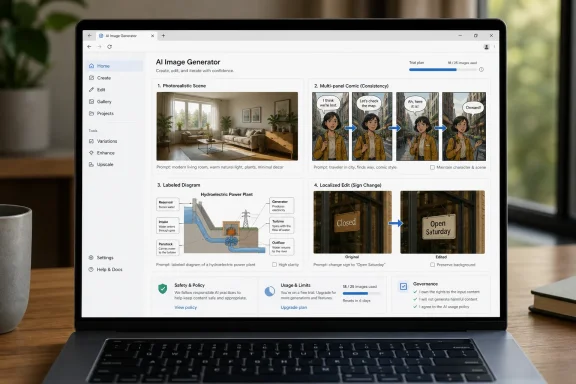
PCMag’s test categories are revealing: basic scenes, complex action, and text. A simple home interior tests realism and object consistency. A multi-panel comic tests continuity, sequencing, and narrative control. A labeled setup diagram tests one of the most stubborn weaknesses in generative imaging: the ability to place readable, accurate text in the right location.
That last test is especially important. For casual art, bad text is funny. For a diagram, ad, instruction sheet, product mockup, or training slide, bad text is a defect. A generator that can draw a beautiful workbench but labels a screwdriver as “flangor tool” is not production-ready; it is a liability with a glossy finish.
This is why Google’s Nano Banana Pro, OpenAI’s newer image systems inside ChatGPT, and Adobe’s Firefly strategy all matter for different reasons. Google has emphasized richer world knowledge and stronger text handling in Gemini’s image tools. OpenAI has pushed image generation deeper into conversational workflows, making editing and iteration feel less like prompt gambling. Adobe has leaned into commercial safety, editing, and integration with professional creative software.
The contest, then, is not only aesthetic. It is a contest over whether generated images can become dependable components in documents, presentations, ads, help articles, social posts, and internal communications. That is a much higher bar than producing a dramatic cyberpunk fox in the rain.
But the exclusion is defensible if the category is “full-service AI image generators” rather than “image-generation models.” Midjourney’s strength has long been taste: it can produce striking, stylized images with relatively little effort. Stable Diffusion’s strength is control: with the right interface, extensions, checkpoints, LoRAs, ControlNet-style workflows, and local hardware, it can do things closed services will not.
Those strengths are also weaknesses for a mainstream list. Midjourney can feel like an art machine first and a general-purpose utility second. Stable Diffusion can feel less like a product than a toolkit, especially when used through ComfyUI or local front ends. The enthusiast may see flexibility; the average buyer sees setup burden, hardware requirements, and too many dials.
This is not an insult to either ecosystem. It is a recognition that the market has split. One branch is for creators who want maximum control and are willing to learn a workflow. The other is for users who want a practical outcome quickly: a banner image, a concept illustration, an editable product mockup, or a diagram that does not hallucinate every label.
For Windows enthusiasts, that split is familiar. It is the difference between building a custom PC and buying a workstation. Both are valid. But a buying guide has to say which audience it is serving.
PCMag’s emphasis on localized edits is therefore the right test. A weak editor rewrites the whole image when asked to change one object. A better editor understands the requested region, preserves the rest of the scene, and makes the change without breaking lighting, perspective, faces, hands, or text. The best services increasingly behave less like slot machines and more like collaborative retouchers.
This matters for business adoption. A marketing team does not usually want to generate a random hero image from scratch; it wants to adjust a campaign visual without reshooting it. A help-desk team does not want a new fantasy interface; it wants an existing screenshot, illustration, or diagram updated with one corrected step. A small business owner may want to change a background, remove an object, or create a seasonal variation of a product image.
The local-editing problem also exposes the limits of model demos. A gallery can hide failure rates. A production workflow cannot. If a tool needs six generations to get the image right, and each generation unpredictably alters previously correct parts, the headline quality is less meaningful than the total cost of reaching a usable result.
That is where services with conversational editing have an advantage. Users increasingly expect to say, “Keep everything the same, but change the sign to read ‘Open Saturday’ and make the background less busy.” The generator that honors all three parts of that instruction wins more practical work than the generator that merely produces the prettiest first draft.
For a WindowsForum audience, this is where AI image generation intersects with the everyday work of sysadmins, trainers, and support professionals. A tool that can generate a clean diagram showing how to connect a router, label the WAN port correctly, and sequence the steps coherently is not a toy. It is a potential time-saver for documentation, onboarding, and internal knowledge bases.
But the risk is equally obvious. If the diagram looks professional but contains a wrong label, fake step, misleading cable path, or impossible configuration, it becomes more dangerous than a crude sketch. The polish creates trust the content may not deserve.
This is why the best testing frameworks now include text and instructions rather than just portraits and landscapes. Real users ask AI systems to create birthday invitations, mock product packaging, posters, menus, classroom materials, installation guides, UI concepts, and infographics. These tasks live or die by legibility and accuracy.
The industry has improved dramatically here, but the standard should remain unforgiving. An image generator that can spell “Settings” correctly nine times out of ten will still create support headaches on the tenth. When the output is instructional, review is not optional.
This is not surprising. Image generation is expensive to run. High-quality models consume serious compute, especially when users request multiple variations, higher resolutions, edits, or complex scenes. Free tiers are therefore shaped by caps, queues, model downgrades, watermarks, lower resolution, or limited access to advanced features.
Google’s Gemini image tools illustrate the new pattern well. Free users may get access to impressive models, but with limits, and those limits can push them back to less advanced models after a quota is reached. That is not a scandal; it is the economics of consumer AI becoming visible.
The challenge for buyers is that pricing pages rarely capture the real cost of use. A plan that looks cheap may become expensive if the model frequently needs rerolls. A more expensive subscription may be cheaper in practice if it produces usable output faster, includes better editing, or grants commercial rights that reduce legal uncertainty.
For IT departments, free tiers are even trickier. They invite shadow adoption. Employees experiment with whatever service is available, paste in prompts, upload reference images, and produce work artifacts before procurement, legal, or security teams have evaluated the platform. The real cost of “free” may arrive later in the form of data exposure, rights confusion, or inconsistent output quality across teams.
PCMag’s comparison notes that Copilot refuses certain real-person generation while Grok is more permissive. That contrast captures the broader industry divide. Microsoft, OpenAI, Google, Adobe, xAI, Meta, and smaller vendors are not merely competing on output quality. They are competing on trust boundaries.
Those boundaries matter because image generation is uniquely suited to abuse. Fake images can harass private individuals, impersonate public figures, fabricate evidence, inflame political conflict, or create reputational harm before corrections catch up. The better the technology gets, the less useful casual visual inspection becomes.
For ordinary users, the ethical guidance is not complicated: do not make deceptive or abusive images of real people. For platforms, the problem is harder. They need to distinguish parody, satire, entertainment, legitimate editing, consent-based use, public-interest commentary, and malicious impersonation at scale.
The services that seem “less restrictive” may feel more powerful in the short term. But permissiveness can become a liability for workplaces, schools, publications, and brands. An IT admin evaluating image tools should ask not only what the generator can do, but what it refuses to do and how consistently those refusals are enforced.
From a consumer perspective, this looks like choice. From an enterprise perspective, it looks like risk. A tool that allows sexual content, celebrity likeness generation, or weakly moderated outputs may be unacceptable on managed devices or corporate accounts, even if its general image quality is excellent.
That is especially true in mixed-use environments. Many modern AI tools blur personal and professional use: the same account might draft email, generate a product mockup, summarize a meeting, and create an image. If the service’s content policies are loose, the employer inherits a governance headache.
The safer approach is not necessarily to demand the most restrictive tool in every context. Artists, game developers, media organizations, and researchers may have legitimate reasons to use systems with broader generation capacity. But those decisions should be explicit, not accidental.
This is another reason service-level evaluation matters. A model might be technically capable of anything. A product has rules, logs, account controls, age gates, enterprise settings, and contractual terms. In 2026, those product layers are no longer secondary; they are part of the generator.
The broader copyright fight has not stopped the market. AI image generators continue to improve, subscriptions continue to sell, and major software vendors continue to embed generation into mainstream products. But unresolved legal questions still shape how businesses choose tools.
Adobe has tried to turn that anxiety into a product advantage by emphasizing commercially safe training sources and enterprise-friendly creative workflows. OpenAI and Google lean on general capability, ecosystem reach, and rapid model iteration. Smaller and more permissive tools often compete by doing what the large platforms refuse to do.
For readers, the lesson is not that one vendor is morally pure and the others are suspect. The lesson is that AI image generation is not a simple utility market. Rights, training data, indemnity, moderation, and brand risk are now buying criteria alongside prompt quality.
That is why a serious “best generator” list should never be read as a universal verdict. The best tool for a YouTube thumbnail may be wrong for a Fortune 500 campaign. The best tool for concept art may be wrong for a school district. The best tool for unrestricted experimentation may be wrong for a newsroom.
It will not. Some generators excel at photorealistic scenes but stumble on text. Some are wonderful for stylized art but poor at diagrams. Some offer strong editing but conservative content policies. Others allow more freedom but create riskier outputs. Some are easy for consumers but thin on enterprise controls.
The practical question is therefore not “Which AI image generator is best?” It is “Which generator fails least painfully for this use case?” A designer can tolerate a few strange generations if the tool produces a strong final visual. A technical writer cannot tolerate mislabeled steps. A social media manager may value speed and style. A compliance officer may value licensing and auditability.
Windows users should also consider where the tool lives. A browser-based generator is easy to access but may raise upload and data-retention questions. A generator embedded in a Microsoft, Google, or Adobe workflow may be easier to govern but harder to separate from broader account ecosystems. A local Stable Diffusion setup may offer privacy and customization but demands hardware, maintenance, and expertise.
That is why PCMag’s service-first approach is useful even for people who disagree with its exclusions. It asks the right mainstream question: if someone wants to use this today, how much friction stands between the prompt and a usable image?
A good test set should include the mundane. Ask for a realistic office scene with specific objects placed in specific locations. Ask for a diagram with labels that must be spelled correctly. Ask for a product image edit that changes only one element. Ask for a multi-step instructional visual where sequence matters. Then repeat the test later and see whether the service remains consistent.
Consistency is the underrated metric. A tool that occasionally produces brilliance but often ignores instructions is entertaining. A tool that reliably produces B-plus work may be more valuable. In business settings, predictable adequacy beats chaotic genius.
The same principle applies to safety. Test what the service refuses. Try prompts involving public figures, private individuals, copyrighted characters, medical claims, political persuasion, and explicit material if those categories are relevant to your environment. A vendor’s policy page is useful, but observed behavior is better.
Finally, count the rerolls. If it takes ten generations to get one acceptable image, the tool’s true cost is higher than the subscription price suggests. Time, attention, and review effort are part of the bill.
ChatGPT-style image generation is strongest when the user wants conversation, iteration, and natural-language editing. Gemini’s image tools are compelling where world knowledge, text handling, and Google ecosystem access matter. Adobe Firefly is attractive when commercial safety, Creative Cloud integration, and professional editing workflows matter more than raw experimentation. Grok and other more permissive tools appeal to users who want fewer restrictions, though that freedom comes with obvious governance concerns.
Midjourney and Stable Diffusion remain important despite their exclusion from a service-focused list. Midjourney still has a visual sensibility many artists admire. Stable Diffusion remains the flexible workshop for people willing to build and maintain their own stack. Their omission is less a verdict on quality than a reminder that “best” is now category-dependent.
This is exactly how mature software markets behave. There is no single best browser, editor, camera, laptop, or cloud platform for every user. There are defaults, specialists, enterprise choices, hobbyist tools, and riskier edge cases. AI image generation has finally become normal enough to be judged the same way.
 The Best Generator Is Now the One That Behaves Like Software
For years, image-generation discourse revolved around model names: Midjourney, Stable Diffusion, DALL-E, Imagen, Firefly. That made sense when the people most interested in the category were hobbyists, designers, researchers, and tinkerers willing to tolerate rough edges in exchange for dazzling output. But the 2026 buyer is different. The new mainstream user does not want a model; they want a service.That is the key editorial turn in PCMag’s framing. The publication excludes local generation setups and treats even famous names like Midjourney and Stable Diffusion as insufficiently service-like for this particular comparison. That does not mean those systems are irrelevant. It means the consumer category has shifted toward tools that can be opened in a browser, prompted in plain English, and judged on whether they deliver usable output without setup rituals.
This is the same pattern we have seen in every maturing technology market. Early adopters reward raw capability. Mainstream users reward reliability, packaging, policy, price, and workflow. The best AI image generator of 2026 is therefore not necessarily the model with the most spectacular gallery examples; it is the product that least often forces the user to understand why the underlying model failed.
That distinction matters for Windows users and IT professionals because AI image generation is increasingly entering ordinary productivity workflows. It is showing up in browser apps, office suites, creative tools, marketing platforms, chatbots, and customer-support content pipelines. Once image generation becomes a feature inside larger software ecosystems, “best” stops meaning “prettiest output in a showcase” and starts meaning “least risky tool to deploy, train, support, and explain.”
Prompt Fidelity Has Become the New Megapixel Race
The old way to compare image generators was to look at resolution, style, or aesthetic polish. Those still matter, but they are no longer the hard part. The hard part is instruction following.PCMag’s test categories are revealing: basic scenes, complex action, and text. A simple home interior tests realism and object consistency. A multi-panel comic tests continuity, sequencing, and narrative control. A labeled setup diagram tests one of the most stubborn weaknesses in generative imaging: the ability to place readable, accurate text in the right location.
That last test is especially important. For casual art, bad text is funny. For a diagram, ad, instruction sheet, product mockup, or training slide, bad text is a defect. A generator that can draw a beautiful workbench but labels a screwdriver as “flangor tool” is not production-ready; it is a liability with a glossy finish.
This is why Google’s Nano Banana Pro, OpenAI’s newer image systems inside ChatGPT, and Adobe’s Firefly strategy all matter for different reasons. Google has emphasized richer world knowledge and stronger text handling in Gemini’s image tools. OpenAI has pushed image generation deeper into conversational workflows, making editing and iteration feel less like prompt gambling. Adobe has leaned into commercial safety, editing, and integration with professional creative software.
The contest, then, is not only aesthetic. It is a contest over whether generated images can become dependable components in documents, presentations, ads, help articles, social posts, and internal communications. That is a much higher bar than producing a dramatic cyberpunk fox in the rain.
The Midjourney Problem Is Really a Product Problem
PCMag’s decision to leave Midjourney and Stable Diffusion out of the main list is bound to annoy power users. Both remain culturally important. Midjourney’s artistic style helped define the public imagination of AI art, while Stable Diffusion remains central to local, open, and highly customizable generation workflows.But the exclusion is defensible if the category is “full-service AI image generators” rather than “image-generation models.” Midjourney’s strength has long been taste: it can produce striking, stylized images with relatively little effort. Stable Diffusion’s strength is control: with the right interface, extensions, checkpoints, LoRAs, ControlNet-style workflows, and local hardware, it can do things closed services will not.
Those strengths are also weaknesses for a mainstream list. Midjourney can feel like an art machine first and a general-purpose utility second. Stable Diffusion can feel less like a product than a toolkit, especially when used through ComfyUI or local front ends. The enthusiast may see flexibility; the average buyer sees setup burden, hardware requirements, and too many dials.
This is not an insult to either ecosystem. It is a recognition that the market has split. One branch is for creators who want maximum control and are willing to learn a workflow. The other is for users who want a practical outcome quickly: a banner image, a concept illustration, an editable product mockup, or a diagram that does not hallucinate every label.
For Windows enthusiasts, that split is familiar. It is the difference between building a custom PC and buying a workstation. Both are valid. But a buying guide has to say which audience it is serving.
Image Editing Is Where the Marketing Claims Meet Reality
Text-to-image generation gets the attention, but image editing is where these tools become genuinely useful. The difference is simple: generation creates a new artifact; editing modifies an existing one. In the real world, most users already have something they want to improve.PCMag’s emphasis on localized edits is therefore the right test. A weak editor rewrites the whole image when asked to change one object. A better editor understands the requested region, preserves the rest of the scene, and makes the change without breaking lighting, perspective, faces, hands, or text. The best services increasingly behave less like slot machines and more like collaborative retouchers.
This matters for business adoption. A marketing team does not usually want to generate a random hero image from scratch; it wants to adjust a campaign visual without reshooting it. A help-desk team does not want a new fantasy interface; it wants an existing screenshot, illustration, or diagram updated with one corrected step. A small business owner may want to change a background, remove an object, or create a seasonal variation of a product image.
The local-editing problem also exposes the limits of model demos. A gallery can hide failure rates. A production workflow cannot. If a tool needs six generations to get the image right, and each generation unpredictably alters previously correct parts, the headline quality is less meaningful than the total cost of reaching a usable result.
That is where services with conversational editing have an advantage. Users increasingly expect to say, “Keep everything the same, but change the sign to read ‘Open Saturday’ and make the background less busy.” The generator that honors all three parts of that instruction wins more practical work than the generator that merely produces the prettiest first draft.
Text in Images Is No Longer a Gimmick Test
The labeled-diagram test is deceptively brutal. It asks a generator to combine visual layout, semantic understanding, spelling, object recognition, and instructional logic. That is not just art. It is document creation.For a WindowsForum audience, this is where AI image generation intersects with the everyday work of sysadmins, trainers, and support professionals. A tool that can generate a clean diagram showing how to connect a router, label the WAN port correctly, and sequence the steps coherently is not a toy. It is a potential time-saver for documentation, onboarding, and internal knowledge bases.
But the risk is equally obvious. If the diagram looks professional but contains a wrong label, fake step, misleading cable path, or impossible configuration, it becomes more dangerous than a crude sketch. The polish creates trust the content may not deserve.
This is why the best testing frameworks now include text and instructions rather than just portraits and landscapes. Real users ask AI systems to create birthday invitations, mock product packaging, posters, menus, classroom materials, installation guides, UI concepts, and infographics. These tasks live or die by legibility and accuracy.
The industry has improved dramatically here, but the standard should remain unforgiving. An image generator that can spell “Settings” correctly nine times out of ten will still create support headaches on the tenth. When the output is instructional, review is not optional.
Free Is a Funnel, Not a Business Model
The question “Is AI image generation free?” has a simple answer and a complicated reality. Yes, many services offer free generation. No, the best experience is usually not free for long.This is not surprising. Image generation is expensive to run. High-quality models consume serious compute, especially when users request multiple variations, higher resolutions, edits, or complex scenes. Free tiers are therefore shaped by caps, queues, model downgrades, watermarks, lower resolution, or limited access to advanced features.
Google’s Gemini image tools illustrate the new pattern well. Free users may get access to impressive models, but with limits, and those limits can push them back to less advanced models after a quota is reached. That is not a scandal; it is the economics of consumer AI becoming visible.
The challenge for buyers is that pricing pages rarely capture the real cost of use. A plan that looks cheap may become expensive if the model frequently needs rerolls. A more expensive subscription may be cheaper in practice if it produces usable output faster, includes better editing, or grants commercial rights that reduce legal uncertainty.
For IT departments, free tiers are even trickier. They invite shadow adoption. Employees experiment with whatever service is available, paste in prompts, upload reference images, and produce work artifacts before procurement, legal, or security teams have evaluated the platform. The real cost of “free” may arrive later in the form of data exposure, rights confusion, or inconsistent output quality across teams.
Real People Are the Policy Minefield
The ability to generate images of real people is one of the sharpest dividing lines between services. Some tools refuse or restrict it heavily. Others allow it more freely. The technical capability is no longer the central question; the policy posture is.PCMag’s comparison notes that Copilot refuses certain real-person generation while Grok is more permissive. That contrast captures the broader industry divide. Microsoft, OpenAI, Google, Adobe, xAI, Meta, and smaller vendors are not merely competing on output quality. They are competing on trust boundaries.
Those boundaries matter because image generation is uniquely suited to abuse. Fake images can harass private individuals, impersonate public figures, fabricate evidence, inflame political conflict, or create reputational harm before corrections catch up. The better the technology gets, the less useful casual visual inspection becomes.
For ordinary users, the ethical guidance is not complicated: do not make deceptive or abusive images of real people. For platforms, the problem is harder. They need to distinguish parody, satire, entertainment, legitimate editing, consent-based use, public-interest commentary, and malicious impersonation at scale.
The services that seem “less restrictive” may feel more powerful in the short term. But permissiveness can become a liability for workplaces, schools, publications, and brands. An IT admin evaluating image tools should ask not only what the generator can do, but what it refuses to do and how consistently those refusals are enforced.
NSFW Capability Is a Feature Until It Becomes a Governance Problem
The adult-content question is often treated as a sideshow, but it is part of the same policy landscape. Some services prohibit NSFW image generation. Others allow more. Dedicated adult generators exist because mainstream tools often do not want the legal, reputational, and moderation burden.From a consumer perspective, this looks like choice. From an enterprise perspective, it looks like risk. A tool that allows sexual content, celebrity likeness generation, or weakly moderated outputs may be unacceptable on managed devices or corporate accounts, even if its general image quality is excellent.
That is especially true in mixed-use environments. Many modern AI tools blur personal and professional use: the same account might draft email, generate a product mockup, summarize a meeting, and create an image. If the service’s content policies are loose, the employer inherits a governance headache.
The safer approach is not necessarily to demand the most restrictive tool in every context. Artists, game developers, media organizations, and researchers may have legitimate reasons to use systems with broader generation capacity. But those decisions should be explicit, not accidental.
This is another reason service-level evaluation matters. A model might be technically capable of anything. A product has rules, logs, account controls, age gates, enterprise settings, and contractual terms. In 2026, those product layers are no longer secondary; they are part of the generator.
The Lawsuit Disclosure Is a Reminder That AI Rankings Are Not Neutral Terrain
The disclosure that Ziff Davis, PCMag’s parent company, sued OpenAI in April 2025 over alleged copyright infringement is important, not because it invalidates PCMag’s testing, but because it reminds readers that generative AI is being evaluated inside a contested media economy. Publications are reviewing tools built by companies accused of training on publishers’ work. That tension is now part of the story.The broader copyright fight has not stopped the market. AI image generators continue to improve, subscriptions continue to sell, and major software vendors continue to embed generation into mainstream products. But unresolved legal questions still shape how businesses choose tools.
Adobe has tried to turn that anxiety into a product advantage by emphasizing commercially safe training sources and enterprise-friendly creative workflows. OpenAI and Google lean on general capability, ecosystem reach, and rapid model iteration. Smaller and more permissive tools often compete by doing what the large platforms refuse to do.
For readers, the lesson is not that one vendor is morally pure and the others are suspect. The lesson is that AI image generation is not a simple utility market. Rights, training data, indemnity, moderation, and brand risk are now buying criteria alongside prompt quality.
That is why a serious “best generator” list should never be read as a universal verdict. The best tool for a YouTube thumbnail may be wrong for a Fortune 500 campaign. The best tool for concept art may be wrong for a school district. The best tool for unrestricted experimentation may be wrong for a newsroom.
The Winner Depends on the Job You Actually Need Done
A modern AI image generator should be judged against the work it is supposed to perform. That sounds obvious, but the market still encourages magical thinking. Users see one stunning output and assume the tool will be equally good at everything.It will not. Some generators excel at photorealistic scenes but stumble on text. Some are wonderful for stylized art but poor at diagrams. Some offer strong editing but conservative content policies. Others allow more freedom but create riskier outputs. Some are easy for consumers but thin on enterprise controls.
The practical question is therefore not “Which AI image generator is best?” It is “Which generator fails least painfully for this use case?” A designer can tolerate a few strange generations if the tool produces a strong final visual. A technical writer cannot tolerate mislabeled steps. A social media manager may value speed and style. A compliance officer may value licensing and auditability.
Windows users should also consider where the tool lives. A browser-based generator is easy to access but may raise upload and data-retention questions. A generator embedded in a Microsoft, Google, or Adobe workflow may be easier to govern but harder to separate from broader account ecosystems. A local Stable Diffusion setup may offer privacy and customization but demands hardware, maintenance, and expertise.
That is why PCMag’s service-first approach is useful even for people who disagree with its exclusions. It asks the right mainstream question: if someone wants to use this today, how much friction stands between the prompt and a usable image?
The Smart Buyer Tests the Failures, Not the Demos
The best way to evaluate an AI image generator is to bring your own prompts and your own failure criteria. Vendor examples are optimized to flatter the model. Real work is not.A good test set should include the mundane. Ask for a realistic office scene with specific objects placed in specific locations. Ask for a diagram with labels that must be spelled correctly. Ask for a product image edit that changes only one element. Ask for a multi-step instructional visual where sequence matters. Then repeat the test later and see whether the service remains consistent.
Consistency is the underrated metric. A tool that occasionally produces brilliance but often ignores instructions is entertaining. A tool that reliably produces B-plus work may be more valuable. In business settings, predictable adequacy beats chaotic genius.
The same principle applies to safety. Test what the service refuses. Try prompts involving public figures, private individuals, copyrighted characters, medical claims, political persuasion, and explicit material if those categories are relevant to your environment. A vendor’s policy page is useful, but observed behavior is better.
Finally, count the rerolls. If it takes ten generations to get one acceptable image, the tool’s true cost is higher than the subscription price suggests. Time, attention, and review effort are part of the bill.
The 2026 Shortlist Is Really a Map of Trade-Offs
The AI image market is no longer waiting for one model to conquer everything. It is organizing into recognizable product philosophies. That is good news for users, because it means choice is becoming more meaningful.ChatGPT-style image generation is strongest when the user wants conversation, iteration, and natural-language editing. Gemini’s image tools are compelling where world knowledge, text handling, and Google ecosystem access matter. Adobe Firefly is attractive when commercial safety, Creative Cloud integration, and professional editing workflows matter more than raw experimentation. Grok and other more permissive tools appeal to users who want fewer restrictions, though that freedom comes with obvious governance concerns.
Midjourney and Stable Diffusion remain important despite their exclusion from a service-focused list. Midjourney still has a visual sensibility many artists admire. Stable Diffusion remains the flexible workshop for people willing to build and maintain their own stack. Their omission is less a verdict on quality than a reminder that “best” is now category-dependent.
This is exactly how mature software markets behave. There is no single best browser, editor, camera, laptop, or cloud platform for every user. There are defaults, specialists, enterprise choices, hobbyist tools, and riskier edge cases. AI image generation has finally become normal enough to be judged the same way.
The Practical Reading of PCMag’s 2026 AI Image Picks
The useful lesson from this year’s testing is not that one generator has ended the race. It is that image generation has become a service-quality contest, and the best products are those that combine output quality with control, editing, policy, and reliability.- Users should test AI image generators with their own real prompts rather than relying on vendor galleries or social-media examples.
- Services that handle text, diagrams, and localized edits well are more useful for work than services that only produce beautiful standalone images.
- Free tiers are best treated as trials, because caps, downgrades, and resolution limits can change the practical experience quickly.
- Tools that allow real-person or NSFW generation require extra scrutiny before they belong on workplace accounts or managed devices.
- Midjourney and Stable Diffusion remain powerful, but they serve a different audience than browser-first consumer and business services.
- The right choice depends on whether the user values realism, editing, commercial safety, permissiveness, ecosystem integration, or local control most.
References
- Primary source: PCMag Australia
Published: 2026-06-24T20:50:29.584506
The Best AI Image Generators for 2026
We've tested the top AI image generation apps to help you find the one that produces the best results for the lowest price.au.pcmag.com - Official source: openai.com
Introducing 4o Image Generation | OpenAI
At OpenAI, we have long believed image generation should be a primary capability of our language models. That’s why we’ve built our most advanced image generator yet into GPT‑4o. The result—image generation that is not only beautiful, but useful.openai.com - Related coverage: blog.laozhang.ai
Gemini 3 Pro Image Free Tier: Complete 2026 Guide (What's Actually Free + 5 Workarounds) | LaoZhang AI Blog
Gemini 3 Pro Image (Nano Banana Pro) has no free API tier as of February 2026. But you can still generate images for free through $300 new-user credits (2,238 images), AI Studio web access, Flash Image free tier, and more. This guide covers every free access path plus cost optimization strategies.blog.laozhang.ai - Related coverage: techradar.com
Google launches Nano Banana Pro, a massive leap in AI image editing powered by Gemini 3 Pro | TechRadar
Visualize any idea and design anythingwww.techradar.com - Related coverage: tomsguide.com
Best AI image generators of 2025 | Tom's Guide
Create stunning art from text or imageswww.tomsguide.com - Official source: cdn.openai.com
