

In 2026, the strongest self-improving AI platforms are not simply the chatbots with the loudest launches, but the systems with the largest feedback loops, fastest model refresh cycles, deepest tool integrations, and clearest ability to turn user corrections into better future behavior. That puts ChatGPT, Gemini, Microsoft Copilot, Claude, GitHub Copilot, DeepSeek, Doubao, Grok, Vellum, and Hermes-style agent frameworks in the serious conversation. But the ranking is less tidy than the hype suggests. “Self-improving AI” has become the industry’s most convenient phrase for a messy stack of reinforcement learning, telemetry, retrieval, tool use, fine-tuning, enterprise data grounding, and old-fashioned product iteration.
The first trap in any “top 10 self-improving AI platforms” list is the phrase itself. Most commercial AI systems do not rewrite their own model weights while you chat with them. They improve through a pipeline: usage data, preference signals, error reports, human review, synthetic training data, benchmark pressure, and model updates shipped later.
That distinction matters because it separates science fiction from what IT buyers actually deploy. A model that remembers your writing style may feel self-improving, but that is often profile memory or retrieval. A coding agent that retries a failed test may be adapting within a task, but that is not the same thing as recursively upgrading its own intelligence.
The commercial reality is still impressive. The leading platforms now observe outcomes, call tools, inspect errors, revise plans, and feed anonymized or governed signals back into future releases. They are becoming better because they are surrounded by giant learning systems, not because every individual chatbot instance has become an autonomous research lab.
This is why the 2026 ranking belongs to ecosystems, not isolated models. The winners are the platforms with enough users, integrations, compute, and governance to turn repeated failure into measurable improvement.
That feedback loop is the closest thing the AI market has to a global nervous system. Every refusal that frustrates users, every tool call that fails, every coding answer that gets corrected, and every workflow that succeeds can inform product and model development. OpenAI does not need every signal to be used directly in training for the platform to improve from use; the sheer volume of observable behavior shapes prioritization.
The company’s strategy has also shifted from “answer engine” toward “action system.” Deep research, code execution, browser-style task completion, custom assistants, and API-based agents all move ChatGPT closer to the place where improvement can be measured by outcomes rather than vibes. Did the code run? Did the spreadsheet reconcile? Did the agent finish the report? Those are richer signals than a thumbs-up button.
For Windows users and IT administrators, ChatGPT’s strength is also its risk. It is powerful precisely because it reaches across documents, code, workflows, and third-party tools. The same breadth that makes it useful makes governance, logging, data retention, and permission design essential rather than optional.
The important 2026 shift is that Gemini is no longer best understood as a chatbot attached to Google Search. Google is pushing it as an agentic platform, with faster Flash-class models, developer tooling, workspace actions, and personal-agent concepts designed to sit between the user and their digital routine. That is where self-improvement becomes commercially meaningful.
Gemini’s advantage is ambient context. If the assistant can see the email, the calendar invite, the Drive folder, and the search trail, it can produce better answers without necessarily being a smarter base model. Over time, Google can tune the system around which actions users accept, which summaries they edit, and which suggestions they ignore.
The caveat is trust. Google has spent decades monetizing user attention and behavioral signals. In enterprise AI, that history cuts both ways: it gives Gemini unmatched context, but it also forces Google to keep proving that productivity AI is governed by clear data boundaries rather than advertising-era instincts.
Copilot’s self-improvement story is organizational rather than purely personal. A company can use Copilot Studio and Microsoft’s agent tooling to build assistants grounded in internal documents, workflows, and business data. The model may not be learning new weights from every employee, but the system can become more useful as it is connected to better knowledge sources, refined prompts, analytics, actions, and permissions.
That is a practical version of self-improvement IT departments can understand. The agent that mishandles HR policy can be corrected by changing its grounding source, topic design, tool policy, or escalation path. The sales assistant that gives vague answers can be improved by connecting it to CRM data and measuring which responses lead to completed tasks.
But Microsoft’s biggest risk is also familiar to WindowsForum readers: forced-feeling integration. Copilot can be genuinely useful, especially in Teams summaries, document drafting, and Excel analysis, but Microsoft has sometimes treated AI as a layer to be inserted everywhere before users have asked for it. The platform’s future depends on whether Copilot becomes a trusted colleague or another ribbon button people learn to ignore.
Claude’s self-improvement story is tied to Anthropic’s research culture. The company has been unusually explicit about frontier-model risks, model behavior, alignment, and the possibility that AI systems may accelerate AI development itself. That does not mean Claude is sitting in a lab recursively improving itself overnight. It does mean Anthropic treats improvement dynamics as a first-order product and safety issue.
Claude has also become a favorite in developer and writing-heavy workflows because it is good at maintaining coherence across long tasks. Tool use, code execution, computer-control experiments, and multi-step reasoning make it a credible agent platform rather than just a polished conversationalist. Its improvements often show up as fewer brittle failures rather than spectacular demo moments.
For enterprise IT, Claude’s appeal is that it feels designed for organizations that want power with restraint. The open question is whether Anthropic can match the distribution advantages of Microsoft and Google without losing the carefulness that made Claude distinctive.
That makes coding assistants different from general chatbots. The output is not merely persuasive text; it is executable work. Copilot can learn from language ecosystems, repository context, IDE behavior, project conventions, and the millions of micro-decisions developers make every day.
By 2026, GitHub Copilot is no longer just autocomplete with a marketing budget. It has expanded into chat, pull-request help, test generation, refactoring, documentation, and agentic workflows that can operate across issues and repositories. Microsoft’s broader agent strategy also gives Copilot a path into enterprise software delivery pipelines.
The governance challenge is equally concrete. Organizations need to know when code was AI-generated, whether secrets or proprietary patterns are exposed, how licenses are handled, and whether agentic coding tools can modify production-adjacent systems. Copilot’s future will be shaped as much by auditability as by benchmark wins.
That gives DeepSeek a different kind of self-improvement loop. It is not just one company watching a product telemetry dashboard. It is a community of developers, researchers, local deployers, and downstream toolmakers testing the models in varied environments and pushing improvements back through fine-tunes, forks, evaluations, and deployment patterns.
The open ecosystem is messy, but it is powerful. A closed platform can improve quickly when the company has enough data and compute. An open model family can improve unpredictably because thousands of users adapt it for tasks the original lab never prioritized. That is why DeepSeek belongs in the top tier even if its enterprise governance story varies by deployment.
For Western IT departments, DeepSeek also raises procurement and compliance questions. Data residency, model provenance, security review, and geopolitical exposure cannot be waved away. But as a technical force, it has pushed the whole market toward cheaper inference, more open evaluation, and less patience for vague claims about model superiority.
Doubao’s self-improvement advantage is ByteDance’s native expertise in engagement loops. Few companies understand large-scale behavioral optimization better. If Doubao is integrated into content creation, short video, voice interfaces, search-like discovery, and app workflows, it can improve around user behavior at a scale most enterprise AI vendors never see.
That strength also makes Doubao a warning. Systems optimized around engagement can become excellent at giving users what keeps them interacting, which is not always the same as giving them what is accurate, healthy, or useful. The same feedback loops that improve creative tools can also amplify low-quality content if incentives are wrong.
Still, Doubao demonstrates that the global AI race is not simply OpenAI versus Google versus Microsoft. China’s AI platforms are evolving inside different app ecosystems, regulatory constraints, hardware pressures, and user behaviors. Their innovations may not map neatly onto Western enterprise software, but they will influence the market.
As a self-improving platform, Grok’s advantage is exposure to real-time human argument. Trends, memes, breaking news, political discourse, product complaints, and social reactions all move quickly through X. A model connected to that stream can feel more current than systems that rely primarily on static training cutoffs and slower browsing workflows.
But real-time data is not automatically high-quality data. Social platforms are full of jokes, bots, propaganda, exaggeration, and coordinated campaigns. A system that learns too eagerly from that environment risks becoming fast rather than right.
Grok’s place in the top 10 is therefore justified but conditional. It is a strong platform for real-time awareness and personality-driven interaction. It is less obviously the best choice for enterprise knowledge work, regulated industries, or tasks where careful sourcing matters more than speed.
That distinction is crucial. Developers increasingly want control over memory, tools, model routing, local execution, logging, retrieval, and task policies. A personal agent that can run in a local or semi-local environment, call command-line tools, remember project context, and improve its own workflows through recorded outcomes may be more valuable to a power user than a glossy consumer chatbot.
Hermes-style CLI agents push this even further. They turn the agent into infrastructure: something that can sit on a server, call tools, manage skills, operate across providers, and preserve traces of what worked. In that world, “self-improvement” often means refining prompts, choosing better models, pruning bad skills, and adjusting execution policies based on prior runs.
These platforms are also where many risks appear first. A developer agent with shell access is not a toy. If it can edit files, run commands, call APIs, and persist memory, it needs the same respect administrators give scripts, scheduled tasks, and privileged automation.
DeepSeek improves through open ecosystem pressure. Doubao improves through consumer-scale engagement loops. Grok improves through live social data. Vellum and Hermes improve through user-controlled agent memory, tooling, and iteration.
Those are not interchangeable strengths. A sysadmin choosing an AI assistant for documentation, PowerShell help, and ticket triage has different needs from a developer choosing a coding agent or a marketer choosing a content system. The best platform is not the one with the biggest benchmark number; it is the one whose feedback loop matches the work.
This is where many 2026 AI rankings become misleading. They compare chatbot fluency, coding benchmarks, image generation, agentic workflows, enterprise adoption, and open-source extensibility as if those were a single scoreboard. They are not. They are overlapping markets that share model technology but differ radically in incentives.
A better ranking is contextual. For general users, ChatGPT and Gemini lead. For Microsoft-heavy organizations, Copilot is unavoidable. For cautious enterprise reasoning and writing, Claude is a top contender. For developers, GitHub Copilot, DeepSeek, Vellum, and Hermes-like frameworks deserve special attention.
Windows has always been a platform where convenience and control fight for space. AI raises the stakes because the assistant is no longer just presenting information; it may summarize confidential files, draft messages, alter code, trigger workflows, and recommend configuration changes. An improving agent can become more useful over time, but it can also become more deeply embedded before an organization has fully understood its permissions.
Microsoft’s approach will matter most for mainstream Windows environments. Copilot’s integration into Microsoft 365 and Windows gives it unmatched reach, but administrators will need strong defaults for data boundaries, audit logs, retention, connector permissions, and agent management. The enterprise AI era will punish vague governance.
The same is true outside Microsoft’s stack. ChatGPT Enterprise, Claude, Gemini, GitHub Copilot, and self-hosted open models all require policy decisions. Which data can be uploaded? Which tools can agents call? Which outputs require review? Which workflows are allowed to run unattended? These are operational questions, not philosophical ones.
Claude belongs fourth because it is one of the most trusted high-end systems for reasoning, writing, coding, and safer agent design. GitHub Copilot should arguably be fifth, ahead of broader consumer platforms, because software development offers unusually measurable feedback loops. DeepSeek follows because open models and low-cost performance have reshaped expectations across the industry.
Doubao deserves a high global position because China’s consumer AI scale is too large to ignore. Grok is a credible real-time specialist but less clearly a general enterprise platform. Vellum and Hermes-style agents round out the list as developer-centric systems that point toward where personal and server-side automation may go next.
That order is not sacred. It depends on whether one values global deployment, raw model quality, openness, autonomy, enterprise controls, coding productivity, or real-time awareness. But it is a more defensible frame than treating every AI product as if it were competing to be the same universal assistant.
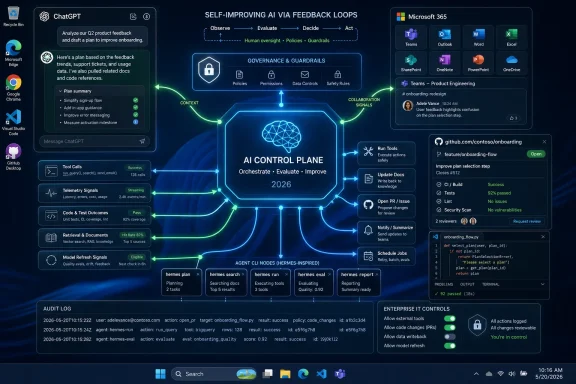 The Best AI Platforms Are Improving Around the User, Not Inside the User’s Session
The first trap in any “top 10 self-improving AI platforms” list is the phrase itself. Most commercial AI systems do not rewrite their own model weights while you chat with them. They improve through a pipeline: usage data, preference signals, error reports, human review, synthetic training data, benchmark pressure, and model updates shipped later.That distinction matters because it separates science fiction from what IT buyers actually deploy. A model that remembers your writing style may feel self-improving, but that is often profile memory or retrieval. A coding agent that retries a failed test may be adapting within a task, but that is not the same thing as recursively upgrading its own intelligence.
The commercial reality is still impressive. The leading platforms now observe outcomes, call tools, inspect errors, revise plans, and feed anonymized or governed signals back into future releases. They are becoming better because they are surrounded by giant learning systems, not because every individual chatbot instance has become an autonomous research lab.
This is why the 2026 ranking belongs to ecosystems, not isolated models. The winners are the platforms with enough users, integrations, compute, and governance to turn repeated failure into measurable improvement.
ChatGPT Remains the Default Benchmark Because Scale Is a Learning Engine
ChatGPT still deserves the top slot because it has become the consumer and developer reference point for general-purpose AI. OpenAI’s advantage is not just model quality; it is the enormous surface area of interaction. Chat, voice, image generation, file analysis, code execution, custom GPTs, API usage, enterprise deployments, and agentic workflows all produce signals about what users are trying to accomplish.That feedback loop is the closest thing the AI market has to a global nervous system. Every refusal that frustrates users, every tool call that fails, every coding answer that gets corrected, and every workflow that succeeds can inform product and model development. OpenAI does not need every signal to be used directly in training for the platform to improve from use; the sheer volume of observable behavior shapes prioritization.
The company’s strategy has also shifted from “answer engine” toward “action system.” Deep research, code execution, browser-style task completion, custom assistants, and API-based agents all move ChatGPT closer to the place where improvement can be measured by outcomes rather than vibes. Did the code run? Did the spreadsheet reconcile? Did the agent finish the report? Those are richer signals than a thumbs-up button.
For Windows users and IT administrators, ChatGPT’s strength is also its risk. It is powerful precisely because it reaches across documents, code, workflows, and third-party tools. The same breadth that makes it useful makes governance, logging, data retention, and permission design essential rather than optional.
Gemini Is Google’s Bet That Context Beats Conversation
Google Gemini ranks near the top because Google owns some of the most valuable context layers in computing: Search, Android, Chrome, Gmail, Docs, Drive, Calendar, YouTube, and enterprise Workspace. A model that lives inside those surfaces can learn not only from prompts but from tasks, documents, schedules, clicks, edits, and search behavior.The important 2026 shift is that Gemini is no longer best understood as a chatbot attached to Google Search. Google is pushing it as an agentic platform, with faster Flash-class models, developer tooling, workspace actions, and personal-agent concepts designed to sit between the user and their digital routine. That is where self-improvement becomes commercially meaningful.
Gemini’s advantage is ambient context. If the assistant can see the email, the calendar invite, the Drive folder, and the search trail, it can produce better answers without necessarily being a smarter base model. Over time, Google can tune the system around which actions users accept, which summaries they edit, and which suggestions they ignore.
The caveat is trust. Google has spent decades monetizing user attention and behavioral signals. In enterprise AI, that history cuts both ways: it gives Gemini unmatched context, but it also forces Google to keep proving that productivity AI is governed by clear data boundaries rather than advertising-era instincts.
Microsoft Copilot Wins the Office, Then Has to Prove the Office Wants Agents
Microsoft Copilot is the most important AI platform for enterprise Windows environments because it is embedded where work already happens. Word, Excel, Outlook, Teams, SharePoint, OneDrive, Windows, Power Platform, GitHub, Defender, and Azure give Microsoft an integration map no startup can replicate. If AI adoption is partly a distribution game, Microsoft began on third base.Copilot’s self-improvement story is organizational rather than purely personal. A company can use Copilot Studio and Microsoft’s agent tooling to build assistants grounded in internal documents, workflows, and business data. The model may not be learning new weights from every employee, but the system can become more useful as it is connected to better knowledge sources, refined prompts, analytics, actions, and permissions.
That is a practical version of self-improvement IT departments can understand. The agent that mishandles HR policy can be corrected by changing its grounding source, topic design, tool policy, or escalation path. The sales assistant that gives vague answers can be improved by connecting it to CRM data and measuring which responses lead to completed tasks.
But Microsoft’s biggest risk is also familiar to WindowsForum readers: forced-feeling integration. Copilot can be genuinely useful, especially in Teams summaries, document drafting, and Excel analysis, but Microsoft has sometimes treated AI as a layer to be inserted everywhere before users have asked for it. The platform’s future depends on whether Copilot becomes a trusted colleague or another ribbon button people learn to ignore.
Claude Has Become the Serious Person’s Agent
Anthropic’s Claude occupies a different place in the market. It is less defined by distribution and more by reliability, writing quality, coding competence, long-context reasoning, and safety positioning. In enterprise settings, that matters. Many organizations do not want the flashiest assistant; they want the one least likely to behave like a caffeinated intern with admin rights.Claude’s self-improvement story is tied to Anthropic’s research culture. The company has been unusually explicit about frontier-model risks, model behavior, alignment, and the possibility that AI systems may accelerate AI development itself. That does not mean Claude is sitting in a lab recursively improving itself overnight. It does mean Anthropic treats improvement dynamics as a first-order product and safety issue.
Claude has also become a favorite in developer and writing-heavy workflows because it is good at maintaining coherence across long tasks. Tool use, code execution, computer-control experiments, and multi-step reasoning make it a credible agent platform rather than just a polished conversationalist. Its improvements often show up as fewer brittle failures rather than spectacular demo moments.
For enterprise IT, Claude’s appeal is that it feels designed for organizations that want power with restraint. The open question is whether Anthropic can match the distribution advantages of Microsoft and Google without losing the carefulness that made Claude distinctive.
GitHub Copilot Is the Cleanest Proof That Feedback Loops Matter
GitHub Copilot may be the most concrete example of self-improving AI because software development produces unusually clear signals. A suggestion is accepted or rejected. A test passes or fails. A pull request gets merged or rewritten. A developer keeps using the tool or turns it off.That makes coding assistants different from general chatbots. The output is not merely persuasive text; it is executable work. Copilot can learn from language ecosystems, repository context, IDE behavior, project conventions, and the millions of micro-decisions developers make every day.
By 2026, GitHub Copilot is no longer just autocomplete with a marketing budget. It has expanded into chat, pull-request help, test generation, refactoring, documentation, and agentic workflows that can operate across issues and repositories. Microsoft’s broader agent strategy also gives Copilot a path into enterprise software delivery pipelines.
The governance challenge is equally concrete. Organizations need to know when code was AI-generated, whether secrets or proprietary patterns are exposed, how licenses are handled, and whether agentic coding tools can modify production-adjacent systems. Copilot’s future will be shaped as much by auditability as by benchmark wins.
DeepSeek Turned Cost Into a Form of Pressure
DeepSeek’s rise changed the AI market because it challenged the assumption that frontier-adjacent capability must always come with frontier-lab pricing. Its open-weight and developer-friendly posture made it especially influential among builders who want to inspect, fine-tune, distill, or host models closer to their own infrastructure.That gives DeepSeek a different kind of self-improvement loop. It is not just one company watching a product telemetry dashboard. It is a community of developers, researchers, local deployers, and downstream toolmakers testing the models in varied environments and pushing improvements back through fine-tunes, forks, evaluations, and deployment patterns.
The open ecosystem is messy, but it is powerful. A closed platform can improve quickly when the company has enough data and compute. An open model family can improve unpredictably because thousands of users adapt it for tasks the original lab never prioritized. That is why DeepSeek belongs in the top tier even if its enterprise governance story varies by deployment.
For Western IT departments, DeepSeek also raises procurement and compliance questions. Data residency, model provenance, security review, and geopolitical exposure cannot be waved away. But as a technical force, it has pushed the whole market toward cheaper inference, more open evaluation, and less patience for vague claims about model superiority.
Doubao Shows What Happens When AI Meets a Super-App Culture
ByteDance’s Doubao is not as familiar to many U.S. Windows users as ChatGPT or Copilot, but it belongs on any global 2026 list. In China, it has become one of the leading consumer AI assistants, backed by ByteDance’s formidable content, recommendation, and mobile-product machinery. That matters because AI adoption is not just about model quality; it is about habit formation.Doubao’s self-improvement advantage is ByteDance’s native expertise in engagement loops. Few companies understand large-scale behavioral optimization better. If Doubao is integrated into content creation, short video, voice interfaces, search-like discovery, and app workflows, it can improve around user behavior at a scale most enterprise AI vendors never see.
That strength also makes Doubao a warning. Systems optimized around engagement can become excellent at giving users what keeps them interacting, which is not always the same as giving them what is accurate, healthy, or useful. The same feedback loops that improve creative tools can also amplify low-quality content if incentives are wrong.
Still, Doubao demonstrates that the global AI race is not simply OpenAI versus Google versus Microsoft. China’s AI platforms are evolving inside different app ecosystems, regulatory constraints, hardware pressures, and user behaviors. Their innovations may not map neatly onto Western enterprise software, but they will influence the market.
Grok Is the Real-Time Wildcard
Grok’s value proposition is obvious: it is tied to X and to the live, chaotic, constantly updating stream of social conversation. That makes it fundamentally different from assistants built around documents, code, or office workflows. Grok is strongest when freshness, public discourse, and rapid reaction matter.As a self-improving platform, Grok’s advantage is exposure to real-time human argument. Trends, memes, breaking news, political discourse, product complaints, and social reactions all move quickly through X. A model connected to that stream can feel more current than systems that rely primarily on static training cutoffs and slower browsing workflows.
But real-time data is not automatically high-quality data. Social platforms are full of jokes, bots, propaganda, exaggeration, and coordinated campaigns. A system that learns too eagerly from that environment risks becoming fast rather than right.
Grok’s place in the top 10 is therefore justified but conditional. It is a strong platform for real-time awareness and personality-driven interaction. It is less obviously the best choice for enterprise knowledge work, regulated industries, or tasks where careful sourcing matters more than speed.
Vellum and Hermes Represent the Developer Counterculture
Vellum and Hermes-style agent frameworks occupy the bottom of the top 10 not because they are unimportant, but because they are different. They are not mass-market assistants in the same sense as ChatGPT, Gemini, or Copilot. They are platforms for people who want to build, run, customize, and observe agents rather than merely subscribe to them.That distinction is crucial. Developers increasingly want control over memory, tools, model routing, local execution, logging, retrieval, and task policies. A personal agent that can run in a local or semi-local environment, call command-line tools, remember project context, and improve its own workflows through recorded outcomes may be more valuable to a power user than a glossy consumer chatbot.
Hermes-style CLI agents push this even further. They turn the agent into infrastructure: something that can sit on a server, call tools, manage skills, operate across providers, and preserve traces of what worked. In that world, “self-improvement” often means refining prompts, choosing better models, pruning bad skills, and adjusting execution policies based on prior runs.
These platforms are also where many risks appear first. A developer agent with shell access is not a toy. If it can edit files, run commands, call APIs, and persist memory, it needs the same respect administrators give scripts, scheduled tasks, and privileged automation.
The Ranking Changes When “Self-Improving” Means Something Specific
A simple top 10 list hides the fact that different platforms improve in different ways. ChatGPT improves through enormous general usage. Gemini improves through context and Google integration. Copilot improves through enterprise grounding and workflow analytics. Claude improves through careful model iteration and safety-focused research. GitHub Copilot improves through executable feedback from developers.DeepSeek improves through open ecosystem pressure. Doubao improves through consumer-scale engagement loops. Grok improves through live social data. Vellum and Hermes improve through user-controlled agent memory, tooling, and iteration.
Those are not interchangeable strengths. A sysadmin choosing an AI assistant for documentation, PowerShell help, and ticket triage has different needs from a developer choosing a coding agent or a marketer choosing a content system. The best platform is not the one with the biggest benchmark number; it is the one whose feedback loop matches the work.
This is where many 2026 AI rankings become misleading. They compare chatbot fluency, coding benchmarks, image generation, agentic workflows, enterprise adoption, and open-source extensibility as if those were a single scoreboard. They are not. They are overlapping markets that share model technology but differ radically in incentives.
A better ranking is contextual. For general users, ChatGPT and Gemini lead. For Microsoft-heavy organizations, Copilot is unavoidable. For cautious enterprise reasoning and writing, Claude is a top contender. For developers, GitHub Copilot, DeepSeek, Vellum, and Hermes-like frameworks deserve special attention.
Windows Users Should Care Less About the Hype and More About the Control Plane
For WindowsForum’s audience, the central issue is not whether AI platforms are improving. They are. The issue is who controls the improvement loop, what data enters it, and whether administrators can see what the agent is doing.Windows has always been a platform where convenience and control fight for space. AI raises the stakes because the assistant is no longer just presenting information; it may summarize confidential files, draft messages, alter code, trigger workflows, and recommend configuration changes. An improving agent can become more useful over time, but it can also become more deeply embedded before an organization has fully understood its permissions.
Microsoft’s approach will matter most for mainstream Windows environments. Copilot’s integration into Microsoft 365 and Windows gives it unmatched reach, but administrators will need strong defaults for data boundaries, audit logs, retention, connector permissions, and agent management. The enterprise AI era will punish vague governance.
The same is true outside Microsoft’s stack. ChatGPT Enterprise, Claude, Gemini, GitHub Copilot, and self-hosted open models all require policy decisions. Which data can be uploaded? Which tools can agents call? Which outputs require review? Which workflows are allowed to run unattended? These are operational questions, not philosophical ones.
The 2026 List, With the Marketing Stripped Out
The strongest ranking for 2026 puts ChatGPT first because it combines frontier capability, massive adoption, a mature API, consumer reach, and increasingly agentic workflows. Gemini follows because Google’s context advantage is immense and its models are becoming more action-oriented. Microsoft Copilot comes third because enterprise distribution and Microsoft 365 integration make it one of the most consequential AI platforms in the world, even if user enthusiasm is uneven.Claude belongs fourth because it is one of the most trusted high-end systems for reasoning, writing, coding, and safer agent design. GitHub Copilot should arguably be fifth, ahead of broader consumer platforms, because software development offers unusually measurable feedback loops. DeepSeek follows because open models and low-cost performance have reshaped expectations across the industry.
Doubao deserves a high global position because China’s consumer AI scale is too large to ignore. Grok is a credible real-time specialist but less clearly a general enterprise platform. Vellum and Hermes-style agents round out the list as developer-centric systems that point toward where personal and server-side automation may go next.
That order is not sacred. It depends on whether one values global deployment, raw model quality, openness, autonomy, enterprise controls, coding productivity, or real-time awareness. But it is a more defensible frame than treating every AI product as if it were competing to be the same universal assistant.
The Real Contest Is Between Feedback Loops
The clearest takeaways from the 2026 market are not hidden in benchmark tables. They are visible in how each platform turns usage into product momentum.- ChatGPT remains the strongest general-purpose self-improving AI platform because it combines scale, model quality, tools, APIs, and broad user feedback.
- Gemini is the leading challenger when context matters because Google can place AI inside Search, Android, Chrome, Gmail, Workspace, and developer tools.
- Microsoft Copilot is the most consequential enterprise AI platform for Windows and Microsoft 365 environments, but its success depends on governance and user trust.
- Claude is the platform to watch for reliable reasoning, long-context work, coding, and safety-conscious agent design.
- GitHub Copilot is the clearest example of outcome-driven AI improvement because developer acceptance, tests, and pull requests create unusually concrete feedback.
- DeepSeek, Doubao, Grok, Vellum, and Hermes-style agents prove that self-improvement is not one market but several competing models of iteration.
References
- Primary source: Nubia Magazine!
Published: 2026-06-22T08:34:08.014177
Top 10 Best Self Improving AI Platforms In The Worlds 2026 | Nubia Magazine
The concept of artificial intelligence that can refine its own behavior without constant human reprogramming has moved from theoretical research to...nubiapage.com - Related coverage: techradar.com
5 prompts that show how the new Gemini 3.5 Flash is its best AI model yet | TechRadar
Google promises the latest model can handle creativity and complexitywww.techradar.com - Related coverage: vellum.ai
8 Best Open-Source Personal AI Assistants in 2026
The best open-source personal AI assistants in 2026 — reviewed and compared on action capability, memory, privacy, and setup friction. www.vellum.ai
- Related coverage: remoteopenclaw.com
Best Hermes Agent Model 2026: Claude vs DeepSeek | Remote OpenClaw
Compare the best Hermes Agent models for quality, budget, local privacy, OpenRouter routing, and Ollama setups across Claude, DeepSeek, Llama, Qwen, GLM, and Kimi.remoteopenclaw.com - Related coverage: haimaker.ai
Best Models for Hermes Agent (2026): Tested & Ranked | haimaker.ai Blog
Which model should you run with Hermes Agent? Sonnet 4.6 for autonomous work, GPT-5.4 Codex for coding, MiniMax M2.5 for budget, Gemma 4 for local. Ranked.haimaker.ai
