

Microsoft is expected to use Build 2026, held June 2–3 at Fort Mason Center in San Francisco and online, to unveil Windows 11 developer updates, local AI tooling, new Microsoft AI models, Copilot consolidation, and GitHub reassurance aimed at developers. The headline is not simply that Microsoft has more AI to show. It is that Redmond is trying to move AI from a cloud service you rent into a Windows platform you build against. If Build lands, Windows becomes less of a passive host for AI apps and more of the control plane for agents, models, silicon, identity, and developer trust.
For most of the generative AI boom, Windows has been more distribution channel than center stage. Copilot arrived in the taskbar, cloud models answered prompts, and Microsoft’s biggest strategic advantage appeared to be Azure capacity plus an OpenAI partnership. That was powerful, but it made Windows feel like the glass through which AI passed rather than the machinery doing the work.
Build 2026 looks designed to change that impression. The reported focus on a developer-optimized Windows 11 experience, local model execution, and hardware partnerships around Nvidia and Qualcomm points to a more ambitious claim: Windows should be where AI applications are built, tested, secured, accelerated, and eventually run.
That matters because developer allegiance is not won by keynote demos alone. Developers follow the platform that gives them reliable tools, predictable APIs, hardware reach, deployable security models, and a reason not to spend half their week fighting the stack. Microsoft knows this better than anyone; the company built Windows by making it the default place to write software for the PC.
The risk is that AI has already trained developers to look elsewhere. Cloud APIs made model access easy. Apple has built a coherent story around local silicon and privacy. Linux remains the default substrate for much AI infrastructure work. Build is Microsoft’s chance to argue that Windows can be the place where local AI becomes normal instead of exotic.
That is why the reported emphasis on local models is more important than any single model name. Microsoft is trying to make Windows the layer that hides the ugly parts of today’s AI hardware landscape. A developer should not need to write one application path for an Nvidia GPU, another for a Qualcomm NPU, another for an Intel chip, another for AMD, and a sad fallback for everything else.
The promise is a Windows-native path where developers can target local inference without becoming silicon archaeologists. Windows ML, Windows AI Foundry, Foundry Local, ONNX Runtime, and Copilot Runtime are all pieces of that broader story. The branding is already dense enough to make even seasoned Microsoft watchers reach for a diagram, but the strategic intent is clear enough: Microsoft wants the Windows app model to absorb AI acceleration the way DirectX absorbed graphics complexity.
That analogy is useful because DirectX did not win by being elegant in isolation. It won because it gave developers a reason to target Windows and gave hardware vendors a reason to optimize for it. If Microsoft can do something similar for local AI, Build 2026 may be remembered less for its demos and more for the moment Windows started acting like an AI runtime.
This is not a small twist in the Copilot+ PC story. Microsoft’s original AI PC push leaned heavily on NPUs, especially Qualcomm’s Snapdragon X family, with the pitch that efficient local acceleration would unlock new Windows experiences. Nvidia brings a different center of gravity: massive developer mindshare, CUDA heritage, gamer credibility, creator workflows, and a long relationship with performance-hungry Windows users.
That gives Microsoft something it badly needs: an AI PC story that does not depend only on thin-and-light productivity machines. RTX Spark can be framed as a developer workstation, creator platform, gaming-adjacent AI box, and local agent machine. It makes the “AI PC” feel less like a label slapped on a laptop sticker and more like a class of hardware with real computational personality.
The catch is that Windows-on-Arm history is littered with promising launches that ran into compatibility anxiety. Microsoft can talk about Prism emulation, native app momentum, and optimized workloads, but developers and IT buyers remember the uneven past. Nvidia’s entrance raises the ceiling, but it also raises expectations: if this new class of Windows AI machines is expensive, specialized, or quirky, the market will treat it as a workstation niche rather than a mass reset.
Build is likely to reinforce that Microsoft does not want developers choosing between “real Windows” on x86 and “experimental Windows” on Arm. The company needs Arm to feel boring in the best sense: compatible, documented, predictable, and worth targeting. If local AI becomes a mainstream development target, native Arm64 support stops being a nice-to-have and becomes table stakes.
The broader Windows hardware ecosystem complicates the pitch. AMD and Intel still dominate huge portions of the installed base. Nvidia GPUs occupy another performance tier. Qualcomm and other Arm vendors push efficiency and integrated AI acceleration. Microsoft’s job is to make that diversity look like reach rather than fragmentation.
That is harder than it sounds. Developers will not embrace local AI if the same app behaves dramatically differently across supposedly modern PCs. IT departments will not standardize on AI features that work beautifully on a keynote machine and poorly on the laptops already deployed across the company. The Build message needs to be less “look what this flagship can do” and more “here is how you ship reliably across the messy reality of Windows hardware.”
For years, Windows developers have lived with a contradiction. Microsoft wants Windows to be the best development environment, yet many serious workflows require a stack of add-ons, terminal tweaks, package managers, virtualization layers, WSL configuration, SDK juggling, security exceptions, and personal muscle memory. The end result can be powerful, but it rarely feels curated.
A developer mode that is more than a settings toggle would acknowledge that modern software work has changed. A developer building AI-assisted apps may need local model tooling, container workflows, GitHub integration, GPU access, package reproducibility, secure secrets handling, terminal-first ergonomics, and fast context switching between code, documentation, test data, and agent output. That is not the same problem Visual Studio solved in 2005.
The danger is that Microsoft over-products the idea. Developers do not need a themed workspace that hides Windows under another layer of Copilot garnish. They need fast setup, fewer conflicts, transparent configuration, reliable rollback, and the confidence that the environment will not become another promotional surface. If Microsoft gets this right, it could make Windows feel deliberately built for modern development again.
A unified Copilot application would be an attempt to clean up that sprawl. If the reported Microsoft Scout agent arrives in preview by late summer, the company will likely frame it as a more coherent gateway to personal and work AI. The real test will be whether the app understands boundaries: local versus cloud, personal versus enterprise identity, file access versus application control, suggestion versus action.
Agents make those boundaries more important. A chatbot that answers incorrectly is frustrating. An agent that acts incorrectly can delete, send, schedule, modify, purchase, or expose information. Microsoft can only push a unified Copilot interface so far before users and administrators ask what exactly the agent can touch and how those permissions are audited.
This is where Windows gives Microsoft an advantage if it uses it well. The operating system already mediates identity, files, apps, credentials, device management, and security policy. A Copilot shell that respects those primitives could be more trustworthy than a browser tab with ambitions. A Copilot shell that hand-waves them will become the next enterprise disablement policy.
The reported positioning of MAI-Thinking-1 as an enterprise-focused reasoning model built without distillation is particularly interesting. “Reasoning model” has become a term of art for systems that spend more compute on multi-step problem solving. “Enterprise-focused” implies Microsoft wants to compete not only on benchmark theater but on reliability, governance, licensing, deployment, and integration with business data.
The “without distillation” claim, if presented on stage, will deserve scrutiny. Distillation has become a common way to train smaller models from larger ones, but it also raises competitive and legal questions when model lineage is unclear. Microsoft may be trying to signal clean-room credibility, differentiated architecture, or simply independence from the perception that everyone is copying everyone else.
MAI-Image-2.5, meanwhile, would fit the broader Copilot and Microsoft 365 content story. Image generation is no longer novel, but enterprise image generation remains constrained by safety, rights, branding, data handling, and workflow integration. Microsoft does not need the most flamboyant image model on the market. It needs one that businesses can turn on without immediately convening legal, security, and communications teams.
GitHub is not just another Microsoft asset. It is the social and operational substrate for a large portion of modern software development. It hosts code, issues, pull requests, releases, packages, security advisories, Actions workflows, Copilot integrations, and the public record of open-source collaboration. When GitHub stumbles, developers do not experience it as a Microsoft service blip; they experience it as a disruption to the nervous system of software work.
This matters even more as Microsoft tries to sell AI-assisted development. GitHub Copilot has been one of the company’s clearest AI wins, both commercially and culturally. But Copilot’s value depends on developer confidence in GitHub as a platform. If the community sees GitHub as unstable, neglected, over-commercialized, or strategically subordinate to Microsoft’s broader AI push, the trust account drains quickly.
Microsoft’s challenge is to speak concretely without sounding defensive. Developers will want service reliability investments, security improvements, transparency, and evidence that GitHub still has product autonomy where it counts. Vague promises to “reimagine developer productivity with AI” will not calm a community worried about outages and governance.
Microsoft’s reported emphasis on OS-enforced identity, containment, and manageability suggests it understands the issue. Those words matter because they map to the concerns administrators actually have. Who is the agent acting as? What resources can it access? Can its actions be logged? Can policies differ by user, device, data classification, tenant, or network state? Can the feature be disabled cleanly?
This is also where local AI is not automatically safer than cloud AI. Keeping inference on the device may reduce some data exposure, but it creates new local attack surfaces and new risks around prompt injection, model manipulation, tool abuse, and privilege confusion. A local agent with access to sensitive files can still cause damage if it is tricked into doing the wrong thing.
For enterprise IT, the acceptable answer will not be “trust the model.” It will be policy, isolation, logging, and recovery. Microsoft has the ingredients: Defender, Entra ID, Intune, Windows security boundaries, virtualization-based security, and years of enterprise management plumbing. Build needs to show how those ingredients become an agent security model rather than a slide full of nouns.
That hybrid model is likely the real future. Small models can summarize, classify, transcribe, search, transform, and automate locally. Larger reasoning models can handle deeper analysis when latency, privacy, or cost constraints allow. Developers will need orchestration layers that decide where work runs, how much context is exposed, and how gracefully the app degrades on older hardware.
Microsoft’s Windows pitch becomes compelling if it gives developers that orchestration without locking them into one vendor’s cloud. The company will naturally prefer Azure and Microsoft AI services, but developers are wary of platforms that begin as abstraction layers and end as toll roads. The more Windows local AI feels open, model-flexible, and hardware-aware, the more likely developers are to adopt it.
There is also a cost argument hiding in plain sight. AI features that rely entirely on cloud inference can become expensive at scale, especially for consumer apps or high-volume enterprise workflows. Local inference turns some of that recurring service cost into hardware utilization. That is attractive to Microsoft because it sells Windows PCs, but it is also attractive to developers trying to build sustainable AI features that do not collapse under their own usage bills.
Microsoft’s Build strategy appears aimed at solving the chicken-and-egg problem from the developer side. If developers get APIs, runtimes, models, toolchains, and hardware guidance, then applications might emerge that justify the machines. If applications justify the machines, OEMs can sell more AI-capable hardware. If the installed base grows, developers have more reason to target the platform.
That flywheel is familiar, but AI adds uncertainty. Unlike graphics or touch, AI features can often be approximated in the cloud, which weakens the need for specific local hardware. Microsoft must therefore show not merely that local AI is possible, but that it is better for certain workflows: private document work, low-latency coding assistants, local media generation, accessibility features, offline summarization, secure enterprise automation, and personal agents that should not phone home for every thought.
The industry also needs to avoid repeating the mistakes of early voice assistants. Those systems promised ambient intelligence but often delivered timers, trivia, and occasional frustration. Local Windows agents need to do real work in real applications, with enough reliability that users trust them beyond novelty. Build can start that story, but the app ecosystem has to finish it.
A Windows developer trying to understand Microsoft’s AI stack can already encounter Copilot Runtime, Windows AI Foundry, Foundry Local, Windows ML, ONNX Runtime, Azure AI Foundry, Semantic Kernel, DirectML, Phi models, GitHub Copilot, Visual Studio integrations, and Microsoft 365 Copilot extensibility. Some of those layers solve different problems. Some overlap. All require explanation.
Build is where Microsoft must turn the maze into a path. The company does not need to simplify the underlying architecture into a toy. It needs to give developers opinionated starting points: build this kind of app this way, target this runtime, use this model packaging method, test across this hardware matrix, apply this security boundary, deploy through this channel.
If Microsoft fails, developers will cherry-pick pieces while the broader platform pitch blurs. If it succeeds, Windows could become the most practical environment for hybrid AI app development, not because it is the prettiest or purest stack, but because it reaches the most users and gives enterprises the controls they demand.
For developers, that credibility gap matters. A development machine is not a billboard; it is a tool. If Microsoft wants Windows to be the center of AI development, it must treat developer attention as scarce and valuable. Distraction-free cannot be a slogan attached to a noisy operating system.
Performance improvements will also be judged harshly. AI workloads are resource-hungry, and local inference can expose bottlenecks in memory, storage, thermals, drivers, and power management. A Windows AI platform that makes laptops hot, fans loud, battery life unpredictable, or foreground apps sluggish will not earn long-term affection.
The best version of Microsoft’s message is almost conservative: Windows will become a better place to develop because it is faster, cleaner, more controllable, and more capable. That may not be as flashy as a new model demo, but it is what working developers will remember after the keynote stream ends.
Microsoft has spent the AI boom proving that it can move quickly when the prize is large enough; Build 2026 will show whether it can also move coherently. The opportunity is enormous: make Windows the place where AI agents become practical, local models become deployable, and developers regain a sense that the PC is not just surviving the AI era but shaping it. The danger is equally plain: if Microsoft adds another layer of branding without reducing complexity, developers will applaud the demos, close the stream, and keep building the future somewhere else.
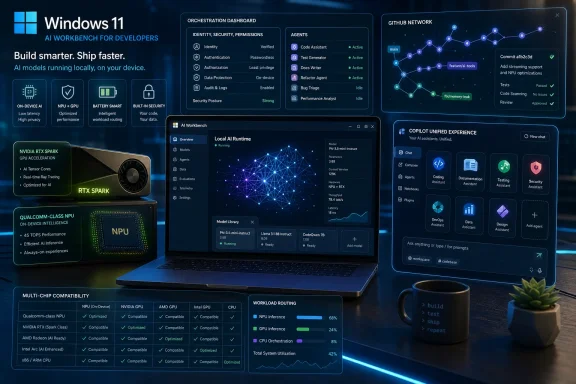 Microsoft Wants Windows to Be the AI Workbench, Not Just the Desktop
For most of the generative AI boom, Windows has been more distribution channel than center stage. Copilot arrived in the taskbar, cloud models answered prompts, and Microsoft’s biggest strategic advantage appeared to be Azure capacity plus an OpenAI partnership. That was powerful, but it made Windows feel like the glass through which AI passed rather than the machinery doing the work.Build 2026 looks designed to change that impression. The reported focus on a developer-optimized Windows 11 experience, local model execution, and hardware partnerships around Nvidia and Qualcomm points to a more ambitious claim: Windows should be where AI applications are built, tested, secured, accelerated, and eventually run.
That matters because developer allegiance is not won by keynote demos alone. Developers follow the platform that gives them reliable tools, predictable APIs, hardware reach, deployable security models, and a reason not to spend half their week fighting the stack. Microsoft knows this better than anyone; the company built Windows by making it the default place to write software for the PC.
The risk is that AI has already trained developers to look elsewhere. Cloud APIs made model access easy. Apple has built a coherent story around local silicon and privacy. Linux remains the default substrate for much AI infrastructure work. Build is Microsoft’s chance to argue that Windows can be the place where local AI becomes normal instead of exotic.
The Local AI Pitch Is Really a Platform Pitch
Running AI models locally sounds like a user feature: faster responses, better privacy, fewer cloud round trips, and useful offline behavior. But for Microsoft, local AI is primarily a platform strategy. If inference happens on the PC, Windows suddenly has leverage over model packaging, hardware abstraction, permissions, identity, containment, management, and app distribution.That is why the reported emphasis on local models is more important than any single model name. Microsoft is trying to make Windows the layer that hides the ugly parts of today’s AI hardware landscape. A developer should not need to write one application path for an Nvidia GPU, another for a Qualcomm NPU, another for an Intel chip, another for AMD, and a sad fallback for everything else.
The promise is a Windows-native path where developers can target local inference without becoming silicon archaeologists. Windows ML, Windows AI Foundry, Foundry Local, ONNX Runtime, and Copilot Runtime are all pieces of that broader story. The branding is already dense enough to make even seasoned Microsoft watchers reach for a diagram, but the strategic intent is clear enough: Microsoft wants the Windows app model to absorb AI acceleration the way DirectX absorbed graphics complexity.
That analogy is useful because DirectX did not win by being elegant in isolation. It won because it gave developers a reason to target Windows and gave hardware vendors a reason to optimize for it. If Microsoft can do something similar for local AI, Build 2026 may be remembered less for its demos and more for the moment Windows started acting like an AI runtime.
Nvidia’s RTX Spark Gives the AI PC a Sharper Edge
The most concrete pre-Build signal is Microsoft’s alignment with Nvidia around RTX Spark-powered Windows PCs. Nvidia says the platform combines a Blackwell RTX GPU, Grace CPU technology, high-bandwidth unified memory, and a full AI and graphics software stack. Microsoft’s Windows messaging adds the platform layer: agents, security primitives, manageability, and Windows compatibility.This is not a small twist in the Copilot+ PC story. Microsoft’s original AI PC push leaned heavily on NPUs, especially Qualcomm’s Snapdragon X family, with the pitch that efficient local acceleration would unlock new Windows experiences. Nvidia brings a different center of gravity: massive developer mindshare, CUDA heritage, gamer credibility, creator workflows, and a long relationship with performance-hungry Windows users.
That gives Microsoft something it badly needs: an AI PC story that does not depend only on thin-and-light productivity machines. RTX Spark can be framed as a developer workstation, creator platform, gaming-adjacent AI box, and local agent machine. It makes the “AI PC” feel less like a label slapped on a laptop sticker and more like a class of hardware with real computational personality.
The catch is that Windows-on-Arm history is littered with promising launches that ran into compatibility anxiety. Microsoft can talk about Prism emulation, native app momentum, and optimized workloads, but developers and IT buyers remember the uneven past. Nvidia’s entrance raises the ceiling, but it also raises expectations: if this new class of Windows AI machines is expensive, specialized, or quirky, the market will treat it as a workstation niche rather than a mass reset.
Qualcomm Still Matters Because the Future Cannot Be One Chip Vendor
Nvidia may deliver the sizzle, but Qualcomm remains central to Microsoft’s local AI ambitions. Snapdragon X systems helped define the first wave of Copilot+ PCs, and Arm-based Windows remains the best route Microsoft has to challenge Apple’s efficiency story. For enterprise fleets, battery life and thermals are not lifestyle details; they are procurement arguments.Build is likely to reinforce that Microsoft does not want developers choosing between “real Windows” on x86 and “experimental Windows” on Arm. The company needs Arm to feel boring in the best sense: compatible, documented, predictable, and worth targeting. If local AI becomes a mainstream development target, native Arm64 support stops being a nice-to-have and becomes table stakes.
The broader Windows hardware ecosystem complicates the pitch. AMD and Intel still dominate huge portions of the installed base. Nvidia GPUs occupy another performance tier. Qualcomm and other Arm vendors push efficiency and integrated AI acceleration. Microsoft’s job is to make that diversity look like reach rather than fragmentation.
That is harder than it sounds. Developers will not embrace local AI if the same app behaves dramatically differently across supposedly modern PCs. IT departments will not standardize on AI features that work beautifully on a keynote machine and poorly on the laptops already deployed across the company. The Build message needs to be less “look what this flagship can do” and more “here is how you ship reliably across the messy reality of Windows hardware.”
A Developer-Focused Windows 11 Mode Is an Admission and an Opportunity
The reported “developer-optimized experience” for Windows 11 may be one of the most revealing pieces of the Build agenda. A distraction-free environment with pre-installed apps, tools, performance improvements, and customization options sounds modest compared with new AI models. It is not.For years, Windows developers have lived with a contradiction. Microsoft wants Windows to be the best development environment, yet many serious workflows require a stack of add-ons, terminal tweaks, package managers, virtualization layers, WSL configuration, SDK juggling, security exceptions, and personal muscle memory. The end result can be powerful, but it rarely feels curated.
A developer mode that is more than a settings toggle would acknowledge that modern software work has changed. A developer building AI-assisted apps may need local model tooling, container workflows, GitHub integration, GPU access, package reproducibility, secure secrets handling, terminal-first ergonomics, and fast context switching between code, documentation, test data, and agent output. That is not the same problem Visual Studio solved in 2005.
The danger is that Microsoft over-products the idea. Developers do not need a themed workspace that hides Windows under another layer of Copilot garnish. They need fast setup, fewer conflicts, transparent configuration, reliable rollback, and the confidence that the environment will not become another promotional surface. If Microsoft gets this right, it could make Windows feel deliberately built for modern development again.
Copilot Consolidation Is a Necessary Retreat From Brand Sprawl
Microsoft’s reported plan to consolidate Copilot assistants into one interface is overdue. Copilot has become both a product and a suffix, attached to Windows, Microsoft 365, GitHub, Security, Azure, Edge, and assorted enterprise workflows. The strategy made sense during land-grab mode, but it created a user experience problem: people increasingly needed to know which Copilot they were talking to before they could know what it could do.A unified Copilot application would be an attempt to clean up that sprawl. If the reported Microsoft Scout agent arrives in preview by late summer, the company will likely frame it as a more coherent gateway to personal and work AI. The real test will be whether the app understands boundaries: local versus cloud, personal versus enterprise identity, file access versus application control, suggestion versus action.
Agents make those boundaries more important. A chatbot that answers incorrectly is frustrating. An agent that acts incorrectly can delete, send, schedule, modify, purchase, or expose information. Microsoft can only push a unified Copilot interface so far before users and administrators ask what exactly the agent can touch and how those permissions are audited.
This is where Windows gives Microsoft an advantage if it uses it well. The operating system already mediates identity, files, apps, credentials, device management, and security policy. A Copilot shell that respects those primitives could be more trustworthy than a browser tab with ambitions. A Copilot shell that hand-waves them will become the next enterprise disablement policy.
Mustafa Suleyman’s Models Signal Microsoft AI Wants Its Own Center of Gravity
The reported appearance of Microsoft AI chief Mustafa Suleyman with models such as MAI-Thinking-1 and MAI-Image-2.5 would mark another important shift. Microsoft has spent years benefiting from association with OpenAI, but it has also been building its own AI identity. New in-house models are a way to show that Microsoft AI is not merely a reseller, integrator, or UI layer for someone else’s frontier work.The reported positioning of MAI-Thinking-1 as an enterprise-focused reasoning model built without distillation is particularly interesting. “Reasoning model” has become a term of art for systems that spend more compute on multi-step problem solving. “Enterprise-focused” implies Microsoft wants to compete not only on benchmark theater but on reliability, governance, licensing, deployment, and integration with business data.
The “without distillation” claim, if presented on stage, will deserve scrutiny. Distillation has become a common way to train smaller models from larger ones, but it also raises competitive and legal questions when model lineage is unclear. Microsoft may be trying to signal clean-room credibility, differentiated architecture, or simply independence from the perception that everyone is copying everyone else.
MAI-Image-2.5, meanwhile, would fit the broader Copilot and Microsoft 365 content story. Image generation is no longer novel, but enterprise image generation remains constrained by safety, rights, branding, data handling, and workflow integration. Microsoft does not need the most flamboyant image model on the market. It needs one that businesses can turn on without immediately convening legal, security, and communications teams.
GitHub Is the Developer Trust Problem Microsoft Cannot Demo Away
The most delicate part of the reported Build agenda is GitHub. Microsoft is expected to address concerns after employee departures, outages, and security issues. That is not the kind of segment companies like to put in a celebratory developer keynote, but ignoring it would be worse.GitHub is not just another Microsoft asset. It is the social and operational substrate for a large portion of modern software development. It hosts code, issues, pull requests, releases, packages, security advisories, Actions workflows, Copilot integrations, and the public record of open-source collaboration. When GitHub stumbles, developers do not experience it as a Microsoft service blip; they experience it as a disruption to the nervous system of software work.
This matters even more as Microsoft tries to sell AI-assisted development. GitHub Copilot has been one of the company’s clearest AI wins, both commercially and culturally. But Copilot’s value depends on developer confidence in GitHub as a platform. If the community sees GitHub as unstable, neglected, over-commercialized, or strategically subordinate to Microsoft’s broader AI push, the trust account drains quickly.
Microsoft’s challenge is to speak concretely without sounding defensive. Developers will want service reliability investments, security improvements, transparency, and evidence that GitHub still has product autonomy where it counts. Vague promises to “reimagine developer productivity with AI” will not calm a community worried about outages and governance.
The Security Story Has to Move From Slogan to Mechanism
Local AI agents introduce a security problem that cannot be solved with upbeat language. If models can observe the screen, read documents, call tools, write code, modify settings, or interact with enterprise systems, then the operating system needs new ways to constrain behavior. Traditional app permissions were not designed for semi-autonomous software that reasons across contexts.Microsoft’s reported emphasis on OS-enforced identity, containment, and manageability suggests it understands the issue. Those words matter because they map to the concerns administrators actually have. Who is the agent acting as? What resources can it access? Can its actions be logged? Can policies differ by user, device, data classification, tenant, or network state? Can the feature be disabled cleanly?
This is also where local AI is not automatically safer than cloud AI. Keeping inference on the device may reduce some data exposure, but it creates new local attack surfaces and new risks around prompt injection, model manipulation, tool abuse, and privilege confusion. A local agent with access to sensitive files can still cause damage if it is tricked into doing the wrong thing.
For enterprise IT, the acceptable answer will not be “trust the model.” It will be policy, isolation, logging, and recovery. Microsoft has the ingredients: Defender, Entra ID, Intune, Windows security boundaries, virtualization-based security, and years of enterprise management plumbing. Build needs to show how those ingredients become an agent security model rather than a slide full of nouns.
The Windows Developer War Is Now About Latency, Privacy, and Control
The strongest argument for local AI is not that it replaces the cloud. It is that it changes the tradeoff developers can offer users. A cloud-only app must pay for tokens, wait for network round trips, manage data transfer, and explain where user information goes. A local-capable app can choose which work belongs on the device and which work merits the cloud.That hybrid model is likely the real future. Small models can summarize, classify, transcribe, search, transform, and automate locally. Larger reasoning models can handle deeper analysis when latency, privacy, or cost constraints allow. Developers will need orchestration layers that decide where work runs, how much context is exposed, and how gracefully the app degrades on older hardware.
Microsoft’s Windows pitch becomes compelling if it gives developers that orchestration without locking them into one vendor’s cloud. The company will naturally prefer Azure and Microsoft AI services, but developers are wary of platforms that begin as abstraction layers and end as toll roads. The more Windows local AI feels open, model-flexible, and hardware-aware, the more likely developers are to adopt it.
There is also a cost argument hiding in plain sight. AI features that rely entirely on cloud inference can become expensive at scale, especially for consumer apps or high-volume enterprise workflows. Local inference turns some of that recurring service cost into hardware utilization. That is attractive to Microsoft because it sells Windows PCs, but it is also attractive to developers trying to build sustainable AI features that do not collapse under their own usage bills.
The AI PC Needs Apps More Than It Needs Stickers
The PC industry has been eager to create a new upgrade cycle around AI. That is understandable. The pandemic hardware surge faded, Windows 10 support deadlines created one kind of refresh pressure, and AI offers another. But the phrase “AI PC” will remain mushy until users can point to applications that are meaningfully better on new hardware.Microsoft’s Build strategy appears aimed at solving the chicken-and-egg problem from the developer side. If developers get APIs, runtimes, models, toolchains, and hardware guidance, then applications might emerge that justify the machines. If applications justify the machines, OEMs can sell more AI-capable hardware. If the installed base grows, developers have more reason to target the platform.
That flywheel is familiar, but AI adds uncertainty. Unlike graphics or touch, AI features can often be approximated in the cloud, which weakens the need for specific local hardware. Microsoft must therefore show not merely that local AI is possible, but that it is better for certain workflows: private document work, low-latency coding assistants, local media generation, accessibility features, offline summarization, secure enterprise automation, and personal agents that should not phone home for every thought.
The industry also needs to avoid repeating the mistakes of early voice assistants. Those systems promised ambient intelligence but often delivered timers, trivia, and occasional frustration. Local Windows agents need to do real work in real applications, with enough reliability that users trust them beyond novelty. Build can start that story, but the app ecosystem has to finish it.
Microsoft’s Biggest Competitor Is Its Own Complexity
There is a familiar Microsoft pattern at work here. The company often sees the full enterprise map earlier than competitors: identity, management, compliance, developer tooling, cloud, desktop, productivity, security, silicon partnerships, and platform APIs. The strength is breadth. The weakness is that breadth can become a maze.A Windows developer trying to understand Microsoft’s AI stack can already encounter Copilot Runtime, Windows AI Foundry, Foundry Local, Windows ML, ONNX Runtime, Azure AI Foundry, Semantic Kernel, DirectML, Phi models, GitHub Copilot, Visual Studio integrations, and Microsoft 365 Copilot extensibility. Some of those layers solve different problems. Some overlap. All require explanation.
Build is where Microsoft must turn the maze into a path. The company does not need to simplify the underlying architecture into a toy. It needs to give developers opinionated starting points: build this kind of app this way, target this runtime, use this model packaging method, test across this hardware matrix, apply this security boundary, deploy through this channel.
If Microsoft fails, developers will cherry-pick pieces while the broader platform pitch blurs. If it succeeds, Windows could become the most practical environment for hybrid AI app development, not because it is the prettiest or purest stack, but because it reaches the most users and gives enterprises the controls they demand.
The Windows 11 Reset Is About Credibility as Much as Features
The reported developer-optimized Windows 11 experience also lands in a broader context: many Windows users want Microsoft to focus on performance, reliability, coherence, and restraint. The company’s AI ambitions have sometimes collided with user fatigue over ads, prompts, account nudges, unwanted widgets, and features that feel designed for Microsoft’s growth metrics rather than the customer’s workflow.For developers, that credibility gap matters. A development machine is not a billboard; it is a tool. If Microsoft wants Windows to be the center of AI development, it must treat developer attention as scarce and valuable. Distraction-free cannot be a slogan attached to a noisy operating system.
Performance improvements will also be judged harshly. AI workloads are resource-hungry, and local inference can expose bottlenecks in memory, storage, thermals, drivers, and power management. A Windows AI platform that makes laptops hot, fans loud, battery life unpredictable, or foreground apps sluggish will not earn long-term affection.
The best version of Microsoft’s message is almost conservative: Windows will become a better place to develop because it is faster, cleaner, more controllable, and more capable. That may not be as flashy as a new model demo, but it is what working developers will remember after the keynote stream ends.
The Build Bet Comes Down to Five Concrete Promises
Microsoft can wrap Build 2026 in agent language, model branding, and hardware excitement, but the practical stakes are more grounded. The company is asking developers and IT pros to believe that Windows can be trusted as the default platform for the next phase of AI software.- Microsoft is shifting the center of gravity from cloud-only Copilot features toward a hybrid model where Windows PCs run more AI work locally.
- Nvidia’s RTX Spark partnership gives Microsoft a higher-performance AI PC story, but it also revives hard questions about Windows-on-Arm compatibility and price.
- A developer-focused Windows 11 experience will only matter if it reduces setup friction, improves performance, and avoids becoming another promotional surface.
- Consolidating Copilot into one interface could reduce confusion, but agents will require strict boundaries around identity, permissions, logging, and enterprise policy.
- GitHub remains Microsoft’s most important developer trust asset, and Build’s reassurances will need to be operational rather than merely rhetorical.
Microsoft has spent the AI boom proving that it can move quickly when the prize is large enough; Build 2026 will show whether it can also move coherently. The opportunity is enormous: make Windows the place where AI agents become practical, local models become deployable, and developers regain a sense that the PC is not just surviving the AI era but shaping it. The danger is equally plain: if Microsoft adds another layer of branding without reducing complexity, developers will applaud the demos, close the stream, and keep building the future somewhere else.
References
- Primary source: Latest news from Azerbaijan
Published: Mon, 01 Jun 2026 15:43:03 GMT
Microsoft set to reveal AI models and developer tools at Build | News.az
The company plans to introduce a new developer-optimized experience for Windows 11, which will include a distraction-free environment with pre-install...news.az - Related coverage: axios.com
Microsoft debuts Nvidia-powered Microsoft Surface Ultra laptop
Microsoft is trying again to redefine the PC for the AI era.www.axios.com
- Related coverage: techradar.com
Windows 12 at Build 2026: What to expect | TechRadar
What Build 2026 signals about the future of the Windowswww.techradar.com - Official source: developer.microsoft.com
Microsoft Developer
Any platform. Any language. Our tools. Develop solutions, on your terms, using Microsoft products and services.developer.microsoft.com - Related coverage: nvidianews.nvidia.com
NVIDIA and Microsoft Reinvent Windows PCs for the Age of Personal AI | NVIDIA Newsroom
NVIDIA today unveiled NVIDIA RTX Spark™, a new superchip that reinvents Windows PCs for the era of personal AI agents — offering a new class of computer that moves from tool to teammate.nvidianews.nvidia.com - Related coverage: investor.nvidia.com
NVIDIA Corporation - NVIDIA and Microsoft Reinvent Windows PCs for the Age of Personal AI
RTX Spark — a 1-Petaflop Superchip, the Full CUDA and RTX Ecosystem, and Windows-Native Agents — a New Beginning for Personal Computers News Summary: NVIDIA RTX Spark powers the world’s first Windows PCs purpose-built for personal agents, featuring 1 petaflop of AI performance, industry-leading...investor.nvidia.com
- Related coverage: windowscentral.com
How to watch Microsoft Build 2026: Windows 11, NVIDIA RTX Spark, AI agents, and more | Windows Central
Build isn't just some boring developer conference. It showcases the future of Windows and computing.www.windowscentral.com - Related coverage: notebookcheck.net
Microsoft Build 2026: What to expect from the June 2 keynote - Notebookcheck News
Microsoft Build 2026 opens June 2 in San Francisco with AI agents, GitHub Copilot updates, and Windows local AI. Here is what developers can expect. www.notebookcheck.net
- Related coverage: tomshardware.com
Microsoft announces first test build for Windows 11 26H1, aimed at 'specific silicon' — Rumor mill suggests first "H1" release in Windows 11's history might be reserved for upcoming Arm PCs | Tom's Hardware
It's available for testing right now.www.tomshardware.com - Official source: learn.microsoft.com
Copilot+ PCs developer guide | Microsoft Learn
Developer guide for Windows Copilot+ PCs.learn.microsoft.com - Related coverage: tomsguide.com
Microsoft Build 2026 preview — all the big announcements to expect | Tom's Guide
Microsoft Build 2026 should be a showcase for the company's latest and upcoming AI efforts. Here are some of the big announcements we expect to see.www.tomsguide.com - Related coverage: qore.com
Microsoft Build 2026: Agentes de IA y computadoras Nvidia
Microsoft Build 2026: Agentes de IA autónomos y las nuevas computadoras con chips de Nvidia.www.qore.com - Related coverage: windowsforum.com
Microsoft Build 2026: MAI-Image 2.5, MAI-Voice 2, and MAI-Transcribe 1.5 | Windows Forum
Microsoft is preparing MAI-Image-2.5, MAI-Transcribe-1.5, and MAI-Voice-2 for its Build 2026 developer conference, which opens June 2 at Fort Mason Center...windowsforum.com - Official source: microsoft.com
- Official source: cdn-dynmedia-1.microsoft.com
Understanding Employee Productivity and Satisfaction Benefits of Next-Generation AI PCs as You Plan Your Next Refresh
IDC White Paper, sponsored by Microsoftcdn-dynmedia-1.microsoft.com
