

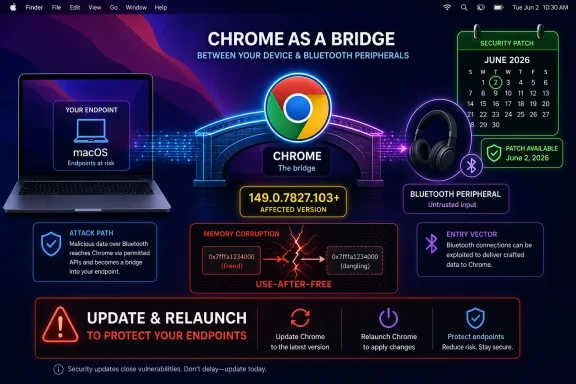
Google’s June 2026 Chrome security update fixed CVE-2026-11633, a critical use-after-free flaw in Chrome’s Bluetooth handling on macOS before version 149.0.7827.103 that could let a remote attacker execute code through a malicious peripheral. The bug is narrow in platform but broad in implication: Chrome is no longer just a browser looking at the web, but a broker between web content, device APIs, local radios, and operating-system trust boundaries. That makes this vulnerability less interesting as a one-off Bluetooth bug than as a warning about where browser attack surfaces have quietly moved.
For years, the comforting model of browser security was that the danger came through pages: a bad site, a malicious ad, a weaponized JavaScript engine exploit, or a compromised download. CVE-2026-11633 complicates that mental model because the stated attack path involves a malicious Bluetooth peripheral, not merely a poisoned web page. That distinction matters for defenders because it moves Chrome risk out of the purely virtual world and into the physical one.
The vulnerability is described as a use after free in Chrome’s Bluetooth component on Mac. In plain English, that means Chrome could keep using a region of memory after it had already been released, creating an opening for memory corruption and possible code execution. The weakness class, CWE-416, is old and well understood; the modern twist is where it appears.
Chrome’s Bluetooth support exists because browsers have steadily grown into application platforms. Web Bluetooth and related device-facing capabilities are meant to let web apps interact with nearby hardware, from development boards to point-of-sale gadgets to specialized enterprise devices. That is useful, but every bridge from browser code to hardware state is also a bridge attackers will eventually test.
The Mac-only scope should not lull anyone into treating this as a boutique problem. The affected configuration in NVD ties Chrome versions prior to 149.0.7827.103 to macOS, and the vendor advisory placed the fix in the Stable channel. For mixed fleets, that means the obvious question is not “Do we use Bluetooth?” but “Which Chrome builds are still running on which Macs, and how quickly can we prove they have moved?”
That apparent tension is familiar in vulnerability management. CVSS measures exploit mechanics and impact through a standardized lens; vendor severity often reflects product context, exploitability assumptions, and the security team’s own sense of risk. A browser bug that could reach arbitrary code execution, even when user interaction is required, is rarely something defenders should put in the “wait for the monthly patch cycle” bucket.
The user-interaction requirement is also less comforting than it sounds. Many enterprise Bluetooth workflows already involve pairing, selecting, trusting, or otherwise interacting with devices. Users are conditioned to approve prompts when trying to connect headphones, conference-room gear, lab equipment, or hardware tokens, and attackers have always exploited the gap between a technical warning and a user’s immediate task.
The better way to read CVE-2026-11633 is not as a drive-by web exploit in the classic sense. It is a browser-mediated peripheral exploit: a case where the browser’s expanding authority over local hardware creates an attack surface that security teams may not be inventorying with the same urgency as JavaScript engine bugs.
The hard part is proving coverage. Chrome’s auto-update system is excellent for consumer machines and decent for many managed environments, but “auto-update exists” is not the same thing as “every endpoint is remediated.” Sleeping laptops, blocked update services, pinned enterprise versions, broken management profiles, and users who never relaunch the browser can all turn a one-day patch into a two-week exposure window.
On macOS fleets, this is especially important because browser management often sits awkwardly between desktop engineering and security operations. Apple’s own update channels, MDM controls, third-party patch tools, and Google’s update mechanisms can all overlap. If ownership is fuzzy, Chrome versions drift.
The right operational response is therefore more prosaic than dramatic. Inventory Chrome versions, prioritize macOS devices below 149.0.7827.103, force or prompt relaunches where necessary, and confirm that managed update policies are actually applying. If Bluetooth is unnecessary for a class of users, review whether device access can be constrained by policy, but do not treat Bluetooth restrictions as a substitute for patching.
That is not unusual. The vulnerability ecosystem is a relay race: vendors publish advisories, CVE records land, ADP participants enrich them, NVD adds configurations and analysis, scanners ingest the data, and enterprises wait for their tools to agree. During that window, defenders often see partial metadata, mismatched severities, or incomplete affected-product mappings.
CVE-2026-11633 is a good example of why teams should avoid over-indexing on a single field. If a dashboard says “NVD score unavailable,” that does not mean the issue is unimportant. If another feed says “High” while Chromium says “Critical,” that does not mean someone is wrong. It means the organization needs a policy for translating multiple severity sources into action.
The CPE question in the NVD record is also more than a clerical detail. NIST added a configuration combining Google Chrome up to but excluding 149.0.7827.103 with Apple macOS. That is the kind of machine-readable mapping scanners depend on, but browser vulnerabilities are often messier than CPEs make them look, particularly when Chromium-derived browsers, enterprise repackaging, and platform-specific builds enter the picture.
Those Macs often have exactly the privileges attackers want. Developers keep credentials, SSH keys, cloud CLIs, source repositories, package registries, and internal dashboards close at hand. Executives keep email, documents, calendars, and messaging apps. A browser compromise on a Mac may not be the shortest path to Active Directory, but it can be an excellent path into SaaS, source code, identity tokens, and corporate communications.
CVE-2026-11633 also lands in an era when the browser is increasingly the enterprise desktop. The operating system matters, but less of the workday lives in native apps than it used to. If Chrome is the front door to identity, productivity, admin consoles, and cloud infrastructure, then a Chrome RCE on macOS is not a “Mac problem.” It is an enterprise access problem wearing a Mac badge.
For WindowsForum readers, the obvious comparison is not “Windows versus Mac.” It is Edge, Chrome, and Chromium as shared infrastructure. Microsoft Edge does not automatically inherit every Chrome-branded CVE in the same way or on the same schedule, but Chromium’s common codebase means IT teams must watch browser advisories as ecosystem events, not merely vendor-specific footnotes.
A malicious peripheral attack does not need to look like a Hollywood gadget. It could be a small device in a meeting room, a conference booth, a shared workspace, a lab, or a public area where users are already trying to connect hardware. The public CVE text does not confirm such scenarios for this bug, but the risk model is clear enough: proximity plus user interaction is still a viable enterprise threat in the right environment.
The lesson is not to panic about every Bluetooth device. It is to recognize that local radios have become part of the browser threat model. Web platform features that expose hardware capabilities should be governed with the same seriousness as camera, microphone, location, clipboard, and USB permissions.
Chrome and macOS both contain permission models, prompts, and sandboxing layers, but those controls are not magic. Memory-safety bugs often matter because they bypass the assumptions those layers depend on. Once code execution enters the picture, the distinction between “the user approved a device” and “the browser remained in control” becomes much less reassuring.
Chrome has invested heavily in hardening, sandboxing, fuzzing, site isolation, and memory-safety mitigations. Those investments have made exploitation harder, but they have not erased memory corruption. The continued appearance of UAF bugs is one reason the industry keeps inching toward memory-safe languages and stricter component isolation.
Bluetooth-facing code adds another layer of statefulness. Devices appear and disappear, connections open and close, permissions are granted and revoked, and operating-system APIs mediate the hardware. That is exactly the kind of lifecycle complexity where a stale object can hide until someone finds the right sequence of events.
For defenders, the important point is that “critical browser vulnerability” does not always mean “malicious website only.” Browser internals now include graphics stacks, media parsers, USB, Bluetooth, file handling, password managers, sync engines, AI features, and extension APIs. Each subsystem has its own failure modes, and attackers do not care which one gives them the cleanest path.
Still, the neighborhood matters. When a Chrome update contains a known exploited bug alongside a critical Bluetooth memory-safety flaw, the patching calculus changes. Attackers study patch diffs, security researchers reverse fixes, and exploit developers look for related weaknesses or useful primitives. Even bugs without public exploitation can become more interesting once the code changes are visible.
This is one reason browser vendors restrict access to bug details until enough users have updated. Security transparency is valuable, but premature detail can help attackers more than defenders. The Chromium issue linked from the CVE record is permission-restricted, which is standard practice for sensitive bugs during the rollout window.
Administrators should resist the temptation to rank this update by only one headline CVE. The presence of an exploited V8 bug may be what gets the emergency ticket opened, but CVE-2026-11633 is part of the same practical answer: update the browser now, verify completion, and treat lagging endpoints as exposed.
Chrome enterprise policies can restrict or shape access to sensitive features, and macOS management can govern Bluetooth behavior at the device level. The exact policy mix will vary, but the strategic point is consistent: device APIs should not be left entirely to individual user prompts in high-risk environments. A prompt is a weak control when the user’s goal is to get the thing working.
Security teams should also segment their thinking by user population. Developers, hardware teams, labs, healthcare, retail, manufacturing, and field operations may legitimately need browser-to-device workflows. Finance, legal, HR, executives, and many office users probably do not need arbitrary web-origin access to Bluetooth peripherals. Treating those groups identically is administratively convenient and strategically lazy.
The mature posture is not “disable everything.” It is default-deny where practical, explicitly allow where business-justified, and monitor the exception list. That posture turns a future Bluetooth or USB browser bug from a fleet-wide scramble into a scoped incident.
The Chrome version number is the cleanest dividing line. On macOS, anything before 149.0.7827.103 is in the vulnerable range described by the CVE. If a management console cannot answer how many Macs are below that build, the vulnerability has revealed an asset-management problem as much as a browser problem.
There is also a communications issue. Users often do not understand that a browser can be “updated” but not protected until it restarts. Chrome’s relaunch requirement can turn a downloaded fix into a pending fix, and pending fixes are not enough when the bug class is code execution. Administrators should be willing to force restarts for high-severity browser updates, especially when the advisory cycle includes active exploitation of a neighboring Chrome flaw.
The best patch programs are boring because they are practiced. CVE-2026-11633 should be handled through that muscle memory: identify, deploy, validate, close the loop. If the organization is improvising those steps for a Chrome update in 2026, the browser has outrun the process.
 The Browser Has Become a Peripheral Manager
For years, the comforting model of browser security was that the danger came through pages: a bad site, a malicious ad, a weaponized JavaScript engine exploit, or a compromised download. CVE-2026-11633 complicates that mental model because the stated attack path involves a malicious Bluetooth peripheral, not merely a poisoned web page. That distinction matters for defenders because it moves Chrome risk out of the purely virtual world and into the physical one.The vulnerability is described as a use after free in Chrome’s Bluetooth component on Mac. In plain English, that means Chrome could keep using a region of memory after it had already been released, creating an opening for memory corruption and possible code execution. The weakness class, CWE-416, is old and well understood; the modern twist is where it appears.
Chrome’s Bluetooth support exists because browsers have steadily grown into application platforms. Web Bluetooth and related device-facing capabilities are meant to let web apps interact with nearby hardware, from development boards to point-of-sale gadgets to specialized enterprise devices. That is useful, but every bridge from browser code to hardware state is also a bridge attackers will eventually test.
The Mac-only scope should not lull anyone into treating this as a boutique problem. The affected configuration in NVD ties Chrome versions prior to 149.0.7827.103 to macOS, and the vendor advisory placed the fix in the Stable channel. For mixed fleets, that means the obvious question is not “Do we use Bluetooth?” but “Which Chrome builds are still running on which Macs, and how quickly can we prove they have moved?”
A Critical Bug With a Local-Radio Shape
The most notable phrase in the CVE description is “via a malicious peripheral.” That wording suggests an exploit path requiring proximity or some form of interaction with a hostile Bluetooth device, though the public record does not spell out a full attack chain. CISA’s ADP scoring assigned a CVSS 3.1 vector of AV:N/AC:L/PR:N/UI:R/S:U/C:H/I:H/A:H, which lands at 8.8, or High, while Chromium labels the severity Critical.That apparent tension is familiar in vulnerability management. CVSS measures exploit mechanics and impact through a standardized lens; vendor severity often reflects product context, exploitability assumptions, and the security team’s own sense of risk. A browser bug that could reach arbitrary code execution, even when user interaction is required, is rarely something defenders should put in the “wait for the monthly patch cycle” bucket.
The user-interaction requirement is also less comforting than it sounds. Many enterprise Bluetooth workflows already involve pairing, selecting, trusting, or otherwise interacting with devices. Users are conditioned to approve prompts when trying to connect headphones, conference-room gear, lab equipment, or hardware tokens, and attackers have always exploited the gap between a technical warning and a user’s immediate task.
The better way to read CVE-2026-11633 is not as a drive-by web exploit in the classic sense. It is a browser-mediated peripheral exploit: a case where the browser’s expanding authority over local hardware creates an attack surface that security teams may not be inventorying with the same urgency as JavaScript engine bugs.
Google’s Patch Solves the Bug, Not the Inventory Problem
The fix is straightforward: Chrome for Mac must be at least 149.0.7827.103. Google’s stable-channel update also included builds for Windows and Linux, but this particular CVE is described against Google Chrome on Mac. That specificity is useful, because it gives administrators a clean compliance target.The hard part is proving coverage. Chrome’s auto-update system is excellent for consumer machines and decent for many managed environments, but “auto-update exists” is not the same thing as “every endpoint is remediated.” Sleeping laptops, blocked update services, pinned enterprise versions, broken management profiles, and users who never relaunch the browser can all turn a one-day patch into a two-week exposure window.
On macOS fleets, this is especially important because browser management often sits awkwardly between desktop engineering and security operations. Apple’s own update channels, MDM controls, third-party patch tools, and Google’s update mechanisms can all overlap. If ownership is fuzzy, Chrome versions drift.
The right operational response is therefore more prosaic than dramatic. Inventory Chrome versions, prioritize macOS devices below 149.0.7827.103, force or prompt relaunches where necessary, and confirm that managed update policies are actually applying. If Bluetooth is unnecessary for a class of users, review whether device access can be constrained by policy, but do not treat Bluetooth restrictions as a substitute for patching.
The NVD Entry Tells a Small Story About a Bigger Delay
The chronology is quick but revealing. The CVE was received from Chrome on June 8, 2026, modified by CISA-ADP the same day with a CVSS vector, and given NIST initial analysis on June 9. NVD had not yet provided its own CVSS score in the entry text supplied by the user, while CISA-ADP had already attached the 8.8 High rating.That is not unusual. The vulnerability ecosystem is a relay race: vendors publish advisories, CVE records land, ADP participants enrich them, NVD adds configurations and analysis, scanners ingest the data, and enterprises wait for their tools to agree. During that window, defenders often see partial metadata, mismatched severities, or incomplete affected-product mappings.
CVE-2026-11633 is a good example of why teams should avoid over-indexing on a single field. If a dashboard says “NVD score unavailable,” that does not mean the issue is unimportant. If another feed says “High” while Chromium says “Critical,” that does not mean someone is wrong. It means the organization needs a policy for translating multiple severity sources into action.
The CPE question in the NVD record is also more than a clerical detail. NIST added a configuration combining Google Chrome up to but excluding 149.0.7827.103 with Apple macOS. That is the kind of machine-readable mapping scanners depend on, but browser vulnerabilities are often messier than CPEs make them look, particularly when Chromium-derived browsers, enterprise repackaging, and platform-specific builds enter the picture.
Mac Users Are Not Outside the Browser Blast Radius
There is still a stubborn myth in parts of the Windows and enterprise community that Mac security problems are edge cases. That was never a great assumption, and it is especially weak in 2026. Macs are common in developer teams, executive offices, design departments, security teams, and startups that later become acquisition targets.Those Macs often have exactly the privileges attackers want. Developers keep credentials, SSH keys, cloud CLIs, source repositories, package registries, and internal dashboards close at hand. Executives keep email, documents, calendars, and messaging apps. A browser compromise on a Mac may not be the shortest path to Active Directory, but it can be an excellent path into SaaS, source code, identity tokens, and corporate communications.
CVE-2026-11633 also lands in an era when the browser is increasingly the enterprise desktop. The operating system matters, but less of the workday lives in native apps than it used to. If Chrome is the front door to identity, productivity, admin consoles, and cloud infrastructure, then a Chrome RCE on macOS is not a “Mac problem.” It is an enterprise access problem wearing a Mac badge.
For WindowsForum readers, the obvious comparison is not “Windows versus Mac.” It is Edge, Chrome, and Chromium as shared infrastructure. Microsoft Edge does not automatically inherit every Chrome-branded CVE in the same way or on the same schedule, but Chromium’s common codebase means IT teams must watch browser advisories as ecosystem events, not merely vendor-specific footnotes.
Bluetooth Is the Kind of Attack Surface Users Forget They Enabled
Bluetooth is everywhere precisely because it is boring. Headsets pair in conference rooms, keyboards roam across desks, development boards advertise themselves nearby, and laptops constantly scan a noisy world of consumer electronics. That ordinariness is what makes Bluetooth-related browser bugs awkward for security teams.A malicious peripheral attack does not need to look like a Hollywood gadget. It could be a small device in a meeting room, a conference booth, a shared workspace, a lab, or a public area where users are already trying to connect hardware. The public CVE text does not confirm such scenarios for this bug, but the risk model is clear enough: proximity plus user interaction is still a viable enterprise threat in the right environment.
The lesson is not to panic about every Bluetooth device. It is to recognize that local radios have become part of the browser threat model. Web platform features that expose hardware capabilities should be governed with the same seriousness as camera, microphone, location, clipboard, and USB permissions.
Chrome and macOS both contain permission models, prompts, and sandboxing layers, but those controls are not magic. Memory-safety bugs often matter because they bypass the assumptions those layers depend on. Once code execution enters the picture, the distinction between “the user approved a device” and “the browser remained in control” becomes much less reassuring.
Use-After-Free Bugs Keep Surviving the Modern Browser
Use-after-free flaws are not new, but they remain painfully durable. They arise when software lifecycle assumptions break: an object is destroyed, some other part of the program still holds a pointer to it, and attacker-influenced timing or memory layout turns that stale reference into leverage. Browser code is especially fertile ground because it is complex, asynchronous, performance-sensitive, and full of interactions among subsystems.Chrome has invested heavily in hardening, sandboxing, fuzzing, site isolation, and memory-safety mitigations. Those investments have made exploitation harder, but they have not erased memory corruption. The continued appearance of UAF bugs is one reason the industry keeps inching toward memory-safe languages and stricter component isolation.
Bluetooth-facing code adds another layer of statefulness. Devices appear and disappear, connections open and close, permissions are granted and revoked, and operating-system APIs mediate the hardware. That is exactly the kind of lifecycle complexity where a stale object can hide until someone finds the right sequence of events.
For defenders, the important point is that “critical browser vulnerability” does not always mean “malicious website only.” Browser internals now include graphics stacks, media parsers, USB, Bluetooth, file handling, password managers, sync engines, AI features, and extension APIs. Each subsystem has its own failure modes, and attackers do not care which one gives them the cleanest path.
The Zero-Day Next Door Raises the Temperature
CVE-2026-11633 was not the only vulnerability in the June 2026 Chrome update cycle drawing attention. Reporting around the same stable-channel release focused heavily on CVE-2026-11645, a V8 issue that Google said had an exploit in the wild. That does not mean CVE-2026-11633 was known to be actively exploited; the public material presented here does not establish that.Still, the neighborhood matters. When a Chrome update contains a known exploited bug alongside a critical Bluetooth memory-safety flaw, the patching calculus changes. Attackers study patch diffs, security researchers reverse fixes, and exploit developers look for related weaknesses or useful primitives. Even bugs without public exploitation can become more interesting once the code changes are visible.
This is one reason browser vendors restrict access to bug details until enough users have updated. Security transparency is valuable, but premature detail can help attackers more than defenders. The Chromium issue linked from the CVE record is permission-restricted, which is standard practice for sensitive bugs during the rollout window.
Administrators should resist the temptation to rank this update by only one headline CVE. The presence of an exploited V8 bug may be what gets the emergency ticket opened, but CVE-2026-11633 is part of the same practical answer: update the browser now, verify completion, and treat lagging endpoints as exposed.
Enterprise Policy Has to Catch Up With Device-Aware Browsers
Most organizations already have browser patch SLAs, but fewer have mature policies for browser access to local devices. That gap is becoming more important. A browser that can talk to Bluetooth devices is doing something qualitatively different from rendering HTML and running JavaScript.Chrome enterprise policies can restrict or shape access to sensitive features, and macOS management can govern Bluetooth behavior at the device level. The exact policy mix will vary, but the strategic point is consistent: device APIs should not be left entirely to individual user prompts in high-risk environments. A prompt is a weak control when the user’s goal is to get the thing working.
Security teams should also segment their thinking by user population. Developers, hardware teams, labs, healthcare, retail, manufacturing, and field operations may legitimately need browser-to-device workflows. Finance, legal, HR, executives, and many office users probably do not need arbitrary web-origin access to Bluetooth peripherals. Treating those groups identically is administratively convenient and strategically lazy.
The mature posture is not “disable everything.” It is default-deny where practical, explicitly allow where business-justified, and monitor the exception list. That posture turns a future Bluetooth or USB browser bug from a fleet-wide scramble into a scoped incident.
The Patch Window Is Where Theory Becomes Exposure
For consumers, the advice is simple: update Chrome and relaunch it. For enterprises, the same advice becomes a workflow. Someone has to know which devices are affected, which users are offline, which update rings are delayed, which controls can enforce a browser restart, and which exceptions are truly necessary.The Chrome version number is the cleanest dividing line. On macOS, anything before 149.0.7827.103 is in the vulnerable range described by the CVE. If a management console cannot answer how many Macs are below that build, the vulnerability has revealed an asset-management problem as much as a browser problem.
There is also a communications issue. Users often do not understand that a browser can be “updated” but not protected until it restarts. Chrome’s relaunch requirement can turn a downloaded fix into a pending fix, and pending fixes are not enough when the bug class is code execution. Administrators should be willing to force restarts for high-severity browser updates, especially when the advisory cycle includes active exploitation of a neighboring Chrome flaw.
The best patch programs are boring because they are practiced. CVE-2026-11633 should be handled through that muscle memory: identify, deploy, validate, close the loop. If the organization is improvising those steps for a Chrome update in 2026, the browser has outrun the process.
The Concrete Lessons Hiding Inside One Mac-Only CVE
This is a small vulnerability entry with a large operational shadow. It names one browser, one operating system family, one component, one fixed version, and one weakness class. But it also points to the broader security reality of modern endpoints: the browser is now an execution environment, a hardware broker, an identity surface, and a policy battleground.- Chrome for Mac should be updated to 149.0.7827.103 or later to address CVE-2026-11633.
- The vulnerability is a use-after-free flaw in Chrome’s Bluetooth component and is classified by Chromium as Critical.
- The public description says exploitation could allow arbitrary code execution through a malicious peripheral, with user interaction reflected in the CVSS vector.
- NVD’s own CVSS assessment was not yet provided in the supplied record, but CISA-ADP scored the issue 8.8 High under CVSS 3.1.
- Administrators should verify installed versions rather than assuming Chrome auto-update has completed across macOS fleets.
- Browser access to Bluetooth and other local device APIs should be governed by policy, not left solely to user prompts.
References
- Primary source: NVD / Chromium
Published: 2026-06-15T19:13:37-07:00
NVD - CVE-2026-11633
 nvd.nist.gov
- Security advisory: MSRC
Published: 2026-06-15T19:13:37-07:00
Original feed URL
Security Update Guide - Microsoft Security Response Center
 msrc.microsoft.com
