On May 26, 2026, CISA added CVE-2026-48172, a LiteSpeed User-End cPanel Plugin privilege-escalation vulnerability, to its Known Exploited Vulnerabilities Catalog after confirming evidence of active exploitation. The move turns a hosting-panel flaw into a federal remediation priority, but the larger warning is aimed well beyond government networks. This is the kind of bug that collapses the boundary between a customer account and the server beneath it. For hosting providers, MSPs, and anyone running cPanel-based infrastructure, the clock has already started.
The Known Exploited Vulnerabilities Catalog was created for federal agencies, but it has become something closer to a public exploitability index for the rest of the industry. When CISA adds a CVE to KEV, the agency is not merely saying that a vulnerability is theoretically serious. It is saying there is evidence attackers are using it.
That distinction matters. Enterprise vulnerability management is drowning in high and critical CVEs, many of which never become practical attack paths for ordinary criminals or advanced operators. KEV is CISA’s attempt to cut through that noise by identifying vulnerabilities that have crossed from “could be exploited” to “is being exploited.”
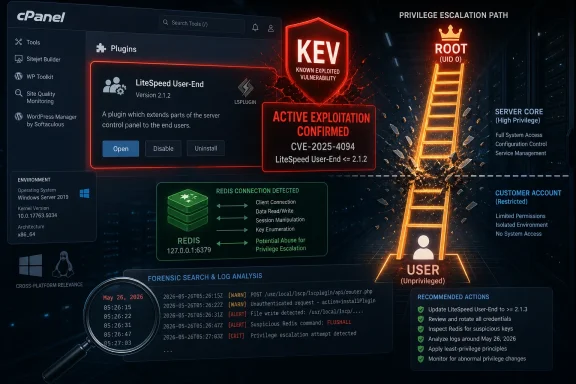
CVE-2026-48172 now sits in that more urgent category. The affected product is the LiteSpeed User-End cPanel Plugin, a component used in web-hosting environments where cPanel users manage site-level features. The vulnerability allows privilege escalation, possibly to root, in affected versions before the fixed release line.
For Federal Civilian Executive Branch agencies, Binding Operational Directive 22-01 gives the catalog teeth. Agencies must remediate listed vulnerabilities by CISA’s due date. For everyone else, the catalog is technically advisory, but ignoring it has become increasingly hard to justify to insurers, auditors, customers, and incident responders.
Privilege escalation bugs are boundary failures. In a single-user server, escalation may convert a limited foothold into full control. In shared hosting, it can convert a compromised tenant, malicious customer, or stolen cPanel credential into a platform-level breach.
That is why CVE-2026-48172 deserves more attention than a routine plugin update. LiteSpeed’s User-End cPanel Plugin sits in the operational path between ordinary hosting users and system-level services. The reported flaw is tied to Redis enable and disable handling, with public descriptions pointing to mishandling in the plugin’s user-facing functionality.
The practical risk is straightforward: an attacker who can reach the vulnerable path may be able to execute actions with privileges far beyond the intended cPanel user context. In the worst case, that means root-level control of the host. At that point, website defacement is the least interesting outcome; credential theft, persistence, lateral movement, data tampering, and customer-to-customer compromise become the real story.
Patching, however, is only the first half of the response. CISA’s KEV listing says active exploitation exists, which means administrators should assume that some vulnerable systems were attacked before they were updated. A clean version number today does not prove the server was clean yesterday.
The public detection guidance circulating around the CVE focuses on searching cPanel logs for requests involving
If hits appear, the next step is not merely blocking an IP address and moving on. Administrators need to reconstruct what the account did, whether commands were run, whether new files appeared in privileged locations, whether SSH keys changed, whether cron jobs were added, whether web shells were dropped, and whether other accounts on the same host show signs of access. Privilege escalation is an impact multiplier, not an isolated event.
This is especially concerning because cPanel environments are often messy by design. They may host legacy PHP applications, old WordPress installations, abandoned customer accounts, forgotten staging sites, and third-party plugins installed years ago by someone who has since left the company. A provider may be disciplined at the host layer and still inherit endless weakness at the tenant layer.
That makes an authenticated or semi-authenticated escalation route particularly toxic. Attackers do not need to break into the provider directly if they can compromise a weaker customer site first. A stolen hosting password, vulnerable CMS, reused credential, or malicious signup can become the first rung on a much taller ladder.
For MSPs and small hosting shops, the business risk is disproportionate. Large cloud providers can absorb emergency patching and forensic churn with dedicated security teams. Smaller operators may discover that a “plugin issue” has turned into a weekend of customer notifications, server rebuilds, and uncomfortable conversations about whether tenants were exposed to each other’s data.
Root access changes everything. It allows an attacker to alter system binaries, hide processes, inspect other users’ files, harvest credentials, modify logs, pivot into backups, and potentially poison future deployments. Even if the initial exploit leaves a visible trail, the post-exploitation phase may not.
That is why remediation guidance for this CVE should be framed around compromise assessment, not just version compliance. Updating the plugin closes the door, but it does not tell you whether someone walked through it. If a vulnerable server handled untrusted customer workloads during the exploitation window, defenders need to treat it as a system where attacker privilege may have reached the administrative plane.
In many cases, the cleanest recovery path may be rebuild-and-restore rather than endless hand-cleaning. That is a painful recommendation, especially for hosting providers juggling customer uptime, but root-level compromise is precisely where confidence becomes the scarce resource. If you cannot prove the server is clean, it may not be worth betting customers’ data on hope.
Attackers do not care whether an organization falls under a federal directive. They scan for vulnerable software, test exploit paths, and automate against whatever responds. Hosting infrastructure is especially attractive because one successful server compromise can expose many domains, mail flows, databases, and customer credentials.
CISA’s advice that all organizations prioritize KEV remediation is often treated as boilerplate, but here it is unusually literal. A vulnerable LiteSpeed cPanel plugin is not an abstract enterprise asset buried behind layers of compensating controls. It is likely to sit on internet-facing hosting infrastructure, close to user-managed workflows, and connected to sensitive operational privileges.
That makes delay expensive. A vulnerability management team that normally batches plugin fixes into scheduled maintenance windows should reconsider that rhythm for this case. When active exploitation is confirmed, the change window is now.
This is how modern control panels accumulate risk. A feature that improves usability for site owners needs a bridge into server administration. The bridge needs validation, privilege separation, command handling, input constraints, and safe execution semantics. If any of those pieces are wrong, a convenience feature becomes an escalation path.
The lesson for vendors is familiar but still under-enforced: user-facing controls that manipulate privileged services require hostile design assumptions. The user is not merely a customer clicking a button. The user may be compromised, malicious, scripted, or operating through an API path that the original interface never made obvious.
The lesson for administrators is equally blunt. Every plugin installed into a control panel becomes part of the trusted computing base for the hosting server. If it can call privileged helpers, manipulate services, or write system-owned files, it deserves the same scrutiny as core infrastructure.
Many Windows-centric organizations still run public websites on Linux hosting stacks, outsource customer portals to cPanel providers, or maintain hybrid infrastructure where Active Directory, Microsoft 365, Windows endpoints, and Linux web servers all share identity, secrets, or operational workflows. A compromised hosting server can become a credential exposure event long before it becomes a Windows intrusion.
The bigger relevance is procedural. Windows administrators already live with Patch Tuesday triage, emergency out-of-band fixes, Exchange and SharePoint exposure, driver blocklists, and the constant negotiation between uptime and risk. KEV-listed vulnerabilities demand the same mature process outside the Microsoft ecosystem.
That means asset inventory must include the systems that do not live in the Windows admin console. It means web-hosting providers need to be held to security SLAs. It means customer portals, marketing sites, staging domains, and legacy control panels belong in incident-response planning, not in a shadow IT appendix.
This matters for boards and executives because KEV creates a simpler risk signal. The catalog does not require leadership to understand every technical nuance of privilege assignment, API routing, or Redis management. It says the vulnerability is known, attackers are using it, and remediation should be prioritized.
For auditors and insurers, the same signal is attractive. If a breach investigation finds that a server was compromised through a KEV-listed vulnerability after public addition and after a reasonable remediation period, the organization’s patch-management story becomes harder to defend. The catalog is not law for most companies, but it increasingly behaves like a baseline expectation.
That pressure is healthy if it leads to better prioritization. It is dangerous if it leads to checkbox behavior. A KEV entry should trigger patching, verification, hunting, and lessons learned. Treating it as merely another ticket to close misses the point.
They should then review logs for known exploitation indicators and correlate any suspicious requests with account activity, file changes, privilege changes, and outbound connections. If evidence suggests successful exploitation, the response should escalate to full incident handling, not remain in routine vulnerability management.
The most important takeaways are the ones that turn this from an alert into an operational plan:
 CISA’s Catalog Is Now the Vulnerability Triage Board Everyone Watches
The Known Exploited Vulnerabilities Catalog was created for federal agencies, but it has become something closer to a public exploitability index for the rest of the industry. When CISA adds a CVE to KEV, the agency is not merely saying that a vulnerability is theoretically serious. It is saying there is evidence attackers are using it.That distinction matters. Enterprise vulnerability management is drowning in high and critical CVEs, many of which never become practical attack paths for ordinary criminals or advanced operators. KEV is CISA’s attempt to cut through that noise by identifying vulnerabilities that have crossed from “could be exploited” to “is being exploited.”
CVE-2026-48172 now sits in that more urgent category. The affected product is the LiteSpeed User-End cPanel Plugin, a component used in web-hosting environments where cPanel users manage site-level features. The vulnerability allows privilege escalation, possibly to root, in affected versions before the fixed release line.
For Federal Civilian Executive Branch agencies, Binding Operational Directive 22-01 gives the catalog teeth. Agencies must remediate listed vulnerabilities by CISA’s due date. For everyone else, the catalog is technically advisory, but ignoring it has become increasingly hard to justify to insurers, auditors, customers, and incident responders.
A Hosting Control Panel Bug Is Not Just Another Server CVE
The most dangerous thing about this vulnerability is not that it lives in a web-hosting ecosystem. It is that web-hosting ecosystems are built around delegated trust. A provider gives many customers access to the same underlying infrastructure, then relies on careful boundaries to keep one account from becoming everyone’s problem.Privilege escalation bugs are boundary failures. In a single-user server, escalation may convert a limited foothold into full control. In shared hosting, it can convert a compromised tenant, malicious customer, or stolen cPanel credential into a platform-level breach.
That is why CVE-2026-48172 deserves more attention than a routine plugin update. LiteSpeed’s User-End cPanel Plugin sits in the operational path between ordinary hosting users and system-level services. The reported flaw is tied to Redis enable and disable handling, with public descriptions pointing to mishandling in the plugin’s user-facing functionality.
The practical risk is straightforward: an attacker who can reach the vulnerable path may be able to execute actions with privileges far beyond the intended cPanel user context. In the worst case, that means root-level control of the host. At that point, website defacement is the least interesting outcome; credential theft, persistence, lateral movement, data tampering, and customer-to-customer compromise become the real story.
The Patch Is Simple; the Investigation Is Not
The immediate operational instruction is familiar: update the affected LiteSpeed User-End cPanel Plugin to a fixed version and verify that all exposed servers have actually received the update. Public vulnerability records identify versions before 2.4.5 as affected, while some security writeups have referenced later hardening and release activity in the LiteSpeed plugin stack. Administrators should treat vendor update guidance as authoritative and avoid assuming that a package manager, control-panel auto-update, or image rebuild has silently solved the problem.Patching, however, is only the first half of the response. CISA’s KEV listing says active exploitation exists, which means administrators should assume that some vulnerable systems were attacked before they were updated. A clean version number today does not prove the server was clean yesterday.
The public detection guidance circulating around the CVE focuses on searching cPanel logs for requests involving
cpanel_jsonapi_func=redisAble. That kind of check can help identify suspicious activity tied to the known exploitation path, but it should not become the entire investigation. Logs may be incomplete, rotated, tampered with, or distributed across paths depending on the server’s cPanel and logging configuration.If hits appear, the next step is not merely blocking an IP address and moving on. Administrators need to reconstruct what the account did, whether commands were run, whether new files appeared in privileged locations, whether SSH keys changed, whether cron jobs were added, whether web shells were dropped, and whether other accounts on the same host show signs of access. Privilege escalation is an impact multiplier, not an isolated event.
Shared Hosting Turns One Weak Account Into a Platform Problem
The uncomfortable reality for hosting providers is that this class of vulnerability erases one of the assumptions behind shared infrastructure: that a low-trust customer account can be safely contained. That assumption is never absolute, but control panels are supposed to enforce it with particular rigor. When the panel or its plugins become the crossing point, the attacker does not need a glamorous kernel exploit.This is especially concerning because cPanel environments are often messy by design. They may host legacy PHP applications, old WordPress installations, abandoned customer accounts, forgotten staging sites, and third-party plugins installed years ago by someone who has since left the company. A provider may be disciplined at the host layer and still inherit endless weakness at the tenant layer.
That makes an authenticated or semi-authenticated escalation route particularly toxic. Attackers do not need to break into the provider directly if they can compromise a weaker customer site first. A stolen hosting password, vulnerable CMS, reused credential, or malicious signup can become the first rung on a much taller ladder.
For MSPs and small hosting shops, the business risk is disproportionate. Large cloud providers can absorb emergency patching and forensic churn with dedicated security teams. Smaller operators may discover that a “plugin issue” has turned into a weekend of customer notifications, server rebuilds, and uncomfortable conversations about whether tenants were exposed to each other’s data.
Root Is a Different Kind of Incident
Security teams sometimes underreact to privilege escalation vulnerabilities because they require a foothold. That is a mistake in hosting environments. The foothold is often the easy part.Root access changes everything. It allows an attacker to alter system binaries, hide processes, inspect other users’ files, harvest credentials, modify logs, pivot into backups, and potentially poison future deployments. Even if the initial exploit leaves a visible trail, the post-exploitation phase may not.
That is why remediation guidance for this CVE should be framed around compromise assessment, not just version compliance. Updating the plugin closes the door, but it does not tell you whether someone walked through it. If a vulnerable server handled untrusted customer workloads during the exploitation window, defenders need to treat it as a system where attacker privilege may have reached the administrative plane.
In many cases, the cleanest recovery path may be rebuild-and-restore rather than endless hand-cleaning. That is a painful recommendation, especially for hosting providers juggling customer uptime, but root-level compromise is precisely where confidence becomes the scarce resource. If you cannot prove the server is clean, it may not be worth betting customers’ data on hope.
The Federal Deadline Is Not the Real Deadline
BOD 22-01 applies to Federal Civilian Executive Branch agencies, and that formal scope can create a misleading sense of distance for private-sector readers. The due date matters for agencies because it establishes accountability. For everyone else, the real deadline is the exploit traffic.Attackers do not care whether an organization falls under a federal directive. They scan for vulnerable software, test exploit paths, and automate against whatever responds. Hosting infrastructure is especially attractive because one successful server compromise can expose many domains, mail flows, databases, and customer credentials.
CISA’s advice that all organizations prioritize KEV remediation is often treated as boilerplate, but here it is unusually literal. A vulnerable LiteSpeed cPanel plugin is not an abstract enterprise asset buried behind layers of compensating controls. It is likely to sit on internet-facing hosting infrastructure, close to user-managed workflows, and connected to sensitive operational privileges.
That makes delay expensive. A vulnerability management team that normally batches plugin fixes into scheduled maintenance windows should reconsider that rhythm for this case. When active exploitation is confirmed, the change window is now.
The Redis Detail Is a Reminder About Feature Creep
One of the more interesting details in public descriptions of CVE-2026-48172 is the link to Redis enable and disable handling. Redis itself is not the villain in this story. The issue is the way a hosting plugin exposed and handled a management feature that needed privileged interaction with the system.This is how modern control panels accumulate risk. A feature that improves usability for site owners needs a bridge into server administration. The bridge needs validation, privilege separation, command handling, input constraints, and safe execution semantics. If any of those pieces are wrong, a convenience feature becomes an escalation path.
The lesson for vendors is familiar but still under-enforced: user-facing controls that manipulate privileged services require hostile design assumptions. The user is not merely a customer clicking a button. The user may be compromised, malicious, scripted, or operating through an API path that the original interface never made obvious.
The lesson for administrators is equally blunt. Every plugin installed into a control panel becomes part of the trusted computing base for the hosting server. If it can call privileged helpers, manipulate services, or write system-owned files, it deserves the same scrutiny as core infrastructure.
Windows Admins Should Still Care About a Linux Hosting Flaw
At first glance, this is not a Windows story. cPanel and LiteSpeed deployments overwhelmingly belong to the Linux hosting world, and the vulnerable plugin does not implicate Windows Server directly. But WindowsForum readers know that enterprise environments rarely divide cleanly along operating-system lines.Many Windows-centric organizations still run public websites on Linux hosting stacks, outsource customer portals to cPanel providers, or maintain hybrid infrastructure where Active Directory, Microsoft 365, Windows endpoints, and Linux web servers all share identity, secrets, or operational workflows. A compromised hosting server can become a credential exposure event long before it becomes a Windows intrusion.
The bigger relevance is procedural. Windows administrators already live with Patch Tuesday triage, emergency out-of-band fixes, Exchange and SharePoint exposure, driver blocklists, and the constant negotiation between uptime and risk. KEV-listed vulnerabilities demand the same mature process outside the Microsoft ecosystem.
That means asset inventory must include the systems that do not live in the Windows admin console. It means web-hosting providers need to be held to security SLAs. It means customer portals, marketing sites, staging domains, and legacy control panels belong in incident-response planning, not in a shadow IT appendix.
The Catalog Is Becoming a De Facto Standard of Care
CISA’s KEV catalog has quietly changed the politics of vulnerability management. A security team can still choose not to patch a listed vulnerability immediately, but it now has to explain why it accepted exposure to a flaw the U.S. government says is being exploited. That is a very different conversation from arguing over a vendor CVSS score.This matters for boards and executives because KEV creates a simpler risk signal. The catalog does not require leadership to understand every technical nuance of privilege assignment, API routing, or Redis management. It says the vulnerability is known, attackers are using it, and remediation should be prioritized.
For auditors and insurers, the same signal is attractive. If a breach investigation finds that a server was compromised through a KEV-listed vulnerability after public addition and after a reasonable remediation period, the organization’s patch-management story becomes harder to defend. The catalog is not law for most companies, but it increasingly behaves like a baseline expectation.
That pressure is healthy if it leads to better prioritization. It is dangerous if it leads to checkbox behavior. A KEV entry should trigger patching, verification, hunting, and lessons learned. Treating it as merely another ticket to close misses the point.
The LiteSpeed Entry Narrows the Choices for Hosting Teams
The concrete response to CVE-2026-48172 should be fast, but it should not be sloppy. Hosting teams need to identify every server running the LiteSpeed User-End cPanel Plugin, confirm the installed version, update to a fixed build, and verify that the parent WHM plugin distinction is understood rather than used as a blanket reassurance.They should then review logs for known exploitation indicators and correlate any suspicious requests with account activity, file changes, privilege changes, and outbound connections. If evidence suggests successful exploitation, the response should escalate to full incident handling, not remain in routine vulnerability management.
The most important takeaways are the ones that turn this from an alert into an operational plan:
- CISA added CVE-2026-48172 to the KEV Catalog on May 26, 2026, because the agency found evidence of active exploitation.
- The vulnerability affects the LiteSpeed User-End cPanel Plugin in versions before the fixed release and is described as a privilege-escalation flaw that may reach root.
- Hosting providers should patch immediately, but they should also hunt for prior exploitation because version compliance does not prove historical safety.
- Administrators should search cPanel logs for suspicious Redis-related API activity and then investigate affected IPs, accounts, files, jobs, credentials, and persistence mechanisms.
- Organizations that outsource cPanel hosting should ask providers for confirmation of patch status and compromise assessment, not just a generic statement that updates are enabled.
References
- Primary source: CISA
Published: 2026-05-26T12:00:00+00:00
- Related coverage: sentinelone.com
CVE-2026-48172: LiteSpeed cPanel Privilege Escalation Flaw
CVE-2026-48172 is a privilege escalation vulnerability in LiteSpeed cPanel Plugin. Learn about its impact, affected versions, and mitigation methods.www.sentinelone.com
- Related coverage: neuracybintel.com
LiteSpeed cPanel Plugin CVE-2026-48172 Exploited for Root-Level Server Compromise
A cPanel account should not be a straight path to root. CVE-2026-48172 makes that boundary fail in exactly the place hosting providers least want it to fail: inside a user-facing control panel plugin. www.neuracybintel.com
- Related coverage: darkwebinformer.com
CVE-2026-48172: Critical LiteSpeed cPanel Plugin Flaw Exploited for Privilege Escalation
LiteSpeed User-End cPanel Plugin privilege-escalation vulnerability reportedly exploited in the wild, with potential root-level impact on affected hosting servers. darkwebinformer.com
- Related coverage: hivepro.com
- Related coverage: labs.cloudsecurityalliance.org
CISA KEV Alert: Fortinet, Adobe, and Microsoft Under Attack
PDF documentlabs.cloudsecurityalliance.org