

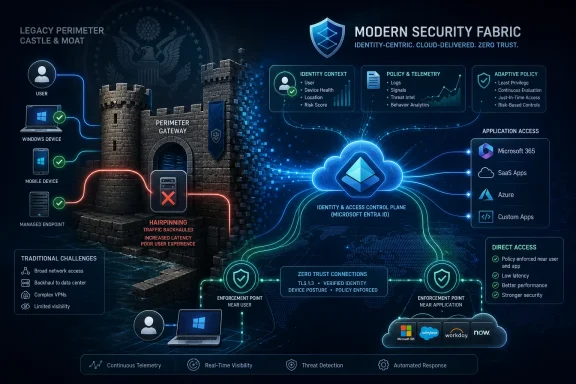
CISA has framed Secure Access Service Edge as a practical modernization path for Trusted Internet Connections 3.0, telling federal agencies in new guidance that distributed cloud-delivered security can replace perimeter-era traffic backhauling while preserving the visibility and control TIC was built to provide. The important part is not that Washington has discovered another acronym. It is that CISA is trying to reconcile two ideas that have often lived in separate procurement folders: zero trust and network modernization. For Windows-heavy enterprises, the lesson is blunt: the secure perimeter is no longer a place, but the policy fabric wrapped around users, devices, workloads, and data.
The original TIC idea made sense in the network it was born into. Agencies had too many internet connections, too little centralized visibility, and a strong incentive to consolidate traffic through managed gateways where inspection, logging, and policy could be enforced. In that world, forcing traffic through a known choke point was not just bureaucratic tidiness; it was a security strategy.
But the modern agency no longer fits neatly behind a federal firewall stack. Users work from home, branch offices, field locations, partner networks, and unmanaged networks. Applications live in agency data centers, Microsoft 365, Azure, AWS, SaaS platforms, and mission-specific cloud environments. The old model asks this distributed estate to behave as if everything still begins and ends in a data center.
That is where SASE enters the TIC 3.0 conversation. Instead of treating the internet connection as the natural enforcement point, SASE treats identity, device posture, application context, routing, inspection, and telemetry as cloud-delivered functions that follow the user and workload. It is a shift from where is the traffic going? to who is requesting access, from what device, under what conditions, to which resource, and with what observed risk?
CISA’s guidance matters because it gives agencies permission to stop confusing TIC compliance with legacy topology. A modern TIC 3.0 architecture can still satisfy the government’s need for visibility, telemetry, and policy enforcement without requiring every packet to make a ceremonial trip through a centralized appliance stack. That is a meaningful change for agencies, and a useful signal for enterprises that have been stuck between zero trust slogans and inherited network designs.
The two overlap, but they are not interchangeable. A badly designed SASE deployment can still reproduce old mistakes: broad access rules, weak device checks, flat internal reachability, incomplete logging, and policy exceptions that become permanent infrastructure. A well-designed SASE deployment, by contrast, can give zero trust a practical enforcement layer across remote users, branch offices, SaaS apps, and private applications.
This distinction is why the TIC 3.0 framing is useful. CISA is not merely telling agencies to buy a cloud security service. It is asking them to map modern access patterns to required security capabilities, telemetry flows, and policy enforcement points. In plain English, the agency still has to prove that the new architecture can see enough, decide enough, and report enough.
That should sound familiar to Windows administrators. Moving from VPN to ZTNA, from on-prem Exchange to Microsoft 365, or from domain-joined laptops to hybrid and cloud-managed endpoints does not eliminate security operations. It changes where the control points live. Microsoft Entra ID conditional access, Defender telemetry, Intune compliance, endpoint detection, browser isolation, and SaaS policy controls become part of the perimeter whether the network team likes that word or not.
Hairpinning is the practice of routing user traffic back through a central inspection point before sending it out again to the destination service. It made sense when users were on agency networks and applications were largely internal. It becomes expensive, slow, and operationally absurd when the user is sitting at home in Ohio, authenticating to a SaaS service hosted in a cloud region hundreds of miles away, while agency policy still drags the session through a legacy gateway somewhere else.
The performance penalty is obvious: latency, congestion, brittle routing, and help-desk tickets that mysteriously disappear when users bypass the VPN. But the security penalty is just as real. When an architecture becomes painful, people route around it. Agencies and enterprises then end up with split tunnels, unmanaged exceptions, shadow SaaS use, and monitoring gaps disguised as productivity fixes.
SASE promises a cleaner bargain. Put inspection and policy enforcement closer to the user and the application, use identity and posture to make access decisions, and send telemetry back to the enterprise and government monitoring fabric. That does not mean every old gateway disappears overnight. It means the gateway stops being the organizing principle of the whole security model.
For IT pros, the operational impact is substantial. Network diagrams become less important than policy diagrams. Access reviews become more important than subnet diagrams. The question “is this user on the VPN?” gives way to “does this session satisfy the policy for this app and data class right now?”
That is the only way the program can remain relevant. Federal agencies do not run one network. They run decades of inherited systems, cloud migrations in various stages of completion, SaaS estates with uneven governance, mobile workforces, classified and unclassified environments, operational technology, and contractor access patterns. A single perimeter design cannot describe that reality.
SASE fits TIC 3.0 because it gives agencies a way to distribute enforcement without abandoning centralized governance. Policy can be authored centrally, enforced through cloud points of presence or local connectors, and observed through logs and telemetry. This is not magic; it is an architecture trade. Agencies exchange the simplicity of a small number of chokepoints for the complexity of orchestrating many policy enforcement points.
That trade is worth making only if the telemetry is good. CISA’s recurring emphasis on visibility is not bureaucratic box-checking. If the government loses sight of user activity, device state, destination risk, data movement, or denied access attempts, then it has not modernized TIC. It has merely outsourced opacity.
That is why Windows endpoint management becomes a zero trust dependency. A laptop that is patched, encrypted, protected by endpoint detection, compliant with configuration baselines, and tied to a known identity can receive a different access decision from a personal device on the same home network. The network location is no longer the decisive fact. The device’s state is.
This changes the daily work of administrators. Group Policy does not disappear, but it no longer tells the whole story. Intune configuration profiles, compliance policies, Defender signals, certificate posture, browser session controls, and identity risk become part of access engineering. The help desk ticket that once read “VPN not connecting” becomes “device not compliant, access blocked to finance app.”
That can be frustrating, but it is also more honest. Traditional VPN access often granted a user broad network adjacency after authentication. ZTNA-style access narrows the aperture to specific applications and conditions. When implemented well, that is a major reduction in blast radius, especially in ransomware scenarios where lateral movement is the attacker’s business model.
That does not mean compliance gets easier. In some ways, it gets harder. A centralized perimeter was inefficient, but it was easy to draw on a diagram and easy to audit in principle. A distributed SASE architecture forces auditors, security teams, and vendors to be much more precise about control mapping.
Where is traffic inspected? Which logs are generated? How are policy decisions made? How are device posture signals validated? How are cloud applications classified? How are privileged sessions treated differently from ordinary sessions? How are denied access attempts correlated with endpoint alerts? These are not philosophical questions. They are the new compliance surface.
The upside is that this better matches real risk. A legacy TIC gateway might show that traffic passed through an approved point, but that alone says little about whether the user should have reached the application, whether the device was compromised, or whether sensitive data moved to an unsanctioned service. SASE, paired with zero trust principles, can produce a richer picture if agencies design for that outcome from the start.
The hard part is not finding a vendor slide that says SASE, TIC 3.0, and zero trust on the same page. The hard part is untangling existing access patterns. Agencies must identify applications, classify data, understand user groups, map device populations, retire stale firewall rules, integrate identity providers, and build telemetry pipelines that satisfy both operational security and federal reporting expectations.
This is where many zero trust programs slow down. The strategy is elegant until it meets the application that only works over a broad network range, the contractor who uses a nonstandard device, the legacy server that cannot support modern authentication, or the mission system whose owner is terrified of any change window. The perimeter did not survive because it was beautiful. It survived because it hid messy dependencies.
SASE exposes those dependencies. That is useful, but politically uncomfortable. When access is defined per application rather than per network, someone must decide what the application is, who owns it, which users need it, what normal behavior looks like, and what risk signals should block it. This is security architecture as organizational therapy.
That reality matters outside government as well. Hospitals, manufacturers, universities, local governments, and mid-sized enterprises often have Windows Server workloads and line-of-business applications that cannot simply be placed behind a fashionable access broker. They need transitional patterns: application connectors, segmentation, identity bridges, privileged access workstations, jump services, and compensating monitoring.
The worst mistake would be to treat SASE as a forced migration event. The better approach is staged modernization. Start with remote user access and SaaS visibility. Move private applications behind narrower access policies. Segment high-value systems. Replace broad VPN access with application-specific paths. Feed logs into the SIEM and tune detections around identity and device context.
That approach is slower than the sales pitch, but it is more likely to survive contact with production. It also aligns with the deeper message of TIC 3.0: modernization is not a topology swap. It is an incremental redistribution of trust decisions.
But distributed security also creates new failure modes. Misconfigured policies can block entire workforces. Identity provider outages can become access outages. Cloud security service disruptions can affect branch connectivity. Poorly tuned posture checks can punish users for benign drift. Overbroad bypass rules can quietly recreate the old perimeter’s weaknesses inside the new architecture.
There is also a concentration risk. If an organization routes web access, private app access, SaaS control, data loss prevention, and remote connectivity through a small number of cloud security platforms, those platforms become critical infrastructure. Agencies must scrutinize resilience, failover, logging continuity, incident response support, and data handling. Vendor trust becomes part of zero trust whether anyone wants to admit it or not.
For Windows environments, the operational lesson is to avoid single-signal policy. Do not let one checkbox decide everything. Device compliance, user risk, app sensitivity, location, session behavior, and authentication strength should work together. A zero trust policy that is too brittle will be bypassed; one that is too loose will be theater.
That means SASE implementations must be judged not just by access outcomes, but by observability. Logs must be normalized, timely, and useful. Denied requests matter. Device posture changes matter. DNS and web activity matter. SaaS usage matters. Authentication events matter. Data movement matters. Administrative actions matter even more.
This is where Windows-centric organizations have an opportunity. Microsoft’s security stack already generates a large amount of identity, endpoint, email, cloud app, and workload telemetry. But telemetry volume is not the same as operational visibility. Agencies and enterprises need correlation, retention, alert quality, and analysts who understand what the signals mean.
A SASE deployment that cannot feed the SOC is an access product, not a security architecture. TIC 3.0 raises the bar by treating telemetry as part of the architecture rather than an afterthought. That is the right instinct.
Private-sector organizations may not need to satisfy CISA reporting requirements, but they do need to answer the same practical questions. Can they see who is accessing sensitive applications? Can they enforce different rules for managed and unmanaged devices? Can they reduce VPN blast radius? Can they detect unusual SaaS behavior? Can they protect legacy applications without granting broad network access?
The answer, increasingly, is some combination of SASE, SSE, ZTNA, endpoint management, identity governance, and microsegmentation. The exact acronym matters less than the design principle. Trust should be explicit, contextual, continuously evaluated, and narrow.
That principle is especially relevant as AI tools, automation agents, and non-human identities expand the access problem. Tomorrow’s perimeter will not just wrap employees and laptops. It will wrap service accounts, workload identities, API calls, automation workflows, and AI-mediated actions. The organizations that cannot express access policy clearly today will struggle badly when the number of actors multiplies.
That sounds simple because the verbs are simple. The work is not. Most organizations discover during this process that they do not have a clean application inventory, do not fully understand privileged access paths, and cannot easily distinguish sanctioned SaaS use from tolerated SaaS use. SASE modernization begins as a network project and quickly becomes an asset management, identity, data governance, and SOC modernization project.
For federal agencies, TIC 3.0 gives political and policy cover for that work. For enterprises, it offers a useful external validation: moving away from centralized backhaul is not inherently reckless if the replacement architecture improves policy enforcement and telemetry. The old perimeter can be retired only when the new controls are demonstrably better, not merely newer.
That is the standard IT leaders should use with vendors. Do not ask whether a product is SASE. Ask what access it narrows, what telemetry it produces, what legacy patterns it can replace, how it handles outage scenarios, and how cleanly it integrates with identity and endpoint signals. Acronyms do not reduce risk. Control design does.
 CISA Moves TIC Away From the Castle Wall
The original TIC idea made sense in the network it was born into. Agencies had too many internet connections, too little centralized visibility, and a strong incentive to consolidate traffic through managed gateways where inspection, logging, and policy could be enforced. In that world, forcing traffic through a known choke point was not just bureaucratic tidiness; it was a security strategy.But the modern agency no longer fits neatly behind a federal firewall stack. Users work from home, branch offices, field locations, partner networks, and unmanaged networks. Applications live in agency data centers, Microsoft 365, Azure, AWS, SaaS platforms, and mission-specific cloud environments. The old model asks this distributed estate to behave as if everything still begins and ends in a data center.
That is where SASE enters the TIC 3.0 conversation. Instead of treating the internet connection as the natural enforcement point, SASE treats identity, device posture, application context, routing, inspection, and telemetry as cloud-delivered functions that follow the user and workload. It is a shift from where is the traffic going? to who is requesting access, from what device, under what conditions, to which resource, and with what observed risk?
CISA’s guidance matters because it gives agencies permission to stop confusing TIC compliance with legacy topology. A modern TIC 3.0 architecture can still satisfy the government’s need for visibility, telemetry, and policy enforcement without requiring every packet to make a ceremonial trip through a centralized appliance stack. That is a meaningful change for agencies, and a useful signal for enterprises that have been stuck between zero trust slogans and inherited network designs.
SASE Is Not Zero Trust, But It Can Carry the Plumbing
One of the hazards in this market is that SASE is routinely sold as if it were zero trust in a subscription wrapper. It is not. SASE is an architecture pattern that converges networking and security services, usually including secure web gateway, cloud access security broker, firewall-as-a-service, data protection, software-defined WAN, and zero trust network access. Zero trust is the security model that insists no user, device, workload, or network segment should be implicitly trusted.The two overlap, but they are not interchangeable. A badly designed SASE deployment can still reproduce old mistakes: broad access rules, weak device checks, flat internal reachability, incomplete logging, and policy exceptions that become permanent infrastructure. A well-designed SASE deployment, by contrast, can give zero trust a practical enforcement layer across remote users, branch offices, SaaS apps, and private applications.
This distinction is why the TIC 3.0 framing is useful. CISA is not merely telling agencies to buy a cloud security service. It is asking them to map modern access patterns to required security capabilities, telemetry flows, and policy enforcement points. In plain English, the agency still has to prove that the new architecture can see enough, decide enough, and report enough.
That should sound familiar to Windows administrators. Moving from VPN to ZTNA, from on-prem Exchange to Microsoft 365, or from domain-joined laptops to hybrid and cloud-managed endpoints does not eliminate security operations. It changes where the control points live. Microsoft Entra ID conditional access, Defender telemetry, Intune compliance, endpoint detection, browser isolation, and SaaS policy controls become part of the perimeter whether the network team likes that word or not.
The Real Target Is Hairpinning
The most immediate villain in this story is not the firewall. It is hairpinning.Hairpinning is the practice of routing user traffic back through a central inspection point before sending it out again to the destination service. It made sense when users were on agency networks and applications were largely internal. It becomes expensive, slow, and operationally absurd when the user is sitting at home in Ohio, authenticating to a SaaS service hosted in a cloud region hundreds of miles away, while agency policy still drags the session through a legacy gateway somewhere else.
The performance penalty is obvious: latency, congestion, brittle routing, and help-desk tickets that mysteriously disappear when users bypass the VPN. But the security penalty is just as real. When an architecture becomes painful, people route around it. Agencies and enterprises then end up with split tunnels, unmanaged exceptions, shadow SaaS use, and monitoring gaps disguised as productivity fixes.
SASE promises a cleaner bargain. Put inspection and policy enforcement closer to the user and the application, use identity and posture to make access decisions, and send telemetry back to the enterprise and government monitoring fabric. That does not mean every old gateway disappears overnight. It means the gateway stops being the organizing principle of the whole security model.
For IT pros, the operational impact is substantial. Network diagrams become less important than policy diagrams. Access reviews become more important than subnet diagrams. The question “is this user on the VPN?” gives way to “does this session satisfy the policy for this app and data class right now?”
TIC 3.0 Becomes a Policy Architecture, Not a Box
The most interesting part of TIC 3.0 is that it has gradually become less of a product category and more of a policy architecture. That evolution is easy to miss because government cybersecurity language often preserves old terms long after the technology underneath has changed. “Trusted Internet Connections” still sounds like a gateway program, but TIC 3.0 is increasingly about security capabilities across varied environments.That is the only way the program can remain relevant. Federal agencies do not run one network. They run decades of inherited systems, cloud migrations in various stages of completion, SaaS estates with uneven governance, mobile workforces, classified and unclassified environments, operational technology, and contractor access patterns. A single perimeter design cannot describe that reality.
SASE fits TIC 3.0 because it gives agencies a way to distribute enforcement without abandoning centralized governance. Policy can be authored centrally, enforced through cloud points of presence or local connectors, and observed through logs and telemetry. This is not magic; it is an architecture trade. Agencies exchange the simplicity of a small number of chokepoints for the complexity of orchestrating many policy enforcement points.
That trade is worth making only if the telemetry is good. CISA’s recurring emphasis on visibility is not bureaucratic box-checking. If the government loses sight of user activity, device state, destination risk, data movement, or denied access attempts, then it has not modernized TIC. It has merely outsourced opacity.
Windows Shops Will Feel This Through Identity First
For the WindowsForum audience, the SASE-and-TIC conversation may sound like federal network architecture, but its center of gravity is identity. In most modern Microsoft estates, identity is the routing table of trust. Entra ID, conditional access, multifactor authentication, privileged identity management, device compliance, and app consent governance increasingly determine what users can reach.That is why Windows endpoint management becomes a zero trust dependency. A laptop that is patched, encrypted, protected by endpoint detection, compliant with configuration baselines, and tied to a known identity can receive a different access decision from a personal device on the same home network. The network location is no longer the decisive fact. The device’s state is.
This changes the daily work of administrators. Group Policy does not disappear, but it no longer tells the whole story. Intune configuration profiles, compliance policies, Defender signals, certificate posture, browser session controls, and identity risk become part of access engineering. The help desk ticket that once read “VPN not connecting” becomes “device not compliant, access blocked to finance app.”
That can be frustrating, but it is also more honest. Traditional VPN access often granted a user broad network adjacency after authentication. ZTNA-style access narrows the aperture to specific applications and conditions. When implemented well, that is a major reduction in blast radius, especially in ransomware scenarios where lateral movement is the attacker’s business model.
The Compliance Story Is Finally Catching Up To Reality
Federal cybersecurity policy has spent years trying to close the gap between legacy compliance language and cloud reality. TIC 3.0 is one of the more important attempts to do that. It acknowledges that agencies cannot secure modern environments by pretending they still operate like 2009 enterprise networks.That does not mean compliance gets easier. In some ways, it gets harder. A centralized perimeter was inefficient, but it was easy to draw on a diagram and easy to audit in principle. A distributed SASE architecture forces auditors, security teams, and vendors to be much more precise about control mapping.
Where is traffic inspected? Which logs are generated? How are policy decisions made? How are device posture signals validated? How are cloud applications classified? How are privileged sessions treated differently from ordinary sessions? How are denied access attempts correlated with endpoint alerts? These are not philosophical questions. They are the new compliance surface.
The upside is that this better matches real risk. A legacy TIC gateway might show that traffic passed through an approved point, but that alone says little about whether the user should have reached the application, whether the device was compromised, or whether sensitive data moved to an unsanctioned service. SASE, paired with zero trust principles, can produce a richer picture if agencies design for that outcome from the start.
The Vendor Pitch Will Be Easier Than the Migration
Every major security vendor can now tell a SASE story. Some tell it through networking heritage, some through cloud security, some through identity, some through endpoint platforms, and some through managed government offerings. That makes procurement look deceptively mature.The hard part is not finding a vendor slide that says SASE, TIC 3.0, and zero trust on the same page. The hard part is untangling existing access patterns. Agencies must identify applications, classify data, understand user groups, map device populations, retire stale firewall rules, integrate identity providers, and build telemetry pipelines that satisfy both operational security and federal reporting expectations.
This is where many zero trust programs slow down. The strategy is elegant until it meets the application that only works over a broad network range, the contractor who uses a nonstandard device, the legacy server that cannot support modern authentication, or the mission system whose owner is terrified of any change window. The perimeter did not survive because it was beautiful. It survived because it hid messy dependencies.
SASE exposes those dependencies. That is useful, but politically uncomfortable. When access is defined per application rather than per network, someone must decide what the application is, who owns it, which users need it, what normal behavior looks like, and what risk signals should block it. This is security architecture as organizational therapy.
The Legacy Estate Still Gets a Vote
CISA’s guidance is careful not to suggest that every agency can leap directly into a pristine cloud-delivered model. Legacy systems remain a central constraint. Many agencies still run applications that assume network proximity, older authentication methods, fixed IP allowlists, or thick-client behavior that does not map cleanly to modern ZTNA.That reality matters outside government as well. Hospitals, manufacturers, universities, local governments, and mid-sized enterprises often have Windows Server workloads and line-of-business applications that cannot simply be placed behind a fashionable access broker. They need transitional patterns: application connectors, segmentation, identity bridges, privileged access workstations, jump services, and compensating monitoring.
The worst mistake would be to treat SASE as a forced migration event. The better approach is staged modernization. Start with remote user access and SaaS visibility. Move private applications behind narrower access policies. Segment high-value systems. Replace broad VPN access with application-specific paths. Feed logs into the SIEM and tune detections around identity and device context.
That approach is slower than the sales pitch, but it is more likely to survive contact with production. It also aligns with the deeper message of TIC 3.0: modernization is not a topology swap. It is an incremental redistribution of trust decisions.
Security Teams Gain Visibility, But Also New Failure Modes
A mature SASE deployment can give defenders a better view of distributed work. It can show which users access which SaaS apps, which devices fail posture checks, which destinations are risky, and which sessions attempt unusual data movement. For agencies that have struggled to see beyond the boundary gateway, that visibility is valuable.But distributed security also creates new failure modes. Misconfigured policies can block entire workforces. Identity provider outages can become access outages. Cloud security service disruptions can affect branch connectivity. Poorly tuned posture checks can punish users for benign drift. Overbroad bypass rules can quietly recreate the old perimeter’s weaknesses inside the new architecture.
There is also a concentration risk. If an organization routes web access, private app access, SaaS control, data loss prevention, and remote connectivity through a small number of cloud security platforms, those platforms become critical infrastructure. Agencies must scrutinize resilience, failover, logging continuity, incident response support, and data handling. Vendor trust becomes part of zero trust whether anyone wants to admit it or not.
For Windows environments, the operational lesson is to avoid single-signal policy. Do not let one checkbox decide everything. Device compliance, user risk, app sensitivity, location, session behavior, and authentication strength should work together. A zero trust policy that is too brittle will be bypassed; one that is too loose will be theater.
The Telemetry Requirement Is the Quiet Center of the Guidance
The phrase “visibility and control” appears so often in federal cybersecurity that it can blur into wallpaper. In this case, it is the core issue. CISA can tolerate architectural diversity only if agencies continue to produce the telemetry needed to understand, defend, and report on federal cyber risk.That means SASE implementations must be judged not just by access outcomes, but by observability. Logs must be normalized, timely, and useful. Denied requests matter. Device posture changes matter. DNS and web activity matter. SaaS usage matters. Authentication events matter. Data movement matters. Administrative actions matter even more.
This is where Windows-centric organizations have an opportunity. Microsoft’s security stack already generates a large amount of identity, endpoint, email, cloud app, and workload telemetry. But telemetry volume is not the same as operational visibility. Agencies and enterprises need correlation, retention, alert quality, and analysts who understand what the signals mean.
A SASE deployment that cannot feed the SOC is an access product, not a security architecture. TIC 3.0 raises the bar by treating telemetry as part of the architecture rather than an afterthought. That is the right instinct.
The TIC 3.0 Lesson for Everyone Outside Government
The guidance is written for federal agencies, but the architectural pressure is universal. Any organization that still relies on a perimeter-first model is facing the same mismatch: users are distributed, applications are distributed, data is distributed, and attackers are very good at turning one trusted foothold into many.Private-sector organizations may not need to satisfy CISA reporting requirements, but they do need to answer the same practical questions. Can they see who is accessing sensitive applications? Can they enforce different rules for managed and unmanaged devices? Can they reduce VPN blast radius? Can they detect unusual SaaS behavior? Can they protect legacy applications without granting broad network access?
The answer, increasingly, is some combination of SASE, SSE, ZTNA, endpoint management, identity governance, and microsegmentation. The exact acronym matters less than the design principle. Trust should be explicit, contextual, continuously evaluated, and narrow.
That principle is especially relevant as AI tools, automation agents, and non-human identities expand the access problem. Tomorrow’s perimeter will not just wrap employees and laptops. It will wrap service accounts, workload identities, API calls, automation workflows, and AI-mediated actions. The organizations that cannot express access policy clearly today will struggle badly when the number of actors multiplies.
The Migration Playbook Hidden Inside CISA’s Guidance
CISA’s SASE guidance is not a magic recipe, but it implies a practical sequence. First, understand the current traffic and access model. Second, identify the highest-value applications and the riskiest access paths. Third, move users and applications into narrower, identity-aware controls. Fourth, keep measuring whether the new architecture produces better visibility and lower risk.That sounds simple because the verbs are simple. The work is not. Most organizations discover during this process that they do not have a clean application inventory, do not fully understand privileged access paths, and cannot easily distinguish sanctioned SaaS use from tolerated SaaS use. SASE modernization begins as a network project and quickly becomes an asset management, identity, data governance, and SOC modernization project.
For federal agencies, TIC 3.0 gives political and policy cover for that work. For enterprises, it offers a useful external validation: moving away from centralized backhaul is not inherently reckless if the replacement architecture improves policy enforcement and telemetry. The old perimeter can be retired only when the new controls are demonstrably better, not merely newer.
That is the standard IT leaders should use with vendors. Do not ask whether a product is SASE. Ask what access it narrows, what telemetry it produces, what legacy patterns it can replace, how it handles outage scenarios, and how cleanly it integrates with identity and endpoint signals. Acronyms do not reduce risk. Control design does.
The Perimeter Gives Way To The Audit Trail
CISA’s new guidance leaves Windows administrators, network engineers, and security leaders with several concrete realities to act on. The broad message is architectural, but the implementation will be measured in routing changes, identity policies, endpoint baselines, logging pipelines, and fewer excuses for blanket VPN access.- Agencies can use SASE-style architectures under TIC 3.0, but only if they preserve the visibility, telemetry, and policy enforcement that TIC requires.
- The practical goal is to reduce legacy traffic backhauling while moving inspection and access decisions closer to users, devices, applications, and data.
- SASE should be treated as an enforcement architecture for zero trust principles, not as a substitute for identity governance, endpoint security, segmentation, or monitoring.
- Windows-heavy environments will feel the shift most directly through Entra ID, device compliance, Defender telemetry, Intune policy, and conditional access design.
- Legacy applications will remain the hardest part of the migration, because many were built for network trust rather than identity-aware access.
- Security teams should judge SASE projects by the quality of their audit trail as much as by user experience or network performance.
References
- Primary source: CISA
Published: 2026-06-24T12:00:00+00:00

Using SASE in a Modern TIC 3.0 Solution | CISA
www.cisa.gov
- Related coverage: passeidireto.com
- Related coverage: cisco.com
- Related coverage: securitymagazine.com
CISA releases Trusted Internet Connections 3.0 core guidance documentation
The Cybersecurity and Infrastructure Security Agency (CISA) released core guidance documentation for the Trusted Internet Connections (TIC) program, developed to assist agencies in protecting modern information technology architectures and services. CISA released final versions of three of the...www.securitymagazine.com
- Related coverage: scribd.com
- Related coverage: hstoday.us
CISA Releases TIC 3.0 Core Guidance Documentation - HSToday
CISA released final versions of three of the TIC 3.0 core guidance documents, representing the conclusion of their adjudication period following the issuance of draft documents in December 2019.www.hstoday.us
- Related coverage: aviatrix.com
A Roadmap to Microsegmentation: CISA’s Zero Trust Guidance
Learn how Part 1 of CISA’s new guide gives practical guidance for using microsegmentation to implement zero trust principles for cloud network security.aviatrix.com - Related coverage: meritalk.com
Cybersecurity – Page 5 – MeriTalk
In 2021, Meritalk, in partnership with MFGS, Inc., surveyed 153 Federal cybersecurity leaders to explore how agencies are employing application security (AppSec). A large majority of leaders have implemented some form of application security and have already seen significant benefits. However...www.meritalk.com
