

CISA published advisory ICSA-26-169-01 on June 18, 2026, warning that multiple AVer PTC camera models used worldwide in government, commercial, and healthcare environments are affected by CVE-2026-40624, a critical file and directory exposure vulnerability rated CVSS 9.8. The short version is grimly familiar: a networked camera has become a computer with a lens, and that computer may now be a path to arbitrary code execution. The longer version matters more for WindowsForum readers, because this is exactly the kind of device that disappears into conference rooms, clinics, classrooms, courtrooms, and municipal facilities until an advisory drags it back into view. The lesson is not merely to patch a camera; it is to stop treating audiovisual gear as if it lives outside the security boundary.
The affected products are AVer’s PTC500S, PTC115, PTC500+, and PTC115+ cameras, with CISA listing all versions as affected by CVE-2026-40624. The advisory describes the weakness as files or directories being accessible to external parties, and says successful exploitation could allow arbitrary code execution. That combination should get attention from administrators even if the device is “just” a camera.
PTC cameras are not generic USB webcams plugged into a single desktop. They are pan-tilt-camera systems designed for spaces where remote control, streaming, tracking, and integration with broader AV workflows are the whole point. They often sit on the same networks as room PCs, controllers, scheduling panels, lecture capture systems, video conferencing appliances, and sometimes management workstations.
That makes this advisory more than a niche hardware notice. In practice, cameras like these are frequently deployed by facilities teams, AV integrators, or departmental buyers rather than central IT. They end up connected to Ethernet, assigned static addresses, given web interfaces, and then left alone for years because the video still works.
CISA’s affected-sector list underscores the point. Government services and facilities, commercial facilities, and healthcare and public health are not fringe categories. They are the places where cameras become operational infrastructure, and where the difference between “device compromise” and “business compromise” can be disturbingly thin.
For defenders, arbitrary code execution is the phrase that collapses the distance between “exposed file path” and “attacker foothold.” If an unauthenticated or lightly constrained attacker can turn access to a vulnerable device into code running on that device, the camera is no longer just leaking information. It becomes a beachhead.
The advisory does not say that CISA is aware of active exploitation targeting this vulnerability. That is important, but it should not be misread as comfort. “No known public exploitation” is not the same thing as “safe,” especially for embedded devices that may be internet-exposed, poorly logged, rarely monitored, and slow to receive operational attention.
The practical risk is compounded by the wording “all versions” for the listed models. When an advisory names only a narrow firmware range, an administrator can often triage by version inventory. When the affected range is all versions, the first response is more urgent and more operational: find every device, assume exposure until proven otherwise, and isolate before waiting for a tidy patch-management cycle.
The security failure here is not that cameras are complicated. It is that they are treated as appliances while behaving like networked servers. They expose web interfaces, accept firmware, store configuration, speak multiple streaming protocols, and integrate with control software. Every one of those functions creates a seam where an implementation mistake can become an exploit path.
The AV world has been migrating into IP for years because IP makes everything easier to deploy and manage. That migration also imports the security obligations of IP networks. A device that once needed a coax run and a local controller now has a browser login, a firmware lifecycle, and a place in vulnerability management.
For Windows-heavy environments, the camera’s presence can be particularly easy to underweight. It may not appear in Microsoft Defender for Endpoint inventory. It may not join Active Directory. It may not be represented in Intune, Configuration Manager, WSUS, or the standard server CMDB. Yet it may be reachable from the same VLAN as the room PC that signs into Teams, Zoom, or a hospital telehealth platform.
The problem is that many camera deployments were not built with that baseline in mind. A conference-room camera may have been installed to solve a meeting-quality problem, not to become part of a formal industrial control or facility security architecture. A clinic may have added a PTZ system for telemedicine. A city agency may have installed cameras in council chambers. A school may have placed them in lecture halls.
In each case, the deployment logic is operational convenience. The management logic should be security segmentation. Those two instincts often collide only after a vulnerability advisory arrives.
Remote access deserves special scrutiny. CISA’s note that VPNs can themselves have vulnerabilities is more than boilerplate. A VPN that drops a vendor, contractor, or administrator directly into a flat network containing unpatched cameras is not a security control so much as a longer hallway to the same unlocked room. Secure remote access should be narrow, logged, patched, and paired with network restrictions that only allow the necessary management paths.
Internet-connected cameras have long been attractive targets because they offer a blend of persistence, bandwidth, weak maintenance, and physical placement. Attackers do not need to care about the camera’s intended purpose. They care whether it can run code, relay traffic, capture credentials, pivot deeper into a network, or join a botnet.
Even when a device is not directly exposed, internal exposure can still matter. A compromised workstation, guest network bridge, misconfigured firewall rule, or vendor laptop can give an attacker the internal reach needed to touch a camera interface. That is why “not on the internet” is a good first control but not a complete answer.
The harder work is segmentation. Cameras should live in a network zone that assumes they are untrusted embedded systems. Management should be limited to specific administrative hosts. East-west traffic should be constrained. Logs should flow somewhere defenders can actually see them. Firmware should be tracked with the same seriousness applied to switches, access points, and NAS boxes.
That creates a familiar bridge between non-Windows appliances and Windows risk. If a compromised camera can serve malicious content to an administrator’s browser, capture reused credentials, stage payloads, or act as a pivot point toward management stations, it becomes part of the Windows security story. The device does not need to run Windows to threaten a Windows estate.
Room systems are especially awkward. A meeting room PC may be domain-joined, auto-signed into collaboration software, connected to AV controllers, and trusted by users who assume the room is “internal.” If the camera and the room PC share a permissive local subnet, the camera can become an unexpected neighbor to a sensitive endpoint.
The same applies to healthcare and public-sector deployments. Telehealth carts, courtroom AV systems, council chambers, and training rooms often combine specialized devices with general-purpose Windows machines. Those hybrid environments are useful precisely because they bridge workflows. They are risky for the same reason.
AV equipment is particularly prone to this failure because ownership is diffuse. IT may control the switch port. Facilities may own the room. A vendor may manage the camera. A department may have paid for it. Security may not know it exists until a scanner finds an unexpected web server or a CISA advisory lands in a mailbox.
The affected list in this case includes multiple PTC models and all versions, which should force a practical question: who inside the organization is accountable for these devices by serial number, location, firmware, and network segment? If that answer requires three meetings and a spreadsheet archaeology expedition, the vulnerability has already found the weak point.
Procurement language can help, but only if it is enforced. Networked cameras should come with documented security update commitments, configuration hardening guides, supported management methods, and a clear vulnerability disclosure process. Buyers should ask whether the device can disable unused services, integrate with logging, support modern authentication, and operate without direct internet exposure.
This is where administrators need support from leadership. Firmware maintenance is rarely visible when it succeeds. It becomes visible only when neglected devices become incident-response line items. The cost of maintaining an accurate inventory of “minor” devices looks annoying until the alternative is emergency discovery during a critical advisory.
But it should not encourage delay. Public advisories often change attacker economics. A vulnerability that was known to a researcher and a vendor becomes known to defenders and adversaries at the same time. Once model names, weakness class, and impact are public, internet-wide scanning and reverse-engineering become rational next steps for offensive operators.
The researcher credited in the advisory, fj016, reported the vulnerability to CISA. Coordinated disclosure is the healthier version of this process, but it still creates a window in which defenders must move faster than opportunistic exploitation. For cameras, that window is often narrowed by poor inventory and vendor-dependent remediation.
The safest reading is this: there may not be confirmed exploitation today, but the advisory has made the affected device family a target. That does not mean every deployment is equally exposed. It does mean every deployment deserves immediate verification.
That framing changes the response to CVE-2026-40624. The task is not only to look for a firmware download and move on. It is to validate exposure, remove unnecessary reachability, rotate credentials where appropriate, review logs for suspicious access, and confirm that management access is limited to trusted hosts.
Organizations should also review whether any affected cameras are reachable from guest Wi-Fi, classroom networks, shared AV VLANs, vendor support tunnels, or building-management segments. In many environments, the most dangerous rule is the old one nobody remembers. A camera installed during a renovation may still be benefiting from a temporary firewall exception that became permanent through neglect.
Monitoring is another gap. Security teams often log Windows endpoints, firewalls, identity providers, and cloud applications while embedded devices remain dark. If a camera is important enough to be on the network, it is important enough to produce auditable evidence. Even basic connection logging at the firewall or switch layer is better than discovering after an incident that the device had been communicating with unknown hosts for months.
The pandemic-era acceleration of hybrid work left many organizations with expanded AV footprints and uneven governance. Rooms were upgraded quickly. Cameras, microphones, controllers, and appliances were added to solve urgent collaboration problems. Some of those purchases were carefully integrated into IT operations. Others were installed like furniture.
That split matters now. A well-managed camera VLAN with restricted admin access, documented firmware, and monitored traffic is a manageable risk. A flat network of forgotten devices with browser interfaces and default-ish operational habits is a gift to attackers.
The uncomfortable truth is that AV modernization often outran security modernization. The industry sold smarter rooms. Organizations bought them. Now security teams must retrofit those rooms into the same discipline that already governs laptops, servers, switches, and cloud services.
The second day’s work is exposure reduction. Any affected camera management interface reachable from the public internet should be removed from direct exposure. Internal access should be restricted to known management stations. If remote vendor support exists, review it immediately and disable anything that is not necessary.
The third day’s work is vendor remediation and monitoring. Check AVer’s support channels for model-specific guidance and firmware availability. If no fixed firmware is available for a given deployment, compensating controls become the control, not a temporary afterthought. Watch for abnormal outbound connections, unexpected authentication attempts, configuration changes, and traffic from unusual internal hosts.
Administrators should also assume that camera credentials may have been handled casually over the years. Shared passwords, browser-saved credentials, vendor-known passwords, and credentials reused across devices are common in AV environments. A critical advisory is a good moment to reset them, but only after confirming that operational dependencies will not break at the worst possible time.
Healthcare organizations should pay particular attention to telehealth and consultation spaces where AV systems may be treated as clinical infrastructure. Government agencies should look at council chambers, courts, emergency operations centers, training rooms, and public-service counters. Commercial facilities should consider executive conference rooms, manufacturing observation areas, and customer-facing spaces.
The risk is not limited to what the lens can see. A compromised camera can provide network position. It can become a persistence point. It can help attackers understand the internal topology of a facility network. In some environments, it may sit close to other devices that were also installed by non-IT teams and are equally under-governed.
That is why CISA’s standard language about impact analysis and risk assessment matters. Emergency defensive changes can disrupt operations. But doing nothing because a camera is operationally convenient is not a risk assessment; it is risk acceptance by accident.
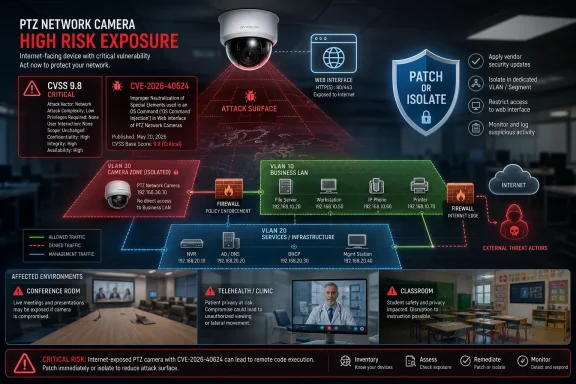 The Camera Is Now Part of the Attack Surface
The affected products are AVer’s PTC500S, PTC115, PTC500+, and PTC115+ cameras, with CISA listing all versions as affected by CVE-2026-40624. The advisory describes the weakness as files or directories being accessible to external parties, and says successful exploitation could allow arbitrary code execution. That combination should get attention from administrators even if the device is “just” a camera.PTC cameras are not generic USB webcams plugged into a single desktop. They are pan-tilt-camera systems designed for spaces where remote control, streaming, tracking, and integration with broader AV workflows are the whole point. They often sit on the same networks as room PCs, controllers, scheduling panels, lecture capture systems, video conferencing appliances, and sometimes management workstations.
That makes this advisory more than a niche hardware notice. In practice, cameras like these are frequently deployed by facilities teams, AV integrators, or departmental buyers rather than central IT. They end up connected to Ethernet, assigned static addresses, given web interfaces, and then left alone for years because the video still works.
CISA’s affected-sector list underscores the point. Government services and facilities, commercial facilities, and healthcare and public health are not fringe categories. They are the places where cameras become operational infrastructure, and where the difference between “device compromise” and “business compromise” can be disturbingly thin.
A CVSS 9.8 Score Is a Governance Problem, Not Just a Technical One
A CVSS 9.8 rating is not a ceremonial badge. It generally indicates a vulnerability that is remotely exploitable, low complexity, requires no privileges, and can have severe confidentiality, integrity, and availability impact. CISA’s plain-language summary is equally direct: exploitation could permit arbitrary code execution.For defenders, arbitrary code execution is the phrase that collapses the distance between “exposed file path” and “attacker foothold.” If an unauthenticated or lightly constrained attacker can turn access to a vulnerable device into code running on that device, the camera is no longer just leaking information. It becomes a beachhead.
The advisory does not say that CISA is aware of active exploitation targeting this vulnerability. That is important, but it should not be misread as comfort. “No known public exploitation” is not the same thing as “safe,” especially for embedded devices that may be internet-exposed, poorly logged, rarely monitored, and slow to receive operational attention.
The practical risk is compounded by the wording “all versions” for the listed models. When an advisory names only a narrow firmware range, an administrator can often triage by version inventory. When the affected range is all versions, the first response is more urgent and more operational: find every device, assume exposure until proven otherwise, and isolate before waiting for a tidy patch-management cycle.
The Weakness Class Is Boring, Which Is Why It Keeps Winning
“Files or Directories Accessible to External Parties” sounds less dramatic than memory corruption or a cryptographic break. It is also one of those weakness classes that can be devastating in embedded products because file layout, scripts, credentials, logs, configuration exports, and update mechanisms often sit closer together than defenders would like. On a camera, the web management interface is not a decorative shell; it is frequently the front door to the device’s real operating environment.The security failure here is not that cameras are complicated. It is that they are treated as appliances while behaving like networked servers. They expose web interfaces, accept firmware, store configuration, speak multiple streaming protocols, and integrate with control software. Every one of those functions creates a seam where an implementation mistake can become an exploit path.
The AV world has been migrating into IP for years because IP makes everything easier to deploy and manage. That migration also imports the security obligations of IP networks. A device that once needed a coax run and a local controller now has a browser login, a firmware lifecycle, and a place in vulnerability management.
For Windows-heavy environments, the camera’s presence can be particularly easy to underweight. It may not appear in Microsoft Defender for Endpoint inventory. It may not join Active Directory. It may not be represented in Intune, Configuration Manager, WSUS, or the standard server CMDB. Yet it may be reachable from the same VLAN as the room PC that signs into Teams, Zoom, or a hospital telehealth platform.
The Old Perimeter Advice Still Applies, but It Is No Longer Enough
CISA’s recommended practices are familiar: minimize network exposure, keep control system devices off the public internet, place them behind firewalls, isolate control networks from business networks, and use secure remote access methods such as updated VPNs where remote access is required. These are not glamorous instructions. They are the baseline that still separates survivable incidents from avoidable disasters.The problem is that many camera deployments were not built with that baseline in mind. A conference-room camera may have been installed to solve a meeting-quality problem, not to become part of a formal industrial control or facility security architecture. A clinic may have added a PTZ system for telemedicine. A city agency may have installed cameras in council chambers. A school may have placed them in lecture halls.
In each case, the deployment logic is operational convenience. The management logic should be security segmentation. Those two instincts often collide only after a vulnerability advisory arrives.
Remote access deserves special scrutiny. CISA’s note that VPNs can themselves have vulnerabilities is more than boilerplate. A VPN that drops a vendor, contractor, or administrator directly into a flat network containing unpatched cameras is not a security control so much as a longer hallway to the same unlocked room. Secure remote access should be narrow, logged, patched, and paired with network restrictions that only allow the necessary management paths.
Internet Exposure Turns a Camera Bug Into a Race
The most urgent question for any organization with affected AVer PTC cameras is simple: can the management interface be reached from the internet? If the answer is yes, the device should be removed from direct exposure immediately. If the answer is “we do not know,” the organization has an inventory problem that is now a vulnerability problem.Internet-connected cameras have long been attractive targets because they offer a blend of persistence, bandwidth, weak maintenance, and physical placement. Attackers do not need to care about the camera’s intended purpose. They care whether it can run code, relay traffic, capture credentials, pivot deeper into a network, or join a botnet.
Even when a device is not directly exposed, internal exposure can still matter. A compromised workstation, guest network bridge, misconfigured firewall rule, or vendor laptop can give an attacker the internal reach needed to touch a camera interface. That is why “not on the internet” is a good first control but not a complete answer.
The harder work is segmentation. Cameras should live in a network zone that assumes they are untrusted embedded systems. Management should be limited to specific administrative hosts. East-west traffic should be constrained. Logs should flow somewhere defenders can actually see them. Firmware should be tracked with the same seriousness applied to switches, access points, and NAS boxes.
The Windows Angle Is the Management Plane
This is not a Windows vulnerability, but it is absolutely a Windows environment problem. Most organizations that deploy these cameras still manage meetings, credentials, directories, endpoints, and identity through a Windows-centered ecosystem. The camera may run embedded Linux or proprietary firmware, but the people who administer it probably use Windows laptops, domain credentials, browser sessions, and shared network infrastructure.That creates a familiar bridge between non-Windows appliances and Windows risk. If a compromised camera can serve malicious content to an administrator’s browser, capture reused credentials, stage payloads, or act as a pivot point toward management stations, it becomes part of the Windows security story. The device does not need to run Windows to threaten a Windows estate.
Room systems are especially awkward. A meeting room PC may be domain-joined, auto-signed into collaboration software, connected to AV controllers, and trusted by users who assume the room is “internal.” If the camera and the room PC share a permissive local subnet, the camera can become an unexpected neighbor to a sensitive endpoint.
The same applies to healthcare and public-sector deployments. Telehealth carts, courtroom AV systems, council chambers, and training rooms often combine specialized devices with general-purpose Windows machines. Those hybrid environments are useful precisely because they bridge workflows. They are risky for the same reason.
Patch Management Fails Where Procurement Ends
The recurring scandal of connected devices is not that vendors ship vulnerabilities. Every vendor does. The scandal is that organizations keep buying networked equipment without a durable plan for firmware, support windows, vulnerability intake, asset ownership, and end-of-life replacement.AV equipment is particularly prone to this failure because ownership is diffuse. IT may control the switch port. Facilities may own the room. A vendor may manage the camera. A department may have paid for it. Security may not know it exists until a scanner finds an unexpected web server or a CISA advisory lands in a mailbox.
The affected list in this case includes multiple PTC models and all versions, which should force a practical question: who inside the organization is accountable for these devices by serial number, location, firmware, and network segment? If that answer requires three meetings and a spreadsheet archaeology expedition, the vulnerability has already found the weak point.
Procurement language can help, but only if it is enforced. Networked cameras should come with documented security update commitments, configuration hardening guides, supported management methods, and a clear vulnerability disclosure process. Buyers should ask whether the device can disable unused services, integrate with logging, support modern authentication, and operate without direct internet exposure.
This is where administrators need support from leadership. Firmware maintenance is rarely visible when it succeeds. It becomes visible only when neglected devices become incident-response line items. The cost of maintaining an accurate inventory of “minor” devices looks annoying until the alternative is emergency discovery during a critical advisory.
“No Known Exploitation” Should Start the Clock, Not Stop It
CISA says no known public exploitation specifically targeting CVE-2026-40624 has been reported to the agency at the time of the advisory. That sentence is useful. It gives defenders a chance to act before the incident narrative hardens into compromise reports, scanning spikes, and exploit chatter.But it should not encourage delay. Public advisories often change attacker economics. A vulnerability that was known to a researcher and a vendor becomes known to defenders and adversaries at the same time. Once model names, weakness class, and impact are public, internet-wide scanning and reverse-engineering become rational next steps for offensive operators.
The researcher credited in the advisory, fj016, reported the vulnerability to CISA. Coordinated disclosure is the healthier version of this process, but it still creates a window in which defenders must move faster than opportunistic exploitation. For cameras, that window is often narrowed by poor inventory and vendor-dependent remediation.
The safest reading is this: there may not be confirmed exploitation today, but the advisory has made the affected device family a target. That does not mean every deployment is equally exposed. It does mean every deployment deserves immediate verification.
Defenders Need to Treat Cameras Like Servers With Bad Keyboards
A useful mental model is to treat every IP camera as a server with a specialized sensor attached and a frustrating patch process. It has services. It has credentials. It has firmware. It has logs, or should. It has a management plane. It has a place in the threat model.That framing changes the response to CVE-2026-40624. The task is not only to look for a firmware download and move on. It is to validate exposure, remove unnecessary reachability, rotate credentials where appropriate, review logs for suspicious access, and confirm that management access is limited to trusted hosts.
Organizations should also review whether any affected cameras are reachable from guest Wi-Fi, classroom networks, shared AV VLANs, vendor support tunnels, or building-management segments. In many environments, the most dangerous rule is the old one nobody remembers. A camera installed during a renovation may still be benefiting from a temporary firewall exception that became permanent through neglect.
Monitoring is another gap. Security teams often log Windows endpoints, firewalls, identity providers, and cloud applications while embedded devices remain dark. If a camera is important enough to be on the network, it is important enough to produce auditable evidence. Even basic connection logging at the firewall or switch layer is better than discovering after an incident that the device had been communicating with unknown hosts for months.
The Advisory Exposes a Bigger AV Security Debt
This AVer advisory arrives in a broader pattern of camera and IoT vulnerabilities that have pushed physical-space technology into the center of cyber risk. Professional video gear now supports remote production, hybrid work, telemedicine, distance learning, and public meetings. The same features that make it operationally valuable also make it harder to secure casually.The pandemic-era acceleration of hybrid work left many organizations with expanded AV footprints and uneven governance. Rooms were upgraded quickly. Cameras, microphones, controllers, and appliances were added to solve urgent collaboration problems. Some of those purchases were carefully integrated into IT operations. Others were installed like furniture.
That split matters now. A well-managed camera VLAN with restricted admin access, documented firmware, and monitored traffic is a manageable risk. A flat network of forgotten devices with browser interfaces and default-ish operational habits is a gift to attackers.
The uncomfortable truth is that AV modernization often outran security modernization. The industry sold smarter rooms. Organizations bought them. Now security teams must retrofit those rooms into the same discipline that already governs laptops, servers, switches, and cloud services.
The Practical Response Starts With Discovery
For administrators, the first day’s work is discovery. Search asset inventories for AVer, PTC500S, PTC115, PTC500+, and PTC115+. Query DHCP, DNS, NAC, switch MAC tables, vulnerability scanners, and procurement records. Ask facilities and AV teams directly, because the authoritative list may live outside IT.The second day’s work is exposure reduction. Any affected camera management interface reachable from the public internet should be removed from direct exposure. Internal access should be restricted to known management stations. If remote vendor support exists, review it immediately and disable anything that is not necessary.
The third day’s work is vendor remediation and monitoring. Check AVer’s support channels for model-specific guidance and firmware availability. If no fixed firmware is available for a given deployment, compensating controls become the control, not a temporary afterthought. Watch for abnormal outbound connections, unexpected authentication attempts, configuration changes, and traffic from unusual internal hosts.
Administrators should also assume that camera credentials may have been handled casually over the years. Shared passwords, browser-saved credentials, vendor-known passwords, and credentials reused across devices are common in AV environments. A critical advisory is a good moment to reset them, but only after confirming that operational dependencies will not break at the worst possible time.
The Small Print Is the Main Story for Regulated Environments
Healthcare, government, and commercial facilities each have different compliance pressures, but the security logic converges. A camera in a clinic, public meeting room, or corporate boardroom may capture sensitive conversations, personal information, operational details, or regulated activity. Even if CVE-2026-40624 is framed as code execution rather than video access, the resulting compromise could have privacy and governance consequences.Healthcare organizations should pay particular attention to telehealth and consultation spaces where AV systems may be treated as clinical infrastructure. Government agencies should look at council chambers, courts, emergency operations centers, training rooms, and public-service counters. Commercial facilities should consider executive conference rooms, manufacturing observation areas, and customer-facing spaces.
The risk is not limited to what the lens can see. A compromised camera can provide network position. It can become a persistence point. It can help attackers understand the internal topology of a facility network. In some environments, it may sit close to other devices that were also installed by non-IT teams and are equally under-governed.
That is why CISA’s standard language about impact analysis and risk assessment matters. Emergency defensive changes can disrupt operations. But doing nothing because a camera is operationally convenient is not a risk assessment; it is risk acceptance by accident.
The AVer Warning Leaves Administrators With Five Immediate Moves
The priority now is to turn a federal advisory into local facts. This is the moment to be concrete: which rooms, which models, which firmware, which network segments, which exposure paths, and which owners. Anything less leaves defenders debating the advisory instead of reducing the risk.- Organizations should identify every AVer PTC500S, PTC115, PTC500+, and PTC115+ camera and treat all versions as affected until vendor guidance proves otherwise.
- Administrators should remove any affected camera management interface from direct internet exposure and restrict internal access to specific trusted management hosts.
- Security teams should review firewall, VPN, VLAN, and vendor-support rules to ensure camera networks are isolated from business systems and unnecessary remote access paths are closed.
- Operations teams should check AVer support channels for remediation guidance and plan firmware updates or compensating controls through normal change-management procedures.
- Defenders should monitor affected camera networks for unusual inbound access, unexpected outbound connections, configuration changes, and traffic involving room PCs or administrator workstations.
- Procurement and IT leadership should use this incident to require ownership, update commitments, and security review for future AV and IoT purchases.
References
- Primary source: CISA
Published: 2026-06-18T12:00:00+00:00

AVer PTC cameras | CISA
www.cisa.gov
- Related coverage: cyber.gov.rw
Article
 cyber.gov.rw
- Related coverage: techradar.com
Honeywell CCTV cameras vulnerable to hijacking which allows hackers to crack passwords easily | TechRadar
CISA tells Honeywell CCTV users to patch nowwww.techradar.com - Related coverage: securityweek.com
TP-Link Patches Vulnerability Exposing VIGI Cameras to Remote Hacking
The researcher who discovered the vulnerability saw more than 2,500 internet-exposed devices.www.securityweek.com - Related coverage: assurantcyber.com
TP-Link Systems Inc. VIGI Series IP Camera - ASSURANT™
TP-Link Systems Inc. VIGI Series IP Camera All CISA Advisories, CISA, February 5, 2026 View CSAF Summary Successful exploitation of this vulnerability could result in unauthorized users gaining administrative access to affected closed circuit television cameras. The following versions of TP-Link... www.assurantcyber.com
- Related coverage: db.gcve.eu
Vulnerability-Lookup
Vulnerability-Lookup - Fast vulnerability lookup correlation from different sources.db.gcve.eu
- Related coverage: averusa.com
- Related coverage: honeywell.com
