

Anthropic launched Claude Fable 5 on June 9, 2026, making its first Mythos-class model broadly available through the Claude API while routing high-risk cybersecurity, biology, chemistry, and model-distillation requests to the less capable Claude Opus 4.8 model instead. The move is less a normal model launch than a public test of whether frontier AI can be sold with parts of its brain deliberately fenced off. For Windows developers, enterprise security teams, and admins already watching AI creep into every workflow, Fable 5 is a glimpse of the next bargain: more capability, more cost, and more vendor-controlled judgment about what your tools are allowed to do.
The AI industry usually launches models with a familiar rhythm: bigger benchmark numbers, a few glossy partner quotes, and vague assurances that safety was handled somewhere in the background. Fable 5 breaks that pattern because the safety mechanism is not a footnote. It is the defining feature.
Anthropic is describing Fable 5 as a Mythos-class model made safe enough for general use. That phrasing matters. It implies that the underlying capability tier exists above the company’s existing Opus line, but that public access depends on cutting off or rerouting the use cases Anthropic considers too risky.
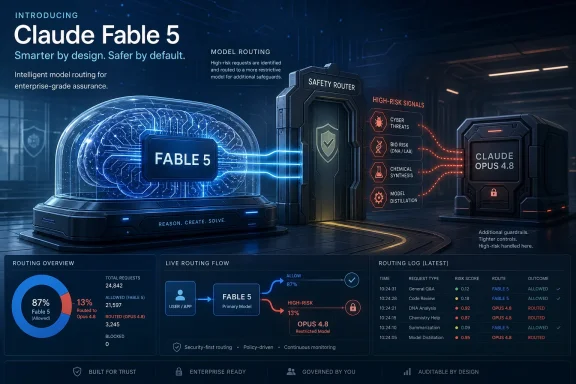
The fallback mechanism is the clever and controversial part. If Fable 5 detects certain high-risk categories, the answer is handled by Claude Opus 4.8 instead. In other words, Anthropic is not merely refusing a class of questions; it is substituting a less capable model for them.
That is a profound design choice. It treats model capability itself as a controlled substance, not just model output. The user may see a Claude response, but behind the scenes Anthropic is deciding which level of intelligence is safe to apply.
Anthropic positioned Mythos as a tool for critical software defense, with partners including major technology and infrastructure players. The company said the model was being used to uncover high- and critical-severity vulnerabilities across important software, a claim that made Mythos sound less like a chatbot and more like an automated red-team operator.
That framing created a tension Anthropic could not avoid forever. If Mythos-level models are genuinely useful for finding dangerous flaws, then withholding them from the public also withholds a powerful defensive tool from smaller organizations. But if they are released too freely, the same capabilities could lower the cost of offensive exploitation.
Fable 5 is Anthropic’s first attempt to split that difference. The company is effectively saying: the general reasoning, coding, research, and analytics gains can go public, while the most dangerous slices stay behind a classifier and a fallback model.
For enterprise IT, that is both reassuring and frustrating. Reassuring, because a public Mythos-class model without any special controls would raise obvious concerns for security teams already dealing with AI-assisted phishing, malware iteration, and vulnerability discovery. Frustrating, because the difference between a blocked harmful request and a legitimate defensive request is rarely clean in the real world.
A Windows admin asking for help investigating suspicious PowerShell behavior may look different from an attacker only by context. A security researcher reproducing an exploit in a lab may use language similar to someone preparing an intrusion. A biology researcher, chemist, or platform engineer can run into dual-use boundaries even when the intent is benign.
That is the cost of classifier-mediated safety. It creates a new layer of operational uncertainty. The model may be astonishingly capable until the moment a workflow touches a sensitive domain, at which point it silently or visibly becomes something else.
That matters for anyone building AI into software development pipelines. If a tool depends on Fable 5 for code analysis, refactoring, testing, or agentic debugging, it may perform brilliantly on ordinary application logic and then behave differently around security-sensitive code. That is not necessarily wrong, but it is something developers must design around.
The model’s fallback to Opus 4.8 also raises audit questions. If an AI assistant is embedded in a development environment, should logs show when a request was routed away from Fable? Should administrators be able to define their own risk threshold? Should regulated enterprises be allowed to force safer routing, while vetted security teams request expanded access?
Those are not theoretical questions for Windows shops. AI coding assistants are already moving into Visual Studio Code, GitHub workflows, ticket queues, security operations centers, and internal developer platforms. A model that changes capability based on inferred risk becomes part of the organization’s control plane.
The company’s reported claim that testers found no universal jailbreaks is significant but narrow. A universal jailbreak is the dramatic case: one trick that breaks the system broadly. Real misuse often looks messier and more incremental, stitched together through paraphrase, tool use, partial outputs, and social engineering of the system itself.
The more capable a model becomes, the more valuable those edge cases become. Attackers do not need perfect access if they can extract enough help across enough attempts. Defenders, meanwhile, may find that safety systems block them precisely when they need the most capable assistance.
This is why Fable 5 should not be judged only by launch-day benchmark scores or red-team claims. It should be judged by how well Anthropic handles appeals, logging, enterprise policy, abuse reports, and the inevitable examples where the classifier makes a defensible but disruptive call.
For developers, the appeal is obvious. A Mythos-class model that can reason through large codebases, fix subtle bugs, design interfaces, and assist with architecture could become a serious productivity multiplier. On Windows, where enterprise code often spans legacy .NET, PowerShell, Win32 components, cloud services, and internal line-of-business applications, better context handling and stronger reasoning matter.
But the same improvement that makes Fable 5 useful also sharpens the risk. A model that is better at understanding code is also better at understanding vulnerable code. A model that can plan a complex refactor can also plan a complex intrusion chain if left unconstrained.
That is the central bargain Anthropic is asking users to accept. You can have the smarter model, but not for everything. And the company, not the user, draws the first version of that line.
If Fable 5 performs as advertised, it could help defenders review scripts, explain suspicious logs, generate safer detection logic, and reason about sprawling enterprise configurations. It may become especially useful for teams that lack dedicated reverse engineers or senior cloud security specialists.
At the same time, the fallback policy is a reminder that the most potent AI security capabilities are not being democratized evenly. Project Glasswing participants and trusted-access customers may get Mythos 5 in restricted form. Everyone else gets Fable 5 with guardrails and fallback.
That may be sensible, but it creates a capability gap. Large vendors and selected partners gain access to the sharpest tools first, while smaller defenders rely on filtered versions. The industry has seen this pattern before with threat intelligence, exploit telemetry, and advanced security tooling; AI may now repeat it at greater speed.
The past year’s AI enthusiasm has already run into a budgeting problem. Developers discover that agentic workflows consume tokens quickly. Managers discover that “just ask the model” becomes a line item. Finance teams discover that proof-of-concept usage and production usage are different planets.
Fable 5 intensifies that problem because the model is positioned as more capable and therefore more tempting. If it can solve harder coding and analytics tasks, teams will want to use it where the work is most expensive. But if every complex agent run burns through premium tokens, organizations will need routing strategies as much as prompt libraries.
That is where Windows and enterprise administrators come back into the frame. AI adoption is no longer just a developer preference. It is becoming a licensing, compliance, security, and cost-management issue — the same kind of cross-functional headache that cloud computing became once the first surprise bills arrived.
There is nothing inherently wrong with this. In fact, it is probably necessary. Not every task needs the most expensive model, and not every prompt should receive the most capable answer. Sensible routing can reduce cost and risk.
But the governance challenge is substantial. If a developer’s AI tool quietly routes a request from Fable 5 to Opus 4.8, then perhaps to another model for summarization, and then to a local tool for execution, administrators need visibility into that chain. Without it, enterprises will have a new kind of shadow IT: not unauthorized apps, but unauthorized model decisions.
The same applies to compliance. A regulated company may need to know whether sensitive data was sent to a frontier model, whether a response came from a restricted-capability model, and whether a high-risk classifier was triggered. “Claude answered the question” will not be enough detail for an audit.
This gives the company a useful message for enterprises and regulators. It can say that it is not hiding frontier capability forever, nor is it dumping it into the market without controls. It is building a middle path: public access for general tasks, restricted access for dangerous domains, and trusted programs for vetted partners.
That message will appeal to boards, governments, and security-conscious buyers. It may also irritate developers who want fewer paternalistic controls and more predictable behavior. The same policy that reassures a chief security officer can feel like a black box to a power user.
The competitive question is whether the market rewards restraint. If Fable 5 is clearly better at day-to-day work, users may accept the guardrails. If rivals offer similar capability with fewer interruptions, Anthropic’s safety architecture will be tested not just by jailbreakers, but by customer churn.
A help desk engineer may ask about credential dumping because they are investigating an incident. A developer may ask about obfuscation because they are reviewing malware found on a user’s PC. A biology student may ask about a dangerous mechanism because they are trying to understand a safety protocol. A Windows admin may ask for a proof-of-concept exploit because they need to verify whether a patch actually mitigates a vulnerability.
If Fable 5 refuses too often or falls back too bluntly, professionals will route around it. If it allows too much, Anthropic’s safety case weakens. If the system provides clear explanations and enterprise-grade controls, it could become a credible template for safer frontier deployment.
That last path is the one Anthropic appears to be aiming for, but it is not guaranteed by a launch announcement. It requires product maturity, policy transparency, and a willingness to admit where the classifier gets it wrong.
There are several immediate implications for Windows users, developers, and IT leaders:
Fable 5 is the beginning of a more complicated AI market, one where the question is no longer simply which model is smartest, but which parts of that intelligence you are allowed to use, under what conditions, at what price, and with whose judgment sitting between the prompt and the answer. For Windows admins and developers, that means the next wave of AI tooling will require the same discipline as any other powerful enterprise platform: testing, logging, policy, cost controls, and a healthy suspicion of vendor magic. The Mythos-class era may bring better code and faster research, but its real legacy could be the end of the idea that a public AI model is a single, stable thing.
 Anthropic Puts the Safety Case Directly Into the Product
The AI industry usually launches models with a familiar rhythm: bigger benchmark numbers, a few glossy partner quotes, and vague assurances that safety was handled somewhere in the background. Fable 5 breaks that pattern because the safety mechanism is not a footnote. It is the defining feature.Anthropic is describing Fable 5 as a Mythos-class model made safe enough for general use. That phrasing matters. It implies that the underlying capability tier exists above the company’s existing Opus line, but that public access depends on cutting off or rerouting the use cases Anthropic considers too risky.
The fallback mechanism is the clever and controversial part. If Fable 5 detects certain high-risk categories, the answer is handled by Claude Opus 4.8 instead. In other words, Anthropic is not merely refusing a class of questions; it is substituting a less capable model for them.
That is a profound design choice. It treats model capability itself as a controlled substance, not just model output. The user may see a Claude response, but behind the scenes Anthropic is deciding which level of intelligence is safe to apply.
Mythos Was Never Just Another Bigger Model
The Mythos story began earlier this year with Project Glasswing, Anthropic’s restricted-access program for using Claude Mythos Preview in defensive cybersecurity work. The premise was straightforward and unsettling: a model powerful enough to find and exploit serious vulnerabilities should not simply be dropped into the public API and left to market forces.Anthropic positioned Mythos as a tool for critical software defense, with partners including major technology and infrastructure players. The company said the model was being used to uncover high- and critical-severity vulnerabilities across important software, a claim that made Mythos sound less like a chatbot and more like an automated red-team operator.
That framing created a tension Anthropic could not avoid forever. If Mythos-level models are genuinely useful for finding dangerous flaws, then withholding them from the public also withholds a powerful defensive tool from smaller organizations. But if they are released too freely, the same capabilities could lower the cost of offensive exploitation.
Fable 5 is Anthropic’s first attempt to split that difference. The company is effectively saying: the general reasoning, coding, research, and analytics gains can go public, while the most dangerous slices stay behind a classifier and a fallback model.
The Fallback Model Is the Real Product Boundary
Most users will experience Fable 5 as a faster or smarter Claude, but the model-routing policy is the real boundary line. Anthropic is not just selling access to a model. It is selling access to a managed capability surface.For enterprise IT, that is both reassuring and frustrating. Reassuring, because a public Mythos-class model without any special controls would raise obvious concerns for security teams already dealing with AI-assisted phishing, malware iteration, and vulnerability discovery. Frustrating, because the difference between a blocked harmful request and a legitimate defensive request is rarely clean in the real world.
A Windows admin asking for help investigating suspicious PowerShell behavior may look different from an attacker only by context. A security researcher reproducing an exploit in a lab may use language similar to someone preparing an intrusion. A biology researcher, chemist, or platform engineer can run into dual-use boundaries even when the intent is benign.
That is the cost of classifier-mediated safety. It creates a new layer of operational uncertainty. The model may be astonishingly capable until the moment a workflow touches a sensitive domain, at which point it silently or visibly becomes something else.
Public AI Is Becoming a Tiered Security Architecture
The launch also signals a broader shift in how frontier labs want to package capability. The old hierarchy was easy to understand: free users got one model, paid users got a better model, enterprise users got more controls, and selected partners got previews. Fable 5 adds a subtler structure where users may access the same named product but not always the same effective capability.That matters for anyone building AI into software development pipelines. If a tool depends on Fable 5 for code analysis, refactoring, testing, or agentic debugging, it may perform brilliantly on ordinary application logic and then behave differently around security-sensitive code. That is not necessarily wrong, but it is something developers must design around.
The model’s fallback to Opus 4.8 also raises audit questions. If an AI assistant is embedded in a development environment, should logs show when a request was routed away from Fable? Should administrators be able to define their own risk threshold? Should regulated enterprises be allowed to force safer routing, while vetted security teams request expanded access?
Those are not theoretical questions for Windows shops. AI coding assistants are already moving into Visual Studio Code, GitHub workflows, ticket queues, security operations centers, and internal developer platforms. A model that changes capability based on inferred risk becomes part of the organization’s control plane.
Anthropic Is Betting That Classifiers Can Hold the Line
Anthropic says it has red-teamed Fable 5’s safeguards and tested them against jailbreak attempts, including through bug bounty work and external red-teaming. That is the right thing to do, but it does not end the debate. Classifiers are software, and software fails at the edges.The company’s reported claim that testers found no universal jailbreaks is significant but narrow. A universal jailbreak is the dramatic case: one trick that breaks the system broadly. Real misuse often looks messier and more incremental, stitched together through paraphrase, tool use, partial outputs, and social engineering of the system itself.
The more capable a model becomes, the more valuable those edge cases become. Attackers do not need perfect access if they can extract enough help across enough attempts. Defenders, meanwhile, may find that safety systems block them precisely when they need the most capable assistance.
This is why Fable 5 should not be judged only by launch-day benchmark scores or red-team claims. It should be judged by how well Anthropic handles appeals, logging, enterprise policy, abuse reports, and the inevitable examples where the classifier makes a defensible but disruptive call.
Coding Gains Arrive With a New Kind of Friction
Anthropic is emphasizing Fable 5’s performance in software engineering, knowledge work, analytics, and scientific research. Partner testing reportedly showed strong results on long-running analytics tasks and difficult coding challenges, including UI design and game coding. That fits the direction of the market: models are no longer judged merely by whether they can answer questions, but by whether they can carry complex tasks across time.For developers, the appeal is obvious. A Mythos-class model that can reason through large codebases, fix subtle bugs, design interfaces, and assist with architecture could become a serious productivity multiplier. On Windows, where enterprise code often spans legacy .NET, PowerShell, Win32 components, cloud services, and internal line-of-business applications, better context handling and stronger reasoning matter.
But the same improvement that makes Fable 5 useful also sharpens the risk. A model that is better at understanding code is also better at understanding vulnerable code. A model that can plan a complex refactor can also plan a complex intrusion chain if left unconstrained.
That is the central bargain Anthropic is asking users to accept. You can have the smarter model, but not for everything. And the company, not the user, draws the first version of that line.
The Windows Security Community Gets Both a Tool and a Warning
For WindowsForum readers, the most immediate angle is security. Windows environments remain a vast attack surface: Active Directory, Entra ID integrations, Exchange remnants, endpoint management agents, remote access tools, PowerShell automation, device drivers, and a long tail of third-party enterprise software. Any model that improves vulnerability discovery will eventually affect that world.If Fable 5 performs as advertised, it could help defenders review scripts, explain suspicious logs, generate safer detection logic, and reason about sprawling enterprise configurations. It may become especially useful for teams that lack dedicated reverse engineers or senior cloud security specialists.
At the same time, the fallback policy is a reminder that the most potent AI security capabilities are not being democratized evenly. Project Glasswing participants and trusted-access customers may get Mythos 5 in restricted form. Everyone else gets Fable 5 with guardrails and fallback.
That may be sensible, but it creates a capability gap. Large vendors and selected partners gain access to the sharpest tools first, while smaller defenders rely on filtered versions. The industry has seen this pattern before with threat intelligence, exploit telemetry, and advanced security tooling; AI may now repeat it at greater speed.
Price Turns Capability Into a Governance Problem
Fable 5’s reported pricing of $10 per million input tokens and $50 per million output tokens makes it expensive enough that organizations will not use it casually at scale without thinking about routing. It is double the regular Opus 4.8 price reported around that model’s launch, and that difference will shape adoption.The past year’s AI enthusiasm has already run into a budgeting problem. Developers discover that agentic workflows consume tokens quickly. Managers discover that “just ask the model” becomes a line item. Finance teams discover that proof-of-concept usage and production usage are different planets.
Fable 5 intensifies that problem because the model is positioned as more capable and therefore more tempting. If it can solve harder coding and analytics tasks, teams will want to use it where the work is most expensive. But if every complex agent run burns through premium tokens, organizations will need routing strategies as much as prompt libraries.
That is where Windows and enterprise administrators come back into the frame. AI adoption is no longer just a developer preference. It is becoming a licensing, compliance, security, and cost-management issue — the same kind of cross-functional headache that cloud computing became once the first surprise bills arrived.
Model Routing Becomes the New Shadow IT
The fallback design also foreshadows a wider routing economy. Instead of choosing one model for all tasks, applications will increasingly select models dynamically based on cost, latency, sensitivity, and risk. Fable 5 makes that logic explicit at the frontier-model level.There is nothing inherently wrong with this. In fact, it is probably necessary. Not every task needs the most expensive model, and not every prompt should receive the most capable answer. Sensible routing can reduce cost and risk.
But the governance challenge is substantial. If a developer’s AI tool quietly routes a request from Fable 5 to Opus 4.8, then perhaps to another model for summarization, and then to a local tool for execution, administrators need visibility into that chain. Without it, enterprises will have a new kind of shadow IT: not unauthorized apps, but unauthorized model decisions.
The same applies to compliance. A regulated company may need to know whether sensitive data was sent to a frontier model, whether a response came from a restricted-capability model, and whether a high-risk classifier was triggered. “Claude answered the question” will not be enough detail for an audit.
Anthropic’s Safety Posture Is Also a Competitive Strategy
It would be naïve to treat Fable 5’s safeguards as pure altruism. Safety is part of Anthropic’s brand, but it is also a market position. By launching a powerful public model with visible restrictions, Anthropic can claim the high ground against rivals that may be more aggressive about capability release.This gives the company a useful message for enterprises and regulators. It can say that it is not hiding frontier capability forever, nor is it dumping it into the market without controls. It is building a middle path: public access for general tasks, restricted access for dangerous domains, and trusted programs for vetted partners.
That message will appeal to boards, governments, and security-conscious buyers. It may also irritate developers who want fewer paternalistic controls and more predictable behavior. The same policy that reassures a chief security officer can feel like a black box to a power user.
The competitive question is whether the market rewards restraint. If Fable 5 is clearly better at day-to-day work, users may accept the guardrails. If rivals offer similar capability with fewer interruptions, Anthropic’s safety architecture will be tested not just by jailbreakers, but by customer churn.
The Safeguards Will Be Judged in the Boring Cases
The dramatic cases are easy to discuss: bioweapons, malware, critical infrastructure, exploit automation. The harder test will be ordinary ambiguity. That is where most enterprise AI friction lives.A help desk engineer may ask about credential dumping because they are investigating an incident. A developer may ask about obfuscation because they are reviewing malware found on a user’s PC. A biology student may ask about a dangerous mechanism because they are trying to understand a safety protocol. A Windows admin may ask for a proof-of-concept exploit because they need to verify whether a patch actually mitigates a vulnerability.
If Fable 5 refuses too often or falls back too bluntly, professionals will route around it. If it allows too much, Anthropic’s safety case weakens. If the system provides clear explanations and enterprise-grade controls, it could become a credible template for safer frontier deployment.
That last path is the one Anthropic appears to be aiming for, but it is not guaranteed by a launch announcement. It requires product maturity, policy transparency, and a willingness to admit where the classifier gets it wrong.
The Mythos Era Arrives With a Kill Switch Built In
The most concrete reading of Fable 5 is that Anthropic believes the industry has crossed a capability threshold. A model can now be generally useful enough to justify public release while still being too capable in certain domains to expose without special handling. That is a new phase for consumer and enterprise AI.There are several immediate implications for Windows users, developers, and IT leaders:
- Fable 5 is the first broadly available Claude model Anthropic is presenting as Mythos-class, but it is not the same access profile as restricted Mythos 5.
- High-risk requests in areas such as cybersecurity, biology, chemistry, and model distillation are routed to Claude Opus 4.8 rather than handled by Fable 5.
- Developers should expect stronger performance on difficult coding and analytical tasks, but they should also expect unpredictable friction around security-sensitive workflows.
- Enterprises adopting Fable 5 through the API should demand logging, routing transparency, and administrative controls before embedding it into production systems.
- The model’s higher token price makes cost-aware routing and usage governance a practical requirement, not an optimization exercise.
- Security teams should treat the launch as evidence that AI-assisted vulnerability discovery is becoming more powerful, even if the strongest public capabilities remain filtered.
Fable 5 is the beginning of a more complicated AI market, one where the question is no longer simply which model is smartest, but which parts of that intelligence you are allowed to use, under what conditions, at what price, and with whose judgment sitting between the prompt and the answer. For Windows admins and developers, that means the next wave of AI tooling will require the same discipline as any other powerful enterprise platform: testing, logging, policy, cost controls, and a healthy suspicion of vendor magic. The Mythos-class era may bring better code and faster research, but its real legacy could be the end of the idea that a public AI model is a single, stable thing.
References
- Primary source: IT Pro
Published: 2026-06-09T17:50:12.579666
Anthropic just launched Claude Fable 5, its first Mythos-class AI model – but it has new safeguards to prevent misuse and will ‘fall back’ to Opus 4.8 for queries in ‘high risk’ topics | IT Pro
The launch of Claude Fable 5 marks the first public release of a Mythos-class AI modelwww.itpro.com - Related coverage: axios.com
Anthropic releases Claude Mythos-level model
Fable 5 includes safeguards to help protect against hacking and bio-terrorism.www.axios.com
- Official source: anthropic.com
Project Glasswing: Securing critical software for the AI era \ Anthropic
A new initiative to secure the world’s most critical software and give defenders a durable advantage in the coming AI-driven era of cybersecurity.www.anthropic.com - Related coverage: venturebeat.com
Anthropic's Claude Opus 4.8 is here with 3X cheaper fast mode and near-Mythos level alignment | VentureBeat
Opus 4.8 shows a growing tendency to reason explicitly about how its outputs will be graded, including in environments where it wasn't told it was being evaluated.venturebeat.com - Related coverage: daveisbest.org
Opus 4.8, Mythos & Glasswing · David Walsh
A new flagship that ships honesty as its headline, a frontier model too dangerous to release, and a coalition quietly finding ten thousand zero-days — what's confirmed, and what's still rumour.www.daveisbest.org - Related coverage: devshelfhub.com
Claude Mythos & Project Glasswing Explained | DevShelfHub
Claude Mythos autonomously found a 27-year-old OpenBSD bug—Project Glasswing, benchmarks, concerning behaviors, and what it means for software careers.www.devshelfhub.com
- Related coverage: worthview.com
After Claude Opus 4.8, What Is Anthropic's Mythos-Class Model? Everything We Know - WorthvieW
Claude Mythos Preview is Anthropic's most powerful AI model ever — but you cannot use it yet. Here's what it is, what it can do, why Anthropic is withholding it, and what to expect when it finally goes public.www.worthview.com - Related coverage: helpnetsecurity.com
Anthropic launches Claude Opus 4.8, prepares Mythos-class models for all customers - Help Net Security
Anthropic released Claude Opus 4.8 and outlined plans to make Mythos-class AI models available to all customers.www.helpnetsecurity.com - Related coverage: rdworldonline.com
How Opus 4.8 compares to Claude Mythos and GPT 5.5
Anthropic launched Claude Opus 4.8 this week, and Artificial Analysis reports that it narrowly tops the independent Artificial Analysis Intelligence Index at 61.4, compared with 60.2 for GPT-5.5 (xhigh). In Anthropic’s announcement for the model, Opus 4.8 looks mostly like an incremental upgrade...www.rdworldonline.com - Related coverage: tomsguide.com
Claude Opus 4.8 just launched — and Anthropic says it's far less likely to ‘fake’ answers | Tom's Guide
Anthropic just launched Claude Opus 4.8 with new reasoning controls, dynamic AI workflows and a major focus on reducing fake or overconfident AI answers.www.tomsguide.com - Related coverage: decodethefuture.org
Claude Mythos: What It Is, Launch & Why It Was Pulled
Claude Mythos is Anthropic's tier above Opus — launched June 9 as Fable 5 and Mythos 5, then pulled June 12 under a US export order. What it is and its status. decodethefuture.org
- Related coverage: thenextweb.com
Anthropic releases Claude Fable 5, its first Mythos-class model for the public
Anthropic launched Claude Fable 5 on Tuesday, a Mythos-class model with safeguards blocking cybersecurity and biology queries, priced at $10 per million input tokens.thenextweb.com - Related coverage: techradar.com
Mythos accessed by unauthorized users via third parties | TechRadar
The Mythos model may have been accessed by unauthorized userswww.techradar.com - Related coverage: omni.se
Anthropic kan släppa AI i Mythos-nivå ”inom veckor”
Anthropic har lanserat den uppgraderade AI-modellen Claude Opus 4.8, som enligt bolaget ska vara betydligt bättre på att erkänna osäkerheter och undvika tvärsäkra felaktigheter än föregångarna.omni.se
- Related coverage: elpais.com
Anthropic oculta su nuevo modelo de IA, Mythos, por ser demasiado peligroso | Tecnología | EL PAÍS
La compañía ha optado por ceder estrictamente su acceso a unas docenas de empresas escogidas para que lo usen para proteger su ‘software’elpais.com
