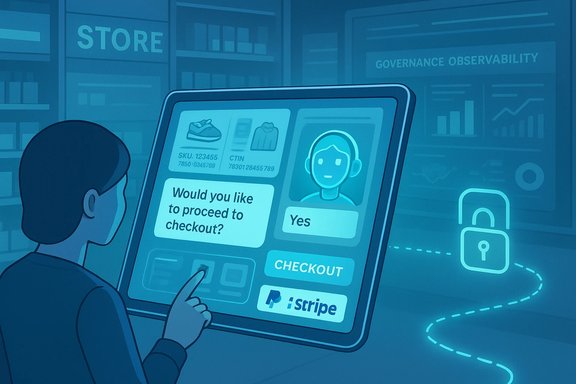
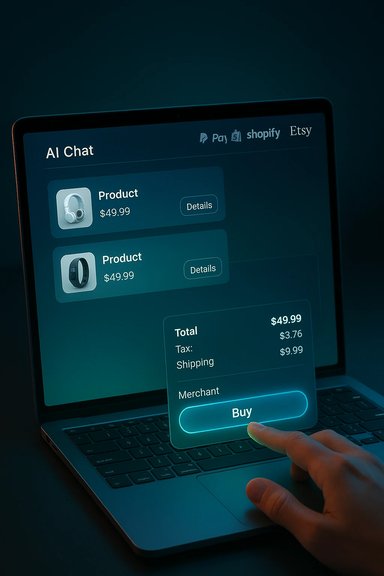
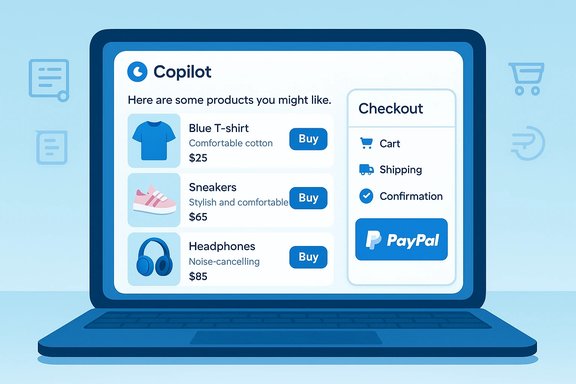
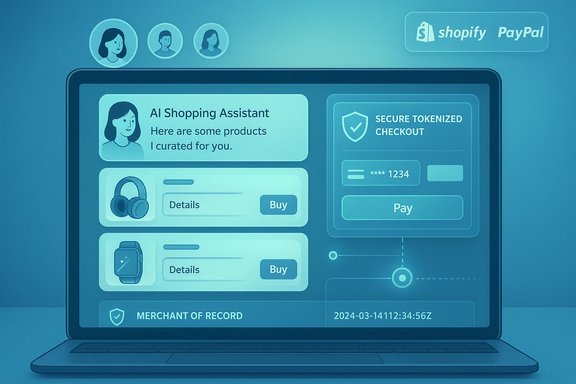
• Thread Author
Microsoft has turned its Copilot chat experience into a functioning checkout lane, enabling in-chat purchases through new integrations with Shopify, PayPal and Etsy and rolling out a U.S.-first Copilot Checkout that keeps merchants as the merchant of record while collapsing discovery-to-purchase into a single conversational surface.

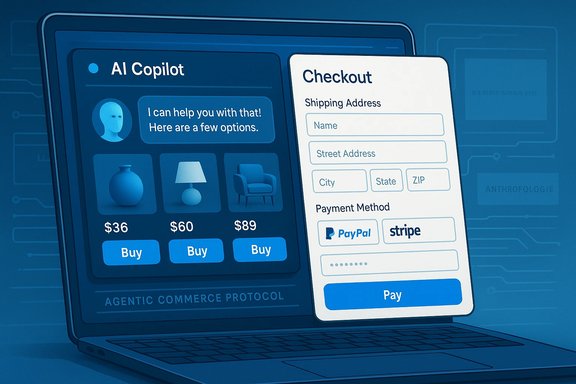
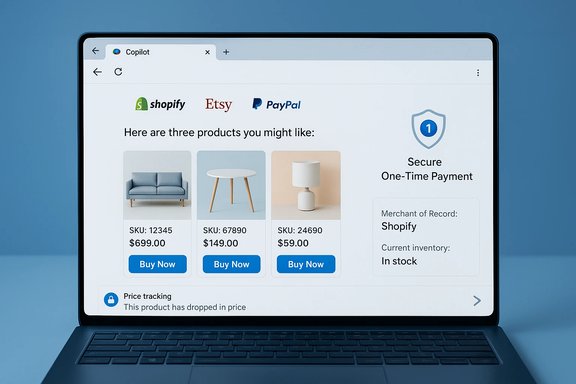
E‑commerce product page on a laptop showing three items, brand logos, and a Secure One-Time Payment badge.Background / Overview​

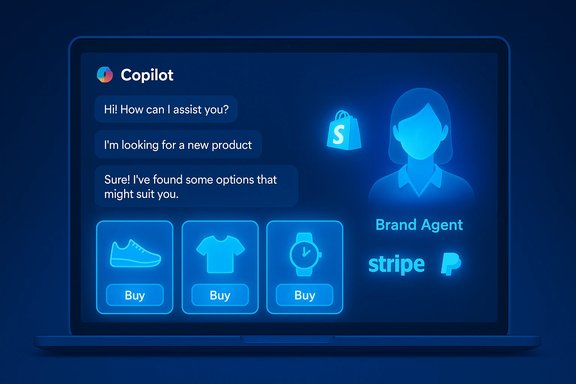
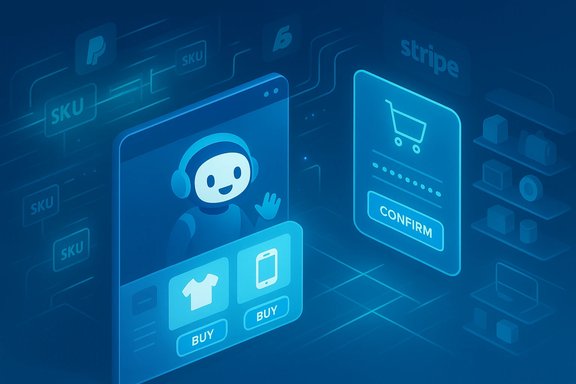
The move marks another decisive step in the industry shift from “links to actions”: rather than finishing a shopping conversation with a link to a merchant page, Copilot can now surface product choices and complete a checkout inside the chat or Copilot app itself. Microsoft positions this capability as Copilot Checkout—a friction-reducing feature that stitches together product discovery, price-tracking, merchant checkout rails and tokenized payments so users can confirm orders without being redirected to traditional storefront pages.
This rollout follows a wave of similar agentic commerce initiatives launched across the ecosystem over the past year, where platforms and commerce providers introduced machine-readable product feeds, delegated-payment primitives and standardized agent-to-merchant protocols. The core technical primitives—structured catalog metadata, ephemeral tokenized payments, and an orchestration/runtime layer that manages multi-step agent flows—are now in active deployment across multiple vendors. Microsoft’s Copilot Checkout leverages those same primitives while relying on partnerships with Shopify, PayPal, Etsy and payments partners such as Stripe to route payments and keep merchants responsible for fulfillment and returns.
The promise is tangible: faster conversions, fewer tabs, and a more personal “concierge” experience inside a tool many people already use for answers. But the emergence of agentic checkout also raises immediate questions about privacy, merchant control, dispute handling, discoverability, and platform economics. This feature is as much a technical integration challenge as it is a strategic shift in where control and value accrue in the shopping stack.

How Copilot Checkout works — a technical walkthrough​

The agentic stack in plain terms​

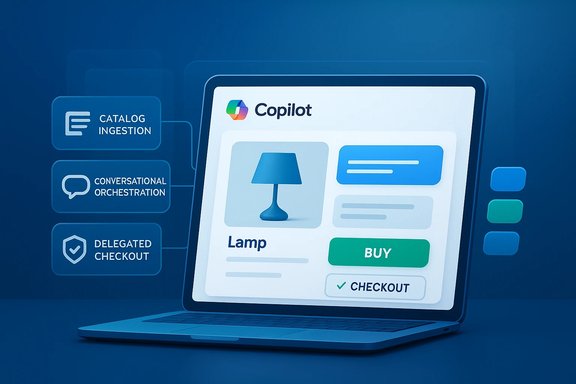
At a high level, Copilot Checkout implements three coordinated layers:
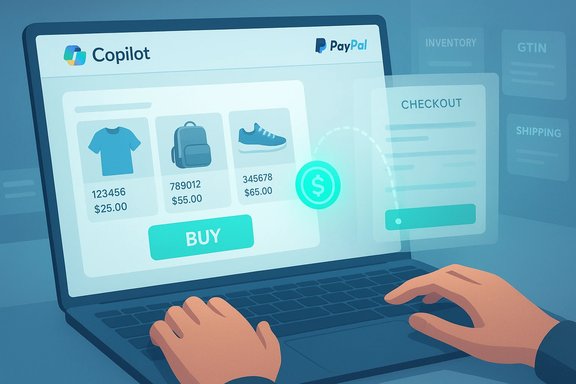
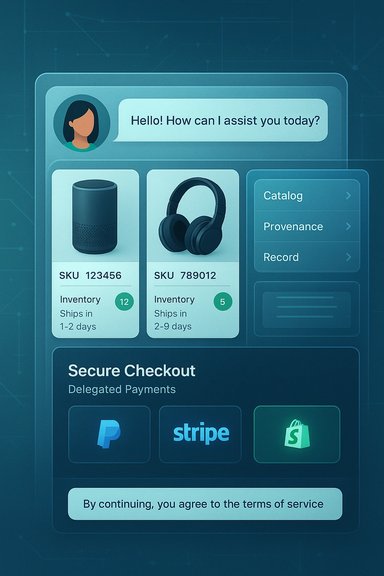
  • Discovery & product feed ingestion — Merchants (via Shopify or other platforms) publish machine-readable catalog data: SKUs, variants, GTINs, images, descriptions, inventory and shipping windows. Agents query these canonical records rather than scraping HTML product pages, which reduces hallucination risk and keeps responses grounded in merchant-provided data.
  • Agent orchestration & conversational flow — The Copilot runtime parses natural-language shopper intent, asks clarifying questions when needed (size, color, delivery window), and presents a short list of vetted options. It maintains provenance—tracking which product records produced each suggestion—so actions can be tied back to auditable orders.
  • Tokenized / delegated checkout — When the user confirms a purchase, the assistant requests a secure, short-lived checkout session or payment token that hands the transaction back to the merchant’s checkout system. The merchant remains the merchant of record; fulfillment, returns and customer service stay with them.

Key technical pieces​

  • Machine-readable product metadata: This is the foundation. Agents rely on structured feeds (Shopify Catalog or similar) so queries like “best cordless drill under $100” return verifiable SKUs with up‑to‑date inventory and shipping metadata.
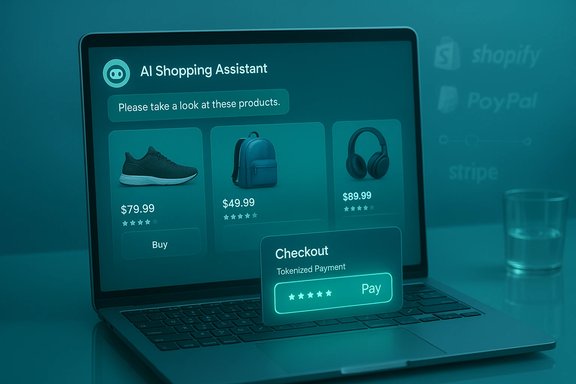
  • Checkout token: Instead of exposing raw payment instruments to the agent, the platform exchanges ephemeral credentials or a delegated payment token that authorizes a single transaction or session. This reduces direct exposure of card data to the assistant and gives a clear audit trail.
  • Provenance & observability: Every step—from the query that discovered an item, to the agent’s reasoning and the checkout token—must be logged and associated with the resulting order to support disputes, refunds and regulatory requirements.

Where the plumbing comes from​

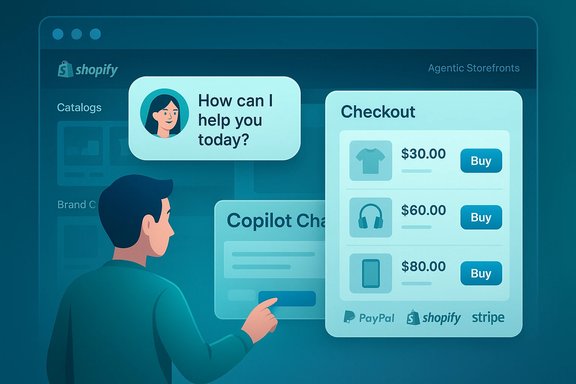
Implementations of agentic commerce increasingly follow a standard pattern: platforms offer a catalog API or feed, payment partners support delegated/tokenized rails, and assistants expose a checkout affordance inside the conversation. Microsoft has bundled these pieces into Copilot Checkout, enabling merchants on Shopify (with opt-in/opt-out choices) and sellers on Etsy to be discoverable and shoppable within Copilot.

The merchant side: benefits and trade-offs​

Benefits for merchants​

  • New distribution channel: Agentic surfaces turn every conversational touchpoint into a potential storefront. Merchants who adopt machine-readable catalogs can appear inside assistant results without building bespoke integrations for each AI platform.
  • Higher conversion potential: By shortening the funnel from discovery to checkout, assistants often lift conversion rates—users who ask and immediately confirm are less likely to abandon.
  • Retention of merchant-of-record status: The architecture routes orders back to merchant checkout rails, preserving control over fulfillment and customer records.

Practical onboarding mechanics​

  • Shopify merchants are being enrolled by default after an opt-out window; merchants can also explicitly configure which AI platforms may surface their products and what storefront policies are shared with agents.
  • Sellers on marketplaces like Etsy may be included through marketplace-level integrations that expose listings for discovery inside the assistant.
  • Payment partners (Stripe, PayPal) provide the tokenized rails that let agents initiate purchases without storing raw card details.

Trade-offs and risks for merchants​

  • Discovery opacity: Platforms can control ranking and prominence inside assistant responses. That creates a new optimization problem—what some call Answer Engine Optimization—where merchants must tune metadata and policies to appear in conversational results.
  • Dependency on platform rules and fees: Even if the merchant remains the merchant of record, platform-level rules and potential fees for in-chat purchases introduce new commercial dynamics that can be hard to predict.
  • Operational friction if data hygiene is poor: Agentic checkout depends on clean catalogs and accurate inventory signals; stale data can cause order failures, disputes and chargebacks, putting vendor reputation at risk.

The consumer experience: convenience with caveats​

What users gain​

  • Convenience & speed: The most obvious benefit is reducing context switches—no need to open multiple tabs, compare carts, or re-enter shipping details across sites.
  • Guided buying: Copilot can ask intelligent clarifying questions—filter by dimensions, materials, or shipping urgency—and present curated options so decisions are easier.
  • Integrated price tracking & rewards: Copilot also bundles helpful features such as price tracking notifications and cashback offers routed through payment partners, providing real monetary benefits if everything works as advertised.

What users should watch for​

  • Data used for personalization & advertising: The experience improves when Copilot has access to browsing context, purchase history or account signals. That same data can be used for personalization and may feed into advertising or measurement products unless consumers adjust privacy settings.
  • Consent and opt-in: Many features require explicit opt-in for Copilot to read tab context, stored credentials or purchase history. Responsible defaults and clear consent flows are essential for trust.
  • Dispute resolution complexity: Although merchants are the merchant of record, the addition of an assistant orchestrating checkout adds an intermediary layer that complicates dispute narratives—users should check how refunds, buyer protections and dispute handling are documented for in-chat purchases.

Privacy, security and compliance concerns​

Privacy trade-offs​

Agentic checkout accumulates a concentrated dataset: queries, intent signals, chosen products, and transaction provenance tied to accounts. That dataset is extremely valuable for personalization and advertising, but also raises risk if used without clear boundaries.
  • Platforms must make it explicit what data powers personalization and what is used for advertising.
  • Users should expect to manage settings across devices and browsers to fully opt out of tracking, since cookie clearing or device-limited preferences may not be enough to revoke all signals.

Payment security & fraud mitigation​

Tokenized checkout substantially reduces exposure of raw card data to assistants, which is a meaningful security improvement. But tokens introduce other requirements:
  • Tokens must be short-lived and scoped.
  • There must be auditable logs tying token issuance to the confirming user intent.
  • Payment and fraud systems must adapt to agent-originated flows and new claims patterns.
Failure to instrument these systems correctly could create new vectors for fraud or dispute escalation.

Regulatory and consumer protection questions​

  • Disclosure and transparency: Agents must state when recommendations are influenced by commercial relationships, platform placement or sponsored content.
  • Data portability and retention: Consumers and regulators will press platforms for clarity on how long conversational logs are retained and how they can be exported or deleted.
  • Antitrust scrutiny: When large OS/platform owners convert conversations into commerce and control discoverability, regulators may examine whether those platforms unfairly advantage their own services or partners.

Business implications — who wins, who risks losing​

Platform plays​

Platforms such as Microsoft, OpenAI and Google are racing to capture the “last inch” of shopping: the moment of purchase. Owning that surface confers several strategic benefits:
  • New monetization: Platforms can monetize discovery, placement, or checkout convenience—either through fees, revenue share, or offer-placement economics.
  • Sticky experiences: The more users complete high-frequency actions like shopping inside an assistant, the more integrated the assistant becomes in daily life.
  • Data advantage: Transactions provide feedback loops that improve personalization and agent accuracy.

Merchants and commerce platforms​

Commerce platforms (Shopify, Etsy) benefit by syndicating catalogs widely, converting their long tail of merchants into discoverable feeds that drive demand. However, merchants face increased dependency on platform policies and must invest in catalog hygiene and fulfillment reliability.

Payments industry​

Payments firms that supply tokenization and dispute tools (Stripe, PayPal) play a vital role and stand to monetize new payment flows. They also absorb operational risk for disputes initiated in conversational contexts and must upgrade tooling accordingly.

Competitive dynamics​

These integrations do not occur in a vacuum. ChatGPT’s Instant Checkout, Google’s shopping agents and other entrants already push the market toward in-chat commerce. Microsoft’s Copilot strategy differentiates itself through deep OS and browser integration (Edge + Windows account signals) and enterprise-forward governance features—advantages that may tilt adoption among users who trust Microsoft’s ecosystem.

Comparing the approaches: Microsoft vs. other assistants​

Microsoft’s approach emphasizes merchant-of-record continuity and integration with large commerce platforms like Shopify and marketplaces like Etsy, while also relying on established payments partners to provide secure tokenized checkout. Other assistants (for example, ChatGPT’s Instant Checkout) have taken earlier steps toward in-chat purchases, but platforms differ in rollout strategy, fees, and where they place merchant control.
Key distinctions to watch:
  • Enrollment model: Shopify merchants may be auto-enrolled with opt-out windows, while other platforms might require explicit opt-in.
  • Fee and revenue model: Platforms can charge merchants for in-chat transactions, keep affiliates, or maintain neutral search-style treatment.
  • Privacy and governance: Microsoft’s enterprise and account-level governance controls may appeal to privacy-minded users and organizations, but cross-device opt-out complexity remains a practical issue.

Practical guidance and takeaways for Windows and Edge users​

  • Review Copilot privacy settings: Understand and configure what Copilot can read—open tabs, browsing history, or stored payment and shipping information—before enabling in-chat checkout features.
  • Merchants: audit catalog hygiene: Ensure SKUs, images, variant information, shipping windows and return policies are accurate and machine-readable to prevent order errors once agentic discovery surfaces your products.
  • Users: know buyer protections: Verify whether purchases completed inside Copilot provide the same dispute and buyer protection guarantees you expect from the merchant or payment provider.
  • Security hygiene: Use payment methods with buyer protections (PayPal or card networks that support dispute resolution) and monitor statements for unfamiliar charges when using new in-chat checkout paths.

Risks and unanswered operational questions​

  • Attribution and discoverability algorithms: Merchants must be prepared for a world where appearing in an assistant’s top result matters. The criteria for ranking inside a conversational result—relevance, price, merchant agreements—are opaque and likely to evolve.
  • Operational fallbacks: How does the assistant handle partial failures—out-of-stock items, token expiration, or mismatch between cart and fulfillment? Robust fallbacks and clear user-facing messaging are essential to avoid negative experiences.
  • Cross-border and tax compliance: In-chat orders that span jurisdictions introduce complexities in tax calculation, duties and regulatory compliance that need merchant and platform coordination.
  • Long-term competition and market power: Platforms that tie an assistant closely to an OS or browser may have structural advantages that attract merchants and reduce the viability of independent discovery channels.
Where claims are company‑reported or early-stage—such as usage numbers, growth multipliers, or near-term merchant rollout schedules—they should be treated as directional and subject to later validation as broader adoption data becomes available.

Strategic verdict — what this means for Windows users, merchants, and the web​

Copilot Checkout is a natural next step in the evolution of commerce on the internet: it closes the loop between conversational discovery and transaction completion. For consumers, the upside is clear—less friction, faster purchases, and potentially better personalization. For commerce platforms and payment providers, agentic commerce opens new monetization and distribution channels.
Yet the change is not only technical; it's strategic. The platform that hosts the shopping surface gains disproportionate influence: it shapes discoverability, defines dispute narratives, and controls the new measurement primitives that will guide merchants’ optimization strategies. That concentration of influence invites scrutiny from merchants, consumers and regulators alike.
The net outcome will depend on execution: do platforms implement robust privacy defaults, transparent ranking rules, auditable provenance of agent actions and reliable tokenized payment flows? Or will convenience outpace governance, creating friction for consumers and burdens for merchants? The answer will determine whether copilot-driven checkout becomes a durable convenience or another battleground in the debate over platform power and user agency.

Conclusion​

Turning conversations into purchases is now a production capability, and Microsoft’s Copilot Checkout—backed by integrations with Shopify, PayPal and marketplaces like Etsy—concretely demonstrates the commerce future many companies have been designing toward: agentic commerce, where discovery, personalization and checkout are woven into the fabric of the conversational assistant.
Adoption will hinge on the small, operational details: accurate product feeds, scoped payment tokens, clear provenance and dispute pathways, and transparent opt-in controls. When those pieces work together, users gain a faster, smarter shopping experience; when they fail, the consequences will be customer confusion, merchant headaches and regulator attention.
For Windows and Edge users, the new experience is compelling but not frictionless—review privacy settings, understand buyer protections, and expect the ecosystem to iterate quickly. For merchants, the message is simple: investing in clean, machine‑readable product data and reliable fulfillment is no longer optional; it is a prerequisite to appearing and competing inside the assistants users increasingly trust.
The next year will be decisive. If platforms pair convenience with clear governance and robust merchant tooling, agentic checkout could become a mainstream, secure way to shop. If not, it will be a cautionary tale about speed without sufficient safeguards.

Source: Axios Microsoft turns Copilot chats into a checkout lane with Shopify, PayPal and Etsy
 

Microsoft says it has delivered the next big push in retail automation — a suite of “agentic” AI capabilities that stitch conversational copilots, catalog intelligence, checkout flows and store‑operations automation into a single, enterprise‑grade playbook for modern retailers. The company’s January announcement frames the move as a shift from isolated point solutions to an intelligence layer that can both advise and act across merchandising, marketing, store operations and fulfillment — with immediate fixtures such as Copilot Checkout, Brand Agents, catalog‑enrichment templates and store‑operations agent templates intended for rapid retailer adoption.

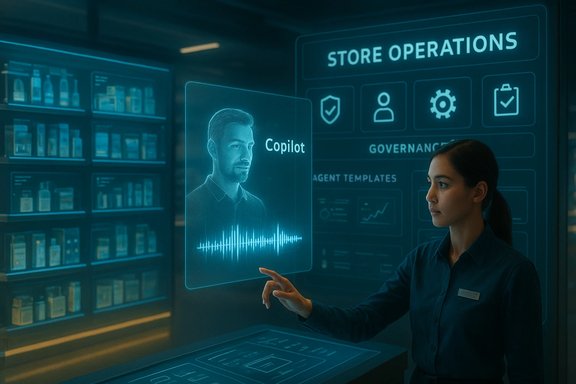
A woman uses a holographic Copilot display in a futuristic store operations room.Background / Overview​

Microsoft has been public about building a layered AI stack for enterprise customers throughout 2024–2025. That foundation includes Copilot Studio for building copilots, Azure AI Foundry (also described in Microsoft messaging as a Foundry/Agent Factory) for agent orchestration and governance, and a collection of templates and connectors for the retail sector. The vendor positions these components as prebuilt primitives that reduce integration work for retailers while providing governance, identity and observability features required at scale. The January PR summarizes Microsoft’s retail offering as “agentic AI” — meaning systems that can take multi‑step, context‑aware actions (not just recommend) and escalate to humans when necessary. Practical examples in the announcement include:
  • Copilot Checkout: a conversational checkout that completes purchases inside Copilot without redirecting shoppers off‑site.
  • Brand Agents and personalized shopping agent templates: tools for embedding a brand’s voice and catalog into conversational surfaces.
  • Catalog enrichment and store operations agent templates: automated workflows to extract product attributes from images, enrich catalogs, and provide store associates with real‑time operational guidance.
Independent reporting and Microsoft’s own industry blog posts make the same technical claims: that agentic agents are already being used in pilot programs, that Copilot Studio and Azure AI Foundry supply orchestrator and safety primitives, and that Microsoft is demonstrating these capabilities at retail industry events. These claims track with reporting from trade outlets and Microsoft’s case references in 2025.

What Microsoft actually announced (the specifics)​

Copilot Checkout — checkout inside the assistant​

Microsoft’s PR introduces Copilot Checkout, a capability that allows merchants to let shoppers finalize purchases inside the Copilot conversational surface without being redirected to an external website. The company says merchants remain the merchant of record, and early partners named include PayPal, Shopify and Stripe, with participating merchants like Urban Outfitters, Anthropologie, Ashley Furniture and Etsy sellers highlighted in the announcement. Microsoft positions Copilot Checkout as available in the U.S. on Copilot.com. Verification and context:
  • Microsoft’s own release lists third‑party payment and platform partners and indicates U.S. availability. This is a vendor statement and therefore verifiable by checking the Copilot commerce experience directly or merchant integrations as they go live. Independent reporting from industry outlets confirmed that Microsoft showcased new commerce templates and direct‑checkout ambitions at NRF‑season events.

Brand Agents and Personalized Shopping Agents​

Two main developer/merchant tools were announced:
  • Brand Agents — a turnkey way for brands to “bring their authentic voice” into digital interactions by training an agent on a product catalog and brand guidance. Reported as ready for Shopify merchants.
  • Personalized shopping agent template in Copilot Studio — a customizable template for deeper product discovery, outfit building and real‑time, cross‑channel recommendations.
These templates are designed to reduce the time to market and standardize behavior across channel surfaces (web, mobile, in‑store).

Catalog enrichment and store operations templates​

Microsoft debuted a catalog enrichment agent in public preview that extracts product attributes (including from images), augments items with social insights, and automates catalog tasks such as categorization and error resolution. A store operations agent template is also public previewed, targeted at frontline staff for instant answers on inventory, policies and next‑best actions. Both use the same multi‑agent patterns Microsoft has been developing with Copilot Studio and Azure AI Foundry.

Platform and governance primitives​

Microsoft stresses enterprise‑grade governance: identity for agents, content safety controls, observability and AgentOps tooling intended to prevent runaway automation or ungoverned agent actions. The vendor’s blog posts show this as part of a broader “agent factory” narrative — treating agents as manageable, auditable artifacts. These governance and identity claims correspond to product features Microsoft has publicized throughout 2024–2025.

Why this matters: retail at the center of agentic AI adoption​

Agentic AI maps naturally onto retail problems because stores and e‑commerce produce high volumes of repetitive queries, orchestration tasks and time‑sensitive events. Automating tasks like inventory lookups, returns processing, personalized recommendations and checkout flows is both high‑value and operationally feasible.
Key business reasons Microsoft and retailers are converging:
  • Retail has rich, structured product and transactional data, which is precise input for agents (reducing hallucination risk when properly integrated).
  • Frontline productivity gains are immediate: fewer tool switches, faster answers for associates and lower average handle times for routine tasks.
  • Commerce revenue capture: embedding checkout in conversational surfaces reduces friction and increases conversion opportunities at the exact moment of intent. Microsoft cites Adobe data showing a large surge in AI‑driven retail traffic during the 2025 holiday season to underscore the urgency.
Independent industry surveys suggest many retailers are already piloting agentic systems for efficiency gains, but full, mature deployment remains rare — a point that tempers hype. Recent analyst reporting shows high pilot rates (~70% piloted or partially implemented) but low rates of fully mature deployments (single‑digit percentages), highlighting the gap between experimentation and scaled production.

Technical verification: which components are real today?​

Microsoft’s announcement builds on several product lines that are publicly documented:
  • Copilot Studio: an authoring and deployment environment for creating copilots and multi‑agent workflows; Microsoft documents several prebuilt templates and connectors aimed at retail and other verticals. Microsoft claims Copilot Studio is used broadly by organizations.
  • Azure AI Foundry (also referenced as Microsoft Foundry or Agent Factory): a service family for model catalogs, observability, agent orchestration, and security primitives. Microsoft has published developer guidance and blog posts about agent orchestration and the Agent Service.
  • Identity and governance: Microsoft describes Agent IDs (Entra) and content safety policies as part of the enterprise controls for agentic systems. These features are reflected in product documentation and Microsoft’s public blog posts.
Cross‑referenced verification:
  • The PR announcing retail capabilities lists templates, partners and availability (Copilot Checkout in the U.S.. That PR is Microsoft’s official statement of product intent and availability.
  • Microsoft’s industry blogs and technical posts from 2024–2025 document the same building blocks — Copilot Studio, agent orchestration, and Foundry/Agent Service — in technical and product terms. Those posts confirm the underlying product primitives.
  • Independent trade reporting during NRF‑period coverage corroborates that Microsoft publicly showcased commerce and checkout demos tied to Copilot at industry events and characterized Copilot as an expanding commerce surface.
These three lines of evidence — vendor PR, vendor technical blogs, and independent news coverage — together provide a convergent signal that the products exist in shipping or preview form and that Microsoft is actively piloting commerce and store operations integrations.

Strengths: what Microsoft brings to retail​

  • Platform breadth and integration: Microsoft combines desktop productivity (Microsoft 365), collaboration (Teams), cloud scale (Azure), developer tooling (GitHub Copilot) and device hardware (Surface) — a broad stack that can reduce integration friction for enterprises that already run Microsoft services. This makes end‑to‑end scenarios easier to implement.
  • Prebuilt templates and connectors: Brand Agents, catalog enrichment and store operations agent templates reduce time to value by codifying best practices and connectors to common e‑commerce platforms (Shopify was explicitly called out). Reducing custom engineering scope is important for faster adoption.
  • Merchant revenue assurances: Copilot Checkout is described as keeping the merchant of record intact, which matters for brand trust, fraud controls and revenue accounting. That posture lowers adoption friction versus models that divert traffic entirely to third‑party marketplaces.
  • Governance and AgentOps emphasis: Microsoft’s messaging stresses agent identity, observability and governance — recognition that agentic systems require operational disciplines. For large retailers, having vendor‑supplied governance primitives is a practical advantage.

Risks and open questions​

Agentic systems are powerful — but they create new operational failure modes and governance demands. The following risks deserve careful attention:
  • Hallucinations and incorrect actions: Even when agents are grounded with catalog and inventory APIs, agents that mix retrieval and generative responses can still produce incorrect or misleading outputs. Retail has low tolerance for mistakes that affect pricing, inventory or returns processing. Microsoft’s templates are a helpful start, but operational guards, human‑in‑the‑loop gates and continuous testing are still necessary.
  • Integration complexity at scale: Real retailers run a stack of bespoke ERPs, POS systems, third‑party marketplaces and legacy inventory systems. Packaging connectors for a few mainstream platforms does not eliminate deep integration work when custom legacy systems are involved. Retailers should budget for significant engineering to ensure data correctness and latency SLAs.
  • Privacy and consent: Personalization and “memories” for shopping agents can drive conversion but also raise customer privacy questions. Data minimization, consent flows and audit trails must be engineered for customer trust and regulatory compliance. Microsoft highlights content safety and governance tools, but retailers remain responsible for how those tools are used.
  • Vendor lock‑in and portability: If an enterprise builds many agentic workflows tightly coupled to Microsoft Foundry and Copilot Studio, migrating away — or adopting a multi‑vendor agent ecosystem — could be costly. Contracts, portability guarantees and data export mechanisms should be reviewed.
  • Economic realism: Pilot enthusiasm does not guarantee durable ROI. Many retailers report successful pilots (reduced handle times, higher conversions) but few have declared fully matured, enterprise‑wide agentic deployments. Independent surveys show widespread piloting but limited mature deployments; expectations must be tempered and measured with clear KPIs.

Practical guidance for retailers evaluating agentic AI​

  • Establish an AI Center of Excellence (CoE) and define AgentOps processes before wide deployment.
  • Start with high‑value, low‑risk pilots: internal employee copilots (store operations, HR) usually present lower reputational risk than customer‑facing autonomous purchase flows.
  • Ground agents on canonical sources of truth: integrate directly with inventory APIs, pricing services and order management systems to reduce hallucination risk.
  • Define human escalation paths and hard stops for any action that changes financial or inventory state.
  • Negotiate portability and data access in procurement documents so agent workflows and data remain auditable and exportable.
  • Measure and report: track conversion lift, average handling time, escalation rates and error rates. Use these KPIs to gate expansion.

Case snapshots and corroborating examples​

  • Levi Strauss & Co. announced a high‑profile Microsoft collaboration in late 2025 to build an Azure‑native Teams‑embedded “superagent” for operations, using Copilot Studio and Foundry primitives to orchestrate subagents for HR, IT, stores and more. Public reporting corroborates that Levi’s pilot included a holiday season store rollout plan and emphasized frontline productivity improvements. This is an example of the enterprise‑scale use case Microsoft’s templates enable.
  • Large retailers and partners (Coles in Australia, Phygrid partnerships, and other retail modernizations) have been cited in Microsoft industry narratives as early pilots of agentic retail features. These examples show both internal operations and customer‑facing experiments.
  • Independent coverage around NRF‑time indicates Microsoft demonstrated commerce and checkout demos and emphasized Copilot as an expanding commerce surface; reporters framed the move as part of a broader industry race to make AI assistants the front door for purchasing.

Conclusion — what retailers and Windows-focused IT teams should take away​

Microsoft’s retail announcement crystallizes a clear vendor strategy: make agentic AI a first‑class enterprise capability by packaging authoring tools (Copilot Studio), orchestration and governance (Azure AI Foundry/Agent Service), and prebuilt retail templates that accelerate time‑to‑value. For retailers already invested in the Microsoft ecosystem, this reduces friction and gives a credible path to agentic automation. However, adoption will be won by careful operational discipline, not product buzz. Retail IT leaders should treat agentic projects as engineering and operational transformations: invest in AgentOps, human‑in‑the‑loop controls, thorough testing against live catalogs, and explicit KPIs for customer trust and financial accuracy. Independent surveys show many organizations are piloting agentic AI, but only a few have reached mature, scalable deployments — a gap that highlights governance and integration as the real barriers to scaling beyond pilots. Finally, while Microsoft’s retail templates and Copilot Checkout lower barriers for experimentation, every retailer must verify partner integrations, contractual terms (merchant of record and payment flows), data portability and compliance obligations before entrusting mission‑critical commerce flows to automated agents. Where vendors provide governance primitives, success will depend on the retailer’s operational rigor in using them.
Microsoft’s announcement marks a credible and practical step toward agentic retail — a future where conversational agents not only advise shoppers but also act on behalf of brands and associates. The outcome will hinge on engineering discipline, governance maturity and careful economics; retailers that blend ambition with prudence will likely capture the early advantages.

Source: WV News Microsoft propels retail forward with agentic AI capabilities that power intelligent automation for every retail function
 

Microsoft has unveiled a sweeping set of retail-focused AI agents, templates, and checkout services that fold conversational commerce, catalog automation, and store operations into the Copilot ecosystem — starting with a U.S. rollout of Copilot Checkout and new Copilot Studio templates for Brand Agents, personalized shopping, and catalog enrichment.

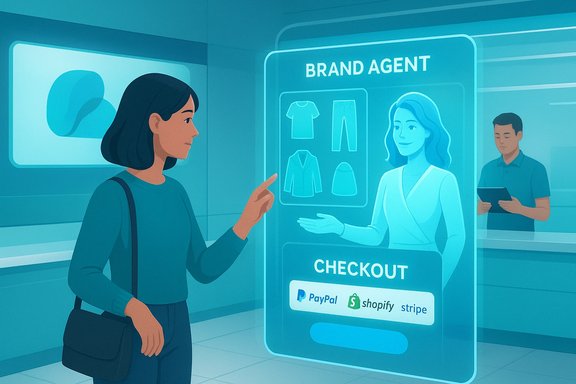
A shopper interacts with a holographic Brand Agent checkout showing clothes and payment options.Overview​

Microsoft’s announcement — timed ahead of NRF 2026 — positions the company to push “agentic commerce” directly into merchant storefronts and conversational surfaces. The move stitches together payments partners (Shopify, PayPal, Stripe), merchant catalog enrichment tools, and no-code/low-code agent templates inside Copilot Studio so brands and retailers can deploy conversational shopping experiences and operational assistants rapidly. At its core, the offering is threefold:
  • A conversational checkout flow called Copilot Checkout that completes purchases without redirecting buyers away from Copilot conversations.
  • Agent templates in Copilot Studio — including Brand Agents, a personalized shopping agent template, and a catalog enrichment agent template — for building branded shopping assistants and automating catalog tasks.
  • Partnerships and onboarding mechanics that connect merchant platforms and payment providers so sellers remain the merchant of record while third parties handle payment processing.
This article breaks down what these changes mean for retailers, platforms, payments, and shoppers — balanced with critical analysis of benefits, risks, and implementation realities.

Background: Why agentic commerce now?​

The retail industry has been moving quickly toward AI-driven discovery and checkout. Retailers and platforms have deployed LLM-driven experiences, and payments firms have begun opening protocols for chat-native purchases. Recent industry data cited by Microsoft — specifically, a large jump in AI-driven ecommerce traffic over the 2025 holiday season — is being used to argue that discovery-to-conversion moments are now critical battlegrounds. Key industry dynamics fueling the launch:
  • Consumer behavior: shoppers increasingly accept conversational and recommendation-driven discovery.
  • Platform competition: OpenAI, Stripe, and other major players have already demonstrated chat-native checkout models; Microsoft’s announcement is both complementary and competitive.
  • Merchant pain points: product onboarding, catalog accuracy, returns, and understaffed stores remain stubborn operational challenges — precisely the areas Microsoft targets with catalog enrichment and store operations agent templates.
Microsoft’s approach emphasizes integration into existing merchant relationships (Shopify, PayPal, Stripe) rather than supplanting merchant systems, asserting that merchants remain the merchant of record while agents and payment partners manage the transaction plumbing.

What is Copilot Checkout and how does it work?​

The marketing claim​

Microsoft describes Copilot Checkout as a way to “turn conversations into conversions — instantly,” enabling buyers to purchase discovered items inside Copilot without being redirected to external merchant pages. The company says Copilot Checkout is available now in the U.S. via Copilot.com and that participating payment partners include Shopify, PayPal, and Stripe.

Mechanics (as described)​

  • The buyer interacts with a Copilot shopping experience (brand agent or discovery flow).
  • When ready, the buyer completes payment within Copilot’s interface through an integration with PayPal, Shopify’s checkout infrastructure, or Stripe. Microsoft stresses the merchant remains the merchant of record.
  • Merchants on Shopify will be auto-enrolled after an opt-out period, while PayPal- or Stripe-connected merchants must apply to onboard. Microsoft lists participating retailers (Urban Outfitters, Anthropologie, Ashley Furniture) and Etsy sellers as initial examples.

How this compares to other chat-native checkouts​

OpenAI’s Instant Checkout and Stripe’s previous integrations showed the feasibility of single-item purchases inside chat interfaces; Microsoft’s Copilot Checkout follows the same trend but ties the capability to its Copilot and Copilot Studio ecosystem and emphasizes merchant-of-record preservation. These parallels indicate a market moving toward multiple, interoperable agentic checkout experiences.

Caveat and verification​

Microsoft’s description is marketing-forward. Implementation details that affect merchants — fees, dispute handling, fraud liability boundaries, exact enrollment windows, and regional availability beyond the U.S. — are specified only at a high level in the announcement. Those details warrant scrutiny during any merchant onboarding decision.

Copilot Studio: Templates that matter for retail​

Microsoft is shipping several Copilot Studio templates aimed at retailers. The ones highlighted are Brand Agents, a personalized shopping agent template, and a catalog enrichment agent template (public preview). Each targets specific retail needs:

Brand Agents (Shopify)​

Brand Agents are turnkey conversational agents trained on a brand’s product catalog to answer product questions, provide brand-aligned responses, and guide shoppers across discovery and purchase flows. Microsoft says Brand Agents are available for merchants on Shopify with minimal setup required. Benefits for merchants:
  • Faster time-to-deploy than building a custom LLM solution.
  • Brand voice consistency by training on a brand’s catalog and content.
  • Direct on-site deployment on web and mobile experiences integrated with Shopify.

Personalized shopping agent template​

This template offers a flexible framework for creating deeper, tailored shopping experiences: real-time product discovery, outfit building, and cross-channel recommendations (web, mobile, in-store). Microsoft positions it as a starting point for retailers that want more control than the turnkey Brand Agent.

Catalog enrichment agent template (public preview)​

This template automates extraction of product attributes from images, enhances listings with social insights, and performs tasks like product onboarding, categorization, and error resolution. The promise is to transform messy product data into structured metadata that improves search, recommendation, and personalization. Microsoft has promoted it as a foundational component for agentic commerce.

Store operations agent template​

Announced as another public preview, the store operations agent provides a natural language interface for store associates and managers: inventory lookups, policy guidance, staffing recommendations, and exception handling informed by internal and external signals like sales trends and local events. It’s aimed at improving productivity and decision-making at the store level.

Ecosystem partners and the merchant experience​

Microsoft’s announcement leans on a partner model rather than a closed system. Key partner points:
  • Shopify: Microsoft says Shopify merchants will be automatically enrolled in Copilot Checkout after an opt-out window; Shopify’s product leaders are quoted supporting the integration. This auto-enroll decision is material for merchants because it affects exposure and defaults.
  • PayPal and Stripe: Both are listed as trusted payment partners for Copilot Checkout. Merchants using PayPal or Stripe are invited to apply to onboard, per Microsoft. Separate vendor announcements (PayPal’s agentic commerce services, Stripe’s prior work on agentic commerce protocols) show payment providers actively building the plumbing for chat-native purchases.
  • Etsy: Microsoft highlights that Etsy will bring its inventory to Copilot Checkout; Etsy leadership is quoted as supportive of the opportunity for sellers to appear on new surfaces.
Operationally, the announcement suggests:
  • Merchants remain the merchant of record (important for tax, compliance, and customer relationship).
  • Payment processing, fraud detection, and buyer protections are handled by the payment partners (details to be clarified by partner agreements).

Benefits for retailers and shoppers​

For merchants​

  • Faster conversion: Conversational checkout removes friction by keeping the buyer in the same interface during purchase. Microsoft claims this shortens time-to-conversion.
  • Catalog automation: The catalog enrichment template reduces manual work around product onboarding and classification, which can free teams to focus on merchandising rather than data cleanup.
  • Brand control: Brand Agents are intentionally trained on each merchant’s catalog, enabling more consistent brand voice in AI-driven interactions.

For shoppers​

  • Seamless flow: Buying without redirection reduces friction and cognitive load during checkout.
  • Personalization: Shopping agents that suggest outfits, complete looks, or recommend alternatives can increase shopper confidence and reduce search time.

Risks, unknowns, and operational caveats​

Microsoft’s announcement is ambitious, but the real-world impact depends on implementation details and merchant oversight. Key concerns:

Data governance and privacy​

AI agents trained on product catalogs and potentially on customer interaction data raise questions about what data is stored, how it’s used to fine-tune models, and whether third parties (partners, underlying LLM providers) gain access to merchant or customer data. The announcement stresses enterprise integration and responsible AI, but exact data flows and retention policies are not fully enumerated in the marketing release. Merchants should demand clear contractual terms.

Fraud, disputes, and buyer protection​

Microsoft states the merchant remains the merchant of record while PayPal, Shopify, and Stripe handle payments. The division of responsibilities in chargebacks, fraud detection, and dispute resolution matters greatly for merchants' risk exposure. Public announcements reference partner roles, but specific liability boundaries and cost structures are not detailed and will vary by partner. Merchants should verify terms directly with each payment provider.

Merchant fees and commercial terms​

Microsoft’s PR does not disclose fee structures for Copilot Checkout versus existing checkout solutions, nor any revenue share that might apply to conversational commerce surfaces. Past experiences with platform-driven discovery indicate fees or revenue-sharing can vary widely; merchants should assess margin impact. Where similar services (OpenAI’s Instant Checkout) imposed fees for completed purchases, the commercial model can materially affect merchant economics.

Experience quality and returns​

Conversational purchases that accelerate checkout also risk buyers making impulse purchases or buying mismatched items, potentially increasing return rates. While personalized agents may reduce returns by offering better guidance, poor recommendations or catalog errors could have the opposite effect. The effectiveness of Microsoft’s catalog enrichment and recommendation models will be a major determinant of outcomes.

Dependency and vendor lock-in​

Auto-enrolling Shopify merchants after an opt-out window accelerates adoption but can raise concerns about default behaviors and vendor gateway dependence. Merchants should evaluate fallback options and data portability for agent models and enriched catalog data.

Regulatory and competition scrutiny​

Large platform-driven shifts in commerce often draw regulatory attention — from payment routing and platform commissions to data sharing and antitrust. Any cross-surface commerce standardization (e.g., open protocols) helps interoperability, but centralized control of agentic experiences by a few big players could invite scrutiny. Stripe and others have pursued open protocols in the past to avoid lock-in, but the competitive landscape remains dynamic.

Implementation checklist for retailers​

Merchants evaluating Copilot Checkout and Copilot Studio templates should walk through a pragmatic checklist before adoption:
  • Confirm commercial terms: fees, revenue-sharing, and billing treatment for Copilot-initiated transactions.
  • Review data flow: ask for explicit data maps showing what merchant, product, and customer data is shared, stored, or used to train models.
  • Validate fraud and dispute procedures with chosen payment partners: who handles chargebacks and which protections apply.
  • Pilot Brand Agents or personalized agents on a narrow SKU set to test conversation quality and return rates.
  • Use the catalog enrichment template in a non-production environment to measure lift in search relevance and metadata accuracy.
  • Prepare customer communication: make customers aware of conversational purchase flows and any changes to receipts, order confirmation links, and returns policy handling.
This stepwise approach helps mitigate business risk and establishes measurable success criteria before broad rollouts.

Technical and operational considerations​

Model training and product data​

Brand Agents and personalized shopping agents depend heavily on the quality of product metadata. The catalog enrichment template’s ability to extract attributes from images and social insights is a necessary precondition; otherwise agents will make incorrect recommendations or struggle with natural language queries. Microsoft positions the template as a way to produce structured, searchable data from messy product assets.

Integration paths​

There are three primary integration patterns merchants should prepare for:
  • Platform-native (Shopify Brand Agents and Copilot Checkout via Shopify integration).
  • Payment-partner onboarding (PayPal, Stripe routes for payments and payout management).
  • Custom or headless storefront deployments using Copilot Studio templates connected to merchant APIs and fulfillment systems.

Monitoring and telemetry​

Agentic commerce requires strong monitoring: query success rates, conversation-to-conversion funnels, intent-to-purchase latency, and post-purchase satisfaction metrics (returns, complaints). Copilot Studio and supporting telemetry need to plug into existing analytics and BI systems to measure uplift and identify model drift or catalog errors. Microsoft’s announcement references enterprise integration but details on telemetry APIs and SLAs should be validated in documentation and partner agreements.

Market implications and competitive context​

Microsoft’s push formalizes a broader industry trend: major cloud and AI platforms are moving beyond tools for internal enterprise productivity and into consumer-facing commerce surfaces where discovery, recommendation, and payment converge.
  • OpenAI and Stripe have already shown chat-native checkout models; Microsoft’s Copilot approach brings a rival path tied to its enterprise relationships and Copilot Studio tooling.
  • Payment providers such as PayPal and Stripe have separately announced agentic commerce services or open standards, signaling a multi-vendor effort to define how conversational commerce will transact. Merchant choice and cross-platform interoperability will be a persistent theme.
  • Platforms like Shopify face a balancing act: enabling new discovery surfaces while protecting merchant economics and offering clear opt-in/opt-out controls. The automated-enrollment approach accelerates reach but may prompt merchant pushback if opt-out windows are not clearly communicated.

What to watch next​

Retailers, platform operators, payments teams, and regulators should watch for these near-term signals:
  • Detailed partner agreements and onboarding documentation that clarify fees, liability, and data governance.
  • Results from early pilots (conversion lift, return rates, merchant satisfaction) and merchant testimonials.
  • Expansion beyond the U.S.: Microsoft’s announcement is U.S.-focused for Copilot Checkout; regional rollouts and compliance with local payments and consumer laws will be consequential.
  • How open protocols (if any) develop and whether industry players adopt shared standards to ease merchant onboarding and preserve portability. Stripe’s prior open-protocol work suggests that standardization is possible, but commercial incentives will shape outcomes.

Conclusion: A pragmatic opportunity with strings attached​

Microsoft’s retail announcements mark a significant, practical step toward mainstreaming agentic commerce: a combined product discovery, automated catalog enrichment, and conversational checkout stack that leverages established payment partners and Shopify’s merchant base. For retailers, the promise of faster conversions, improved catalog quality, and better in-store-associate tooling is enticing. However, the business benefits will depend on careful implementation: transparent commercial terms, rigorous data governance, robust fraud and dispute arrangements, and measured pilots that validate the impact on return rates and customer satisfaction. Microsoft’s marketing frames Copilot Checkout and Copilot Studio as turnkey enablers of “agentic storefronts,” but the operational and legal details are what will determine whether agentic commerce becomes a win for merchants, consumers, and the broader retail ecosystem — or a source of new vendor lock-in, unexpected costs, and compliance headaches. Retailers should treat today’s announcements as a practical invitation: pilot strategically, insist on contractual clarity, and measure outcomes empirically before expanding agentic commerce across the business.

Source: MSDynamicsWorld.com Microsoft announces AI agents and templates for retail scenarios
 

Microsoft and PayPal have joined forces to put native payment rails inside Copilot, enabling shoppers to discover, decide, and pay without leaving the Copilot experience — a shift that crystallizes the move from search-and-click to agentic commerce and raises immediate technical, operational, and regulatory questions for merchants and IT teams.

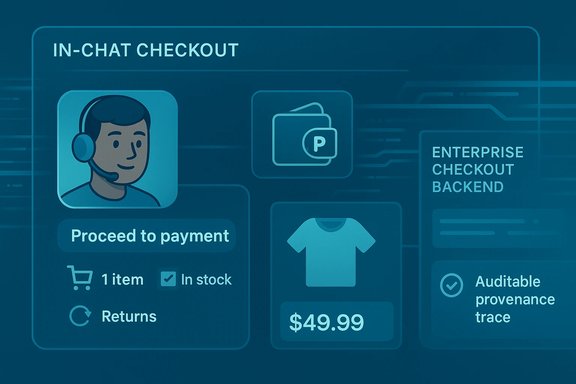
In-chat checkout interface showing an item card, price $49.99, stock/returns, and enterprise backend.Background and overview​

Copilot Checkout is Microsoft’s latest attempt to transform Copilot from a conversational assistant into a transaction-capable platform that closes the loop from discovery to purchase. At launch, Microsoft says Copilot Checkout is available in the U.S. via Copilot.com and will surface merchant inventory and enable purchases directly in the Copilot interface while keeping merchants as the merchant of record. Trusted payment partners at launch include PayPal, Shopify, and Stripe, with Etsy sellers and a set of major retail chains named as early participants. PayPal’s announcement frames its role as the payment and commerce partner that will power inventory surfacing, branded checkout, guest checkout, and credit card acceptance via PayPal’s store sync and its recently publicized agentic commerce services. PayPal also emphasizes buyer and seller protections and says it will extend Copilot Checkout support across Copilot surfaces over time. This partnership is the latest installment in a rapidly evolving ecosystem where platforms (Microsoft, OpenAI, Google) and payments providers (PayPal, Stripe) are building agentic primitives — machine-readable catalogs, delegated/tokenized payment flows, and orchestration layers — that let assistants act on purchasing intent instead of simply returning links. Independent reporting confirms Microsoft rolled the feature out publicly at NRF 2026 and that the broader agentic retail play includes Brand Agents, catalog-enrichment templates, and store-ops agents intended to reduce merchant friction.

What PayPal announced — the essentials​

  • PayPal will power in-Copilot payment processing and surfacing of merchant inventory using its agentic commerce services and store sync.
  • Multiple funding options will be available, including the PayPal wallet, with buyer and seller protections applying to eligible transactions.
  • The integration starts on Copilot.com with plans to expand to other Copilot surfaces and devices.
  • PayPal positions its approach as open and compatible with leading agentic protocols, offering merchants a single integration pathway to multiple AI ecosystems.
These statements mirror Microsoft’s framing that payments partners will enable checkout without redirecting buyers away from Copilot while preserving merchant control for fulfillment and returns. Both vendors position the work as complementary: Microsoft owns the discovery and conversational surface; PayPal and other payment partners provide the delegated payment plumbing.

How Copilot Checkout works — technical anatomy​

At a high level, Copilot Checkout stitches together three core layers: catalog ingestion, conversational orchestration, and delegated checkout.

1) Catalog ingestion and product metadata​

Merchants publish machine-readable product feeds (SKU, GTIN, inventory, images, shipping windows). Agents query these canonical records to avoid hallucinations and present verifiable, up-to-date options to users. Microsoft’s retail tooling includes a catalog enrichment template to automate attribute extraction and metadata normalization.

2) Conversational orchestration (Copilot runtime)​

Copilot interprets shopper intent, asks clarifying questions (size, color, delivery timing), and returns curated, shoppable results in-chat. Provenance and observability are emphasized: the assistant must log which catalog records led to a suggestion to support disputes and audit trails.

3) Delegated / tokenized checkout​

When a buyer confirms a purchase, Copilot requests a short-lived checkout session or a delegated payment token that hands the transaction to the merchant’s checkout system or a payments partner. Tokenization reduces direct exposure of raw card details to the assistant and creates auditable, single-use credentials for the purchase. PayPal’s agentic commerce services — including store sync — handle merchant routing and payment orchestration in PayPal’s description.

Why this matters: reach, friction reduction, and the data shift​

Microsoft and PayPal both make the commercial argument that collapsing discovery and checkout reduces friction, shortens time-to-conversion, and places merchants directly in front of high-intent shoppers inside Copilot. Microsoft’s internal data, cited in vendor materials, reports that Copilot-driven journeys produce 53% more purchases within 30 minutes and, when shopping intent is present, conversion rates can be 194% higher versus journeys without Copilot. These figures have been repeated across coverage and vendor briefings but are labeled as observational, vendor-sourced findings. For merchants, the value propositions are straightforward:
  • New distribution channel inside a conversational surface.
  • Reduced cart abandonment via in-context checkout.
  • Potential for higher average order values through contextual cross-sells and bundling inside conversations.
For PayPal, the deal accelerates a multi-platform payments play that complements other integrations (OpenAI, Google, Perplexity) and positions PayPal as the payments hub for agentic commerce.

Cross-checking the claims: verification and caveats​

Key facts and partner lists in PayPal’s announcement are corroborated by Microsoft’s retail PR and independent coverage from outlets such as GeekWire and Axios. Those sources confirm PayPal, Shopify, and Stripe as launch partners and that the initial rollout is U.S.-first on Copilot.com. However, several critical claims should be treated with caution:
  • The 53% / 194% statistics originate from Microsoft internal datasets and marketing materials; they are observational and may not generalize across all merchant categories or geographies. Independent reporting reproduces the numbers but traces them back to vendor analyses rather than third‑party studies. Treat these figures as indicative rather than definitive, and require merchant-specific pilots to validate uplift.
  • The line “backed by over 192,000” in PayPal’s release is ambiguous in isolation; press artifacts show truncated phrasing. Public materials imply scale is significant but vendors’ exact counts (merchants, SKUs, storefronts) and the methodology behind those totals need direct verification with PayPal for procurement-grade decisions. Flag this as an unverifiable or imprecise claim until PayPal provides the concrete metric and definition.
  • Enrollment mechanics matter: Shopify merchants are slated for automatic enrollment after an opt‑out window. Auto-enrollment accelerates adoption but raises operational and consent concerns for merchants who require control over where their catalog appears. Microsoft’s PR confirms the opt‑out approach, and independent reporting highlights the potential friction this can create. Merchants should confirm enrollment timelines and opt‑out specifics directly with Shopify and Microsoft.

Strengths and opportunities (what’s compelling)​

  • Friction reduction: Completing purchase flows inside the conversational surface reduces context switching and is likely to materially shorten checkout funnels for many users. Vendor reporting and early pilots show faster decisions and improved short-term conversion metrics.
  • Interoperable payment rails: PayPal’s promise to support leading agentic protocols and to act as a single integration point for merchants across multiple AI ecosystems simplifies integration overhead and reduces per-platform engineering effort.
  • Merchant-centric design claim: Microsoft and PayPal emphasize that merchants remain the merchant of record — a meaningful design choice that preserves merchant responsibility for fulfillment, returns, and first‑party customer relationships (if implemented as described). This reduces one of the thornier objections merchants had to earlier agentic checkout experiments.
  • Practical tooling for catalog quality: Microsoft’s catalog enrichment templates and PayPal’s store sync aim to reduce manual catalog work, improving search relevance and the quality of AI recommendations. For merchants with poor metadata, these tools can be transformational.

Risks, unknowns, and operational challenges​

  • Data governance and privacy: Agentic experiences depend on contextual signals (browsing context, order history, catalog content). Vendors promise permissioned behaviors, but the precise data flows, retention policies, and whether enriched data is used for model training must be spelled out in contracts. Organizations should insist on data maps and explicit terms about training usage and retention.
  • Dispute, fraud, and chargeback liability: Public statements leave many liability questions to partner agreements: who manages chargebacks, where fraud detection runs, and how buyer protections apply in delegated payment flows. Merchants must clarify who bears financial risk in fraud scenarios and whether PayPal’s or other partners’ protections fully cover agentic transactions.
  • Discovery opacity and answer‑engine optimization: When AI surfaces products conversationally, ranking and discoverability become opaque. Merchants face a new optimization problem — not SEO, but AEO (Answer Engine Optimization) — in which metadata, feed freshness, and platform placement dictate visibility. This shifts bargaining power toward platform operators.
  • Operational lock‑in and defaults: Auto-enrollment of Shopify merchants may accelerate reach but also creates dependence and potential vendor lock-in if portability and exportability of enriched catalogs or agent models are not guaranteed. Merchants should validate portability and termination clauses.
  • Regulatory and competition scrutiny: Consolidation of discovery, transaction, and data into assistant platforms increases regulatory interest in privacy, antitrust, and payments routing. Expect oversight or policy challenges in some jurisdictions if platform economics or default behaviors materially disadvantage other players.

Competitive context: who else is building agentic checkout?​

  • OpenAI launched Instant Checkout (with Stripe and merchant partners) and PayPal had previously announced adoption of the Agentic Commerce Protocol for ChatGPT — positioning PayPal across multiple assistant ecosystems.
  • Google has experimented with “Buy for Me” and agent-led commerce integrations, and continues to roll out shopping experimentation inside Gemini-powered surfaces.
  • Stripe has been an early mover on payment primitives for agents and tokenization, and remains a core partner in assistant-native checkout experiments.
That landscape means merchants will face a multi-platform reality: integrating with a single payments provider like PayPal may ease multi-assistant reach, but merchant strategy should include on‑property AI experiences (retailer-owned assistants) as a counterweight to platform-dependent discovery.

Practical checklist for merchants and Windows/retail IT teams​

  • Confirm enrollment and opt‑out mechanics for your platform (Shopify auto‑enrollment timelines, Etsy marketplace inclusion, PayPal onboarding).
  • Request detailed data flow diagrams and a data governance addendum specifying:
  • What product and customer data is shared
  • Retention timelines and training usage
  • Access controls and audit logs.
  • Validate fraud and dispute responsibilities with your payment partner: who handles chargebacks and who bears the cost of fraudulent transactions?
  • Pilot on a narrow SKU set before wide rollout. Measure conversation-to-conversion funnels, return rates, and average order value.
  • Preserve first‑party relationships: require APIs or webhooks that deliver order and customer data back to your systems for CRM, fulfillment, and analytics.
  • Prepare customer communication: clarify receipts, return instructions, and customer-service routing for Copilot-initiated orders.

Implementation notes for Windows/IT teams​

  • Inventory sync and tokenized payment flows will require secure connectors and likely new firewall/connector allowances to PayPal and Microsoft endpoints. Ensure enterprise proxies permit the required API traffic and certificate chains.
  • Monitoring and observability are critical: log conversation provenance, session tokens, and final order IDs so your order management system can reconcile Copilot-initiated orders.
  • Human-in-the-loop guardrails should be standard: escalate edge‑case decisions (unusual discounts, out-of-stock alternatives) to a human reviewer to avoid automated mis-fulfillments.

Strategic takeaways​

  • Copilot Checkout represents a tangible acceleration of conversational commerce and makes the payments layer a strategic battleground. Microsoft’s merchant-first messaging and PayPal’s multi-platform payments play reduce some merchant objections, but not all.
  • Vendors’ uplift claims (53% faster purchases; 194% lift where shopping intent is present) are compelling but vendor-sourced; they should be validated in merchant pilots and treated as directional evidence rather than universal truth.
  • The near-term winners will be merchants that:
  • Maintain clean, real-time product metadata,
  • Negotiate clear data governance and liability terms,
  • Preserve first-party customer touchpoints by ensuring order and CRM data returns to their systems.
  • From a platform perspective, PayPal’s role as an interoperable payments hub across Copilot, ChatGPT, and other assistant ecosystems makes it a natural enabler of multi-platform agentic commerce — but merchants should avoid over-dependence on any single discovery surface.

Conclusion​

The PayPal–Microsoft collaboration to power Copilot Checkout is a consequential step in the agentic commerce evolution: it stitches together discovery, catalog automation, and delegated payments into a single in‑chat flow that promises to reduce friction and accelerate purchases. The technical primitives are real, the early partner list is credible, and vendor-supplied metrics argue for meaningful short‑term conversion gains. But the move also sharpens the commercial and governance questions that will determine long‑term success: who owns the customer relationship, how disputes and fraud are allocated, what data is reused for model training, and how merchants protect their margins when discovery shifts into assistants. Merchants and IT teams should treat Copilot Checkout as an opportunity to test, measure, and negotiate — not an automatic migration. A disciplined pilot, explicit contractual safeguards, and robust telemetry will determine whether conversational commerce becomes a profitable channel or simply another place to chase ephemeral placements.
Source: PayPal Newsroom PayPal Powers Microsoft’s Launch of Copilot Checkout
 

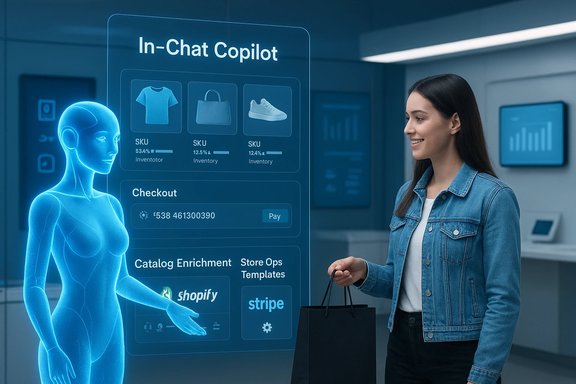
A shopper chats with a holographic AI assistant displaying products and a checkout panel.
Microsoft’s latest retail push folds conversational commerce, catalog automation, and store‑operations intelligence into a single, agentic stack designed to let assistants not only advise shoppers but complete purchases and act on behalf of retailers, starting with a U.S. rollout of Copilot Checkout and a set of Copilot Studio templates for Brand Agents, catalog enrichment, and store‑ops automation.

Background / Overview​

Microsoft has been assembling a layered enterprise AI stack—Copilot Studio for authoring copilots and multi‑agent workflows, Azure AI Foundry (Agent Service) for orchestration and governance, and a growing catalog of prebuilt templates and connectors targeted at verticals like retail. The company frames this collection as agentic AI—systems that can take multi‑step, context‑aware actions and escalate to humans when necessary—rather than simple recommendation engines. Retail is a natural first domain for agentic systems. Rich structured product data, high volumes of repetitive interactions, and time‑sensitive decisions across discovery, checkout, and store operations make retailers fertile ground for automation that reduces friction and scales frontline productivity. Microsoft’s January announcement positions the offering as an “intelligence layer” that can both advise and act across merchandising, marketing, store operations, and fulfillment. This article unpacks what Microsoft announced, how the technology works at a technical and operational level, where value is likely to appear, and the practical governance and risk considerations every retailer should weigh before turning a conversational assistant into a checkout lane.

What Microsoft Announced​

Microsoft’s retail package includes three headline elements designed to work together:
  • Copilot Checkout — an in‑chat checkout that allows shoppers to complete purchases inside Copilot without being redirected to an external merchant site. Microsoft insists merchants remain the merchant of record. Launch partners include PayPal, Shopify and Stripe; early merchant examples named are Urban Outfitters, Anthropologie, Ashley Furniture and Etsy sellers. Copilot Checkout is rolling out in the United States on Copilot.com.
  • Copilot Studio templates for retail — turnkey templates such as Brand Agents (Shopify merchants), a personalized shopping agent template, a catalog enrichment agent (public preview), and a store operations agent (public preview) that automate product onboarding, catalog normalization, conversational shopping, and frontline support. These templates aim to shorten time‑to‑deploy and standardize behavior across channels.
  • Ecosystem and governance primitives — Microsoft pairs these features with identity, observability and AgentOps tooling intended to govern agent behavior, enforce brand safety, and provide audit trails across actions taken by agents. The company emphasizes enterprise‑grade controls as a core differentiator.
These pieces are explicitly designed to be composable: Copilot Studio builds the agents, Azure AI Foundry provides orchestration and model management, and payments/catalog partners provide the commerce plumbing required for in‑conversation purchases.

Copilot Checkout: how it works and what it promises​

Copilot Checkout converts a product recommendation or conversational result into a shoppable experience inside Copilot. In practice, the flow uses three coordinated layers:
  • Structured catalog ingestion so agents rely on machine‑readable product feeds (SKUs, images, inventory, shipping metadata) rather than scraping webpages.
  • Conversational orchestration (Copilot runtime) that interprets intent, asks clarifying questions, and maintains provenance so every suggestion links back to auditable product records.
  • Delegated, tokenized checkout where the assistant requests an ephemeral, single‑use checkout session or payment token that hands the transaction back to the merchant or a payments partner. This approach reduces exposure of raw card data to the conversational surface while preserving merchant‑of‑record responsibilities.
Microsoft’s press materials and partner statements make three business claims about Copilot Checkout: faster conversion (shorter funnel from discovery to purchase), merchant retention of operational control (fulfillment and returns stay with merchants), and broader distribution (agents expose merchant catalogs across conversational surfaces). PayPal’s announcement highlights seller/buyer protections and store sync functionality as part of its role powering Copilot Checkout. The practical upshot for merchants: Copilot becomes another high‑intent distribution channel. For shoppers, the attraction is a frictionless, guided buying experience without context switching. Early demo partners and publicized examples show the behavior Microsoft intends to scale.

Copilot Studio templates: Brand Agents, Catalog Enrichment, Store Ops​

Copilot Studio’s templates serve distinct operational roles:
  • Brand Agents (Shopify) — turnkey agents trained on a merchant’s catalog and brand guidance to deliver a consistent voice and guided shopping flows across web, mobile and in‑chat surfaces. Shopify merchants will be offered Brand Agents with minimal setup, and Shopify has agreed to an auto‑enrollment model for Copilot Checkout following an opt‑out window.
  • Personalized shopping agent template — a flexible framework for outfit building, cross‑channel recommendations and real‑time product discovery that retailers can customize for richer, brand‑specific experiences.
  • Catalog Enrichment Agent (public preview) — automates extraction of product attributes (including from images), generates descriptions, categorizes SKUs, and enriches listings using social insights. The agent supports autonomous writeback to PIM/ERP systems or human‑review workflows and is designed to reduce manual catalog cleanup and onboarding time. This capability is currently in preview and requires sign‑up.
  • Store operations agent (preview) — gives store associates natural‑language access to inventory, policy guidance and next‑best actions, reducing tool switching and time to service on the floor.
Collectively, these templates are sold as prebuilt primitives that reduce integration work and accelerate pilots—an intentional contrast to bespoke LLM development that demands high engineering investment.

Technical anatomy: the plumbing behind agentic commerce​

Under the hood, agentic commerce converges three engineering patterns that Microsoft and partners have been standardizing:
  • Machine‑readable product feeds — canonical product records (SKUs, GTINs, inventory, images) are central to reducing hallucinations and ensuring agents surface accurate, auditable recommendations. Microsoft and partners emphasize catalog quality as the foundation for reliable agentic behavior.
  • Delegated / tokenized payments — conversational surfaces never hold raw card data; instead they request ephemeral checkout sessions or delegated tokens that authorize a single transaction with the merchant’s payment processor (PayPal, Stripe, Shopify). This minimizes exposure and helps create auditable trails for disputes and refunds.
  • Provenance, observability and AgentOps — every agent decision, the catalog records that informed it, and the checkout token exchange must be logged to support chargebacks, refunds and regulatory compliance. Microsoft’s Foundry/Agent Service and Copilot Studio include identity, safety policies and observability tools intended to meet enterprise governance needs.
This technical stack is interoperable with the larger agentic ecosystem. Open protocols like the Agentic Commerce Protocol (ACP) and Stripe‑led standards are emerging across vendors; Microsoft’s approach binds those payment and catalog standards into Copilot and Copilot Studio while leaning on partner integrations for the payment rails and merchant plumbing. The result aims to be a standards‑based but platform‑aware architecture.

Business case: where value is most likely to appear​

Agentic retail promises measurable wins in three tangible areas:
  • Conversion lift and shorter funnels. By collapsing discovery and checkout into one conversational surface, Microsoft claims significant conversion improvements when shopping intent is present, and partners stress faster time‑to‑transaction compared to traditional link‑based flows. Early partner messaging argues that Copilot journeys lead to more purchases in the short window after interaction. Retailers with high frequency, low‑consideration goods (fast fashion, accessories, convenience goods) are likely to see the fastest ROI.
  • Operational efficiency and frontline productivity. Store operations agents reduce tool switching for associates, shrink average handle time on routine queries, and accelerate onboarding for seasonal staff. Catalog enrichment reduces manual data cleanup, speeding product onboarding and improving search/recommendation quality. These operational gains translate to labor savings and improved availability for customer‑facing tasks.
  • Personalization at scale. Brand Agents and personalized shopping templates can stitch past behavior, live inventory and promotional rules into one conversational experience—if retailers provide the structured data and governance controls needed to keep recommendations accurate and brand‑aligned.
For Microsoft and its partners, the commercial upside is both platform growth—positioning Copilot as a first‑class transactional surface—and deeper integration with merchant systems, which can create stickiness if merchants adopt Copilot Studio templates and Azure Foundry orchestration widely.

Risks, unknowns and operational caveats​

The potential upside is real, but the practical and legal hazards are equally consequential. Key risks include:
  • Data governance and model training exposure. Agents trained on catalogs and conversation logs may create new data flows and secondary uses. Retailers must confirm contractual terms that define what data is stored, how long it is retained, whether it is used for model improvement, and who can access it. Microsoft’s marketing emphasizes enterprise controls, but exact data flow rules vary by agreement and region and must be audited before production use.
  • Disputes, chargebacks and fraud liability. Although Microsoft and partners say merchants remain the merchant of record, the distribution and payment flows change how disputes surface. Merchants must verify who handles fraud detection, chargeback disputes, and refunds under each integration model (PayPal, Stripe, Shopify). The division of liability and the operational SLA for payouts are contract terms that materially affect merchant risk.
  • Discovery opacity and Answer Engine Optimization (AEO). Agents control which products are surfaced and how—creating a new optimization problem for merchants. Merchants will need to invest in higher quality metadata, prioritization signals and catalog hygiene to appear prominently. Platform control over ranking also raises antitrust and fairness concerns if platforms favor their own placements or commercial partners.
  • Operational fragility from poor data hygiene. Agentic checkout depends on accurate inventory, shipping windows and price signals. Stale feeds will generate failed orders, disputes and reputational damage. Robust testing, monitoring and human‑in‑the‑loop approvals remain necessary to prevent widespread errors.
  • Regulatory and privacy scrutiny. As assistants become transactional surfaces, regulators may scrutinize disclosure requirements (how recommendations are ranked), consumer consent for data reuse, and liability for erroneous orders. The auto‑enroll model for some merchants (Shopify opt‑out) is likely to draw attention and requires careful communication to avoid merchant backlash.
  • Vendor lock‑in and commercial complexity. While Microsoft emphasizes partner integrations, the practical outcome may still concentrate control of discovery and analytics with the conversational platform. Merchants should evaluate escape clauses, data portability, and the economics of in‑chat purchases (fees, promotional costs, reporting).
These are not hypothetical—industry reporting and Microsoft’s own materials emphasize that many retailers are already piloting agentic systems, but fully mature, scaled deployments remain rare. That gap is the product of governance, integration and operational readiness more than raw technical capability.

Competitive landscape: not the only player in the ring​

Microsoft’s Copilot Checkout arrives amid an accelerating multi‑front battle over who owns discovery and checkout in the age of agentic commerce:
  • OpenAI / ChatGPT Instant Checkout launched an in‑chat checkout experience earlier in the rollout cycle, working with Stripe and the Agentic Commerce Protocol (ACP) to enable similar conversational purchases.
  • Google has been experimenting with agentic checkout in Search / AI Mode, with experiments designed to let the assistant “Buy for Me.”
  • Perplexity and other search assistants are also moving toward integrated commerce primitives and browser‑scale shopping flows.
This competition matters because distribution and consumer adoption are as important as technical functionality: larger consumer chat audiences create more high‑intent queries and therefore greater conversion potential for the platform that owns the surface. Microsoft’s advantage is deep enterprise integrations (Shopify partnership, Azure backbone, Copilot distribution across Edge and Windows), but OpenAI and Google have strong consumer footprints—so the race will be decided by usability, merchant economics, and trust.

Practical checklist for retailers and IT teams​

For retail IT leaders and product teams evaluating Copilot Checkout and agentic templates, treat the initiative as an operational transformation rather than a point product. A practical rollout checklist:
  1. Confirm enrollment model and opt‑out rules. Verify whether your Shopify store will be auto‑enrolled and understand the steps, timelines and consequences of opt‑out.
  2. Audit data flows and contractual terms. Clarify what catalog and customer data Microsoft and partners store, how long it’s retained, and whether it will be used for model training or benchmarking.
  3. Define liability boundaries. Ask partners to specify chargeback, fraud detection and refund responsibilities and the SLAs for payouts and dispute handling.
  4. Harden catalog hygiene. Establish automated validation for SKU accuracy, inventory sync, pricing and shipping windows. Consider a preflight automated test suite that simulates conversational flows and checkout handoffs.
  5. Implement AgentOps and human‑in‑the‑loop approvals. Use Copilot Studio’s approval workflows where available and maintain human oversight for high‑value or unusual writes to PIM/ERP systems.
  6. Plan small, measurable pilots. Start with narrow use cases (frequent‑purchase categories, curated product sets) and measure A/B lifts on conversion, return rates, dispute frequency and CSAT.
  7. Document consumer disclosures. Ensure conversational surfaces clearly disclose merchant identity, pricing, shipping terms and any sponsored or ranked placements. Prepare compliance‑ready copy and transcripts for audits.
Following these steps reduces operational surprise and preserves customer trust while enabling measured experimentation.

What to watch next (near term signals)​

The market will be watching several signals to judge whether agentic retail moves from demo‑worthy to durable:
  • Merchant adoption metrics. The rate at which Shopify merchants accept or opt out of Copilot Checkout will indicate merchant appetite and comfort with the model. Microsoft’s auto‑enroll approach is a practical lever to accelerate adoption but may provoke pushback if merchants feel surprised by defaults.
  • Operational reliability stats. Metrics such as failed order rate, chargeback incidence, dispute resolution time and average time‑to‑refund will be early indicators of operational readiness.
  • Consumer trust and reporting. Transparency about how recommendations are ranked and whether merchant payments affect placement will matter for regulatory and trust reasons.
  • Regulatory attention. As assistants become transactional surfaces, expect consumer protection and competition authorities to examine disclosure, ranking fairness and anticompetitive tie‑ins.
  • Interoperability protocols. Adoption of shared agentic commerce protocols (e.g., ACP) and tokenized payment standards will determine how open or closed the emerging conversational commerce ecosystem becomes.

Critical assessment: strengths and limits​

Microsoft’s retail package demonstrates several notable strengths:
  • Integrated enterprise footing. Copilot Studio + Azure Foundry + identity/governance tooling is a coherent stack for enterprises that already run on Microsoft clouds and collaboration surfaces. This lowers the friction for retailers invested in the Microsoft ecosystem.
  • Practical, composable primitives. By packaging Brand Agents, catalog enrichment and store‑ops templates, Microsoft reduces the engineering burden of agentic projects and accelerates pilots.
  • Partner ecosystem for payments and marketplace reach. Partnering with PayPal, Stripe, Shopify and Etsy brings existing commerce plumbing and buyer protections into the experience—critical elements for practical deployment.
But there are meaningful limits and risks:
  • Governance remains the hard problem. Microsoft’s governance primitives are necessary but not sufficient—retailers must invest in AgentOps, human oversight and contractual clarity. Otherwise, automation errors and privacy missteps will produce outsized reputational and financial costs.
  • Vendor and platform economics. Even with the merchant‑of‑record claim, platform rules, fees and ranking control could shift economics in ways that disadvantage merchants over time. Transparency on commercial terms will be decisive.
  • Adoption and integration complexity. The promise of frictionless checkout rests on clean data, real‑time inventory sync and robust payments integrations—areas many retailers struggle with today. The gap between pilot and production will be where many projects stall.

Conclusion​

Microsoft’s agentic retail announcement—anchored by Copilot Checkout and a suite of Copilot Studio templates—marks a significant step in the evolution of conversational commerce. The offering is strategically coherent: it combines authoring tools, orchestration, governance, and partner payment rails to convert discovery into in‑chat transactions while promising enterprise controls and brand experience consistency. Practical success, however, will be decided by operational discipline. Retailers that invest in catalog hygiene, contractual clarity, AgentOps and measured pilots will capture early advantages in conversion and frontline productivity. Those that rush into auto‑enrolled in‑chat commerce without hard operational SLAs, tested dispute flows, and clear data governance risk costly errors—and possible regulatory scrutiny.
For Windows‑centric IT teams and retail technologists, the immediate task is pragmatic: evaluate the templates against real operational processes, test the delegated checkout flow end‑to‑end, and negotiate clear terms with payment and platform partners. If executed with engineering rigor and governance maturity, agentic retail can be a powerful lever for conversion and efficiency. If executed poorly, it will be a cautionary case study in automation without accountability.
(Claims and product details above are drawn from Microsoft’s January announcement and partner press releases, independent reporting, and Microsoft Learn documentation; readers should validate contractual and regional availability details for their specific markets before onboarding.
Source: thebull.com.au https://thebull.com.au/us-news/micr...ail-automation-with-new-agentic-ai-solutions/
 

Blue neon laptop screen shows Copilot chat, product cards, and a Brand Agent panel.
Microsoft has begun turning its Copilot AI from an assistant into a point-of-sale, launching Copilot Checkout — a native checkout experience inside Copilot conversations — alongside Brand Agents, an out-of-the-box, brand‑voiced shopping agent for merchants. The rollout, which initially targets U.S. users on Copilot.com and ties into major commerce and payments partners, promises frictionless, in-chat purchases without redirecting shoppers off the Copilot surface. Microsoft positions this move as the next step in “agentic commerce,” aiming to convert intent into transactions while keeping merchants “merchant of record.”

Background​

Microsoft has been consolidating many AI features under the Copilot umbrella across consumer and enterprise apps. The company reports broad adoption of Copilot-branded tools, and executives have cited more than 100 million monthly active users across the family of Copilot apps, a scale Microsoft uses to justify deeper commerce integration. Building commerce directly into conversational AI is a trend across big tech — a move toward embedding payments, product discovery, and purchase flows inside assistants rather than routing users to merchant sites. This announcement arrives at a moment when retailers and payments platforms are experimenting with generative AI to capture high-intent shoppers. Microsoft frames Copilot Checkout and Brand Agents as merchant-first solutions — offering turnkey onboarding for Shopify stores, direct integrations with PayPal and Stripe, and a protocol-based approach to let third-party payment engines and seller platforms interoperate with Copilot’s agentic layer.

What is Copilot Checkout?​

Copilot Checkout is a checkout experience rendered inside the Copilot chat UI. When a conversation leads to a purchase decision, Copilot can surface a “Buy” path that opens a native checkout widget where shoppers can provide shipping, payment, and fulfillment choices without being redirected to a merchant’s external website. Microsoft says merchants remain the merchant of record, and the initial U.S. roll-out will include participating retailers such as Urban Outfitters, Anthropologie, Ashley Furniture, and Etsy sellers. Payments at launch are enabled through partners including Shopify (for Shopify merchants), PayPal, and Stripe. Why this matters: by removing the redirect step, Copilot Checkout intends to cut friction and reduce cart abandonment that typically happens when users move between discovery and payment channels. Microsoft frames the experience as “conversation to conversion” — delivering speed and contextual relevance at the moment of purchase intent.

How it appears to shoppers​

  • Copilot suggests products as part of an interactive chat.
  • A built-in buy flow appears alongside recommended items.
  • Shoppers can complete payment and shipping details inside Copilot without visiting external pages.
This is similar in spirit to the “in-assistant” purchases OpenAI and other providers have piloted, but Microsoft emphasizes merchant control and broader payments partner support.

Brand Agents — AI that speaks in your tone​

Brand Agents are prebuilt shopping agents merchants can deploy on their websites and across Copilot surfaces. Designed as turnkey, brand‑voiced assistants, they are trained on a merchant’s product catalog and configured through Copilot Studio templates and Microsoft tooling. The stated goals are to raise engagement, improve discovery, and accelerate purchase decisions by offering a store-specific conversational experience that reflects the brand’s voice and policies. Microsoft also highlights quick deployment timelines and measurable uplift examples from early adopters. Key features Microsoft highlights:
  • Conversational shopping guided by catalog understanding.
  • Deployment options for Shopify merchants and integration pathways for others.
  • Templates in Copilot Studio for personalized shopping agents.
  • Analytics hooks and control panels for brands to manage tone, product rules, and returns.
The pitch: Brand Agents replicate the brick-and-mortar associate who understands the inventory and the brand, replacing static FAQs and search boxes with dynamic dialogue designed to drive conversions.

Partnerships and the promise of an open standard​

At launch the initiative lists three primary payments and platform partners: Shopify, Stripe, and PayPal. Shopify merchants will be automatically enrolled in Copilot Checkout after an opt-out window, while Stripe and PayPal integrations are available for merchants choosing to opt in via application. Microsoft says this multi-partner approach is supported by the Agentic Commerce Protocol (ACP) — an open standard co-developed with partners to enable agentic commerce plumbing between Copilot and sellers’ systems. This architecture matters for scale: rather than forcing a single checkout provider, Microsoft is positioning Copilot as a surface that can call into different payment processors and merchant backends via a standard protocol. That should, in theory, let merchants preserve inventory feeds, fulfillment logic, tax rules, and return policies while letting Copilot orchestrate the customer-facing conversation.

Technical mechanics: how purchases are executed​

  1. Discovery: A user asks Copilot for recommendations or is shown product suggestions during a chat.
  2. Selection: Copilot surfaces product options, metadata, and a buy affordance.
  3. Checkout invocation: Copilot initiates a checkout widget tied to the merchant’s catalog and payment processor via ACP.
  4. Payment and fulfillment: The payment flow uses the merchant’s chosen provider (Shopify, Stripe, PayPal), which processes the payment and hands fulfillment back to the merchant. Microsoft states merchants remain the merchant of record.
Behind the scenes, Microsoft emphasizes that Copilot Checkout is built to respect merchant controls — catalog visibility, pricing, inventory levels, and policies are intended to come from the merchant’s systems rather than being overridden by Copilot. However, implementation complexity will vary by merchant platform and bespoke storefront architectures.

What Microsoft claims merchants will get​

Microsoft’s public messaging stresses several benefits for merchants:
  • Increased reach across Copilot surfaces (Copilot.com, Bing, Edge, MSN) with no extra integration if you’re on supported platforms.
  • Faster buyer journeys, reducing discovery-to-purchase latency.
  • Merchant-of-record retention: merchants should keep control of pricing, taxes, and fulfillment.
  • Automatic Shopify enrollment (opt-out model) to rapidly expand merchant coverage.
  • Integration options for PayPal and Stripe merchants via application.
The marketing material includes early case anecdotes claiming significantly higher conversion rates for Brand Agent-assisted sessions, but those figures come from vendor-supplied examples or pilot data and should be treated cautiously until independent verification is available. Microsoft’s announcements include one retailer anecdote indicating over 3× conversion in Brand Agent-assisted sessions; that is promising but not independently validated. Treat vendor case studies as directional rather than definitive.

Early adoption and merchant onboarding mechanics​

  • Shopify merchants: automatic enrollment with an opt-out window; merchants can manage Copilot Checkout from Shopify admin.
  • Stripe and PayPal merchants: can apply to enable Copilot Checkout; both companies have posted partnership notes indicating they power payments and merchant sync for Copilot purchases.
  • Etsy integration: Etsy’s product catalog and some sellers are present at launch; Microsoft highlights this as a way to surface unique and handcrafted items.
Automatic enrollment is designed to accelerate scale, but it is also the most sensitive design choice since merchants will want clear control over participation, fee structures, and customer support responsibilities. Automatic opt-ins risk generating merchant pushback if the opt-out process is unclear or if expectations around dispute handling are not well-defined. Several merchant platforms are rapidly clarifying administrative controls and reporting tools in response.

Benefits for consumers — and where UX risks remain​

For shoppers, the advantages are obvious:
  • Speed: fewer clicks to buy.
  • Contextuality: Copilot remembers the conversation context and can auto-select options or offer bundle suggestions.
  • Familiar interface: completing checkout inside an AI conversation can feel less disruptive than opening new tabs.
That said, there are UX and trust risks to manage:
  • Transparency about who is selling the item, return policies, and shipping estimates must be clearly visible inside the Copilot interface to avoid confusion.
  • Payment method choice and saved-payment controls must mirror the merchant’s expectations.
  • Fraud prevention and chargeback flows need to be seamless — a native checkout introduces a new attack surface for social-engineering or UI-based scams if not hardened properly.

Privacy, security, and data-sharing considerations​

Embedding commerce into conversational AI raises immediate questions about data scope and control. Critical points include:
  • What customer and transaction data flows to Microsoft, and what remains with the merchant and payment partner?
  • How does Microsoft store or cache shipping and payment preferences used by Copilot?
  • Which organization is responsible for KYC, fraud monitoring, and dispute resolution in cross-platform purchases?
Microsoft states that merchants remain the merchant of record — a legal position that typically preserves responsibility for taxes, returns, and customer service. Payments partners (Stripe, PayPal) will handle processing, but the integration points require careful mapping of data sharing agreements and compliance with PCI standards and regional privacy laws. Merchants should require clear SLAs and data-usage disclosures before enabling Copilot Checkout. Privacy advocates will likely scrutinize:
  • How conversational transcripts tied to purchases are retained and used.
  • Whether personalized recommendations inside Copilot are informed by cross-site behavioral signals or aggregated telemetry.
  • The implications of automatic Shopify enrollment on merchants’ consent and data sharing choices.

Business implications for retailers and platforms​

Copilot Checkout and Brand Agents represent a strategic bet: capture purchase intent earlier and make AI-native surfaces a new retail channel. Potential impacts:
  • Channel shift: If Copilot becomes a high-volume sales channel, retailers will treat Copilot as they do marketplaces today — optimizing feeds, promotions, and inventory specifically for the surface.
  • Fee pressure and economics: Microsoft’s messaging emphasizes keeping merchants as merchant-of-record, but that does not eliminate the need to negotiate fulfillment, fees from payment partners, or platform-related costs (e.g., Shopify’s fees). Merchants must evaluate incremental margin after any transaction costs and potential returns.
  • Discovery optimization: Brands will invest in agentic optimization — ensuring their catalogs, images, and product metadata are Copilot-ready to surface optimally in conversational prompts.
  • Customer support: Conversations that begin in Copilot might need new escalation paths to merchant support teams, impacting staffing and tooling.
For marketplaces and commerce platforms, being integrated early (Shopify, Etsy) is a competitive advantage; for smaller merchants, the opt-in application process for PayPal/Stripe means a potential lag in availability.

Regulatory and competitive landscape — potential flashpoints​

This approach raises a few regulatory and antitrust considerations worth watching:
  • Platform neutrality: If Copilot preferentially surfaces products from partners or merchants who pay for better integration, regulators could examine whether discovery is biased.
  • Data portability and competition: The Agentic Commerce Protocol is presented as open, but adoption and technical specifics will determine whether it truly enables competition or simply advantages large providers who can implement it quickly.
  • Consumer protection: Regulators will scrutinize refund, cancellation, and dispute handling in cases where the assistant mediates the sale but the merchant handles fulfillment.
Antitrust and privacy regulators are already attentive to how large tech platforms expand into commerce; embedding checkout directly into widely distributed AI assistants may attract scrutiny if market power is perceived to shift dramatically toward big tech intermediaries.

Practical steps for merchants — a short playbook​

  1. Audit readiness: Verify product catalogs, images, and metadata are clean and optimized for conversational discovery.
  2. Review terms: Read Copilot Checkout and Brand Agent integration terms, especially around merchant-of-record obligations, dispute handling, and fees.
  3. Decide enrollment posture: Shopify merchants should evaluate the opt-out window carefully; non-Shopify merchants should assess PayPal/Stripe application timelines.
  4. Test returns and chargebacks: Run simulated returns and dispute scenarios to ensure customer service workflows are robust when purchases originate from Copilot.
  5. Monitor analytics: Configure logging and analytics to track Brand Agent-assisted sessions versus unassisted sessions to measure lift and ROI.
  6. Prepare for content control: Use Copilot Studio controls to manage agent tone, promotion placement, and content compliance.

Risks and unanswered questions​

  • Vendor claims vs. independent verification: Microsoft’s conversion uplift anecdotes are promising but vendor-supplied. Independent, third-party performance studies will be required to quantify sustained benefits. Flagged: vendor case-study figures need external validation.
  • Scope of data sharing: Public announcements outline partner roles but not the full schema of data retention and cross-service usage. Merchants must confirm data handling details with legal counsel and partners.
  • Dispute and fraud workflows: Who bears liability in edge cases (fraud, unauthorized purchases, refunds) needs airtight clarity; implementers should validate indemnification clauses and operational procedures.
  • Consumer trust: Rapid adoption depends on shoppers understanding who they are buying from, how returns work, and what protections they retain. UI clarity and customer education will be crucial.

How this fits into the larger AI-commerce trend​

Microsoft’s move reflects a broader industry shift toward agentic interfaces that not only recommend but transact. Other companies have tested in-assistant purchases or integrated buy buttons in search and chat. The addition of an open-ish protocol and a multi-partner approach is Microsoft’s attempt to avoid vendor lock-in narratives and scale the concept across diverse payment and platform ecosystems. If Copilot can reliably deliver high-intent traffic and keep merchants satisfied on margins and control, agentic commerce could become a major acquisition channel for retail.

Final assessment — strengths, strategic risks, and what to watch next​

Strengths:
  • Seamless buyer journeys: Reduces friction by keeping the purchase inside the conversational flow.
  • Partnered payments model: Using Shopify, Stripe, and PayPal decreases the implementation burden for many merchants.
  • Scalability through templates: Brand Agents and Copilot Studio lower technical barriers to launch conversational storefronts quickly.
Strategic risks:
  • Merchant consent and control: Automatic enrollment for Shopify merchants could provoke backlash if not communicated clearly.
  • Data governance: Ambiguities in data flows and retention policies can erode merchant and consumer trust.
  • Regulatory scrutiny: Aggressive expansion of commerce inside large tech platforms could draw attention from competition and consumer-protection regulators.
  • Overpromised conversion metrics: Vendor-provided uplift figures require independent verification to establish long-term efficacy.
What to watch next:
  • Independent performance reports from merchants and analytics firms.
  • Clarifications from Microsoft, Shopify, Stripe, and PayPal on data-sharing contracts and dispute workflows.
  • Early merchant feedback on the opt-out enrollment process and operational impacts.
  • Regulatory commentary or inquiries from competition and consumer-protection bodies.

Conclusion​

Copilot Checkout and Brand Agents mark a pragmatic and aggressive attempt by Microsoft to graft commerce onto the emerging landscape of conversational AI. The approach combines familiar commerce plumbing with the promise of contextual shopping inside AI conversations — a powerful proposition if Microsoft can balance merchant control, transparent data practices, and consumer protections. For merchants, the opportunity is real: a potential new channel that reduces friction and meets buyers at the moment of intent. For consumers, the success of the idea will hinge on clear disclosure, secure payments, and dependable fulfillment.
The rollout’s immediate success will be measured by merchant uptake, verified conversion lifts, and how clearly Microsoft and its partners define operational responsibilities. In the months ahead, independent data and merchant case studies will determine whether agentic commerce is a durable new channel or a convenience experiment that needs deeper structural work.
Source: Neowin https://www.neowin.net/news/microsoft-launches-copilot-checkout-and-brand-agents-for-merchants/
 

Microsoft’s latest retail play pushes a decisive shift: treat AI not as a sidebar helper but as an operational layer that can discover, decide, and execute commerce workflows end-to-end—anchored by Dynamics 365, Copilot, and a new Model Context Protocol (MCP) surface that promises to make agentic commerce practical at scale.

A woman interacts with a glowing holographic AI assistant in a futuristic store.Background / Overview​

Retail has always been an information‑flow problem: products, prices, inventory, promotions, and customer intent must be aligned continuously across stores, web, marketplaces, and conversational surfaces. Microsoft’s recent messaging reframes that problem as an opportunity to embed AI agents where decisions and value are created—on the shelf, at checkout, in merchandising, and across fulfillment—so that agents can act (not only advise) with governed access to enterprise systems. This is the essence of “agentic commerce” or “Commerce Anywhere.” Microsoft’s industry and Dynamics 365 messaging lays out three practical elements of that approach: Copilot‑powered conversational surfaces (including in‑chat checkout), prebuilt agent templates (catalog enrichment, personalized shopping, store ops), and MCP servers that expose controlled, discoverable, auditable business functions to agents. The immediate headlines from Microsoft and its partners include Copilot Checkout (in‑chat checkout powered with payments integrations), managed agent templates in Copilot Studio, and the Dynamics 365 Commerce MCP Server as the commerce‑grade ground for agent execution. Independent reporting from multiple outlets confirms Copilot Checkout rolling out in the U.S. with payment platform partners like PayPal and Stripe and merchants such as Urban Outfitters and Anthropologie.

What is agentic commerce — and why now?​

The operating model shift​

Agentic commerce treats AI agents as operational workers rather than one-off recommendation engines. Agents are designed to:
  • Continuously monitor signals (customer intent, inventory, supplier status, weather, local events).
  • Use a shared, enterprise‑grade context to reach decisions.
  • Execute governed actions in systems of record (catalog updates, reservations, fulfillment changes, checkout token exchanges).
  • Hand off to humans for strategy, exceptions, and policy enforcement.
This model answers persistent retail pain points—volatile demand, labor constraints, and margin pressure—by enabling faster, more consistent decisions at scale. Microsoft frames leading organizations that adopt this pattern as “Frontier Firms,” which embed intelligence across the value chain rather than patching point problems.

The practical ingredients​

Agentic commerce requires three technical primitives working in concert:
  • A conversational and orchestration layer (Copilot and Copilot Studio) to author, deploy, and run multi‑agent workflows.
  • A secure protocol and tool surface (Model Context Protocol, MCP) that exposes business capabilities as discoverable, permissioned tools agents can call.
  • Payment and transaction protocols that let agents initiate compliant, auditable transactions without holding raw payment data.
Microsoft’s announcements package those primitives with enterprise governance—agent identity, observability, safety policies, and AgentOps tooling—aimed at letting agents act while leaving humans in control.

Model Context Protocol (MCP) and Agent Communication Protocol (ACP): the plumbing of agentic retail​

What MCP does​

Model Context Protocol (MCP) is a protocol-first bridge between agents and enterprise systems. Rather than rely on brittle point‑to‑point connectors or ad‑hoc prompt engineering, MCP describes tools (capabilities), structured inputs/outputs, and a security contract so that an agent can deterministically discover and call business functions—catalog queries, price calculations, inventory reservations, cart updates, or fulfillment actions.
The commercial promise: expose hundreds of thousands of retail functions (catalog, pricing, promotions, inventory, orders, fulfillment) as MCP‑enabled capabilities so agents can securely discover, decide, and execute real‑time workflows against live systems. MCP aims to preserve auditability, least‑privilege access, and traceability for every agent action. This is the foundational idea behind the Dynamics 365 Commerce MCP Server.

Why ACP and payment agent protocols matter​

Agent Communication Protocol (ACP) is the coordination layer that lets agents across merchandising, supply chain, store ops, and service work together. When ACP, MCP, and secure transaction protocols are combined, agents can negotiate availability, modify fulfillment plans, and initiate tokenized payments while leaving legal merchant relationships and settlement to established payment rails.
Payments integrations are intentionally tokenized and delegated—conversational surfaces do not hold raw card details. Instead, the agent requests an ephemeral checkout session or a delegated token that the merchant’s payment processor (PayPal, Stripe, Shopify) redeems. This design reduces PCI exposure and creates auditable trails for disputes, refunds, and chargebacks, a critical requirement for any commerce deployment. PayPal and Stripe have publicly announced integrations with Microsoft Copilot Checkout as early partners.

Introducing Dynamics 365 Commerce MCP Server (what Microsoft says)​

Microsoft’s Dynamics 365 Commerce MCP Server is positioned as a commerce‑grade MCP implementation that exposes core retail business logic—catalog, pricing, promotions, inventory, carts, orders, and fulfillment—as MCP‑enabled, discoverable tools for agents to call. The vendor explains this will make it possible for AI agents to securely discover, decide, and execute retail workflows across digital, physical, and conversational channels, enabling the “Commerce Anywhere” vision. Dynamics 365’s Commerce surface, combined with ERP and Analytics MCP servers, is presented as the substrate for an agent‑driven operating model. Microsoft’s messaging around the Commerce MCP Server frames three adoption patterns for retailers:
  • Use agents embedded directly into Dynamics 365 (purpose‑built agents).
  • Build custom agents using Copilot Studio and MCP to encode unique business rules.
  • Extend agentic capabilities with partner‑built agents and ecosystem solutions.
Those three paths let organizations progress at their own pace—starting with out‑of‑the‑box templates and moving toward deeper, custom automation. Caveat: marketing materials and partner articles reference a preview timeline for Commerce MCP Server (Microsoft’s announcements say early previews are expected around February 2026). That specific date appears in vendor briefings and partner write‑ups but independent confirmation of the exact preview start may vary by region and tenant; organizations should verify availability and sign‑up mechanics directly with Microsoft before planning projects that depend on the preview timeline.

Agent types and real examples: embedded, custom, and partner agents​

1) Embedded agents in Dynamics 365​

Microsoft ships purpose‑built retail agents in Copilot Studio and the Dynamics 365 ecosystem, such as:
  • Supplier Communications Agent — monitors supply signals and helps coordinate supplier confirmations and timeline updates, reducing surprises and accelerating responsiveness.
  • Catalog Enrichment Agent — ingests images, PDFs, and vendor feeds to populate and standardize product metadata, flagging low‑confidence items for human review.
  • Personalized Shopping Agent — runs conversational product discovery across channels, asking clarifying questions and recommending items tuned to brand voice.
These embedded agents are designed for rapid time‑to‑value by tying directly into Dynamics data models and workflows.

2) Custom agents built with Copilot Studio + MCP​

For business‑unique workflows—replenishment rules, allocation strategies, store formats, or brand policies—retailers can build custom agents in Copilot Studio that call MCP tools on Dynamics 365 ERP, Commerce, and Analytics servers. Custom agents can live inside collaboration surfaces like Microsoft Teams or the point‑of‑sale workflow and can be governed by enterprise identity, RBAC, and observability tooling.
Example scenario:
  • A replenishment agent reads forecasted demand and supplier lead times from ERP (via MCP).
  • It proposes an allocation plan and reserves stock across DCs.
  • It updates orders or escalates exceptions to planners with an audit trail.
This pattern turns planning actions into agent‑callable workflows while preserving human oversight and governance.

3) Partner-built agents and the ecosystem​

Microsoft’s partner ecosystem already showcases agentic retail use cases:
  • Argano Retail Clienteling Agent — uses Commerce MCP Server to surface customer insights and commerce context to associates for high‑touch, luxury clienteling experiences.
  • Amicis Store Commerce Agent — voice‑first assistant for phone‑or‑floor tasks (returns, exchanges, policy checks) that adapts to the POS surface.
  • Evenica B2B Licensee Product Request Agent — uses conversational AI and image recognition to help licensees find products and create product intake requests.
  • Visionet FashionGPT Agent — maps natural‑language intent into real‑time product, pricing, inventory, and promotion actions across channels.
Partner solutions accelerate adoption by reducing integration overhead and delivering scenario‑specific logic that plugs into MCP semantics and governance primitives.

In practice: Copilot Checkout and tokenized payments​

A practical example of agentic commerce in action is Copilot Checkout—a conversation‑native checkout that surfaces a “Buy” option inside Copilot and completes payment using delegated tokens via payment partners. Microsoft and partners (PayPal, Stripe, Shopify) describe a model where the conversational surface generates a one‑time checkout session or token that a payment processor redeems, so the merchant remains the merchant of record while conversational checkout reduces friction and shortens the path to purchase. Early press coverage and partner press releases confirm US availability and partner integration; merchants named in demos include Urban Outfitters, Anthropologie, Ashley Furniture, and Etsy sellers. Operational and compliance details to note:
  • Checkout flows use ephemeral tokens rather than storing raw card data inside Copilot, minimizing PCI scope.
  • Payment platforms surface merchant protection features and buyer protections identical or similar to their native flows (PayPal emphasized seller/buyer protections in their Copilot announcement).
  • Every agent action and the catalog records that informed it should be logged for chargebacks, refunds, and regulatory audits.

How retailers should begin adopting agentic commerce (practical roadmap)​

Microsoft recommends three entry paths; here’s a pragmatic adoption roadmap that maps to retail realities:
1. Start small with embedded agents and templates
  • Deploy catalog enrichment and store operations agent templates in test teams to measure time saved and catalog quality improvements.
  • Use the agent to flag low‑confidence entries and require human approval for high‑risk writebacks.
  • Validate KPIs: time per SKU processed, catalog completeness, and search conversion lift.
2. Pilot custom agents with narrow scopes
  • Build a replenishment or allocation agent in Copilot Studio that calls a small set of MCP functions in a non‑production tenant.
  • Keep human‑in‑the‑loop gates for writebacks; instrument telemetry and set escalation rules.
  • Run A/B pilots to measure availability, fulfillment accuracy, and margin impacts.
3. Expand with partner solutions and payments pilots
  • Trial Copilot Checkout with a small set of SKUs and a single payments partner (PayPal or Stripe) to validate transaction flows and refund handling.
  • Use partner agents for clienteling or store productivity where prebuilt UX reduces integration time.
Numbered checklist for a safe pilot:
  • Clean and normalize catalog and master data (SKUs, GTINs, taxonomies).
  • Define clear guardrails and escalation policies for every agentic action.
  • Configure Entra‑backed agent identities and enforce least‑privilege.
  • Enable end‑to‑end logging (agent input, decision trace, system writes, and user approvals).
  • Run controlled experiments with rollback paths and human audits.

Benefits retailers can expect (realistic, measurable outcomes)​

  • Faster product onboarding and improved search relevance from catalog enrichment automation.
  • Reduced associate handle times and improved in‑store conversion from store operations and clienteling agents.
  • Conversion lift from frictionless, contextual checkout inside conversational flows. Industry and partner commentary cite conversion improvements when discovery and checkout are collapsed into one experience.
  • Scalable personalization and operational consistency across channels when agents are grounded in a single commerce context (MCP).
These gains are measurable: testable KPIs include catalog completeness, time to onboard SKU, average handling time (AHT), add‑to‑cart conversion, and fulfillment SLAs.

Risks, failure modes, and governance considerations​

Agentic commerce introduces new failure modes that demand operational controls and discipline.
  • Data quality risk: Agents act on whatever context they are given. Poor master data (mis‑matched SKUs, stale inventory) can make agent actions harmful—automated writebacks amplify errors. Master‑data hygiene is a precondition.
  • Model and logic drift: Agents that learn from corrections can develop undesirable behaviors without sufficient guardrails. Human‑in‑the‑loop thresholds and rollout throttles are essential.
  • Transactional and regulatory risk: Conversational checkout must preserve merchant‑of‑record relationships, dispute processes, and consumer protections. Tokenized payment flows reduce PCI scope but do not remove the need for careful reconciliation and dispute workflows. PayPal and Stripe communications emphasize these protections in their integrations.
  • Security and identity: Agent identities (Entra Agent IDs) must be tightly scoped and auditable. Agent lifecycle controls—quarantine, kill switches, and telemetry—are necessary to manage large fleets of agents. Microsoft’s Agent 365 and AgentOps tooling aim to provide those controls, but customers must operationalize AgentOps practices in their orgs.
  • Vendor ROI claims: Many vendor and partner metrics (conversion lifts, percent increases) are drawn from pilot or internal datasets. Buyers should demand reproducible benchmarks, production‑grade SLA definitions, and reference customers. Independent verification remains essential.

Critical analysis — strengths, blind spots, and where to be skeptical​

Notable strengths​

  • Practicality: Microsoft’s use of templates and MCP tool abstractions lowers the engineering bar for retailers that lack deep ML expertise but have solid operational data. Templates map to where value is realized—catalogs, store ops, and checkout.
  • Enterprise grounding: Emphasis on identity, observability, and tokenized payments addresses core enterprise concerns (auditability, least‑privilege, compliance). Partners like PayPal and Stripe committing to agentic payment flows reduces integration risk for merchants.
  • Ecosystem approach: MCP reduces point‑to‑point connector complexity and enables third‑party partners to deliver scenario‑specific agents that plug into Dynamics 365 as the system of execution. This composability is critical for real‑world retail heterogeneity.

Potential blind spots and risks​

  • Data engineering friction: The theoretical benefits presuppose clean master data and consistent metric definitions. Retailers with heavily customized ERPs or messy product feeds will face significant upfront costs before agents are safe to operate autonomously.
  • Vendor timelines vs. production reality: Product preview timelines (for example, the Dynamics 365 Commerce MCP Server preview noted for February 2026 in vendor briefings) are useful planning signals but should be validated; preview availability can be region- or tenant‑specific and may change. Treat preview dates as tentative until confirmed in tenant enrollment or partner communications.
  • Human‑agent interaction design: The competitive edge will be human + agent workflows, not agent replacement. Organizations that over‑automate customer‑facing interactions risk losing brand voice and customer trust unless they tightly control agent style and escalation paths.

Practical checklist for IT and retail leaders​

  • Confirm the availability and preview schedule for the Dynamics 365 Commerce MCP Server in your region and tenant. Treat preview dates as planning milestones—not guarantees.
  • Prioritize master‑data and catalog clean‑up: SKU normalization, taxonomy alignment, and image/text completeness. Catalog quality is the critical foundation for reliable agent behavior.
  • Plan for AgentOps: define ownership, lifecycle controls, quarantine and emergency kill switch procedures, telemetry retention, and cost monitoring. Use Entra for agent identity and follow least‑privilege practices.
  • Start with limited, high‑value pilots (catalog enrichment, store ops) and measure clearly defined KPIs (time to onboard SKU, AHT, conversion lift). Validate claims in your operational context before expanding to transactional agents like Copilot Checkout.
  • Validate payment and dispute flows for conversational checkout pilots: confirm merchant protections, reconciliation processes, and test chargeback handling with your payment partner.

Conclusion​

Microsoft’s Dynamics 365 agentic retail narrative is both bold and pragmatic: bold in its claim that agents can transform commerce end‑to‑end, and pragmatic in how it packages templates, governance, and a protocol (MCP) to make agent actions deterministic and auditable. The practical upshot for retailers is a clear adoption path—start with embedded agents and templates, pilot custom agent workflows grounded in MCP, and extend via ecosystem partners where appropriate.
The upside is tangible: faster catalog onboarding, smoother in‑store operations, and shorter discovery‑to‑checkout funnels. The real risk is organizational and data readiness. Agentic systems amplify both good data and bad data; they also expand the attack surface for governance, security, and financial reconciliation. Retailers that succeed will be the ones that pair aggressive pilots with rigorous AgentOps, careful human‑in‑the‑loop design, and validated payment workflows.
For WindowsForum readers who run or advise retail IT, the immediate priorities are clear: verify access to the Commerce MCP preview when your account is eligible, shore up catalog and inventory master data, and design your first pilot around operationally observable KPIs rather than vendor promises. The next wave of retail differentiation will come not from adding another point AI tool, but from redesigning operations so agents and people work from the same authoritative context—and that is precisely the operating model Microsoft is selling with Dynamics 365 and MCP.
Source: Microsoft Reimagining retail with Dynamics 365 and AI Agents
 

Microsoft has begun testing a native in-chat shopping and checkout experience called Copilot Checkout, letting U.S. users search for products and complete purchases without leaving the Copilot conversation — a move that stitches discovery, comparison, and payment into Microsoft’s conversational surface across Copilot.com, Bing, MSN, and Microsoft Edge.

Laptop screen shows an AI Shopping Assistant with product cards and a checkout dialog.Background​

Microsoft’s step into in-chat commerce is part of a larger industry trend toward agentic commerce — where conversational AIs act as active shopping agents that can recommend items, build carts, and finalize purchases on behalf of users. That framework rests on an open set of specifications and payment integrations, notably the Agentic Commerce Protocol (ACP) initially codified by OpenAI and Stripe and now used by multiple platforms as a de‑facto standard for in-chat checkout flows. The practical effect is to turn assistants from research and recommendation tools into transaction surfaces. Microsoft’s pitch: reduce friction in the discovery-to-purchase journey by keeping everything inside Copilot — from product suggestion to payment and order confirmation — while leaving merchants as the merchant of record and forwarding order fulfillment to the seller’s existing systems. Microsoft has described Copilot Checkout as rolling out first on Copilot.com in the U.S., with the integration planned across other Copilot surfaces over time.

What Microsoft is shipping: an overview​

  • A native Buy path inside Copilot conversations that opens a checkout widget where buyers enter shipping and payment details without being redirected to merchant sites.
  • Merchant partnerships and early testers that include established retail names and marketplaces (Urban Outfitters, Anthropologie, Ashley Furniture, Etsy sellers) and automatic enrollment for Shopify merchants. Microsoft also provides onboarding for merchants that use PayPal or Stripe.
  • Use of agentic commerce standards and delegated payment flows (tokenized, short‑lived checkout sessions) so Copilot can initiate purchases without directly storing raw card credentials.
  • A related developer/merchant-facing product called Brand Agents (delivered via Microsoft Clarity and limited to Shopify sites in beta) that places a brand‑voiced AI shopping assistant on merchant storefronts to help guide customers, recommend complementary products, and complete purchases.
This packaged capability aims to address three friction points that commonly kill conversion: page redirects, slow fill-in of checkout forms, and the cognitive overhead of comparing vendors across multiple tabs.

How Copilot Checkout works (technical anatomy)​

Copilot Checkout assembles three core layers: catalog ingestion, conversational orchestration, and delegated checkout. Each layer is built to preserve merchant control while enabling the assistant to act as an effective shopping agent.

1. Catalog ingestion and product metadata​

Merchants provide machine‑readable product feeds (SKUs, GTINs, inventory counts, images, shipping windows). Copilot queries those canonical records so suggestions reference authoritative product data rather than free‑text approximations. The Agentic Commerce Protocol defines a Product Feed spec for exactly this purpose.

2. Conversational orchestration​

Copilot interprets intent, asks refinement questions (size, color, delivery date), and returns curated, shoppable results inline. The assistant surfaces provenance (which catalog record produced the suggestion) and preserves an auditable trail to support dispute resolution. Microsoft describes the runtime as a conversation-first interface that can show product cards, price history, reviews, and an inline “Buy” affordance when items are available.

3. Delegated / tokenized checkout​

When a buyer confirms purchase intent, Copilot creates a short-lived checkout session or requests a tokenized payment primitive from an integrated payments provider — for example, Stripe’s flow that issues a scoped Shared Payment Token — that the merchant or PSP uses to finalize the charge on their systems. Tokenization reduces exposure of raw card data to the assistant while producing an auditable, single-use credential for the transaction. The Agentic Commerce Protocol includes a Delegated Payment spec built for this model.

Merchant onboarding and partner ecosystem​

Microsoft has organized Copilot Checkout to make merchant participation as seamless as possible:
  • Shopify merchants are automatically consented for Copilot Checkout and can manage checkout behavior from their Shopify admin. That auto-enrollment is intended to give wide coverage quickly to the large Shopify merchant base.
  • PayPal and Stripe play explicit roles: PayPal offers store sync and agentic commerce services to handle inventory surfacing and buyer protections, while Stripe’s ACP work powers delegated payment primitives and token flows used by several instant-checkout programs. Microsoft’s merchant portal and the Microsoft Merchant Center are the places merchants can register and submit feeds when required.
Microsoft has published onboarding flows and merchant application pages and has indicated there is a simple path for non-Shopify merchants using PayPal or Stripe to join Copilot Checkout. The commercial pitch: reach buyers at the precise moment of decision with lower friction and higher conversion potential.

Brand Agents: turning merchant sites into conversational storefronts​

Brand Agents are Microsoft’s complementary play to soft‑lock customers into the conversational loop while they are still on a merchant site. Delivered via Microsoft Clarity and currently targeted at Shopify storefronts, Brand Agents allow merchants to:
  • Embed a brand‑voiced AI assistant on product pages.
  • Use built-in templates to surface product recommendations, run promotions, and assist with size selection or cross-sells.
  • Access a dashboard with agent performance metrics and analytics to refine conversational prompts and measure conversion lift.
From a UX perspective, Brand Agents let sellers offer a consistent brand voice across channels while tying those conversations back into Copilot’s broader discovery and checkout mechanics. Early access for Brand Agents is currently limited and subject to platform beta gating.

What this means for merchants and shoppers​

The promise of Copilot Checkout is straightforward: faster conversions, fewer cart abandonments, and a new sales channel that taps into conversational intent. For merchants, the benefits include:
  • Access to high‑intent buyers inside Copilot surfaces without relinquishing merchant-of-record responsibilities.
  • Integration with existing order and fulfillment systems through ACP-compliant feeds and delegated payments, preserving tax, fulfillment, and returns processes.
  • A potential uplift in mobile and embedded conversions because users don’t need to leave the assistant interface to finalize purchases.
For shoppers, the primary benefits are convenience and reduced friction: product discovery, price comparison, and checkout happen in a single, conversational flow. Microsoft and partners emphasize that the checkout flow preserves buyer protections and merchant control while leveraging payment tokens and PSP fraud checks to reduce risk.

Verification of technical claims and cross‑checks​

Several key technical claims have been cross‑checked against independent sources and vendor documentation:
  • The Agentic Commerce Protocol and Instant Checkout specification (OpenAI/Stripe) exist and are publicly documented; the docs describe REST checkout session endpoints, delegated payment specs, and product feed requirements. Implementation guidance and security considerations (HTTPS, API keys, tokenization) are explicitly covered.
  • Stripe and OpenAI announced ACP and Instant Checkout capabilities, and Stripe’s newsroom explains the Shared Payment Token and delegated payment model now used in several in-chat checkout pilots. Reuters and other outlets independently reported OpenAI’s Instant Checkout partnership with Etsy and Shopify earlier in the rollout timeline.
  • Microsoft’s own product and advertising blogs confirm Copilot Checkout’s U.S. start, partner list, and use of open standards — and they outline merchant onboarding steps via Microsoft Merchant Center and Clarity for Brand Agents. Those Microsoft pages also emphasize opt‑in controls and merchant-of-record responsibilities.
Where documentation is explicit, the specs align: checkout sessions are REST-based, merchants must return authoritative cart states, and delegated payment tokens are the preferred path to limit exposure of raw payment credentials. Where claims are still evolving (timelines, volume of merchants, exact payout modalities across all regions), Microsoft and partners have left room for regional rollouts and staged expansion.

Privacy, security, and regulatory considerations​

Embedding checkout within an assistant amplifies both convenience and risk. The implementation choices Microsoft and its partners have made mitigate some risks, but important concerns remain.

Tokenization and PCI scope​

Delegated payment and token flows reduce an assistant’s PCI exposure by avoiding persistent storage of raw card data in conversational logs. The ACP and PSP flows explicitly call out token exchange and single-use session handling. That reduces attack surface, but it does not eliminate compliance obligations for participating merchants and PSPs. Merchants must still maintain PCI compliance on their end when they accept/settle the payment.

Data minimization and provenance​

A critical design expectation in these systems is provenance: every suggestion, price, and catalog result must be traceable back to a merchant‑provided record to support disputes. Microsoft has emphasized auditable trails and visible permission prompts (e.g., Page Context permissions for Copilot Mode) so users know when Copilot reads page context. Those indicators are necessary but not sufficient — merchants and regulators will demand robust logging and dispute resolution workflows as volume increases.

Fraud, chargebacks, and buyer protection​

While tokenization and PSP fraud scoring help, delegated checkouts introduce new operational paths for fraud: agents can generate orders that are unfamiliar to merchants if feeds are stale or synchronization fails. Merchant acceptance flows — the ability for sellers to accept or decline orders after review — are included in ACP designs, but managing false positives and chargebacks will require careful integration and operational playbooks.

Privacy and enterprise risk​

Copilot Mode’s proactive features — which scan open tabs to detect alternative prices or cashback — require explicit user opt‑in and create additional telemetry vectors that enterprises must manage. IT administrators will need group policies to control Copilot’s Page Context permissions, especially for managed devices that handle sensitive data. Microsoft documents those admin controls, but policy configuration and user training are essential.

UX and trust questions​

The UX is the central battleground for in‑chat commerce. A few practical questions bear close monitoring:
  • Will users trust the assistant enough to enter payment details inside a chat? Microsoft, Stripe, and PayPal are relying on brand trust and clear UI affordances, but trust takes time. Early rollouts will be critical to build a track record.
  • How are price comparisons assembled and ranked? The assistant aggregates retailer listings and shows alternatives, but merchant coverage is not exhaustive; sellers not included in the feed may be omitted from comparisons. That partial visibility can bias consumer decisions if users assume completeness. Microsoft and partners must make coverage limits explicit in the UI.
  • Is the “Buy” surface sufficiently audited to prevent accidental purchases? Guardrails like pre‑purchase confirmation, clear shipping summaries, and saved-payment choice confirmation are essential. The ACP flow describes explicit confirmation steps, but product implementations must be tested for edge cases (e.g., multi-item carts, mixed‑seller baskets).

Competitive and market implications​

Microsoft’s strategy differs from Amazon and Google in an important way: Microsoft is not trying to own fulfillment; instead, it aims to own the conversational discovery surface and to orchestrate purchases that are fulfilled and reconciled by merchants themselves. That opens a path to scale via partnerships rather than vertically integrating commerce end‑to‑end.
However, the move puts Microsoft squarely into direct competition with OpenAI (ChatGPT Instant Checkout), Google Shopping/Genesis integrations, and a raft of vertical players building chat‑first commerce. The Industry’s open standards like ACP, and broad PSP participation (Stripe, PayPal), increase interoperability — but they also create a multi‑platform race to be the primary shopping assistant across devices and search surfaces.

Risks and downside scenarios​

  • Merchant operational friction: If feeds or sync mechanisms fail, merchants may receive incorrect orders, leading to cancellations and disputes. Merchants must instrument monitoring and reconciliation to handle agent-originated orders.
  • Privacy backlash: Users and regulators remain sensitive to assistants reading browsing context or accessing personal data for shopping. Mistakes in data handling or unclear consent UX could spark consumer and regulatory pushback.
  • Fraud escalation: Delegated tokens lower PCI risks but introduce new fraud vectors at orchestration boundaries; PSP risk scoring and merchant acceptance policies must be robust.
  • Concentration of discovery: If conversational platforms become the primary discovery channel, smaller merchants outside major feed ecosystems could see traffic decline unless integration becomes truly frictionless and universal.
Each risk is manageable with correct operational investments, but the timeline and magnitude of adoption will determine whether the benefits outweigh the costs for merchants of varying sizes.

Practical advice — what shoppers should do today​

  • Treat in-chat checkout like any new payment surface: confirm the merchant name, shipping terms, and return policy before finalizing. Copilot should surface these, but confirm manually when in doubt.
  • Keep receipts and order confirmations. Because assistant-driven purchases still flow through merchant fulfillment systems, monitor your card statements and order pages in the merchant account.
  • Use saved, tokenized wallets (Link, Apple Pay, PayPal) where available — these reduce exposure of raw card data and make dispute resolution easier. ACP flows are built to accept wallet methods in many cases.

Practical advice — what merchants should do today​

  • Review product feed quality and implement real‑time inventory sync to avoid oversells. ACP requires authoritative catalog records; poor feed hygiene causes order friction.
  • Validate PSP integration and fraud‑scoring rules to handle agent-originated tokens and checkout sessions. Test settlement and refund pathways thoroughly.
  • Prepare a customer service playbook for agent-originated orders, including clear cancellation and refund flows, and ensure order provenance is logged for dispute resolution.
  • For Shopify merchants, evaluate Brand Agents and Clarity beta; for non-Shopify merchants, engage Microsoft Merchant Center and consider PayPal/Stripe onboarding paths.

Strategic takeaways and final assessment​

Microsoft’s Copilot Checkout is a logical next step in the evolution of assistant-driven commerce: it reduces friction, expands channels for merchants, and leverages platform distribution (Edge, Windows, Copilot) to capture discovery moments. The technical foundations — ACP, delegated payments, tokenization — are sound and mirror cross-industry approaches being adopted by OpenAI, Stripe, and other PSPs. However, the success of this play hinges on execution:
  • Operational reliability (feed sync, inventory accuracy) must be near flawless to avoid merchant distrust.
  • UX clarity and consent mechanisms must prevent accidental purchases and reassure users that their data is handled appropriately.
  • Fraud prevention and dispute workflows must be robust and well-tested across PSPs and merchant systems.
If Microsoft and its PSP partners can demonstrate consistent, low‑friction, auditable transactions and if merchants see conversion lift without increased operational costs, Copilot Checkout and Brand Agents could shift how many users buy online — from search-and-click to conversation-and-convert. Early adopters (Shopify merchants, select retailers) will test the model, and the initial U.S.-first rollout will provide the usage signals needed to expand regionally and refine the product.

Microsoft’s in-chat commerce experiment has matured from concept to live testing; it is technically plausible, commercially sensible, and strategically consistent with how platforms monetize attention. The core question now is not whether the technology will work — the standards and tokenized payment flows say it will — but whether users, merchants, and regulators will embrace the change quickly enough to justify the investment and whether the ecosystem will keep agentic commerce open and interoperable rather than closed and platform‑exclusive.
Source: Thurrott.com Microsoft is Bringing a Shopping Experience to its Copilot Assistant
 

PayPal’s technology is now a built‑in payment lane inside Microsoft’s Copilot: shoppers can discover, decide and complete purchases without leaving the Copilot experience, as PayPal announced it will power inventory surfacing, branded and guest checkout, and card acceptance for Copilot Checkout starting on Copilot.com.

Online laptop checkout showing Copilot and PayPal, product cards, and a prominent Buy button.Background​

Copilot Checkout represents a strategic shift from “search-and-click” to what the industry calls agentic commerce—AI agents that do more than recommend products and instead execute multi‑step purchase journeys on behalf of users. Microsoft’s rollout of Copilot Checkout collapses discovery, decisioning and payment into a single conversational surface, leveraging partner payment rails so merchants remain the merchant of record while platforms orchestrate the shopping flow. PayPal’s recent product work—branded as Agentic Commerce Services including agent ready and store sync—is specifically engineered to plug merchant catalogs and payment orchestration into AI shopping surfaces like Copilot and third‑party agents. The company markets store sync as a one‑to‑many integration that makes merchant product data discoverable and purchasable across multiple AI channels.

What Copilot Checkout is (and what it isn’t)​

The core idea​

Copilot Checkout is an in‑chat checkout widget: when Copilot returns shoppable recommendations it surfaces a Buy affordance; clicking that opens a native checkout flow inside Copilot where the buyer can select shipping, payment, and complete an order without being redirected to a merchant site. Payments at launch are routed through partners—PayPal, Stripe and Shopify—so Copilot orchestrates the UX while payments and merchant systems handle settlement and fulfillment.

What Microsoft and PayPal are promising​

  • Merchants remain the merchant of record—they keep responsibility for pricing, taxes, fulfillment and returns.
  • PayPal will surface merchant inventories via store sync, offer branded checkout and guest checkout, and support multiple funding sources (including PayPal Wallet).
  • Microsoft positions Copilot as the conversational discovery and orchestration layer; payments partners provide delegated, tokenized payment primitives.

Not a full‑replacement for merchant sites (yet)​

Copilot Checkout is a distribution surface, not a replacement for merchant checkout systems. Native checkout support depends on merchant integrations and feed quality; in many cases Copilot will still rely on canonical merchant systems for final order confirmation and fulfillment. Early rollouts are U.S.‑first and merchant participation will drive the user experience.

How it works: technical anatomy​

Copilot Checkout stitches together three technical layers that are already becoming standard in agentic commerce stacks:

1. Catalog ingestion and product metadata​

Merchants expose machine‑readable product feeds (SKU, GTIN, inventory, images, dimensions, shipping windows) so agents can return verifiable, up‑to‑date options rather than hallucinated results. PayPal’s store sync aims to automate that ingestion and map merchant catalogs into agentic discovery systems.

2. Conversational orchestration (the Copilot runtime)​

Copilot interprets shopper intent, asks clarifying questions (size, color, delivery need), presents a small curated set of shoppable recommendations and maintains provenance—i.e., links every suggestion back to the catalog record that produced it. This provenance is essential for dispute handling and audit trails.

3. Delegated / tokenized checkout​

When a user confirms purchase intent, Copilot requests a short‑lived checkout session or delegated payment token that hands the transaction to the merchant’s checkout system or to a payments partner like PayPal. Tokenization reduces exposure of raw card details to the conversational surface and creates auditable, single‑use credentials for the transaction. PayPal’s agentic plumbing (agent ready + delegated payments) handles routing, fraud checks and buyer/seller protections.

Features and merchant/consumer functionality​

  • Seamless surfacing of merchant catalogs inside Copilot via PayPal store sync.
  • Branded checkout (merchant look‑and‑feel inside Copilot) plus guest checkout for quick buys.
  • Support for multiple funding options including PayPal Wallet, cards and local payment methods where enabled.
  • Native, in‑chat Buy button and checkout widget so customers can finish purchases without leaving Copilot.
  • Observability and provenance: audit logs linking suggestions to specific SKU records to aid customer service and disputes.
These features are bolstered by PayPal’s buyer and seller protections on eligible transactions and the company’s fraud detection and dispute management systems—capabilities PayPal highlights as central to enabling trust on AI surfaces.

The performance claims — verification and caution​

PayPal and Microsoft cite impressive uplift metrics: Copilot‑driven interactions reportedly produce 53% more purchases within 30 minutes, and conversion rates are claimed to be 194% higher when shopping intent is present versus journeys without Copilot. These exact figures appear in the PayPal announcement and Microsoft materials. However, those numbers are vendor‑sourced observational metrics and are best treated as directional evidence rather than universal guarantees. Independent reporting reproduces the figures in press coverage, but neither PayPal nor Microsoft has released a third‑party study that isolates variables across merchant categories, geographies and sample sizes. Merchants should run controlled pilots to validate expected uplift for their specific catalogs and audiences.

Why merchants should care — potential benefits​

  • Reduced friction and higher conversion: native checkout removes redirect friction and form re-entry, which is a known cause of cart abandonment. Vendor examples and early case anecdotes suggest strong conversion improvements when agents guide shoppers through choice and checkout.
  • New distribution channel for intent: Copilot surfaces shoppers at the moment of purchase intent; for merchants this is high‑intent traffic they don’t have to buy via search or ads.
  • Single integration to many surfaces (via store sync): PayPal’s store sync and agentic approach aim to let one integration make catalogs discoverable across multiple assistants and platforms—helpful for scale and lower integration cost.
  • Built‑in fraud, dispute and buyer protection plumbing: PayPal brings longstanding post‑purchase service capabilities which can reduce merchant operational load and increase buyer confidence.

Key risks and practical limits​

Data freshness and catalog fidelity​

If merchant feeds are incomplete or stale, Copilot recommendations can be inaccurate: out‑of‑stock items, wrong sizes, or incorrect pricing create a poor experience and costly disputes. Merchant systems must keep canonical product metadata and inventory synchronized and adopt the store sync toolchain carefully.

Privacy, consent and data concentration​

Copilot centralizes shopping signals, order history and receipts inside Microsoft’s ecosystem when users permit it. This concentration is convenient but raises privacy tradeoffs for users and compliance questions for merchants operating under region‑specific laws (e.g., GDPR, CCPA). Proactive opt‑in design and transparent disclosures will be essential.

Operational complexity for fulfillment and returns​

Being merchant of record means merchants must honor fulfillment SLAs, returns and dispute resolution even when the transaction is initiated by an agent. Merchants should confirm how orders appear in their systems when routed through PayPal’s agentic services and test exception cases (partial shipments, cancellations, chargebacks).

Economic and competitive concerns​

Platforms that control discovery and checkout can shift the economics of customer acquisition. Paid placements and ranking biases in conversational surfaces can change where customers find merchants, increasing pressure to participate in Copilot’s ecosystem or lose visibility. Merchants must weigh incremental revenue against changes in margin and channel costs.

Security and compliance​

Delegated payments reduce surface‑level card exposure, but tokenization and delegated tokens must be implemented securely. Merchants and platform partners must verify PCI scope, token lifecycle, fraud detection coverage and dispute flows. PayPal’s architecture claims to handle these concerns, but each merchant should validate controls end‑to‑end.

Cross‑checks and independent confirmation​

Multiple independent outlets reported Microsoft’s rollout of Copilot Checkout and referenced PayPal, Stripe and Shopify as partners; The Verge describes the in‑chat Buy button and native checkout flow, while Axios and other reporting contextualized the launch at NRF 2026 and the broader agentic commerce race among tech giants. PayPal’s press release confirms its role and the store sync capability, and PayPal’s earlier October 2025 agentic commerce announcement and other partnerships (e.g., Perplexity, Mastercard collaboration) further corroborate the vendor strategy. Taken together, vendor claims and independent reporting align on partners and high‑level mechanics; the uplift metrics remain vendor‑sourced and should be validated by merchants in practice.

Practical checklist for merchants and IT teams​

  • Inventory readiness: audit product feeds for completeness—SKUs, GTINs, images, shipping windows, and return policies—and fix gaps before enabling store sync.
  • Integration choice: decide whether to adopt PayPal’s store sync/agent ready or integrate via Shopify/Stripe connectors; weigh auto‑enrollment terms if you’re on a managed platform.
  • Payment and dispute flow testing: simulate tokenized checkouts, partial shipments, refunds and chargebacks to confirm visibility in merchant dashboards and ERP systems.
  • Privacy and transparency: update privacy notices and checkout disclosures to reflect agentic order initiation and store the minimum necessary shopper data. Ensure opt‑in controls for proactive behaviors.
  • Customer service readiness: align CX scripts and returns workflows for orders originating from Copilot; ensure agents can link Copilot provenance IDs to internal order records for quick resolution.

Governance, observability and auditability​

Agentic commerce amplifies the need for AgentOps—the governance, observability and control framework around AI agents. Merchants should demand:
  • Provenance logs tying every recommended SKU back to a canonical catalog entry.
  • Audit trails for delegated payment tokens: who requested them, by which agent and when.
  • Escalation flows for human review on high‑risk transactions or unusual patterns.
Microsoft’s retail tooling emphasizes these observability primitives in public materials; PayPal’s agentic services describe handling routing and fraud, but independent verification by merchants is necessary.

Regulatory and card‑network implications​

Payments, data transfers and consumer protections remain subject to regional rules. PayPal’s collaborations with card networks and frameworks like Mastercard’s Agent Pay Acceptance work aim to standardize credential access and agent verification, but merchants must ensure tax, VAT, cross‑border compliance and local consumer law obligations are met for orders initiated via Copilot. Card acceptance frameworks and agentic protocols are evolving; merchants and legal teams should monitor guidance from payments partners closely.

Retail case study perspective: Ashley Furniture and vertical examples​

Merchants in furniture and large‑ticket verticals often benefit from guided discovery and longer deliberation windows. Early partners such as Ashley Global Retail highlight how agentic commerce can replicate an in‑store design advisor—helping shoppers find matching pieces and then complete a checkout in a single conversational flow. However, these verticals also face complex fulfillment and white‑glove logistics, which make integration testing and SLA mapping critical before wide deployment. PayPal’s press materials include quotes from Ashley’s product lead underscoring the expected customer convenience and the need for proper execution.

What shoppers should know​

  • Convenience: Copilot can drastically shorten the path from curiosity to purchase by offering Buy buttons and native checkout.
  • Consent & control: proactive behaviors (cross‑tab price nudges, cashback detection) are opt‑in; users should review permissions and privacy controls.
  • Verify before buy: always confirm final price, shipping, taxes and merchant terms at checkout—aggregated cards are helpful, but final authority rests with the merchant’s checkout confirmation.

The strategic picture: platforms, payments and the battle for commerce​

Copilot Checkout is part of a broader industry contest: platforms want to own discovery and checkout, payments firms want to be the plumbing across many agents, and merchants must adapt to new channels without losing control of fulfillment and customer relationships. Microsoft’s distribution advantage (Edge + Copilot app + Windows integration) gives it reach; PayPal’s long history in payments and new agentic services give it a strong technology and trust narrative. Other players—OpenAI with Instant Checkout, Google’s agentic experiments, Stripe’s ACP work—are racing to standardize interoperability and capture commerce flows. The result will be a new channel mix that rewards merchants who can move fast while preserving governance and operational rigor.

Recommendations — a short roadmap for merchants​

  • Prioritize product feed hygiene and automated inventory synchronization first.
  • Run a controlled pilot with a subset of SKUs and carefully instrument conversion and return metrics.
  • Validate PayPal/partner fraud and dispute workflows end‑to‑end.
  • Update customer communications and CS scripts to include agent‑origin order flows.
  • Monitor economics closely for any paid placements or promotional tilts inside conversational surfaces.

Final assessment​

The PayPal–Microsoft Copilot Checkout collaboration is a meaningful step in turning conversational assistants into transaction platforms. It combines Microsoft’s conversational surface and distribution with PayPal’s payments, fraud, and catalog connectivity ambitions. For merchants, the opportunity is real: higher intent distribution and shorter funnels. For consumers, the promise is convenience and speed.
That said, the initiative’s true business value will depend on the mundane but essential work of data fidelity, integration testing, dispute handling and transparent governance. Vendor‑reported uplift figures are promising but vendor‑sourced; merchants should plan measured pilots, demand provenance and auditability, and treat agentic commerce as both an engineering project and a new channel strategy. Copilot Checkout marks another milestone in the fast‑moving intersection of AI and commerce: it will rewire parts of the shopping stack, but its long‑term success hinges on careful execution, merchant readiness and clear rules that protect buyers and sellers alike.

Source: El-Balad.com PayPal Fuels Microsoft’s Copilot Checkout Launch
 

Microsoft’s Copilot Checkout has gone live in the United States, turning conversational AI into a direct checkout lane and doing so with a clear “merchant consent” argument as its public differentiator. The rollout ties Copilot to payment and commerce infrastructure from PayPal, Shopify, and Stripe and ships with Shopify merchants automatically enrolled after an opt‑out window — a move that instantly scales Microsoft’s reach into millions of storefronts while attempting to avoid the consent controversy currently dogging Amazon’s rival “Buy for Me” experiments.

A person uses a Shopify storefront UI with a chat assistant and a checkout panel.Background​

The past year has seen a rapid shift from research experiments to commercial deployments in agentic commerce — where AI agents discover, compare and complete purchases on users’ behalf. Adobe’s holiday analysis reported a dramatic increase in retail traffic coming from generative AI tools during the 2025 season, a stat that helped set the launch cadence for big platform players. That same market pressure has accelerated partnerships: PayPal’s integration with OpenAI, Google’s agentic checkout pilots, and payment networks preparing standards for agentic flows. Microsoft’s Copilot Checkout, unveiled as part of a broader retail-focused agentic toolkit, is the company’s attempt to convert conversational intent into immediate revenue while keeping merchants in the loop.

What Microsoft launched (and how it works)​

Copilot Checkout integrates a buy‑in‑chat experience inside Copilot.com and Copilot apps in the U.S., allowing shoppers to complete purchases without being redirected to external storefronts. The experience is built on partner plumbing: merchants’ product data is surfaced via platform integrations, and payments are handled through PayPal, Shopify and Stripe depending on merchant setup. Microsoft positions the system so that the merchant remains the merchant of record, while Copilot provides conversational product discovery and an in‑thread “Buy” flow.
  • Key features announced:
  • In‑chat checkout flows that present a branded, in‑conversation purchase screen.
  • Integration with PayPal, Shopify and Stripe for payment processing and store sync.
  • Tools for retailers in Copilot Studio: Brand Agents, personalized shopping templates, and catalog‑enrichment templates.
  • Early retailer participation including Urban Outfitters, Anthropologie, Ashley Furniture and Etsy sellers.
This approach is explicitly “consent‑first”: merchants onboard either by explicit integration (PayPal/Stripe applicants) or via Shopify’s automated route. Shopify merchants are slated for automatic enrollment after an opt‑out window, meaning Microsoft can instantly access a broad catalog of retail inventory without negotiating with each brand one‑by‑one. Shopify bills this as part of its new Agentic Storefronts initiative, which syndicates merchant catalogs to AI platforms like ChatGPT, Perplexity and Microsoft Copilot.

Partnerships, platform strategy, and scale​

Microsoft’s launch rests on a three‑way strategy: partner with payment processors, rely on commerce platforms for catalog access, and provide tooling for brands to manage voice and data in agentic surfaces.
  • PayPal: announced directly as a payments partner and highlighted its technology for surfacing merchant inventory and powering branded checkouts inside Copilot. PayPal also adopted the Agentic Commerce Protocol in its broader partnerships, making PayPal wallets available inside chat platforms.
  • Shopify: Agentic Storefronts provides the structural advantage. One integration with Shopify Catalog plus an opt‑out enrollment model gives Microsoft immediate scale on millions of merchants. Shopify frames this as preserving brand control while enabling discoverability across agentic surfaces.
  • Stripe: positioned as payments infrastructure building the rails and helping authenticate the transactions that agents complete. Microsoft’s marketing materials list Stripe among the initial partners enabling Copilot Checkout.
This partnership orientation is intentionally different from a one‑by‑one merchant outreach play. By relying on Shopify and PayPal as distribution layers, Microsoft inherits merchant catalogs, product metadata and basic controls — a classic platform strategy: integrate once, reach many.

How Shopify’s Agentic Storefronts changes the game​

Shopify’s Agentic Storefronts (announced in its Winter ’26 release) is the infrastructure play that makes Microsoft’s rapid merchant footprint possible. The product standardizes catalogs into machine‑readable formats that AI agents can consume, adds metadata for accurate matching, and offers merchant controls for brand voice and policy — crucial in a world where AI can easily hallucinate product attributes or misrepresent stock. Shopify’s messaging emphasizes merchant ownership of customer relationships while enabling in‑chat purchases powered by Shopify’s checkout. Shopify CEO Tobi Lütke’s blunt framing — “We’re making every Shopify store agent‑ready by default” — encapsulates the strategy: become the plumbing that sits between AI discovery surfaces and tens of millions of merchants. That gives Shopify a structural role in shaping how agentic commerce interprets product data, enforces policies, and routes payments. For Microsoft, that plumbing is a shortcut to scale.

Market context: why everyone is racing to own checkout​

Multiple indicators explain the timing. Adobe’s data showed generative AI–driven traffic to retail sites spiked during the 2025 holiday season — Adobe reported a roughly 693% jump in clicks from generative AI sources year‑over‑year for the holiday window. That explosive growth, combined with consumer receptivity to AI shopping assistants, has convinced payments companies, marketplaces and cloud platforms to accelerate commercial offerings for agentic transactions. PayPal’s tie‑up with OpenAI, Google’s own agentic checkout pilots and aggressive moves by card networks all point to a market that is moving from pilot to production. Visa and other payment security teams have also signaled that commercial agentic transactions could arrive in the near term, and they are actively exploring protocols and verification systems to secure them. The payments ecosystem recognizes both the revenue upside and the heightened fraud surface that agentic automation creates.

Amazon’s “Buy for Me” backlash: a cautionary counterpoint​

Where Microsoft is emphasizing consent, Amazon’s recent experiments have attracted vocal merchant backlash. Amazon’s “Buy for Me” and related Shop Direct features — which allow Amazon to list and procure items from third‑party merchants’ sites — have led to complaints from over a hundred independent brands that say their sites were scraped and their product catalogs listed on Amazon without explicit permission. Merchants report out‑of‑stock orders, mismatched descriptions, and difficulty managing customer relationships or opting out. The Financial Times and other outlets documented multiple cases and merchant statements underscoring this tension. The operational consequences for merchants are nontrivial. Complaints include:
  • Unexpected order flows and fulfillment headaches when inventory on a merchant’s site is different from what Amazon listed.
  • Increased chargebacks and fraud exposure tied to unfamiliar order sources.
  • Loss of direct customer relationship and data when a marketplace intermediates fulfillment and communications.
These problems crystallize why some merchants prefer explicit opt‑in models: they grant control over branding, pricing, data flows and fulfillment. Microsoft’s consent‑focused pitch aims to avoid the reputational and operational harms that the Amazon controversy has surfaced.

Risk: fraud, malicious agents, and the widening attack surface​

Agentic commerce dramatically reshapes fraud vectors. Visa’s analysis flagged a dramatic spike in dark‑web chatter referencing “AI Agent” and a material increase in bot‑initiated malicious transactions — figures that underscore how fraudsters are rapidly adopting agentic tools to scale attacks. Visa warned that adversaries can now fabricate convincing fraudulent merchants, automate checkout flows, and optimize attacks specifically to mislead shopping agents. These dynamics create a risk profile that is distinct from traditional ecommerce fraud — fast, adaptive and often orchestrated end‑to‑end by AI. Contributing factors to the fraud risk:
  • Agents can be gamed by counterfeit merchants engineered to pass automated checks.
  • Automated checkout flows reduce human intervention and the incidental friction that once blocked many fraud attempts.
  • Synthetic content, spoofed sites and AI‑driven social engineering can conspire to deceive both agents and consumers.
Visa’s recommended mitigations include agent authentication protocols, continuous telemetry, and new verification layers designed for machine‑to‑machine commerce. The industry will need interoperable standards and shared telemetry to detect fast‑moving scams across platforms.

Privacy and regulation: the ICO’s warning​

Beyond fraud is privacy and regulatory risk. The UK Information Commissioner’s Office released a report warning that agentic AI could soon make purchases and manage personal finances, and it urged firms to embed data‑protection by design. The ICO emphasized that the public will need "assurances their personal information is secure and well managed" before they trust agentic systems with sensitive financial and behavioral data. Microsoft’s messaging and platform partners will need to demonstrate concrete privacy controls and transparency to avoid regulatory scrutiny and consumer distrust. Practical implications for merchants and platforms:
  • Demonstrate explicit consent flows and clear data‑use disclosures for agentic transactions.
  • Design audit trails and revocation mechanisms so consumers can understand and undo agentic purchases.
  • Implement minimization and purpose‑limitation: only share data necessary to complete a transaction and no more.

Merchant control, brand voice and the tooling Microsoft offers​

Microsoft isn’t just offering a checkout button; it launched a suite of agentic tools targeting retailers’ operational pain points. Highlights include Brand Agents (Shopify merchants get turnkey conversational brand agents), catalog enrichment templates that extract attributes from images, and store operations agent templates to help frontline staff. The value proposition to merchants is twofold: increase conversion by reducing friction from intent to sale, and maintain brand control by letting merchants supply the canonical data and brand voice to agents. Microsoft’s product teams say the goal is to “amplify what sets [retailers] apart” while automating repetitive tasks. Those tools are useful in theory, but they require merchants to:
  • Invest in clean, structured product data and knowledge bases.
  • Configure policies and disclosure language for agentic surfaces.
  • Monitor channel performance and consumer feedback to catch errors early.
Shopify’s Agentic Storefronts aims to reduce that burden by standardizing catalog data and providing admin controls, but practical success will hinge on merchant diligence and platform enforcement.

Strengths of Microsoft’s approach​

  • Consent and partnership model: Choosing platform partners and an opt‑in (or documented opt‑out for Shopify) strategy reduces the risk of merchant outrage and legal challenges tied to unauthorized scraping.
  • Platform leverage: Integrations with Shopify and PayPal grant immediate catalog and payments coverage, giving Microsoft reach without bespoke retailer contracts.
  • Tooling for merchants: Brand Agents, templates and Copilot Studio give retailers tangible ways to control voice and catalog fidelity, addressing core concerns about hallucination and misattribution.
  • Focus on merchant-of-record continuity: By designing flows that keep merchants as the merchant of record, Microsoft preserves brand and post‑purchase relationships, which are central to many independent brands’ business models.

Unresolved risks and potential weaknesses​

  • Auto‑enrollment optics: Shopify’s auto‑enrollment after an opt‑out window is pragmatic from a rollout perspective, but it may spark backlash from merchants who either didn’t fully understand the change or feel default enrollment undermines their choice. Clear, visible opt‑out mechanisms and proactive merchant communication are essential.
  • Data governance complexity: Even with merchant controls, agentic flows introduce new data‑sharing patterns. Merchants will need to validate how inventory, pricing, customer data and fulfillment details are synchronized and who holds liability for errors.
  • Fraud escalation: Visa’s warnings are not theoretical. As agentic commerce scales, fraud detection systems must evolve — and smaller merchants without advanced fraud teams may be disproportionately exposed.
  • Regulatory uncertainty: Data protection authorities have already flagged privacy risks. Differing regulations across markets (EU, UK, US states) could complicate cross‑border agentic transactions.
  • Consumer trust: Surveys show shoppers remain cautious about trusting AI recommendations and will often validate information independently. If agentic checkout misfires, consumer trust could erode quickly.

What merchants should do now (practical steps)​

  • Audit product data: Ensure SKUs, images, prices and availability are accurate and machine‑readable (structured metadata is now table stakes).
  • Review platform settings: If on Shopify, confirm whether you’re auto‑enrolled and understand the opt‑out process and timing.
  • Harden fraud defenses: Update risk rules to detect unusual order patterns originating from agentic channels; work with payment partners to monitor agent signatures.
  • Publish clear policies: Include explicit statements about third‑party agent interactions, returns and communications to reduce consumer confusion.
  • Test agentic flows: Use available simulation tools (Shopify SimGym or Microsoft templates) to see how agents present your brand before going live.
  • Monitor telemetry: Track attribution, chargeback rates and customer service tickets by channel to catch degradation early.
These steps will not eliminate risk, but they meaningfully lower the chance of operational surprises and reputational damage.

Outlook: who stands to gain — and who should worry​

Microsoft’s consent‑first entry positions Copilot Checkout as a merchant‑friendly alternative to the marketplace‑led model that generated friction for Amazon. Merchants that prize direct customer relationships, accurate branding and predictable fulfillment will likely prefer platforms that keep them in the loop. Shopify stands to consolidate power as the data and catalog middleware for agentic consumer discovery, while PayPal and Stripe reinforce their roles as trusted payment partners in new AI‑first flows. Conversely, marketplaces and vertical aggregators that aim to expand reach by sweeping public internet data into their storefronts face reputational and regulatory risk if consent and transparency aren’t prioritized. The Amazon backlash is an instructive example: short‑term discovery gains can be erased by merchant pushback, legal scrutiny and operational headaches. Longer term, the winner(s) will be the organizations that deliver:
  • Robust anti‑fraud telemetry across agentic channels.
  • Clear, easily auditable consent models that merchants and consumers trust.
  • Interoperable standards for agent identity and verification so agents can be authenticated across platforms.
  • Merchant controls that let brands set the terms for how their products appear and are transacted in agentic surfaces.

Final analysis and implications for WindowsForum readers​

Copilot Checkout represents a pragmatic, partnership‑led approach to directly monetizing AI conversations. For WindowsForum’s audience — developers, IT pros and small retailers considering platform choices — the implications are concrete:
  • Technical teams should prioritize structured product data, API readiness and telemetry exports into centralized logs to help detect anomalous agentic traffic.
  • Security teams must plan for new bot signatures, agent‑level authentication and faster fraud cycles; network and payment teams should coordinate with partners to share signals.
  • Merchants and platform operators must make measured decisions about enrollment, public messaging and customer experience design — the wrong opt‑in defaults or opaque flows will create downstream headaches.
The industry is moving from experimentation to execution. Microsoft’s consent‑forward strategy lowers some immediate political risk and gives merchants tools to manage brand integrity. But the larger ecosystem problems — fraud, privacy, cross‑border regulation and consumer trust — remain open and require coordinated industry responses. The companies that combine scale with clear, machine‑native protections for merchants and consumers will capture the most sustainable value as agentic commerce matures. Copilot Checkout’s debut is a milestone, not a finish line: it proves the mechanics of buying inside an AI conversation work at scale, but it also makes plain that how platforms get there — through consent, clarity and shared defenses — will determine whether agentic commerce is a win for merchants, consumers and the broader internet economy or another source of operational friction and regulatory friction.

Source: WinBuzzer Microsoft Launches Copilot Checkout in the US, Betting on Merchant Consent as Amazon Faces Backlash - WinBuzzer
 

Microsoft’s Copilot Checkout is live in the U.S., and PayPal is one of the primary payment engines powering in‑chat purchases — a move that accelerates the shift from link‑based discovery to agentic commerce where AI agents discover, decide and complete purchases without redirecting shoppers to merchant websites.

Blue futuristic e-commerce interface featuring a waving chatbot and buy/confirm panels.Background​

Copilot Checkout is Microsoft’s new in‑chat checkout capability that surfaces product recommendations inside Copilot conversations and presents a native “Buy” path so customers can finish orders without leaving the Copilot experience. The initial rollout is U.S.‑first on Copilot.com and relies on a partner ecosystem that includes PayPal, Shopify and Stripe to provide catalog ingestion, tokenized payments and fulfillment handoffs. Microsoft describes the feature as a way to “turn conversations into conversions — instantly.” PayPal’s announcement confirms it will power merchant inventory surfacing, branded checkout, guest checkout and card acceptance for Copilot Checkout — using its recently launched agentic commerce capabilities (notably store sync and agent ready) to make merchant catalogs discoverable and purchasable across AI shopping surfaces. PayPal positions these services as a single integration that can syndicate a merchant’s catalog to multiple AI ecosystems while preserving merchant control for fulfillment and returns.

What’s new, in practical terms​

  • In‑chat buy buttons: When Copilot recommends products, it will show a “Details” and a “Buy” affordance; choosing Buy opens an in‑chat checkout screen where the shopper confirms shipping and payment. This experience removes the redirect step that traditionally separates discovery from checkout.
  • Multiple payment rails at launch: PayPal, Stripe and Shopify are launch partners. Merchants using PayPal or Stripe can apply to be included; Shopify merchants are being automatically enrolled (with an opt‑out window) to provide immediate scale.
  • Catalog & discovery plumbing: Merchants provide machine‑readable product feeds (SKU, GTIN, inventory, images, shipping metadata). PayPal’s store sync automates catalog ingestion and mapping so items become discoverable across agentic channels like Copilot. Microsoft also offers Copilot Studio templates (Brand Agents, catalog enrichment, store ops) to help merchants create brand‑voiced agents and normalize product data.
  • Tokenized/delegated checkout: Copilot does not hold raw card data. Instead the assistant initiates a short‑lived checkout session or requests a delegated payment token from the merchant’s PSP (PayPal, Stripe, Shopify) to execute settlement and fraud checks. This reduces direct exposure of payment credentials to the conversational surface.

Why PayPal’s role matters​

PayPal brings three practical capabilities to Copilot Checkout that matter for merchants and shoppers:
  • Catalog sync at scale: Store sync promises one‑to‑many catalog distribution so a single integration can make a merchant’s inventory discoverable across multiple AI shopping surfaces. That lowers integration cost and shortens time‑to‑market for agentic experiences.
  • Buyer and seller trust primitives: PayPal’s long‑running buyer protection, seller protection, fraud detection and dispute resolution systems are positioned as risk mitigants for purchases that originate inside AI assistants. Those protections are promised for eligible Copilot Checkout transactions.
  • Flexible funding options: The integration supports PayPal wallet plus card acceptance and guest checkout flows — addressing different buyer preferences and conversion scenarios.
These points are central to the commercial pitch: agents increase intent‑driven discovery, and payments partners like PayPal convert that intent into trusted transactions while leaving merchants as the merchant of record.

Verification and cross‑checks​

Key launch facts and quoted claims are documented in multiple independent sources:
  • Microsoft’s retail announcement confirms the Copilot Checkout product, partners and merchant examples (Urban Outfitters, Anthropologie, Ashley Furniture, Etsy sellers) and describes onboarding paths including Shopify auto‑enrollment.
  • PayPal’s press release outlines its role, cites the same partner list and quotes Michelle Gill (GM, Small Business and Financial Services) about the strategic partnership with Microsoft. Microsoft’s product team (Nayna Sheth, Head of Product for Agentic Payments) is quoted praising PayPal’s commerce expertise. These quotes are present in PayPal’s newsroom post.
  • Independent coverage by The Verge, GeekWire and PYMNTS corroborates the practical behavior of the feature and the set of payments partners, while adding context on industry reaction and comparisons with other platform efforts (OpenAI, Google).
  • PayPal’s October 28, 2025 announcement about agentic commerce services (agent ready and store sync) explains the underlying product constructs PayPal is using to support Copilot Checkout. That October release and current documentation confirm agentic primitives and partner integrations.
Caveat on vendor metrics: PayPal and Microsoft publish impressive uplift figures — for example, claims that Copilot journeys produce 53% more purchases within 30 minutes and 194% higher conversion where shopping intent exists — but both vendors label these as observational internal data. Independent third‑party studies are not published alongside these claims, so they should be treated as vendor‑sourced performance signals rather than universal guarantees.

What this means for merchants and IT teams​

Copilot Checkout and PayPal’s role create concrete technical, operational and commercial implications. Below are the most consequential items, grouped into opportunities and challenges.

Opportunities — why merchants should take notice​

  • Lower friction = higher potential conversions. Removing redirects and pre-filling contextual choices (size, color, shipping) reduces cart abandonment and shortens the path from discovery to payment. Early vendor anecdotes and press materials position Copilot as a high‑intent distribution channel.
  • One integration, many surfaces. PayPal’s store sync and Agentic Commerce Protocols let a single catalog feed populate multiple AI shopping experiences, reducing repetitive integration work. That’s attractive for mid‑market and enterprise merchants who want reach without bespoke builds.
  • Built‑in trust services. PayPal’s fraud detection and dispute mechanisms can reduce friction around chargebacks and buyer concerns on novel surfaces such as conversational assistants.
  • Faster experimentation with templates. Microsoft’s Copilot Studio templates (Brand Agents, catalog enrichment) can shorten launch time for conversational storefronts and reduce engineering overhead for routine tasks like metadata enrichment.

Risks and technical challenges​

  • Catalog fidelity & freshness are non‑negotiable. Inaccurate feeds (price mismatches, out‑of‑stock SKUs) produce bad UX and costly disputes. Merchants must ensure real‑time or near‑real‑time inventory and pricing synchronization to avoid negative buyer experiences.
  • Privacy and data concentration. Centralizing purchase intent and order data inside Copilot raises data governance questions. Merchants operating across privacy regimes (GDPR, CCPA, other local laws) need to verify data flows, consent models and retention policies.
  • Liability and dispute orchestration. While Microsoft emphasizes that merchants remain the merchant of record, the practical mechanics of dispute handling across a triad (Copilot → PSP → merchant) must be clarified contractually. Merchants should validate SLA, chargeback timing and evidence requirements.
  • Auto‑enrollment concerns (Shopify). Shopify’s auto‑enroll pathway accelerates scale but raises questions about merchant consent, opt‑out visibility and potential commercial terms that should be scrutinized by merchants.
  • Fraud vectors and faster attack cycles. Agentic flows can amplify automation-based fraud. Security teams must integrate agentic telemetry into SOC tooling and ensure PSPs share fraud signals in real time.

Technical anatomy — how Copilot Checkout works (simplified)​

  • Catalog ingestion: Merchant product feeds (or Shopify catalog) are synced into discovery layers via Microsoft Merchant Center, PayPal store sync, or platform connectors. Accurate metadata and images are essential.
  • Conversational orchestration: Copilot interprets shopper intent, asks clarifying questions, and presents curated, provenance‑linked product cards inside the chat UI. Provenance (which SKU produced a suggestion) is logged for audit and dispute resolution.
  • Delegated/tokenized checkout: Copilot requests a short‑lived checkout session or payment token from an integrated payment provider (PayPal/Stripe/Shopify). The PSP performs fraud checks and executes settlement; the merchant remains responsible for fulfillment and returns.
Key technical principles here are machine‑readable canonical product data, tokenization of payment credentials, and auditable action logs that link conversational recommendations to the underlying catalog records.

Practical checklist for merchants preparing to join Copilot Checkout​

  • Ensure product feeds are complete, normalized and updated in near real time (prices, inventory, GTINs, images).
  • Verify integration method: Shopify merchants should review auto‑enrollment terms; non‑Shopify merchants should assess PayPal/Stripe application paths.
  • Test delegated checkout flows in staging, confirming token exchange, fraud rules, and refund/return automation.
  • Harden AgentOps and logging: store provenance for every agent suggestion, preserve audit trails for disputes, and integrate into central observability.
  • Review buyer/seller protection coverage with PayPal or your PSP; map typical chargeback scenarios to operational workflows.
  • Update privacy policies and disclosures to reflect agentic interactions and data flows; ensure consent flows are explicit and reversible.
  • Simulate fraud scenarios with your fraud team and PSP to detect faster, agent‑driven attack patterns.
  • Run controlled pilots with a subset of SKUs to measure conversion lift and operational burden before scaling.

Commercial and competitive context​

Copilot Checkout joins a flurry of platform efforts to embed commerce into conversational experiences. OpenAI launched instant checkout with Stripe integrations; Google has tested agentic checkout; Perplexity and other specialist vendors offer in‑assistant purchasing; all of these moves create competitive pressure across platform, payment and merchant ecosystems. Microsoft emphasizes merchant control and a partner‑based model (Shopify, PayPal, Stripe) to reduce merchant reluctance to participate. Independent coverage and industry press confirm Microsoft’s partner list and the practical mechanics of the launch. For PayPal, the partnership is an extension of a strategy launched in late 2025 to position the company as the payments backbone for agentic commerce (agent ready, store sync). That earlier announcement signaled PayPal’s intent to make existing merchants AI‑ready without heavy engineering lift. The Copilot integration is a visible early customer for that strategy.

Governance, regulation and potential watchdog interest​

Agentic checkout raises new regulatory questions that will likely draw attention from consumer protection and payments regulators:
  • Disclosure & transparency: Regulators will want to ensure users understand when an AI is acting, what data is shared, and who is legally responsible for the transaction.
  • Liability distribution: How are refunds, returns and fraudulent charges allocated between platform, PSP and merchant? Clear contractual frameworks will be necessary.
  • Cross‑border compliance: Multi‑jurisdictional deployments must respect local payments, tax, customs, and data transfer rules.
  • Anti‑fraud rules and KYC: Faster, automated purchasing flows must still meet AML and KYC requirements where applicable.
Merchants and platforms should assume regulatory scrutiny will intensify as agentic commerce scales. Preparedness — clear disclosures, auditable logs and contractual clarity — will reduce downstream risk.

Strengths, weaknesses and final assessment​

Strengths​

  • Convenience and conversion potential: Native checkout inside Copilot removes friction where intent is highest. Early vendor claims and partner anecdotes indicate strong relative uplift, even if those numbers are vendor‑sourced.
  • Partnered, merchant‑centric design: Microsoft’s approach emphasizes keeping merchants as the merchant of record and using existing payment rails (PayPal, Stripe, Shopify) instead of capturing fulfillment and customer service. That helps reduce merchant resistance.
  • PayPal’s trust stack: Established payments, buyer/seller protections and the new store sync tooling provide a credible path for merchants to get AI‑discoverability without heavy engineering.

Weaknesses / Risks​

  • Vendor‑sourced performance claims: Uplift metrics are promising but observational; independent, peer‑reviewed validation is not yet available and lift will vary by merchant, category and region. Treat the numbers as directional.
  • Operational dependency on catalog quality: Agentic experiences amplify the cost of stale or inaccurate feeds; merchants that cannot guarantee feed fidelity will see disputes and customer friction.
  • Governance and privacy complexity: Centralizing intent and order flow in platform ecosystems requires mature privacy practices and contract clarity to avoid regulatory exposure.

Final assessment​

Copilot Checkout is a practical, partner‑centered entry into agentic commerce that stitches Microsoft’s conversational surface to existing commerce and payments infrastructure. PayPal’s involvement brings necessary trust primitives and a one‑to‑many catalog sync model that reduces integration cost for merchants. The technical building blocks (catalog feeds, tokenized payments, provenance logs) are in place; success for merchants will depend on operational readiness, SLAs with PSPs/platforms, and clearly defined governance for disputes and data flows.

Conclusion​

The debut of Copilot Checkout — powered in part by PayPal’s agentic commerce services — marks a turning point in how AI and commerce converge. For merchants, the opportunity is immediate: access to high‑intent shoppers inside Copilot with a lower engineering burden thanks to store sync and platform partnerships. For IT, security and product teams, readiness means tackling the fundamentals: canonical, up‑to‑date product data; robust tokenized checkout tests; integrated fraud telemetry; and contractual clarity about dispute mechanics.
Vendor metrics and vendor narratives present optimism; measured pilots and strong AgentOps will determine whether that promise converts into durable revenue and a reliable new distribution channel. The architecture is promising and the partners are experienced — but the operational details around catalog fidelity, privacy, fraud and legal liability will shape whether agentic commerce becomes a sustainable channel or a complicated experiment.

Source: PayPal Holdings PayPal Powers Microsoft’s Launch of Copilot Checkout
 

Microsoft and PayPal have quietly turned Copilot from an adviser into a checkout lane: Copilot Checkout now lets U.S. shoppers complete purchases inside a Copilot conversation — without being redirected to a merchant’s website — with PayPal, Stripe and Shopify providing the payment and catalog plumbing that makes in‑chat shopping possible.

A blue-toned laptop screen shows an AI Copilot shopping UI with items and a checkout form.Background​

Copilot Checkout arrives at the center of a fast‑moving industry shift often called agentic commerce — the idea that AI agents should do more than recommend products and instead complete purchase journeys on behalf of users. Microsoft’s announcement frames Copilot Checkout as a merchant‑forward, consented approach: agents surface curated, shoppable results during a chat and then open a native, in‑chat checkout where payment and shipping are confirmed. Merchants remain the merchant of record and retain responsibility for pricing, fulfillment and customer service. PayPal has been named as a primary payments partner at launch. In its Jan. 8, 2026 press release PayPal says it will power inventory surfacing, branded checkout, guest checkout and card acceptance on Copilot.com using its “store sync” and other agentic commerce services — services positioned as a one‑to‑many integration that makes merchant catalogs discoverable across AI shopping surfaces. Microsoft, Stripe and Shopify have publicly confirmed complementary roles: Stripe provides agentic payment plumbing for non‑Shopify merchants, and Shopify merchants will be automatically enrolled (subject to an opt‑out window) to scale merchant coverage rapidly. Independent reporting and early partner statements indicate that launch inventory includes retailers such as Urban Outfitters, Anthropologie, Ashley Furniture and listings from Etsy sellers — positioning Copilot as a new distribution surface for high‑intent shopping journeys.

What Copilot Checkout actually does​

The user experience: discover, decide, buy — in one place​

When a Copilot conversation turns shopping‑ready, the assistant surfaces a short list of curated options. For each item the UI shows a “Details” button and a “Buy” affordance; selecting Buy opens a compact, branded checkout screen inside Copilot where the buyer confirms shipping, chooses payment, and completes the order without leaving the chat. The checkout is rendered in‑chat, but settlement and fraud controls are executed by the merchant’s payment processor (PayPal, Stripe, Shopify) through a delegated, tokenized flow. Key UX points:
  • In‑chat product cards with images, price, and availability metadata.
  • “Buy” opens an embedded checkout widget (no full redirect).
  • Shipping and payment confirmation occur inside Copilot; settlement hands off to the merchant’s PSP.
  • Merchants keep control of fulfillment, returns, taxes and customer service.

The technical plumbing: catalogs, tokens, and protocol​

Copilot Checkout is implemented on three coordinated layers:
  • Catalog ingestion and normalization. Merchants provide machine‑readable product feeds (SKUs, GTINs, images, inventory, shipping metadata). PayPal’s store sync and Shopify’s Agentic Storefronts are specifically called out as mechanisms that standardize and distribute catalogs to Copilot.
  • Conversational orchestration. The Copilot runtime parses intent, asks clarifying questions (size, color, delivery date), keeps provenance linking the suggestion back to an authoritative product record, and surfaces the in‑chat buy path. Microsoft positions this as a path from “conversation to conversion.”
  • Delegated, tokenized checkout. Copilot does not store raw card data. Instead it requests a short‑lived checkout session or delegated payment token from the merchant’s PSP, which then executes settlement and fraud checks. That reduces the conversational surface’s exposure to raw payment credentials while letting the PSPs run risk and dispute flows.
This architecture echoes the Agentic Commerce Protocol (ACP) concept that the industry has been coalescing around: a set of standards and message flows that let assistants call into merchant systems and payment providers without inventing bespoke point‑to‑point plumbing for every partner. Microsoft and Stripe publicly reference protocol interoperability as a design principle for scaling the product.

Why this matters: strategic implications for merchants, platforms and shoppers​

For shoppers: lower friction, faster checkout​

The most immediate consumer benefit is convenience. Copilot collapses discovery, comparison and checkout into a single conversational surface. For high‑intent purchases, less context switching and fewer redirects can materially increase conversions and reduce cart abandonment — that is the user experience Microsoft and partners are selling. PayPal’s announcement highlights metrics claiming journeys with Copilot produce higher near‑term purchases, though those figures are vendor‑sourced and should be interpreted cautiously. Additional shopper benefits include:
  • Choice of funding methods (PayPal wallet, card, guest checkout).
  • PayPal’s buyer protections potentially applying to eligible Copilot transactions.
  • Faster, mobile‑friendly flows inside Copilot apps and the browser.

For merchants: new distribution, new technical obligations​

Copilot represents a new distribution channel — similar at a high level to marketplaces or social‑commerce surfaces, but with a different control model. Microsoft emphasizes merchants remain in control of pricing, taxes, inventory and fulfillment; the platform’s role is discovery and orchestration. That model can be attractive: brands get exposure to conversational, high‑intent moments while maintaining merchant‑of‑record responsibilities. However, merchants now face new operational requirements:
  • Maintain machine‑readable, accurate product feeds (inventory, shipping windows, GTINs).
  • Ensure product metadata is precise to avoid hallucinations or mismatches.
  • Update customer service scripts and dispute handling to account for agent‑origin orders.
  • Monitor economics and placement mechanics (how often Copilot surfaces a merchant’s inventory, whether paid placements or promotions affect fairness).
Shopify’s automatic enrollment model gives Microsoft immediate catalog scale, but it also forces merchants to exercise opt‑out choices proactively if they do not want to appear inside Copilot Checkout. That opt‑out model shifts the default and should be a strategic consideration for brands.

For payment providers: a chance to own the AI checkout layer​

For PayPal, Stripe and Shopify, Copilot Checkout is a strategic play to be the default payment layer for AI‑led commerce. PayPal, in particular, frames store sync and agentic commerce services as a single integration that can syndicate merchant catalogs across AI ecosystems — effectively attempting to make PayPal the tokenized payments and risk stack for agent‑driven purchases. This builds on PayPal’s two‑sided consumer/merchant network and its dispute and protection offerings.

What’s new versus what’s similar​

  • Similar: OpenAI and other platforms have piloted in‑assistant checkout flows; the general concept of completing purchases inside a conversational surface is now an industry trend. Microsoft’s Copilot Checkout is another entrant in that race.
  • New: Microsoft packages Copilot Checkout with Copilot Studio templates (Brand Agents, catalog enrichment, store‑ops agents) aimed at lowering merchant integration burden and preserving brand voice across agentic surfaces. Microsoft’s emphasis on merchant consent and retention of merchant‑of‑record status is a practical differentiation point in public messaging.

Critical analysis — strengths, practical benefits​

  • Friction reduction is real and measurable. The in‑chat checkout flow removes redirects that historically cause abandonment. Early vendor data suggests meaningful uplifts in conversion and speed from intent to purchase, and external coverage confirms the UX removes several friction points common to multi‑tab shopping. That matters most for high‑intent buyers.
  • Protocol‑based approach enables scale. Relying on agentic commerce standards and PSP integrations (Shopify, Stripe, PayPal) reduces bespoke integration costs and lets Microsoft scale across millions of merchants via Shopify’s Agentic Storefronts. For merchants already on those platforms this can be low friction to enable.
  • Risk mitigation via delegated tokens. The tokenized checkout model reduces direct exposure of cardholder data in the conversational surface; PSPs retain settlement and fraud controls. That is a robust design choice for minimizing direct platform liability and protecting consumer data.
  • Brand Agents and tooling help preserve voice and fidelity. Copilot Studio templates let merchants deploy brand‑voiced assistants that understand catalog constraints, which helps reduce the risk of off‑brand or inaccurate recommendations. This tooling reduces barriers for mid‑market brands to participate.

Risks, unanswered questions and governance concerns​

  • Vendor‑sourced metrics need independent validation. PayPal and Microsoft cite conversion and purchase uplift figures; these are observational vendor stats and may reflect selected samples or short pilot windows. Merchants should run controlled pilots and measure lift against their own baselines before relying on platform claims. Treat vendor metrics as directional, not definitive.
  • Catalog fidelity and hallucination risk. Agentic agents depend on accurate, up‑to‑date product metadata. If feeds are stale or malformed, the assistant may surface unavailable or incorrect items. That can lead to customer dissatisfaction, increased disputes, and reputational damage. Merchants will need stricter feed governance and faster reconciliation between inventory systems and agentic feeds.
  • Dispute and liability allocation. While Microsoft says merchants remain the merchant of record, the practical allocation of liability for fraud, delivery delays, or misrepresentation is nuanced. PSPs will handle payment disputes, but platforms may be called upon in investigations when agents misrepresent products. Contracts, SLAs and clear dispute playbooks are essential.
  • Privacy and consent management. Copilot will have more context about a shopper’s preferences and purchase intent. Ensuring clear disclosures around what data is stored, how purchase histories are used to personalize future suggestions, and how to opt out will be important to maintain consumer trust and comply with regional privacy regimes.
  • Platform economics and neutrality. If Copilot surfaces paid placements, promotional content, or preferential placement for integrated partners, smaller merchants could lose visibility. Microsoft’s opt‑out enrollment for Shopify merchants raises questions about default consent models and whether merchants can fairly negotiate visibility guarantees. Transparent policies and reporting will be necessary to reassure merchants about fairness.
  • Regulatory scrutiny is likely to increase. As assistants become transactional, consumer protection regulators and payments authorities may demand clear disclosures, liability rules, and audit trails when purchases originate from AI agents. Cross‑border tax and regulatory compliance will complicate rapid international rollouts.

Practical guidance for merchants and Windows‑focused IT teams​

  • Prioritize catalog hygiene:
  • Ensure feeds include accurate SKUs, GTINs, inventory counts, shipping windows and clear images.
  • Normalize metadata to the platform’s required schema and verify mapping with test orders.
  • Validate onboarding and control settings:
  • If on Shopify, review opt‑out windows and visibility controls in the admin to manage whether your catalog is discoverable in Copilot.
  • For PayPal/Stripe integrations, understand application and vetting requirements to join Copilot Checkout.
  • Strengthen AgentOps and observability:
  • Instrument logs so agent‑origin orders include provenance data tying recommendations back to product feed entries.
  • Monitor for anomalous agentic traffic and set alerting for mismatch rates and fraud indicators.
  • Review terms, SLAs and dispute flows:
  • Clarify responsibilities for chargebacks, returns and customer service when orders originate in Copilot.
  • Document any differences in dispute handling for tokenized delegated payments.
  • Pilot, measure, and iterate:
  • Run an early pilot to measure incremental conversion lift, return rates and customer satisfaction.
  • Compare vendor claims with your own control groups and hold partners to performance SLAs.
  • Prepare customer communications:
  • Update FAQs and customer support scripts to explicitly mention agent‑origin purchases, shipping timelines and return instructions.

What to watch next​

  • Geographic expansion beyond the U.S.: Microsoft’s initial rollout is U.S.‑first on Copilot.com; international availability will require payments localizations, tax compliance, and regional PSP partnerships.
  • Card networks and standards: Microsoft and partners mentioned future integrations with network solutions like Mastercard Agent Pay and Visa Intelligent Commerce — watch for card‑network primitives that standardize agentic checkout.
  • Protocol governance: The long‑term scalability of agentic commerce depends on open standards, third‑party audits, and a governance model for ACP‑like protocols to prevent vendor lock‑in and ensure merchant portability.
  • Regulatory attention: Consumer protection, anti‑fraud, and privacy regulators will likely issue guidance as agentic assistants take on transactional roles. Companies should anticipate inquiries about disclosures, liability and recordkeeping.

Conclusion​

Copilot Checkout is a pragmatic next step in the migration from link‑centric discovery to agentic commerce — an architecture where AIs don’t just recommend products but can actually close the sale. Microsoft’s approach stitches conversational discovery, PSP integrations (PayPal, Stripe, Shopify) and merchant tooling into a single offering designed to scale quickly via platform partnerships. The UX promise is compelling: faster conversions, less context switching and brand‑voiced interactions that keep merchants as the merchant of record. That promise comes with hard operational realities. Merchants must invest in catalog accuracy, dispute workflows and governance. Vendors’ uplift figures should be treated as directional until proven in controlled merchant pilots. And regulators, card networks and merchant advocates will watch closely to ensure transparency, fairness and consumer protections don’t lag behind the technology.
For retailers and Windows‑focused IT professionals, the practical play is deliberate experimentation: set up a pilot, harden AgentOps telemetry, review contractual liability, and measure actual conversion and support costs. If Copilot Checkout delivers on its promise while merchants keep operational control and consumers retain protections, it will be another meaningful step in turning conversational AI into a dependable commerce surface — not by replacing merchant systems, but by becoming a trusted front door to them.
Source: TestingCatalog PayPal and Microsoft bring in-chat shopping to Copilot in US
 

Laptop displays Copilot product page for a lamp, with Buy and Checkout options.
Microsoft’s new Copilot Checkout flips a familiar shopping pattern: rather than redirecting a customer from a conversation to a retailer’s site, the purchase completes inside the AI assistant itself, turning discovery and checkout into a single, uninterrupted flow that Microsoft says will help convert intent into transactions faster and with less friction.

Background​

Microsoft unveiled Copilot Checkout at NRF 2026 as part of a broader retail push that bundles conversational shopping, catalog tools and store‑operations agents under the Copilot umbrella. The company positions the offering as an “agentic commerce” solution — AI agents that not only recommend products but also act to complete purchases when the user confirms. Microsoft says Copilot Checkout is rolling out in the United States on Copilot.com and will be supported at launch by major commerce and payments partners including PayPal, Shopify and Stripe. This is the latest, high‑visibility step in a race between major platforms to own the moment of purchase. OpenAI and Stripe launched Instant Checkout inside ChatGPT in 2025; other major players, including Google and Perplexity, are building comparable chat‑native checkout experiences. Microsoft’s approach places Copilot as both discovery engine and checkout surface while stressing that the merchant remains the merchant of record.

What Copilot Checkout actually does​

The user experience, in plain terms​

  • A shopper asks Copilot to find or recommend a product (for example, “show me bedside lamps under $60”).
  • Copilot responds with curated options and shows a small product card that includes Details and Buy actions.
  • Tapping Buy opens a native checkout widget inside Copilot where the customer confirms shipping, payment and delivery options and completes the order — without being redirected to the merchant’s website.
Microsoft and partners emphasize that this is a delegated checkout: Copilot orchestrates the UI and conversation, but payment processing and order fulfilment are handled by the merchant’s existing commerce stack or the merchant’s chosen payments provider. Merchants, Microsoft says, remain the merchant of record and retain control over fulfillment, returns, and customer data.

Core technical primitives​

Copilot Checkout is built on three coordinated layers:
  • Catalog ingestion and normalization: merchants publish machine‑readable product feeds (SKUs, variants, inventory, GTINs, images, shipping windows). Agents consume this canonical data to avoid hallucination and to maintain provenance for each suggestion.
  • Conversational orchestration: Copilot’s runtime interprets intent, asks clarifying questions (size, color, delivery window) and maintains an auditable trace linking recommendations to canonical product records.
  • Delegated / tokenized checkout: when a buyer confirms, Copilot requests a short‑lived checkout session or a Shared Payment Token (SPT) from the merchant’s payment provider; the PSP executes settlement and fraud checks, reducing Copilot’s exposure to raw card data.
These building blocks map closely to the Agentic Commerce Protocol (ACP), an open specification co‑developed and promoted by payments vendors and AI platforms to standardize agent‑to‑merchant commerce flows. ACP (and implementations from Stripe and others) define how agents can invoke merchant checkouts, pass scoped payment tokens and preserve merchant control of pricing and inventory.

Partners, early merchants and scale​

Microsoft’s launch messaging lists PayPal, Shopify and Stripe as the initial enabling partners. PayPal issued a co‑announcement confirming it will power inventory surfacing, branded checkout, guest checkout and card acceptance for Copilot Checkout, and suggested buyer/seller protections will apply to eligible transactions. Shopify is a strategic scale partner: Microsoft says Shopify merchants will be automatically enrolled in Copilot Checkout after an opt‑out window, creating immediate reach to millions of storefronts. Microsoft and early reporting named retail partners such as Urban Outfitters, Anthropologie, Ashley Furniture, and selected Etsy sellers as examples of merchants available at launch on Copilot.com. The combination of platform integrations and prebuilt Copilot Studio templates (Brand Agents, catalog enrichment, store‑ops agents) is designed to speed merchant onboarding.

Why Microsoft says this matters​

Microsoft frames Copilot Checkout as a solution to a familiar e‑commerce problem: cart abandonment and friction created by context switching between discovery (search or recommendation) and checkout (merchant site). By keeping discovery and payment inside the same conversational surface, Microsoft expects to shorten conversion paths and lift purchase rates for participating merchants. PayPal’s announcement echoed this, citing vendor metrics about faster conversions and higher intent-driven purchase rates (vendor‑reported uplift figures that need independent verification in merchants’ own tests).

How Copilot Checkout compares to the competition​

  • OpenAI (ChatGPT) launched Instant Checkout in late 2025 using Stripe and ACP primitives to enable in‑chat purchases from Etsy and Shopify merchants; OpenAI has publicly warned users to verify pricing and availability on merchant sites because agentic systems can make mistakes.
  • Google has been piloting agentic checkout capabilities in Search and AI Mode, pursuing a similar vision of “discover and buy” inside a single surface.
  • Perplexity and other AI‑centric browsers are also exploring in‑assistant commerce experiences.
Microsoft’s differentiator is a merchant‑first message: it stresses merchant of record control, tight integrations with commerce platforms (Shopify) and payments providers (PayPal, Stripe), and Copilot Studio tooling to let brands preserve voice and rules across agentic surfaces. In practice, the battle for adoption will turn on merchant trust, integration costs, user safety and how disputes and refunds are handled across platforms.

Payments, tokens and fraud controls — what’s public and what isn’t​

What Microsoft and partners say publicly​

  • Copilot does not hold raw card data. Instead, it uses delegated payment sessions or Scoped/Shared Payment Tokens that authorize a single merchant transaction. This pattern limits exposure of sensitive payment credentials to the conversational surface and relies on the PSP to perform fraud and settlement tasks.
  • PayPal’s role includes catalog sync (making merchant inventory discoverable across agentic surfaces) and applying its buyer and seller protections to eligible Copilot Checkout transactions.

What remains unspecified or requires verification​

Microsoft’s public materials and partner statements describe the architectural primitives but stop short of detailed, technical descriptions of specific safeguards in production:
  • Microsoft has not fully disclosed the operational details it will use to prevent erroneous purchases caused by misinterpreted conversational intent (for example, accidental multi‑item orders, selecting the wrong size or colour, or misapplied discounts). Independent reporting notes that Microsoft has been contacted for clarification but has not yet published full specifics. This is an important operational shortfall to watch as Copilot Checkout scales.
  • The precise dispute resolution flow, liability allocation among Microsoft, merchants and PSPs, and the evidentiary artifacts preserved for chargebacks are described only at a high level in partner marketing materials; merchants should verify the contract‑level arrangements and SLAs before enabling Copilot Checkout at scale.

Trust, accuracy and the real risk of “bad buys”​

AI agents bring speed, but they also introduce unique sources of error:
  • Hallucination vs. canonical data: agents that rely on scraped or non‑normalized feeds risk recommending out‑of‑date prices or unavailable inventory. Microsoft’s emphasis on machine‑readable catalogs and catalog‑enrichment tools aims to reduce this risk, but the approach depends on feed quality and synchronization.
  • Conversational ambiguity: natural language can be ambiguous. Without explicit confirmation steps that are designed and audited, a user could accidentally confirm a purchase they didn’t intend to place.
  • UX pitfalls: small screens, inattentive clicks, or quick “yes” replies inside chat dialogues raise unique usability hazards that can cause unintended orders.
  • Fraud and dispute handling: delegated tokens and PSP protections help, but complex multi‑party chargebacks or mismatched fulfilment scenarios (different ship-to addresses, split orders, or marketplace commissions) require clear operational playbooks.
Because these risks cross technical, legal and UX boundaries, early pilots should instrument provenance logging, human escalation, mandatory confirmations for high‑value orders, and visible order summaries that require explicit consent before settlement.

What merchants must negotiate before enabling Copilot Checkout​

For retailers and platform teams, Copilot Checkout offers potential new distribution — but it’s not a flip‑the‑switch decision. Practical considerations include:
  • Contractual terms with the platform, PSP and any intermediary marketplaces.
  • Auditability: ensure logs capture which canonical catalog record produced the recommendation, the exact question/answer pair that triggered the buy path, and the tokenized payment evidence used to settle the transaction.
  • Refund and dispute workflows: map Copilot‑originated orders to existing returns/signature capture, and confirm who owns the customer relationship post‑order.
  • Pricing and promotional controls: verify that discounts, coupons, and region‑specific taxes are applied consistently when orders are created via Copilot.
  • Opt‑out and discoverability controls: Shopify merchants will be automatically enrolled after an opt‑out window — merchants must know how to opt out and how their catalog and pricing will appear in Copilot.

A practical, prioritized rollout checklist for merchants​

  1. Verify how product feeds are ingested and ensure SKU-level accuracy.
  2. Run a closed pilot (limited SKUs and geographies) with careful logging and a dedicated dispute response path.
  3. Confirm which PSP (PayPal/Stripe/Shopify Checkout) will process the transactions and request written SLAs for chargeback handling.
  4. Build UX fallbacks: require explicit, two‑step confirmation for orders above a configurable threshold.
  5. Train customer service teams to recognize and handle “Copilot‑origin” orders and refunds.

Legal and regulatory considerations​

Agentic commerce raises several areas regulators will want to watch:
  • Consumer disclosures: customers must be clearly informed when an AI agent is initiating a transaction on their behalf and what the refund/return path is. The moment of consent should be unambiguous.
  • Liability for errors: who pays in the event of mistaken orders — the merchant, the PSP, or the platform — must be contractually clear and operationally executable.
  • Data protection and PCI scope: tokenized checkouts reduce Copilot’s PCI footprint, but personal data still flows between agent, platform, and merchant; privacy and data residency requirements must be honored.
  • Competition and antitrust scrutiny: as platforms aggregate discovery and payment, regulators may examine how access is granted to merchants and whether platform-level promotion skews competition.

How this intersects with payments industry standards​

The Agentic Commerce Protocol (ACP) is becoming the de facto standard for agentic flows: it defines product feed formats, token exchange patterns and security constraints for agent-to-merchant commerce. Stripe, OpenAI and numerous partners have published or implemented ACP‑compatible tooling, and Microsoft signals adoption of the same set of primitives to maximize interoperability between agents and merchants. That architecture makes it technically feasible for a merchant to accept transactions originated by multiple agents while preserving control of inventory and pricing. This standardization benefits merchants by reducing one‑off integrations, but it also increases the importance of thorough testing and governance — an ACP‑compatible integration can still fail badly if catalog metadata is incomplete or tokens are mis-scoped.

Real world signals and vendor claims — treat them cautiously​

Vendor press materials include optimistic lift metrics: PayPal’s announcement includes vendor‑reported percentage gains in purchase velocity and conversion for Copilot journeys. Microsoft and its partners will naturally highlight positive pilot results; these are useful signposts but not substitutes for independent A/B testing inside a merchant’s own environment. Merchants should validate vendor claims against controlled experiments and measure the true incremental value net of fees, returns and dispute costs.

The user perspective — convenience vs. control​

For shoppers, Copilot Checkout promises comfort and speed: fewer tabs, fewer forms and an embedded contextual experience that combines price comparison, review summaries and a one‑click pathway to buy. But convenience can also erode control: implicit confirmations inside a chat, insufficiently prominent price or delivery disclosures, and errors in product variant selection are real consumer harms that must be addressed through UX design and enforceable policy.
Practical safeguards that should be standard:
  • Explicit, human‑readable order summary and total before settlement.
  • Visible identification of merchant of record and return policy.
  • Easy, prominent links to full order details and customer service contacts.
  • Mandatory re‑authentication for high‑value transactions or payment method changes.

Strategic implications: winners and losers​

  • Platforms: Copilot strengthens Microsoft’s position as a multi‑modal interface that goes beyond search and productivity, creating a new distribution channel for merchants.
  • Payments providers: PayPal and Stripe stand to increase transaction volumes as PSPs in the agentic economy, while their fraud and protection tooling becomes more critical.
  • Merchants: those that are prepared with clean catalogs, tight inventory sync and robust operations could see improved conversion; those that are not prepared risk poor customer experiences and expensive disputes.
  • Consumers: they may benefit from speed and friction reduction, but only if safeguards and clear disclosures are implemented consistently.

Final assessment and recommendations​

Copilot Checkout is a logical — and technically credible — next step in the evolution of AI‑driven commerce. Microsoft’s architecture aligns with industry standards (ACP), and the company has assembled credible partners (PayPal, Shopify, Stripe) and early merchant participants to seed adoption. Those facts are supported by Microsoft’s retail announcement and partner press releases. That said, the technology’s success depends less on marketing and more on three operational realities:
  • Feed fidelity: accurate, timely product metadata is essential to avoid hallucinated or stale recommendations.
  • Consent and UX: the purchase flow must make explicit what the buyer is authorizing and require intentional confirmation for any material action.
  • Contracts and operational slates: merchants must clarify liability, dispute handling and who preserves the customer relationship after a Copilot‑origin order.
Merchants and platform teams should adopt a conservative, data‑driven approach: pilot with a contained catalog, instrument every event for attribution and disputes, and require explicit human confirmations for higher‑risk transactions. Customers and regulators will rightly demand transparency; vendors should publish clear operational guidelines and measurable guardrails.
Copilot Checkout signals an acceleration of agentic commerce from experiments into production channels. It promises convenience, but the path to durable success will run through careful governance, feature design that centers consent, and open standards that let merchants keep control of the commerce stack. The next six to twelve months of pilot results, dispute data and merchant case studies will determine whether in‑chat checkout becomes an accepted mainstream channel or a high‑risk novelty requiring stricter guardrails.

Source: channelnews.com.au Microsoft Launches Copilot Checkout To Enable In-Chat Online Shopping – channelnews
 

Microsoft has begun turning Copilot from a conversational assistant into a direct checkout lane—rolling out Copilot Checkout in the United States with an ecosystem-first, consent-based approach that stitches product discovery, catalog ingestion, and tokenized payment flows into an in-chat purchase experience. Early partners include PayPal, Shopify and Stripe, and Microsoft is shipping merchant tooling—Brand Agents and Copilot Studio templates—to help retailers present brand-voiced shopping agents and normalized catalogs inside Copilot conversations.

A futuristic digital storefront UI featuring a chat assistant, product cards, and secure checkout options.Background: why Copilot Checkout matters now​

The shopping funnel is collapsing. AI-powered discovery has driven enormous growth in referral traffic to retailer sites, and platform vendors are racing to convert that intent into transactions without forcing users to leave conversational surfaces. Adobe’s data shows generative-AI‑driven traffic to U.S. retail sites surged dramatically through 2024–25, with a 4,700% year‑over‑year increase reported in July 2025—evidence that agentic commerce is not a thought experiment but a fast-growing channel. At the same moment, payments networks and major commerce platforms are readying delegated, tokenized payment primitives and acceptance rails to support agent-initiated transactions. Visa and Mastercard have been explicit about building standards and infrastructure for secure, agentic purchases and have signaled near-term commercial pilots and rollouts that could materialize in early 2026. That mix—explosive consumer interest, platform distribution, and payments plumbing—creates a commercial inflection point: assistants can now meaningfully go from “what should I buy?” to “here’s your order confirmation” inside a single conversational surface. Copilot Checkout is Microsoft’s entry into that moment, positioned as a merchant-forward, consent-first alternative to other approaches in the market.

What Copilot Checkout actually does​

Copilot Checkout implements three coordinated layers that mirror the emerging agentic commerce architecture:
  • Structured catalog ingestion: merchants provide machine‑readable product feeds (SKU, GTIN, inventory, images, shipping metadata) or rely on partner store-sync tooling so Copilot recommends grounded, auditable product records rather than scraped or hallucinated entries.
  • Conversational orchestration (Copilot runtime): the assistant interprets shopper intent, asks clarifying questions (size, color, delivery preferences), surfaces product cards and price history, and maintains provenance linking a suggestion to a catalog record.
  • Delegated, tokenized checkout: when the buyer confirms, Copilot initiates a short‑lived checkout session or requests a delegated payment token from the merchant’s PSP (PayPal, Stripe, Shopify), handing settlement and fraud checks to the merchant’s systems rather than storing raw card data in the assistant.
Key product behaviors at launch:
  • A persistent conversational “Buy” affordance appears inside Copilot; tapping it opens an in-chat checkout widget to confirm shipping, select payment and complete the purchase without redirecting to an external storefront.
  • Merchants remain merchant of record—fulfillment, returns and customer relationships are retained by sellers, according to Microsoft’s announced model.
  • Shopify merchants will be automatically enrolled in Copilot Checkout following an opt‑out window to accelerate coverage, while PayPal and Stripe provide opt‑in paths for non-Shopify sellers.
  • Copilot Studio ships templates for Brand Agents, catalog enrichment and store‑ops agents to reduce merchant integration friction.
These choices define Microsoft’s commercial trade-offs: keep buyer experience fast by avoiding redirects, but anchor recommendations and transactions on merchant-provided data and established payment rails to preserve merchant control.

The partner and competitive landscape​

The Copilot Checkout announcement arrives amid an intensifying race among platform and payments incumbents.
  • PayPal has publicly partnered with OpenAI to make PayPal wallets and catalog sync discoverable in ChatGPT’s Instant Checkout flows, and PayPal is a named payments partner for Copilot Checkout—positioning it as a cross‑ecosystem catalog and payments provider for agentic commerce.
  • Google has rolled agentic shopping features—letting AI call stores, check inventory and trigger checkout via Google Pay—with launch partners such as Wayfair, Chewy and Quince. The company’s “agentic” shopping features reached consumers ahead of the 2025 holiday season.
  • OpenAI’s Instant Checkout in ChatGPT and PayPal’s collaboration means multiple assistants can offer in-chat purchases, increasing the number of surfaces where agentic commerce can occur.
  • Shopify’s Agentic Storefronts and the vendor ecosystem are positioning Shopify as an infrastructure layer that syndicates merchant catalogs across multiple AI ecosystems (ChatGPT, Perplexity, Copilot), while providing turnkey Brand Agents that preserve merchants’ tone and catalogue fidelity.
This crowded field matters for merchants: distribution is fragmented across assistants (Copilot, ChatGPT, Google, Perplexity), and merchant decisions about where to participate will shape discoverability and channel economics going forward.

Why Microsoft emphasizes “consent” — and the Amazon cautionary tale​

Microsoft is explicitly leaning into a consent narrative: Copilot Checkout requires merchant catalog ingestion and partner opt‑in/opt‑out mechanisms rather than relying on large‑scale scraping or unsanctioned indexing. That positioning is meant to draw a contrast with Amazon’s controversial “Buy for Me” and related experiments, which several small retailers say listed their products on Amazon’s AI shopping surfaces without explicit consent and forced them into fulfillment flows they hadn’t agreed to. Multiple independent outlets have reported that Amazon expanded the universe of Buy-for‑Me listings dramatically—from roughly 65,000 at launch to statements claiming over 500,000 by November 2025—and that hundreds of merchants raised complaints. For merchants, the difference is fundamental:
  • Automatic enrollment or large‑scale scraping can create fulfillment and customer‑service headaches—orders appear with the merchant’s branding while merchant systems lack buyer contact, inventory alignment, or opportunity to apply their pricing and shipping policies.
  • A consent‑based model preserves merchant agency, provenance and data flows—but requires each merchant to provide accurate feeds and embrace new operational patterns.
Microsoft’s go‑to‑market therefore combines opt‑in rails with a promise that merchants remain the merchant of record and keep fulfillment and returns, aiming to limit legal and reputational backlash while still scaling reach through partners such as Shopify.

Real-world implications for merchants and platform operators​

The shift from link-based discovery to in-chat checkout changes how retailers must think about integration, fraud, and channel economics.

Operational impacts (short and medium term)​

  • Catalog hygiene becomes mandatory: accurate GTINs, variant metadata, inventory flags and shipping windows are non‑negotiable to prevent mis‑orders and disputes. Copilot and partners stress machine‑readable product feeds and catalog enrichment tooling.
  • Customer data and support loops must be reflowed: merchants remain merchant of record, so customer communications, returns and dispute processes must be updated to account for agent-origin orders and metadata needed for provenance.
  • Analytics and attribution will shift: platforms that capture high‑intent traffic will gain more influence over discovery economics, forcing merchants to measure agentic channels, conversion uplift, and cost per acquisition differently. Vendor-reported conversion gains should be treated as directional until validated in merchant-controlled tests.

Security, fraud and compliance risks​

Agentic commerce introduces new attack surfaces. Visa’s analysis identifies dramatic shifts in the threat landscape: a more than 450% increase in dark‑web posts referencing “AI Agent” in a recent six‑month window and a 25% increase in malicious, bot‑initiated transactions globally (with a 40% rise in the U.S.—trends Visa links directly to the rise of agentic tools that can be abused to create synthetic merchants, spoof brands and scale social‑engineering attacks. Merchants and PSPs must therefore deploy new detection and verification layers—such as Know Your Agent identity checks and time‑based transaction challenges—to separate legitimate agent-origin flows from malicious automation. Financial institutions and payments networks are already responding: Visa and Mastercard are building agent‑aware frameworks (Trusted Agent Protocols, merchant attestation and telemetry feeds) designed to preserve payment security in an era where the buyer may be an autonomous agent, not a human at a browser. Expect increased compliance obligations and evolving chargeback dynamics as agentic commerce scales.

Consumer behavior: rapid adoption, measured conversion​

Consumer surveys and Adobe’s behavioral data paint a consistent picture: a sizeable slice of shoppers already uses AI for parts of the journey, and many expect to use it more.
  • Adobe’s survey of 5,000 U.S. respondents found that 38% had used generative AI for shopping and observed a strong uplift in AI-referred traffic metrics.
  • Industry analysis synthesizing IAB and eMarketer reporting shows similar consumer expectations—around 38% of consumers currently use AI when shopping, and roughly 80% expect to increase AI use—indicating a steady trend rather than a fleeting fad.
Yet conversion rates for AI-origin visits historically lag other channels, though the gap has narrowed rapidly as agentic surfaces improve. In July 2025 Adobe reported that AI-driven visits were becoming much closer in value to non‑AI visits as purchase friction decreases. This combination—growing usage but evolving trust—makes the first movers’ design choices consequential: frictionless checkout wins short-term revenue, but privacy incidents, fraud or poor post‑purchase experiences will quickly erode consumer trust and merchant willingness to participate.

Strengths and opportunities in Microsoft’s approach​

Microsoft’s Copilot Checkout contains several notable strengths that make it attractive to merchants and platforms:
  • Merchant-forward tooling and governance: by emphasizing catalog ingestion, delegated payments, and merchant-of-record control, Microsoft reduces certain legal and operational risks merchants feared from approaches that scrape or republish inventory.
  • Partnered payments rails: launching with PayPal, Shopify and Stripe gives Copilot Checkout immediate operational pathways for millions of merchants and several forms of buyer protection, which helps address common merchant concerns about fraud and chargebacks.
  • Rapid merchant scale via Shopify: automatic enrollment (with opt-out) is a blunt but fast way to populate the product graph and provide immediate shopper coverage—valuable for proving the value proposition to both merchants and consumers.
  • Copilot Studio and Brand Agents: offering branded, tone-controlled assistants helps merchants maintain brand voice and policy enforcement inside agent-driven experiences, which is critical for premium brands that care about presentation and compliance.

Risks, trade-offs and unresolved questions​

Despite the promise, the rollout exposes several risks and open questions that merchants, platforms and regulators should scrutinize closely.
  • Data governance and privacy: vendors claim opt‑in controls and tokenized payments, but agentic interactions can expand data exposure (order history, saved addresses, entitlement tokens). Regulators and privacy watchdogs are already asking for clear safeguards and auditability before users will entrust agents with payments. Public statements from regulatory risk officers underscore the demand for strong data governance.
  • Fraud and identity of agents: ensuring that the entity initiating a purchase is a legitimate, authorized agent requires new identity and telemetry standards. Visa’s warnings about synthetic merchants and AI-driven spam ecosystems are a red flag: the industry needs agent verification standards before agentic commerce scales safely.
  • Merchant economics and discoverability: platforms controlling conversational surfaces can reroute traffic and influence discovery economics. Merchants must demand transparent provenance, anti‑bias rules about ranking, and clarity on any placements or fee structures embedded in assistant results. Vendor claims about conversion uplift should be verified with merchant-controlled A/B tests.
  • Operational readiness: many small merchants lack the catalog discipline or fulfillment automation required to operate smoothly in agentic flows. Automatic enrollment aids scale but can produce the exact operational friction that provoked backlash against experiments like Amazon’s Buy for Me.
Where claims or timelines are vendor-sourced—conversion boosts, projected rollouts, or “commercial as early as Q1 2026” forecasts—stakeholders should treat them as directional roadmaps rather than guaranteed outcomes and validate in controlled pilots. Several vendors and payments networks have public roadmaps and pilot summaries, but measured merchant testing remains essential.

Practical guidance for merchants and IT teams​

For merchants evaluating Copilot Checkout or any agentic commerce surface, practical readiness comes down to four priorities:
  • Clean and publish canonical product feeds (SKUs, GTINs, images, inventory, shipping windows). Machines need high‑quality data; poor feeds mean wrong orders.
  • Review contract and admin flows: understand opt‑in/opt‑out mechanics, data sharing, and where merchant-of-record responsibilities remain. Ensure your returns and dispute policies map to agent-origin orders.
  • Strengthen fraud detection and KYC: work with your PSP to integrate agent‑aware fraud signals and enroll in tokenized-payment practices to reduce exposure. Consider telemetry that can identify agent activity and flag unusual patterns.
  • Pilot and measure: run small, instrumented pilots to validate claims about conversion, AOV and customer experience. Demand provenance logging from platforms so you can audit recommendations and disputes.
These steps reduce surprise, protect margins and set the stage for participating on favorable terms as agentic channels evolve.

The near-term outlook​

The next 6–12 months will determine whether agentic commerce becomes an incremental distribution layer or a fundamental re‑wiring of retail discovery and conversion.
  • Expect more pilots and public‑facing integrations across Copilot, ChatGPT/Instant Checkout, Google’s agentic shopping features and Perplexity-style storefront syndication.
  • Payments networks and fraud teams will push agent identity and verification standards into commercial practice; Visa and Mastercard activity suggests that secure, auditable agent flows may reach commercial scale in early 2026 if the ecosystem coalesces on protocols and verification.
  • Merchant sentiment will be shaped by operational outcomes: if auto-enrollment and syndication deliver incremental revenue without commensurate support costs or fraud losses, adoption will accelerate; if not, regulators and merchant pressure will force stricter consent and opt-in guardrails.

Conclusion​

Copilot Checkout is a substantive step in the agentic commerce race: it packages in‑chat discovery, structured catalog ingestion and delegated tokenized payments into a native conversational checkout experience and seeks to do so under a consent-first, merchant-of-record model. That model addresses some of the biggest merchant objections raised in recent controversies—most notably Amazon’s “Buy for Me” complaints—by emphasizing merchant control and partner payment rails.
At the same time, the launch underscores the central tension of agentic commerce: convenience and conversion on one side, and fraud, privacy, and operational complexity on the other. Payments networks, platform vendors and merchants are building standards and tooling rapidly, but the market’s next months will be dominated by the real‑world tests that prove whether in‑chat checkout can be as secure, auditable and merchant-friendly as vendors claim. Until those tests mature, merchant caution, rigorous pilots, and sharp attention to data governance will be the sensible path forward.

Source: Technobezz Microsoft Tests Copilot Checkout Feature for US Users
 

Microsoft has shifted Copilot from helper to checkout lane: the company unveiled a coordinated suite of agentic AI tools that let conversational assistants not only recommend products but complete purchases, enrich product catalogs, and act as frontline operational aides for stores — starting with a U.S. rollout of Copilot Checkout and a set of Copilot Studio templates for Brand Agents, catalog enrichment, and store operations.

A person uses a large touchscreen checkout panel with item cards, a Yes option, and a Stripe button.Background​

Microsoft frames this release as part of a larger strategy to create an “intelligence layer” for retail — an operating model where agents can perform multi‑step, context‑aware actions (not just surface recommendations) while observability, identity and governance are built into the stack. The push bundles prebuilt templates in Copilot Studio with orchestration and lifecycle tooling in Azure AI Foundry (Microsoft’s enterprise agent platform), and connects to payment and commerce platforms so agents can act against live systems without holding raw payment credentials.
This is part of a wider industry trend: major platforms are racing to move discovery-to-purchase into assistant surfaces, with competing efforts from other AI platform and payments vendors. Independent reporting and partner press releases confirm Microsoft’s intention to treat Copilot as a transactional surface and to rely on payments and commerce partners for the plumbing.

What Microsoft announced (the essentials)​

  • Copilot Checkout — a native, in‑chat checkout widget that allows shoppers to confirm shipping and payment and finalize purchases inside Copilot without being redirected to merchant storefronts. Microsoft says merchants remain the merchant of record. Initial U.S. availability was announced for Copilot.com.
  • Brand Agents & Personalized Shopping Templates — prebuilt Copilot Studio templates that train a shopping agent on a merchant’s catalog and brand guidance so interactions carry brand voice, product knowledge and business rules. A “Brand Agents” workflow is specifically targeted at Shopify merchants initially.
  • Catalog Enrichment Agent (public preview) — automated extraction and normalization of product attributes from images, vendor feeds, PDFs and unstructured content; it can auto‑suggest or write back cleaned metadata to PIM/ERP systems with human review for low‑confidence items.
  • Store Operations Agent (preview) — frontline assistant for store associates to query inventory, policies, next‑best actions and staffing recommendations. It can incorporate internal sales data with external signals such as weather and local events to prioritize tasks.
  • Partner integrations — Microsoft launched Copilot Checkout with payment and platform partners including PayPal, Stripe and Shopify, and cited early participating merchants such as Urban Outfitters, Anthropologie, Ashley Furniture and selected Etsy sellers. Shopify merchants are slated for automatic enrollment after an opt‑out period.
These product elements are sold as a composable operating layer: Copilot Studio for authoring agents, Azure AI Foundry for orchestration and governance, and partner payment/commerce stacks for actual checkout execution.

Technical anatomy: how agentic commerce is constructed​

Microsoft’s public messaging and partner documentation make it clear that Copilot Checkout and the retail templates rely on a small set of engineering primitives that are now becoming industry norms.

1. Canonical, machine‑readable product data​

Agents are intended to reference structured product feeds (SKU, GTIN, variants, inventory, images, shipping windows) rather than scraped HTML. This canonical catalog reduces hallucination risk and creates traceability linking every recommendation to the originating record. Microsoft’s catalog‑enrichment tooling is explicitly intended to raise feed quality when merchants lack clean metadata.

2. Conversational orchestration (the Copilot runtime)​

The Copilot runtime interprets user intent, asks clarifying questions (size, color, delivery window), and maintains an auditable provenance trail for suggestions — crucial for dispute resolution and compliance. This orchestration supports multi‑step flows: discovery → clarification → selection → checkout.

3. Delegated, tokenized checkout​

To limit exposure to raw card data, Copilot requests a short‑lived checkout session or a delegated payment token from the merchant’s payment provider. That partner executes settlement, fraud checks and dispute workflows. Stripe and PayPal have described delegated/tokenized flows that interoperate with agentic commerce standards such as the Agentic Commerce Protocol.

4. Governance, identity and AgentOps​

Microsoft pairs these capabilities with identity and observability tooling — agent identity, logs of every agent action, and policy controls that aim to keep automation auditable and human‑governed. Those are positioned as enterprise differentiators relative to ad hoc LLM deployments.

Partners, scale mechanics and early merchants​

Microsoft’s model is clearly partner‑first: rather than onboarding merchants individually, it connects to platform layers that already hold merchant catalogs and payment capabilities.
  • PayPal announced it will power inventory surfacing, branded checkout and payment acceptance for Copilot Checkout starting on Copilot.com; PayPal emphasizes buyer and seller protections and store sync to expose merchant catalogs.
  • Stripe confirmed it will power Stripe‑backed checkouts inside Copilot and that the integration uses the Agentic Commerce Protocol to connect sellers. Stripe explicitly named Etsy sellers and retailers such as Urban Outfitters and Anthropologie as examples.
  • Shopify’s Agentic Storefronts initiative standardizes catalogs for AI consumption and enables automatic enrollment of Shopify merchants into Copilot Checkout following an opt‑out window, dramatically increasing initial coverage.
Taken together, these integrations produce fast reach: Microsoft can access a vast set of merchant catalogs through one integration with Shopify or via PSPs like PayPal and Stripe, rather than bespoke per‑merchant engineering. That’s the strategic lever that turns an assistant into a viable commerce surface almost overnight.

Business case: what Microsoft and partners say this delivers​

Vendors pitching agentic commerce highlight three principal value streams:
  • Conversion lift and reduced friction — collapsing discovery and checkout into a single conversational surface reduces the number of context switches and tends to accelerate purchases when intent is present. Microsoft’s partners point to faster conversions and short windows of purchase activity. PayPal’s materials cite internal Microsoft data suggesting large near‑term conversion effects (vendor claim; vendor data).
  • Operational efficiency — catalog enrichment automates manual onboarding and cleanup, and store‑ops agents reduce tool‑switching for associates, improving time‑to‑serve and staffing decisions. Early pilot customers cite time savings and quicker onboarding for seasonal staff.
  • Personalization at scale — Brand Agents grounded on a retailer’s catalog and brand rules let merchants offer highly tailored discovery without building custom LLM pipelines from scratch.
These are credible benefits, but the magnitude and generalizability of vendor‑reported lift figures remain to be validated in broad deployments. Vendor pilots and internal metrics are useful signals; they are not the same as independent, third‑party benchmarks. PayPal’s press materials explicitly note Microsoft internal data in several claims — flagging those as vendor‑provided.

Critical analysis — strengths, practical upside and immediate limits​

Strengths and practical advantages​

  • Speed to deploy: Prebuilt templates in Copilot Studio and the ability to consume Shopify Agentic Storefronts accelerate time‑to‑value for merchants that lack engineering bandwidth. This lowers the bar for small and mid‑market merchants to participate in agentic surfaces.
  • Interoperable payment plumbing: Using delegated tokens and PSP integrations means Copilot can offer checkout without needing to manage raw payment data — a substantial security and compliance simplification when done correctly. Stripe and PayPal documentation confirm these delegated flows.
  • Operational productivity: Store associates gain faster access to inventory and policy answers via natural language interfaces, reducing tool switching and average handle time. Realized savings in pilot programs are plausible and align with prior enterprise bot deployments.

Limitations, risks and game-changing open questions​

  • Vendor metrics are not independent: Many of the persuasive conversion stats being circulated are Microsoft internal metrics or partner press claims. They require independent validation at scale before being treated as reliable performance baselines. PayPal and Microsoft both reference internal data; treat those as vendor claims.
  • Discoverability bias and platform economics: When Copilot becomes both discovery and commerce surface, the platform controls which products are surfaced and when. Ranking logic, ad models and placement rules will shape merchant visibility. Without transparent controls and fair access, platform economics can shift value away from merchants toward distribution platforms. This is a systemic risk already debated in industry conversations.
  • Automatic enrollment and consent friction: Shopify’s automatic enrollment model (merchant opt‑out) accelerates reach but risks merchant surprise and downstream disputes over fees, returns management, or visibility control. Automatic opt‑in mechanics must be accompanied by clear merchant controls and simple opt‑out flows.
  • Chargebacks, refunds and dispute workflows: When an assistant initiates a purchase, merchant, PSP and platform responsibilities must be airtight for disputes. Delegated payment tokens help, but operational flows for refunds, returns and chargebacks must be tested under real traffic and fraud conditions. Several vendor statements emphasize that merchants remain merchant of record — that claim is necessary but operationally nontrivial.
  • Hallucination risk and catalog quality: Agents still depend on high‑quality structured data. Poor metadata or mismatches between catalog and real inventory will cause customer confusion and disputes. Catalog enrichment tools lessen the burden, but they are not perfect: low‑confidence outputs must be routed to human review to avoid reputation and compliance damage.
  • Regulatory scrutiny and consumer protections: Embedding checkout in assistants draws attention from regulators focused on transparency, unfair platform practices, and consumer protection. The more purchasing happens via intermediated assistants, the more regulators will ask who is responsible for disclosures, pricing and competition. Industry players and observers have already called out these issues.

Practical checklist for retailers and platform architects​

Retailers considering Copilot Checkout and agentic templates should treat this as a product and an operational program, not a single feature toggle.
  • Inventory and catalog readiness:
  • Ensure canonical feeds include SKUs, GTINs, accurate inventory signals and shipping windows.
  • Enroll in catalog enrichment previews where needed, but require human review for low‑confidence writes.
  • Payments and fraud posture:
  • Validate PSP integrations (PayPal, Stripe, Shopify Checkout) and confirm delegated token mechanics and fraud detection rules.
  • Rehearse refund and chargeback flows with PSPs and Microsoft to confirm responsibilities.
  • Merchandising guardrails:
  • Define brand voice rules, merchandising priorities, and placement policies for Brand Agents.
  • Set clear rules for discounting, promotions and bundling inside agent interactions.
  • Data, privacy and consent:
  • Map data flows from Copilot to merchant systems, identify what data Microsoft captures, and ensure GDPR/CCPA compliance where applicable.
  • Update privacy policies and consent dialogs to reflect agentic checkout flows.
  • Observability and AgentOps:
  • Implement logging, traces and human‑in‑the‑loop escalation rules for agent actions.
  • Track KPIs: conversion windows, time‑to‑order, return rates, chargeback rates and dispute resolution times.
  • Merchant governance:
  • If on Shopify, review the opt‑out window and merchant admin controls immediately on launch.
  • Negotiate fee and payout cadence terms with PSPs and platform partners where applicable.
  • Pilot plan:
  • Start with a controlled pilot (selected SKUs, limited categories) to validate UX, returns and disputes. Measure outcomes for 30–90 days before a broad rollout.
These steps will help convert vendor claims into operationally reliable outcomes and reduce the risk of surprise costs or brand damage. Many of these recommendations are drawn from Microsoft’s own template and partner playbooks and from independent industry reporting.

Governance and transparency demands​

Agentic commerce raises a governance imperative: put policy, observability, identity and human oversight at the center of any rollout. Key governance elements include:
  • Provenance logging — every recommendation and checkout must be traceable to catalog records and decision logic to support refunds, disputes and external audits.
  • Least‑privilege agent identities — agents should receive scoped permissions to only the endpoints and data needed to complete their work. Microsoft’s Foundry and AgentOps messaging emphasizes identity and lifecycle management for agents.
  • Human escalation points — agents should escalate ambiguous, high‑value, or policy‑sensitive interactions to humans. Automating everything creates systemic risk; practical deployments should be human‑led.
  • Transparent ranking and placement — retailers and regulators will demand clarity about how agents choose which products to surface and whether paid placement influences recommendations. Platform transparency on ranking signals and promotional slots will be critical to maintain merchant trust.
When governance is weak, the upside collapses into legal and reputational downside. Early adopters that bake governance into their pilots will emerge with clear operational advantages.

Where this fits in the competitive landscape​

Copilot Checkout joins a fast‑moving competitive set. OpenAI introduced Instant Checkout inside ChatGPT in 2025 and PayPal announced integrations across major assistant platforms; Google and other players are also piloting chat‑native purchasing. Microsoft’s differentiator is its enterprise play — linking Copilot Studio, Azure Foundry, Dynamics 365 capabilities and an enterprise governance story to a commerce surface that can be deployed across brand sites and in natural language. However, market success is not preordained. The outcome will depend on merchant acceptance of platform terms, evidence that agentic commerce drives incremental net revenue, and the regulatory climate around intermediary platforms controlling purchase surfaces. The industry’s next 12–24 months of deployments and independent measurements will determine whether agentic commerce is a durable architectural shift or a platform experiment that needs tighter guardrails.

Flags and unverifiable claims​

  • Several conversion and lift statistics being cited in vendor communications (for example, the specific percentage increases in near‑term purchases tied to Copilot journeys) are vendor‑provided metrics — helpful as directional evidence but not yet independently verified. Treat such numbers as preliminary until validated by impartial benchmarks or larger, peer‑reviewable pilot results.
  • Statements about availability and merchant participation are dynamic: Microsoft has announced a U.S. rollout for Copilot Checkout, and partner press releases confirm PayPal and Stripe plumbing; merchants named in launch communications are early participants and not an exhaustive list. Expect merchant participation to expand and terms to evolve.

Conclusion​

Microsoft’s retail move packages three powerful trends into a single proposition: conversational discovery, automated catalog intelligence, and delegated checkout. The combination can deliver faster conversions, lower operational cost, and richer personalization — especially for merchants that adopt the prebuilt templates and connect through platform partners such as Shopify, PayPal and Stripe.
At the same time, agentic commerce introduces material operational, commercial and regulatory risks. Merchants and platform architects must treat governance, observability and merchant consent as integral to any rollout. Pilot first, instrument constantly, and demand transparent placement and dispute‑resolution rules from platform partners. The potential upside is real, but so is the need for rigorous controls if conversational assistants are going to become trusted checkout lanes rather than opaque intermediaries.
Ultimately, Copilot Checkout and the Copilot Studio retail templates are an important milestone in the migration from “search and link” to “converse and buy.” How well the industry balances convenience with accountability will decide whether agentic commerce empowers merchants and shoppers alike — or simply re‑allocates value toward the new assistant layer.

Source: RTTNews Microsoft Rolls Out Agentic AI Tools To Automate And Personalize Retail Operations
 

Microsoft has quietly turned Copilot into a direct shopping channel: Copilot Checkout lets users discover and buy products inside Copilot conversations without being redirected to retailer websites, and the feature is rolling out in the United States with support from PayPal, Shopify, Stripe and Etsy as early partners.

Laptop screen shows an AI Chat checkout with two $49.99 products and a glowing Buy button.Background​

Copilot Checkout is part of a wider industry push to integrate conversational AI with commerce flows so shoppers can move from inspiration to transaction inside a single AI experience. Microsoft announced the launch during NRF 2026 and framed it as a faster, lower-friction alternative to traditional e-commerce checkouts, with select retail partners—including Urban Outfitters, Anthropologie and Ashley Furniture—enabled at launch. This move follows similar initiatives from other major AI platforms. OpenAI rolled out integrated checkout capabilities and partner integrations (notably with Instacart, Etsy and Shopify across 2024–2025), and the broader market has seen players from Google to Perplexity experimenting with in-chat commerce. Those rollouts have raised the same questions Microsoft now faces: who is liable when an AI misstates price or availability, how are transactions verified, and what protections exist for consumers and merchants?

What Copilot Checkout does — the core features​

Copilot Checkout aims to collapse the shopping funnel into the Copilot interface. Key capabilities Microsoft and its partners describe include:
  • In-conversation product discovery: Copilot can surface product suggestions and show Details and Buy options directly in the chat interface.
  • Native checkout flow: Selecting Buy opens a checkout page inside Copilot where users enter shipping and payment details, rather than being redirected to a retailer’s site.
  • Multiple payment integrations: At launch Copilot Checkout works with PayPal, Shopify, Stripe, and connects to Etsy sellers in supported regions.
  • Merchant-of-record continuity: Microsoft says participating retailers remain the merchant of record—the seller handles the transaction, inventory and customer data, while Microsoft manages the interface and AI-powered journey.
These elements are designed to reduce friction at the moment of purchase and to let Copilot act as both an advisor and an executor for commerce tasks.

How Microsoft positions merchant and payments responsibilities​

Microsoft’s public materials emphasize that Copilot Checkout is merchant-forward: sellers retain merchant-of-record status and continue to manage inventory, fulfillment and customer data, while Microsoft orchestrates the user experience and the AI flow that leads to the purchase. Payment processors and commerce platforms supply the plumbing that actually moves money and syncs catalogs. PayPal’s press materials explicitly describe powering inventory surfacing, branded checkout, guest checkout and card payments inside Copilot at launch. From a legal and operational viewpoint, that division is important: it means existing merchant protections, return and refund policies, and seller liabilities remain in effect. But it also raises practical concerns about synchronization, transparency and liability when something goes wrong—topics Microsoft has been asked to clarify publicly as the rollout proceeds.

Rollout specifics and merchant onboarding​

Microsoft is rolling Copilot Checkout out on Copilot.com in the U.S. first, and promises broader availability across Copilot surfaces (Bing, Edge, MSN and other integrations) over time. Shopify merchants will be automatically enrolled via an opt-out mechanism after a grace window, while PayPal and Stripe merchants must apply to participate or connect their stores. Early retail partners listed by Microsoft include Urban Outfitters, Anthropologie, Ashley Furniture and Etsy sellers; more are joining in waves. Why automatic enrollment matters: Shopify’s default opt-in expands Microsoft’s addressable catalog quickly, but it also sparks debate among merchants about control, fees, data sharing and how their brand appears within Copilot experiences. Merchant control over product presentation, pricing consistency and inventory accuracy will be central to whether retailers embrace or resist the channel.

The promise: convenience, higher conversion, and a shorter funnel​

Microsoft’s partner materials highlight conversion gains and speed: one partner briefing cited by PayPal claims Copilot journeys lead to substantially faster purchase behavior—Microsoft’s internal analytics (shared in partner communications) point to higher conversion when shoppers interact with Copilot during discovery. Microsoft and PayPal position Copilot Checkout as a tool to capture impulse and high-intent purchases at the exact moment of decision, removing the friction of tab-switching, site load times, login hurdles and multi-page checkouts. For consumers, the attraction is simple: discovery and checkout in one place. For brands, the pitch is access to “high-intent” shoppers who are actively asking for recommendations and are therefore closer to conversion than a general search or browse session.

The risks and open questions​

The engineering and product promise is bold, but the risks are nontrivial—and some remain unresolved in Microsoft’s public statements.

AI hallucinations, price and availability errors​

AI assistants are prone to hallucinations—fabricating or misstating facts that appear authoritative. In commerce this can manifest as incorrect product specs, wrong SKUs, outdated pricing, or false availability statements. OpenAI’s rollout of instant checkout included explicit customer warnings that AI-generated details may be incorrect and to double-check merchant sites; Microsoft’s messaging has emphasized an end-to-end Copilot checkout without necessarily foregrounding the same caveats. How Copilot verifies catalog accuracy in real time—especially for third-party marketplaces and small sellers—hasn’t been fully detailed.

Price mismatches and regulatory risk​

History suggests regulatory scrutiny follows frictionless purchase innovations. Amazon’s physical Dash buttons and even its “1-Click” patent era faced legal challenges tied to consumer protections and the need to display accurate pricing and terms at purchase time. Regulators in some jurisdictions have already pushed back on frictionless models that obscure price or contractual terms. Copilot Checkout must ensure that price, tax and shipping costs are displayed and confirmed before user authorization to avoid consumer protection issues.

Fraud, authentication and payment security​

Reducing friction in checkout can inadvertently reduce security prompts that help detect fraud. Microsoft’s integration with established payment providers like PayPal and Stripe mitigates some risk because those platforms already operate anti-fraud and KYC mechanisms. Still, when authorization occurs inside an AI conversation, additional safeguards will be necessary—clear transaction confirmation steps, biometric or two-factor steps where appropriate, and transparent displays of merchant identity and terms. PayPal’s partnership messaging underscores protections through its buyer-seller protections, but the details of how chargebacks, disputes and fraud investigations will be routed remain operational questions for merchants and processors.

Data privacy and customer data flows​

Microsoft says sellers remain merchant of record, but questions remain about what customer data flows to Microsoft for personalization and for the agentic experience. If Copilot caches purchase history, payment preferences, or shipping addresses—especially across device and service boundaries—consumers will expect strict controls and opt-outs. Similarly, merchants need clarity on how Microsoft will use transaction metadata for analytics, advertising, or to improve Copilot’s recommendations. Transparent data transfer, retention and deletion policies will be critical for legal compliance and merchant trust.

Merchant implications: opportunity and friction​

For retailers, Copilot Checkout presents both upside and new operational headaches.
  • Benefits:
  • Access to high-intent shoppers inside an AI discovery surface.
  • Reduced friction that can lift conversion rates, especially for mobile or voice-first users.
  • Potential for richer, personalized shopping experiences generated by AI, which may increase average order value.
  • Challenges:
  • Catalog sync and real-time inventory accuracy become mission-critical.
  • Price integrity and consistent presentation across Copilot and merchant channels.
  • Fee and revenue-share dynamics for sales facilitated by Copilot; Microsoft hasn’t detailed long-term commercial terms for merchants beyond early launch messaging.
  • Brand control: how a merchant’s product is summarized, pictured and recommended by Copilot affects perception and returns.
Shopify’s decision to automatically enroll merchants (with an opt-out window) accelerates participation but may intensify merchant pushback if returns, disputes or misrepresentations spike. Merchant education, robust catalog sync tooling, and clear dispute-handling processes will be necessary to sustain the channel.

How Copilot Checkout compares to prior attempts at frictionless purchasing​

This isn’t the first time tech companies have tried to eliminate checkout friction. The 1-Click patent that Amazon popularized and the later Dash buttons aimed to get consumers to buy with minimal steps, but both faced adoption limits and regulatory scrutiny. The difference now is that large language models and agentic commerce integrations can interpret intent, compare options, and assemble a purchase flow dynamically—raising the scale of possible impact, and the stakes around error prevention. OpenAI’s checkout initiatives—particularly its work with Instacart and the earlier Etsy/Shopify integrations—helped prove the viability of in-chat purchasing and showed demand for an integrated experience. Microsoft’s Copilot Checkout is the latest major platform-level test to see if conversational commerce can match the sales volume of conventional e-commerce at scale.

Technical and verification challenges: what Microsoft must solve​

To prevent the very class of errors that could undercut trust, Microsoft and its partners need to deliver robust engineering and procedural safeguards:
  • Real-time catalog verification
  • Synchronize inventory, price and shipping metadata across merchant systems with low latency.
  • Transaction confirmation and non-repudiation
  • Provide explicit human-readable confirmation screens that show final price, tax, shipping, seller identity and return/refund terms before charging.
  • Clear buyer protection and dispute flows
  • Map Copilot-originated purchases into existing dispute frameworks at PayPal/Stripe and merchants’ systems to ensure predictable outcomes.
  • Audit logs and explainability
  • Maintain logs of AI prompts and decision paths so merchants and consumers can verify why Copilot recommended a product.
  • Opt-in controls and transparency
  • Let consumers opt out of saved-payment or auto-fill features, and give merchants controls over how and when their catalog appears in agentic contexts.
Microsoft’s partner messaging indicates work toward these integrations, but public documentation is currently limited; independent verification of the exact protections and engineering approaches will be essential as the platform scales.

Consumer protections and regulatory outlook​

Frictionless commerce tends to invite regulatory attention, especially in regions with strict consumer protection laws. Examples from the past show courts and regulators scrutinizing purchase flows that obscure terms or pricing. German consumer agencies challenged Amazon’s Dash buttons due to price transparency concerns, and similar arguments could arise with AI checkouts if buyers are not clearly shown final pricing and seller identity before authorizing payment. Copilot Checkout must be both legally robust and geographically adaptable to local e-commerce rules. Additionally, regulators focused on AI safety will want to understand how hallucination risks are mitigated when financial decisions are downstream of model outputs. If an AI agent confidently asserts a product exists at a given price and the user is charged a different amount, regulators may question who is responsible and whether consumers were misled.

UX and discoverability: balancing persuasion and clarity​

The UX design choices that make Copilot Checkout appealing can also amplify risk. Persuasive conversational techniques may nudge consumers toward purchase without showing adequate, up-front cost details. Best practices for any in-chat commerce UI should include:
  • Prominent, non-ambiguous display of final price, shipping and taxes before confirming payment.
  • A clear merchant identity and a one-line summary of return/refund policy.
  • A visible, easily accessible “Review Order” step that cannot be bypassed by the agent.
  • Session-level transparency: a recorded transcript or order preview saved to the user account for later verification.
Design patterns that prioritize transparency over convenience will be key to regulatory goodwill and consumer trust.

Business model: how platforms, merchants and payment partners stand to win​

Copilot Checkout opens monetization paths for Microsoft beyond subscriptions and advertising. Potential revenue streams include:
  • Commerce fees or revenue share on transactions facilitated via Copilot.
  • Paid prioritization or placement inside Copilot’s discovery surfaces (subject to antitrust and fairness scrutiny).
  • Expanded advertising and promotional inventory targeting the moment of purchase intent.
Payment partners and platforms—PayPal, Stripe, Shopify—gain distribution: embedding payment and storefront capabilities inside Copilot makes their plumbing indispensable to the new commerce surface. Merchants gain a new channel for high-intent traffic but face questions about margins and brand control.

Practical advice for consumers and merchants at launch​

For consumers:
  • Confirm final price, shipping, taxes and merchant identity before authorizing payment.
  • Use platforms with buyer protections (PayPal, major card networks) when possible.
  • Retain order confirmation receipts and transcripts of the Copilot conversation for disputes.
For merchants:
  • Ensure catalog sync, pricing and inventory feeds are real-time and accurate.
  • Test the Copilot presentation of your product data to verify description accuracy and image fidelity.
  • Clarify returns, shipping and dispute policies and ensure they appear in the Copilot order preview step.
  • Consider whether to opt out during early enrollment if your backend systems aren’t ready.

What to watch next​

Several developments will determine whether Copilot Checkout becomes a mainstream sales channel or remains a niche convenience:
  • Expanded merchant transparency: clear documentation of dispute-handling, merchant fees and data sharing.
  • Regulatory feedback: whether consumer protection agencies or privacy regulators request changes to the UX and disclosure rules.
  • Error and fraud metrics: how often Copilot-originated transactions require manual reconciliation or refunds.
  • Merchant uptake: whether major brands beyond the early partners choose to participate or publish reservations.
  • International rollout: how Microsoft adjusts the experience for local consumer protection laws and payment ecosystems.
Microsoft and PayPal’s early launch messaging points to a coordinated partner approach, but meaningful public detail on verification and error-prevention mechanisms remains limited. Independent tests, merchant reports and regulatory inquiries are likely to follow as the feature expands.

Conclusion​

Copilot Checkout represents a significant step in the maturation of conversational commerce—one that stitches discovery, comparison and payment into a single AI-driven surface. The potential benefits are real: faster conversions, higher intent matches and a simpler shopping experience. Yet the technical, legal and trust challenges are equally real: catalog accuracy, transparent pricing, fraud prevention and data governance must all be solved at scale.
Microsoft’s decision to keep merchants as the merchant of record and to partner with established payments and commerce platforms helps distribute risk, but it does not eliminate the core problem of AI-generated errors and the transparency consumers and regulators demand. As Copilot Checkout expands, the market will be watching how Microsoft balances convenience with verification, and whether the platform can deliver both speed and the concrete protections that support durable consumer trust.

Source: digit.in After OpenAI, Microsoft adds Copilot Checkout to turn Copilot into an AI shopping assistant
 

PayPal is now an in-chat payment lane inside Microsoft Copilot: Copilot Checkout lets users discover, compare and complete purchases without leaving the Copilot experience, with PayPal powering inventory surfacing, branded and guest checkout, and card acceptance at launch on Copilot.com.

A laptop displays an e-commerce UI with product recommendations and a PayPal checkout panel.Background​

Microsoft revealed Copilot Checkout as part of a broader retail and “agentic commerce” push that folds conversational shopping, catalog tooling and store-ops automation into the Copilot family. The initial rollout is U.S.-first on Copilot.com and ships with multiple partners — PayPal, Shopify and Stripe — to provide the catalog, payment and fulfillment plumbing necessary for secure, delegated checkout. The launch sits squarely in an accelerating industry trend: major AI platforms are collapsing discovery and payment into a single conversational surface. OpenAI’s Instant Checkout, built with Stripe and launched in 2025, is the most visible precedent; Google and others have been testing similar agent-native purchase flows. Microsoft positions Copilot Checkout as a merchant-forward, consent-first approach that keeps merchants as the merchant of record while Copilot orchestrates the buying conversation. Microsoft and PayPal say the immediate goal is practical: reduce friction at the moment of intent and help brands convert high-intent shoppers who are already in research or comparison mode. Early merchant examples include Urban Outfitters, Anthropologie, Ashley Furniture and selected Etsy sellers. Shopify merchants are slated for automatic enrollment after an opt-out window to jumpstart scale.

What Copilot Checkout actually is​

At a product level Copilot Checkout is an embedded, in-chat checkout widget surfaced when a conversation reaches purchase intent. Instead of closing a discovery interaction with links that redirect users to merchant sites, Copilot shows curated product cards with “Details” and Buy actions; tapping Buy opens a branded checkout experience rendered inside Copilot where the shopper confirms shipping, payment and delivery options. Settlement and fraud mitigation are executed by the merchant’s chosen payment partner (PayPal, Stripe, Shopify). Key product attributes at launch:
  • In‑conversation product discovery: Copilot leverages catalog metadata to return verifiable, curated options, not scraped or hallucinated entries.
  • Native, embedded checkout: Buyers complete payment and delivery confirmation inside Copilot with no full-page redirect.
  • Delegated/tokenized payment: Copilot invokes short-lived checkout sessions or tokenized credentials provided by PSPs so the assistant never stores raw card data.
  • Merchant-of-record continuity: Merchants retain responsibility for pricing, fulfillment, returns and customer service; Copilot orchestrates the UX.
These elements match the emerging architecture for “agentic commerce” — machine-readable product feeds, conversational orchestration and delegated checkout — and echo the design principles of the Agentic Commerce Protocol (ACP) developed to standardize agent-to-merchant interactions.

PayPal’s role and technology: Store Sync and agentic commerce services​

PayPal’s announcement framed its role as the commerce and payments engine that will make merchant catalogs discoverable inside Copilot and process in‑chat purchases. Specifically, PayPal will power:
  • product inventory surfacing,
  • branded checkout UI within Copilot,
  • guest checkout and credit card acceptance,
  • PayPal Wallet funding options,
  • buyer and seller protections on eligible transactions.
A central technical piece is Store Sync, PayPal’s one-to-many catalog integration that maps merchant product feeds into AI surfaces so a single merchant integration can publish inventory across multiple agentic channels. PayPal’s agentic commerce services also include “agent ready” payment plumbing that supports tokenized, delegated payment flows and fraud orchestration. These are the same primitives required by Copilot Checkout to keep provenance, inventory accuracy and audit trails intact. PayPal and Microsoft describe the integration as open and interoperable: PayPal is designing its agentic primitives to work across leading AI platforms and payment protocols so merchants can plug in once and be discoverable in more than one assistant ecosystem. That one-to-many approach is a deliberate strategic bet — aiming to make PayPal the payments and discoverability layer for agent-originated commerce.

How it works: the technical anatomy​

Copilot Checkout stitches three coordinated layers:
  • Catalog ingestion and normalization
  • Merchants publish machine‑readable product feeds (SKUs, GTINs, images, inventory, shipping windows). Microsoft and partners provide catalog-enrichment templates to normalize attributes and reduce hallucination risk. PayPal’s Store Sync automates ingestion and distribution to Copilot.
  • Conversational orchestration (Copilot runtime)
  • Copilot parses intent, asks clarifying follow-ups (size, color, delivery timing), and returns curated product cards linked to canonical records; provenance is logged to support disputes and audits.
  • Delegated, tokenized checkout
  • When a buyer confirms, Copilot initiates a short-lived checkout session or requests a delegated payment token from the merchant’s PSP. The PSP executes settlement, fraud checks, and returns the transaction outcome; Copilot never holds raw payment credentials. This model reduces direct exposure and preserves merchant‑side control over order lifecycle.
This technical model aligns with the Agentic Commerce Protocol (ACP) that OpenAI and Stripe popularized for chat-native checkout: the agent orchestrates, the merchant and PSP retain control of settlement and fulfillment.

Benefits for merchants and shoppers​

For merchants:
  • Access to high‑intent buyers: Copilot is intended to surface merchants when shoppers are research‑ready; Microsoft and PayPal argue this reduces the distance between discovery and purchase and can lift conversion rates.
  • Simpler integrations: With Store Sync and ACP-compatible flows, merchants can onboard once and be discoverable across multiple AI shopping surfaces.
  • Brand continuity: Microsoft and partners emphasize that merchants remain the merchant of record, keeping fulfillment, pricing and returns under their control.
For shoppers:
  • Lower friction: Fewer redirects, instant comparison and faster checkout can mean quicker purchases and fewer abandoned carts.
  • Payment choice and protections: Users can pick PayPal Wallet or credit cards and (on eligible purchases) benefit from PayPal buyer protections and PayPal’s dispute workflows.
Microsoft and PayPal cite promising early metrics: vendor materials note Copilot journeys produced “53% more purchases within 30 minutes” and conversion rates “194% higher” when shopping intent is present. Those numbers are vendor‑sourced and framed as observational partner data; they should be viewed as early indicators rather than independently verified benchmarks.

Risks, unanswered questions and primary concerns​

The technology delivers convenience, but it also raises several non-trivial operational, legal and consumer-protection questions:
  • AI hallucinations and pricing/availability mismatch
  • Even with canonical product feeds, an agent can misstate attributes, availability or shipping windows if feeds are stale or mapping is incorrect. That creates exposure for merchants and consumer confusion that must be resolved through robust provenance, monitoring and quick customer service workflows.
  • Liability and liability flows
  • Microsoft says merchants stay the merchant of record, but the delegated flow does not erase ambiguity: when Copilot formats a price or misrepresents a product, who is responsible for customer refunds, chargebacks or regulatory disclosures? Vendors state the merchant retains primary responsibility, but real-world disputes will stress contract, API behavior and operator transparency.
  • Fraud, chargebacks, and risk management
  • Tokenized sessions reduce exposure to raw credentials, but the velocity of agent-originated commerce and one-click flows could increase fraud attempts. Payments partners will need to evolve fraud signals and dispute handling for agentic patterns, and merchants must accept a new profile of risk. PayPal highlights seller protection tools, but limits and eligibility apply and merchants should not assume blanket coverage.
  • Data privacy and telemetry
  • Agentic discovery means platforms see more of the purchase path — queries, refinements, and product interactions. Merchants must clarify what telemetry Microsoft retains, what is shared back, and how that data affects marketing, ad targeting and customer profiles. Regulatory regimes (GDPR, CCPA-style rules) could require strict data governance.
  • Merchant economics and default opt‑ins
  • Shopify’s planned automatic enrollment after an opt-out window accelerates scale but shifts defaults. Merchants need clear visibility into fees, placement mechanics, promotional programs inside Copilot, and the ability to control or whitelist content. Automatic opt-in risks surprising merchants who have not evaluated the channel’s economics.
  • Concentration and platform power
  • Major platforms integrating discovery and checkout can reshape distribution economics. If Copilot or other assistants start to own the moment of intent, merchant bargaining power around fees, placement and data access could weaken — a structural risk for independent sellers.

Competitive landscape: how Copilot Checkout fits the market​

The Copilot announcement is an important, but not unique, move in a larger multi‑front competition:
  • OpenAI’s Instant Checkout (with Stripe) already demonstrated chat-native purchases inside ChatGPT and helped establish the ACP tooling for agents.
  • Google and other search/assistant providers have been experimenting with “Buy for Me” and agentic checkout prototypes that embed purchasing into search and assistant flows; payments networks and card brands have signaled support for agent payment primitives.
  • Payment platforms (PayPal, Stripe, Shopify, Worldpay) are racing to be the payments rails and risk stack for the new channel; PayPal’s Store Sync and agentic services are explicitly intended to be that rails layer.
The immediate consequence is a fragmented but interoperable ecosystem: agents (Copilot, ChatGPT, Google), protocols (ACP), and payments providers (PayPal, Stripe, Shopify/Shop Pay) will interoperate but also compete for developer mindshare and merchant relationships.

Practical guidance for merchants and IT teams​

Merchants should treat Copilot Checkout as a new distribution channel that requires both product discipline and governance:
  • Audit and normalize product feeds
  • Ensure each SKU includes accurate GTINs, inventory counts, dimensions, and shipping windows. Data hygiene is the single biggest determinant of safe agentic commerce participation.
  • Evaluate enrollment mechanics and fees
  • Shopify merchants should carefully track the opt-out window and understand placement rules; non-Shopify merchants should assess PayPal and Stripe onboarding requirements.
  • Update customer service and dispute flows
  • Prepare scripts and SLA rules for agent-originated orders; ensure returns, refunds and fulfillment processes are robust to avoid churn and chargeback costs.
  • Monitor performance and provenance
  • Use logging and analytics to trace recommendations back to canonical records; this aids dispute resolution and product improvement.
  • Re-evaluate fraud controls
  • Work with PSP partners (PayPal, Stripe) to tune fraud models for agentic patterns; verify seller protection eligibility and limits.
  • Clarify data sharing and privacy
  • Negotiate or review platform agreements to understand what Copilot shares back (telemetry, buyer signals) and how that data may be used for marketing or ads.

Policy, regulation and consumer protection implications​

Agentic commerce raises policy questions that could attract regulatory attention:
  • Disclosure and transparency: Platforms may be required to clearly disclose when an AI agent is acting on buyer instructions and how prices or inventory were determined.
  • Liability and refund rules: Regulators could insist on explicit liability allocations when AI misrepresents a product or price, or when agent-initiated purchases exceed user intent.
  • Privacy and profiling: The increased telemetry from conversational shopping may trigger stricter notice-and-consent regimes for profiling and targeted advertising.
  • Competition and platform neutrality: Automatic enrollments and default placement on assistant surfaces could be scrutinized under competition rules if platforms favor their partners.
Merchants and consumer advocates should press for clear terms, auditable logs and simple opt-out/appeal paths so agentic commerce scales without hollowing out customer trust.

What’s next and how adoption will likely evolve​

PayPal says Copilot Checkout will expand beyond Copilot.com to other Copilot surfaces and devices over time, and the company is positioning its agentic commerce services as broadly compatible with leading protocols and AI platforms. Merchant enrollment is already underway and platform partners plan phased rollouts to broaden catalog coverage quickly. Expect near-term developments in three areas:
  • Protocol maturity: Agents and PSPs will refine ACP/Delegated Payment specs to close edge cases (multi-item carts, returns, tax handling).
  • Risk tooling: Fraud detection and dispute orchestration will evolve to support agent-originated checkout patterns.
  • Merchant controls: Platforms will add richer controls for merchants around placement, promotional mechanics and data sharing as adoption grows.
Real-world pilots will determine whether in-chat checkout becomes a mainstream conversion channel or a niche convenience for certain verticals (furniture, fashion, curated goods) that benefit most from conversational discovery.

Conclusion​

Copilot Checkout is a logical — and strategically important — next step in the convergence of conversational AI and commerce. By integrating PayPal’s store sync and agentic commerce services with Copilot’s conversational surface, Microsoft aims to compress the purchase funnel and give merchants access to buyers at the exact moment of intent. The launch demonstrates practical engineering: canonical product feeds, delegated payment tokens and merchant-of-record continuity address many obvious technical and operational objections. At the same time, the model amplifies real risks: data governance, liability in catalog mismatches, evolving fraud patterns and stewarding merchant economics are unresolved at scale. Early vendor metrics are promising but vendor‑sourced; independent verification and broader market data will be needed before merchants and regulators can judge long-term impact. For merchants, the pragmatic path is clear: treat Copilot as a new channel that must be managed like a marketplace — maintain pristine product data, test the checkout flows, understand fees and protections, and tighten operational guardrails. For consumers and regulators, the imperative is transparency: audited provenance, clear dispute channels and explicit disclosures must accompany any system that moves from recommendation to automatic purchase. The race to own the moment of purchase is now in full view — Copilot Checkout is another major milestone, but its success will be won or lost in the messy, real‑world details of catalog fidelity, risk management and trust.

Source: News9live PayPal and Microsoft launch Copilot checkout to enable AI-powered shopping and payments
 

Microsoft’s Copilot is now a checkout lane: the company has launched Copilot Checkout and Brand Agents, two tightly coupled tools that aim to collapse product discovery and purchase into a single AI-driven interaction across Copilot surfaces and merchant websites. The move—announced alongside partner integrations with PayPal, Shopify and Stripe—places Microsoft squarely in the fast-growing field of agentic commerce, where assistants not only recommend but also complete transactions on behalf of users.

A blue-tinted laptop screen showing an AI Shopping Assistant with product cards and a secure checkout panel.Background / Overview​

Microsoft unveiled the new commerce capabilities as part of a broader retail and agentic AI push designed to automate discovery, comparison and checkout while preserving merchant control over fulfillment and customer relationships. The announcement frames Copilot Checkout as an in-conversation, merchant-of-record-preserving checkout widget available first on Copilot.com in the United States, with rollout plans across Copilot surfaces such as Bing, Edge and MSN. The company also introduced Brand Agents—prebuilt, brand-voiced conversational assistants that merchants can deploy on their sites (initially via Shopify + Microsoft Clarity) to guide shoppers, answer logistics questions, and surface checkout links at appropriate moments in the purchase journey. Microsoft positions Brand Agents as fast-to-deploy instruments for improving discovery and conversion while maintaining brand voice and site navigation. This announcement follows and echoes similar efforts across the industry—OpenAI and Stripe’s Instant Checkout, Google’s experiments, and payments vendors building tokenized rails—converging on an architecture that relies on machine-readable catalogs, conversational orchestration, and delegation to trusted payment processors.

What Copilot Checkout actually is​

The shopper experience​

Copilot Checkout converts a product recommendation into a shoppable, in-chat experience. When a user asks Copilot to find or compare products, the assistant can return curated product cards with Details and Buy affordances. Selecting Buy opens an embedded checkout widget inside the conversation where a shopper confirms shipping, selects payment, and completes the order—without being redirected to the merchant’s website. At launch this flow is available on Copilot.com in the U.S., with select merchants visible in demos and early rollouts. Microsoft and partners emphasize that the conversational surface orchestrates the experience while payment processing, settlement and fulfillment stay within the merchant’s existing commerce stack via delegated token flows. That separation is fundamental to Microsoft’s messaging that merchants remain the merchant of record and retain responsibility for returns, taxes, and fulfillment.

The underlying technical model​

Copilot Checkout is built on three coordinated layers:
  • Catalog ingestion and normalization: merchants supply machine-readable product feeds (SKUs, GTINs, inventory, images, shipping windows). Partner store-sync services (for example PayPal’s store sync or Shopify’s agentic storefront tooling) can publish catalog data into agentic channels.
  • Conversational orchestration: Copilot’s runtime interprets intent, asks clarifying questions (size, color, delivery preferences), and presents curated results linked back to canonical product records—providing provenance for suggestions and enabling auditable trails for disputes.
  • Delegated, tokenized checkout: when the user confirms purchase intent, Copilot invokes a short-lived checkout session or shared payment token from the merchant’s payment provider (Stripe, PayPal, Shopify Checkout). The PSP finalizes settlement and fraud checks so Copilot never holds raw card data.
This architecture maps closely to the emerging Agentic Commerce Protocol (ACP) and industry practices for tokenized, delegated payments—intended to standardize how agents interact with merchant systems without forcing a single checkout provider.

Merchant onboarding and partner roles​

Shopify, PayPal, Stripe: different paths to participation​

Microsoft is using a partner-first approach to scale merchant coverage quickly:
  • Shopify merchants: will be automatically enrolled into Copilot Checkout after a brief opt-out window to accelerate reach across millions of storefronts. Merchants can manage settings from Shopify admin.
  • PayPal / Stripe merchants: merchants using PayPal or Stripe can apply to participate in Copilot Checkout if they want their catalog and checkout enabled for in-chat purchases.
Microsoft says product feeds from Microsoft Merchant Center (MMC) can improve organic Copilot discovery but are not strictly required for participation. Once enabled, Copilot Checkout does not require additional per-merchant integrations beyond the supported platform or PSP in many cases.

Launch merchant participation​

At launch Microsoft named a set of merchants participating on Copilot.com examples including Urban Outfitters, Anthropologie, Ashley Furniture, and selected Etsy sellers—intended to demonstrate the breadth of inventory and formats supported. Additional merchants are expected to be added as the platform scales.

Brand Agents: conversational storefronts​

What they are and how they behave​

Brand Agents are turnkey, brand-voiced shopping assistants intended for deployment on merchant websites and across Copilot surfaces. They are designed to:
  • Respond in a merchant-defined brand voice.
  • Guide customers through discovery and product comparison.
  • Answer shipping, returns and product-fit questions.
  • Surface checkout links at appropriate moments.
  • Offer post-purchase recommendations (add-ons, replenishments).
Microsoft positions Brand Agents as non-invasive: they support existing site navigation and brand identity rather than replace it, and can be brought online in hours for Shopify merchants via Microsoft Clarity integration and a waitlist process.

Analytics: Microsoft Clarity integration​

Brand Agents connect to Microsoft Clarity, giving merchants dashboards that report engagement rates, conversion uplift, average order value and comparisons between agent-assisted sessions and organic traffic. This is intended to enable continuous optimization of agent behavior and measure real, attributable lift from conversational assistance.

PayPal’s role and protections​

PayPal is a primary payments and commerce partner at launch. In its press release PayPal confirmed it will:
  • Power inventory surfacing inside Copilot by pushing merchant catalogs into discoverable agentic feeds via store sync.
  • Provide branded checkout experiences within Copilot and support guest checkout, card payments and PayPal wallet funding options.
  • Extend buyer and seller protections to eligible Copilot Checkout transactions and support one-to-many integrations so merchants can connect across multiple AI platforms through a single integration.
PayPal frames this as a trust and scale play: catalog discoverability, fraud and dispute handling, and the backing of established buyer/seller protections are the primary risk mitigants it brings to in-chat commerce.

Early performance claims — read with caution​

Microsoft and PayPal cite promising early signals: vendor-supplied figures include “53% more purchases within 30 minutes when Copilot is part of the journey” and “When shopping intent is present, journeys with Copilot are 194% more likely to result in a purchase.” These numbers appear in partner materials and press statements and should be treated as vendor-provided early pilot metrics rather than independently verified industry benchmarks. Independent verification or third-party studies will be necessary before treating these metrics as broadly representative.

Competitive landscape​

Major platforms are racing to own the conversational checkout moment. OpenAI’s Instant Checkout (with Stripe) showed the feasibility of in-chat purchases in 2025, and Google, Perplexity and other AI players are building similar experiences. Microsoft’s approach differentiates by tightly integrating with existing commerce platforms (Shopify) and payments partners (PayPal, Stripe) and promoting merchant-of-record continuity rather than a closed proprietary checkout. This multi-provider, protocol-orientated approach should help merchants avoid vendor lock-in—if the industry actually converges on shared standards like ACP and payments primitives such as tokenized, delegated payment flows.

Security, privacy and fraud considerations​

Embedding checkout inside a chat surface raises several non-trivial governance and risk questions for merchants and platforms:
  • Payment tokenization and PSP liability: Copilot relies on short-lived payment sessions or shared payment tokens handed to PSPs. While this reduces Copilot’s exposure to raw card data, merchants and PSPs must clarify liability boundaries and dispute-handling processes for agent-initiated transactions. The contract language and support flows between merchant, PSP, and Microsoft will be consequential.
  • Provenance and audit trails: To defend against disputes and price/availability mismatches, agents must log and surface canonical product records and timestamps linking suggestions to the merchant’s master catalog. Microsoft emphasizes auditable traces, but merchants should validate the granularity and retention policies of those logs.
  • Fraud and chargeback risk: Agentic checkout can increase velocity but might also attract novel fraud vectors (automated bulk ordering, credential stuffing in chat contexts). Robust PSP fraud controls, multi-factor verification for high-value transactions, and rate-limiting policies will help mitigate exposure. PayPal and Stripe both emphasize fraud controls in their materials, but merchants should require explicit SLAs and monitoring dashboards.
  • Privacy and data sharing: Merchants must understand what customer data flows to Microsoft, to PSPs, and which party retains marketing/customer contact rights. Microsoft states merchants remain the merchant of record, but privacy policies, data-processing addenda and consent flows should be reviewed before wide rollout.
Any merchant considering participation should insist on explicit documentation for liability, data-handling, and dispute resolution flows—and test these in pilot runs with constrained inventory and fulfilled orders.

Operational and brand risks​

Automatic Shopify enrollment accelerates scale but raises governance concerns. Quick enrollment means merchant catalogs may appear in a new distribution channel before brands fully understand pricing alignment, inventory sync behavior, or how returns/disputes will be managed.
  • Inventory fidelity: Ensure store sync or catalog feeds are real-time or near-real-time. Mismatched stock status is a primary source of disputes.
  • Price and promotion control: Agents must respect merchant promotion rules, discount codes and regional pricing. Tests should include scenarios for sale-boundary conditions and rollback handling.
  • Customer service expectations: Agent-initiated purchases create a new touchpoint for post-purchase support. Merchants must ensure customer service teams receive order metadata and provenance logs to resolve inquiries efficiently.

Practical checklist: what merchants should do before enabling Copilot Checkout or Brand Agents​

  • Review contract terms with your PSP (PayPal/Stripe/Shopify Checkout) to clarify fraud liability, chargeback processing and SLAs.
  • Validate catalog feeds and enable real-time inventory sync (test cancellation and price-change scenarios).
  • Pilot Brand Agents on a staging storefront to tune tone, rules, and escalation to human agents.
  • Confirm data flows and privacy controls: who receives order-level data, marketing opt-ins, and retention windows.
  • Define dispute resolution and return-handling playbooks including required audit logs and documentation exports.
  • Train customer service on Copilot-originated order metadata and establish a quick-response SLA for agent orders.
  • Run controlled A/B tests (agent-assisted vs. organic routes) and use Microsoft Clarity analytics to measure lift and friction points.

Business implications: when this makes sense​

Copilot Checkout and Brand Agents will make the most sense for merchants with:
  • High-margin products where conversion uplift offsets integration and incremental fees.
  • Stable, well-structured catalogs that can be normalized into machine-readable feeds.
  • Mature infrastructure for fulfillment, returns, and customer service to absorb higher conversion velocity.
  • A willingness to experiment with conversational UX and to operationalize provenance and audit logging.
Smaller sellers or merchants with highly dynamic pricing, limited fulfillment capacity, or complex customization needs should proceed cautiously and prefer staged pilots rather than full auto-enrollment.

Regulatory and consumer-protection context​

Agentic commerce touches areas regulators and industry bodies are watching: consumer protection, disclosure rules, payment authorization standards, and liability allocation. Platforms building in-chat checkouts will be scrutinized for:
  • Clear disclosure that a purchase is being completed on a merchant’s platform (merchant of record) and what protections apply.
  • Authorization validity, ensuring user consent flows meet payment-card network requirements and local electronic commerce laws.
  • Data protection compliance (GDPR, CCPA), because conversational agents may surface personal data or shopping history in mixed contexts.
Merchants and platforms should track regulatory guidance and be prepared for audits and compliance reviews as these agentic commerce flows grow.

Where independent verification is still needed​

Several performance and behavioral claims are still vendor-provided and deserve independent study:
  • The uplift figures (53% more purchases within 30 minutes; 194% higher purchase likelihood with shopping intent) are cited in Microsoft and PayPal materials but currently rest on early pilot data. Treat them as directional and subject to confirmation.
  • Fee structures and the precise allocation of chargeback/fraud liability across Microsoft, the PSP, and the merchant are not publicly detailed in launch materials; merchants should obtain contract-level clarity.
  • The real-world UX impact across high-volume holiday cycles and global markets will require broader adoption and third-party measurement to validate vendor claims.

Final analysis: strengths and risks​

Notable strengths​

  • Friction reduction: collapsing discovery and checkout reduces context switching and can materially lower cart abandonment for shoppers already engaged in conversational discovery.
  • Scale via platform partners: Shopify auto-enrollment plus PayPal/Stripe integrations give Microsoft a rapid path to catalogue reach.
  • Protocol-first architecture: reliance on ACP-style patterns and tokenized delegation preserves merchant-of-record responsibilities while enabling agentic flows.
  • Turnkey Brand Agents + analytics: the combination of prebuilt agents and Microsoft Clarity dashboards should make measurement and iteration straightforward for merchants who adopt them.

Potential risks and open questions​

  • Operational risk from auto-enrollment: merchants may find catalog and price errors surface quickly if opt-out controls aren’t clear and rapid.
  • Unclear liability split: public launch materials lack granular detail on how chargebacks and fraud costs will be allocated—this is a key commercial negotiation point.
  • Vendor-provided metrics: early conversion claims are encouraging but must be independently audited before making large business decisions.
  • Regulatory scrutiny: as agentic commerce scales, regulators may require stricter disclosure and authorization standards that could change implementation requirements.

Conclusion​

Microsoft’s Copilot Checkout and Brand Agents are a well-engineered step into agentic commerce: a pragmatic, partner-oriented play that ties conversational discovery to delegated, tokenized payments while attempting to keep merchants squarely in control. The combination of Shopify’s enrollment scale, PayPal’s store sync and buyer protections, and Stripe’s underlying payment rails gives the program legitimate operational heft out of the gate.
For merchants, the opportunity is clear—reach customers at the moment of decision with less friction and potentially higher conversion. The caveat is equally clear: success depends on tight operational controls, clear contractual terms with PSPs and Microsoft, robust inventory and pricing fidelity, and careful pilot testing. Vendor-supplied lift numbers are promising but must be validated in live seller environments before becoming the basis for large-scale adoption.
In short, Copilot Checkout and Brand Agents could become a powerful new distribution channel for merchants that plan and govern for the unique operational, legal and fraud risks of agentic commerce. The near-term winners will be the brands and platforms that combine fast experimentation with conservative operational guardrails and full transparency in customer and data handling.

Source: FoneArena.com Microsoft expands AI commerce tools with Copilot Checkout and Brand Agents
 

Microsoft has begun rolling out Copilot Checkout, a new AI-driven shopping and payment experience that lets consumers discover products and complete purchases directly inside the Copilot interface without being redirected to a retailer’s website. The feature, announced at the NRF 2026 retail conference, positions Copilot as an in-chat commerce layer powered by partnerships with major payments and storefront platforms and is available now in the U.S. on Copilot.com in collaboration with select merchants.

UI mockup for an AI shopping assistant showing headphones for $99.99 with buy and shipping options.Background​

Online shopping has long been split between discovery and transaction: search, recommendations and browsing frequently happen on one surface while checkout and payment require multiple redirects, forms and authentication steps on merchant websites. That friction creates abandoned carts and lost conversions for retailers and a disjointed experience for consumers. Microsoft’s Copilot Checkout aims to collapse that flow into a single, conversational surface where discovery, product details, shipping selection and payment are handled inside an AI assistant. Microsoft frames this initiative as part of a broader push for agentic AI in retail—AI tools that not only suggest actions but can execute transactions on behalf of users and merchants. Copilot Checkout builds on existing Copilot features and newly announced retail templates for catalog enrichment and agent-based automation in Copilot Studio, extending Microsoft’s cloud and AI stack into the commerce stack.

What Copilot Checkout actually does​

In-chat discovery and buy flow​

Copilot Checkout adds interactive product cards with Details and Buy actions directly into Copilot conversations. When a user asks Copilot to find a product or reacts to a recommendation, the assistant can show purchasable inventory and present a branded checkout experience without sending the shopper to a separate storefront. That checkout supports guest and authenticated payments and gathers shipping information inline.

Payments and partners​

Microsoft is integrating payment and commerce partners to power the transaction layer. At launch, announced payment and commerce partners include PayPal, Stripe and Shopify, each handling different pieces of inventory surfacing and payment processing. Microsoft has also listed initial retail partners including Urban Outfitters, Anthropologie, Ashley Furniture and select Etsy sellers; more merchants are expected to join the rollout.

Merchant-of-record and catalog control​

One important operational point in Microsoft’s description is that merchants remain the merchant of record—Microsoft is positioning Copilot as the checkout surface while letting retailers retain responsibility for order fulfillment, returns and customer data tied to the transaction. Catalogs are surfaced inside Copilot via merchant integrations (for example, PayPal’s store sync for certain sellers), and Microsoft is also shipping catalog enrichment tools to help merchants prepare inventory for conversational discovery.

Why this matters: potential benefits​

  • Reduced friction for buyers. Eliminating redirects and long multi-page checkouts can materially shorten the purchase path, lowering abandonment and improving conversion rates.
  • Unified discovery-to-purchase loop. Conversational interfaces let shoppers articulate needs in natural language and immediately convert intent into action; that convenience can drive impulse purchases and higher average order values.
  • New discovery surface for merchants. Participating retailers gain visibility inside Copilot’s recommendation funnel, which could expose products to buyers who might never reach a merchant’s website.
  • Integrated payments and trust signals. By relying on established payment partners such as PayPal and Stripe, Copilot Checkout can provide recognized trust cues and payment protections within the AI interface.
These benefits align with Microsoft’s stated rationale for agentic commerce: capture the moment of intent and remove friction from transaction flows. For retailers that integrate cleanly, that can mean better conversion economics and streamlined catalog management through tools like the catalog enrichment agent template.

Technical underpinnings and merchant integrations​

Catalog enrichment and Copilot Studio​

Microsoft is shipping a catalog enrichment agent template in Copilot Studio designed to extract attributes from product images, tag items with useful metadata and enrich listings with social and contextual signals. That structured output feeds discovery algorithms and recommendation engines inside Copilot, improving the relevance of in-chat product suggestions. The template is being pitched as a time-saver for merchants that struggle with manual product onboarding and categorization.

Checkout plumbing: PayPal, Stripe, Shopify​

  • PayPal: Announced as a powering partner for Copilot Checkout, PayPal supports surfacing merchant inventory, branded checkout options, guest payments, and card transactions while enabling merchant store sync for inventory exposure.
  • Stripe: Listed among the payment partners in Microsoft’s rollout information; Stripe’s APIs are commonly used for card processing, tokenization and PCI-compliant checkout flows.
  • Shopify: Microsoft said Shopify merchants will be enrolled automatically into Copilot Checkout after an opt-out period, effectively making Copilot an additional sales channel for Shopify stores that accept the enrollment. That approach can quickly expand Copilot’s merchant footprint but raises questions about consent and operational impacts for small merchants.

Agentic actions and “computer use”​

Copilot’s agentic capabilities—features that let AI act on web pages or interact with apps—already exist in Copilot Studio and related product features. These automation primitives help when no API is available, allowing configured agents to perform clicks, fill forms and carry out multi-step processes to get a purchase completed. Those capabilities underpin how Copilot might interact with merchant systems during discovery, fulfillment checks or inventory validation.

Privacy, security and compliance considerations​

Data surfaced to Copilot​

Copilot’s personalized experience is powered by contextual data and memory features that learn preferences and past interactions. Any shopping surface that remembers address and payment preferences must be scrutinized for data minimization, purpose limitation and clear user control over what Copilot retains. Microsoft’s enterprise materials describe memory features and controls, but consumer-facing commerce introduces additional privacy touchpoints—billing, addresses, order history—that demand robust user-facing controls and transparent retention policies.

Payment security and PCI compliance​

By partnering with established payment providers, Microsoft reduces the scope of stored card data on its own systems, but the end-to-end security posture depends on integration choices. If PayPal, Stripe or a merchant’s payment processor tokenizes card data, Copilot can present a low-surface payment flow without directly holding sensitive information. Still, merchants and Microsoft must ensure PCI responsibilities are clearly allocated and that data flows are audited. PayPal’s announcement emphasizes supporting branded checkout and guest payments, which suggests tokenization and standard payment security practices will be used.

Fraud, disputes and chargebacks​

In-chat checkouts could change the signals used by fraud detection systems. Conversation-based discovery and instant conversion may increase velocity but could also be exploited for certain fraud patterns (account takeovers, synthetic identity, coerced payments). The merchant-as-merchant-of-record model preserves responsibility for returns and disputes, but the practical resolution path—especially when Copilot intermediates discovery—will require integrated dispute-handling workflows and clear customer support touchpoints.

Marketplace and regulatory dynamics​

Channel ownership and competition​

Copilot Checkout introduces a new commerce channel that sits between retailers and customers. That channel can be a huge opportunity or a strategic threat for merchants depending on revenue share, data access and placement algorithms. If Copilot becomes a dominant discovery layer, merchants may be forced to adapt product data strategies and potentially concede margin to platform-level fees or promotional placements. These are the same tensions that have shaped relationships between marketplaces and merchants historically.

Antitrust and platform regulation risk​

Any move by a major platform to internalize discovery and transactions invites regulatory scrutiny—particularly where default enrollment mechanisms (like Shopify’s opt-out enrollment) or privileged placements are involved. If Copilot gains significant influence over shopping intent, regulators could examine whether it uses that control to favor Microsoft-owned or preferred partners, or whether enrollment practices are anti-competitive. Retailers and regulators alike will be watching for preferential treatment and data portability constraints.

Consumer experience: UX trade-offs and trust​

Familiarity versus control​

Conversational checkouts are convenient, but they also abstract away familiar controls such as merchant website terms, shipping policies or full product pages. Microsoft and partners will need to ensure that consumers can easily review return policies, shipping timelines and product descriptions in the Copilot flow, not just a condensed summary. UX patterns that allow a quick “read full policy” or “view full product page” afford the transparency many consumers expect before buying.

Brand experience and merchandising​

For brands, Copilot Checkout is both a new shelf and a constraint: product presentation within a chat card is different from full-site storytelling. Merchants will need to optimize images, short descriptions and metadata for conversational discovery. Tools like catalog enrichment are a direct response to that need, but nuanced merchandising—bundling, rich media, detailed sizing guides—requires new patterns inside Copilot.

Practical steps for retailers — a short playbook​

  • Audit product data and images to ensure rich, structured metadata exists for each SKU.
  • Opt into catalog enrichment tools or prepare a data feed that supports attribute extraction and tagging.
  • Review payment and fulfillment workflows to ensure merchant-of-record responsibilities are clear.
  • Update return and customer service policies with explicit wording for Copilot-originated orders.
  • Monitor conversion metrics and fraud signals closely during early rollout and retain the ability to opt out or adjust listings.

Risks and unknowns worth highlighting​

  • Adoption friction for merchants: Automatic enrollment for large platforms can be beneficial for scale but risky for smaller merchants unfamiliar with new operational requirements. There are open questions about inventory sync, fulfillment SLAs and fees tied to Copilot orders.
  • Customer support complexity: When discovery, payment and order confirmation happen inside Copilot, the handoff between Microsoft, payment providers and merchants must be seamless; otherwise, customers will face confusing support journeys when something goes wrong.
  • Regulatory scrutiny: The emergence of new commerce channels controlled by major AI platforms invites regulatory attention on competition and consumer protection grounds. This is particularly relevant where opt-out enrollments or default settings expand reach quickly.
  • Fraud and abuse vectors: Conversational purchase flows change fraud signals and may create attack surfaces if authentication, session management and payment verification are not tightly integrated. Merchants and platform providers must invest in anti-fraud tooling tailored to in-chat commerce.
Where claims about user convenience or conversion uplift are made, early evidence will be needed to substantiate long-term impact. Initial vendor statements and demos show promise, but independent measurement of conversion, cart value and fraud rates will be the definitive test.

How Copilot Checkout compares to similar moves from other platforms​

The industry is converging on in-chat or in-agent commerce. Competitors and adjacent players (including other large AI platforms and search providers) are experimenting with similar checkout surfaces and shopping assistants. Microsoft’s differentiators include deep enterprise integrations, a broad partner list for payments and commerce, and an emphasis on merchant continuity (merchant of record). But other players may pull ahead in sheer user volume or in tighter integrations with dominant marketplaces. Early comparative metrics—user reach, conversion lifts, merchant sentiment—will determine who controls the critical discovery-to-purchase funnel.

Developer and partner opportunities​

  • Independent developers and agencies can help merchants prepare for Copilot as a new channel by providing catalog optimization services, product attribute enrichment and integration testing.
  • Payments and fraud vendors can offer specialized modules for conversational checkout flows—tokenization, identity verification and velocity checks tailored to agentic commerce.
  • Platform integrators can build dashboards that reconcile Copilot-originated orders with merchant ERPs and fulfillment systems, ensuring a smooth operational flow from AI checkout to warehouse.

Verification and cross-checks​

Key factual claims in this piece have been cross-referenced against Microsoft’s retail and Copilot announcements and independent reporting from technology publications. Microsoft states Copilot Checkout is available in the U.S. on Copilot.com with initial partners including PayPal, Stripe, Shopify, Urban Outfitters, Anthropologie, Ashley Furniture and Etsy sellers; independent reporting confirms the in-chat buy buttons and partner list and contextualizes the market trend toward AI-powered checkout. Where public materials were promotional or forward-looking, this article flags those as vendor claims and highlights areas—fees, fraud rates, merchant opt-in mechanics—that require empirical validation as the feature scales.

Final analysis: opportunity tempered by operational complexity​

Copilot Checkout is a consequential step in the evolution of AI-enabled commerce: it unites discovery and transaction inside a conversational agent and leverages trusted payment partners to lower friction. For consumers, the promise is clear—fewer clicks, less form-filling, faster checkout. For merchants, the opportunity is equally clear—new exposure, simplified checkout—but accompanied by operational and strategic costs: integration work, dispute workflows, potential shifts in channel power and regulatory attention.
The short-term winners will be merchants who proactively prepare their product data, test Copilot-originated flows and tighten fraud controls. The long-term winners will be platforms that balance convenience with transparency and give merchants predictable economics and data access. Microsoft’s emphasis on merchants remaining the merchant of record and on technical partners such as PayPal, Stripe and Shopify addresses some concerns—but not all. The next 12 to 18 months of adoption data, independent audits and merchant feedback will determine whether in-chat checkout becomes a dominant retail channel or just another experimental touchpoint in the fragmented e-commerce landscape.
Conclusion
Copilot Checkout accelerates a broader industry pivot: AI moving from product discovery to transactional competence. The launch is significant, technically credible and commercially scaled through major partners, but it also exposes real questions around merchant control, privacy, fraud and platform governance. The feature will be judged not by its demos but by the day-to-day realities of order accuracy, dispute resolution and merchant economics—areas where clarity, transparent defaults and robust integrations will determine whether Copilot becomes a preferred checkout lane or a short-lived novelty.
Source: Analytics Insight Microsoft Copilot Checkout Brings AI-Powered Shopping to Chat
 

Microsoft’s Copilot Checkout has quietly crossed a familiar threshold: conversation to commerce. The AI in your browser can now not only recommend a lamp or a pair of sneakers, it can also present a native “Buy” button and complete the payment flow without redirecting you to a merchant site — a bold step that promises convenience while raising new operational, legal, and consumer-protection questions for retailers and shoppers alike.

Stylized online storefront UI with a glowing Buy button, avatar chat, and payment options (PayPal, Stripe, Shopify).Background​

What just launched​

Microsoft announced Copilot Checkout, an in-chat checkout capability built into Copilot that lets users discover products inside conversations and complete purchases directly within the Copilot surface. The rollout is U.S.-first and appears initially on Copilot.com and related Copilot surfaces, with payments and merchant plumbing provided by partners including PayPal, Stripe, and Shopify, and early retail participants named by Microsoft include Urban Outfitters, Anthropologie, Ashley Furniture, plus Etsy sellers. Microsoft frames the feature as an extension of its agentic AI playbook — turning discovery and intent into immediate transactions without tab-switching. The company also positions participating sellers as the merchant of record, meaning merchants retain legal responsibility for fulfillment, pricing, taxes and returns even when the UI and checkout orchestration are managed by Copilot.

How this fits the wider market​

Copilot Checkout joins a wave of AI platforms embedding payments into conversational interfaces. OpenAI launched Instant Checkout for ChatGPT and has reinforced warnings to verify pricing and availability on merchant pages; Google and other players are testing agentic “buy” flows too. The industry debate is no longer hypothetical: agents are moving from suggestions to settlement.

How Copilot Checkout works (simplified)​

Key technical primitives​

  • Catalog ingestion and sync: Merchant product feeds are ingested into discovery layers (Microsoft Merchant Center, PayPal/Shopify/Stripe connectors). Accurate, machine-readable metadata (SKUs, GTINs, images, shipping windows) is central.
  • Conversational orchestration: Copilot interprets shopper intent, surfaces curated product cards, and supports clarifying dialog before checkout. Provenance (which SKU produced a suggestion) is logged for audit and dispute evidence.
  • Delegated/tokenized payments: Instead of storing raw card data in Copilot, the system obtains short-lived payment tokens or delegated payment sessions from PSPs (PayPal, Stripe, Shopify Checkout). The payment provider performs fraud checks and settlement; merchants remain responsible for the order. This model reduces direct exposure of payment credentials on the conversational surface.

Partners and enrollment​

  • Shopify: Shopify merchants will be automatically enrolled into Copilot Checkout following an opt-out window, managed through Shopify admin controls.
  • Stripe & PayPal: These providers are accepting applications and powering native checkouts for qualified merchants; Stripe specifically highlights the Agentic Commerce Protocol as part of integration.

What Copilot Checkout promises — and the real upside​

  • Speed and reduced friction. Completing checkout without leaving an assistant reduces cognitive overhead and tab churn for routine buys, increasing the chance of conversion at the moment of intent. Microsoft’s materials and partner briefs stress faster conversion and a shorter funnel.
  • Integrated discovery and personalization. Copilot can combine price history, review summarization, and personalized preferences within a single conversational context, making follow-up and bundling easier.
  • New merchant distribution surface. Appearing in Copilot’s curated cards offers an additional high-intent channel for merchants who keep their feeds accurate and integrate with supported PSPs.
  • Tokenization & PSP fraud tooling. Using established payment partners reduces many PCI and fraud exposure vectors compared with raw card capture inside an assistant UI.

Where the risks are concentrated​

The convenience of an in-AI checkout is not cost-free. The most pressing risks fall into a handful of concrete categories:

1. Accuracy, hallucinations and "bad buys"​

AI summarizers and retrieval pipelines can and do make errors: outdated prices, stale inventory, incorrect SKUs, or mischaracterized product attributes. Those errors translate directly into consumer frustration and merchant disputes when purchases are completed inside an agentic flow. OpenAI’s Instant Checkout explicitly warns users that product info may be incorrect and should be verified; Microsoft’s messaging emphasizes a native checkout but leaves public details about real‑time verification sparse. Treat vendor-provided claims about enumeration and price synchronization as directional until validated in operational pilots.

2. Ambiguity in liability and dispute plumbing​

Saying “merchant of record” is necessary but insufficient. When an AI formats a price or omits a shipping surcharge and the customer disputes the order, the tri-party choreography (Copilot → PSP → merchant) must preserve evidence, timelines and exact price displays to resolve chargebacks. Vendors have published high-level flows, but contractual SLAs and operational playbooks—not press releases—determine real-world outcomes.

3. Fraud vectors and authorization friction​

Friction reduction can remove intermediate steps that catch fraud. Agent-native checkouts increase the velocity of purchases and can enable new automation-driven attack patterns (spoofed agent prompts, replayed tokens, social‑engineered confirmations). While tokenization helps, PSP fraud systems will need agent‑specific signals and real-time telemetry to detect abuse.

4. Data privacy and concentration​

Centralizing purchase intent, order history, and conversational transcripts inside Copilot raises privacy questions: what data does Microsoft retain, for how long, and is it used to personalize or monetize future experiences? Microsoft emphasizes opt-in controls, but the default behaviors (and cross-device retention) require scrutiny for GDPR/CCPA compliance and user trust.

5. Commercial economics and merchant control​

Platforms with discovery and native checkout wield leverage: discoverability, default enrollment (Shopify’s opt-out model), placement, and possible revenue-share mechanics can reshape merchant economics. Vendors cite conversion uplifts in partner materials, but those figures are vendor-sourced and should be verified in independent pilots before merchants assume uniform benefits.

How Copilot Checkout differs from OpenAI’s Instant Checkout​

  • Merchant messaging and positioning: OpenAI’s Instant Checkout has been explicit about user warnings to verify price and availability and publishes a merchant FAQ describing the flow and who is the merchant of record. Microsoft emphasizes a smooth end-to-end Copilot payment but has been less granular in public about how it will surface uncertainty in product data. Both approaches rely on PSPs for settlement.
  • Partner fabric: Microsoft’s launch highlights PayPal and Shopify as strong launch partners alongside Stripe, and Shopify auto-enrollment is a notable scaling lever. OpenAI’s early Instant Checkout leaned on Etsy and Shopify + Stripe relationships in its own rollout. Both vendors are converging on similar partner ecosystems but differ in distribution advantages — Microsoft trades on Windows/Edge reach and enterprise retail tooling.

Practical advice — what consumers should do today​

  • Confirm the seller and final price before authorizing payment. Always verify the checkout screen’s line items, taxes, shipping and returns policy even if the assistant presents a single “Confirm” button.
  • Prefer payment methods with buyer protections (PayPal, card networks) for initial experiments with any in‑assistant checkout. PSPs may offer dispute remedies not available for card-on-file flows.
  • Limit stored payment methods until you trust the UI behavior, and review Copilot privacy settings to understand what conversational and purchase data is retained or used for personalization.
  • Keep receipts and take screenshots of the confirmation UI when making high-value purchases to speed up dispute resolution if needed. This small habit is a practical hedge against provenance gaps.

Practical advice — what merchants and retail IT teams should do now​

  • Audit catalog hygiene: ensure every SKU has correct GTINs, up-to-date prices, accurate images, and reliable inventory signals. Agentic discovery amplifies whatever you publish.
  • Pilot in narrow bands: run closed pilots on limited SKUs and geographies to validate token exchange, fraud rules, and return/dispute workflows. Instrument provenance logs linking Copilot recommendations to canonical catalog records.
  • Demand contractual clarity: get explicit SLAs for settlements, chargeback handling, and data retention from platform and PSP partners before enabling wide-scale enrollment. The “merchant of record” label must be backed by detailed operational commitments.
  • Harden AgentOps and observability: preserve the Q→A pair that led to each purchase, the catalog record used for the card, and the payment token evidence. These logs are essential for disputes and regulatory audits.

Regulatory and antitrust implications​

Agentic checkout concentrates influence: platforms that own discovery and settlement can effectively control who gets seen and how purchases are routed. That invites scrutiny both from merchants (who worry about placement bias and default opt‑ins) and regulators interested in competition, consumer disclosure, and data portability. Historically, frictionless innovations such as one‑click purchasing have drawn attention for potentially obscuring pricing or contractual terms — agentic checkout will be watched closely for similar concerns.
Regulators will pay particular attention to:
  • Whether price/tax/delivery terms are fully presented prior to authorization.
  • Whether ranking and placement inside AI results are transparent and non‑discriminatory.
  • Data sharing and retention practices that could give platforms an unfair advantage in advertising or merchandising.

Where the engineering safeguards matter most​

  • Real-time catalog freshness: feeds must be near‑real‑time for pricing and inventory. Cached or scraped feeds create the highest risk of “cart drift.”
  • Explicit confirmation UX: conversational flows must surface a clear, auditable confirmation screen that shows the final price and merchant identity before settlement. This UX is the last line of defense against accidental or hallucination-driven purchases.
  • Token lifecycle and replay protection: short-lived tokens tied to a single merchant transaction reduce replay risks and limit exposure if an authorization is intercepted.
  • Agent-specific fraud signals: PSPs and merchant fraud systems should extend models to detect agent-driven anomalies (high-velocity one-click patterns, odd geolocation/payment combinations).

A balanced verdict​

Copilot Checkout is both inevitable and speculative. The technical mechanics — catalog sync, tokenized delegated checkout, PSP anti‑fraud tooling — are mature enough to make agentic checkout feasible at scale. Microsoft’s distribution across Windows and Edge, plus merchant tooling in Copilot Studio and Brand Agents, positions it to become a significant discovery surface for many shoppers. Yet the business and regulatory logic will be written in the details: how well feeds are synchronized, how transparently the UI communicates uncertainty and merchant identity, how disputes and chargebacks are handled in practice, and how default merchant enrollments (Shopify’s opt-out) affect merchant consent and economics. Vendor-provided conversion gains are promising but remain vendor-sourced observations that require independent validation. Until those pieces prove reliable in live, high-volume commerce scenarios, Copilot Checkout is best treated as a powerful convenience with meaningful operational caveats for both shoppers and sellers.

Actionable checklist (short)​

  • For shoppers:
  • Verify final price, shipping, and returns on the confirmation screen.
  • Use buyer-protected payment methods for early experimentation.
  • Control Copilot privacy settings and limit stored payment instruments.
  • For merchants:
  • Validate full catalog fidelity and test tokenized checkout in staging.
  • Secure written SLAs with PSPs and platform partners about chargebacks and settlement windows.
  • Instrument provenance logging and AgentOps playbooks for escalation.
  • Consider an initial limited SKU pilot to measure returns, fraud, and conversion metrics.

Conclusion​

Copilot Checkout represents a consequential shift: AI assistants are no longer only advisers but are becoming legitimate transactional surfaces. For Windows users and merchants, that could mean faster purchases and novel discovery opportunities. For regulators, it raises familiar questions about disclosure, fairness, and liability in a new technical form. The technology is ready; the governance, contracts, and UX guardrails must catch up if this convenience is to be trusted at scale. Early adopters will reap the most immediate benefits — but only those who pair aggressive pilots with robust data, legal, and fraud controls will avoid the pitfalls that accompany any major change to how we buy online.
Source: Pune Mirror Copilot Checkout shocking twist: AI shopping revolution with risks
 

Back
Top