• Thread Author
Microsoft has turned its Copilot chat experience into a functioning checkout lane, enabling in-chat purchases through new integrations with Shopify, PayPal and Etsy and rolling out a U.S.-first Copilot Checkout that keeps merchants as the merchant of record while collapsing discovery-to-purchase into a single conversational surface.

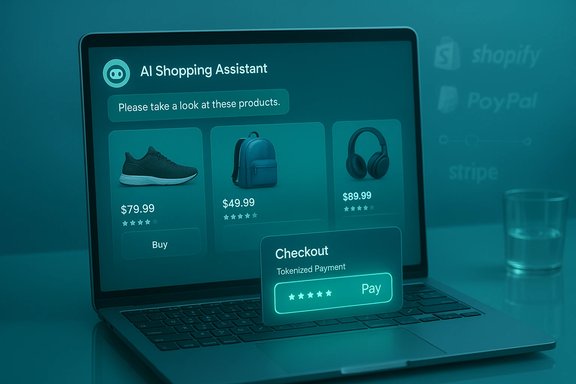
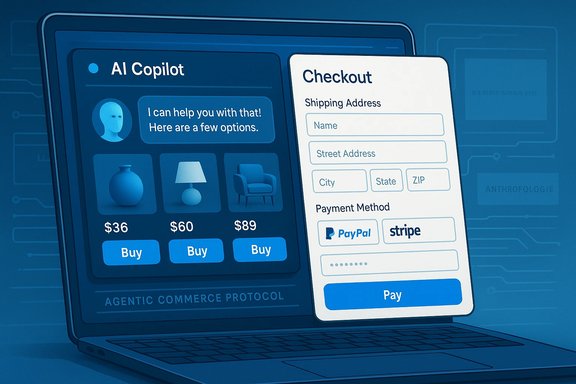
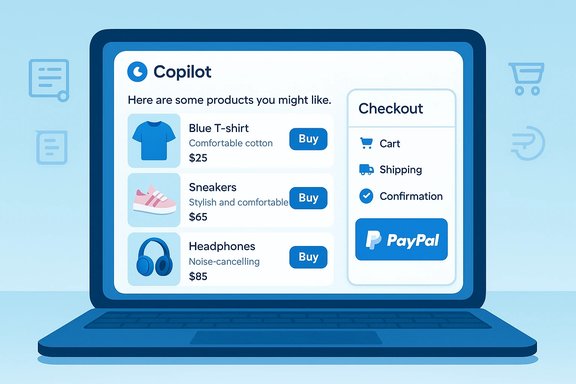
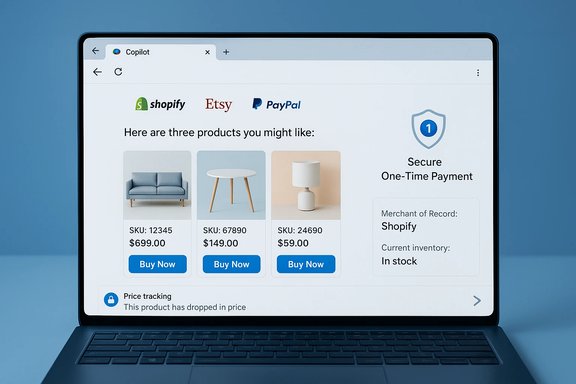
E‑commerce product page on a laptop showing three items, brand logos, and a Secure One-Time Payment badge.Background / Overview​

The move marks another decisive step in the industry shift from “links to actions”: rather than finishing a shopping conversation with a link to a merchant page, Copilot can now surface product choices and complete a checkout inside the chat or Copilot app itself. Microsoft positions this capability as Copilot Checkout—a friction-reducing feature that stitches together product discovery, price-tracking, merchant checkout rails and tokenized payments so users can confirm orders without being redirected to traditional storefront pages.
This rollout follows a wave of similar agentic commerce initiatives launched across the ecosystem over the past year, where platforms and commerce providers introduced machine-readable product feeds, delegated-payment primitives and standardized agent-to-merchant protocols. The core technical primitives—structured catalog metadata, ephemeral tokenized payments, and an orchestration/runtime layer that manages multi-step agent flows—are now in active deployment across multiple vendors. Microsoft’s Copilot Checkout leverages those same primitives while relying on partnerships with Shopify, PayPal, Etsy and payments partners such as Stripe to route payments and keep merchants responsible for fulfillment and returns.
The promise is tangible: faster conversions, fewer tabs, and a more personal “concierge” experience inside a tool many people already use for answers. But the emergence of agentic checkout also raises immediate questions about privacy, merchant control, dispute handling, discoverability, and platform economics. This feature is as much a technical integration challenge as it is a strategic shift in where control and value accrue in the shopping stack.

How Copilot Checkout works — a technical walkthrough​

The agentic stack in plain terms​

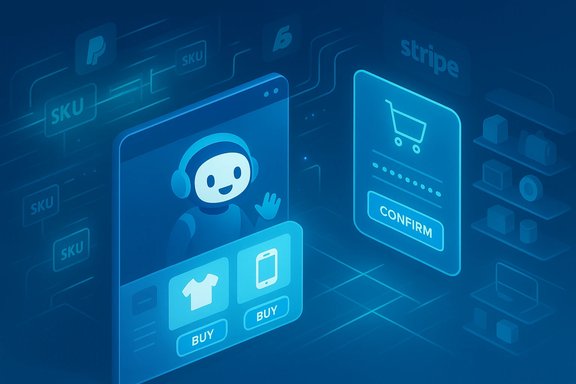
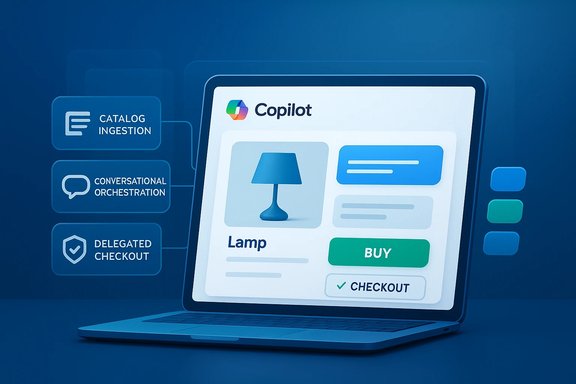
At a high level, Copilot Checkout implements three coordinated layers:
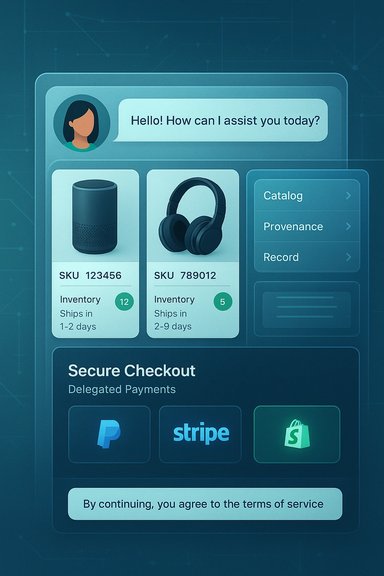
  • Discovery & product feed ingestion — Merchants (via Shopify or other platforms) publish machine-readable catalog data: SKUs, variants, GTINs, images, descriptions, inventory and shipping windows. Agents query these canonical records rather than scraping HTML product pages, which reduces hallucination risk and keeps responses grounded in merchant-provided data.
  • Agent orchestration & conversational flow — The Copilot runtime parses natural-language shopper intent, asks clarifying questions when needed (size, color, delivery window), and presents a short list of vetted options. It maintains provenance—tracking which product records produced each suggestion—so actions can be tied back to auditable orders.
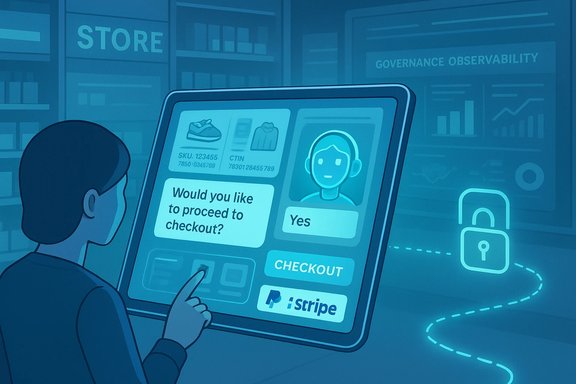
  • Tokenized / delegated checkout — When the user confirms a purchase, the assistant requests a secure, short-lived checkout session or payment token that hands the transaction back to the merchant’s checkout system. The merchant remains the merchant of record; fulfillment, returns and customer service stay with them.

Key technical pieces​

  • Machine-readable product metadata: This is the foundation. Agents rely on structured feeds (Shopify Catalog or similar) so queries like “best cordless drill under $100” return verifiable SKUs with up‑to‑date inventory and shipping metadata.
  • Checkout token: Instead of exposing raw payment instruments to the agent, the platform exchanges ephemeral credentials or a delegated payment token that authorizes a single transaction or session. This reduces direct exposure of card data to the assistant and gives a clear audit trail.
  • Provenance & observability: Every step—from the query that discovered an item, to the agent’s reasoning and the checkout token—must be logged and associated with the resulting order to support disputes, refunds and regulatory requirements.

Where the plumbing comes from​

Implementations of agentic commerce increasingly follow a standard pattern: platforms offer a catalog API or feed, payment partners support delegated/tokenized rails, and assistants expose a checkout affordance inside the conversation. Microsoft has bundled these pieces into Copilot Checkout, enabling merchants on Shopify (with opt-in/opt-out choices) and sellers on Etsy to be discoverable and shoppable within Copilot.

The merchant side: benefits and trade-offs​

Benefits for merchants​

  • New distribution channel: Agentic surfaces turn every conversational touchpoint into a potential storefront. Merchants who adopt machine-readable catalogs can appear inside assistant results without building bespoke integrations for each AI platform.
  • Higher conversion potential: By shortening the funnel from discovery to checkout, assistants often lift conversion rates—users who ask and immediately confirm are less likely to abandon.
  • Retention of merchant-of-record status: The architecture routes orders back to merchant checkout rails, preserving control over fulfillment and customer records.

Practical onboarding mechanics​

  • Shopify merchants are being enrolled by default after an opt-out window; merchants can also explicitly configure which AI platforms may surface their products and what storefront policies are shared with agents.
  • Sellers on marketplaces like Etsy may be included through marketplace-level integrations that expose listings for discovery inside the assistant.
  • Payment partners (Stripe, PayPal) provide the tokenized rails that let agents initiate purchases without storing raw card details.

Trade-offs and risks for merchants​

  • Discovery opacity: Platforms can control ranking and prominence inside assistant responses. That creates a new optimization problem—what some call Answer Engine Optimization—where merchants must tune metadata and policies to appear in conversational results.
  • Dependency on platform rules and fees: Even if the merchant remains the merchant of record, platform-level rules and potential fees for in-chat purchases introduce new commercial dynamics that can be hard to predict.
  • Operational friction if data hygiene is poor: Agentic checkout depends on clean catalogs and accurate inventory signals; stale data can cause order failures, disputes and chargebacks, putting vendor reputation at risk.

The consumer experience: convenience with caveats​

What users gain​

  • Convenience & speed: The most obvious benefit is reducing context switches—no need to open multiple tabs, compare carts, or re-enter shipping details across sites.
  • Guided buying: Copilot can ask intelligent clarifying questions—filter by dimensions, materials, or shipping urgency—and present curated options so decisions are easier.
  • Integrated price tracking & rewards: Copilot also bundles helpful features such as price tracking notifications and cashback offers routed through payment partners, providing real monetary benefits if everything works as advertised.

What users should watch for​

  • Data used for personalization & advertising: The experience improves when Copilot has access to browsing context, purchase history or account signals. That same data can be used for personalization and may feed into advertising or measurement products unless consumers adjust privacy settings.
  • Consent and opt-in: Many features require explicit opt-in for Copilot to read tab context, stored credentials or purchase history. Responsible defaults and clear consent flows are essential for trust.
  • Dispute resolution complexity: Although merchants are the merchant of record, the addition of an assistant orchestrating checkout adds an intermediary layer that complicates dispute narratives—users should check how refunds, buyer protections and dispute handling are documented for in-chat purchases.

Privacy, security and compliance concerns​

Privacy trade-offs​

Agentic checkout accumulates a concentrated dataset: queries, intent signals, chosen products, and transaction provenance tied to accounts. That dataset is extremely valuable for personalization and advertising, but also raises risk if used without clear boundaries.
  • Platforms must make it explicit what data powers personalization and what is used for advertising.
  • Users should expect to manage settings across devices and browsers to fully opt out of tracking, since cookie clearing or device-limited preferences may not be enough to revoke all signals.

Payment security & fraud mitigation​

Tokenized checkout substantially reduces exposure of raw card data to assistants, which is a meaningful security improvement. But tokens introduce other requirements:
  • Tokens must be short-lived and scoped.
  • There must be auditable logs tying token issuance to the confirming user intent.
  • Payment and fraud systems must adapt to agent-originated flows and new claims patterns.
Failure to instrument these systems correctly could create new vectors for fraud or dispute escalation.

Regulatory and consumer protection questions​

  • Disclosure and transparency: Agents must state when recommendations are influenced by commercial relationships, platform placement or sponsored content.
  • Data portability and retention: Consumers and regulators will press platforms for clarity on how long conversational logs are retained and how they can be exported or deleted.
  • Antitrust scrutiny: When large OS/platform owners convert conversations into commerce and control discoverability, regulators may examine whether those platforms unfairly advantage their own services or partners.

Business implications — who wins, who risks losing​

Platform plays​

Platforms such as Microsoft, OpenAI and Google are racing to capture the “last inch” of shopping: the moment of purchase. Owning that surface confers several strategic benefits:
  • New monetization: Platforms can monetize discovery, placement, or checkout convenience—either through fees, revenue share, or offer-placement economics.
  • Sticky experiences: The more users complete high-frequency actions like shopping inside an assistant, the more integrated the assistant becomes in daily life.
  • Data advantage: Transactions provide feedback loops that improve personalization and agent accuracy.

Merchants and commerce platforms​

Commerce platforms (Shopify, Etsy) benefit by syndicating catalogs widely, converting their long tail of merchants into discoverable feeds that drive demand. However, merchants face increased dependency on platform policies and must invest in catalog hygiene and fulfillment reliability.

Payments industry​

Payments firms that supply tokenization and dispute tools (Stripe, PayPal) play a vital role and stand to monetize new payment flows. They also absorb operational risk for disputes initiated in conversational contexts and must upgrade tooling accordingly.

Competitive dynamics​

These integrations do not occur in a vacuum. ChatGPT’s Instant Checkout, Google’s shopping agents and other entrants already push the market toward in-chat commerce. Microsoft’s Copilot strategy differentiates itself through deep OS and browser integration (Edge + Windows account signals) and enterprise-forward governance features—advantages that may tilt adoption among users who trust Microsoft’s ecosystem.

Comparing the approaches: Microsoft vs. other assistants​

Microsoft’s approach emphasizes merchant-of-record continuity and integration with large commerce platforms like Shopify and marketplaces like Etsy, while also relying on established payments partners to provide secure tokenized checkout. Other assistants (for example, ChatGPT’s Instant Checkout) have taken earlier steps toward in-chat purchases, but platforms differ in rollout strategy, fees, and where they place merchant control.
Key distinctions to watch:
  • Enrollment model: Shopify merchants may be auto-enrolled with opt-out windows, while other platforms might require explicit opt-in.
  • Fee and revenue model: Platforms can charge merchants for in-chat transactions, keep affiliates, or maintain neutral search-style treatment.
  • Privacy and governance: Microsoft’s enterprise and account-level governance controls may appeal to privacy-minded users and organizations, but cross-device opt-out complexity remains a practical issue.

Practical guidance and takeaways for Windows and Edge users​

  • Review Copilot privacy settings: Understand and configure what Copilot can read—open tabs, browsing history, or stored payment and shipping information—before enabling in-chat checkout features.
  • Merchants: audit catalog hygiene: Ensure SKUs, images, variant information, shipping windows and return policies are accurate and machine-readable to prevent order errors once agentic discovery surfaces your products.
  • Users: know buyer protections: Verify whether purchases completed inside Copilot provide the same dispute and buyer protection guarantees you expect from the merchant or payment provider.
  • Security hygiene: Use payment methods with buyer protections (PayPal or card networks that support dispute resolution) and monitor statements for unfamiliar charges when using new in-chat checkout paths.

Risks and unanswered operational questions​

  • Attribution and discoverability algorithms: Merchants must be prepared for a world where appearing in an assistant’s top result matters. The criteria for ranking inside a conversational result—relevance, price, merchant agreements—are opaque and likely to evolve.
  • Operational fallbacks: How does the assistant handle partial failures—out-of-stock items, token expiration, or mismatch between cart and fulfillment? Robust fallbacks and clear user-facing messaging are essential to avoid negative experiences.
  • Cross-border and tax compliance: In-chat orders that span jurisdictions introduce complexities in tax calculation, duties and regulatory compliance that need merchant and platform coordination.
  • Long-term competition and market power: Platforms that tie an assistant closely to an OS or browser may have structural advantages that attract merchants and reduce the viability of independent discovery channels.
Where claims are company‑reported or early-stage—such as usage numbers, growth multipliers, or near-term merchant rollout schedules—they should be treated as directional and subject to later validation as broader adoption data becomes available.

Strategic verdict — what this means for Windows users, merchants, and the web​

Copilot Checkout is a natural next step in the evolution of commerce on the internet: it closes the loop between conversational discovery and transaction completion. For consumers, the upside is clear—less friction, faster purchases, and potentially better personalization. For commerce platforms and payment providers, agentic commerce opens new monetization and distribution channels.
Yet the change is not only technical; it's strategic. The platform that hosts the shopping surface gains disproportionate influence: it shapes discoverability, defines dispute narratives, and controls the new measurement primitives that will guide merchants’ optimization strategies. That concentration of influence invites scrutiny from merchants, consumers and regulators alike.
The net outcome will depend on execution: do platforms implement robust privacy defaults, transparent ranking rules, auditable provenance of agent actions and reliable tokenized payment flows? Or will convenience outpace governance, creating friction for consumers and burdens for merchants? The answer will determine whether copilot-driven checkout becomes a durable convenience or another battleground in the debate over platform power and user agency.

Conclusion​

Turning conversations into purchases is now a production capability, and Microsoft’s Copilot Checkout—backed by integrations with Shopify, PayPal and marketplaces like Etsy—concretely demonstrates the commerce future many companies have been designing toward: agentic commerce, where discovery, personalization and checkout are woven into the fabric of the conversational assistant.
Adoption will hinge on the small, operational details: accurate product feeds, scoped payment tokens, clear provenance and dispute pathways, and transparent opt-in controls. When those pieces work together, users gain a faster, smarter shopping experience; when they fail, the consequences will be customer confusion, merchant headaches and regulator attention.
For Windows and Edge users, the new experience is compelling but not frictionless—review privacy settings, understand buyer protections, and expect the ecosystem to iterate quickly. For merchants, the message is simple: investing in clean, machine‑readable product data and reliable fulfillment is no longer optional; it is a prerequisite to appearing and competing inside the assistants users increasingly trust.
The next year will be decisive. If platforms pair convenience with clear governance and robust merchant tooling, agentic checkout could become a mainstream, secure way to shop. If not, it will be a cautionary tale about speed without sufficient safeguards.

Source: Axios Microsoft turns Copilot chats into a checkout lane with Shopify, PayPal and Etsy
 

Microsoft says it has delivered the next big push in retail automation — a suite of “agentic” AI capabilities that stitch conversational copilots, catalog intelligence, checkout flows and store‑operations automation into a single, enterprise‑grade playbook for modern retailers. The company’s January announcement frames the move as a shift from isolated point solutions to an intelligence layer that can both advise and act across merchandising, marketing, store operations and fulfillment — with immediate fixtures such as Copilot Checkout, Brand Agents, catalog‑enrichment templates and store‑operations agent templates intended for rapid retailer adoption.

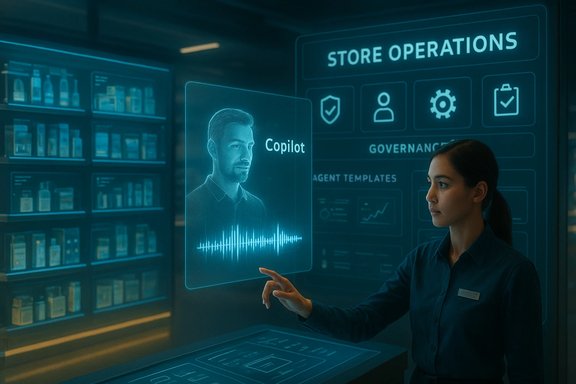
A woman uses a holographic Copilot display in a futuristic store operations room.Background / Overview​

Microsoft has been public about building a layered AI stack for enterprise customers throughout 2024–2025. That foundation includes Copilot Studio for building copilots, Azure AI Foundry (also described in Microsoft messaging as a Foundry/Agent Factory) for agent orchestration and governance, and a collection of templates and connectors for the retail sector. The vendor positions these components as prebuilt primitives that reduce integration work for retailers while providing governance, identity and observability features required at scale. The January PR summarizes Microsoft’s retail offering as “agentic AI” — meaning systems that can take multi‑step, context‑aware actions (not just recommend) and escalate to humans when necessary. Practical examples in the announcement include:
  • Copilot Checkout: a conversational checkout that completes purchases inside Copilot without redirecting shoppers off‑site.
  • Brand Agents and personalized shopping agent templates: tools for embedding a brand’s voice and catalog into conversational surfaces.
  • Catalog enrichment and store operations agent templates: automated workflows to extract product attributes from images, enrich catalogs, and provide store associates with real‑time operational guidance.
Independent reporting and Microsoft’s own industry blog posts make the same technical claims: that agentic agents are already being used in pilot programs, that Copilot Studio and Azure AI Foundry supply orchestrator and safety primitives, and that Microsoft is demonstrating these capabilities at retail industry events. These claims track with reporting from trade outlets and Microsoft’s case references in 2025.

What Microsoft actually announced (the specifics)​

Copilot Checkout — checkout inside the assistant​

Microsoft’s PR introduces Copilot Checkout, a capability that allows merchants to let shoppers finalize purchases inside the Copilot conversational surface without being redirected to an external website. The company says merchants remain the merchant of record, and early partners named include PayPal, Shopify and Stripe, with participating merchants like Urban Outfitters, Anthropologie, Ashley Furniture and Etsy sellers highlighted in the announcement. Microsoft positions Copilot Checkout as available in the U.S. on Copilot.com. Verification and context:
  • Microsoft’s own release lists third‑party payment and platform partners and indicates U.S. availability. This is a vendor statement and therefore verifiable by checking the Copilot commerce experience directly or merchant integrations as they go live. Independent reporting from industry outlets confirmed that Microsoft showcased new commerce templates and direct‑checkout ambitions at NRF‑season events.

Brand Agents and Personalized Shopping Agents​

Two main developer/merchant tools were announced:
  • Brand Agents — a turnkey way for brands to “bring their authentic voice” into digital interactions by training an agent on a product catalog and brand guidance. Reported as ready for Shopify merchants.
  • Personalized shopping agent template in Copilot Studio — a customizable template for deeper product discovery, outfit building and real‑time, cross‑channel recommendations.
These templates are designed to reduce the time to market and standardize behavior across channel surfaces (web, mobile, in‑store).

Catalog enrichment and store operations templates​

Microsoft debuted a catalog enrichment agent in public preview that extracts product attributes (including from images), augments items with social insights, and automates catalog tasks such as categorization and error resolution. A store operations agent template is also public previewed, targeted at frontline staff for instant answers on inventory, policies and next‑best actions. Both use the same multi‑agent patterns Microsoft has been developing with Copilot Studio and Azure AI Foundry.

Platform and governance primitives​

Microsoft stresses enterprise‑grade governance: identity for agents, content safety controls, observability and AgentOps tooling intended to prevent runaway automation or ungoverned agent actions. The vendor’s blog posts show this as part of a broader “agent factory” narrative — treating agents as manageable, auditable artifacts. These governance and identity claims correspond to product features Microsoft has publicized throughout 2024–2025.

Why this matters: retail at the center of agentic AI adoption​

Agentic AI maps naturally onto retail problems because stores and e‑commerce produce high volumes of repetitive queries, orchestration tasks and time‑sensitive events. Automating tasks like inventory lookups, returns processing, personalized recommendations and checkout flows is both high‑value and operationally feasible.
Key business reasons Microsoft and retailers are converging:
  • Retail has rich, structured product and transactional data, which is precise input for agents (reducing hallucination risk when properly integrated).
  • Frontline productivity gains are immediate: fewer tool switches, faster answers for associates and lower average handle times for routine tasks.
  • Commerce revenue capture: embedding checkout in conversational surfaces reduces friction and increases conversion opportunities at the exact moment of intent. Microsoft cites Adobe data showing a large surge in AI‑driven retail traffic during the 2025 holiday season to underscore the urgency.
Independent industry surveys suggest many retailers are already piloting agentic systems for efficiency gains, but full, mature deployment remains rare — a point that tempers hype. Recent analyst reporting shows high pilot rates (~70% piloted or partially implemented) but low rates of fully mature deployments (single‑digit percentages), highlighting the gap between experimentation and scaled production.

Technical verification: which components are real today?​

Microsoft’s announcement builds on several product lines that are publicly documented:
  • Copilot Studio: an authoring and deployment environment for creating copilots and multi‑agent workflows; Microsoft documents several prebuilt templates and connectors aimed at retail and other verticals. Microsoft claims Copilot Studio is used broadly by organizations.
  • Azure AI Foundry (also referenced as Microsoft Foundry or Agent Factory): a service family for model catalogs, observability, agent orchestration, and security primitives. Microsoft has published developer guidance and blog posts about agent orchestration and the Agent Service.
  • Identity and governance: Microsoft describes Agent IDs (Entra) and content safety policies as part of the enterprise controls for agentic systems. These features are reflected in product documentation and Microsoft’s public blog posts.
Cross‑referenced verification:
  • The PR announcing retail capabilities lists templates, partners and availability (Copilot Checkout in the U.S.. That PR is Microsoft’s official statement of product intent and availability.
  • Microsoft’s industry blogs and technical posts from 2024–2025 document the same building blocks — Copilot Studio, agent orchestration, and Foundry/Agent Service — in technical and product terms. Those posts confirm the underlying product primitives.
  • Independent trade reporting during NRF‑period coverage corroborates that Microsoft publicly showcased commerce and checkout demos tied to Copilot at industry events and characterized Copilot as an expanding commerce surface.
These three lines of evidence — vendor PR, vendor technical blogs, and independent news coverage — together provide a convergent signal that the products exist in shipping or preview form and that Microsoft is actively piloting commerce and store operations integrations.

Strengths: what Microsoft brings to retail​

  • Platform breadth and integration: Microsoft combines desktop productivity (Microsoft 365), collaboration (Teams), cloud scale (Azure), developer tooling (GitHub Copilot) and device hardware (Surface) — a broad stack that can reduce integration friction for enterprises that already run Microsoft services. This makes end‑to‑end scenarios easier to implement.
  • Prebuilt templates and connectors: Brand Agents, catalog enrichment and store operations agent templates reduce time to value by codifying best practices and connectors to common e‑commerce platforms (Shopify was explicitly called out). Reducing custom engineering scope is important for faster adoption.
  • Merchant revenue assurances: Copilot Checkout is described as keeping the merchant of record intact, which matters for brand trust, fraud controls and revenue accounting. That posture lowers adoption friction versus models that divert traffic entirely to third‑party marketplaces.
  • Governance and AgentOps emphasis: Microsoft’s messaging stresses agent identity, observability and governance — recognition that agentic systems require operational disciplines. For large retailers, having vendor‑supplied governance primitives is a practical advantage.

Risks and open questions​

Agentic systems are powerful — but they create new operational failure modes and governance demands. The following risks deserve careful attention:
  • Hallucinations and incorrect actions: Even when agents are grounded with catalog and inventory APIs, agents that mix retrieval and generative responses can still produce incorrect or misleading outputs. Retail has low tolerance for mistakes that affect pricing, inventory or returns processing. Microsoft’s templates are a helpful start, but operational guards, human‑in‑the‑loop gates and continuous testing are still necessary.
  • Integration complexity at scale: Real retailers run a stack of bespoke ERPs, POS systems, third‑party marketplaces and legacy inventory systems. Packaging connectors for a few mainstream platforms does not eliminate deep integration work when custom legacy systems are involved. Retailers should budget for significant engineering to ensure data correctness and latency SLAs.
  • Privacy and consent: Personalization and “memories” for shopping agents can drive conversion but also raise customer privacy questions. Data minimization, consent flows and audit trails must be engineered for customer trust and regulatory compliance. Microsoft highlights content safety and governance tools, but retailers remain responsible for how those tools are used.
  • Vendor lock‑in and portability: If an enterprise builds many agentic workflows tightly coupled to Microsoft Foundry and Copilot Studio, migrating away — or adopting a multi‑vendor agent ecosystem — could be costly. Contracts, portability guarantees and data export mechanisms should be reviewed.
  • Economic realism: Pilot enthusiasm does not guarantee durable ROI. Many retailers report successful pilots (reduced handle times, higher conversions) but few have declared fully matured, enterprise‑wide agentic deployments. Independent surveys show widespread piloting but limited mature deployments; expectations must be tempered and measured with clear KPIs.

Practical guidance for retailers evaluating agentic AI​

  • Establish an AI Center of Excellence (CoE) and define AgentOps processes before wide deployment.
  • Start with high‑value, low‑risk pilots: internal employee copilots (store operations, HR) usually present lower reputational risk than customer‑facing autonomous purchase flows.
  • Ground agents on canonical sources of truth: integrate directly with inventory APIs, pricing services and order management systems to reduce hallucination risk.
  • Define human escalation paths and hard stops for any action that changes financial or inventory state.
  • Negotiate portability and data access in procurement documents so agent workflows and data remain auditable and exportable.
  • Measure and report: track conversion lift, average handling time, escalation rates and error rates. Use these KPIs to gate expansion.

Case snapshots and corroborating examples​

  • Levi Strauss & Co. announced a high‑profile Microsoft collaboration in late 2025 to build an Azure‑native Teams‑embedded “superagent” for operations, using Copilot Studio and Foundry primitives to orchestrate subagents for HR, IT, stores and more. Public reporting corroborates that Levi’s pilot included a holiday season store rollout plan and emphasized frontline productivity improvements. This is an example of the enterprise‑scale use case Microsoft’s templates enable.
  • Large retailers and partners (Coles in Australia, Phygrid partnerships, and other retail modernizations) have been cited in Microsoft industry narratives as early pilots of agentic retail features. These examples show both internal operations and customer‑facing experiments.
  • Independent coverage around NRF‑time indicates Microsoft demonstrated commerce and checkout demos and emphasized Copilot as an expanding commerce surface; reporters framed the move as part of a broader industry race to make AI assistants the front door for purchasing.

Conclusion — what retailers and Windows-focused IT teams should take away​

Microsoft’s retail announcement crystallizes a clear vendor strategy: make agentic AI a first‑class enterprise capability by packaging authoring tools (Copilot Studio), orchestration and governance (Azure AI Foundry/Agent Service), and prebuilt retail templates that accelerate time‑to‑value. For retailers already invested in the Microsoft ecosystem, this reduces friction and gives a credible path to agentic automation. However, adoption will be won by careful operational discipline, not product buzz. Retail IT leaders should treat agentic projects as engineering and operational transformations: invest in AgentOps, human‑in‑the‑loop controls, thorough testing against live catalogs, and explicit KPIs for customer trust and financial accuracy. Independent surveys show many organizations are piloting agentic AI, but only a few have reached mature, scalable deployments — a gap that highlights governance and integration as the real barriers to scaling beyond pilots. Finally, while Microsoft’s retail templates and Copilot Checkout lower barriers for experimentation, every retailer must verify partner integrations, contractual terms (merchant of record and payment flows), data portability and compliance obligations before entrusting mission‑critical commerce flows to automated agents. Where vendors provide governance primitives, success will depend on the retailer’s operational rigor in using them.
Microsoft’s announcement marks a credible and practical step toward agentic retail — a future where conversational agents not only advise shoppers but also act on behalf of brands and associates. The outcome will hinge on engineering discipline, governance maturity and careful economics; retailers that blend ambition with prudence will likely capture the early advantages.

Source: WV News Microsoft propels retail forward with agentic AI capabilities that power intelligent automation for every retail function
 

Microsoft has unveiled a sweeping set of retail-focused AI agents, templates, and checkout services that fold conversational commerce, catalog automation, and store operations into the Copilot ecosystem — starting with a U.S. rollout of Copilot Checkout and new Copilot Studio templates for Brand Agents, personalized shopping, and catalog enrichment.

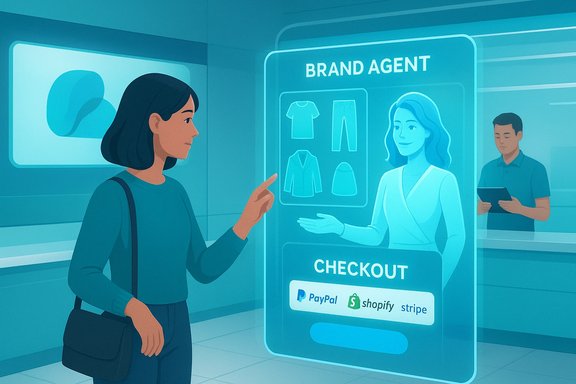
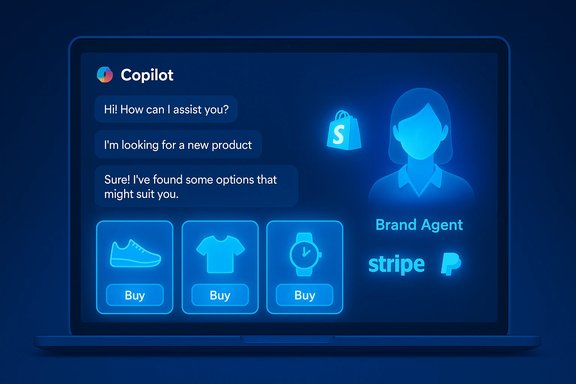
A shopper interacts with a holographic Brand Agent checkout showing clothes and payment options.Overview​

Microsoft’s announcement — timed ahead of NRF 2026 — positions the company to push “agentic commerce” directly into merchant storefronts and conversational surfaces. The move stitches together payments partners (Shopify, PayPal, Stripe), merchant catalog enrichment tools, and no-code/low-code agent templates inside Copilot Studio so brands and retailers can deploy conversational shopping experiences and operational assistants rapidly. At its core, the offering is threefold:
  • A conversational checkout flow called Copilot Checkout that completes purchases without redirecting buyers away from Copilot conversations.
  • Agent templates in Copilot Studio — including Brand Agents, a personalized shopping agent template, and a catalog enrichment agent template — for building branded shopping assistants and automating catalog tasks.
  • Partnerships and onboarding mechanics that connect merchant platforms and payment providers so sellers remain the merchant of record while third parties handle payment processing.
This article breaks down what these changes mean for retailers, platforms, payments, and shoppers — balanced with critical analysis of benefits, risks, and implementation realities.

Background: Why agentic commerce now?​

The retail industry has been moving quickly toward AI-driven discovery and checkout. Retailers and platforms have deployed LLM-driven experiences, and payments firms have begun opening protocols for chat-native purchases. Recent industry data cited by Microsoft — specifically, a large jump in AI-driven ecommerce traffic over the 2025 holiday season — is being used to argue that discovery-to-conversion moments are now critical battlegrounds. Key industry dynamics fueling the launch:
  • Consumer behavior: shoppers increasingly accept conversational and recommendation-driven discovery.
  • Platform competition: OpenAI, Stripe, and other major players have already demonstrated chat-native checkout models; Microsoft’s announcement is both complementary and competitive.
  • Merchant pain points: product onboarding, catalog accuracy, returns, and understaffed stores remain stubborn operational challenges — precisely the areas Microsoft targets with catalog enrichment and store operations agent templates.
Microsoft’s approach emphasizes integration into existing merchant relationships (Shopify, PayPal, Stripe) rather than supplanting merchant systems, asserting that merchants remain the merchant of record while agents and payment partners manage the transaction plumbing.

What is Copilot Checkout and how does it work?​

The marketing claim​

Microsoft describes Copilot Checkout as a way to “turn conversations into conversions — instantly,” enabling buyers to purchase discovered items inside Copilot without being redirected to external merchant pages. The company says Copilot Checkout is available now in the U.S. via Copilot.com and that participating payment partners include Shopify, PayPal, and Stripe.

Mechanics (as described)​

  • The buyer interacts with a Copilot shopping experience (brand agent or discovery flow).
  • When ready, the buyer completes payment within Copilot’s interface through an integration with PayPal, Shopify’s checkout infrastructure, or Stripe. Microsoft stresses the merchant remains the merchant of record.
  • Merchants on Shopify will be auto-enrolled after an opt-out period, while PayPal- or Stripe-connected merchants must apply to onboard. Microsoft lists participating retailers (Urban Outfitters, Anthropologie, Ashley Furniture) and Etsy sellers as initial examples.

How this compares to other chat-native checkouts​

OpenAI’s Instant Checkout and Stripe’s previous integrations showed the feasibility of single-item purchases inside chat interfaces; Microsoft’s Copilot Checkout follows the same trend but ties the capability to its Copilot and Copilot Studio ecosystem and emphasizes merchant-of-record preservation. These parallels indicate a market moving toward multiple, interoperable agentic checkout experiences.

Caveat and verification​

Microsoft’s description is marketing-forward. Implementation details that affect merchants — fees, dispute handling, fraud liability boundaries, exact enrollment windows, and regional availability beyond the U.S. — are specified only at a high level in the announcement. Those details warrant scrutiny during any merchant onboarding decision.

Copilot Studio: Templates that matter for retail​

Microsoft is shipping several Copilot Studio templates aimed at retailers. The ones highlighted are Brand Agents, a personalized shopping agent template, and a catalog enrichment agent template (public preview). Each targets specific retail needs:

Brand Agents (Shopify)​

Brand Agents are turnkey conversational agents trained on a brand’s product catalog to answer product questions, provide brand-aligned responses, and guide shoppers across discovery and purchase flows. Microsoft says Brand Agents are available for merchants on Shopify with minimal setup required. Benefits for merchants:
  • Faster time-to-deploy than building a custom LLM solution.
  • Brand voice consistency by training on a brand’s catalog and content.
  • Direct on-site deployment on web and mobile experiences integrated with Shopify.

Personalized shopping agent template​

This template offers a flexible framework for creating deeper, tailored shopping experiences: real-time product discovery, outfit building, and cross-channel recommendations (web, mobile, in-store). Microsoft positions it as a starting point for retailers that want more control than the turnkey Brand Agent.

Catalog enrichment agent template (public preview)​

This template automates extraction of product attributes from images, enhances listings with social insights, and performs tasks like product onboarding, categorization, and error resolution. The promise is to transform messy product data into structured metadata that improves search, recommendation, and personalization. Microsoft has promoted it as a foundational component for agentic commerce.

Store operations agent template​

Announced as another public preview, the store operations agent provides a natural language interface for store associates and managers: inventory lookups, policy guidance, staffing recommendations, and exception handling informed by internal and external signals like sales trends and local events. It’s aimed at improving productivity and decision-making at the store level.

Ecosystem partners and the merchant experience​

Microsoft’s announcement leans on a partner model rather than a closed system. Key partner points:
  • Shopify: Microsoft says Shopify merchants will be automatically enrolled in Copilot Checkout after an opt-out window; Shopify’s product leaders are quoted supporting the integration. This auto-enroll decision is material for merchants because it affects exposure and defaults.
  • PayPal and Stripe: Both are listed as trusted payment partners for Copilot Checkout. Merchants using PayPal or Stripe are invited to apply to onboard, per Microsoft. Separate vendor announcements (PayPal’s agentic commerce services, Stripe’s prior work on agentic commerce protocols) show payment providers actively building the plumbing for chat-native purchases.
  • Etsy: Microsoft highlights that Etsy will bring its inventory to Copilot Checkout; Etsy leadership is quoted as supportive of the opportunity for sellers to appear on new surfaces.
Operationally, the announcement suggests:
  • Merchants remain the merchant of record (important for tax, compliance, and customer relationship).
  • Payment processing, fraud detection, and buyer protections are handled by the payment partners (details to be clarified by partner agreements).

Benefits for retailers and shoppers​

For merchants​

  • Faster conversion: Conversational checkout removes friction by keeping the buyer in the same interface during purchase. Microsoft claims this shortens time-to-conversion.
  • Catalog automation: The catalog enrichment template reduces manual work around product onboarding and classification, which can free teams to focus on merchandising rather than data cleanup.
  • Brand control: Brand Agents are intentionally trained on each merchant’s catalog, enabling more consistent brand voice in AI-driven interactions.

For shoppers​

  • Seamless flow: Buying without redirection reduces friction and cognitive load during checkout.
  • Personalization: Shopping agents that suggest outfits, complete looks, or recommend alternatives can increase shopper confidence and reduce search time.

Risks, unknowns, and operational caveats​

Microsoft’s announcement is ambitious, but the real-world impact depends on implementation details and merchant oversight. Key concerns:

Data governance and privacy​

AI agents trained on product catalogs and potentially on customer interaction data raise questions about what data is stored, how it’s used to fine-tune models, and whether third parties (partners, underlying LLM providers) gain access to merchant or customer data. The announcement stresses enterprise integration and responsible AI, but exact data flows and retention policies are not fully enumerated in the marketing release. Merchants should demand clear contractual terms.

Fraud, disputes, and buyer protection​

Microsoft states the merchant remains the merchant of record while PayPal, Shopify, and Stripe handle payments. The division of responsibilities in chargebacks, fraud detection, and dispute resolution matters greatly for merchants' risk exposure. Public announcements reference partner roles, but specific liability boundaries and cost structures are not detailed and will vary by partner. Merchants should verify terms directly with each payment provider.

Merchant fees and commercial terms​

Microsoft’s PR does not disclose fee structures for Copilot Checkout versus existing checkout solutions, nor any revenue share that might apply to conversational commerce surfaces. Past experiences with platform-driven discovery indicate fees or revenue-sharing can vary widely; merchants should assess margin impact. Where similar services (OpenAI’s Instant Checkout) imposed fees for completed purchases, the commercial model can materially affect merchant economics.

Experience quality and returns​

Conversational purchases that accelerate checkout also risk buyers making impulse purchases or buying mismatched items, potentially increasing return rates. While personalized agents may reduce returns by offering better guidance, poor recommendations or catalog errors could have the opposite effect. The effectiveness of Microsoft’s catalog enrichment and recommendation models will be a major determinant of outcomes.

Dependency and vendor lock-in​

Auto-enrolling Shopify merchants after an opt-out window accelerates adoption but can raise concerns about default behaviors and vendor gateway dependence. Merchants should evaluate fallback options and data portability for agent models and enriched catalog data.

Regulatory and competition scrutiny​

Large platform-driven shifts in commerce often draw regulatory attention — from payment routing and platform commissions to data sharing and antitrust. Any cross-surface commerce standardization (e.g., open protocols) helps interoperability, but centralized control of agentic experiences by a few big players could invite scrutiny. Stripe and others have pursued open protocols in the past to avoid lock-in, but the competitive landscape remains dynamic.

Implementation checklist for retailers​

Merchants evaluating Copilot Checkout and Copilot Studio templates should walk through a pragmatic checklist before adoption:
  • Confirm commercial terms: fees, revenue-sharing, and billing treatment for Copilot-initiated transactions.
  • Review data flow: ask for explicit data maps showing what merchant, product, and customer data is shared, stored, or used to train models.
  • Validate fraud and dispute procedures with chosen payment partners: who handles chargebacks and which protections apply.
  • Pilot Brand Agents or personalized agents on a narrow SKU set to test conversation quality and return rates.
  • Use the catalog enrichment template in a non-production environment to measure lift in search relevance and metadata accuracy.
  • Prepare customer communication: make customers aware of conversational purchase flows and any changes to receipts, order confirmation links, and returns policy handling.
This stepwise approach helps mitigate business risk and establishes measurable success criteria before broad rollouts.

Technical and operational considerations​

Model training and product data​

Brand Agents and personalized shopping agents depend heavily on the quality of product metadata. The catalog enrichment template’s ability to extract attributes from images and social insights is a necessary precondition; otherwise agents will make incorrect recommendations or struggle with natural language queries. Microsoft positions the template as a way to produce structured, searchable data from messy product assets.

Integration paths​

There are three primary integration patterns merchants should prepare for:
  • Platform-native (Shopify Brand Agents and Copilot Checkout via Shopify integration).
  • Payment-partner onboarding (PayPal, Stripe routes for payments and payout management).
  • Custom or headless storefront deployments using Copilot Studio templates connected to merchant APIs and fulfillment systems.

Monitoring and telemetry​

Agentic commerce requires strong monitoring: query success rates, conversation-to-conversion funnels, intent-to-purchase latency, and post-purchase satisfaction metrics (returns, complaints). Copilot Studio and supporting telemetry need to plug into existing analytics and BI systems to measure uplift and identify model drift or catalog errors. Microsoft’s announcement references enterprise integration but details on telemetry APIs and SLAs should be validated in documentation and partner agreements.

Market implications and competitive context​

Microsoft’s push formalizes a broader industry trend: major cloud and AI platforms are moving beyond tools for internal enterprise productivity and into consumer-facing commerce surfaces where discovery, recommendation, and payment converge.
  • OpenAI and Stripe have already shown chat-native checkout models; Microsoft’s Copilot approach brings a rival path tied to its enterprise relationships and Copilot Studio tooling.
  • Payment providers such as PayPal and Stripe have separately announced agentic commerce services or open standards, signaling a multi-vendor effort to define how conversational commerce will transact. Merchant choice and cross-platform interoperability will be a persistent theme.
  • Platforms like Shopify face a balancing act: enabling new discovery surfaces while protecting merchant economics and offering clear opt-in/opt-out controls. The automated-enrollment approach accelerates reach but may prompt merchant pushback if opt-out windows are not clearly communicated.

What to watch next​

Retailers, platform operators, payments teams, and regulators should watch for these near-term signals:
  • Detailed partner agreements and onboarding documentation that clarify fees, liability, and data governance.
  • Results from early pilots (conversion lift, return rates, merchant satisfaction) and merchant testimonials.
  • Expansion beyond the U.S.: Microsoft’s announcement is U.S.-focused for Copilot Checkout; regional rollouts and compliance with local payments and consumer laws will be consequential.
  • How open protocols (if any) develop and whether industry players adopt shared standards to ease merchant onboarding and preserve portability. Stripe’s prior open-protocol work suggests that standardization is possible, but commercial incentives will shape outcomes.

Conclusion: A pragmatic opportunity with strings attached​

Microsoft’s retail announcements mark a significant, practical step toward mainstreaming agentic commerce: a combined product discovery, automated catalog enrichment, and conversational checkout stack that leverages established payment partners and Shopify’s merchant base. For retailers, the promise of faster conversions, improved catalog quality, and better in-store-associate tooling is enticing. However, the business benefits will depend on careful implementation: transparent commercial terms, rigorous data governance, robust fraud and dispute arrangements, and measured pilots that validate the impact on return rates and customer satisfaction. Microsoft’s marketing frames Copilot Checkout and Copilot Studio as turnkey enablers of “agentic storefronts,” but the operational and legal details are what will determine whether agentic commerce becomes a win for merchants, consumers, and the broader retail ecosystem — or a source of new vendor lock-in, unexpected costs, and compliance headaches. Retailers should treat today’s announcements as a practical invitation: pilot strategically, insist on contractual clarity, and measure outcomes empirically before expanding agentic commerce across the business.

Source: MSDynamicsWorld.com Microsoft announces AI agents and templates for retail scenarios
 

Microsoft and PayPal have joined forces to put native payment rails inside Copilot, enabling shoppers to discover, decide, and pay without leaving the Copilot experience — a shift that crystallizes the move from search-and-click to agentic commerce and raises immediate technical, operational, and regulatory questions for merchants and IT teams.

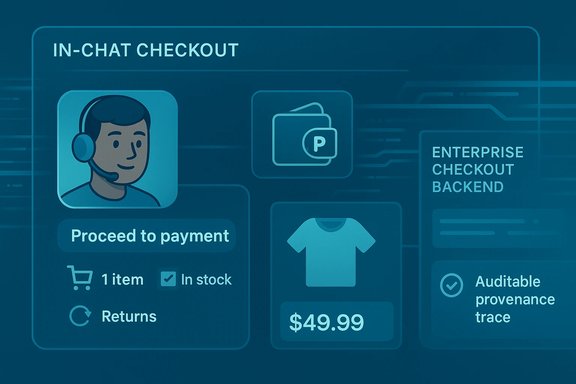
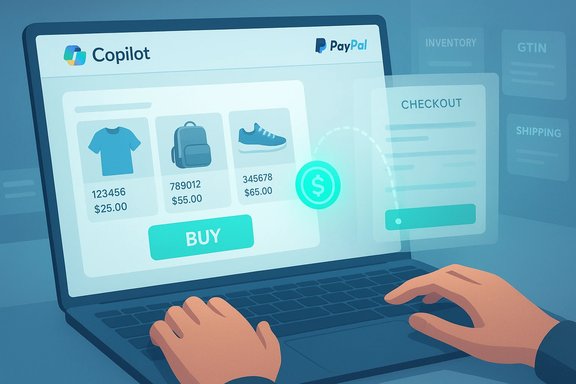
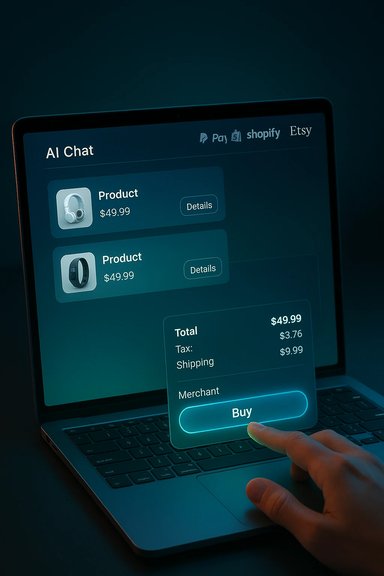
In-chat checkout interface showing an item card, price $49.99, stock/returns, and enterprise backend.Background and overview​

Copilot Checkout is Microsoft’s latest attempt to transform Copilot from a conversational assistant into a transaction-capable platform that closes the loop from discovery to purchase. At launch, Microsoft says Copilot Checkout is available in the U.S. via Copilot.com and will surface merchant inventory and enable purchases directly in the Copilot interface while keeping merchants as the merchant of record. Trusted payment partners at launch include PayPal, Shopify, and Stripe, with Etsy sellers and a set of major retail chains named as early participants. PayPal’s announcement frames its role as the payment and commerce partner that will power inventory surfacing, branded checkout, guest checkout, and credit card acceptance via PayPal’s store sync and its recently publicized agentic commerce services. PayPal also emphasizes buyer and seller protections and says it will extend Copilot Checkout support across Copilot surfaces over time. This partnership is the latest installment in a rapidly evolving ecosystem where platforms (Microsoft, OpenAI, Google) and payments providers (PayPal, Stripe) are building agentic primitives — machine-readable catalogs, delegated/tokenized payment flows, and orchestration layers — that let assistants act on purchasing intent instead of simply returning links. Independent reporting confirms Microsoft rolled the feature out publicly at NRF 2026 and that the broader agentic retail play includes Brand Agents, catalog-enrichment templates, and store-ops agents intended to reduce merchant friction.

What PayPal announced — the essentials​

  • PayPal will power in-Copilot payment processing and surfacing of merchant inventory using its agentic commerce services and store sync.
  • Multiple funding options will be available, including the PayPal wallet, with buyer and seller protections applying to eligible transactions.
  • The integration starts on Copilot.com with plans to expand to other Copilot surfaces and devices.
  • PayPal positions its approach as open and compatible with leading agentic protocols, offering merchants a single integration pathway to multiple AI ecosystems.
These statements mirror Microsoft’s framing that payments partners will enable checkout without redirecting buyers away from Copilot while preserving merchant control for fulfillment and returns. Both vendors position the work as complementary: Microsoft owns the discovery and conversational surface; PayPal and other payment partners provide the delegated payment plumbing.

How Copilot Checkout works — technical anatomy​

At a high level, Copilot Checkout stitches together three core layers: catalog ingestion, conversational orchestration, and delegated checkout.

1) Catalog ingestion and product metadata​

Merchants publish machine-readable product feeds (SKU, GTIN, inventory, images, shipping windows). Agents query these canonical records to avoid hallucinations and present verifiable, up-to-date options to users. Microsoft’s retail tooling includes a catalog enrichment template to automate attribute extraction and metadata normalization.

2) Conversational orchestration (Copilot runtime)​

Copilot interprets shopper intent, asks clarifying questions (size, color, delivery timing), and returns curated, shoppable results in-chat. Provenance and observability are emphasized: the assistant must log which catalog records led to a suggestion to support disputes and audit trails.

3) Delegated / tokenized checkout​

When a buyer confirms a purchase, Copilot requests a short-lived checkout session or a delegated payment token that hands the transaction to the merchant’s checkout system or a payments partner. Tokenization reduces direct exposure of raw card details to the assistant and creates auditable, single-use credentials for the purchase. PayPal’s agentic commerce services — including store sync — handle merchant routing and payment orchestration in PayPal’s description.

Why this matters: reach, friction reduction, and the data shift​

Microsoft and PayPal both make the commercial argument that collapsing discovery and checkout reduces friction, shortens time-to-conversion, and places merchants directly in front of high-intent shoppers inside Copilot. Microsoft’s internal data, cited in vendor materials, reports that Copilot-driven journeys produce 53% more purchases within 30 minutes and, when shopping intent is present, conversion rates can be 194% higher versus journeys without Copilot. These figures have been repeated across coverage and vendor briefings but are labeled as observational, vendor-sourced findings. For merchants, the value propositions are straightforward:
  • New distribution channel inside a conversational surface.
  • Reduced cart abandonment via in-context checkout.
  • Potential for higher average order values through contextual cross-sells and bundling inside conversations.
For PayPal, the deal accelerates a multi-platform payments play that complements other integrations (OpenAI, Google, Perplexity) and positions PayPal as the payments hub for agentic commerce.

Cross-checking the claims: verification and caveats​

Key facts and partner lists in PayPal’s announcement are corroborated by Microsoft’s retail PR and independent coverage from outlets such as GeekWire and Axios. Those sources confirm PayPal, Shopify, and Stripe as launch partners and that the initial rollout is U.S.-first on Copilot.com. However, several critical claims should be treated with caution:
  • The 53% / 194% statistics originate from Microsoft internal datasets and marketing materials; they are observational and may not generalize across all merchant categories or geographies. Independent reporting reproduces the numbers but traces them back to vendor analyses rather than third‑party studies. Treat these figures as indicative rather than definitive, and require merchant-specific pilots to validate uplift.
  • The line “backed by over 192,000” in PayPal’s release is ambiguous in isolation; press artifacts show truncated phrasing. Public materials imply scale is significant but vendors’ exact counts (merchants, SKUs, storefronts) and the methodology behind those totals need direct verification with PayPal for procurement-grade decisions. Flag this as an unverifiable or imprecise claim until PayPal provides the concrete metric and definition.
  • Enrollment mechanics matter: Shopify merchants are slated for automatic enrollment after an opt‑out window. Auto-enrollment accelerates adoption but raises operational and consent concerns for merchants who require control over where their catalog appears. Microsoft’s PR confirms the opt‑out approach, and independent reporting highlights the potential friction this can create. Merchants should confirm enrollment timelines and opt‑out specifics directly with Shopify and Microsoft.

Strengths and opportunities (what’s compelling)​

  • Friction reduction: Completing purchase flows inside the conversational surface reduces context switching and is likely to materially shorten checkout funnels for many users. Vendor reporting and early pilots show faster decisions and improved short-term conversion metrics.
  • Interoperable payment rails: PayPal’s promise to support leading agentic protocols and to act as a single integration point for merchants across multiple AI ecosystems simplifies integration overhead and reduces per-platform engineering effort.
  • Merchant-centric design claim: Microsoft and PayPal emphasize that merchants remain the merchant of record — a meaningful design choice that preserves merchant responsibility for fulfillment, returns, and first‑party customer relationships (if implemented as described). This reduces one of the thornier objections merchants had to earlier agentic checkout experiments.
  • Practical tooling for catalog quality: Microsoft’s catalog enrichment templates and PayPal’s store sync aim to reduce manual catalog work, improving search relevance and the quality of AI recommendations. For merchants with poor metadata, these tools can be transformational.

Risks, unknowns, and operational challenges​

  • Data governance and privacy: Agentic experiences depend on contextual signals (browsing context, order history, catalog content). Vendors promise permissioned behaviors, but the precise data flows, retention policies, and whether enriched data is used for model training must be spelled out in contracts. Organizations should insist on data maps and explicit terms about training usage and retention.
  • Dispute, fraud, and chargeback liability: Public statements leave many liability questions to partner agreements: who manages chargebacks, where fraud detection runs, and how buyer protections apply in delegated payment flows. Merchants must clarify who bears financial risk in fraud scenarios and whether PayPal’s or other partners’ protections fully cover agentic transactions.
  • Discovery opacity and answer‑engine optimization: When AI surfaces products conversationally, ranking and discoverability become opaque. Merchants face a new optimization problem — not SEO, but AEO (Answer Engine Optimization) — in which metadata, feed freshness, and platform placement dictate visibility. This shifts bargaining power toward platform operators.
  • Operational lock‑in and defaults: Auto-enrollment of Shopify merchants may accelerate reach but also creates dependence and potential vendor lock-in if portability and exportability of enriched catalogs or agent models are not guaranteed. Merchants should validate portability and termination clauses.
  • Regulatory and competition scrutiny: Consolidation of discovery, transaction, and data into assistant platforms increases regulatory interest in privacy, antitrust, and payments routing. Expect oversight or policy challenges in some jurisdictions if platform economics or default behaviors materially disadvantage other players.

Competitive context: who else is building agentic checkout?​

  • OpenAI launched Instant Checkout (with Stripe and merchant partners) and PayPal had previously announced adoption of the Agentic Commerce Protocol for ChatGPT — positioning PayPal across multiple assistant ecosystems.
  • Google has experimented with “Buy for Me” and agent-led commerce integrations, and continues to roll out shopping experimentation inside Gemini-powered surfaces.
  • Stripe has been an early mover on payment primitives for agents and tokenization, and remains a core partner in assistant-native checkout experiments.
That landscape means merchants will face a multi-platform reality: integrating with a single payments provider like PayPal may ease multi-assistant reach, but merchant strategy should include on‑property AI experiences (retailer-owned assistants) as a counterweight to platform-dependent discovery.

Practical checklist for merchants and Windows/retail IT teams​

  • Confirm enrollment and opt‑out mechanics for your platform (Shopify auto‑enrollment timelines, Etsy marketplace inclusion, PayPal onboarding).
  • Request detailed data flow diagrams and a data governance addendum specifying:
  • What product and customer data is shared
  • Retention timelines and training usage
  • Access controls and audit logs.
  • Validate fraud and dispute responsibilities with your payment partner: who handles chargebacks and who bears the cost of fraudulent transactions?
  • Pilot on a narrow SKU set before wide rollout. Measure conversation-to-conversion funnels, return rates, and average order value.
  • Preserve first‑party relationships: require APIs or webhooks that deliver order and customer data back to your systems for CRM, fulfillment, and analytics.
  • Prepare customer communication: clarify receipts, return instructions, and customer-service routing for Copilot-initiated orders.

Implementation notes for Windows/IT teams​

  • Inventory sync and tokenized payment flows will require secure connectors and likely new firewall/connector allowances to PayPal and Microsoft endpoints. Ensure enterprise proxies permit the required API traffic and certificate chains.
  • Monitoring and observability are critical: log conversation provenance, session tokens, and final order IDs so your order management system can reconcile Copilot-initiated orders.
  • Human-in-the-loop guardrails should be standard: escalate edge‑case decisions (unusual discounts, out-of-stock alternatives) to a human reviewer to avoid automated mis-fulfillments.

Strategic takeaways​

  • Copilot Checkout represents a tangible acceleration of conversational commerce and makes the payments layer a strategic battleground. Microsoft’s merchant-first messaging and PayPal’s multi-platform payments play reduce some merchant objections, but not all.
  • Vendors’ uplift claims (53% faster purchases; 194% lift where shopping intent is present) are compelling but vendor-sourced; they should be validated in merchant pilots and treated as directional evidence rather than universal truth.
  • The near-term winners will be merchants that:
  • Maintain clean, real-time product metadata,
  • Negotiate clear data governance and liability terms,
  • Preserve first-party customer touchpoints by ensuring order and CRM data returns to their systems.
  • From a platform perspective, PayPal’s role as an interoperable payments hub across Copilot, ChatGPT, and other assistant ecosystems makes it a natural enabler of multi-platform agentic commerce — but merchants should avoid over-dependence on any single discovery surface.

Conclusion​

The PayPal–Microsoft collaboration to power Copilot Checkout is a consequential step in the agentic commerce evolution: it stitches together discovery, catalog automation, and delegated payments into a single in‑chat flow that promises to reduce friction and accelerate purchases. The technical primitives are real, the early partner list is credible, and vendor-supplied metrics argue for meaningful short‑term conversion gains. But the move also sharpens the commercial and governance questions that will determine long‑term success: who owns the customer relationship, how disputes and fraud are allocated, what data is reused for model training, and how merchants protect their margins when discovery shifts into assistants. Merchants and IT teams should treat Copilot Checkout as an opportunity to test, measure, and negotiate — not an automatic migration. A disciplined pilot, explicit contractual safeguards, and robust telemetry will determine whether conversational commerce becomes a profitable channel or simply another place to chase ephemeral placements.
Source: PayPal Newsroom PayPal Powers Microsoft’s Launch of Copilot Checkout
 

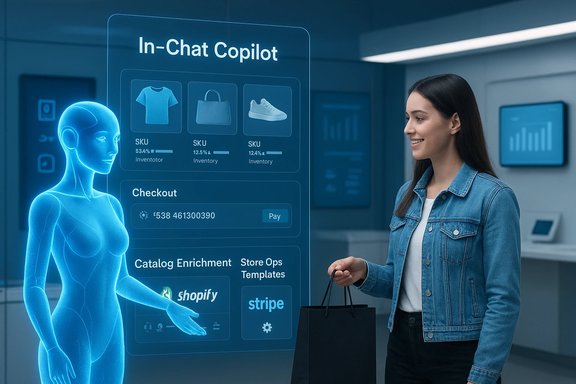
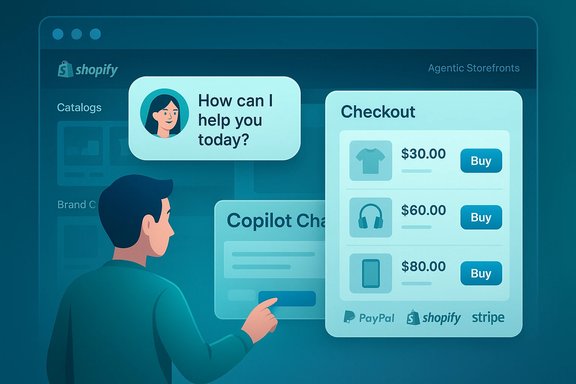
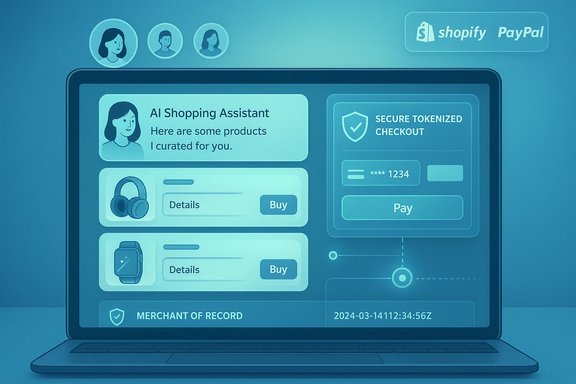
A shopper chats with a holographic AI assistant displaying products and a checkout panel.
Microsoft’s latest retail push folds conversational commerce, catalog automation, and store‑operations intelligence into a single, agentic stack designed to let assistants not only advise shoppers but complete purchases and act on behalf of retailers, starting with a U.S. rollout of Copilot Checkout and a set of Copilot Studio templates for Brand Agents, catalog enrichment, and store‑ops automation.

Background / Overview​

Microsoft has been assembling a layered enterprise AI stack—Copilot Studio for authoring copilots and multi‑agent workflows, Azure AI Foundry (Agent Service) for orchestration and governance, and a growing catalog of prebuilt templates and connectors targeted at verticals like retail. The company frames this collection as agentic AI—systems that can take multi‑step, context‑aware actions and escalate to humans when necessary—rather than simple recommendation engines. Retail is a natural first domain for agentic systems. Rich structured product data, high volumes of repetitive interactions, and time‑sensitive decisions across discovery, checkout, and store operations make retailers fertile ground for automation that reduces friction and scales frontline productivity. Microsoft’s January announcement positions the offering as an “intelligence layer” that can both advise and act across merchandising, marketing, store operations, and fulfillment. This article unpacks what Microsoft announced, how the technology works at a technical and operational level, where value is likely to appear, and the practical governance and risk considerations every retailer should weigh before turning a conversational assistant into a checkout lane.

What Microsoft Announced​

Microsoft’s retail package includes three headline elements designed to work together:
  • Copilot Checkout — an in‑chat checkout that allows shoppers to complete purchases inside Copilot without being redirected to an external merchant site. Microsoft insists merchants remain the merchant of record. Launch partners include PayPal, Shopify and Stripe; early merchant examples named are Urban Outfitters, Anthropologie, Ashley Furniture and Etsy sellers. Copilot Checkout is rolling out in the United States on Copilot.com.
  • Copilot Studio templates for retail — turnkey templates such as Brand Agents (Shopify merchants), a personalized shopping agent template, a catalog enrichment agent (public preview), and a store operations agent (public preview) that automate product onboarding, catalog normalization, conversational shopping, and frontline support. These templates aim to shorten time‑to‑deploy and standardize behavior across channels.
  • Ecosystem and governance primitives — Microsoft pairs these features with identity, observability and AgentOps tooling intended to govern agent behavior, enforce brand safety, and provide audit trails across actions taken by agents. The company emphasizes enterprise‑grade controls as a core differentiator.
These pieces are explicitly designed to be composable: Copilot Studio builds the agents, Azure AI Foundry provides orchestration and model management, and payments/catalog partners provide the commerce plumbing required for in‑conversation purchases.

Copilot Checkout: how it works and what it promises​

Copilot Checkout converts a product recommendation or conversational result into a shoppable experience inside Copilot. In practice, the flow uses three coordinated layers:
  • Structured catalog ingestion so agents rely on machine‑readable product feeds (SKUs, images, inventory, shipping metadata) rather than scraping webpages.
  • Conversational orchestration (Copilot runtime) that interprets intent, asks clarifying questions, and maintains provenance so every suggestion links back to auditable product records.
  • Delegated, tokenized checkout where the assistant requests an ephemeral, single‑use checkout session or payment token that hands the transaction back to the merchant or a payments partner. This approach reduces exposure of raw card data to the conversational surface while preserving merchant‑of‑record responsibilities.
Microsoft’s press materials and partner statements make three business claims about Copilot Checkout: faster conversion (shorter funnel from discovery to purchase), merchant retention of operational control (fulfillment and returns stay with merchants), and broader distribution (agents expose merchant catalogs across conversational surfaces). PayPal’s announcement highlights seller/buyer protections and store sync functionality as part of its role powering Copilot Checkout. The practical upshot for merchants: Copilot becomes another high‑intent distribution channel. For shoppers, the attraction is a frictionless, guided buying experience without context switching. Early demo partners and publicized examples show the behavior Microsoft intends to scale.

Copilot Studio templates: Brand Agents, Catalog Enrichment, Store Ops​

Copilot Studio’s templates serve distinct operational roles:
  • Brand Agents (Shopify) — turnkey agents trained on a merchant’s catalog and brand guidance to deliver a consistent voice and guided shopping flows across web, mobile and in‑chat surfaces. Shopify merchants will be offered Brand Agents with minimal setup, and Shopify has agreed to an auto‑enrollment model for Copilot Checkout following an opt‑out window.
  • Personalized shopping agent template — a flexible framework for outfit building, cross‑channel recommendations and real‑time product discovery that retailers can customize for richer, brand‑specific experiences.
  • Catalog Enrichment Agent (public preview) — automates extraction of product attributes (including from images), generates descriptions, categorizes SKUs, and enriches listings using social insights. The agent supports autonomous writeback to PIM/ERP systems or human‑review workflows and is designed to reduce manual catalog cleanup and onboarding time. This capability is currently in preview and requires sign‑up.
  • Store operations agent (preview) — gives store associates natural‑language access to inventory, policy guidance and next‑best actions, reducing tool switching and time to service on the floor.
Collectively, these templates are sold as prebuilt primitives that reduce integration work and accelerate pilots—an intentional contrast to bespoke LLM development that demands high engineering investment.

Technical anatomy: the plumbing behind agentic commerce​

Under the hood, agentic commerce converges three engineering patterns that Microsoft and partners have been standardizing:
  • Machine‑readable product feeds — canonical product records (SKUs, GTINs, inventory, images) are central to reducing hallucinations and ensuring agents surface accurate, auditable recommendations. Microsoft and partners emphasize catalog quality as the foundation for reliable agentic behavior.
  • Delegated / tokenized payments — conversational surfaces never hold raw card data; instead they request ephemeral checkout sessions or delegated tokens that authorize a single transaction with the merchant’s payment processor (PayPal, Stripe, Shopify). This minimizes exposure and helps create auditable trails for disputes and refunds.
  • Provenance, observability and AgentOps — every agent decision, the catalog records that informed it, and the checkout token exchange must be logged to support chargebacks, refunds and regulatory compliance. Microsoft’s Foundry/Agent Service and Copilot Studio include identity, safety policies and observability tools intended to meet enterprise governance needs.
This technical stack is interoperable with the larger agentic ecosystem. Open protocols like the Agentic Commerce Protocol (ACP) and Stripe‑led standards are emerging across vendors; Microsoft’s approach binds those payment and catalog standards into Copilot and Copilot Studio while leaning on partner integrations for the payment rails and merchant plumbing. The result aims to be a standards‑based but platform‑aware architecture.

Business case: where value is most likely to appear​

Agentic retail promises measurable wins in three tangible areas:
  • Conversion lift and shorter funnels. By collapsing discovery and checkout into one conversational surface, Microsoft claims significant conversion improvements when shopping intent is present, and partners stress faster time‑to‑transaction compared to traditional link‑based flows. Early partner messaging argues that Copilot journeys lead to more purchases in the short window after interaction. Retailers with high frequency, low‑consideration goods (fast fashion, accessories, convenience goods) are likely to see the fastest ROI.
  • Operational efficiency and frontline productivity. Store operations agents reduce tool switching for associates, shrink average handle time on routine queries, and accelerate onboarding for seasonal staff. Catalog enrichment reduces manual data cleanup, speeding product onboarding and improving search/recommendation quality. These operational gains translate to labor savings and improved availability for customer‑facing tasks.
  • Personalization at scale. Brand Agents and personalized shopping templates can stitch past behavior, live inventory and promotional rules into one conversational experience—if retailers provide the structured data and governance controls needed to keep recommendations accurate and brand‑aligned.
For Microsoft and its partners, the commercial upside is both platform growth—positioning Copilot as a first‑class transactional surface—and deeper integration with merchant systems, which can create stickiness if merchants adopt Copilot Studio templates and Azure Foundry orchestration widely.

Risks, unknowns and operational caveats​

The potential upside is real, but the practical and legal hazards are equally consequential. Key risks include:
  • Data governance and model training exposure. Agents trained on catalogs and conversation logs may create new data flows and secondary uses. Retailers must confirm contractual terms that define what data is stored, how long it is retained, whether it is used for model improvement, and who can access it. Microsoft’s marketing emphasizes enterprise controls, but exact data flow rules vary by agreement and region and must be audited before production use.
  • Disputes, chargebacks and fraud liability. Although Microsoft and partners say merchants remain the merchant of record, the distribution and payment flows change how disputes surface. Merchants must verify who handles fraud detection, chargeback disputes, and refunds under each integration model (PayPal, Stripe, Shopify). The division of liability and the operational SLA for payouts are contract terms that materially affect merchant risk.
  • Discovery opacity and Answer Engine Optimization (AEO). Agents control which products are surfaced and how—creating a new optimization problem for merchants. Merchants will need to invest in higher quality metadata, prioritization signals and catalog hygiene to appear prominently. Platform control over ranking also raises antitrust and fairness concerns if platforms favor their own placements or commercial partners.
  • Operational fragility from poor data hygiene. Agentic checkout depends on accurate inventory, shipping windows and price signals. Stale feeds will generate failed orders, disputes and reputational damage. Robust testing, monitoring and human‑in‑the‑loop approvals remain necessary to prevent widespread errors.
  • Regulatory and privacy scrutiny. As assistants become transactional surfaces, regulators may scrutinize disclosure requirements (how recommendations are ranked), consumer consent for data reuse, and liability for erroneous orders. The auto‑enroll model for some merchants (Shopify opt‑out) is likely to draw attention and requires careful communication to avoid merchant backlash.
  • Vendor lock‑in and commercial complexity. While Microsoft emphasizes partner integrations, the practical outcome may still concentrate control of discovery and analytics with the conversational platform. Merchants should evaluate escape clauses, data portability, and the economics of in‑chat purchases (fees, promotional costs, reporting).
These are not hypothetical—industry reporting and Microsoft’s own materials emphasize that many retailers are already piloting agentic systems, but fully mature, scaled deployments remain rare. That gap is the product of governance, integration and operational readiness more than raw technical capability.

Competitive landscape: not the only player in the ring​

Microsoft’s Copilot Checkout arrives amid an accelerating multi‑front battle over who owns discovery and checkout in the age of agentic commerce:
  • OpenAI / ChatGPT Instant Checkout launched an in‑chat checkout experience earlier in the rollout cycle, working with Stripe and the Agentic Commerce Protocol (ACP) to enable similar conversational purchases.
  • Google has been experimenting with agentic checkout in Search / AI Mode, with experiments designed to let the assistant “Buy for Me.”
  • Perplexity and other search assistants are also moving toward integrated commerce primitives and browser‑scale shopping flows.
This competition matters because distribution and consumer adoption are as important as technical functionality: larger consumer chat audiences create more high‑intent queries and therefore greater conversion potential for the platform that owns the surface. Microsoft’s advantage is deep enterprise integrations (Shopify partnership, Azure backbone, Copilot distribution across Edge and Windows), but OpenAI and Google have strong consumer footprints—so the race will be decided by usability, merchant economics, and trust.

Practical checklist for retailers and IT teams​

For retail IT leaders and product teams evaluating Copilot Checkout and agentic templates, treat the initiative as an operational transformation rather than a point product. A practical rollout checklist:
  1. Confirm enrollment model and opt‑out rules. Verify whether your Shopify store will be auto‑enrolled and understand the steps, timelines and consequences of opt‑out.
  2. Audit data flows and contractual terms. Clarify what catalog and customer data Microsoft and partners store, how long it’s retained, and whether it will be used for model training or benchmarking.
  3. Define liability boundaries. Ask partners to specify chargeback, fraud detection and refund responsibilities and the SLAs for payouts and dispute handling.
  4. Harden catalog hygiene. Establish automated validation for SKU accuracy, inventory sync, pricing and shipping windows. Consider a preflight automated test suite that simulates conversational flows and checkout handoffs.
  5. Implement AgentOps and human‑in‑the‑loop approvals. Use Copilot Studio’s approval workflows where available and maintain human oversight for high‑value or unusual writes to PIM/ERP systems.
  6. Plan small, measurable pilots. Start with narrow use cases (frequent‑purchase categories, curated product sets) and measure A/B lifts on conversion, return rates, dispute frequency and CSAT.
  7. Document consumer disclosures. Ensure conversational surfaces clearly disclose merchant identity, pricing, shipping terms and any sponsored or ranked placements. Prepare compliance‑ready copy and transcripts for audits.
Following these steps reduces operational surprise and preserves customer trust while enabling measured experimentation.

What to watch next (near term signals)​

The market will be watching several signals to judge whether agentic retail moves from demo‑worthy to durable:
  • Merchant adoption metrics. The rate at which Shopify merchants accept or opt out of Copilot Checkout will indicate merchant appetite and comfort with the model. Microsoft’s auto‑enroll approach is a practical lever to accelerate adoption but may provoke pushback if merchants feel surprised by defaults.
  • Operational reliability stats. Metrics such as failed order rate, chargeback incidence, dispute resolution time and average time‑to‑refund will be early indicators of operational readiness.
  • Consumer trust and reporting. Transparency about how recommendations are ranked and whether merchant payments affect placement will matter for regulatory and trust reasons.
  • Regulatory attention. As assistants become transactional surfaces, expect consumer protection and competition authorities to examine disclosure, ranking fairness and anticompetitive tie‑ins.
  • Interoperability protocols. Adoption of shared agentic commerce protocols (e.g., ACP) and tokenized payment standards will determine how open or closed the emerging conversational commerce ecosystem becomes.

Critical assessment: strengths and limits​

Microsoft’s retail package demonstrates several notable strengths:
  • Integrated enterprise footing. Copilot Studio + Azure Foundry + identity/governance tooling is a coherent stack for enterprises that already run on Microsoft clouds and collaboration surfaces. This lowers the friction for retailers invested in the Microsoft ecosystem.
  • Practical, composable primitives. By packaging Brand Agents, catalog enrichment and store‑ops templates, Microsoft reduces the engineering burden of agentic projects and accelerates pilots.
  • Partner ecosystem for payments and marketplace reach. Partnering with PayPal, Stripe, Shopify and Etsy brings existing commerce plumbing and buyer protections into the experience—critical elements for practical deployment.
But there are meaningful limits and risks:
  • Governance remains the hard problem. Microsoft’s governance primitives are necessary but not sufficient—retailers must invest in AgentOps, human oversight and contractual clarity. Otherwise, automation errors and privacy missteps will produce outsized reputational and financial costs.
  • Vendor and platform economics. Even with the merchant‑of‑record claim, platform rules, fees and ranking control could shift economics in ways that disadvantage merchants over time. Transparency on commercial terms will be decisive.
  • Adoption and integration complexity. The promise of frictionless checkout rests on clean data, real‑time inventory sync and robust payments integrations—areas many retailers struggle with today. The gap between pilot and production will be where many projects stall.

Conclusion​

Microsoft’s agentic retail announcement—anchored by Copilot Checkout and a suite of Copilot Studio templates—marks a significant step in the evolution of conversational commerce. The offering is strategically coherent: it combines authoring tools, orchestration, governance, and partner payment rails to convert discovery into in‑chat transactions while promising enterprise controls and brand experience consistency. Practical success, however, will be decided by operational discipline. Retailers that invest in catalog hygiene, contractual clarity, AgentOps and measured pilots will capture early advantages in conversion and frontline productivity. Those that rush into auto‑enrolled in‑chat commerce without hard operational SLAs, tested dispute flows, and clear data governance risk costly errors—and possible regulatory scrutiny.
For Windows‑centric IT teams and retail technologists, the immediate task is pragmatic: evaluate the templates against real operational processes, test the delegated checkout flow end‑to‑end, and negotiate clear terms with payment and platform partners. If executed with engineering rigor and governance maturity, agentic retail can be a powerful lever for conversion and efficiency. If executed poorly, it will be a cautionary case study in automation without accountability.
(Claims and product details above are drawn from Microsoft’s January announcement and partner press releases, independent reporting, and Microsoft Learn documentation; readers should validate contractual and regional availability details for their specific markets before onboarding.
Source: thebull.com.au https://thebull.com.au/us-news/micr...ail-automation-with-new-agentic-ai-solutions/
 

Blue neon laptop screen shows Copilot chat, product cards, and a Brand Agent panel.
Microsoft has begun turning its Copilot AI from an assistant into a point-of-sale, launching Copilot Checkout — a native checkout experience inside Copilot conversations — alongside Brand Agents, an out-of-the-box, brand‑voiced shopping agent for merchants. The rollout, which initially targets U.S. users on Copilot.com and ties into major commerce and payments partners, promises frictionless, in-chat purchases without redirecting shoppers off the Copilot surface. Microsoft positions this move as the next step in “agentic commerce,” aiming to convert intent into transactions while keeping merchants “merchant of record.”

Background​

Microsoft has been consolidating many AI features under the Copilot umbrella across consumer and enterprise apps. The company reports broad adoption of Copilot-branded tools, and executives have cited more than 100 million monthly active users across the family of Copilot apps, a scale Microsoft uses to justify deeper commerce integration. Building commerce directly into conversational AI is a trend across big tech — a move toward embedding payments, product discovery, and purchase flows inside assistants rather than routing users to merchant sites. This announcement arrives at a moment when retailers and payments platforms are experimenting with generative AI to capture high-intent shoppers. Microsoft frames Copilot Checkout and Brand Agents as merchant-first solutions — offering turnkey onboarding for Shopify stores, direct integrations with PayPal and Stripe, and a protocol-based approach to let third-party payment engines and seller platforms interoperate with Copilot’s agentic layer.

What is Copilot Checkout?​

Copilot Checkout is a checkout experience rendered inside the Copilot chat UI. When a conversation leads to a purchase decision, Copilot can surface a “Buy” path that opens a native checkout widget where shoppers can provide shipping, payment, and fulfillment choices without being redirected to a merchant’s external website. Microsoft says merchants remain the merchant of record, and the initial U.S. roll-out will include participating retailers such as Urban Outfitters, Anthropologie, Ashley Furniture, and Etsy sellers. Payments at launch are enabled through partners including Shopify (for Shopify merchants), PayPal, and Stripe. Why this matters: by removing the redirect step, Copilot Checkout intends to cut friction and reduce cart abandonment that typically happens when users move between discovery and payment channels. Microsoft frames the experience as “conversation to conversion” — delivering speed and contextual relevance at the moment of purchase intent.

How it appears to shoppers​

  • Copilot suggests products as part of an interactive chat.
  • A built-in buy flow appears alongside recommended items.
  • Shoppers can complete payment and shipping details inside Copilot without visiting external pages.
This is similar in spirit to the “in-assistant” purchases OpenAI and other providers have piloted, but Microsoft emphasizes merchant control and broader payments partner support.

Brand Agents — AI that speaks in your tone​

Brand Agents are prebuilt shopping agents merchants can deploy on their websites and across Copilot surfaces. Designed as turnkey, brand‑voiced assistants, they are trained on a merchant’s product catalog and configured through Copilot Studio templates and Microsoft tooling. The stated goals are to raise engagement, improve discovery, and accelerate purchase decisions by offering a store-specific conversational experience that reflects the brand’s voice and policies. Microsoft also highlights quick deployment timelines and measurable uplift examples from early adopters. Key features Microsoft highlights:
  • Conversational shopping guided by catalog understanding.
  • Deployment options for Shopify merchants and integration pathways for others.
  • Templates in Copilot Studio for personalized shopping agents.
  • Analytics hooks and control panels for brands to manage tone, product rules, and returns.
The pitch: Brand Agents replicate the brick-and-mortar associate who understands the inventory and the brand, replacing static FAQs and search boxes with dynamic dialogue designed to drive conversions.

Partnerships and the promise of an open standard​

At launch the initiative lists three primary payments and platform partners: Shopify, Stripe, and PayPal. Shopify merchants will be automatically enrolled in Copilot Checkout after an opt-out window, while Stripe and PayPal integrations are available for merchants choosing to opt in via application. Microsoft says this multi-partner approach is supported by the Agentic Commerce Protocol (ACP) — an open standard co-developed with partners to enable agentic commerce plumbing between Copilot and sellers’ systems. This architecture matters for scale: rather than forcing a single checkout provider, Microsoft is positioning Copilot as a surface that can call into different payment processors and merchant backends via a standard protocol. That should, in theory, let merchants preserve inventory feeds, fulfillment logic, tax rules, and return policies while letting Copilot orchestrate the customer-facing conversation.

Technical mechanics: how purchases are executed​

  1. Discovery: A user asks Copilot for recommendations or is shown product suggestions during a chat.
  2. Selection: Copilot surfaces product options, metadata, and a buy affordance.
  3. Checkout invocation: Copilot initiates a checkout widget tied to the merchant’s catalog and payment processor via ACP.
  4. Payment and fulfillment: The payment flow uses the merchant’s chosen provider (Shopify, Stripe, PayPal), which processes the payment and hands fulfillment back to the merchant. Microsoft states merchants remain the merchant of record.
Behind the scenes, Microsoft emphasizes that Copilot Checkout is built to respect merchant controls — catalog visibility, pricing, inventory levels, and policies are intended to come from the merchant’s systems rather than being overridden by Copilot. However, implementation complexity will vary by merchant platform and bespoke storefront architectures.

What Microsoft claims merchants will get​

Microsoft’s public messaging stresses several benefits for merchants:
  • Increased reach across Copilot surfaces (Copilot.com, Bing, Edge, MSN) with no extra integration if you’re on supported platforms.
  • Faster buyer journeys, reducing discovery-to-purchase latency.
  • Merchant-of-record retention: merchants should keep control of pricing, taxes, and fulfillment.
  • Automatic Shopify enrollment (opt-out model) to rapidly expand merchant coverage.
  • Integration options for PayPal and Stripe merchants via application.
The marketing material includes early case anecdotes claiming significantly higher conversion rates for Brand Agent-assisted sessions, but those figures come from vendor-supplied examples or pilot data and should be treated cautiously until independent verification is available. Microsoft’s announcements include one retailer anecdote indicating over 3× conversion in Brand Agent-assisted sessions; that is promising but not independently validated. Treat vendor case studies as directional rather than definitive.

Early adoption and merchant onboarding mechanics​

  • Shopify merchants: automatic enrollment with an opt-out window; merchants can manage Copilot Checkout from Shopify admin.
  • Stripe and PayPal merchants: can apply to enable Copilot Checkout; both companies have posted partnership notes indicating they power payments and merchant sync for Copilot purchases.
  • Etsy integration: Etsy’s product catalog and some sellers are present at launch; Microsoft highlights this as a way to surface unique and handcrafted items.
Automatic enrollment is designed to accelerate scale, but it is also the most sensitive design choice since merchants will want clear control over participation, fee structures, and customer support responsibilities. Automatic opt-ins risk generating merchant pushback if the opt-out process is unclear or if expectations around dispute handling are not well-defined. Several merchant platforms are rapidly clarifying administrative controls and reporting tools in response.

Benefits for consumers — and where UX risks remain​

For shoppers, the advantages are obvious:
  • Speed: fewer clicks to buy.
  • Contextuality: Copilot remembers the conversation context and can auto-select options or offer bundle suggestions.
  • Familiar interface: completing checkout inside an AI conversation can feel less disruptive than opening new tabs.
That said, there are UX and trust risks to manage:
  • Transparency about who is selling the item, return policies, and shipping estimates must be clearly visible inside the Copilot interface to avoid confusion.
  • Payment method choice and saved-payment controls must mirror the merchant’s expectations.
  • Fraud prevention and chargeback flows need to be seamless — a native checkout introduces a new attack surface for social-engineering or UI-based scams if not hardened properly.

Privacy, security, and data-sharing considerations​

Embedding commerce into conversational AI raises immediate questions about data scope and control. Critical points include:
  • What customer and transaction data flows to Microsoft, and what remains with the merchant and payment partner?
  • How does Microsoft store or cache shipping and payment preferences used by Copilot?
  • Which organization is responsible for KYC, fraud monitoring, and dispute resolution in cross-platform purchases?
Microsoft states that merchants remain the merchant of record — a legal position that typically preserves responsibility for taxes, returns, and customer service. Payments partners (Stripe, PayPal) will handle processing, but the integration points require careful mapping of data sharing agreements and compliance with PCI standards and regional privacy laws. Merchants should require clear SLAs and data-usage disclosures before enabling Copilot Checkout. Privacy advocates will likely scrutinize:
  • How conversational transcripts tied to purchases are retained and used.
  • Whether personalized recommendations inside Copilot are informed by cross-site behavioral signals or aggregated telemetry.
  • The implications of automatic Shopify enrollment on merchants’ consent and data sharing choices.

Business implications for retailers and platforms​

Copilot Checkout and Brand Agents represent a strategic bet: capture purchase intent earlier and make AI-native surfaces a new retail channel. Potential impacts:
  • Channel shift: If Copilot becomes a high-volume sales channel, retailers will treat Copilot as they do marketplaces today — optimizing feeds, promotions, and inventory specifically for the surface.
  • Fee pressure and economics: Microsoft’s messaging emphasizes keeping merchants as merchant-of-record, but that does not eliminate the need to negotiate fulfillment, fees from payment partners, or platform-related costs (e.g., Shopify’s fees). Merchants must evaluate incremental margin after any transaction costs and potential returns.
  • Discovery optimization: Brands will invest in agentic optimization — ensuring their catalogs, images, and product metadata are Copilot-ready to surface optimally in conversational prompts.
  • Customer support: Conversations that begin in Copilot might need new escalation paths to merchant support teams, impacting staffing and tooling.
For marketplaces and commerce platforms, being integrated early (Shopify, Etsy) is a competitive advantage; for smaller merchants, the opt-in application process for PayPal/Stripe means a potential lag in availability.

Regulatory and competitive landscape — potential flashpoints​

This approach raises a few regulatory and antitrust considerations worth watching:
  • Platform neutrality: If Copilot preferentially surfaces products from partners or merchants who pay for better integration, regulators could examine whether discovery is biased.
  • Data portability and competition: The Agentic Commerce Protocol is presented as open, but adoption and technical specifics will determine whether it truly enables competition or simply advantages large providers who can implement it quickly.
  • Consumer protection: Regulators will scrutinize refund, cancellation, and dispute handling in cases where the assistant mediates the sale but the merchant handles fulfillment.
Antitrust and privacy regulators are already attentive to how large tech platforms expand into commerce; embedding checkout directly into widely distributed AI assistants may attract scrutiny if market power is perceived to shift dramatically toward big tech intermediaries.

Practical steps for merchants — a short playbook​

  1. Audit readiness: Verify product catalogs, images, and metadata are clean and optimized for conversational discovery.
  2. Review terms: Read Copilot Checkout and Brand Agent integration terms, especially around merchant-of-record obligations, dispute handling, and fees.
  3. Decide enrollment posture: Shopify merchants should evaluate the opt-out window carefully; non-Shopify merchants should assess PayPal/Stripe application timelines.
  4. Test returns and chargebacks: Run simulated returns and dispute scenarios to ensure customer service workflows are robust when purchases originate from Copilot.
  5. Monitor analytics: Configure logging and analytics to track Brand Agent-assisted sessions versus unassisted sessions to measure lift and ROI.
  6. Prepare for content control: Use Copilot Studio controls to manage agent tone, promotion placement, and content compliance.

Risks and unanswered questions​

  • Vendor claims vs. independent verification: Microsoft’s conversion uplift anecdotes are promising but vendor-supplied. Independent, third-party performance studies will be required to quantify sustained benefits. Flagged: vendor case-study figures need external validation.
  • Scope of data sharing: Public announcements outline partner roles but not the full schema of data retention and cross-service usage. Merchants must confirm data handling details with legal counsel and partners.
  • Dispute and fraud workflows: Who bears liability in edge cases (fraud, unauthorized purchases, refunds) needs airtight clarity; implementers should validate indemnification clauses and operational procedures.
  • Consumer trust: Rapid adoption depends on shoppers understanding who they are buying from, how returns work, and what protections they retain. UI clarity and customer education will be crucial.

How this fits into the larger AI-commerce trend​

Microsoft’s move reflects a broader industry shift toward agentic interfaces that not only recommend but transact. Other companies have tested in-assistant purchases or integrated buy buttons in search and chat. The addition of an open-ish protocol and a multi-partner approach is Microsoft’s attempt to avoid vendor lock-in narratives and scale the concept across diverse payment and platform ecosystems. If Copilot can reliably deliver high-intent traffic and keep merchants satisfied on margins and control, agentic commerce could become a major acquisition channel for retail.

Final assessment — strengths, strategic risks, and what to watch next​

Strengths:
  • Seamless buyer journeys: Reduces friction by keeping the purchase inside the conversational flow.
  • Partnered payments model: Using Shopify, Stripe, and PayPal decreases the implementation burden for many merchants.
  • Scalability through templates: Brand Agents and Copilot Studio lower technical barriers to launch conversational storefronts quickly.
Strategic risks:
  • Merchant consent and control: Automatic enrollment for Shopify merchants could provoke backlash if not communicated clearly.
  • Data governance: Ambiguities in data flows and retention policies can erode merchant and consumer trust.
  • Regulatory scrutiny: Aggressive expansion of commerce inside large tech platforms could draw attention from competition and consumer-protection regulators.
  • Overpromised conversion metrics: Vendor-provided uplift figures require independent verification to establish long-term efficacy.
What to watch next:
  • Independent performance reports from merchants and analytics firms.
  • Clarifications from Microsoft, Shopify, Stripe, and PayPal on data-sharing contracts and dispute workflows.
  • Early merchant feedback on the opt-out enrollment process and operational impacts.
  • Regulatory commentary or inquiries from competition and consumer-protection bodies.

Conclusion​

Copilot Checkout and Brand Agents mark a pragmatic and aggressive attempt by Microsoft to graft commerce onto the emerging landscape of conversational AI. The approach combines familiar commerce plumbing with the promise of contextual shopping inside AI conversations — a powerful proposition if Microsoft can balance merchant control, transparent data practices, and consumer protections. For merchants, the opportunity is real: a potential new channel that reduces friction and meets buyers at the moment of intent. For consumers, the success of the idea will hinge on clear disclosure, secure payments, and dependable fulfillment.
The rollout’s immediate success will be measured by merchant uptake, verified conversion lifts, and how clearly Microsoft and its partners define operational responsibilities. In the months ahead, independent data and merchant case studies will determine whether agentic commerce is a durable new channel or a convenience experiment that needs deeper structural work.
Source: Neowin https://www.neowin.net/news/microsoft-launches-copilot-checkout-and-brand-agents-for-merchants/
 

Microsoft’s latest retail play pushes a decisive shift: treat AI not as a sidebar helper but as an operational layer that can discover, decide, and execute commerce workflows end-to-end—anchored by Dynamics 365, Copilot, and a new Model Context Protocol (MCP) surface that promises to make agentic commerce practical at scale.

A woman interacts with a glowing holographic AI assistant in a futuristic store.Background / Overview​

Retail has always been an information‑flow problem: products, prices, inventory, promotions, and customer intent must be aligned continuously across stores, web, marketplaces, and conversational surfaces. Microsoft’s recent messaging reframes that problem as an opportunity to embed AI agents where decisions and value are created—on the shelf, at checkout, in merchandising, and across fulfillment—so that agents can act (not only advise) with governed access to enterprise systems. This is the essence of “agentic commerce” or “Commerce Anywhere.” Microsoft’s industry and Dynamics 365 messaging lays out three practical elements of that approach: Copilot‑powered conversational surfaces (including in‑chat checkout), prebuilt agent templates (catalog enrichment, personalized shopping, store ops), and MCP servers that expose controlled, discoverable, auditable business functions to agents. The immediate headlines from Microsoft and its partners include Copilot Checkout (in‑chat checkout powered with payments integrations), managed agent templates in Copilot Studio, and the Dynamics 365 Commerce MCP Server as the commerce‑grade ground for agent execution. Independent reporting from multiple outlets confirms Copilot Checkout rolling out in the U.S. with payment platform partners like PayPal and Stripe and merchants such as Urban Outfitters and Anthropologie.

What is agentic commerce — and why now?​

The operating model shift​

Agentic commerce treats AI agents as operational workers rather than one-off recommendation engines. Agents are designed to:
  • Continuously monitor signals (customer intent, inventory, supplier status, weather, local events).
  • Use a shared, enterprise‑grade context to reach decisions.
  • Execute governed actions in systems of record (catalog updates, reservations, fulfillment changes, checkout token exchanges).
  • Hand off to humans for strategy, exceptions, and policy enforcement.
This model answers persistent retail pain points—volatile demand, labor constraints, and margin pressure—by enabling faster, more consistent decisions at scale. Microsoft frames leading organizations that adopt this pattern as “Frontier Firms,” which embed intelligence across the value chain rather than patching point problems.

The practical ingredients​

Agentic commerce requires three technical primitives working in concert:
  • A conversational and orchestration layer (Copilot and Copilot Studio) to author, deploy, and run multi‑agent workflows.
  • A secure protocol and tool surface (Model Context Protocol, MCP) that exposes business capabilities as discoverable, permissioned tools agents can call.
  • Payment and transaction protocols that let agents initiate compliant, auditable transactions without holding raw payment data.
Microsoft’s announcements package those primitives with enterprise governance—agent identity, observability, safety policies, and AgentOps tooling—aimed at letting agents act while leaving humans in control.

Model Context Protocol (MCP) and Agent Communication Protocol (ACP): the plumbing of agentic retail​

What MCP does​

Model Context Protocol (MCP) is a protocol-first bridge between agents and enterprise systems. Rather than rely on brittle point‑to‑point connectors or ad‑hoc prompt engineering, MCP describes tools (capabilities), structured inputs/outputs, and a security contract so that an agent can deterministically discover and call business functions—catalog queries, price calculations, inventory reservations, cart updates, or fulfillment actions.
The commercial promise: expose hundreds of thousands of retail functions (catalog, pricing, promotions, inventory, orders, fulfillment) as MCP‑enabled capabilities so agents can securely discover, decide, and execute real‑time workflows against live systems. MCP aims to preserve auditability, least‑privilege access, and traceability for every agent action. This is the foundational idea behind the Dynamics 365 Commerce MCP Server.

Why ACP and payment agent protocols matter​

Agent Communication Protocol (ACP) is the coordination layer that lets agents across merchandising, supply chain, store ops, and service work together. When ACP, MCP, and secure transaction protocols are combined, agents can negotiate availability, modify fulfillment plans, and initiate tokenized payments while leaving legal merchant relationships and settlement to established payment rails.
Payments integrations are intentionally tokenized and delegated—conversational surfaces do not hold raw card details. Instead, the agent requests an ephemeral checkout session or a delegated token that the merchant’s payment processor (PayPal, Stripe, Shopify) redeems. This design reduces PCI exposure and creates auditable trails for disputes, refunds, and chargebacks, a critical requirement for any commerce deployment. PayPal and Stripe have publicly announced integrations with Microsoft Copilot Checkout as early partners.

Introducing Dynamics 365 Commerce MCP Server (what Microsoft says)​

Microsoft’s Dynamics 365 Commerce MCP Server is positioned as a commerce‑grade MCP implementation that exposes core retail business logic—catalog, pricing, promotions, inventory, carts, orders, and fulfillment—as MCP‑enabled, discoverable tools for agents to call. The vendor explains this will make it possible for AI agents to securely discover, decide, and execute retail workflows across digital, physical, and conversational channels, enabling the “Commerce Anywhere” vision. Dynamics 365’s Commerce surface, combined with ERP and Analytics MCP servers, is presented as the substrate for an agent‑driven operating model. Microsoft’s messaging around the Commerce MCP Server frames three adoption patterns for retailers:
  • Use agents embedded directly into Dynamics 365 (purpose‑built agents).
  • Build custom agents using Copilot Studio and MCP to encode unique business rules.
  • Extend agentic capabilities with partner‑built agents and ecosystem solutions.
Those three paths let organizations progress at their own pace—starting with out‑of‑the‑box templates and moving toward deeper, custom automation. Caveat: marketing materials and partner articles reference a preview timeline for Commerce MCP Server (Microsoft’s announcements say early previews are expected around February 2026). That specific date appears in vendor briefings and partner write‑ups but independent confirmation of the exact preview start may vary by region and tenant; organizations should verify availability and sign‑up mechanics directly with Microsoft before planning projects that depend on the preview timeline.

Agent types and real examples: embedded, custom, and partner agents​

1) Embedded agents in Dynamics 365​

Microsoft ships purpose‑built retail agents in Copilot Studio and the Dynamics 365 ecosystem, such as:
  • Supplier Communications Agent — monitors supply signals and helps coordinate supplier confirmations and timeline updates, reducing surprises and accelerating responsiveness.
  • Catalog Enrichment Agent — ingests images, PDFs, and vendor feeds to populate and standardize product metadata, flagging low‑confidence items for human review.
  • Personalized Shopping Agent — runs conversational product discovery across channels, asking clarifying questions and recommending items tuned to brand voice.
These embedded agents are designed for rapid time‑to‑value by tying directly into Dynamics data models and workflows.

2) Custom agents built with Copilot Studio + MCP​

For business‑unique workflows—replenishment rules, allocation strategies, store formats, or brand policies—retailers can build custom agents in Copilot Studio that call MCP tools on Dynamics 365 ERP, Commerce, and Analytics servers. Custom agents can live inside collaboration surfaces like Microsoft Teams or the point‑of‑sale workflow and can be governed by enterprise identity, RBAC, and observability tooling.
Example scenario:
  • A replenishment agent reads forecasted demand and supplier lead times from ERP (via MCP).
  • It proposes an allocation plan and reserves stock across DCs.
  • It updates orders or escalates exceptions to planners with an audit trail.
This pattern turns planning actions into agent‑callable workflows while preserving human oversight and governance.

3) Partner-built agents and the ecosystem​

Microsoft’s partner ecosystem already showcases agentic retail use cases:
  • Argano Retail Clienteling Agent — uses Commerce MCP Server to surface customer insights and commerce context to associates for high‑touch, luxury clienteling experiences.
  • Amicis Store Commerce Agent — voice‑first assistant for phone‑or‑floor tasks (returns, exchanges, policy checks) that adapts to the POS surface.
  • Evenica B2B Licensee Product Request Agent — uses conversational AI and image recognition to help licensees find products and create product intake requests.
  • Visionet FashionGPT Agent — maps natural‑language intent into real‑time product, pricing, inventory, and promotion actions across channels.
Partner solutions accelerate adoption by reducing integration overhead and delivering scenario‑specific logic that plugs into MCP semantics and governance primitives.

In practice: Copilot Checkout and tokenized payments​

A practical example of agentic commerce in action is Copilot Checkout—a conversation‑native checkout that surfaces a “Buy” option inside Copilot and completes payment using delegated tokens via payment partners. Microsoft and partners (PayPal, Stripe, Shopify) describe a model where the conversational surface generates a one‑time checkout session or token that a payment processor redeems, so the merchant remains the merchant of record while conversational checkout reduces friction and shortens the path to purchase. Early press coverage and partner press releases confirm US availability and partner integration; merchants named in demos include Urban Outfitters, Anthropologie, Ashley Furniture, and Etsy sellers. Operational and compliance details to note:
  • Checkout flows use ephemeral tokens rather than storing raw card data inside Copilot, minimizing PCI scope.
  • Payment platforms surface merchant protection features and buyer protections identical or similar to their native flows (PayPal emphasized seller/buyer protections in their Copilot announcement).
  • Every agent action and the catalog records that informed it should be logged for chargebacks, refunds, and regulatory audits.

How retailers should begin adopting agentic commerce (practical roadmap)​

Microsoft recommends three entry paths; here’s a pragmatic adoption roadmap that maps to retail realities:
1. Start small with embedded agents and templates
  • Deploy catalog enrichment and store operations agent templates in test teams to measure time saved and catalog quality improvements.
  • Use the agent to flag low‑confidence entries and require human approval for high‑risk writebacks.
  • Validate KPIs: time per SKU processed, catalog completeness, and search conversion lift.
2. Pilot custom agents with narrow scopes
  • Build a replenishment or allocation agent in Copilot Studio that calls a small set of MCP functions in a non‑production tenant.
  • Keep human‑in‑the‑loop gates for writebacks; instrument telemetry and set escalation rules.
  • Run A/B pilots to measure availability, fulfillment accuracy, and margin impacts.
3. Expand with partner solutions and payments pilots
  • Trial Copilot Checkout with a small set of SKUs and a single payments partner (PayPal or Stripe) to validate transaction flows and refund handling.
  • Use partner agents for clienteling or store productivity where prebuilt UX reduces integration time.
Numbered checklist for a safe pilot:
  • Clean and normalize catalog and master data (SKUs, GTINs, taxonomies).
  • Define clear guardrails and escalation policies for every agentic action.
  • Configure Entra‑backed agent identities and enforce least‑privilege.
  • Enable end‑to‑end logging (agent input, decision trace, system writes, and user approvals).
  • Run controlled experiments with rollback paths and human audits.

Benefits retailers can expect (realistic, measurable outcomes)​

  • Faster product onboarding and improved search relevance from catalog enrichment automation.
  • Reduced associate handle times and improved in‑store conversion from store operations and clienteling agents.
  • Conversion lift from frictionless, contextual checkout inside conversational flows. Industry and partner commentary cite conversion improvements when discovery and checkout are collapsed into one experience.
  • Scalable personalization and operational consistency across channels when agents are grounded in a single commerce context (MCP).
These gains are measurable: testable KPIs include catalog completeness, time to onboard SKU, average handling time (AHT), add‑to‑cart conversion, and fulfillment SLAs.

Risks, failure modes, and governance considerations​

Agentic commerce introduces new failure modes that demand operational controls and discipline.
  • Data quality risk: Agents act on whatever context they are given. Poor master data (mis‑matched SKUs, stale inventory) can make agent actions harmful—automated writebacks amplify errors. Master‑data hygiene is a precondition.
  • Model and logic drift: Agents that learn from corrections can develop undesirable behaviors without sufficient guardrails. Human‑in‑the‑loop thresholds and rollout throttles are essential.
  • Transactional and regulatory risk: Conversational checkout must preserve merchant‑of‑record relationships, dispute processes, and consumer protections. Tokenized payment flows reduce PCI scope but do not remove the need for careful reconciliation and dispute workflows. PayPal and Stripe communications emphasize these protections in their integrations.
  • Security and identity: Agent identities (Entra Agent IDs) must be tightly scoped and auditable. Agent lifecycle controls—quarantine, kill switches, and telemetry—are necessary to manage large fleets of agents. Microsoft’s Agent 365 and AgentOps tooling aim to provide those controls, but customers must operationalize AgentOps practices in their orgs.
  • Vendor ROI claims: Many vendor and partner metrics (conversion lifts, percent increases) are drawn from pilot or internal datasets. Buyers should demand reproducible benchmarks, production‑grade SLA definitions, and reference customers. Independent verification remains essential.

Critical analysis — strengths, blind spots, and where to be skeptical​

Notable strengths​

  • Practicality: Microsoft’s use of templates and MCP tool abstractions lowers the engineering bar for retailers that lack deep ML expertise but have solid operational data. Templates map to where value is realized—catalogs, store ops, and checkout.
  • Enterprise grounding: Emphasis on identity, observability, and tokenized payments addresses core enterprise concerns (auditability, least‑privilege, compliance). Partners like PayPal and Stripe committing to agentic payment flows reduces integration risk for merchants.
  • Ecosystem approach: MCP reduces point‑to‑point connector complexity and enables third‑party partners to deliver scenario‑specific agents that plug into Dynamics 365 as the system of execution. This composability is critical for real‑world retail heterogeneity.

Potential blind spots and risks​

  • Data engineering friction: The theoretical benefits presuppose clean master data and consistent metric definitions. Retailers with heavily customized ERPs or messy product feeds will face significant upfront costs before agents are safe to operate autonomously.
  • Vendor timelines vs. production reality: Product preview timelines (for example, the Dynamics 365 Commerce MCP Server preview noted for February 2026 in vendor briefings) are useful planning signals but should be validated; preview availability can be region- or tenant‑specific and may change. Treat preview dates as tentative until confirmed in tenant enrollment or partner communications.
  • Human‑agent interaction design: The competitive edge will be human + agent workflows, not agent replacement. Organizations that over‑automate customer‑facing interactions risk losing brand voice and customer trust unless they tightly control agent style and escalation paths.

Practical checklist for IT and retail leaders​

  • Confirm the availability and preview schedule for the Dynamics 365 Commerce MCP Server in your region and tenant. Treat preview dates as planning milestones—not guarantees.
  • Prioritize master‑data and catalog clean‑up: SKU normalization, taxonomy alignment, and image/text completeness. Catalog quality is the critical foundation for reliable agent behavior.
  • Plan for AgentOps: define ownership, lifecycle controls, quarantine and emergency kill switch procedures, telemetry retention, and cost monitoring. Use Entra for agent identity and follow least‑privilege practices.
  • Start with limited, high‑value pilots (catalog enrichment, store ops) and measure clearly defined KPIs (time to onboard SKU, AHT, conversion lift). Validate claims in your operational context before expanding to transactional agents like Copilot Checkout.
  • Validate payment and dispute flows for conversational checkout pilots: confirm merchant protections, reconciliation processes, and test chargeback handling with your payment partner.

Conclusion​

Microsoft’s Dynamics 365 agentic retail narrative is both bold and pragmatic: bold in its claim that agents can transform commerce end‑to‑end, and pragmatic in how it packages templates, governance, and a protocol (MCP) to make agent actions deterministic and auditable. The practical upshot for retailers is a clear adoption path—start with embedded agents and templates, pilot custom agent workflows grounded in MCP, and extend via ecosystem partners where appropriate.
The upside is tangible: faster catalog onboarding, smoother in‑store operations, and shorter discovery‑to‑checkout funnels. The real risk is organizational and data readiness. Agentic systems amplify both good data and bad data; they also expand the attack surface for governance, security, and financial reconciliation. Retailers that succeed will be the ones that pair aggressive pilots with rigorous AgentOps, careful human‑in‑the‑loop design, and validated payment workflows.
For WindowsForum readers who run or advise retail IT, the immediate priorities are clear: verify access to the Commerce MCP preview when your account is eligible, shore up catalog and inventory master data, and design your first pilot around operationally observable KPIs rather than vendor promises. The next wave of retail differentiation will come not from adding another point AI tool, but from redesigning operations so agents and people work from the same authoritative context—and that is precisely the operating model Microsoft is selling with Dynamics 365 and MCP.
Source: Microsoft Reimagining retail with Dynamics 365 and AI Agents
 

Back
Top