

CISA republished ABB’s advisory for CVE-2025-11043 on May 5, 2026, warning that B&R Automation Studio versions before 6.5 improperly validate server certificates in OPC UA and ANSL-over-TLS client connections, enabling a network-positioned attacker to impersonate a trusted server. The bug is not a Hollywood-style remote takeover, and that is precisely why it matters. It lives in the trust plumbing of industrial engineering software, where compromise is less about smashing the front door than quietly persuading the workstation that the wrong machine is the right one. ABB has fixed the flaw in Automation Studio 6.5, but the advisory is a useful reminder that encrypted industrial traffic is only as trustworthy as the certificate checks behind it.
Industrial cybersecurity conversations tend to gravitate toward controllers, field devices, and internet-exposed boxes with embarrassing banners. That focus is understandable: programmable logic controllers and remote access gateways are where production risk becomes visible. But engineering workstations remain one of the most consequential machines in an OT environment because they sit at the boundary between human intent and machine behavior.
B&R Automation Studio is not a casual desktop utility. It is the development environment used to build, configure, and maintain automation systems across control, motion, HMI, operations, and safety-adjacent workflows. If an attacker can interfere with what that environment sees when it talks to a server, the compromise can become operationally meaningful without ever needing to exploit a PLC directly.
That is the uncomfortable part of CVE-2025-11043. The affected clients use OPC UA and ABB B&R’s ANSL over TLS, both of which are meant to provide secure communications. The vulnerability is not that encryption is absent; it is that the software’s certificate validation was insufficient. In security terms, that is the difference between locking the door and failing to check whether the person holding the key is actually the owner.
The CVSS 3.1 score of 7.4 lands in “high” territory, with network attack vector, no privileges required, no user interaction, and high confidentiality and integrity impact. The attack complexity is rated high, which is important, but it should not comfort anyone responsible for a plant network. High complexity does not mean implausible; it means the attacker must already be in a position to manipulate traffic, routing, name resolution, or a comparable network path.
That is why improper certificate validation is such a stubborn class of vulnerability. It does not usually announce itself with crashes, obvious failures, or dramatic symptoms. The connection may appear normal. The session may be encrypted. The application may behave as though it has reached the intended server, while an attacker in the middle can observe, alter, or relay data.
In enterprise IT, this maps neatly to man-in-the-middle attacks, rogue proxies, poisoned DNS, compromised gateways, and malicious certificates. In industrial environments, the practical routes can be messier: maintenance laptops, remote support paths, jump hosts, flat network segments, misconfigured firewalls, and legacy assumptions that “inside the plant” means “trusted.” The advisory’s exploitation description is not exotic. It requires network access and the ability to redirect communication while presenting manipulated certificates that pass validation checks.
That last clause is the heart of the issue. A properly validating client should reject a server that cannot prove its identity. If the client accepts a certificate it should not accept, the attacker does not need to break TLS. They only need to become the party TLS mistakenly trusts.
Still, the signal boost has value. CISA’s industrial control system advisories occupy a different channel than vendor PDFs. They are consumed by asset owners, managed security providers, insurers, regulators, and incident responders who may never read a vendor security page unless procurement forces the issue. When CISA republishes an advisory, it effectively translates vendor-specific risk into the broader language of national critical infrastructure.
The affected sector listed here is critical manufacturing, with worldwide deployment and ABB’s headquarters in Switzerland. That does not mean every factory using B&R tooling is in immediate danger. It means the software sits in environments where downtime, process deviation, intellectual property leakage, and unauthorized engineering changes can have consequences beyond a help desk ticket.
The advisory also says ABB had not received reports of exploitation when the advisory was originally issued. That is reassuring but limited. OT exploitation is often under-detected, under-reported, or discovered months after initial access. In the case of an interception bug, absence of known exploitation is especially slippery because successful abuse may not leave obvious artifacts unless logging, network monitoring, and certificate telemetry are mature.
But attackers do not evaluate vulnerabilities in isolation. They chain them with weak segmentation, stolen credentials, exposed VPNs, unmanaged switches, shared admin workstations, remote contractor access, and the slow sediment of years of exceptions. Once an intruder has a foothold inside an industrial network, traffic-positioning attacks become more realistic, particularly in environments where engineering systems and control systems share more trust than they should.
This is why certificate validation flaws are strategically useful. They can convert a network foothold into application-layer trust. An attacker who cannot authenticate to a legitimate server may instead impersonate that server to a vulnerable client. Depending on what data is exchanged, the result could be disclosure of sensitive engineering information, manipulation of data in transit, or interference with workflows that operators believe are legitimate.
The advisory does not claim remote code execution. It does not claim safety impact. It does not say an attacker can directly seize a controller. But industrial compromise often begins long before the dramatic phase. The prelude is reconnaissance, trust abuse, configuration capture, and careful manipulation of the systems used by engineers to understand and modify the plant.
In practice, secure protocols can be undermined by insecure implementation or careless deployment. Certificate management in OT is notoriously awkward. Plants run equipment for decades, engineering laptops come and go, maintenance windows are scarce, and certificate rotation can feel like an administrative luxury until it becomes a security incident. The protocol may offer the right controls, but the environment must use them correctly and the software must enforce them rigorously.
CVE-2025-11043 is therefore not an indictment of OPC UA as a concept. It is a reminder that a secure protocol stack is not self-executing. If the client fails to reject bad certificates, the strongest cipher suite in the world cannot save the session from misplaced trust.
The ANSL-over-TLS side of the advisory tells the same story in a vendor-specific dialect. TLS is doing the transport security work, but certificate validation determines whether the tunnel leads to the intended endpoint. For engineering software, that distinction is not academic. The identity of the server is part of the operational truth the workstation relies on.
In real plants, engineering software upgrades are not always routine. Automation environments may be tied to project versions, validated build chains, vendor support agreements, and local practices that discourage touching working systems. A minor-sounding workstation update can trigger compatibility testing, backup procedures, change approvals, and coordination with production schedules.
That friction is not an excuse to delay indefinitely. It is the operational reality security teams must plan around. The right response is not merely to shout “patch now,” but to identify which engineering stations run Automation Studio, which versions are installed, which projects and systems depend on them, and whether the upgrade to 6.5 affects existing workflows.
There is also a subtle inventory problem. Many organizations maintain asset lists for controllers, HMIs, servers, and network devices, but engineering tools can be harder to track. They may live on laptops, virtual machines, contractor systems, or shared workstations that are only powered on during maintenance. A vulnerability in engineering software therefore becomes a test of whether the organization knows where its engineering authority actually resides.
In the Purdue-style mental model many OT teams still use, Level 1 is where basic control devices and sensors live, while Level 2 contains supervisory systems and localized control functions. Engineering workstations often have an uncomfortable relationship with these layers because they need privileged access across boundaries during commissioning and maintenance. That need can become a standing trust relationship unless carefully constrained.
Putting Automation Studio in a trusted Level 2 environment is not a magic shield. It is a way to reduce exposure to less trusted networks, business IT traffic, remote access sprawl, and arbitrary lateral movement. If the workstation only communicates through known paths to known systems, the attacker’s job becomes meaningfully harder.
This is where many industrial security programs still struggle. Segmentation diagrams look clean during audits, but real-world maintenance creates exceptions. A vendor needs temporary access. A line is down. A switch gets added. A firewall rule becomes permanent because nobody wants to rediscover why it existed. Over time, the path an attacker needs to intercept traffic may appear not through design but through accumulated convenience.
But for this vulnerability, the more useful question is not simply whether Automation Studio is reachable from the internet. It is whether a compromised host inside the organization could influence how Automation Studio resolves, routes, or trusts a server connection. That brings DNS, DHCP, routing, certificate stores, local administrator rights, and remote access tooling into scope.
A workstation can be “not internet-exposed” and still vulnerable to a nearby adversary. A contractor laptop on the same maintenance subnet may be enough. A compromised jump server may be enough. A misconfigured firewall that permits more east-west traffic than intended may be enough. The old perimeter language is necessary, but it does not fully describe modern OT attack paths.
This is why certificate validation bugs deserve a different operational response than ordinary patch triage. Teams should not only update the affected software; they should also examine whether certificate trust is being monitored, whether unexpected server identities generate alerts, and whether engineering workstations are allowed to communicate with anything they do not strictly need.
Industrial environments add higher stakes and older assumptions, but the pattern is familiar. Trust shortcuts outlive the problem they were meant to solve. Engineers prioritize uptime and access because those are the metrics the plant feels immediately. Security controls that interfere with commissioning or troubleshooting are softened, bypassed, or postponed.
The result is that certificate validation, which should be a binary security property, becomes a cultural negotiation. Does the application really need to reject this certificate? Can we click through the warning? Can we pin it later? Can we just make it work for now? CVE-2025-11043 is vendor-fixed, but the broader habit of treating identity validation as an inconvenience is not fixed by one software release.
For Windows administrators supporting OT teams, the lesson is direct. Engineering workstations should be managed as privileged systems, not as ordinary desktops with unusual software. They need patch visibility, controlled local admin rights, hardened remote access, logging, backup discipline, and network rules that reflect the authority they carry.
Yet CVSS has always struggled with industrial context. It scores properties of the software flaw, not the production consequences of the environment where the software is used. A data integrity issue in an engineering workflow can be minor in one lab and deeply consequential in a plant where configuration, motion control, or operational visibility depends on the affected communications.
The CVE record also includes a CVSS 4.0 score of 9.1 from ABB’s CNA data, which illustrates how newer scoring can represent the same issue more sharply. Whether an organization anchors on 7.4 or 9.1, the practical answer should be the same: affected Automation Studio installations need to be found, upgraded, and protected by network controls that assume the workstation is a high-value target.
Security teams should resist both extremes. This is not a reason to panic-shutdown engineering workstations. It is also not a reason to bury the advisory because exploitation requires network access. In OT, “requires network access” often describes the second stage of a real intrusion, not a theoretical barrier.
That is the category CVE-2025-11043 belongs to. Its risk is not merely interception; it is manipulated confidence. The attacker’s advantage comes from making the abnormal look normal at precisely the layer where the software is supposed to establish trust.
For defenders, that means detection should include more than malware signatures and failed logins. Network teams should care about unexpected certificate chains, server identity changes, DNS anomalies, route changes, and traffic patterns involving engineering workstations. OT teams should know what normal Automation Studio communications look like, not just whether the application launches successfully.
The advisory’s statement that exploitation requires manipulated certificates and traffic redirection should be read as a defensive checklist in reverse. If an attacker needs to redirect traffic, monitor the paths by which that could happen. If an attacker needs a certificate to pass validation, understand what the client trusts. If an attacker needs access to the system network, reduce the number of systems and users that can provide it.
A mature response would start with inventory and end with architecture. Which machines run B&R Automation Studio? Which versions are installed? Which ones connect over OPC UA or ANSL over TLS? Which servers do they talk to? Which network segments can influence those sessions? Which certificates and authorities are trusted? Which remote users can reach those machines?
Those questions are not glamorous, but they are the substance of industrial defense. The attacker does not care whether the vulnerable component is a controller, an engineering suite, a historian, or a remote support appliance. The attacker cares whether compromise of that component can move them closer to operational influence.
ABB’s fix handles the immediate improper validation problem. CISA’s republication broadens awareness. The remaining work belongs to asset owners, integrators, and IT teams who must turn an advisory into an actual change before the next maintenance window becomes the next excuse.
Source: CISA ABB B&R Automation Studio | CISA
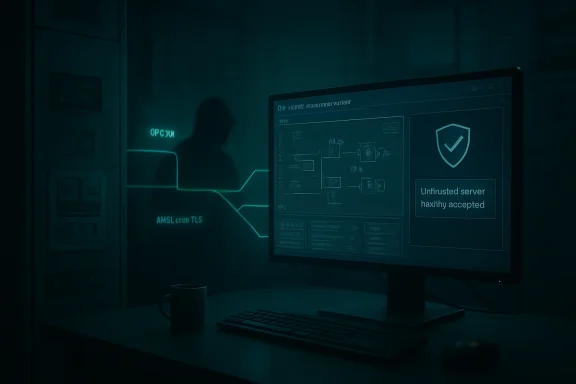 The Industrial Workstation Is Still the Soft Underbelly
Industrial cybersecurity conversations tend to gravitate toward controllers, field devices, and internet-exposed boxes with embarrassing banners. That focus is understandable: programmable logic controllers and remote access gateways are where production risk becomes visible. But engineering workstations remain one of the most consequential machines in an OT environment because they sit at the boundary between human intent and machine behavior.B&R Automation Studio is not a casual desktop utility. It is the development environment used to build, configure, and maintain automation systems across control, motion, HMI, operations, and safety-adjacent workflows. If an attacker can interfere with what that environment sees when it talks to a server, the compromise can become operationally meaningful without ever needing to exploit a PLC directly.
That is the uncomfortable part of CVE-2025-11043. The affected clients use OPC UA and ABB B&R’s ANSL over TLS, both of which are meant to provide secure communications. The vulnerability is not that encryption is absent; it is that the software’s certificate validation was insufficient. In security terms, that is the difference between locking the door and failing to check whether the person holding the key is actually the owner.
The CVSS 3.1 score of 7.4 lands in “high” territory, with network attack vector, no privileges required, no user interaction, and high confidentiality and integrity impact. The attack complexity is rated high, which is important, but it should not comfort anyone responsible for a plant network. High complexity does not mean implausible; it means the attacker must already be in a position to manipulate traffic, routing, name resolution, or a comparable network path.
Certificate Validation Bugs Turn Encryption Into Theater
TLS has a public reputation as a magic security blanket, but in practice it is a contract made of details. The client must verify that the server certificate is valid, trusted, unexpired, correctly chained, and bound to the identity the client intended to reach. If that verification is weak, then encryption can still occur — just between the victim and the wrong party.That is why improper certificate validation is such a stubborn class of vulnerability. It does not usually announce itself with crashes, obvious failures, or dramatic symptoms. The connection may appear normal. The session may be encrypted. The application may behave as though it has reached the intended server, while an attacker in the middle can observe, alter, or relay data.
In enterprise IT, this maps neatly to man-in-the-middle attacks, rogue proxies, poisoned DNS, compromised gateways, and malicious certificates. In industrial environments, the practical routes can be messier: maintenance laptops, remote support paths, jump hosts, flat network segments, misconfigured firewalls, and legacy assumptions that “inside the plant” means “trusted.” The advisory’s exploitation description is not exotic. It requires network access and the ability to redirect communication while presenting manipulated certificates that pass validation checks.
That last clause is the heart of the issue. A properly validating client should reject a server that cannot prove its identity. If the client accepts a certificate it should not accept, the attacker does not need to break TLS. They only need to become the party TLS mistakenly trusts.
CISA’s Republication Changes the Audience, Not the Bug
ABB’s PSIRT advisory was originally issued on January 19, 2026. CISA’s May 5 republication does not appear to introduce a new exploit report or a revised technical finding; it republishes the vendor’s CSAF advisory to widen visibility. That distinction matters because the security community often treats a new CISA page as a new event, when sometimes it is better understood as a signal boost.Still, the signal boost has value. CISA’s industrial control system advisories occupy a different channel than vendor PDFs. They are consumed by asset owners, managed security providers, insurers, regulators, and incident responders who may never read a vendor security page unless procurement forces the issue. When CISA republishes an advisory, it effectively translates vendor-specific risk into the broader language of national critical infrastructure.
The affected sector listed here is critical manufacturing, with worldwide deployment and ABB’s headquarters in Switzerland. That does not mean every factory using B&R tooling is in immediate danger. It means the software sits in environments where downtime, process deviation, intellectual property leakage, and unauthorized engineering changes can have consequences beyond a help desk ticket.
The advisory also says ABB had not received reports of exploitation when the advisory was originally issued. That is reassuring but limited. OT exploitation is often under-detected, under-reported, or discovered months after initial access. In the case of an interception bug, absence of known exploitation is especially slippery because successful abuse may not leave obvious artifacts unless logging, network monitoring, and certificate telemetry are mature.
The Attack Requires Position, Which Is Exactly What Intruders Seek
The most tempting mistake is to dismiss CVE-2025-11043 because it is not a one-packet remote compromise from the public internet. The attacker must be able to intercept and redirect communications between Automation Studio and the target server. In a well-designed industrial architecture, that requirement should be difficult.But attackers do not evaluate vulnerabilities in isolation. They chain them with weak segmentation, stolen credentials, exposed VPNs, unmanaged switches, shared admin workstations, remote contractor access, and the slow sediment of years of exceptions. Once an intruder has a foothold inside an industrial network, traffic-positioning attacks become more realistic, particularly in environments where engineering systems and control systems share more trust than they should.
This is why certificate validation flaws are strategically useful. They can convert a network foothold into application-layer trust. An attacker who cannot authenticate to a legitimate server may instead impersonate that server to a vulnerable client. Depending on what data is exchanged, the result could be disclosure of sensitive engineering information, manipulation of data in transit, or interference with workflows that operators believe are legitimate.
The advisory does not claim remote code execution. It does not claim safety impact. It does not say an attacker can directly seize a controller. But industrial compromise often begins long before the dramatic phase. The prelude is reconnaissance, trust abuse, configuration capture, and careful manipulation of the systems used by engineers to understand and modify the plant.
OPC UA’s Security Promise Still Depends on Implementations
OPC UA was built, in part, to move industrial communications beyond the insecure assumptions of older protocols. It supports authentication, encryption, signing, and certificate-based trust. In theory, that makes it a better fit for modern connected industrial systems than protocols designed for isolated serial links and benevolent networks.In practice, secure protocols can be undermined by insecure implementation or careless deployment. Certificate management in OT is notoriously awkward. Plants run equipment for decades, engineering laptops come and go, maintenance windows are scarce, and certificate rotation can feel like an administrative luxury until it becomes a security incident. The protocol may offer the right controls, but the environment must use them correctly and the software must enforce them rigorously.
CVE-2025-11043 is therefore not an indictment of OPC UA as a concept. It is a reminder that a secure protocol stack is not self-executing. If the client fails to reject bad certificates, the strongest cipher suite in the world cannot save the session from misplaced trust.
The ANSL-over-TLS side of the advisory tells the same story in a vendor-specific dialect. TLS is doing the transport security work, but certificate validation determines whether the tunnel leads to the intended endpoint. For engineering software, that distinction is not academic. The identity of the server is part of the operational truth the workstation relies on.
The Fix Is Simple; The Deployment Politics Are Not
ABB says the issue is corrected in B&R Automation Studio 6.5 and recommends customers apply the update at the earliest convenience. On paper, that is straightforward. Update the engineering environment, verify the installed version, and move on.In real plants, engineering software upgrades are not always routine. Automation environments may be tied to project versions, validated build chains, vendor support agreements, and local practices that discourage touching working systems. A minor-sounding workstation update can trigger compatibility testing, backup procedures, change approvals, and coordination with production schedules.
That friction is not an excuse to delay indefinitely. It is the operational reality security teams must plan around. The right response is not merely to shout “patch now,” but to identify which engineering stations run Automation Studio, which versions are installed, which projects and systems depend on them, and whether the upgrade to 6.5 affects existing workflows.
There is also a subtle inventory problem. Many organizations maintain asset lists for controllers, HMIs, servers, and network devices, but engineering tools can be harder to track. They may live on laptops, virtual machines, contractor systems, or shared workstations that are only powered on during maintenance. A vulnerability in engineering software therefore becomes a test of whether the organization knows where its engineering authority actually resides.
ABB’s Architecture Advice Is Doing More Work Than It Seems
The advisory recommends operating B&R Automation Studio within Level 2 of the ABB ICS Cyber Security Reference Architecture when connecting to Level 1 devices via ANSL over TLS or OPC UA. That may sound like boilerplate segmentation language, but it carries the practical mitigation logic of the entire advisory. If exploitation requires network positioning, then architecture determines whether that positioning is easy or hard.In the Purdue-style mental model many OT teams still use, Level 1 is where basic control devices and sensors live, while Level 2 contains supervisory systems and localized control functions. Engineering workstations often have an uncomfortable relationship with these layers because they need privileged access across boundaries during commissioning and maintenance. That need can become a standing trust relationship unless carefully constrained.
Putting Automation Studio in a trusted Level 2 environment is not a magic shield. It is a way to reduce exposure to less trusted networks, business IT traffic, remote access sprawl, and arbitrary lateral movement. If the workstation only communicates through known paths to known systems, the attacker’s job becomes meaningfully harder.
This is where many industrial security programs still struggle. Segmentation diagrams look clean during audits, but real-world maintenance creates exceptions. A vendor needs temporary access. A line is down. A switch gets added. A firewall rule becomes permanent because nobody wants to rediscover why it existed. Over time, the path an attacker needs to intercept traffic may appear not through design but through accumulated convenience.
The “No Internet Exposure” Advice Is Necessary but Incomplete
CISA’s standard recommendations appear in the advisory: minimize network exposure, keep control systems off the internet, isolate control networks from business networks, use firewalls, and rely on secure remote access methods such as updated VPNs when remote access is required. These are not wrong. They are the baseline.But for this vulnerability, the more useful question is not simply whether Automation Studio is reachable from the internet. It is whether a compromised host inside the organization could influence how Automation Studio resolves, routes, or trusts a server connection. That brings DNS, DHCP, routing, certificate stores, local administrator rights, and remote access tooling into scope.
A workstation can be “not internet-exposed” and still vulnerable to a nearby adversary. A contractor laptop on the same maintenance subnet may be enough. A compromised jump server may be enough. A misconfigured firewall that permits more east-west traffic than intended may be enough. The old perimeter language is necessary, but it does not fully describe modern OT attack paths.
This is why certificate validation bugs deserve a different operational response than ordinary patch triage. Teams should not only update the affected software; they should also examine whether certificate trust is being monitored, whether unexpected server identities generate alerts, and whether engineering workstations are allowed to communicate with anything they do not strictly need.
Windows Shops Should Recognize the Pattern
WindowsForum readers have seen this movie before in enterprise clothing. A domain-joined workstation trusts the wrong certificate authority. A proxy intercepts TLS in ways nobody documents. A line-of-business app disables strict validation because a certificate rollover once broke production. The first time, it is called a workaround. Five years later, it is called an attack surface.Industrial environments add higher stakes and older assumptions, but the pattern is familiar. Trust shortcuts outlive the problem they were meant to solve. Engineers prioritize uptime and access because those are the metrics the plant feels immediately. Security controls that interfere with commissioning or troubleshooting are softened, bypassed, or postponed.
The result is that certificate validation, which should be a binary security property, becomes a cultural negotiation. Does the application really need to reject this certificate? Can we click through the warning? Can we pin it later? Can we just make it work for now? CVE-2025-11043 is vendor-fixed, but the broader habit of treating identity validation as an inconvenience is not fixed by one software release.
For Windows administrators supporting OT teams, the lesson is direct. Engineering workstations should be managed as privileged systems, not as ordinary desktops with unusual software. They need patch visibility, controlled local admin rights, hardened remote access, logging, backup discipline, and network rules that reflect the authority they carry.
Severity Scores Understate Operational Context
A CVSS 3.1 score of 7.4 is serious but not catastrophic on its face. The score reflects high confidentiality and integrity impact, no availability impact, no privileges required, no user interaction, and high attack complexity. That is a fair technical shape for the vulnerability as described.Yet CVSS has always struggled with industrial context. It scores properties of the software flaw, not the production consequences of the environment where the software is used. A data integrity issue in an engineering workflow can be minor in one lab and deeply consequential in a plant where configuration, motion control, or operational visibility depends on the affected communications.
The CVE record also includes a CVSS 4.0 score of 9.1 from ABB’s CNA data, which illustrates how newer scoring can represent the same issue more sharply. Whether an organization anchors on 7.4 or 9.1, the practical answer should be the same: affected Automation Studio installations need to be found, upgraded, and protected by network controls that assume the workstation is a high-value target.
Security teams should resist both extremes. This is not a reason to panic-shutdown engineering workstations. It is also not a reason to bury the advisory because exploitation requires network access. In OT, “requires network access” often describes the second stage of a real intrusion, not a theoretical barrier.
The Quiet Risk Is Manipulated Confidence
The most damaging industrial cyber incidents are not always the ones that make machines stop immediately. Sometimes the greater danger is that humans and systems continue operating on false assumptions. A trusted connection is believed to be authentic. A data exchange is believed to be intact. A workstation is believed to be talking to the intended server.That is the category CVE-2025-11043 belongs to. Its risk is not merely interception; it is manipulated confidence. The attacker’s advantage comes from making the abnormal look normal at precisely the layer where the software is supposed to establish trust.
For defenders, that means detection should include more than malware signatures and failed logins. Network teams should care about unexpected certificate chains, server identity changes, DNS anomalies, route changes, and traffic patterns involving engineering workstations. OT teams should know what normal Automation Studio communications look like, not just whether the application launches successfully.
The advisory’s statement that exploitation requires manipulated certificates and traffic redirection should be read as a defensive checklist in reverse. If an attacker needs to redirect traffic, monitor the paths by which that could happen. If an attacker needs a certificate to pass validation, understand what the client trusts. If an attacker needs access to the system network, reduce the number of systems and users that can provide it.
The Patch Is a Product Fix, Not a Trust Strategy
Updating to Automation Studio 6.5 closes the vendor-identified vulnerability, and that should be the priority. But the advisory also exposes a broader dependency that every industrial operator has to manage: the engineering toolchain is part of the control system’s security boundary. Treating it as external to OT risk is a category error.A mature response would start with inventory and end with architecture. Which machines run B&R Automation Studio? Which versions are installed? Which ones connect over OPC UA or ANSL over TLS? Which servers do they talk to? Which network segments can influence those sessions? Which certificates and authorities are trusted? Which remote users can reach those machines?
Those questions are not glamorous, but they are the substance of industrial defense. The attacker does not care whether the vulnerable component is a controller, an engineering suite, a historian, or a remote support appliance. The attacker cares whether compromise of that component can move them closer to operational influence.
ABB’s fix handles the immediate improper validation problem. CISA’s republication broadens awareness. The remaining work belongs to asset owners, integrators, and IT teams who must turn an advisory into an actual change before the next maintenance window becomes the next excuse.
The Automation Studio Advisory Leaves Little Room for Comfortable Delay
The practical reading of CVE-2025-11043 is narrow enough to act on and broad enough to matter. It affects Automation Studio before 6.5, it concerns certificate validation in OPC UA and ANSL-over-TLS clients, and it rewards attackers who can get close enough to tamper with industrial communications.- Organizations running B&R Automation Studio versions before 6.5 should plan an upgrade to version 6.5 rather than treating segmentation as a permanent substitute for the fix.
- Engineering workstations should be inventoried and managed as privileged OT assets, including laptops and virtual machines that may not appear in standard server or controller inventories.
- Network defenders should treat unexpected certificate behavior, DNS changes, and routing anomalies around engineering systems as meaningful security signals.
- Remote access paths into OT environments should be reviewed with the assumption that a compromised intermediate system could support traffic interception.
- Segmentation should be tested against real maintenance workflows, because documented architecture often differs from the access paths engineers and vendors actually use.
Source: CISA ABB B&R Automation Studio | CISA
