

Palo Alto Networks disclosed CVE-2026-0257 on May 13, 2026, then updated the advisory on May 29 after exploitation attempts were observed against unpatched PAN-OS devices running GlobalProtect portal or gateway configurations without mitigations. For WindowsForum’s sysadmin and IT-pro audience, the immediate work is plain: identify exposed GlobalProtect deployments, verify whether authentication override cookies and the relevant certificate configuration are in use, and move affected PAN-OS branches to fixed releases. The deeper issue is that this is not merely a firewall patch; it is a warning about what happens when the VPN itself becomes the compromised trust boundary.
CVE-2026-0257 matters because it sits at the point where many enterprises decide whether a user is inside enough to reach internal systems. GlobalProtect is often treated as a perimeter identity gate: once a session is established, downstream Windows file shares, management consoles, intranet applications, jump hosts, and administrative interfaces may behave as if the hard part has already happened.
That assumption is exactly what makes an authentication bypass in a VPN portal or gateway so dangerous. The advisory language is narrow, but the operational consequence is broad: an attacker who can establish an unauthorized VPN connection may inherit the network position normally reserved for authenticated remote users. That does not automatically mean domain compromise, lateral movement, or data theft, but it does change the starting line.
The flaw also lands in an uncomfortable moment for enterprise remote access. Over the last several years, VPN appliances have become both a lifeline for hybrid work and a favorite target class for attackers who want durable access. A perimeter device that fronts identity, encryption, policy, and routing is not just infrastructure; it is a concentrated trust broker.
For Windows-heavy environments, that distinction matters. A compromised web app is one problem; an unauthorized VPN session can become a staging ground for probing SMB exposure, RDP policies, identity federation paths, endpoint management tooling, and legacy applications that were never designed to face an untrusted network.
That is why this bug should be understood as a trust-boundary failure. Authentication override cookies are meant to preserve or streamline legitimate access decisions. Certificates are meant to anchor trust in cryptographic identity. When those mechanisms interact in a vulnerable configuration, the thing being attacked is not a password prompt in the ordinary sense; it is the logic that allows the system to accept a session as already legitimate.
That distinction should shape incident response. Administrators should not treat this as a simple “patch and forget” event if their environment matched the exposed configuration. They should treat it as a possible unauthorized session problem and examine whether GlobalProtect access was granted where it should not have been.
This is also why the bug has implications beyond Palo Alto appliances themselves. If internal services depend on the VPN as their practical authentication boundary, then the risk flows outward. The appliance may be where the vulnerability exists, but the systems that trust the resulting session are where the attacker may seek value.
That does not mean every GlobalProtect deployment is vulnerable. The exposure requirements matter. A shop that does not use the affected GlobalProtect portal or gateway configuration, or that does not meet the cookie and certificate conditions described by Palo Alto, may not be exposed in the same way. But the operational burden is now on defenders to prove that, not to assume it.
The affected PAN-OS branches listed by Palo Alto include 10.2, 11.1, 11.2, and 12.1. Fixed releases include 10.2.18-h6, 11.1.15, 11.2.12, and 12.1.7. That gives administrators a concrete version target, but it also creates the usual enterprise friction: maintenance windows, HA pair planning, change approvals, regression concerns, and business units that treat VPN availability as mission-critical.
The uncomfortable reality is that attackers do not wait for that process to become convenient. Once exploitation is public enough to appear in vendor updates and government catalogs, defenders should assume scanning and opportunistic testing will accelerate. VPN bugs often have a short path from advisory to weaponization because the targets are internet-facing by design.
Many internal architectures still rely on VPN presence as a coarse security signal. A user connected through the VPN is often allowed to reach resources that would otherwise be blocked. That design made sense when remote access was rarer, endpoints were more uniform, and the perimeter was easier to define. It is less convincing when the VPN front door itself becomes a regularly targeted application surface.
For Windows administrators, this means reviewing downstream assumptions. If a VPN subnet can talk broadly to domain controllers, management servers, file servers, application servers, or privileged admin portals, then unauthorized VPN access is not a contained event. It is a potential foothold inside the network’s most sensitive paths.
The response should include log review for anomalous GlobalProtect sessions, but the goal should not be limited to finding a single known pattern. Teams should look for unexpected connection times, unfamiliar source geographies, unusual user/session pairings, strange internal destinations reached shortly after connection, and access that does not match ordinary help desk or workforce behavior. The facts supplied by Palo Alto do not provide a universal indicator list, so defenders should avoid overfitting to a single signature.
This is also a good moment to revisit segmentation. A VPN should not automatically mean broad east-west access. If internal services require their own authorization checks, if privileged tools sit behind additional controls, and if remote-access groups are narrowly scoped, then a VPN authentication bypass is still serious—but it is less likely to become an enterprise-wide trust collapse.
That is why the phrase “unauthorized VPN connection” should stop administrators in their tracks. The VPN session is not the final objective; it is the passport. Once the tunnel exists, the attacker can test which internal systems accept that passport as sufficient proof of legitimacy.
This is particularly relevant for environments that still operate a mix of modern identity controls and older internal applications. A cloud app protected by conditional access may challenge a user repeatedly. A legacy intranet app reachable only from VPN space may not. A management interface that was never meant to be exposed to the internet may rely on network location as a major part of its risk model.
GlobalProtect deployments often sit in exactly that gap between old and new enterprise security. They protect internal resources built for a perimeter world while serving users who now work from everywhere. When the VPN’s own authentication boundary weakens, the organization gets a live-fire test of how much implicit trust remains behind the curtain.
But configuration-dependent vulnerabilities are still dangerous because administrators often do not have a clean, real-time inventory of how every perimeter service is configured. VPN platforms are long-lived, frequently tuned, and often modified under pressure during migrations, mergers, outages, and remote-work surges. A setting that was reasonable in one operational moment can become a liability months or years later.
The certificate angle is especially important because certificates are often treated as background plumbing once deployed. Teams renew them, reuse them, export them, and attach them to services without always mapping the trust consequences. A vulnerability that depends on certificate configuration is a reminder that cryptographic material is not just a file in an appliance UI; it is an authority boundary.
Authentication override cookies deserve the same scrutiny. Convenience features are not inherently reckless, but they are security-sensitive because they preserve authentication state. If an attacker can abuse the mechanism that carries that state, the organization’s multifactor, password, and policy layers may not be consulted in the way defenders expect.
The right question is not simply “are we vulnerable?” It is “where have we allowed convenience mechanisms to become equivalent to authentication?” That question applies well beyond this CVE.
An unauthorized VPN session can therefore become a reconnaissance platform. Even without administrator credentials, a connected attacker may be able to observe naming conventions, test reachable services, identify authentication prompts, and map segmentation boundaries. That information is valuable because it turns a faceless external target into a navigable internal environment.
The risk is higher in networks where VPN users land on broad internal ranges. It is lower where access is constrained by user group, device posture, application proxying, and service-level authorization. The vulnerability does not erase those defenses; it tests whether they exist.
Windows environments also tend to accumulate exceptions. A vendor support subnet here, a temporary RDP allowance there, an old file share that still trusts network location, a management tool reachable from “VPN users” because it simplified operations during a crisis. These are exactly the places where a perimeter authentication bypass can have consequences that outlive the original patch.
Inventory should identify PAN-OS versions in the affected branches and determine whether GlobalProtect portal or gateway configurations match the exposure conditions. Mitigation should focus on the vendor-described configuration risk while the patch process moves toward fixed releases. Patching should target the relevant fixed version for the branch in use, not a vague “latest soon” promise.
Verification matters because perimeter appliances often exist in pairs, clusters, or distributed regional deployments. A single upgraded gateway does not help if another exposed portal remains on an affected version. Nor does a fixed version help if administrators assume the configuration state changed when it did not.
Hunting should focus on the period before the fix, especially after May 13 and around the May 29 update, because the public risk posture changed as the advisory evolved. Teams should be careful with wording here: Palo Alto reported exploitation attempts against unpatched, unmitigated devices, but the available facts do not provide enough detail to declare every exposed organization compromised. The responsible position is to investigate, not to panic.
The lesson is not that VPNs are obsolete. For many organizations, they remain necessary, especially for administrative access, legacy applications, and hybrid networks that cannot be rebuilt overnight. The lesson is that VPN authentication must not be the only meaningful control separating the public internet from sensitive internal systems.
This is where zero-trust rhetoric often outruns implementation. Vendors sell identity-aware access, posture checks, segmentation, and continuous verification, but many networks still behave as if tunnel establishment is the big binary decision. CVE-2026-0257 is a reminder that the binary decision can be attacked.
A mature response therefore has two tracks. The first is immediate hygiene: patch the affected PAN-OS branches and remove the exposed configuration where applicable. The second is architectural: reduce the blast radius of any future VPN failure by making internal services distrust network location alone.
But version numbers can also create a false sense of completion. The appliance may be patched while logs remain unchecked. The vulnerable configuration may be removed while VPN address pools still have excessive reach. The advisory may be closed while downstream applications continue to assume that “reachable from VPN” equals “trusted user.”
This is why the article’s angle matters. If CVE-2026-0257 is filed mentally as just another PAN-OS patch, the response will be too small. If it is understood as a trust-boundary failure at the cookie and certificate layer, the response becomes more useful: validate sessions, constrain access, review certificate use, and stop treating VPN presence as identity proof.
There is also a communications lesson for security teams. Business leaders understand outages and patches, but they may not understand why a VPN bug changes internal risk. The clearest explanation is simple: the VPN is the door guard, and this flaw may let the wrong person receive a badge. The question is then where that badge works.
That means administrators should resist two bad instincts. The first is denial: assuming the configuration caveat means someone else’s problem. The second is theater: declaring compromise without evidence and burying teams in unfocused emergency work. The right middle path is fast validation followed by targeted remediation.
For most environments, the immediate checklist is compact:
The uncomfortable part is that many organizations have modernized the vocabulary faster than the architecture. They talk about conditional access and least privilege while still allowing broad internal reach once a VPN client connects. They deploy certificates and cookies for smoother access while underestimating how much trust those mechanisms carry.
GlobalProtect is not unique in this regard. Any remote-access platform that can convert an external request into an internal session deserves the same scrutiny. That includes how it authenticates, how it preserves authentication state, how certificates are scoped, how sessions are logged, and how much the rest of the network believes the result.
The smart response to this incident is therefore not vendor panic. It is trust-boundary discipline. Patch the Palo Alto systems. Audit the configuration. Hunt for unauthorized sessions. Then look behind the VPN and ask how many services still behave as if the tunnel itself is proof enough.
CVE-2026-0257 will eventually become another closed advisory in a patch dashboard, but the design lesson should stay open: remote-access infrastructure is now part of the identity plane, and every cookie, certificate, and session decision at that edge can reshape the risk of the Windows estate behind it. The organizations that come out stronger will be the ones that treat this not as a one-week Palo Alto emergency, but as a rehearsal for the next time a trusted gateway is asked to prove it deserves that trust.
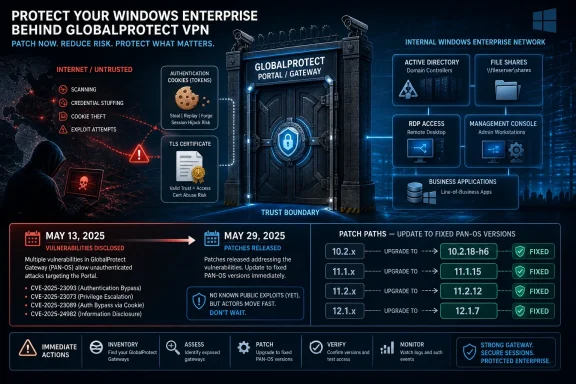 The VPN Gate Is the Asset, Not the Appliance
CVE-2026-0257 matters because it sits at the point where many enterprises decide whether a user is inside enough to reach internal systems. GlobalProtect is often treated as a perimeter identity gate: once a session is established, downstream Windows file shares, management consoles, intranet applications, jump hosts, and administrative interfaces may behave as if the hard part has already happened.That assumption is exactly what makes an authentication bypass in a VPN portal or gateway so dangerous. The advisory language is narrow, but the operational consequence is broad: an attacker who can establish an unauthorized VPN connection may inherit the network position normally reserved for authenticated remote users. That does not automatically mean domain compromise, lateral movement, or data theft, but it does change the starting line.
The flaw also lands in an uncomfortable moment for enterprise remote access. Over the last several years, VPN appliances have become both a lifeline for hybrid work and a favorite target class for attackers who want durable access. A perimeter device that fronts identity, encryption, policy, and routing is not just infrastructure; it is a concentrated trust broker.
For Windows-heavy environments, that distinction matters. A compromised web app is one problem; an unauthorized VPN session can become a staging ground for probing SMB exposure, RDP policies, identity federation paths, endpoint management tooling, and legacy applications that were never designed to face an untrusted network.
The Cookie and Certificate Layer Becomes the Attack Surface
The most important detail in Palo Alto’s advisory is not merely that GlobalProtect portal and gateway components are affected. It is that exposure requires a specific set of conditions involving GlobalProtect portal or gateway use, authentication override cookies, and a particular certificate configuration. In other words, the vulnerability lives in the machinery that tells the VPN, “this user has already satisfied the necessary authentication conditions.”That is why this bug should be understood as a trust-boundary failure. Authentication override cookies are meant to preserve or streamline legitimate access decisions. Certificates are meant to anchor trust in cryptographic identity. When those mechanisms interact in a vulnerable configuration, the thing being attacked is not a password prompt in the ordinary sense; it is the logic that allows the system to accept a session as already legitimate.
That distinction should shape incident response. Administrators should not treat this as a simple “patch and forget” event if their environment matched the exposed configuration. They should treat it as a possible unauthorized session problem and examine whether GlobalProtect access was granted where it should not have been.
This is also why the bug has implications beyond Palo Alto appliances themselves. If internal services depend on the VPN as their practical authentication boundary, then the risk flows outward. The appliance may be where the vulnerability exists, but the systems that trust the resulting session are where the attacker may seek value.
The Timeline Leaves Little Room for Slow Change Windows
Palo Alto published CVE-2026-0257 on May 13, 2026, and updated the advisory on May 29. The update is the line that should move this from routine maintenance planning into urgent exposure review: Palo Alto says exploitation attempts were already observed against unpatched PAN-OS devices that lacked mitigations.That does not mean every GlobalProtect deployment is vulnerable. The exposure requirements matter. A shop that does not use the affected GlobalProtect portal or gateway configuration, or that does not meet the cookie and certificate conditions described by Palo Alto, may not be exposed in the same way. But the operational burden is now on defenders to prove that, not to assume it.
The affected PAN-OS branches listed by Palo Alto include 10.2, 11.1, 11.2, and 12.1. Fixed releases include 10.2.18-h6, 11.1.15, 11.2.12, and 12.1.7. That gives administrators a concrete version target, but it also creates the usual enterprise friction: maintenance windows, HA pair planning, change approvals, regression concerns, and business units that treat VPN availability as mission-critical.
The uncomfortable reality is that attackers do not wait for that process to become convenient. Once exploitation is public enough to appear in vendor updates and government catalogs, defenders should assume scanning and opportunistic testing will accelerate. VPN bugs often have a short path from advisory to weaponization because the targets are internet-facing by design.
Patch Management Is Necessary, but Session Trust Is the Real Audit
The minimum response is to patch affected systems to a fixed PAN-OS release. That is the part most organizations already know how to do, even if they do it slowly. The harder response is to ask what the environment trusted once a GlobalProtect session existed.Many internal architectures still rely on VPN presence as a coarse security signal. A user connected through the VPN is often allowed to reach resources that would otherwise be blocked. That design made sense when remote access was rarer, endpoints were more uniform, and the perimeter was easier to define. It is less convincing when the VPN front door itself becomes a regularly targeted application surface.
For Windows administrators, this means reviewing downstream assumptions. If a VPN subnet can talk broadly to domain controllers, management servers, file servers, application servers, or privileged admin portals, then unauthorized VPN access is not a contained event. It is a potential foothold inside the network’s most sensitive paths.
The response should include log review for anomalous GlobalProtect sessions, but the goal should not be limited to finding a single known pattern. Teams should look for unexpected connection times, unfamiliar source geographies, unusual user/session pairings, strange internal destinations reached shortly after connection, and access that does not match ordinary help desk or workforce behavior. The facts supplied by Palo Alto do not provide a universal indicator list, so defenders should avoid overfitting to a single signature.
This is also a good moment to revisit segmentation. A VPN should not automatically mean broad east-west access. If internal services require their own authorization checks, if privileged tools sit behind additional controls, and if remote-access groups are narrowly scoped, then a VPN authentication bypass is still serious—but it is less likely to become an enterprise-wide trust collapse.
GlobalProtect Is an Identity Control Whether Security Teams Admit It or Not
Vendors often describe VPN products in networking terms: portals, gateways, tunnels, clients, certificates, policies. Attackers experience them differently. To an attacker, a VPN is a credential translator and a location changer. It can turn an outsider into someone who appears to be connecting from a sanctioned path.That is why the phrase “unauthorized VPN connection” should stop administrators in their tracks. The VPN session is not the final objective; it is the passport. Once the tunnel exists, the attacker can test which internal systems accept that passport as sufficient proof of legitimacy.
This is particularly relevant for environments that still operate a mix of modern identity controls and older internal applications. A cloud app protected by conditional access may challenge a user repeatedly. A legacy intranet app reachable only from VPN space may not. A management interface that was never meant to be exposed to the internet may rely on network location as a major part of its risk model.
GlobalProtect deployments often sit in exactly that gap between old and new enterprise security. They protect internal resources built for a perimeter world while serving users who now work from everywhere. When the VPN’s own authentication boundary weakens, the organization gets a live-fire test of how much implicit trust remains behind the curtain.
The Configuration Caveat Should Not Become an Excuse
It is tempting to read the exposure conditions and relax. The vulnerability requires GlobalProtect portal or gateway use plus authentication override cookies and a specific certificate configuration. That is narrower than a universal unauthenticated remote code execution bug hitting every exposed appliance.But configuration-dependent vulnerabilities are still dangerous because administrators often do not have a clean, real-time inventory of how every perimeter service is configured. VPN platforms are long-lived, frequently tuned, and often modified under pressure during migrations, mergers, outages, and remote-work surges. A setting that was reasonable in one operational moment can become a liability months or years later.
The certificate angle is especially important because certificates are often treated as background plumbing once deployed. Teams renew them, reuse them, export them, and attach them to services without always mapping the trust consequences. A vulnerability that depends on certificate configuration is a reminder that cryptographic material is not just a file in an appliance UI; it is an authority boundary.
Authentication override cookies deserve the same scrutiny. Convenience features are not inherently reckless, but they are security-sensitive because they preserve authentication state. If an attacker can abuse the mechanism that carries that state, the organization’s multifactor, password, and policy layers may not be consulted in the way defenders expect.
The right question is not simply “are we vulnerable?” It is “where have we allowed convenience mechanisms to become equivalent to authentication?” That question applies well beyond this CVE.
The Windows Estate Behind the Tunnel Is Where the Stakes Multiply
For WindowsForum readers, the practical concern is not that PAN-OS has a vulnerability in isolation. It is that the assets behind a GlobalProtect deployment are often Windows-centric, business-critical, and deeply interconnected. Active Directory, file services, endpoint management, remote administration, SQL-backed business apps, and line-of-business systems frequently sit behind the VPN.An unauthorized VPN session can therefore become a reconnaissance platform. Even without administrator credentials, a connected attacker may be able to observe naming conventions, test reachable services, identify authentication prompts, and map segmentation boundaries. That information is valuable because it turns a faceless external target into a navigable internal environment.
The risk is higher in networks where VPN users land on broad internal ranges. It is lower where access is constrained by user group, device posture, application proxying, and service-level authorization. The vulnerability does not erase those defenses; it tests whether they exist.
Windows environments also tend to accumulate exceptions. A vendor support subnet here, a temporary RDP allowance there, an old file share that still trusts network location, a management tool reachable from “VPN users” because it simplified operations during a crisis. These are exactly the places where a perimeter authentication bypass can have consequences that outlive the original patch.
The Incident Response Window Starts Before the Upgrade Reboot
The cleanest operational sequence is inventory, mitigate, patch, verify, and hunt. In reality, many organizations will do those in parallel because VPN downtime is politically difficult and attacker interest is already present. That is acceptable as long as teams do not confuse motion with closure.Inventory should identify PAN-OS versions in the affected branches and determine whether GlobalProtect portal or gateway configurations match the exposure conditions. Mitigation should focus on the vendor-described configuration risk while the patch process moves toward fixed releases. Patching should target the relevant fixed version for the branch in use, not a vague “latest soon” promise.
Verification matters because perimeter appliances often exist in pairs, clusters, or distributed regional deployments. A single upgraded gateway does not help if another exposed portal remains on an affected version. Nor does a fixed version help if administrators assume the configuration state changed when it did not.
Hunting should focus on the period before the fix, especially after May 13 and around the May 29 update, because the public risk posture changed as the advisory evolved. Teams should be careful with wording here: Palo Alto reported exploitation attempts against unpatched, unmitigated devices, but the available facts do not provide enough detail to declare every exposed organization compromised. The responsible position is to investigate, not to panic.
The Old VPN Lesson Keeps Repeating
WindowsForum has covered enough remote-access security stories to make the pattern familiar. Whether the product logo is Palo Alto, Pulse Secure, Fortinet, Ivanti, or another gateway vendor, the theme recurs: internet-facing access brokers become high-value targets because they sit between attackers and everything else. Past community discussion around Pulse Secure exploitation and newer VPN CVEs is not just historical color; it is the institutional memory administrators should bring to this incident.The lesson is not that VPNs are obsolete. For many organizations, they remain necessary, especially for administrative access, legacy applications, and hybrid networks that cannot be rebuilt overnight. The lesson is that VPN authentication must not be the only meaningful control separating the public internet from sensitive internal systems.
This is where zero-trust rhetoric often outruns implementation. Vendors sell identity-aware access, posture checks, segmentation, and continuous verification, but many networks still behave as if tunnel establishment is the big binary decision. CVE-2026-0257 is a reminder that the binary decision can be attacked.
A mature response therefore has two tracks. The first is immediate hygiene: patch the affected PAN-OS branches and remove the exposed configuration where applicable. The second is architectural: reduce the blast radius of any future VPN failure by making internal services distrust network location alone.
The Version Numbers Are the Easy Part of the Story
The fixed PAN-OS releases named by Palo Alto give administrators a concrete target: 10.2.18-h6, 11.1.15, 11.2.12, and 12.1.7. That specificity is useful, and organizations should use it to drive change tickets instead of waiting for broad monthly patch cycles. If a GlobalProtect portal or gateway meets the exposure conditions, the upgrade path should be treated as security work, not routine lifecycle maintenance.But version numbers can also create a false sense of completion. The appliance may be patched while logs remain unchecked. The vulnerable configuration may be removed while VPN address pools still have excessive reach. The advisory may be closed while downstream applications continue to assume that “reachable from VPN” equals “trusted user.”
This is why the article’s angle matters. If CVE-2026-0257 is filed mentally as just another PAN-OS patch, the response will be too small. If it is understood as a trust-boundary failure at the cookie and certificate layer, the response becomes more useful: validate sessions, constrain access, review certificate use, and stop treating VPN presence as identity proof.
There is also a communications lesson for security teams. Business leaders understand outages and patches, but they may not understand why a VPN bug changes internal risk. The clearest explanation is simple: the VPN is the door guard, and this flaw may let the wrong person receive a badge. The question is then where that badge works.
The Concrete Work Starts With Proving Exposure
The facts available are specific enough to support decisive action, but not broad enough to justify invented certainty. Palo Alto has identified affected PAN-OS branches, fixed versions, required exposure conditions, and observed exploitation attempts against unpatched devices without mitigations. It has not, in the verified facts available here, supplied a universal compromise pattern, a public attacker profile, or a claim that every GlobalProtect deployment is vulnerable.That means administrators should resist two bad instincts. The first is denial: assuming the configuration caveat means someone else’s problem. The second is theater: declaring compromise without evidence and burying teams in unfocused emergency work. The right middle path is fast validation followed by targeted remediation.
For most environments, the immediate checklist is compact:
- Confirm whether any GlobalProtect portal or gateway is running on PAN-OS 10.2, 11.1, 11.2, or 12.1 in a version below the fixed release for that branch.
- Determine whether authentication override cookies are enabled and whether the certificate configuration matches Palo Alto’s exposure conditions.
- Apply the relevant fixed PAN-OS release, including 10.2.18-h6, 11.1.15, 11.2.12, or 12.1.7 where applicable.
- Review GlobalProtect session activity for unexpected or anomalous VPN connections before remediation was completed.
- Reassess which internal Windows services and administrative interfaces trust VPN network location as a substitute for stronger authorization.
The Perimeter Is Still There, Just More Fragile Than Advertised
For years, security vendors have told customers that the perimeter is dissolving. That is only half true. The perimeter did not disappear; it moved into identity providers, access brokers, VPN gateways, cookies, certificates, device posture checks, and policy engines. CVE-2026-0257 is a perimeter failure in that newer sense.The uncomfortable part is that many organizations have modernized the vocabulary faster than the architecture. They talk about conditional access and least privilege while still allowing broad internal reach once a VPN client connects. They deploy certificates and cookies for smoother access while underestimating how much trust those mechanisms carry.
GlobalProtect is not unique in this regard. Any remote-access platform that can convert an external request into an internal session deserves the same scrutiny. That includes how it authenticates, how it preserves authentication state, how certificates are scoped, how sessions are logged, and how much the rest of the network believes the result.
The smart response to this incident is therefore not vendor panic. It is trust-boundary discipline. Patch the Palo Alto systems. Audit the configuration. Hunt for unauthorized sessions. Then look behind the VPN and ask how many services still behave as if the tunnel itself is proof enough.
CVE-2026-0257 will eventually become another closed advisory in a patch dashboard, but the design lesson should stay open: remote-access infrastructure is now part of the identity plane, and every cookie, certificate, and session decision at that edge can reshape the risk of the Windows estate behind it. The organizations that come out stronger will be the ones that treat this not as a one-week Palo Alto emergency, but as a rehearsal for the next time a trusted gateway is asked to prove it deserves that trust.
References
- Primary source: security.paloaltonetworks.com
CVE-2026-0257 PAN-OS: GlobalProtect Authentication Bypass Vulnerabilities
Palo Alto Networks Security Advisory: CVE-2026-0257 PAN-OS: GlobalProtect Authentication Bypass Vulnerabilities Authentication bypass vulnerabilities in the GlobalProtect portal and gateway of Palo Alto Networks PAN-OS® software allows the attacker to bypass security restrictions and establish... security.paloaltonetworks.com
- Independent coverage: threataft.com
PAN-OS GlobalProtect Auth Bypass CVE-2026-0257 Exploited | ThreatAft
CVE-2026-0257 in PAN-OS GlobalProtect lets attackers forge VPN cookies and bypass authentication. CISA KEV listed, actively exploited. Patch now.threataft.com - Independent coverage: threatprotect.qualys.com
- Independent coverage: cybernewsai.com
Active Exploitation of PAN-OS GlobalProtect Authentication Bypass (CVE-2026-0257) | CyberNewsAI
A critical authentication bypass vulnerability (CVE-2026-0257) in PAN-OS GlobalProtect gateways is under active exploitation.www.cybernewsai.com - Independent coverage: sentinelone.com
CVE-2026-0257: PAN-OS GlobalProtect Auth Bypass Flaw
CVE-2026-0257 is an authentication bypass vulnerability in PAN-OS GlobalProtect. Learn about its impact, affected versions, and mitigation methods.www.sentinelone.com
- Independent coverage: threat-modeling.com
Palo Alto PAN-OS GlobalProtect Authentication Bypass (CVE-2026-0257): Actively Exploited, CISA KEV Deadline June 1 - Threat-Modeling.com
Palo Alto Networks has disclosed an authentication bypass vulnerability in PAN-OS GlobalProtect, tracked as CVE-2026-0257, carrying a CVSS score of 9.1. The vulnerability has been ... <a title="Palo Alto PAN-OS GlobalProtect Authentication Bypass (CVE-2026-0257): Actively Exploited, CISA... threat-modeling.com

- Independent coverage: rivercore.tech
PAN-OS CVE-2026-0257 GlobalProtect Bypass | RiverCore
CVE-2026-0257 is actively exploited and CISA KEV-listed. Learn how this PAN-OS GlobalProtect VPN bypass affects your architecture and why patching now is cri...rivercore.tech - Independent coverage: nvd.nist.gov
NVD - CVE-2026-0257
 nvd.nist.gov
- Independent coverage: threatclaw.ai
CVE-2026-0257 — CRITICAL Vulnerability | CISA KEV | CVSS 9.1 | ThreatClaw
CVE-2026-0257 is actively exploited in the wild (CISA KEV). CVSS 9.1. Exploitation risk score: 54/100. Authentication bypass vulnerabilities in the GlobalProtecwww.threatclaw.ai - Independent coverage: cyberuptive.com
PAN-OS CVE-2026-0257: GlobalProtect KEV Guide | Cyberuptive
CISA added PAN-OS CVE-2026-0257 to KEV. How to verify GlobalProtect exposure, check authentication override config, patch fast, and review VPN evidence. www.cyberuptive.com
- Independent coverage: rapid7.com
Rapid7 Observed Exploitation of PAN-OS GlobalProtect Authentication Bypass Vulnerability (CVE-2026-0257)
Rapid7 MDR has observed active exploitation of PAN-OS GlobalProtect Authentication Bypass Vulnerability CVE-2026-0257.www.rapid7.com - Independent coverage: pinaka.sh
CVE-2026-0257: Palo Alto Networks PAN-OS Critical Vulnerability | Pinaka Security
CVE-2026-0257, critical severity Palo Alto Networks PAN-OS vulnerability (CVSS 9.1). Actively exploited, in CISA KEV since 2026-05-29. Public exploit…pinaka.sh
