

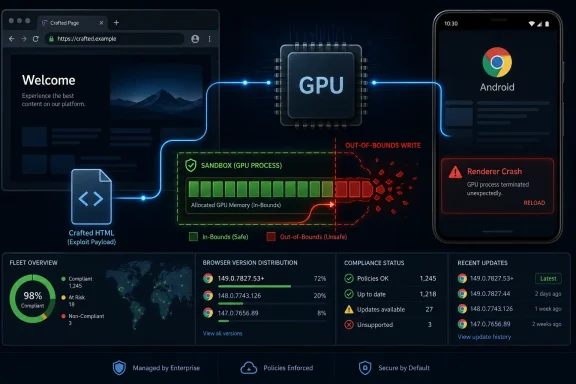
Google published CVE-2026-10892 on June 4, 2026, identifying a critical out-of-bounds write in Chrome’s GPU component on Android before version 149.0.7827.53 that could let a remote attacker attempt a sandbox escape through a crafted HTML page. The phrasing is dry, but the implication is not: this is the kind of browser bug that turns “just visiting a page” into a security boundary problem. For WindowsForum readers, the Android label should not invite complacency, because Chrome’s GPU attack surface is part of a broader Chromium ecosystem that spans Chrome, Edge, Electron apps, WebView, and enterprise-managed fleets. CVE-2026-10892 is less interesting as an isolated entry than as a reminder that the modern browser is now an operating system component in everything but name.
A decade ago, a serious browser vulnerability mostly meant patching the browser and warning users not to click suspicious links. That advice was never sufficient, but it at least matched the mental model: the browser was an application, the operating system was the platform, and a sandbox was supposed to keep the damage contained.
CVE-2026-10892 lives in a different reality. The affected component is the GPU path, the exploit vector is a crafted HTML page, and the stated impact is a potential sandbox escape. That combination puts the bug at the intersection of web content, graphics acceleration, memory safety, and privilege boundaries.
The GPU process has become one of the most attractive places to look for browser compromise because it has to translate untrusted web content into accelerated graphics operations at high speed. It touches drivers, shaders, buffers, codecs, compositors, and platform-specific hardware paths. When a memory corruption bug appears there, the result is rarely a tidy web-only failure.
Google’s description limits the issue to Chrome on Android prior to 149.0.7827.53, and that matters. But Chromium security advisories often reveal more about the shape of the attack surface than the literal list of affected builds. GPU bugs tend to be portable in concept even when specific exploitability is platform-bound.
Still, the reference trail is awkward. The change history points to a Chrome stable-channel desktop update as a vendor advisory, while the CVE description specifically names Android. That is not unusual in Chromium’s disclosure machinery, where a single release post may cover a cluster of fixes across channels and platforms, but it can confuse vulnerability scanners and patch dashboards that want a neat product-to-CVE mapping.
This is why the “missing CPE” question matters. NVD’s initial configuration reportedly used an AND relationship between Google Chrome versions before 149.0.7827.53 and Android as the operating system. That is a reasonable attempt to express “Chrome on Android,” but CPE modeling has always struggled with application flaws whose exploitability depends on platform, channel, build, and packaging.
For enterprise IT, the practical answer is not to wait for the CPE tree to become elegant. If the managed asset is Android and it runs Chrome older than 149.0.7827.53, treat it as exposed. If the asset is Windows, macOS, or Linux, do not pretend this exact CVE automatically applies, but do verify Chromium-family browser versions anyway because the same Chrome 149 release train carried many other security fixes.
In a GPU context, the risk is amplified by complexity. Browser engines must accept hostile inputs from web pages, validate them, translate them into graphics commands, and pass them through platform layers that were not originally designed for today’s adversarial web. Every browser vendor has spent years trying to isolate that machinery, and every major browser vendor has learned that isolation is a moving target.
The GPU process exists partly because browsers already know graphics code is dangerous. By separating GPU work from the renderer and browser process, Chrome reduces the blast radius of bugs. But a sandbox escape means the attacker may be able to move beyond the confinement that was supposed to limit the damage.
That is why the severity is critical even with user interaction required. In browser vulnerability scoring, “user interaction” often means a victim must open or be directed to a page. On the public web, in messaging apps, in ad tech, and in compromised legitimate sites, that is not a reassuring barrier.
HTML is no longer just markup. It is the entry point to JavaScript, WebGL, WebGPU-adjacent graphics paths, media pipelines, fonts, layout engines, extensions, service workers, storage APIs, and hardware acceleration. A “crafted page” can be a carefully arranged stress test for every parser, allocator, compiler, renderer, and compositor the browser exposes.
For Windows users, the closest analogy is not a malicious executable attachment. It is a document preview, a Teams message, a webmail tab, or a helpdesk ticket that renders content inside a Chromium surface. The browser is no longer confined to the browser icon on the taskbar.
On Android, that reach is even more intimate. Chrome is a browser, but Chromium technology also appears through WebView-dependent apps and embedded web surfaces. The CVE names Chrome, not every embedded component, yet the operational lesson is that browser patch latency on mobile devices is now a first-order security problem.
But the sandbox also created a new category of high-value bug: the escape. A renderer compromise without an escape may be serious, but a renderer compromise plus a sandbox escape is a path toward broader device control. CVE-2026-10892 is notable because the public description goes straight to the possibility of escaping confinement.
Security teams should read that carefully. The description says “potentially,” which is doing important work. Public CVE text rarely proves exploit reliability, and there is no public indication from the provided record that this specific vulnerability was being exploited in the wild at disclosure.
Even so, a critical Chromium GPU sandbox-escape bug does not need a confirmed exploit to deserve urgency. Browser exploit developers understand these primitives. If enough detail leaks, or if a patch can be diffed against older builds, the gap between advisory and weaponization can narrow quickly.
For consumers, the path is straightforward: update Chrome from Google Play and confirm the installed version. For enterprises, the work is messier. Android fleets may include personally owned devices, rugged devices, kiosk deployments, managed work profiles, and OEM-controlled update channels that do not move in lockstep.
The hardest devices to protect are often not the newest phones. They are the shared scanners, tablets, conference-room panels, retail devices, and field-service handsets that sit just outside normal desktop patching rituals. Those systems browse intranet portals, authenticate users, scan codes, and load web content all day.
The fact that this is “Chrome on Android” should make administrators ask an uncomfortable question: who owns browser patch compliance for mobile endpoints? In many organizations, the desktop team owns Chrome, the mobility team owns Android, and neither owns the risk created by web content flowing through both.
But the broader answer is that CPEs are often too blunt for modern browser risk. They are good at saying “this named product and version exist.” They are weaker at saying “this application is vulnerable only on one operating system, only in a particular channel, only when packaged through a specific ecosystem, and only when the vulnerable component is reachable.”
This is especially frustrating for vulnerability management tools. A scanner may see Chrome 149.0.7827.52 on a Windows system and flag the CVE because the application version is below the fixed version. Another tool may suppress it because the platform is not Android. Both behaviors can be defensible depending on the available metadata.
The mature response is to separate exposure management from score chasing. Track the authoritative product scope, document why a CVE is or is not applicable to a platform, and avoid letting a green dashboard substitute for patched software. When Chromium ships a large security update, the right answer is usually to update broadly even if a single CVE’s CPE mapping is imperfect.
That has consequences for IT operations. Browser patching cannot be treated as a monthly ritual borrowed from the old operating-system calendar. Chrome, Edge, Brave, Vivaldi, Electron runtimes, and Android WebView-style dependencies move on a faster and more fragmented cadence.
Windows administrators already know this from Microsoft Edge. Edge rides Chromium, but it has its own update mechanism, enterprise policies, release channels, and compatibility concerns. A Chromium security fix may land in Chrome first, Edge shortly after, and third-party Chromium products on their own schedules.
The Android side adds another layer of uncertainty. Google can publish a fixed Chrome build, but actual protection depends on device update behavior, Play Store policy, user settings, enterprise mobility management, and whether the device is still receiving app updates at all. A critical CVE with a clean fixed version can still leave a messy installed base.
The tempting mistake is to over-weight the user-interaction field. In enterprise desktop security, user interaction often suggests phishing, macros, or social engineering. In browser security, it may only mean that the victim has to load attacker-controlled content.
Modern users load attacker-controlled content constantly. Ads are attacker-controlled until proven otherwise. Comments, shared documents, previews, QR-code landing pages, captive portals, shortened links, and compromised websites all create paths to untrusted HTML.
On mobile, the line is thinner still. A link in an SMS message, a malicious ad in a legitimate app, or a web login flow opened from an enterprise application can all route through Chrome. The user may not think they are “interacting” with an attack at all; they are simply using the device.
That is why this CVE belongs in a Windows security conversation. Attackers do not respect departmental boundaries. If an Android browser bug can help steal tokens, pivot through authenticated web sessions, or compromise a device enrolled in the same management ecosystem, it becomes a Windows risk by adjacency.
The more cloud-centric the organization, the more true this becomes. When sensitive work happens in the browser, the endpoint operating system is less important than the browser’s ability to protect session state, credentials, and isolation boundaries. A sandbox escape on a mobile endpoint may not look like a domain compromise, but it can still be a meaningful identity compromise.
Administrators should also remember that many Windows workflows now depend on mobile approval. Push MFA, passwordless sign-in, authenticator apps, device compliance checks, and conditional access policies often assume the phone is a trustworthy second factor. Browser compromise on that same device complicates the trust model.
The linked Chromium issue requires permission, which is normal for security bugs. That means defenders get the label, the affected component, the fixed version, and the general impact, but not the technical recipe. Attackers, meanwhile, can diff code, watch commits, test crash behavior, and infer exploitability from the shape of the fix.
This asymmetry is built into browser security. Vendors must patch quickly without publishing exploit instructions. Defenders must act quickly without perfect detail. The only losing move is to wait for proof of exploitation before updating a remotely reachable, critical browser bug.
For home users, automatic updates usually solve this if the device is allowed to update and restart. For organizations, the problem is exception handling. Every deferred update, pinned browser version, unmanaged BYOD phone, or abandoned kiosk becomes a small bet that no one will weaponize the bug before the fleet catches up.
The first operational step is version inventory. Security teams should confirm Chrome for Android is at 149.0.7827.53 or later wherever they have management authority. That includes corporate-owned fully managed devices, work-profile devices, kiosk devices, and any Android endpoints allowed to access sensitive corporate resources.
The second step is policy review. If mobile devices can authenticate to sensitive applications, then browser version should be part of compliance posture where tooling allows it. Conditional access that checks device enrollment but ignores critical app versions leaves a blind spot.
The third step is communication. Users should be told to update Chrome, but the message should avoid panic and avoid vague “security improvements” language. A clear instruction to update through Google Play and verify the version is more useful than a dramatic warning about hackers and crafted pages.
Organizations that can answer those questions will handle this bug as routine emergency hygiene. Organizations that cannot will discover that their browser estate is more distributed than their patch process. The browser may update automatically, but accountability does not.
This is where many vulnerability programs still lag. They are built around servers and desktop operating systems, with mobile browsers treated as secondary. But the threat model has moved. The browser is now the universal client, and mobile browsers are not lightweight accessories to the “real” enterprise endpoint.
The governance lesson extends to CPE interpretation. A clean vulnerability program should record that CVE-2026-10892 is scoped to Chrome on Android before 149.0.7827.53, while also ensuring Chromium browsers elsewhere are kept current because adjacent fixes may apply. Precision and urgency are not opposites.
 The Browser Bug Is No Longer Just a Browser Bug
A decade ago, a serious browser vulnerability mostly meant patching the browser and warning users not to click suspicious links. That advice was never sufficient, but it at least matched the mental model: the browser was an application, the operating system was the platform, and a sandbox was supposed to keep the damage contained.CVE-2026-10892 lives in a different reality. The affected component is the GPU path, the exploit vector is a crafted HTML page, and the stated impact is a potential sandbox escape. That combination puts the bug at the intersection of web content, graphics acceleration, memory safety, and privilege boundaries.
The GPU process has become one of the most attractive places to look for browser compromise because it has to translate untrusted web content into accelerated graphics operations at high speed. It touches drivers, shaders, buffers, codecs, compositors, and platform-specific hardware paths. When a memory corruption bug appears there, the result is rarely a tidy web-only failure.
Google’s description limits the issue to Chrome on Android prior to 149.0.7827.53, and that matters. But Chromium security advisories often reveal more about the shape of the attack surface than the literal list of affected builds. GPU bugs tend to be portable in concept even when specific exploitability is platform-bound.
The Android Scope Is Real, but the Chromium Lesson Is Wider
The NVD entry says Chrome on Android before 149.0.7827.53 is affected. That is the direct product impact, and administrators should avoid widening it beyond the published facts. There is no public basis here to say that Windows desktop Chrome was vulnerable to this exact Android sandbox escape in the same way.Still, the reference trail is awkward. The change history points to a Chrome stable-channel desktop update as a vendor advisory, while the CVE description specifically names Android. That is not unusual in Chromium’s disclosure machinery, where a single release post may cover a cluster of fixes across channels and platforms, but it can confuse vulnerability scanners and patch dashboards that want a neat product-to-CVE mapping.
This is why the “missing CPE” question matters. NVD’s initial configuration reportedly used an AND relationship between Google Chrome versions before 149.0.7827.53 and Android as the operating system. That is a reasonable attempt to express “Chrome on Android,” but CPE modeling has always struggled with application flaws whose exploitability depends on platform, channel, build, and packaging.
For enterprise IT, the practical answer is not to wait for the CPE tree to become elegant. If the managed asset is Android and it runs Chrome older than 149.0.7827.53, treat it as exposed. If the asset is Windows, macOS, or Linux, do not pretend this exact CVE automatically applies, but do verify Chromium-family browser versions anyway because the same Chrome 149 release train carried many other security fixes.
The GPU Process Is Where the Web Meets the Metal
The phrase out-of-bounds write is easy to skim past because it has become vulnerability-report boilerplate. It should not be. An out-of-bounds write means software wrote data outside the memory region it was supposed to control, a classic route to corrupting adjacent memory and potentially steering execution in ways the original program never intended.In a GPU context, the risk is amplified by complexity. Browser engines must accept hostile inputs from web pages, validate them, translate them into graphics commands, and pass them through platform layers that were not originally designed for today’s adversarial web. Every browser vendor has spent years trying to isolate that machinery, and every major browser vendor has learned that isolation is a moving target.
The GPU process exists partly because browsers already know graphics code is dangerous. By separating GPU work from the renderer and browser process, Chrome reduces the blast radius of bugs. But a sandbox escape means the attacker may be able to move beyond the confinement that was supposed to limit the damage.
That is why the severity is critical even with user interaction required. In browser vulnerability scoring, “user interaction” often means a victim must open or be directed to a page. On the public web, in messaging apps, in ad tech, and in compromised legitimate sites, that is not a reassuring barrier.
A Crafted HTML Page Is the Oldest Trick in the Newest Stack
The exploit scenario described for CVE-2026-10892 is almost boring: a remote attacker uses a crafted HTML page. That simplicity is part of the problem. The web’s security model assumes that browsers can safely process arbitrary hostile documents every second of every day.HTML is no longer just markup. It is the entry point to JavaScript, WebGL, WebGPU-adjacent graphics paths, media pipelines, fonts, layout engines, extensions, service workers, storage APIs, and hardware acceleration. A “crafted page” can be a carefully arranged stress test for every parser, allocator, compiler, renderer, and compositor the browser exposes.
For Windows users, the closest analogy is not a malicious executable attachment. It is a document preview, a Teams message, a webmail tab, or a helpdesk ticket that renders content inside a Chromium surface. The browser is no longer confined to the browser icon on the taskbar.
On Android, that reach is even more intimate. Chrome is a browser, but Chromium technology also appears through WebView-dependent apps and embedded web surfaces. The CVE names Chrome, not every embedded component, yet the operational lesson is that browser patch latency on mobile devices is now a first-order security problem.
The Sandbox Was the Promise, Not the Finish Line
Chrome’s sandbox has been one of the browser’s defining security achievements. It forced attackers to chain vulnerabilities rather than rely on a single memory corruption bug in a renderer. That changed the economics of exploitation and raised the bar for drive-by compromise.But the sandbox also created a new category of high-value bug: the escape. A renderer compromise without an escape may be serious, but a renderer compromise plus a sandbox escape is a path toward broader device control. CVE-2026-10892 is notable because the public description goes straight to the possibility of escaping confinement.
Security teams should read that carefully. The description says “potentially,” which is doing important work. Public CVE text rarely proves exploit reliability, and there is no public indication from the provided record that this specific vulnerability was being exploited in the wild at disclosure.
Even so, a critical Chromium GPU sandbox-escape bug does not need a confirmed exploit to deserve urgency. Browser exploit developers understand these primitives. If enough detail leaks, or if a patch can be diffed against older builds, the gap between advisory and weaponization can narrow quickly.
Patch Numbers Matter More Than Patch Intentions
The fixed threshold in the CVE description is Chrome 149.0.7827.53 for Android. That version number is the operational anchor. “Updated recently” is not a control; “at or above the fixed build” is.For consumers, the path is straightforward: update Chrome from Google Play and confirm the installed version. For enterprises, the work is messier. Android fleets may include personally owned devices, rugged devices, kiosk deployments, managed work profiles, and OEM-controlled update channels that do not move in lockstep.
The hardest devices to protect are often not the newest phones. They are the shared scanners, tablets, conference-room panels, retail devices, and field-service handsets that sit just outside normal desktop patching rituals. Those systems browse intranet portals, authenticate users, scan codes, and load web content all day.
The fact that this is “Chrome on Android” should make administrators ask an uncomfortable question: who owns browser patch compliance for mobile endpoints? In many organizations, the desktop team owns Chrome, the mobility team owns Android, and neither owns the risk created by web content flowing through both.
The CPE Problem Is a Symptom of a Messier Supply Chain
The user-facing question attached to this CVE is whether a CPE is missing. In a narrow sense, NVD appears to have modeled the affected configuration as Chrome up to, but not including, 149.0.7827.53 combined with Android. That captures the published platform scope without declaring every Chrome platform vulnerable.But the broader answer is that CPEs are often too blunt for modern browser risk. They are good at saying “this named product and version exist.” They are weaker at saying “this application is vulnerable only on one operating system, only in a particular channel, only when packaged through a specific ecosystem, and only when the vulnerable component is reachable.”
This is especially frustrating for vulnerability management tools. A scanner may see Chrome 149.0.7827.52 on a Windows system and flag the CVE because the application version is below the fixed version. Another tool may suppress it because the platform is not Android. Both behaviors can be defensible depending on the available metadata.
The mature response is to separate exposure management from score chasing. Track the authoritative product scope, document why a CVE is or is not applicable to a platform, and avoid letting a green dashboard substitute for patched software. When Chromium ships a large security update, the right answer is usually to update broadly even if a single CVE’s CPE mapping is imperfect.
Chrome 149 Shows How Security Debt Arrives in Bulk
CVE-2026-10892 did not arrive in a vacuum. It surfaced alongside the Chrome 149 stable-channel update, a release train that security advisories and downstream alerts described as unusually large. Even if any “record-breaking” count should be treated cautiously unless tied directly to Google’s own accounting, the pattern is familiar: Chromium fixes now arrive as dense clusters rather than isolated events.That has consequences for IT operations. Browser patching cannot be treated as a monthly ritual borrowed from the old operating-system calendar. Chrome, Edge, Brave, Vivaldi, Electron runtimes, and Android WebView-style dependencies move on a faster and more fragmented cadence.
Windows administrators already know this from Microsoft Edge. Edge rides Chromium, but it has its own update mechanism, enterprise policies, release channels, and compatibility concerns. A Chromium security fix may land in Chrome first, Edge shortly after, and third-party Chromium products on their own schedules.
The Android side adds another layer of uncertainty. Google can publish a fixed Chrome build, but actual protection depends on device update behavior, Play Store policy, user settings, enterprise mobility management, and whether the device is still receiving app updates at all. A critical CVE with a clean fixed version can still leave a messy installed base.
“User Interaction Required” Is Not the Comfort It Sounds Like
The CISA-ADP CVSS vector reportedly gives the bug a 9.6 critical rating under CVSS 3.1, with network attack vector, low complexity, no privileges required, user interaction required, changed scope, and high impact to confidentiality, integrity, and availability. That is a harsh score, and it is appropriate for a browser sandbox escape class issue.The tempting mistake is to over-weight the user-interaction field. In enterprise desktop security, user interaction often suggests phishing, macros, or social engineering. In browser security, it may only mean that the victim has to load attacker-controlled content.
Modern users load attacker-controlled content constantly. Ads are attacker-controlled until proven otherwise. Comments, shared documents, previews, QR-code landing pages, captive portals, shortened links, and compromised websites all create paths to untrusted HTML.
On mobile, the line is thinner still. A link in an SMS message, a malicious ad in a legitimate app, or a web login flow opened from an enterprise application can all route through Chrome. The user may not think they are “interacting” with an attack at all; they are simply using the device.
Windows Shops Should Not Dismiss an Android CVE
WindowsForum is not an Android site, but Windows shops increasingly administer heterogeneous endpoint fleets. The same identity provider signs into Windows laptops, Android phones, iPads, browser sessions, SaaS apps, and privileged admin portals. A compromised mobile browser can become a foothold into the same enterprise identity fabric that protects Windows assets.That is why this CVE belongs in a Windows security conversation. Attackers do not respect departmental boundaries. If an Android browser bug can help steal tokens, pivot through authenticated web sessions, or compromise a device enrolled in the same management ecosystem, it becomes a Windows risk by adjacency.
The more cloud-centric the organization, the more true this becomes. When sensitive work happens in the browser, the endpoint operating system is less important than the browser’s ability to protect session state, credentials, and isolation boundaries. A sandbox escape on a mobile endpoint may not look like a domain compromise, but it can still be a meaningful identity compromise.
Administrators should also remember that many Windows workflows now depend on mobile approval. Push MFA, passwordless sign-in, authenticator apps, device compliance checks, and conditional access policies often assume the phone is a trustworthy second factor. Browser compromise on that same device complicates the trust model.
The Absence of Public Exploitation Is Not a License to Wait
There is no public evidence in the provided record that CVE-2026-10892 was exploited in the wild before disclosure. That is good news, but it is not the same as safety. Chromium fixes are closely watched, and attackers often learn from patches even when original bug reports remain restricted.The linked Chromium issue requires permission, which is normal for security bugs. That means defenders get the label, the affected component, the fixed version, and the general impact, but not the technical recipe. Attackers, meanwhile, can diff code, watch commits, test crash behavior, and infer exploitability from the shape of the fix.
This asymmetry is built into browser security. Vendors must patch quickly without publishing exploit instructions. Defenders must act quickly without perfect detail. The only losing move is to wait for proof of exploitation before updating a remotely reachable, critical browser bug.
For home users, automatic updates usually solve this if the device is allowed to update and restart. For organizations, the problem is exception handling. Every deferred update, pinned browser version, unmanaged BYOD phone, or abandoned kiosk becomes a small bet that no one will weaponize the bug before the fleet catches up.
The Practical Response Is Boring, Which Is Why It Works
There is no exotic mitigation that competes with installing the fixed Chrome build. Browser hardening, safe browsing, DNS filtering, exploit protection, and mobile threat defense can reduce exposure, but they do not remove a memory corruption flaw from the GPU path. The patch does.The first operational step is version inventory. Security teams should confirm Chrome for Android is at 149.0.7827.53 or later wherever they have management authority. That includes corporate-owned fully managed devices, work-profile devices, kiosk devices, and any Android endpoints allowed to access sensitive corporate resources.
The second step is policy review. If mobile devices can authenticate to sensitive applications, then browser version should be part of compliance posture where tooling allows it. Conditional access that checks device enrollment but ignores critical app versions leaves a blind spot.
The third step is communication. Users should be told to update Chrome, but the message should avoid panic and avoid vague “security improvements” language. A clear instruction to update through Google Play and verify the version is more useful than a dramatic warning about hackers and crafted pages.
The Real Story Is Patch Governance, Not One GPU Bug
CVE-2026-10892 is a high-severity event, but it is also a case study in governance. Who notices the advisory? Who maps the platform scope? Who confirms the fixed build? Who decides whether Windows browser policies need to change because of an Android CVE? Who signs off on exceptions?Organizations that can answer those questions will handle this bug as routine emergency hygiene. Organizations that cannot will discover that their browser estate is more distributed than their patch process. The browser may update automatically, but accountability does not.
This is where many vulnerability programs still lag. They are built around servers and desktop operating systems, with mobile browsers treated as secondary. But the threat model has moved. The browser is now the universal client, and mobile browsers are not lightweight accessories to the “real” enterprise endpoint.
The governance lesson extends to CPE interpretation. A clean vulnerability program should record that CVE-2026-10892 is scoped to Chrome on Android before 149.0.7827.53, while also ensuring Chromium browsers elsewhere are kept current because adjacent fixes may apply. Precision and urgency are not opposites.
The Signal Hidden in the Version String
The important facts in CVE-2026-10892 are compact, but they carry more weight than their length suggests.- Google Chrome on Android before 149.0.7827.53 is the affected product scope described in the public CVE record.
- The vulnerability is an out-of-bounds write in the GPU component, a memory corruption class that can be especially serious inside a browser graphics pipeline.
- The published impact is a potential sandbox escape through a crafted HTML page, which makes ordinary web content the relevant attack surface.
- The CISA-ADP scoring places the issue in critical territory, with low attack complexity, no privileges required, and high confidentiality, integrity, and availability impact.
- The CPE modeling appears to express Chrome plus Android rather than every desktop Chrome installation, but scanners may still vary in how they flag it.
- The practical remediation is to update Chrome for Android to 149.0.7827.53 or later and verify fleet compliance rather than rely on advisory parsing alone.
References
- Primary source: NVD / Chromium
Published: 2026-06-09T07:00:11-07:00
NVD - CVE-2026-10892
 nvd.nist.gov
- Security advisory: MSRC
Published: 2026-06-09T07:00:11-07:00
Original feed URL
Security Update Guide - Microsoft Security Response Center
 msrc.microsoft.com
- Related coverage: radar.offseq.com
CVE-2026-10892: Out of bounds write in Google Chrome - Live Threat Intelligence - Threat Radar | OffSeq.com
Detailed information about CVE-2026-10892: Out of bounds write in Google Chrome affecting Google Chrome. Get real-time updates, technical details, and mitigatioradar.offseq.com - Related coverage: vuldb.com
CVE-2026-10892 Google Chrome GPU out-of-bounds write (ID 513165 / WID-SEC-2026-1794)
A vulnerability was found in Google Chrome on Android. This vulnerability was named CVE-2026-10892. You should upgrade the affected component.vuldb.com - Related coverage: security.snyk.io
Out-of-bounds Write in chromium | CVE-2026-10892 | Snyk
Out-of-bounds Write in chromium | CVE-2026-10892security.snyk.io
