

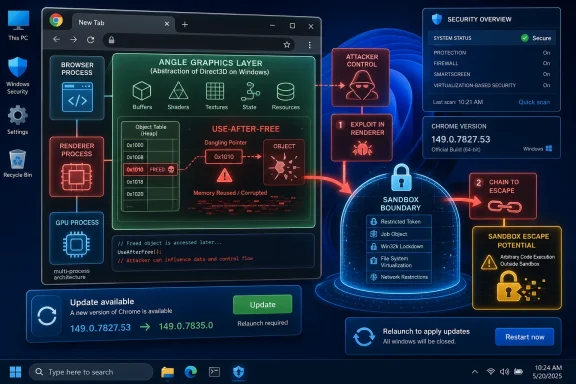
A Medium Bug With Critical Ambitions
The uncomfortable thing about CVE-2026-11065 is not that it gives an attacker everything in one move. It does not. The description says the attacker must already have compromised the renderer process, which means this is not the first domino in a typical web attack.
But browser exploitation has not been about single dominos for a long time. Modern Chrome is built around layers: the renderer parses hostile web content, the sandbox limits what that renderer can do, and privileged services broker access to the rest of the machine. A vulnerability that helps move from a compromised renderer toward a sandbox escape is therefore not a side note. It is the bridge between “bad tab” and “bad endpoint.”
That is why the scoring around this CVE looks more dramatic than the Chromium severity label. Chrome calls it Medium, while CISA’s ADP enrichment assigns a CVSS 3.1 score of 9.6, using a vector that treats the issue as network-reachable, low-complexity, requiring user interaction, and capable of high confidentiality, integrity, and availability impact after scope change. The gap is not necessarily a contradiction. It is a reminder that vendor severity and enterprise risk scoring answer different questions.
Google is usually rating the bug in the context of Chrome’s architecture and exploit prerequisites. A defender is asking what happens if this is chained with another browser memory bug, a malicious page, and a user who only has to browse to the wrong place. Those are different threat models, and Chrome’s June 2026 patch train gives defenders little reason to grade on optimism.
ANGLE Is Plumbing, Which Is Exactly Why It Matters
ANGLE is one of those components most users never know exists, but it is deeply involved in making web graphics work across platforms. It translates graphics API calls so web content can use GPU acceleration consistently across Windows, macOS, Linux, and other environments. On Windows, that translation layer has historically mattered because browsers have had to reconcile web-facing graphics standards with Direct3D, drivers, GPU process boundaries, and a sprawling hardware ecosystem.
That makes ANGLE security-sensitive by design. It handles complex inputs, it lives close to GPU-facing code paths, and it exists to make rich web content fast enough that developers use it without thinking about the machinery underneath. The web long ago stopped being a document viewer. It is an application runtime with video pipelines, 3D graphics, machine-learning APIs, conferencing stacks, and file workflows running inside the browser window.
A use-after-free bug in such a component is a familiar class of memory safety failure. In plain English, software keeps using an object after it has already been freed, creating a chance that memory can be reoccupied or manipulated in ways the program did not expect. In exploit development, that can become control over program behavior. In browser exploit development, the question becomes where that control lands and what additional restrictions still stand in the way.
CVE-2026-11065’s wording places it after a renderer compromise. That matters. It suggests the bug is not merely about making a tab crash or corrupting memory inside already-contained web content. It is about the boundary between the renderer and something more privileged, which is why the sandbox-escape language is doing so much work.
The Sandbox Is the Prize, Not the Footnote
Chrome’s sandbox is one of the major reasons drive-by browser attacks are harder than they were in the bad old days. A renderer compromise can be serious, but the renderer is intentionally constrained. It should not be able to freely read files, install persistence, tamper with other processes, or roam through the system as if it were a normal desktop application.
Attackers therefore chain bugs. One flaw gets code execution or memory control in the renderer. Another flaw breaks out. Sometimes the second flaw lives in IPC handling, sometimes in a brokered service, sometimes in GPU or media paths, and sometimes in the complicated glue code that makes the browser feel seamless.
CVE-2026-11065 belongs in that second category of concern. The phrase “who had compromised the renderer process” should not lull anyone into thinking the issue is academic. It describes the assumed starting point for a chain, not an exotic laboratory condition. Renderer bugs are a recurring feature of browser security advisories because the renderer is where hostile web content goes first.
For enterprise defenders, this is why browser patching cannot be triaged purely by whether a CVE says “remote code execution” in the most direct possible way. A sandbox escape primitive can be the difference between an exploit that dies in containment and one that becomes an endpoint compromise. The fact that the user interaction is essentially “open a crafted page” does not improve the picture much.
Chrome 149 Was Not a Normal Patch Note
CVE-2026-11065 arrived as part of the Chrome 149 stable channel update for desktop, with fixed versions beginning at 149.0.7827.53 on Linux and 149.0.7827.53/54 on Windows and macOS. The bulletin was unusually crowded, even by Chrome standards. It included a large number of security fixes across components such as ANGLE, GPU, V8, WebRTC, PDFium, Blink, Dawn, WebView, and extension-related surfaces.
That density changes the operational meaning of any single CVE. If CVE-2026-11065 were the only item in the release, defenders could isolate it as a medium-severity graphics-layer bug with a renderer compromise prerequisite. In the actual June bulletin, it sits among many memory safety and validation issues, including other ANGLE bugs with higher stated severity. The browser attack surface was not patched with a scalpel; it was patched with a broom.
The issue was reported by Google on April 3, 2026, then published through the CVE process on June 4. That is a fairly ordinary pipeline for a vulnerability discovered internally or through automated and manual security work. What matters for administrators is not the romance of discovery but the patch boundary: anything before 149.0.7827.53 is on the wrong side for this CVE.
The timing also matters because Chrome did not stand still after that release. By June 9, Google had already pushed a newer stable update to address another Chrome vulnerability, CVE-2026-11645, with exploitation reported in the wild. That later update moved the practical “fully patched” target beyond the .53 build for many environments. In other words, 149.0.7827.53 is the fix line for CVE-2026-11065, but it is not where a cautious Windows fleet should stop checking version compliance today.
The CPE Question Has a Straight Answer and a Messy Reality
The NVD entry’s “Are we missing a CPE?” prompt is boilerplate, but the underlying question is worth taking seriously. For CVE-2026-11065, NVD’s change history shows a CPE configuration for Google Chrome versions up to, but excluding, 149.0.7827.53. That is the expected product-level mapping for the public vulnerability entry.
So, no, the obvious Chrome CPE is not missing once NVD’s initial analysis is accounted for. The product affected is Google Chrome before 149.0.7827.53. The CPE record is broad, product-level, and version-bounded, which is exactly what most vulnerability scanners and asset systems need for first-pass detection.
The messier part is what this means in Chromium-derived environments. Microsoft Edge, Brave, Vivaldi, Opera, Electron-based applications, embedded WebViews, and other Chromium-adjacent products do not automatically inherit Chrome’s CPE just because the underlying project shares code. A vulnerability may exist in shared Chromium code, but each downstream product has its own release cadence, patch integration process, and product identifiers.
That distinction is a daily headache for vulnerability management teams. A Chrome CVE can be a signal to check Chromium-based browsers, but it is not proof that every Chromium-based application is affected in the same way or fixed at the same version number. For Windows fleets, the right workflow is to treat Chrome’s advisory as the first alarm, then verify Edge and other Chromium-dependent software through their own update channels and vendor advisories.
Windows Makes the Graphics Stack a Bigger Attack Surface
Windows users should pay special attention to graphics-layer browser bugs because the browser is one of the busiest GPU clients on the machine. Hardware acceleration is enabled by default in typical configurations, and the modern web leans heavily on GPU-backed rendering even when users are not playing games or running WebGL demos. Maps, video conferencing, canvas-heavy sites, visual editors, PDF viewers, and AI-enhanced web apps all pull on this machinery.
That does not mean CVE-2026-11065 is a Windows-only bug. The public description is for Google Chrome prior to 149.0.7827.53, and the stable channel update covered desktop platforms. But Windows is where browser, driver, endpoint security, enterprise policy, and legacy application compatibility most visibly collide. A bug in a graphics translation layer is not merely a browser issue when the browser is the primary application platform for half the workday.
ANGLE’s job is portability, but portability brings complexity. It has to abstract over graphics APIs and implementations that were not designed around the same assumptions. Every abstraction layer makes life easier for developers and harder for security engineers, because it creates translation states, validation paths, and edge cases that attackers can study.
For administrators, the practical answer is not to disable all GPU acceleration across the estate unless there is a specific incident-driven reason to do so. That kind of blanket change can break workflows and create helpdesk noise without addressing the root problem. The better answer is aggressive browser patching, tight extension control, exploit mitigation, and visibility into which endpoints are lagging behind current stable builds.
The Renderer Prerequisite Is Not a Comfort Blanket
Security advisories often contain phrases that sound reassuring until you translate them into attacker workflow. “Requires user interaction” can mean the user visits a web page. “Requires renderer compromise” can mean the attacker already has the kind of first-stage browser foothold that exploit chains routinely seek. “Potentially perform a sandbox escape” can mean the difference between a contained exploit and a post-exploitation foothold.
This is why CVE-2026-11065 deserves more attention than its Chromium Medium label might suggest. It is not because every Medium bug should be treated as an emergency. It is because this particular Medium bug is described as a sandbox-escape enabler in a component that has appeared repeatedly in Chrome security fixes.
There is also no public indication from the supplied NVD and Chrome release information that CVE-2026-11065 itself was exploited in the wild at publication time. That distinction matters. Defenders should not inflate every patched bug into a zero-day scare, because doing so trains organizations to ignore urgent warnings when they are real.
But the absence of known exploitation is not the same as low value. Browser exploit chains are assembled from exactly these sorts of primitives: memory corruption, type confusion, validation mistakes, GPU-adjacent bugs, and sandbox boundary failures. Once a patch ships, attackers can diff code, study bug patterns, and attempt to weaponize nearby conditions against unpatched systems.
CVSS Is Telling a Different Story Than Chrome Severity
The severity split is one of the most interesting parts of this CVE. Chrome’s security severity is Medium. CISA-ADP’s CVSS 3.1 base score is 9.6, squarely Critical. NVD had not yet provided its own CVSS score in the entry as of the supplied data, which means many dashboards may show an awkward mixture of “N/A,” “Medium,” and “Critical” depending on which field they ingest.
This is not merely a paperwork problem. It changes patch prioritization, executive reporting, SLA clocks, and ticket routing. A vulnerability management system that keys off CVSS may flag this as a critical item requiring rapid remediation. A browser team reading the Chrome bulletin may see a medium-severity issue among hundreds. A security operations team may care most about whether exploitation is known in the wild.
All three views are defensible, but none is complete. CVSS is useful for comparability, but it can overstate practical urgency when prerequisites are complex or chaining is required. Vendor severity can understate enterprise risk when a “medium” flaw enables a step in a realistic multi-bug attack. Exploit intelligence is decisive when available, but it is often late.
The safest operational stance is to treat browser security updates as cumulative risk reduction rather than single-CVE triage. Chrome is not a line-of-business app where every patch can wait for a monthly change board. It is an Internet-facing runtime used by nearly every employee, often with credentials, documents, SaaS sessions, and privileged admin portals one click away.
Patch Management Still Trips Over the Browser Restart
Chrome’s update system is good, but it is not magic. The patch has to download, install, and take effect after the browser restarts. In consumer settings, that usually means a colored update indicator and a relaunch prompt. In enterprise settings, it means policy, user behavior, device uptime, virtual desktop refresh cycles, and third-party patch tools all get a vote.
The quiet failure mode is the user who leaves Chrome open for days. The update may be staged, but the vulnerable process remains alive until relaunch. On Windows, that problem is amplified by sleep-resume habits and the modern tendency to treat browsers as permanent workspaces. A patched installer does not help much if the vulnerable renderer and GPU processes are still running from an old build.
Administrators should therefore measure running version, not just installed version. Endpoint tooling should confirm that Chrome processes have restarted into the fixed build. Where policies allow, forced relaunch windows can be a necessary inconvenience, especially after updates that include sandbox escape or active exploitation language.
This is also where the later June 2026 Chrome update complicates the message. If an endpoint is already being touched to remediate CVE-2026-11065, it should not be left merely at 149.0.7827.53 when newer stable builds are available to address subsequent vulnerabilities. The right target is the current stable channel build approved for the platform, not the minimum version that closes last week’s CVE.
Edge Shops Should Not Look Away
WindowsForum readers live in a world where Chrome is important even when Chrome is not the official enterprise browser. Microsoft Edge is Chromium-based, and many Windows environments standardize on Edge while still tolerating Chrome for compatibility, user preference, developer workflows, or acquired business units. Browser monoculture is rarely as clean in the asset database as it is in policy documents.
A Chrome vulnerability in ANGLE should prompt Edge administrators to check Microsoft’s own release notes and version state, not assume automatic immunity or automatic exposure. The same applies to other Chromium-based browsers. Shared code creates shared concern, but each vendor’s packaging and patch timing determines the actual exposure window.
The bigger point is that Windows browser management is now a multi-browser discipline. You cannot secure “the browser” by patching only the one in your standard image. Developers may install Chrome Canary, users may install consumer Chrome, packaged apps may embed Chromium, and helpdesk tools may quietly ship browser components of their own.
That sprawl makes CVE-level mapping harder. It also makes software inventory more important than ever. The endpoint question is not “Do we use Chrome?” It is “Where does Chromium-derived code execute, who updates it, and how quickly can we prove the vulnerable build is gone?”
The Long Tail Is Where Browser Bugs Become Incidents
Google can patch quickly, and Chrome can update rapidly, but the Internet does not run on the median endpoint. It runs on the long tail: unmanaged laptops, old VDI images, lab machines, kiosk devices, contractor systems, offline workstations, and user profiles where update mechanisms are broken or blocked. Attackers do not need every system to be vulnerable. They need the right one.
That is why NVD’s version boundary matters. “Prior to 149.0.7827.53” is a clean line for CVE-2026-11065, and clean lines are valuable. They allow scanners, scripts, and administrators to make binary decisions. But clean version lines only help if organizations can see the devices that fall below them.
The consumer story is easier. Open Chrome, go to the About page, let it update, relaunch. The enterprise story is more tedious but more important. Confirm policy deployment. Confirm update service health. Confirm that security tools are not blocking the update mechanism. Confirm that users restarted. Confirm that non-persistent images have been refreshed. Confirm that exception groups are not quietly becoming permanent.
Browser patching is often treated as routine hygiene because it happens so often. That is true in the same way that locking doors is routine hygiene. The repetition does not make it optional; it makes lapses easier to miss.
AI-Scale Bug Discovery Is Changing the Shape of Patch Tuesday’s Cousin
One striking feature of the Chrome 149 bulletin is the sheer volume of issues and the number of internally reported bugs. Google’s release notes show many CVEs reported by Google itself, and the broader security community has been watching automated vulnerability discovery become more productive. Whether one credits fuzzing, AI-assisted analysis, expanded internal review, or all of the above, the effect is visible: browser vendors are finding and fixing large numbers of memory and validation bugs before public exploitation is known.
That is good news, but it creates a new burden for defenders. Security teams are used to prioritizing the spectacular: the named bug, the logo, the actively exploited zero-day, the emergency out-of-band patch. Chrome’s routine stable updates now contain enough serious-looking vulnerabilities that “routine” no longer means low stakes.
CVE-2026-11065 is a useful example because it is not the loudest bug in the release. It is not the one that will dominate headlines. It is a medium-rated ANGLE use-after-free with sandbox escape potential, hiding in a crowd. In older eras, that might have been the headline. In Chrome 149, it is one paragraph in a flood.
The defensive model has to adjust. Organizations cannot manually debate every browser CVE at the depth they might apply to a server-side remote code execution flaw. Instead, they need a browser update posture that assumes high update velocity, low tolerance for lag, and fast rollback plans if a release causes compatibility problems.
The Practical Lesson Buried in the ANGLE Entry
For home users, the advice is deliberately boring: update Chrome and restart it. If Chrome reports a version newer than the fixed build, the specific CVE-2026-11065 exposure is addressed. Given the subsequent June 2026 stable update, users should prefer the latest available Chrome 149 stable build rather than aiming for the minimum .53 threshold.
For IT pros, the lesson is broader. Treat this CVE as an indicator of why GPU and browser sandbox boundaries deserve attention in risk models. A crafted HTML page is enough to reach the attack surface. A renderer compromise is a plausible first stage. A sandbox escape is the outcome defenders spend years trying to prevent.
There is no need to panic over CVE-2026-11065 specifically, based on the public information available. There is also no good reason to let it age in the environment. Browser vulnerabilities are perishable for defenders and useful for attackers; once the patch is public, the race becomes less theoretical.
The best organizations will not create a special process for this one CVE. They will use it to test whether the process they already claim to have actually works.
The Version Number Is the Only Part That Cannot Be Hand-Waved
Here is the concrete operational view for WindowsForum readers who need to turn the advisory into action rather than admiration for Chrome’s architecture.
- Chrome versions before 149.0.7827.53 are vulnerable to CVE-2026-11065, according to the public NVD and Chrome release information.
- The flaw is a use-after-free in ANGLE, and the public description says it could help an attacker escape the sandbox after compromising the renderer process.
- Chrome’s own severity label is Medium, but CISA-ADP’s CVSS 3.1 enrichment rates the issue at 9.6 Critical, so dashboards may disagree about urgency.
- The obvious NVD CPE mapping for Google Chrome is present as a version range excluding 149.0.7827.53, but Chromium-derived products need their own vendor-specific verification.
- Administrators should verify the running Chrome version after restart, not merely the installed package version before users relaunch.
- Because newer Chrome 149 stable builds were released after the .53 fix, remediation should target the latest available stable build for the platform, not just the first build that fixed this CVE.
The most important thing about CVE-2026-11065 is that it is ordinary in a way that should make defenders uneasy: a memory safety bug in a performance-critical browser component, reachable through web content, useful after a renderer compromise, and fixed in a release crowded with similar problems. Chrome’s sandbox still matters, and so does the engineering that keeps attackers trapped inside it. But the forward-looking conclusion for Windows users is blunt: as browsers absorb more of the operating system’s daily workload, the difference between “medium” and “critical” will increasingly be decided not by the label in the advisory, but by how quickly the fixed build actually reaches the machine in front of the user.