

CVE-2026-11295 is a newly published Google Chrome for Android WebView vulnerability, disclosed on June 4, 2026 and patched before version 149.0.7827.53, that could let a remote attacker escalate privileges if a user opened a crafted HTML page. The oddity is not that Chrome had another bug; Chrome always has another bug. The oddity is the mismatch between Chromium’s “Low” severity label and CISA’s high CVSS score, a gap that says as much about vulnerability triage as it does about WebView. For WindowsForum readers, the practical lesson is familiar but uncomfortable: browser security is now platform security, and metadata lag can turn a simple patch decision into a classification argument.
On paper, CVE-2026-11295 looks almost routine. Google’s description is terse: an “inappropriate implementation” in WebView in Chrome on Android before 149.0.7827.53 allowed privilege escalation through a crafted HTML page. That is the kind of entry security teams see dozens of times during a busy browser release week.
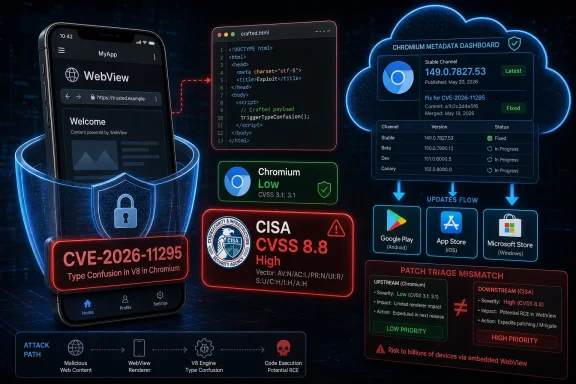
Then the scoring muddies the water. Chromium labels the issue Low, while CISA’s ADP enrichment assigns a CVSS 3.1 score of 8.8, with high impacts across confidentiality, integrity, and availability. NVD, meanwhile, had not yet provided its own CVSS score in the user-supplied record, though it had begun adding affected configuration data.
That is not a small clerical disagreement. A Low browser bug may ride the normal update train; an 8.8 vulnerability can trigger emergency patch SLAs, executive dashboards, and mobile fleet escalations. The same CVE can therefore mean “patch soon” to one system and “drop everything” to another.
The heart of the story is not whether Google or CISA is “right” in some abstract sense. It is that modern vulnerability management depends on layers of interpretation, and those layers increasingly arrive at different times, from different organizations, using different assumptions.
That makes a WebView bug materially different from a desktop-only Chrome flaw. A user may never open the Chrome icon and still encounter WebView content inside a banking app, a helpdesk portal, a messaging client, an identity provider flow, or a custom line-of-business application. On Android, the browser engine is not merely a browser; it is an operating-system service used by other apps.
The CVE description says exploitation requires a crafted HTML page. That does not automatically mean drive-by compromise, and the presence of user interaction in the CISA vector matters. But it also does not mean the exposure is theoretical. In the WebView world, “open this page” can be disguised as “view this embedded login,” “preview this message,” or “complete this support workflow.”
For enterprises, the key question is less whether CVE-2026-11295 is dramatic by itself and more whether affected Android devices are reliably receiving browser component updates. Mobile device management policies often focus on OS patch levels, app versions, and compliance posture, but WebView’s update path can create a gap between “the device is current enough” and “the embedded browser surface is actually patched.”
When a browser update contains hundreds of fixes, security teams tend to collapse the whole package into one operational instruction: update Chrome. That is often the right practical answer. It is also analytically blunt, because individual CVEs can have very different affected platforms, prerequisites, exploitability, and relevance to managed environments.
CVE-2026-11295 is especially easy to misread because the public release reference is a Chrome stable-channel update, while the CVE description specifically calls out Chrome on Android and WebView. NVD’s affected configuration, as supplied by the user, includes a Chrome application CPE up to but excluding 149.0.7827.53 and an Android operating-system CPE as part of an AND relationship. That is a hint that the platform context matters.
This is where scanners can get noisy. If a tool sees “Chrome before 149.0.7827.53,” it may flag desktop Chrome. If it sees “Android,” it may flag devices based on OS inventory rather than WebView component state. If it sees the CISA CVSS score, it may rank the item alongside more obviously exploitable browser memory-corruption flaws.
The result is not necessarily false positive chaos, but it is a place where asset context matters. Windows admins who also manage Android fleets through Intune, Workspace ONE, Jamf for mobile-adjacent inventories, or other MDM platforms should treat this as a mobile browser-component patch, not merely another desktop Chrome advisory.
The uncomfortable answer is that a CPE may be present and still not be useful enough. CPE naming has always struggled with components that are simultaneously apps, platform services, and dependencies consumed by other software. Android WebView is exactly that sort of component.
A clean inventory model would distinguish among Google Chrome desktop, Chrome for Android, Android System WebView, OEM-packaged WebView variants, Chromium packages in Linux distributions, and downstream apps that embed web content. Public vulnerability metadata often cannot capture that distinction neatly at publication time.
That does not mean NVD is useless. It means CPE data should be treated as a starting point, not the final arbiter of exposure. If your scanner reports CVE-2026-11295 on Windows desktops because Chrome is below 149.0.7827.53, you should validate whether the vulnerability actually applies to that platform. If it reports the issue on Android devices, you should check the Chrome/WebView update state rather than rely only on the Android OS version.
There is also a timing problem. The record shows the CVE was received from Chrome on June 4, modified by CISA-ADP on June 5, and then initially analyzed by NIST on June 8. That is a normal-looking sequence, but for automated vulnerability management it spans several business days during which scanners, dashboards, and patch rules may have seen different versions of the truth.
Those systems often align, but when they diverge the divergence is itself useful information. A vendor may rate an issue Low because exploitation is constrained, because the privilege boundary is narrow, or because defense-in-depth limits impact. A CVSS vector may still produce a high score if the modeled impact is broad once exploitation succeeds.
In CVE-2026-11295, the CISA vector supplied by the user is network exploitable, low complexity, no privileges required, user interaction required, unchanged scope, and high impact to confidentiality, integrity, and availability. That is a recipe for a high numerical score. Yet the Chromium label remains Low.
Security teams should resist the temptation to pick the more convenient label. The practical answer is to patch as part of the Chrome/WebView update process, but not to inflate the issue into a confirmed mass-exploitation event absent evidence. High CVSS does not equal known exploitation, and a vendor Low does not equal safe to ignore.
The better operational phrasing is this: CVE-2026-11295 is a patchable WebView privilege-escalation issue affecting Chrome on Android before 149.0.7827.53, with conflicting severity signals and no need for heroic mitigation if normal browser-component updates are working.
A compromised or misbehaving mobile browser component can threaten the same identity plane that Windows admins protect on laptops. If a crafted page can manipulate WebView behavior inside an app that handles authentication, tokens, or privileged workflows, the downstream risk is not confined to the phone’s home screen.
This is particularly relevant for organizations using Android Enterprise work profiles. In those deployments, personal and work contexts are separated, but browser components still need to be patched promptly within the managed profile’s policy constraints. A stale WebView can become a weak link in an otherwise reasonable compliance story.
The Windows angle is therefore not “this affects Windows directly.” It is that Windows administrators increasingly own the user’s whole access environment. If a mobile device can satisfy conditional access while carrying an outdated browser component, the distinction between endpoint security and identity security starts to blur.
That creates a reporting problem. An Android device may show an acceptable OS security patch level while Chrome or Android System WebView lags behind. Conversely, a device may receive a WebView fix quickly even if the OEM’s OS update cadence is slow. The component that matters is not always the one your dashboard highlights.
For consumers, the advice is simple: update Chrome and WebView through Google Play, and do not postpone browser updates. For administrators, the advice is more procedural: verify that managed Android devices can receive and install Chrome/WebView updates without being blocked by app approval workflows, store restrictions, battery policies, or stale management profiles.
There is also a lesson for scanner vendors. A CPE entry that says Chrome before a version and Android as the platform should not be flattened into a generic Chrome vulnerability across every desktop estate. Doing so trains administrators to distrust alerts, and alert distrust is one of the most expensive outcomes in security operations.
The linked Chromium issue reportedly requires permission to view, which is common for browser vulnerabilities while details are restricted. That opacity is frustrating but not unusual. Browser vendors often limit technical detail until patches have propagated widely enough to reduce copycat exploitation.
The release-note reference also creates a subtle mismatch. A desktop stable-channel post can be used as a reference for a CVE whose description names Android WebView. That does not necessarily mean the reference is wrong; Chrome release infrastructure often groups fixes across channels and platforms. But it does mean defenders need to read the CVE description, not just the advisory headline.
This is where editorial restraint matters. There is no need to declare a crisis merely because one enrichment source gives the bug an 8.8. There is also no need to wave it away because Chromium called it Low. The public facts support a narrower conclusion: this is a real browser-component vulnerability with a patch threshold, and organizations should verify whether Android Chrome/WebView is below that threshold.
The concrete lessons are straightforward:
 A Low-Severity Chrome Bug Walks Into a High-Severity Database
On paper, CVE-2026-11295 looks almost routine. Google’s description is terse: an “inappropriate implementation” in WebView in Chrome on Android before 149.0.7827.53 allowed privilege escalation through a crafted HTML page. That is the kind of entry security teams see dozens of times during a busy browser release week.Then the scoring muddies the water. Chromium labels the issue Low, while CISA’s ADP enrichment assigns a CVSS 3.1 score of 8.8, with high impacts across confidentiality, integrity, and availability. NVD, meanwhile, had not yet provided its own CVSS score in the user-supplied record, though it had begun adding affected configuration data.
That is not a small clerical disagreement. A Low browser bug may ride the normal update train; an 8.8 vulnerability can trigger emergency patch SLAs, executive dashboards, and mobile fleet escalations. The same CVE can therefore mean “patch soon” to one system and “drop everything” to another.
The heart of the story is not whether Google or CISA is “right” in some abstract sense. It is that modern vulnerability management depends on layers of interpretation, and those layers increasingly arrive at different times, from different organizations, using different assumptions.
WebView Is the Quiet Attack Surface Inside Android
WebView is easy to underestimate because most users do not launch it by name. It is the embedded browser component Android apps use to render web content inside an application, which means it sits at the intersection of the browser, the app sandbox, account sessions, ads, authentication flows, and enterprise-managed mobile software.That makes a WebView bug materially different from a desktop-only Chrome flaw. A user may never open the Chrome icon and still encounter WebView content inside a banking app, a helpdesk portal, a messaging client, an identity provider flow, or a custom line-of-business application. On Android, the browser engine is not merely a browser; it is an operating-system service used by other apps.
The CVE description says exploitation requires a crafted HTML page. That does not automatically mean drive-by compromise, and the presence of user interaction in the CISA vector matters. But it also does not mean the exposure is theoretical. In the WebView world, “open this page” can be disguised as “view this embedded login,” “preview this message,” or “complete this support workflow.”
For enterprises, the key question is less whether CVE-2026-11295 is dramatic by itself and more whether affected Android devices are reliably receiving browser component updates. Mobile device management policies often focus on OS patch levels, app versions, and compliance posture, but WebView’s update path can create a gap between “the device is current enough” and “the embedded browser surface is actually patched.”
The Chrome 149 Release Makes One CVE Hard to See
CVE-2026-11295 did not arrive in isolation. It was tied to Chrome 149.0.7827.53, a large stable-channel update that security trackers and advisories have described as addressing a very large number of vulnerabilities across Chrome’s desktop platforms. That kind of release is good news for users but bad news for anyone trying to reason clearly about a single issue.When a browser update contains hundreds of fixes, security teams tend to collapse the whole package into one operational instruction: update Chrome. That is often the right practical answer. It is also analytically blunt, because individual CVEs can have very different affected platforms, prerequisites, exploitability, and relevance to managed environments.
CVE-2026-11295 is especially easy to misread because the public release reference is a Chrome stable-channel update, while the CVE description specifically calls out Chrome on Android and WebView. NVD’s affected configuration, as supplied by the user, includes a Chrome application CPE up to but excluding 149.0.7827.53 and an Android operating-system CPE as part of an AND relationship. That is a hint that the platform context matters.
This is where scanners can get noisy. If a tool sees “Chrome before 149.0.7827.53,” it may flag desktop Chrome. If it sees “Android,” it may flag devices based on OS inventory rather than WebView component state. If it sees the CISA CVSS score, it may rank the item alongside more obviously exploitable browser memory-corruption flaws.
The result is not necessarily false positive chaos, but it is a place where asset context matters. Windows admins who also manage Android fleets through Intune, Workspace ONE, Jamf for mobile-adjacent inventories, or other MDM platforms should treat this as a mobile browser-component patch, not merely another desktop Chrome advisory.
The CPE Question Is Really an Inventory Question
The user’s question asks whether a CPE is missing. Based on the supplied NVD change history, NIST added a configuration that combines Google Chrome versions before 149.0.7827.53 with Android. That appears designed to express Chrome-on-Android rather than all Chrome installations everywhere.The uncomfortable answer is that a CPE may be present and still not be useful enough. CPE naming has always struggled with components that are simultaneously apps, platform services, and dependencies consumed by other software. Android WebView is exactly that sort of component.
A clean inventory model would distinguish among Google Chrome desktop, Chrome for Android, Android System WebView, OEM-packaged WebView variants, Chromium packages in Linux distributions, and downstream apps that embed web content. Public vulnerability metadata often cannot capture that distinction neatly at publication time.
That does not mean NVD is useless. It means CPE data should be treated as a starting point, not the final arbiter of exposure. If your scanner reports CVE-2026-11295 on Windows desktops because Chrome is below 149.0.7827.53, you should validate whether the vulnerability actually applies to that platform. If it reports the issue on Android devices, you should check the Chrome/WebView update state rather than rely only on the Android OS version.
There is also a timing problem. The record shows the CVE was received from Chrome on June 4, modified by CISA-ADP on June 5, and then initially analyzed by NIST on June 8. That is a normal-looking sequence, but for automated vulnerability management it spans several business days during which scanners, dashboards, and patch rules may have seen different versions of the truth.
Severity Labels Are Not Risk Labels
The Chrome severity rating and CISA CVSS score are measuring different things. Chromium’s internal severity reflects Google’s assessment of the bug within its own security model, exploit constraints, and product context. CVSS tries to express technical severity in a standardized way that can be consumed across organizations and tools.Those systems often align, but when they diverge the divergence is itself useful information. A vendor may rate an issue Low because exploitation is constrained, because the privilege boundary is narrow, or because defense-in-depth limits impact. A CVSS vector may still produce a high score if the modeled impact is broad once exploitation succeeds.
In CVE-2026-11295, the CISA vector supplied by the user is network exploitable, low complexity, no privileges required, user interaction required, unchanged scope, and high impact to confidentiality, integrity, and availability. That is a recipe for a high numerical score. Yet the Chromium label remains Low.
Security teams should resist the temptation to pick the more convenient label. The practical answer is to patch as part of the Chrome/WebView update process, but not to inflate the issue into a confirmed mass-exploitation event absent evidence. High CVSS does not equal known exploitation, and a vendor Low does not equal safe to ignore.
The better operational phrasing is this: CVE-2026-11295 is a patchable WebView privilege-escalation issue affecting Chrome on Android before 149.0.7827.53, with conflicting severity signals and no need for heroic mitigation if normal browser-component updates are working.
Windows Shops Still Have a Mobile Browser Problem
WindowsForum readers may reasonably ask why an Android WebView CVE belongs in their patch conversation. The answer is that most Windows-centered environments are no longer Windows-only environments. Microsoft 365, Entra ID, Teams, Outlook, Edge, Chrome, conditional access, device compliance, and mobile app protection policies all meet users on phones.A compromised or misbehaving mobile browser component can threaten the same identity plane that Windows admins protect on laptops. If a crafted page can manipulate WebView behavior inside an app that handles authentication, tokens, or privileged workflows, the downstream risk is not confined to the phone’s home screen.
This is particularly relevant for organizations using Android Enterprise work profiles. In those deployments, personal and work contexts are separated, but browser components still need to be patched promptly within the managed profile’s policy constraints. A stale WebView can become a weak link in an otherwise reasonable compliance story.
The Windows angle is therefore not “this affects Windows directly.” It is that Windows administrators increasingly own the user’s whole access environment. If a mobile device can satisfy conditional access while carrying an outdated browser component, the distinction between endpoint security and identity security starts to blur.
Patch Management Fails Quietly When Components Move Faster Than Operating Systems
Traditional patch management was built around operating-system updates and major application versions. Browser security broke that model by moving to rapid release cycles. WebView complicates it further because the vulnerable component may update through an app store mechanism rather than a full OS update.That creates a reporting problem. An Android device may show an acceptable OS security patch level while Chrome or Android System WebView lags behind. Conversely, a device may receive a WebView fix quickly even if the OEM’s OS update cadence is slow. The component that matters is not always the one your dashboard highlights.
For consumers, the advice is simple: update Chrome and WebView through Google Play, and do not postpone browser updates. For administrators, the advice is more procedural: verify that managed Android devices can receive and install Chrome/WebView updates without being blocked by app approval workflows, store restrictions, battery policies, or stale management profiles.
There is also a lesson for scanner vendors. A CPE entry that says Chrome before a version and Android as the platform should not be flattened into a generic Chrome vulnerability across every desktop estate. Doing so trains administrators to distrust alerts, and alert distrust is one of the most expensive outcomes in security operations.
The Public Record Is Useful, But It Is Not a Patch Runbook
The NVD entry gives us the skeleton: CVE identifier, publication date, last-modified date, description, weakness classification, references, and emerging affected configurations. That is enough to identify the issue and begin triage. It is not enough to determine every environment’s real exposure.The linked Chromium issue reportedly requires permission to view, which is common for browser vulnerabilities while details are restricted. That opacity is frustrating but not unusual. Browser vendors often limit technical detail until patches have propagated widely enough to reduce copycat exploitation.
The release-note reference also creates a subtle mismatch. A desktop stable-channel post can be used as a reference for a CVE whose description names Android WebView. That does not necessarily mean the reference is wrong; Chrome release infrastructure often groups fixes across channels and platforms. But it does mean defenders need to read the CVE description, not just the advisory headline.
This is where editorial restraint matters. There is no need to declare a crisis merely because one enrichment source gives the bug an 8.8. There is also no need to wave it away because Chromium called it Low. The public facts support a narrower conclusion: this is a real browser-component vulnerability with a patch threshold, and organizations should verify whether Android Chrome/WebView is below that threshold.
The Small WebView Entry That Should Change the Checklist
CVE-2026-11295 is not the most spectacular Chrome bug of the year, and it may never become one. Its value is that it exposes the seams in the vulnerability-management machine: vendor severity versus CVSS, CPE presence versus useful applicability, desktop release references versus Android component exposure, and operating-system inventory versus browser-component reality.The concrete lessons are straightforward:
- Organizations should treat Chrome on Android and Android WebView as security-relevant components that require version tracking, not as incidental mobile apps.
- Devices running Chrome or WebView components before 149.0.7827.53 should be updated through the normal Android app update channel as soon as practical.
- Scanner findings for this CVE should be validated against platform context, because the vulnerability description points to Chrome on Android WebView rather than generic desktop Chrome.
- The CISA CVSS score should influence prioritization, but it should not be mistaken for evidence of active exploitation.
- NVD CPE data is useful for automation, but administrators should expect lag, revision, and occasional ambiguity for cross-platform browser components.
- Mobile compliance policies should verify browser and WebView update health alongside Android OS patch level.
References
- Primary source: NVD / Chromium
Published: 2026-06-09T07:00:42-07:00
NVD - CVE-2026-11295
 nvd.nist.gov
- Security advisory: MSRC
Published: 2026-06-09T07:00:42-07:00
Original feed URL
Security Update Guide - Microsoft Security Response Center
 msrc.microsoft.com
- Official source: nist.gov
National Vulnerability Database
NIST maintains the National Vulnerability Database (NVD), a repository of information on software and hardware flaws that can compromise computer security. This is a key piece of the nation’s cybersecurity infrastructure.www.nist.gov - Related coverage: security.snyk.io
CVE-2026-11295 in chromium | CVE-2026-11295 | Snyk
CVE-2026-11295 in chromium | CVE-2026-11295security.snyk.io - Related coverage: govcert.gov.hk
GovCERT.HK - Security Alert (A26-06-08): Multiple Vulnerabilities in Google Chrome
Security Alert (A26-06-08): Multiple Vulnerabilities in Google Chromewww.govcert.gov.hk
- Related coverage: labs.cloudsecurityalliance.org
NVD Enrichment Triage: Enterprise Vulnerability Programs Must Adapt
PDF documentlabs.cloudsecurityalliance.org
