

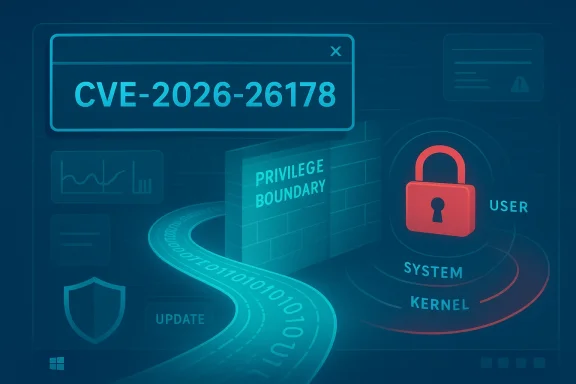
Microsoft has published a new advisory for CVE-2026-26178, describing it as a Windows Advanced Rasterization Platform elevation of privilege vulnerability. The advisory text points readers to Microsoft’s own severity and exploitability guidance, which is often the first signal that a flaw is real, actionable, and relevant to defenders even before the technical exploit mechanics are fully understood. In practical terms, the naming alone tells us this is not a browser-only issue or a niche graphics bug; it is an operating-system-level privilege boundary problem with potentially broad consequences for Windows endpoints.
The Windows Advanced Rasterization Platform—better known as WARP—is Microsoft’s software-based graphics rendering path. It exists to make graphics features available when hardware acceleration is unavailable, constrained, or disabled, which means it sits in a surprisingly important place in the Windows stack. Components like this are easy to overlook because they are not consumer-facing in the way that File Explorer or Edge is, but they are deeply embedded in how Windows handles modern rendering workloads.
WARP matters because it is designed to be resilient and widely compatible, and that inevitably gives it a large attack surface. A software renderer must process complex inputs from applications, drivers, browser content, media pipelines, and system APIs. When a privilege boundary is crossed in a component like that, the result is often more serious than a straightforward application crash because the component may be reachable from low-privilege contexts that users and administrators assume are isolated.
Microsoft’s advisory for CVE-2026-26178 is sparse in the way many early security notices are sparse. That scarcity does not mean the issue is unimportant. It usually means the vendor has confirmed enough to publish a CVE identifier, but is still controlling the amount of technical detail that could help attackers weaponize the flaw. The wording in the advisory makes clear that this is an elevation of privilege issue, which typically means a local attacker, or an attacker who can run code in some constrained context, may be able to break out into more privileged execution.
Historically, Windows graphics and rendering subsystems have been fertile ground for privilege-escalation bugs because they blend performance-sensitive code, complex parsing, and broad system integration. These are exactly the kinds of places where memory-safety issues, type confusion, integer truncation, and state-machine mistakes can create exploitable conditions. Even when the initial payload is delivered through an application layer, the impact often lands in the kernel or another privileged subsystem, which is why defenders treat graphics-related EoP bugs with caution.
This advisory also fits a familiar modern pattern: Microsoft discloses the vulnerability, assigns it a CVE, and frames the risk in terms of privilege escalation rather than remote code execution. That distinction matters. EoP vulnerabilities often become the second stage in a real-world attack chain, used after phishing, sandbox escape, browser exploitation, or initial access through a separate weakness. In other words, a local privilege bug may not be the first thing an attacker lands on, but it can be the piece that turns a foothold into full system compromise.
What is missing from the public description is just as important as what is present. Microsoft has not, at least in the public-facing summary available here, disclosed the exact trigger, the vulnerable code path, or the exploitation conditions. That means defenders should treat the advisory as actionable but incomplete. The absence of detail is not a reason to dismiss the issue; it is a reason to assume the final attack surface may be broader than a single component name suggests.
A vulnerability in WARP is especially concerning because graphics subsystems often receive highly structured yet complex data. Complex data paths are fertile ground for security bugs because parsers, dispatch routines, and memory management all have to agree on the same assumptions. Small logic mistakes in these environments can become major privilege boundaries once an attacker finds a way to influence the input stream.
In a practical attack scenario, the most dangerous part is not necessarily the renderer itself, but the trust relationship around it. If WARP processes content that originates from a browser, application sandbox, or media pipeline, then a vulnerability there could help an attacker move from constrained code execution into a higher-privileged Windows context.
That said, confidence in existence is not the same thing as confidence in exploitability. A confirmed bug may still be hard to weaponize, especially if the trigger requires rare conditions or if the affected code path is not commonly reachable. Security teams should therefore avoid overreacting to the label alone while still treating the issue as priority material for patching and exposure analysis.
Important caveats remain:
Enterprises also need to think about virtual desktop infrastructure, remote work setups, and managed devices where software rendering paths may be more common than in high-end desktop configurations. Fallback graphics paths can be especially common in VMs and restricted environments, which makes the WARP attack surface potentially more relevant in enterprise fleets than in a casual consumer setting. That does not mean every environment is equally exposed, but it does mean the component should not be ignored simply because it sounds niche.
Browser-heavy households are worth special attention. If a malicious webpage, extension, or downloaded file can help an attacker reach code execution in a constrained context, a follow-on local escalation flaw can become the final step in a compromise chain. That is one reason security teams often separate initial access from privilege escalation when evaluating severity: the first step gets in, but the second step finishes the job.
The interesting strategic question is whether CVE-2026-26178 is an isolated bug or another reminder that complex system components continue to carry meaningful escalation risk. If the flaw proves easy to trigger, it could join the long list of Windows EoP issues that defenders prioritize immediately because they are attractive chain components for real-world attackers. If it proves hard to reach, it may still matter a great deal as a targeted post-exploitation tool.
A disciplined response also means checking whether systems that rely heavily on graphics virtualization, remote sessions, or browser-intensive workflows need to be placed earlier in the patch queue. If a vulnerability sits in a component like WARP, the systems most likely to use software rendering should not be treated as edge cases; they may be the ones most exposed in practice.
For many organizations, the most useful hunting logic will be behavioral rather than signature-based. That is especially true when the underlying flaw has not been fully described to the public. Behavioral detections are imperfect but resilient because they look for the consequences of exploitation rather than one exact exploit chain.
There is also a broader platform signal here. When a graphics-related component is implicated in privilege escalation, competitors and ecosystem partners take note because it reinforces the value of sandboxing, privilege separation, and memory-safe redesigns. The market does not respond only to the exploit; it responds to the confidence that attackers have in a given class of bug.
More broadly, CVE-2026-26178 is a reminder that the most important security bugs are not always the loudest. Quiet privilege escalations inside platform infrastructure can be just as dangerous as headline-grabbing browser exploits because they sit at the exact point where a foothold becomes full compromise. For defenders, that makes the right move both simple and urgent: patch quickly, validate carefully, and watch for signs of privilege abuse that go beyond any single advisory.
Source: MSRC Security Update Guide - Microsoft Security Response Center
 Background
The Windows Advanced Rasterization Platform—better known as WARP—is Microsoft’s software-based graphics rendering path. It exists to make graphics features available when hardware acceleration is unavailable, constrained, or disabled, which means it sits in a surprisingly important place in the Windows stack. Components like this are easy to overlook because they are not consumer-facing in the way that File Explorer or Edge is, but they are deeply embedded in how Windows handles modern rendering workloads.WARP matters because it is designed to be resilient and widely compatible, and that inevitably gives it a large attack surface. A software renderer must process complex inputs from applications, drivers, browser content, media pipelines, and system APIs. When a privilege boundary is crossed in a component like that, the result is often more serious than a straightforward application crash because the component may be reachable from low-privilege contexts that users and administrators assume are isolated.
Microsoft’s advisory for CVE-2026-26178 is sparse in the way many early security notices are sparse. That scarcity does not mean the issue is unimportant. It usually means the vendor has confirmed enough to publish a CVE identifier, but is still controlling the amount of technical detail that could help attackers weaponize the flaw. The wording in the advisory makes clear that this is an elevation of privilege issue, which typically means a local attacker, or an attacker who can run code in some constrained context, may be able to break out into more privileged execution.
Historically, Windows graphics and rendering subsystems have been fertile ground for privilege-escalation bugs because they blend performance-sensitive code, complex parsing, and broad system integration. These are exactly the kinds of places where memory-safety issues, type confusion, integer truncation, and state-machine mistakes can create exploitable conditions. Even when the initial payload is delivered through an application layer, the impact often lands in the kernel or another privileged subsystem, which is why defenders treat graphics-related EoP bugs with caution.
This advisory also fits a familiar modern pattern: Microsoft discloses the vulnerability, assigns it a CVE, and frames the risk in terms of privilege escalation rather than remote code execution. That distinction matters. EoP vulnerabilities often become the second stage in a real-world attack chain, used after phishing, sandbox escape, browser exploitation, or initial access through a separate weakness. In other words, a local privilege bug may not be the first thing an attacker lands on, but it can be the piece that turns a foothold into full system compromise.
What Microsoft Is Saying
The Microsoft advisory page for CVE-2026-26178 is the authoritative source for the vulnerability’s identity and category. The page labels it as a Windows Advanced Rasterization Platform elevation of privilege vulnerability and includes Microsoft’s standard confidence framing around the existence and credibility of the issue. That phrasing matters because it signals not just theoretical risk, but a vendor-confirmed flaw with enough certainty to be tracked in MSRC’s update guide.What is missing from the public description is just as important as what is present. Microsoft has not, at least in the public-facing summary available here, disclosed the exact trigger, the vulnerable code path, or the exploitation conditions. That means defenders should treat the advisory as actionable but incomplete. The absence of detail is not a reason to dismiss the issue; it is a reason to assume the final attack surface may be broader than a single component name suggests.
Why the advisory format matters
Microsoft’s update-guide pages are designed to help security teams triage quickly. They usually include severity, exploitability, affected platforms, and patch guidance once available. When the public wording is minimal, security teams should still use the CVE identifier as the anchor for asset inventory, patch validation, and threat-hunting tasks.- CVE assignment confirms the issue is tracked formally.
- Privilege escalation suggests post-compromise value, not just nuisance impact.
- Platform-wide component naming implies a potentially broad footprint.
- Sparse details usually mean the disclosure is early or intentionally restrained.
Why WARP Is an Interesting Attack Surface
WARP is not a flashy consumer brand, but it is a strategically important subsystem because it sits at the intersection of rendering, compatibility, and fallback behavior. Systems fall back to software rendering for many reasons: incompatible GPU drivers, remote desktop sessions, constrained VMs, security isolation, or simply workload requirements. That fallback path often handles inputs from applications that assume the graphics stack is trustworthy, which is exactly why attackers like to probe it.A vulnerability in WARP is especially concerning because graphics subsystems often receive highly structured yet complex data. Complex data paths are fertile ground for security bugs because parsers, dispatch routines, and memory management all have to agree on the same assumptions. Small logic mistakes in these environments can become major privilege boundaries once an attacker finds a way to influence the input stream.
The software renderer problem
Software rendering is a compatibility feature, but compatibility features frequently become security liabilities. The more situations a component must support, the more code paths it must maintain, and the harder it becomes to guarantee that every path is equally hardened. That is why engineers and defenders alike tend to view software fallback layers as security-sensitive infrastructure, not just performance alternatives.In a practical attack scenario, the most dangerous part is not necessarily the renderer itself, but the trust relationship around it. If WARP processes content that originates from a browser, application sandbox, or media pipeline, then a vulnerability there could help an attacker move from constrained code execution into a higher-privileged Windows context.
- Broad compatibility increases exposure.
- Complex input processing increases bug density.
- Fallback behavior often runs in privileged trust zones.
- Rendering bugs are frequently chained with other weaknesses.
Confidence, Credibility, and Exploitability
The user-provided description of the metric is important because it highlights an often overlooked dimension of vulnerability management: confidence in the existence of the flaw. A vulnerability that is fully confirmed, documented, and assigned a CVE deserves more operational weight than a rumor or research hypothesis. CVE-2026-26178 is not just an abstract report; it is a Microsoft-tracked issue with a named product area and an elevation-of-privilege classification.That said, confidence in existence is not the same thing as confidence in exploitability. A confirmed bug may still be hard to weaponize, especially if the trigger requires rare conditions or if the affected code path is not commonly reachable. Security teams should therefore avoid overreacting to the label alone while still treating the issue as priority material for patching and exposure analysis.
What defenders should infer
From the public information alone, a reasonable inference is that Microsoft considers the issue real enough to publish, but not yet worthy of a detailed exploit narrative. That is often the case when the company wants to raise awareness without amplifying attacker knowledge. It is also consistent with the way vendors handle newly disclosed flaws that may have proof-of-concept potential but are not yet fully characterized.Important caveats remain:
- The public page does not describe the attack vector.
- The public page does not state whether exploitation is known in the wild.
- The public page does not identify whether the bug is local-only or chainable.
- The public page does not reveal whether the issue has a known proof of concept.
Enterprise Impact
For enterprises, the biggest concern is not whether a single workstation can be compromised in isolation. It is whether a local privilege bug can be used to turn a low-trust foothold into a durable system-level compromise. That is especially relevant in environments where users run browsers, collaboration tools, and line-of-business applications with broad access to shared resources. If an attacker can elevate privileges on a workstation, the next steps often include credential theft, persistence, or lateral movement.Enterprises also need to think about virtual desktop infrastructure, remote work setups, and managed devices where software rendering paths may be more common than in high-end desktop configurations. Fallback graphics paths can be especially common in VMs and restricted environments, which makes the WARP attack surface potentially more relevant in enterprise fleets than in a casual consumer setting. That does not mean every environment is equally exposed, but it does mean the component should not be ignored simply because it sounds niche.
Operational consequences
A WARP-related elevation bug can affect several layers of enterprise risk management at once. It can undermine endpoint hardening, complicate incident response, and force accelerated patch cycles if the flaw becomes widely weaponized. It may also increase the value of least-privilege controls, application control policies, and endpoint detection that watches for unusual token or process behavior.- Faster attacker escalation after initial access.
- Greater risk on shared or managed endpoints.
- Potential lateral movement amplification.
- Increased pressure on patch verification.
- Possible interaction with browser or sandbox escapes.
Consumer Impact
Consumers usually experience privilege escalation issues differently from enterprises. The immediate effect may be less visible than a data breach, but the risk is still real. A local elevation bug can help malware move from user-level execution into system-level control, which increases the chance that security tools can be disabled, persistence can be installed, or data can be exfiltrated more effectively.Browser-heavy households are worth special attention. If a malicious webpage, extension, or downloaded file can help an attacker reach code execution in a constrained context, a follow-on local escalation flaw can become the final step in a compromise chain. That is one reason security teams often separate initial access from privilege escalation when evaluating severity: the first step gets in, but the second step finishes the job.
What consumer users should care about
Consumers often underestimate local EoP vulnerabilities because they do not sound as dramatic as ransomware or remote code execution. Yet local escalation is frequently what turns ordinary malware into fully persistent malware. Once the system is compromised at a high privilege level, user-level protections become much less effective.- Malware can gain deeper control over the device.
- Security software may be easier to tamper with.
- Browser and app sandboxes become less protective.
- Credential theft becomes more practical.
- Cleanup becomes harder after compromise.
How This Fits the Current Windows Security Landscape
Microsoft has spent years hardening Windows with measures like virtualization-based security, process isolation, and better attack surface reduction. Yet elevation-of-privilege issues continue to appear because Windows must balance backward compatibility, rich feature support, and a huge ecosystem of software and drivers. That tradeoff is especially visible in subsystems that need to stay fast and compatible at the same time.The interesting strategic question is whether CVE-2026-26178 is an isolated bug or another reminder that complex system components continue to carry meaningful escalation risk. If the flaw proves easy to trigger, it could join the long list of Windows EoP issues that defenders prioritize immediately because they are attractive chain components for real-world attackers. If it proves hard to reach, it may still matter a great deal as a targeted post-exploitation tool.
Historical pattern
Windows graphics and kernel-adjacent components have long been among the most security-sensitive parts of the platform. The combination of broad OS integration and high privilege creates a recurring pattern: when attackers want to escape a sandbox or deepen control, they often probe the same classes of system components. That pattern is not unique to Microsoft, but the scale of Windows deployment makes it especially consequential.- Platform complexity creates recurring security pressure.
- Privilege boundaries are only as strong as their weakest subsystem.
- Attackers value escalation bugs as chainable assets.
- Defensive hardening reduces risk but does not eliminate it.
Patch Management and Response Priorities
The first response to a disclosed Windows privilege flaw is straightforward: identify affected systems, verify update channels, and schedule remediation based on exposure and business criticality. The advisory itself is the trigger for inventory work, not the final word on risk. Teams should assume that any system using the affected Windows build family could be relevant until proven otherwise.A disciplined response also means checking whether systems that rely heavily on graphics virtualization, remote sessions, or browser-intensive workflows need to be placed earlier in the patch queue. If a vulnerability sits in a component like WARP, the systems most likely to use software rendering should not be treated as edge cases; they may be the ones most exposed in practice.
Suggested response sequence
- Identify affected Windows versions and device classes.
- Confirm whether Microsoft has released fixes or mitigations.
- Prioritize internet-facing, high-value, and shared systems.
- Validate patch deployment rather than assuming success.
- Monitor for unusual privilege changes or endpoint tampering.
Detection and Hunting Considerations
Because Microsoft’s public information is limited, defenders should not wait for a perfect indicator list before taking action. Instead, they should focus on suspicious privilege-related behavior across endpoint telemetry. Local privilege escalation often leaves signs in process ancestry, token elevation events, service manipulation, security log clearing attempts, or unexpected access to security tooling.For many organizations, the most useful hunting logic will be behavioral rather than signature-based. That is especially true when the underlying flaw has not been fully described to the public. Behavioral detections are imperfect but resilient because they look for the consequences of exploitation rather than one exact exploit chain.
Telemetry worth reviewing
- Unusual child processes spawned from browser or document handlers.
- Sudden changes in token privilege level.
- Creation of suspicious services or scheduled tasks.
- Attempts to disable or tamper with EDR tools.
- Graphics-heavy processes behaving like privilege-escalation tooling.
Competitive and Ecosystem Implications
Windows security issues have implications beyond Microsoft’s own patch cycle. Enterprise security vendors, managed service providers, and browser vendors all have a stake in how privilege bugs are chained and detected. If CVE-2026-26178 becomes a common post-exploitation step, third-party defenders may build detections around the behavior that follows exploitation, not the vulnerability itself. That often reshapes tooling and telemetry priorities across the ecosystem.There is also a broader platform signal here. When a graphics-related component is implicated in privilege escalation, competitors and ecosystem partners take note because it reinforces the value of sandboxing, privilege separation, and memory-safe redesigns. The market does not respond only to the exploit; it responds to the confidence that attackers have in a given class of bug.
Broader lessons for the market
Security vendors will likely treat the disclosure as another reminder that endpoint control must extend beyond antivirus-style signatures. Browser makers may also pay attention if the bug can be chained from web content. Meanwhile, enterprise buyers will continue to expect faster patch turnaround and better visibility into whether a vulnerability is being exploited in their own fleets.- Endpoint vendors will watch for behavioral signatures.
- Browser ecosystems may care if web content is a trigger.
- Enterprises will demand faster validation.
- Platform hardening will remain a differentiator.
Strengths and Opportunities
The good news is that Microsoft’s disclosure model gives defenders a head start, even when the technical details are light. A confirmed CVE with a clear component name gives security teams enough structure to begin inventory, prioritization, and monitoring immediately. It also reinforces the importance of least privilege, patch discipline, and layered detection, which are always valuable regardless of the final exploit path.- Clear vendor acknowledgment provides confidence that the issue is real.
- Component-specific naming helps with asset mapping.
- Privilege escalation classification makes triage straightforward.
- Patch and telemetry workflows can be reused from prior EoP events.
- Enterprise least-privilege programs gain another concrete justification.
- Behavioral detection can be applied even before exploit details emerge.
- Security awareness may improve around graphics and fallback paths.
Risks and Concerns
The main concern is that sparse disclosure can lull organizations into delaying action until more detail appears. That is risky because attackers often learn enough from public CVE labels, patch behavior, and reverse engineering to start building weaponization paths long before full technical writeups are available. A second concern is that graphics and rendering components can be more widely reachable than their names suggest, especially in browser-heavy or virtualized environments.- Delayed remediation because the advisory lacks technical detail.
- Underestimating software rendering exposure in VMs and remote sessions.
- Attack chaining from browsers or constrained apps into higher privilege.
- False reassurance from the absence of an immediate exploit bulletin.
- Patch validation gaps that leave systems vulnerable despite deployment.
- Overreliance on signatures instead of behavioral telemetry.
- Local admin sprawl amplifying the impact of any successful exploit.
Looking Ahead
The key question is whether Microsoft will later publish more detail about the vulnerable code path, exploitation likelihood, or mitigation strategy. If the flaw becomes publicly weaponized, defenders will need to move from generic privilege-escalation hunting to exploit-specific response. If it remains a quietly patched issue, it will still serve as another data point in the long-running story of Windows subsystem hardening.More broadly, CVE-2026-26178 is a reminder that the most important security bugs are not always the loudest. Quiet privilege escalations inside platform infrastructure can be just as dangerous as headline-grabbing browser exploits because they sit at the exact point where a foothold becomes full compromise. For defenders, that makes the right move both simple and urgent: patch quickly, validate carefully, and watch for signs of privilege abuse that go beyond any single advisory.
- Watch for updated Microsoft guidance.
- Confirm patch availability across all supported builds.
- Monitor threat intelligence for exploit chaining.
- Prioritize systems most likely to use WARP or software rendering.
- Recheck least-privilege controls and endpoint tamper protections.
Source: MSRC Security Update Guide - Microsoft Security Response Center
Last edited:
