

Microsoft has published CVE-2026-32185 as a Microsoft Teams spoofing vulnerability in the Security Update Guide, and as of May 12, 2026, the public framing is less about a dramatic exploit chain than about a confirmed trust-boundary failure in a collaboration platform used inside millions of organizations. That distinction matters because Teams is not just another desktop app; it is where identity, messaging, files, meetings, approvals, and external collaboration collide. A spoofing bug in that environment does not need to look like ransomware to be operationally serious. It needs only to make the wrong thing look trustworthy at the wrong moment.
The modern Windows workplace has quietly moved its highest-value social interactions out of email and into chat. A finance approval, a password-reset nudge, a file-sharing request, a help desk escalation, and a “quick call?” message may all now arrive through Microsoft Teams. That migration has made Teams more useful, but it has also made it a more attractive place to attack the meaning of identity rather than the mechanics of code execution.
That is why CVE-2026-32185 deserves attention even if the public advisory does not hand defenders a tidy exploit narrative. “Spoofing” is one of those vulnerability classes that can sound soft beside remote code execution or privilege escalation. In practice, it can be the bridge between a technically modest flaw and a very expensive incident.
A spoofing vulnerability is about false representation. It can involve misleading a user, confusing a client, abusing a trust indicator, or causing one security context to appear as another. In Teams, any such weakness lands in a product where users are trained to respond quickly because the interface implies proximity and legitimacy.
The uncomfortable lesson is that collaboration software has inherited the threat model of email while adding real-time urgency. Email users have spent years being told to distrust attachments and strange links. Teams users still tend to treat chat as a warmer, more authenticated channel — and attackers know it.
Microsoft has spent the last several years trying to make its vulnerability data more machine-readable and more standardized. The Security Update Guide, CVE records, CWE mappings, and structured advisory formats are meant to help asset managers and vulnerability teams automate triage. But automation does not remove the human judgment required when an advisory tells you the impact class without revealing the attacker’s exact move.
That is where the “confidence” language attached to vulnerability scoring becomes important. The metric described in the prompt measures how sure the ecosystem is that the vulnerability exists and how credible the known technical details are. In plain English, it asks whether defenders are dealing with rumor, partial research, or a vendor-confirmed flaw.
For CVE-2026-32185, the source is Microsoft’s own Security Update Guide. That moves the issue out of the realm of speculation. The exact exploitation mechanics may remain opaque, but the existence of the vulnerability is not merely a forum post, a researcher teaser, or a vendor-disputed claim.
This distinction is easy to underestimate. In vulnerability management, uncertainty is not binary. A confirmed vulnerability with few public details creates a different operational posture from an unconfirmed bug with a dramatic write-up. The former is less satisfying to read, but often more actionable.
There is a good reason for that restraint. A Teams spoofing vulnerability may involve user-interface behavior, identity presentation, tenant boundary handling, invitation flows, message rendering, link preview behavior, notification surfaces, or service-side validation. Publishing precise trigger conditions too early could turn a manageable patch cycle into opportunistic abuse.
But opacity has costs. Administrators cannot easily write custom detections for behavior they cannot see. Security awareness teams cannot precisely tell users what to avoid. Risk committees struggle to compare a vague spoofing issue against flashier vulnerabilities elsewhere in the patch queue.
That is the trade Microsoft keeps asking customers to accept. The company gives enough structure for enterprise tooling, but often withholds enough detail that defenders must infer the likely blast radius from product context. In Teams, that context is broad.
Teams is not merely chat. It is a front end for Microsoft 365 identity, SharePoint and OneDrive content, Exchange calendars, guest access, app integrations, meeting invites, presence, and notification workflows. A spoofing flaw in that environment may not compromise every one of those layers, but defenders cannot responsibly pretend the layers are unrelated.
That is especially true in Teams because the product is designed around identity cues. Users look at names, avatars, tenant labels, meeting contexts, chat history, organizational relationships, and app prompts. If any one of those cues can be forged, confused, or misrepresented, the attacker does not need to defeat the whole system. They need to defeat the user’s momentary judgment.
The problem is not that users are careless. The problem is that collaboration platforms deliberately reduce friction. Teams is built to make response feel immediate. The same design pattern that lets a distributed organization move quickly also gives attackers a high-trust lane for deception.
This is why “spoofing” should not be read as a low-drama category. A spoofed trust signal can be the first domino in credential theft, OAuth consent abuse, malicious file execution, help desk manipulation, invoice fraud, or remote support scams. The vulnerability may be in the presentation layer, but the incident can end in identity compromise.
Security teams should resist the temptation to rank this issue only by whether it produces code execution. In a cloud collaboration environment, belief is an execution primitive. If the interface convinces the right person to do the wrong thing, the attacker has already crossed a meaningful boundary.
That centrality changes the risk calculation for any Teams vulnerability. A flaw in a rarely used utility may affect a narrow group of users. A flaw in Teams affects the place where many organizations now conduct their most routine and most sensitive internal coordination.
The rise of external collaboration makes the issue sharper. Many organizations allow chats, meetings, shared channels, federated communication, or guest access with suppliers, customers, contractors, and partners. Those features are useful, but they also expand the set of identities users are expected to evaluate.
A spoofing flaw does not have to break tenant isolation outright to be dangerous. It may only need to blur the visual or contextual distinction between an internal user and an external participant, a trusted app and an untrusted one, or a legitimate notification and a crafted one. Those distinctions are exactly what users rely on when they decide whether to click, approve, upload, or call.
The strategic irony is hard to miss. Microsoft has pushed customers toward integrated cloud productivity partly because centralized identity and policy should be safer than fragmented tools. But when the central collaboration surface has a trust presentation bug, the consolidation itself increases the stakes.
That last phrase matters. Teams exists in a messy real-world estate. Some users run the new Teams client, some still have classic components, some use browser access, some rely on mobile clients, and some access Teams through virtual desktops. A vulnerability entry may say “Microsoft Teams,” but the operational footprint is rarely one clean package.
Administrators should pay particular attention to update compliance in managed Windows environments. If Teams is installed per-user, updated outside the traditional Windows servicing rhythm, or constrained by virtual desktop images, the organization may not have the uniform patch state it assumes it has. The risk is not merely whether Microsoft has shipped a fix; it is whether the fix has reached the user population.
Security teams should also treat this as a reason to revisit Teams external access and guest collaboration settings. The right response is not panic-disablement. It is a sober review of whether the organization’s collaboration exposure still matches its business need.
For highly regulated environments, the advisory should trigger a second conversation about logging and evidence. If a spoofing issue is later tied to real-world abuse, investigators will want Teams audit logs, sign-in telemetry, message trace context where available, endpoint records, and identity events. Those records are often retained according to licensing, policy, and cost decisions made long before a specific CVE arrives.
Attackers do not need every detail of a CVE to understand where to look. Once a vendor names a product and an impact class, researchers and adversaries can start diffing clients, watching service behavior, testing identity displays, and probing edge cases. A sparse advisory slows that process; it does not stop it.
Teams is also a product where abuse may be difficult to distinguish from normal user behavior. If a spoofing flaw helps deliver a convincing lure, the eventual security alert may show up as a user clicking a link, granting consent, joining a meeting, or sharing a file. The vulnerability’s role may be visible only after careful reconstruction.
This is one reason collaboration-platform vulnerabilities are hard to measure. The exploit may not leave the kind of crisp crash, shell, or suspicious process tree that endpoint teams are trained to hunt. It may leave a trail of ordinary actions performed under false assumptions.
That does not make detection impossible. It means defenders need to look at identity, messaging, endpoint, and SaaS telemetry together. A Teams spoofing issue is not just a Teams administrator’s problem; it is a security operations problem with a user-experience component.
A confirmed advisory from the vendor means the vulnerability has crossed an evidentiary threshold. It does not mean every public detail is complete, and it does not mean the vendor’s severity judgment is beyond challenge. But it does mean the issue is real enough to enter the patch and governance machinery without waiting for independent proof.
This matters because enterprise vulnerability queues are overflowing. Every month brings browser bugs, Windows kernel issues, Office parsing flaws, Exchange or SharePoint advisories, third-party driver problems, VPN defects, and cloud service warnings. Teams vulnerabilities can look less urgent in that crowd if they do not carry a catastrophic score.
Report confidence helps cut through that noise. A confirmed spoofing issue in a central collaboration product deserves a different response from a speculative bug in a peripheral tool. The former should be handled as a live operational risk even if the public write-up is terse.
The nuance is that confidence is not the same as severity. A highly confirmed vulnerability may still have limited impact. A severe-sounding vulnerability may still be poorly substantiated. CVE-2026-32185 sits in the category that administrators dislike but must handle: credible enough to act on, incomplete enough to require judgment.
Users should not be told to distrust Teams wholesale. That would be both unrealistic and counterproductive. They should be taught that Teams is a communication channel, not an automatic proof of identity or intent.
The distinction is subtle but important. A message appearing in Teams may indicate that an account, guest identity, federation path, or app integration was able to reach the user. It does not prove the sender’s request is safe, the linked file is benign, or the displayed context is impossible to manipulate.
Organizations should reinforce out-of-band verification for sensitive actions. Payment changes, credential requests, remote support sessions, OAuth approvals, and unusual file-sharing prompts should not be approved merely because they appear in a familiar chat window. That guidance was once email hygiene. It is now collaboration hygiene.
The best training will be specific to workflow. A finance team needs examples involving invoice and bank-detail changes. A help desk needs examples involving impersonated executives and remote assistance. Developers need examples involving repository access, build secrets, and app approvals. Generic “be careful online” messaging will not meet the moment.
A mature response starts with inventory. Administrators should know which Teams clients are in use, how they update, which users are allowed external communication, which tenants are allow-listed, which apps can be installed, and how guest access is governed. Without that baseline, a CVE advisory becomes a guessing exercise.
The next layer is policy hardening. External access should reflect business reality, not historical sprawl. App permissions should be reviewed. Guest lifecycle processes should remove stale accounts. Meeting policies should account for impersonation and lobby risks. File-sharing defaults should be aligned with data classification.
Then comes monitoring. Teams activity should be part of the security operations picture, not a separate collaboration silo. Suspicious sign-ins, unusual guest interactions, risky OAuth grants, anomalous file access, and user-reported messages should be correlated rather than investigated in isolation.
None of this requires treating CVE-2026-32185 as the end of the world. It requires treating it as another signal that collaboration platforms are now security platforms. The organizations that understand that will patch faster, investigate better, and suffer less confusion when the next Teams advisory lands.
Source: MSRC Security Update Guide - Microsoft Security Response Center
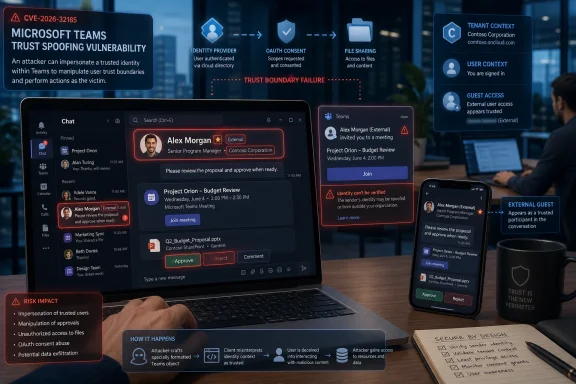 Teams Has Become the Place Where Trust Gets Spent
The modern Windows workplace has quietly moved its highest-value social interactions out of email and into chat. A finance approval, a password-reset nudge, a file-sharing request, a help desk escalation, and a “quick call?” message may all now arrive through Microsoft Teams. That migration has made Teams more useful, but it has also made it a more attractive place to attack the meaning of identity rather than the mechanics of code execution.That is why CVE-2026-32185 deserves attention even if the public advisory does not hand defenders a tidy exploit narrative. “Spoofing” is one of those vulnerability classes that can sound soft beside remote code execution or privilege escalation. In practice, it can be the bridge between a technically modest flaw and a very expensive incident.
A spoofing vulnerability is about false representation. It can involve misleading a user, confusing a client, abusing a trust indicator, or causing one security context to appear as another. In Teams, any such weakness lands in a product where users are trained to respond quickly because the interface implies proximity and legitimacy.
The uncomfortable lesson is that collaboration software has inherited the threat model of email while adding real-time urgency. Email users have spent years being told to distrust attachments and strange links. Teams users still tend to treat chat as a warmer, more authenticated channel — and attackers know it.
Microsoft’s Wording Leaves Defenders With a Familiar Problem
The public source material for CVE-2026-32185 is sparse in the way many Microsoft vulnerability entries are sparse on day one. The entry identifies the product family and the impact category, but it does not provide a step-by-step exploit path, proof-of-concept behavior, or a detailed technical root cause. That is frustrating for defenders, but it is not unusual.Microsoft has spent the last several years trying to make its vulnerability data more machine-readable and more standardized. The Security Update Guide, CVE records, CWE mappings, and structured advisory formats are meant to help asset managers and vulnerability teams automate triage. But automation does not remove the human judgment required when an advisory tells you the impact class without revealing the attacker’s exact move.
That is where the “confidence” language attached to vulnerability scoring becomes important. The metric described in the prompt measures how sure the ecosystem is that the vulnerability exists and how credible the known technical details are. In plain English, it asks whether defenders are dealing with rumor, partial research, or a vendor-confirmed flaw.
For CVE-2026-32185, the source is Microsoft’s own Security Update Guide. That moves the issue out of the realm of speculation. The exact exploitation mechanics may remain opaque, but the existence of the vulnerability is not merely a forum post, a researcher teaser, or a vendor-disputed claim.
This distinction is easy to underestimate. In vulnerability management, uncertainty is not binary. A confirmed vulnerability with few public details creates a different operational posture from an unconfirmed bug with a dramatic write-up. The former is less satisfying to read, but often more actionable.
“Confirmed” Does Not Mean “Fully Explained”
Security teams often want public advisories to answer three questions at once: Is it real, how bad is it, and exactly how does it work? Vendors rarely answer all three with equal clarity. CVE-2026-32185 appears to fit the familiar Microsoft pattern: enough information to drive remediation, not enough to make every attacker’s job easier.There is a good reason for that restraint. A Teams spoofing vulnerability may involve user-interface behavior, identity presentation, tenant boundary handling, invitation flows, message rendering, link preview behavior, notification surfaces, or service-side validation. Publishing precise trigger conditions too early could turn a manageable patch cycle into opportunistic abuse.
But opacity has costs. Administrators cannot easily write custom detections for behavior they cannot see. Security awareness teams cannot precisely tell users what to avoid. Risk committees struggle to compare a vague spoofing issue against flashier vulnerabilities elsewhere in the patch queue.
That is the trade Microsoft keeps asking customers to accept. The company gives enough structure for enterprise tooling, but often withholds enough detail that defenders must infer the likely blast radius from product context. In Teams, that context is broad.
Teams is not merely chat. It is a front end for Microsoft 365 identity, SharePoint and OneDrive content, Exchange calendars, guest access, app integrations, meeting invites, presence, and notification workflows. A spoofing flaw in that environment may not compromise every one of those layers, but defenders cannot responsibly pretend the layers are unrelated.
Spoofing Is the Vulnerability Class Built for Social Engineering
The industry’s scoring systems are good at counting technical preconditions. They are worse at capturing human credibility. A vulnerability that causes a malicious message, file, caller, app, or notification to appear more legitimate can amplify every downstream social-engineering tactic.That is especially true in Teams because the product is designed around identity cues. Users look at names, avatars, tenant labels, meeting contexts, chat history, organizational relationships, and app prompts. If any one of those cues can be forged, confused, or misrepresented, the attacker does not need to defeat the whole system. They need to defeat the user’s momentary judgment.
The problem is not that users are careless. The problem is that collaboration platforms deliberately reduce friction. Teams is built to make response feel immediate. The same design pattern that lets a distributed organization move quickly also gives attackers a high-trust lane for deception.
This is why “spoofing” should not be read as a low-drama category. A spoofed trust signal can be the first domino in credential theft, OAuth consent abuse, malicious file execution, help desk manipulation, invoice fraud, or remote support scams. The vulnerability may be in the presentation layer, but the incident can end in identity compromise.
Security teams should resist the temptation to rank this issue only by whether it produces code execution. In a cloud collaboration environment, belief is an execution primitive. If the interface convinces the right person to do the wrong thing, the attacker has already crossed a meaningful boundary.
Teams Sits at the Center of Microsoft’s Identity Bet
Microsoft’s enterprise strategy has made Teams one of the most privileged pieces of the user experience. It is where Entra ID identity becomes visible to ordinary employees. It is where conditional access, guest policies, retention rules, compliance controls, and app permissions meet daily behavior.That centrality changes the risk calculation for any Teams vulnerability. A flaw in a rarely used utility may affect a narrow group of users. A flaw in Teams affects the place where many organizations now conduct their most routine and most sensitive internal coordination.
The rise of external collaboration makes the issue sharper. Many organizations allow chats, meetings, shared channels, federated communication, or guest access with suppliers, customers, contractors, and partners. Those features are useful, but they also expand the set of identities users are expected to evaluate.
A spoofing flaw does not have to break tenant isolation outright to be dangerous. It may only need to blur the visual or contextual distinction between an internal user and an external participant, a trusted app and an untrusted one, or a legitimate notification and a crafted one. Those distinctions are exactly what users rely on when they decide whether to click, approve, upload, or call.
The strategic irony is hard to miss. Microsoft has pushed customers toward integrated cloud productivity partly because centralized identity and policy should be safer than fragmented tools. But when the central collaboration surface has a trust presentation bug, the consolidation itself increases the stakes.
The Patch Decision Is Easier Than the Risk Explanation
For most organizations, the practical answer is straightforward: take the Teams update path Microsoft provides and do not wait for a public exploit demonstration. Teams is a cloud-connected product with multiple client surfaces, and many fixes may arrive through service-side changes, client updates, or a combination of both. The job for administrators is to verify that the relevant clients and policies are actually current.That last phrase matters. Teams exists in a messy real-world estate. Some users run the new Teams client, some still have classic components, some use browser access, some rely on mobile clients, and some access Teams through virtual desktops. A vulnerability entry may say “Microsoft Teams,” but the operational footprint is rarely one clean package.
Administrators should pay particular attention to update compliance in managed Windows environments. If Teams is installed per-user, updated outside the traditional Windows servicing rhythm, or constrained by virtual desktop images, the organization may not have the uniform patch state it assumes it has. The risk is not merely whether Microsoft has shipped a fix; it is whether the fix has reached the user population.
Security teams should also treat this as a reason to revisit Teams external access and guest collaboration settings. The right response is not panic-disablement. It is a sober review of whether the organization’s collaboration exposure still matches its business need.
For highly regulated environments, the advisory should trigger a second conversation about logging and evidence. If a spoofing issue is later tied to real-world abuse, investigators will want Teams audit logs, sign-in telemetry, message trace context where available, endpoint records, and identity events. Those records are often retained according to licensing, policy, and cost decisions made long before a specific CVE arrives.
The Absence of Public Exploitation Is Not a Comfort Blanket
At the time of writing, there is no need to claim that CVE-2026-32185 is being widely exploited unless Microsoft or credible incident responders say so. Overstating exploitation is bad security journalism and worse security practice. But the absence of confirmed exploitation should not be confused with low priority.Attackers do not need every detail of a CVE to understand where to look. Once a vendor names a product and an impact class, researchers and adversaries can start diffing clients, watching service behavior, testing identity displays, and probing edge cases. A sparse advisory slows that process; it does not stop it.
Teams is also a product where abuse may be difficult to distinguish from normal user behavior. If a spoofing flaw helps deliver a convincing lure, the eventual security alert may show up as a user clicking a link, granting consent, joining a meeting, or sharing a file. The vulnerability’s role may be visible only after careful reconstruction.
This is one reason collaboration-platform vulnerabilities are hard to measure. The exploit may not leave the kind of crisp crash, shell, or suspicious process tree that endpoint teams are trained to hunt. It may leave a trail of ordinary actions performed under false assumptions.
That does not make detection impossible. It means defenders need to look at identity, messaging, endpoint, and SaaS telemetry together. A Teams spoofing issue is not just a Teams administrator’s problem; it is a security operations problem with a user-experience component.
Report Confidence Is the Quiet Metric That Changes the Queue
The user-supplied metric description points to one of the more underappreciated parts of vulnerability scoring: confidence in the report itself. Security teams often obsess over base severity while ignoring the difference between a vendor-confirmed issue and a loosely described claim. That is a mistake.A confirmed advisory from the vendor means the vulnerability has crossed an evidentiary threshold. It does not mean every public detail is complete, and it does not mean the vendor’s severity judgment is beyond challenge. But it does mean the issue is real enough to enter the patch and governance machinery without waiting for independent proof.
This matters because enterprise vulnerability queues are overflowing. Every month brings browser bugs, Windows kernel issues, Office parsing flaws, Exchange or SharePoint advisories, third-party driver problems, VPN defects, and cloud service warnings. Teams vulnerabilities can look less urgent in that crowd if they do not carry a catastrophic score.
Report confidence helps cut through that noise. A confirmed spoofing issue in a central collaboration product deserves a different response from a speculative bug in a peripheral tool. The former should be handled as a live operational risk even if the public write-up is terse.
The nuance is that confidence is not the same as severity. A highly confirmed vulnerability may still have limited impact. A severe-sounding vulnerability may still be poorly substantiated. CVE-2026-32185 sits in the category that administrators dislike but must handle: credible enough to act on, incomplete enough to require judgment.
Security Awareness Has to Catch Up With Chat
One predictable mistake after a Teams spoofing advisory is to treat it solely as a patching item. Patching matters, but Teams risk also lives in user expectations. Many organizations have not updated their anti-phishing training for a world where the lure arrives through chat, meeting invitations, shared channels, or app cards.Users should not be told to distrust Teams wholesale. That would be both unrealistic and counterproductive. They should be taught that Teams is a communication channel, not an automatic proof of identity or intent.
The distinction is subtle but important. A message appearing in Teams may indicate that an account, guest identity, federation path, or app integration was able to reach the user. It does not prove the sender’s request is safe, the linked file is benign, or the displayed context is impossible to manipulate.
Organizations should reinforce out-of-band verification for sensitive actions. Payment changes, credential requests, remote support sessions, OAuth approvals, and unusual file-sharing prompts should not be approved merely because they appear in a familiar chat window. That guidance was once email hygiene. It is now collaboration hygiene.
The best training will be specific to workflow. A finance team needs examples involving invoice and bank-detail changes. A help desk needs examples involving impersonated executives and remote assistance. Developers need examples involving repository access, build secrets, and app approvals. Generic “be careful online” messaging will not meet the moment.
Admins Should Treat Teams as an Attack Surface, Not a Utility
For years, many IT departments treated collaboration tools as productivity utilities rather than security-critical platforms. That posture is no longer defensible. Teams has become an attack surface with identity, data, and workflow implications.A mature response starts with inventory. Administrators should know which Teams clients are in use, how they update, which users are allowed external communication, which tenants are allow-listed, which apps can be installed, and how guest access is governed. Without that baseline, a CVE advisory becomes a guessing exercise.
The next layer is policy hardening. External access should reflect business reality, not historical sprawl. App permissions should be reviewed. Guest lifecycle processes should remove stale accounts. Meeting policies should account for impersonation and lobby risks. File-sharing defaults should be aligned with data classification.
Then comes monitoring. Teams activity should be part of the security operations picture, not a separate collaboration silo. Suspicious sign-ins, unusual guest interactions, risky OAuth grants, anomalous file access, and user-reported messages should be correlated rather than investigated in isolation.
None of this requires treating CVE-2026-32185 as the end of the world. It requires treating it as another signal that collaboration platforms are now security platforms. The organizations that understand that will patch faster, investigate better, and suffer less confusion when the next Teams advisory lands.
The Teams Trust Bug Leaves a Short List for This Week
CVE-2026-32185 is not a reason to declare Teams unsafe, but it is a reason to stop treating Teams trust indicators as background decoration. The immediate work is practical, and it belongs to desktop engineering, Microsoft 365 administration, identity teams, and security operations together.- Organizations should verify that Microsoft Teams clients and service-managed components are receiving the relevant security updates rather than assuming cloud connectivity guarantees full remediation.
- Administrators should review external access, federation, guest access, and shared-channel policies because spoofing risk becomes more consequential when users routinely interact across tenant boundaries.
- Security teams should preserve and review Teams, Entra ID, endpoint, and Microsoft 365 audit telemetry so that suspicious collaboration activity can be reconstructed if abuse is later reported.
- User-awareness guidance should explicitly cover Teams-based phishing, impersonation, malicious meeting requests, suspicious file shares, and requests for remote support or credential action.
- Vulnerability managers should treat Microsoft’s publication of the CVE as confirmation that the issue exists, while acknowledging that public technical details remain limited.
- Risk owners should avoid ranking the bug solely by exploit glamour, because spoofing in a high-trust collaboration surface can enable serious downstream compromise.
Source: MSRC Security Update Guide - Microsoft Security Response Center
