

CVE-2026-41054 is a local privilege-escalation flaw in the Linux haveged entropy daemon, disclosed and fixed in haveged 1.9.21 on May 19–20, 2026, in which a failed root-only command-socket permission check still allowed unprivileged users to reach privileged daemon commands. The bug is not a remote wormable catastrophe, but it is the kind of small control-flow mistake that turns a low-privilege foothold into a root problem. For WindowsForum readers, the lesson is not that Linux entropy daemons are suddenly exotic malware magnets; it is that mixed Windows-and-Linux estates increasingly inherit Unix daemon risk through WSL, appliances, containers, and cloud images. The boring patch note is doing more work than it first appears.
The vulnerability sits in haveged, a daemon historically used to feed entropy into the Linux random device, especially on systems where early boot or headless workloads could suffer from weak or slow randomness. It is the sort of background service many administrators install once, forget about, and then rediscover only when a scanner lights up.
The reported flaw was in the command socket handling path. The daemon checked the connecting peer’s credentials and recognized when the caller was not root, but after preparing a negative response it did not actually stop processing. Execution continued into the command switch, which meant the “no” was sent without the operational equivalent of closing the door.
That distinction matters. Security checks are not merely predicates; they are control-flow gates. A permission check that detects a violation but fails to exit is often worse than no check at all, because reviewers, packagers, and administrators may assume the boundary exists when the code path has already walked past it.
The public description points to commands such as chroot-related behavior and command-socket closure as reachable by a local unprivileged user. That puts the bug in a familiar class: not remote code execution from the internet, but local privilege escalation against a daemon already running with root authority.
For defenders, “local” should not be read as “low priority.” Modern compromises are often chained. A web app shell, a stolen SSH credential, a compromised CI runner, a container escape attempt, or a weak service account can all supply the local presence that makes a root escalation useful.
The user-supplied MSRC text emphasizes total or serious loss of availability. That is an important impact vector, particularly where an attacker can repeatedly disrupt a component or force a persistent bad state. But in this case, the more uncomfortable phrase is “could lead to root exploit,” because root changes the incident-response math.
Availability failures are visible. Privilege escalations can be quieter. A broken daemon might trigger service monitoring, but an attacker using a local privilege-escalation primitive as one step in a larger intrusion may leave administrators staring at symptoms rather than the underlying escalation path.
The bug also has the classic shape of a logic flaw rather than memory corruption. There is no need to imagine heap feng shui, speculative CPU behavior, or kernel race timing. The code reportedly identified a non-root caller, sent a rejection marker, and then continued. That simplicity is precisely why the issue deserves attention.
In security engineering, simple bugs age badly. They are easy to explain, easy to test, and easy to weaponize once the affected version is known. The absence of a remote network vector does not make them harmless; it just moves the first step of the attack chain somewhere else.
Linux’s random-number infrastructure has evolved substantially over the years, and many modern systems rely on kernel improvements, CPU instructions, virtio RNG, TPMs, hardware RNGs, or distribution defaults rather than a user-space entropy daemon. That does not mean haveged disappeared. It means it became part of the long tail of operational fixes that remain installed after the original reason has faded.
That long tail is where vulnerabilities like this do their damage. A package may no longer be central to a system’s security posture, but if it runs as root and exposes a command channel, it still becomes part of the attack surface. Legacy helper daemons are often overlooked precisely because they are considered solved infrastructure.
For Windows admins managing Linux servers alongside Active Directory, Intune, Defender, and Azure assets, this is a familiar pattern. The most dangerous service is not always the one with the most glamorous function. Sometimes it is the little daemon installed five years ago to make boot-time entropy warnings go away.
The practical response is not to panic-uninstall every entropy helper. It is to ask whether the helper is still needed, whether the installed version carries command socket support, and whether a distribution update has already replaced the vulnerable build. In 2026, “why is this root daemon still here?” is a healthier question than “what did this daemon originally solve?”
That second change is the one security reviewers should linger on. Mature fixes do not merely patch the symptom; they narrow the dangerous path. If command parsing happens only after identity is validated, future mistakes have less room to become privilege-boundary failures.
This is also where the language of “missing exit” is useful. Many vulnerability write-ups collapse logic flaws into generic “improper authorization” phrasing. Here, the phrasing helps administrators understand why the bug is dangerous: the code knew the caller was unauthorized, but the function did not leave.
It is a reminder that authorization failures are not always failures of knowledge. The program may know exactly who the caller is and exactly that the caller should not be allowed. The exploit lives in what happens next.
That lesson applies well beyond haveged. Windows services, Linux daemons, cloud metadata proxies, management agents, and local IPC endpoints all live or die by the same pattern. Authenticate early, authorize before parsing privileged commands, and return decisively on failure.
Developers run WSL distributions on Windows workstations. Enterprises deploy Linux containers on Windows-managed endpoints and in cloud pipelines. Security teams operate Linux-based appliances. Azure estates mix Windows Server, Linux VMs, Kubernetes nodes, and marketplace images under the same identity and logging umbrella. A “Linux local privilege escalation” can therefore be part of a Windows shop’s real risk surface.
The most likely enterprise exposure is not a consumer Windows desktop casually running haveged under WSL. WSL distributions usually do not mirror a traditional Linux boot environment with every daemon enabled by default, and the Windows host boundary is a different question from root inside a Linux user space. The larger concern is operational: administrators responsible for Windows fleets often also own the Linux systems that support build, monitoring, identity, backup, and edge infrastructure.
That mixed estate creates a patch-management blind spot. Windows Update, WSUS, Intune, and Autopatch do not automatically answer whether a forgotten Linux package inside an appliance image or VM template has been fixed. If the asset inventory stops at “Ubuntu server” or “SUSE appliance,” a vulnerable haveged package can remain invisible until a vulnerability scanner or incident response team finds it.
This is why CVE-2026-41054 belongs in the same conversation as Windows hardening. Not because it attacks Windows directly, but because Windows-centric organizations increasingly depend on Linux components that can become stepping stones. The attacker does not care which operating system owns the brand identity of the environment; they care where privilege can be gained.
A compromised web application may run as a restricted service account. A stolen developer token may open a shell inside a build container. A vulnerable monitoring plugin may permit command execution under a non-root user. In each case, the attacker’s next question is the same: how do I become root or administrator?
That is where bugs like CVE-2026-41054 become valuable. They convert a limited foothold into control of a host component. If the affected daemon runs as root and accepts local commands over an abstract Unix socket, the local-only boundary may be much thinner than administrators imagine.
The availability angle also deserves nuance. Closing a daemon command socket or forcing chroot behavior can break service expectations, but disruption is rarely the attacker’s only goal. A noisy denial-of-service effect can be a diversion, a test, or the byproduct of failed exploitation.
For defenders, the right model is chained risk. A local privilege escalation is not necessarily the first stage of the attack. It is the stage that turns a containable event into a host-level incident.
This is exactly the kind of bug that automated assistance can help surface. A human reviewer may skim a permission check and register that unauthorized users receive a rejection. A model asked to reason through the function path may notice that rejection does not necessarily terminate execution.
The industry should be careful with the lesson. AI-assisted discovery will produce false positives, shallow findings, and overconfident write-ups. But if models are good at identifying “you checked but did not return” patterns, then maintainers should assume attackers and defenders alike will increasingly use them for that purpose.
That changes the baseline for old daemons. Code that once benefited from obscurity or low reviewer attention is becoming cheaper to re-audit. Small projects, dormant packages, and infrastructure utilities may see more vulnerability reports not because they suddenly became worse, but because the economics of finding their old mistakes improved.
For enterprises, that means software bills of materials and package inventories become more valuable. If the discovery rate rises across aging open-source components, the organizations that can quickly answer “where do we run this?” will patch faster than those still treating Linux packages as anonymous contents of an image.
That matters because version strings can mislead. Some enterprise distributions backport security fixes while retaining older upstream version numbers. Others move quickly to the new upstream release. A naive check that only asks “is this exactly 1.9.21?” may produce false alarms or false reassurance depending on the platform.
The operational playbook should be straightforward. Identify systems with haveged installed. Determine whether the package includes the vulnerable command socket support. Check the vendor advisory or changelog for CVE-2026-41054. Apply the relevant package update. Restart the daemon or reboot if required by the package manager or service state.
Administrators should also consider whether haveged is necessary at all. On modern kernels and virtualized environments with reliable entropy sources, it may be redundant. Removing an unnecessary root daemon is often better than merely patching it, provided the removal is tested against boot behavior, cryptographic workloads, and vendor support requirements.
The key is not to improvise during an incident. If haveged is part of a hardened image, a vendor appliance, or a regulated build baseline, removal may require change control. Patching first and rationalizing later is usually the safer sequence.
Microsoft’s ecosystem has good reasons to surface non-Windows vulnerabilities. Defender Vulnerability Management, cloud workload protection, container scanning, Linux agents, Azure marketplace images, and enterprise exposure-management tools all need to understand CVEs outside the traditional Windows patch Tuesday universe. A Linux daemon flaw can matter to a Microsoft customer if that daemon runs in an Azure VM, a Kubernetes node, or a developer environment governed by Microsoft tooling.
This is part of a larger shift in security operations. The authoritative fix may come from an upstream maintainer or Linux distribution, while the alert may arrive through Microsoft, CISA, Tenable, Qualys, Rapid7, Mondoo, or an internal scanner. The source of the notification is not always the source of the patch.
That distinction is important for administrators. Seeing a CVE in a Microsoft-facing portal does not mean Windows Update will fix it. It means the vulnerability has entered a risk-management workflow that may require Linux package updates, image rebuilds, container refreshes, or vendor firmware action.
In other words, MSRC’s presence should broaden the audience, not confuse the remediation path. The fix still lives where the affected software lives.
A privileged daemon command can have side effects that reshape the environment around it. Chroot changes filesystem perspective. Socket closure changes manageability and availability. Even when individual commands appear constrained, their security model depends on the assumption that only trusted callers can invoke them.
That assumption is exactly what CVE-2026-41054 broke. Once an untrusted local user can reach commands intended for root, defenders must analyze the command set as an attack surface rather than a management feature.
This is a recurring pattern in service design. Developers create a local control socket because it is convenient, faster than a full management API, and assumed to be reachable only by privileged tooling. Then a permission check, file mode, credential validation, namespace boundary, or return path fails, and the internal interface becomes an escalation interface.
The safest control sockets are boring. They authenticate before parsing, authorize before acting, log rejected attempts, minimize command power, and fail closed. Anything else eventually becomes an incident report with a small code diff and a large blast radius.
The correct triage question is not “can the internet hit haveged?” It is “who can obtain local code execution on this system, and what would root mean there?” On a single-purpose appliance, the answer may be limited. On a CI server holding signing keys or deployment credentials, the answer may be existential.
Container environments complicate the picture. If haveged runs on the host, a container compromise that reaches the host namespace or local socket could become more serious. If haveged is inside a container image, root inside that container may or may not translate into host compromise, depending on isolation, capabilities, mounts, and runtime configuration. The CVE does not erase those boundaries, but it can stress them.
Administrators should also separate exploitability from exposure. A package can be installed but inactive. A vulnerable version can be present in a dormant image. A fixed package can still leave a running old process if the daemon was not restarted. Good vulnerability management needs all three views: installed software, active services, and running process state.
That is where Windows-centric management often struggles with Linux assets. The Windows world has mature habits around reboot state, pending updates, and service inventory. Linux fleets need the same discipline, especially when they sit inside broader Microsoft-managed operations.
Near-term, administrators should move to a fixed distribution package or haveged 1.9.21 where appropriate. They should restart the service, rebuild golden images, refresh containers, and make sure vulnerability scanners are looking at the new artifacts rather than the old base layers. If haveged is not needed, they should plan removal rather than carry another privileged daemon indefinitely.
Longer-term, teams should scrutinize local management sockets across their Linux estate. Root-running daemons with local command channels are common. Some are essential. Some are historical leftovers. The difference matters more now that automated code review and vulnerability discovery are lowering the cost of finding old mistakes.
There is also a governance lesson. Mixed Windows and Linux environments need a single ownership model for vulnerability response. If a Microsoft dashboard reports a Linux CVE, a Linux team patches it, a cloud team owns the image, and an app team owns the workload, the handoff itself becomes the vulnerability.
The better organizations will use this CVE as a drill. Can they find haveged? Can they tell whether it is running? Can they identify which images include it? Can they patch or remove it without breaking boot or cryptographic workloads? Can they prove the fix landed?
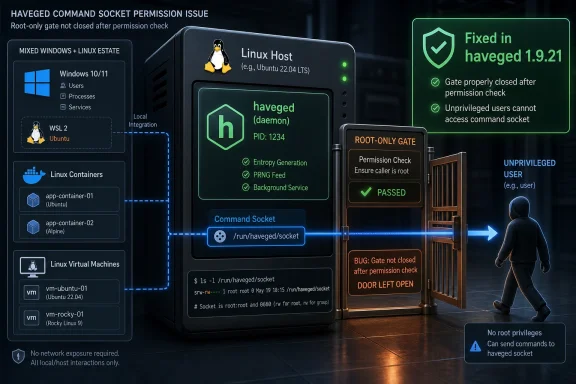 A One-Line Security Check Became a Root Boundary
The vulnerability sits in haveged, a daemon historically used to feed entropy into the Linux random device, especially on systems where early boot or headless workloads could suffer from weak or slow randomness. It is the sort of background service many administrators install once, forget about, and then rediscover only when a scanner lights up.The reported flaw was in the command socket handling path. The daemon checked the connecting peer’s credentials and recognized when the caller was not root, but after preparing a negative response it did not actually stop processing. Execution continued into the command switch, which meant the “no” was sent without the operational equivalent of closing the door.
That distinction matters. Security checks are not merely predicates; they are control-flow gates. A permission check that detects a violation but fails to exit is often worse than no check at all, because reviewers, packagers, and administrators may assume the boundary exists when the code path has already walked past it.
The public description points to commands such as chroot-related behavior and command-socket closure as reachable by a local unprivileged user. That puts the bug in a familiar class: not remote code execution from the internet, but local privilege escalation against a daemon already running with root authority.
For defenders, “local” should not be read as “low priority.” Modern compromises are often chained. A web app shell, a stolen SSH credential, a compromised CI runner, a container escape attempt, or a weak service account can all supply the local presence that makes a root escalation useful.
The Severity Score Is Less Interesting Than the Shape of the Bug
The published scoring around CVE-2026-41054 lands in the high range, with confidentiality, integrity, and availability all treated as high-impact outcomes. That makes sense if an unprivileged local user can cause a root-running daemon to obey commands that were intended to be root-only. Once that trust boundary breaks, the affected component’s availability is only one piece of the story.The user-supplied MSRC text emphasizes total or serious loss of availability. That is an important impact vector, particularly where an attacker can repeatedly disrupt a component or force a persistent bad state. But in this case, the more uncomfortable phrase is “could lead to root exploit,” because root changes the incident-response math.
Availability failures are visible. Privilege escalations can be quieter. A broken daemon might trigger service monitoring, but an attacker using a local privilege-escalation primitive as one step in a larger intrusion may leave administrators staring at symptoms rather than the underlying escalation path.
The bug also has the classic shape of a logic flaw rather than memory corruption. There is no need to imagine heap feng shui, speculative CPU behavior, or kernel race timing. The code reportedly identified a non-root caller, sent a rejection marker, and then continued. That simplicity is precisely why the issue deserves attention.
In security engineering, simple bugs age badly. They are easy to explain, easy to test, and easy to weaponize once the affected version is known. The absence of a remote network vector does not make them harmless; it just moves the first step of the attack chain somewhere else.
Haveged Is a Legacy Comfort Blanket in a Modern RNG World
Haveged exists because entropy used to be a more visible operational pain. Headless servers, virtual machines, and embedded systems could block or stumble when the kernel did not have enough randomness available for cryptographic operations. Administrators reached for entropy daemons because stalled boot processes and slow key generation were real annoyances.Linux’s random-number infrastructure has evolved substantially over the years, and many modern systems rely on kernel improvements, CPU instructions, virtio RNG, TPMs, hardware RNGs, or distribution defaults rather than a user-space entropy daemon. That does not mean haveged disappeared. It means it became part of the long tail of operational fixes that remain installed after the original reason has faded.
That long tail is where vulnerabilities like this do their damage. A package may no longer be central to a system’s security posture, but if it runs as root and exposes a command channel, it still becomes part of the attack surface. Legacy helper daemons are often overlooked precisely because they are considered solved infrastructure.
For Windows admins managing Linux servers alongside Active Directory, Intune, Defender, and Azure assets, this is a familiar pattern. The most dangerous service is not always the one with the most glamorous function. Sometimes it is the little daemon installed five years ago to make boot-time entropy warnings go away.
The practical response is not to panic-uninstall every entropy helper. It is to ask whether the helper is still needed, whether the installed version carries command socket support, and whether a distribution update has already replaced the vulnerable build. In 2026, “why is this root daemon still here?” is a healthier question than “what did this daemon originally solve?”
The Patch Tells a Story About Defense in Depth
The fix is notable because it appears to do the obvious thing and then the more defensive thing. The immediate correction is to exit after rejecting a non-root caller, closing the hole created by the missing control-flow break. The hardening step moves the credential check earlier, before command parsing, reducing the amount of code reachable before authorization is established.That second change is the one security reviewers should linger on. Mature fixes do not merely patch the symptom; they narrow the dangerous path. If command parsing happens only after identity is validated, future mistakes have less room to become privilege-boundary failures.
This is also where the language of “missing exit” is useful. Many vulnerability write-ups collapse logic flaws into generic “improper authorization” phrasing. Here, the phrasing helps administrators understand why the bug is dangerous: the code knew the caller was unauthorized, but the function did not leave.
It is a reminder that authorization failures are not always failures of knowledge. The program may know exactly who the caller is and exactly that the caller should not be allowed. The exploit lives in what happens next.
That lesson applies well beyond haveged. Windows services, Linux daemons, cloud metadata proxies, management agents, and local IPC endpoints all live or die by the same pattern. Authenticate early, authorize before parsing privileged commands, and return decisively on failure.
Windows Shops Still Own This Linux Problem
At first glance, a Linux entropy daemon may seem outside the normal WindowsForum beat. That would have been a stronger argument fifteen years ago. Today, Windows environments routinely include Linux in ways that are easy to underestimate.Developers run WSL distributions on Windows workstations. Enterprises deploy Linux containers on Windows-managed endpoints and in cloud pipelines. Security teams operate Linux-based appliances. Azure estates mix Windows Server, Linux VMs, Kubernetes nodes, and marketplace images under the same identity and logging umbrella. A “Linux local privilege escalation” can therefore be part of a Windows shop’s real risk surface.
The most likely enterprise exposure is not a consumer Windows desktop casually running haveged under WSL. WSL distributions usually do not mirror a traditional Linux boot environment with every daemon enabled by default, and the Windows host boundary is a different question from root inside a Linux user space. The larger concern is operational: administrators responsible for Windows fleets often also own the Linux systems that support build, monitoring, identity, backup, and edge infrastructure.
That mixed estate creates a patch-management blind spot. Windows Update, WSUS, Intune, and Autopatch do not automatically answer whether a forgotten Linux package inside an appliance image or VM template has been fixed. If the asset inventory stops at “Ubuntu server” or “SUSE appliance,” a vulnerable haveged package can remain invisible until a vulnerability scanner or incident response team finds it.
This is why CVE-2026-41054 belongs in the same conversation as Windows hardening. Not because it attacks Windows directly, but because Windows-centric organizations increasingly depend on Linux components that can become stepping stones. The attacker does not care which operating system owns the brand identity of the environment; they care where privilege can be gained.
Local Exploits Are the Currency of Post-Compromise
Security teams often triage local privilege-escalation bugs below remote code execution, and that hierarchy is rational. A flaw that requires local access starts after an attacker has already crossed some boundary. But in real intrusions, getting “some” code execution is often easier than getting the right privilege.A compromised web application may run as a restricted service account. A stolen developer token may open a shell inside a build container. A vulnerable monitoring plugin may permit command execution under a non-root user. In each case, the attacker’s next question is the same: how do I become root or administrator?
That is where bugs like CVE-2026-41054 become valuable. They convert a limited foothold into control of a host component. If the affected daemon runs as root and accepts local commands over an abstract Unix socket, the local-only boundary may be much thinner than administrators imagine.
The availability angle also deserves nuance. Closing a daemon command socket or forcing chroot behavior can break service expectations, but disruption is rarely the attacker’s only goal. A noisy denial-of-service effect can be a diversion, a test, or the byproduct of failed exploitation.
For defenders, the right model is chained risk. A local privilege escalation is not necessarily the first stage of the attack. It is the stage that turns a containable event into a host-level incident.
The AI-Found Detail Is a Glimpse of the New Audit Floor
One of the more interesting details in the disclosure trail is that the issue was reportedly found by Gemini Pro operated by a SUSE engineer. That should not be inflated into a grand claim that artificial intelligence has solved code auditing. It does, however, fit a broader trend: large language models are becoming useful at spotting simple but consequential control-flow mistakes in mature code.This is exactly the kind of bug that automated assistance can help surface. A human reviewer may skim a permission check and register that unauthorized users receive a rejection. A model asked to reason through the function path may notice that rejection does not necessarily terminate execution.
The industry should be careful with the lesson. AI-assisted discovery will produce false positives, shallow findings, and overconfident write-ups. But if models are good at identifying “you checked but did not return” patterns, then maintainers should assume attackers and defenders alike will increasingly use them for that purpose.
That changes the baseline for old daemons. Code that once benefited from obscurity or low reviewer attention is becoming cheaper to re-audit. Small projects, dormant packages, and infrastructure utilities may see more vulnerability reports not because they suddenly became worse, but because the economics of finding their old mistakes improved.
For enterprises, that means software bills of materials and package inventories become more valuable. If the discovery rate rises across aging open-source components, the organizations that can quickly answer “where do we run this?” will patch faster than those still treating Linux packages as anonymous contents of an image.
Distribution Packaging Is the Real Patch Path
Upstream haveged 1.9.21 is the fixed release, but most production administrators should not treat upstream tarballs as their first patching mechanism. The safer path is to follow the distribution’s package channel unless the organization has a deliberate source-build process. Debian, Fedora, SUSE, Ubuntu derivatives, appliance vendors, and container base-image maintainers each have their own cadence and backporting conventions.That matters because version strings can mislead. Some enterprise distributions backport security fixes while retaining older upstream version numbers. Others move quickly to the new upstream release. A naive check that only asks “is this exactly 1.9.21?” may produce false alarms or false reassurance depending on the platform.
The operational playbook should be straightforward. Identify systems with haveged installed. Determine whether the package includes the vulnerable command socket support. Check the vendor advisory or changelog for CVE-2026-41054. Apply the relevant package update. Restart the daemon or reboot if required by the package manager or service state.
Administrators should also consider whether haveged is necessary at all. On modern kernels and virtualized environments with reliable entropy sources, it may be redundant. Removing an unnecessary root daemon is often better than merely patching it, provided the removal is tested against boot behavior, cryptographic workloads, and vendor support requirements.
The key is not to improvise during an incident. If haveged is part of a hardened image, a vendor appliance, or a regulated build baseline, removal may require change control. Patching first and rationalizing later is usually the safer sequence.
The MSRC Appearance Reflects the Vulnerability-Data Supply Chain
The user-provided source is Microsoft’s Security Update Guide entry, which may surprise readers who associate MSRC only with Windows, Office, Azure, and Microsoft products. In practice, vulnerability intelligence now crosses vendor lines because customers consume risk through portals, scanners, cloud services, and compliance dashboards rather than through neat product silos.Microsoft’s ecosystem has good reasons to surface non-Windows vulnerabilities. Defender Vulnerability Management, cloud workload protection, container scanning, Linux agents, Azure marketplace images, and enterprise exposure-management tools all need to understand CVEs outside the traditional Windows patch Tuesday universe. A Linux daemon flaw can matter to a Microsoft customer if that daemon runs in an Azure VM, a Kubernetes node, or a developer environment governed by Microsoft tooling.
This is part of a larger shift in security operations. The authoritative fix may come from an upstream maintainer or Linux distribution, while the alert may arrive through Microsoft, CISA, Tenable, Qualys, Rapid7, Mondoo, or an internal scanner. The source of the notification is not always the source of the patch.
That distinction is important for administrators. Seeing a CVE in a Microsoft-facing portal does not mean Windows Update will fix it. It means the vulnerability has entered a risk-management workflow that may require Linux package updates, image rebuilds, container refreshes, or vendor firmware action.
In other words, MSRC’s presence should broaden the audience, not confuse the remediation path. The fix still lives where the affected software lives.
The Chroot Detail Is a Warning About “Administrative” Commands
The reported impact includes the ability for a local unprivileged user to force daemon behavior involving chroot to an attacker-controlled directory or to close the daemon’s command socket. That may sound narrower than “execute arbitrary command as root,” but administrative control channels rarely need to expose a shell to be dangerous.A privileged daemon command can have side effects that reshape the environment around it. Chroot changes filesystem perspective. Socket closure changes manageability and availability. Even when individual commands appear constrained, their security model depends on the assumption that only trusted callers can invoke them.
That assumption is exactly what CVE-2026-41054 broke. Once an untrusted local user can reach commands intended for root, defenders must analyze the command set as an attack surface rather than a management feature.
This is a recurring pattern in service design. Developers create a local control socket because it is convenient, faster than a full management API, and assumed to be reachable only by privileged tooling. Then a permission check, file mode, credential validation, namespace boundary, or return path fails, and the internal interface becomes an escalation interface.
The safest control sockets are boring. They authenticate before parsing, authorize before acting, log rejected attempts, minimize command power, and fail closed. Anything else eventually becomes an incident report with a small code diff and a large blast radius.
Scanner Findings Need Context, Not Complacency
When vulnerability scanners flag CVE-2026-41054, some teams will be tempted to suppress it because exploitation requires local access. That may be reasonable for narrowly scoped systems with no untrusted users, no exposed services, and strong isolation. It is reckless for shared hosts, build machines, bastion-adjacent systems, hosting environments, developer workstations, and internet-facing servers where a separate weakness could provide the first foothold.The correct triage question is not “can the internet hit haveged?” It is “who can obtain local code execution on this system, and what would root mean there?” On a single-purpose appliance, the answer may be limited. On a CI server holding signing keys or deployment credentials, the answer may be existential.
Container environments complicate the picture. If haveged runs on the host, a container compromise that reaches the host namespace or local socket could become more serious. If haveged is inside a container image, root inside that container may or may not translate into host compromise, depending on isolation, capabilities, mounts, and runtime configuration. The CVE does not erase those boundaries, but it can stress them.
Administrators should also separate exploitability from exposure. A package can be installed but inactive. A vulnerable version can be present in a dormant image. A fixed package can still leave a running old process if the daemon was not restarted. Good vulnerability management needs all three views: installed software, active services, and running process state.
That is where Windows-centric management often struggles with Linux assets. The Windows world has mature habits around reboot state, pending updates, and service inventory. Linux fleets need the same discipline, especially when they sit inside broader Microsoft-managed operations.
The Real Fix Is Smaller Attack Surface, Not Better Panic
CVE-2026-41054 should be patched promptly, but it should not be treated as an isolated freak event. It is a case study in why old root daemons, local IPC, and assumed-trusted helper commands deserve periodic review. The vulnerability’s simplicity is the point.Near-term, administrators should move to a fixed distribution package or haveged 1.9.21 where appropriate. They should restart the service, rebuild golden images, refresh containers, and make sure vulnerability scanners are looking at the new artifacts rather than the old base layers. If haveged is not needed, they should plan removal rather than carry another privileged daemon indefinitely.
Longer-term, teams should scrutinize local management sockets across their Linux estate. Root-running daemons with local command channels are common. Some are essential. Some are historical leftovers. The difference matters more now that automated code review and vulnerability discovery are lowering the cost of finding old mistakes.
There is also a governance lesson. Mixed Windows and Linux environments need a single ownership model for vulnerability response. If a Microsoft dashboard reports a Linux CVE, a Linux team patches it, a cloud team owns the image, and an app team owns the workload, the handoff itself becomes the vulnerability.
The better organizations will use this CVE as a drill. Can they find haveged? Can they tell whether it is running? Can they identify which images include it? Can they patch or remove it without breaking boot or cryptographic workloads? Can they prove the fix landed?
The Small Daemon That Exposes the Big Inventory Problem
The concrete lessons from CVE-2026-41054 are narrower than the noise around “root exploit” but broader than one entropy package. This is a local flaw with a fixed upstream release, yet its operational reach depends entirely on whether organizations know where the daemon lives.- Systems running haveged with command socket support should be checked against distribution advisories and updated to a build containing the CVE-2026-41054 fix.
- Administrators should verify service restart or reboot status because updating a package is not always the same as replacing the running daemon.
- Teams should determine whether haveged is still required on modern systems rather than keeping it as inherited boot-time folklore.
- Shared Linux hosts, CI runners, appliances, and cloud images deserve higher triage priority than isolated single-user machines.
- Windows-first organizations should treat this as part of their estate-wide exposure management, not as somebody else’s Linux housekeeping.
References
- Primary source: MSRC
Published: 2026-05-24T01:42:19-07:00
Security Update Guide - Microsoft Security Response Center
 msrc.microsoft.com
- Related coverage: mondoo.com
CVE-2026-41054 | Mondoo Vulnerability Intelligence
CVE-2026-41054 - HIGH severity: Missing exit out of permission check in haveged could lead to root exploitmondoo.com - Related coverage: linuxsecurity.com
SUSE OpenSUSE Haveged Important Root Exploit CVE-2026-41054
An important security update for haveged identifies a root exploit risk. Details on patching available. linuxsecurity.com
- Related coverage: issihosts.com
- Related coverage: linuxcommandlibrary.com
haveged man | Linux Command Library
haveged linux command man page: random number generator daemon that feeds the Linux kernel's entropy pool linuxcommandlibrary.com
- Related coverage: wiki.archlinux.org
- Related coverage: packages.fedoraproject.org
haveged - Fedora Packages
View haveged in the Fedora package repositories. haveged: A Linux entropy source using the HAVEGE algorithmpackages.fedoraproject.org - Related coverage: openmamba.org
- Related coverage: man.archlinux.org
haveged(8) — Arch manual pages
man.archlinux.org
