

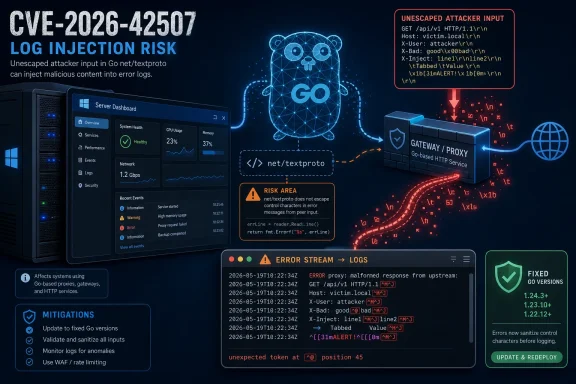
net/textproto could include attacker-controlled input in error messages without escaping it, creating a path for misleading log entries or terminal-control injection in software that prints or records those errors. The flaw is not a classic remote-code-execution panic button, and Windows administrators should resist treating it like one. Its importance is subtler: a low-glamour logging bug in a foundational networking package can still distort the evidence trail that security teams depend on after something else goes wrong. For modern Windows shops that run Go-built agents, gateways, CLIs, proxies, and cloud-native plumbing, this is exactly the kind of CVE that tests whether software inventory is real or merely aspirational.
The Bug Is Small; the Blast Radius Comes From Go’s Ubiquity
The vulnerable component, net/textproto, is not a consumer-facing application and not something most Windows users would ever knowingly install. It is part of Go’s standard library, the networking substrate used by countless programs that speak HTTP-like or mail-like text protocols. That distinction matters because the first instinct with a Microsoft Security Response Center entry is often to ask which Windows patch fixes it. In this case, the more useful question is which Go-built binaries inside your environment were compiled with affected Go versions or vendored into products that depend on the vulnerable behavior.
The Go vulnerability database describes the issue plainly: when certain functions returned errors, they could include input as part of the error. If that input came from an attacker-controlled source, the attacker could inject misleading content into errors that were printed or logged. The affected symbols include functions used around response parsing and MIME header handling, including ReadMIMEHeader, a detail that immediately broadens the audience beyond niche protocol tooling.
The fixed Go lines are also concrete. The issue affects Go versions before 1.25.11 and the 1.26 development/release line before 1.26.4. That does not mean every Go binary built before those versions is exploitable in practice, but it does mean every security team relying on Go-based network software should know how that software was built.
This is why the MSRC listing is useful even if the code at issue belongs to Go rather than Windows itself. Microsoft’s security guide has become a cross-ecosystem risk register, and Windows estates are no longer made only of Windows components. A Defender-adjacent service, a developer CLI, a Kubernetes helper, a gateway appliance, or an observability agent may all be part of the operational Windows story even when their vulnerable line of code lives in an open-source runtime.
Log Injection Is the Sort of Vulnerability That Looks Harmless Until It Is Evidence
There is a tendency to downgrade any bug that “only” affects logs. That instinct is understandable and sometimes correct. A log-injection flaw typically does not hand an attacker a shell, bypass authentication, or exfiltrate a database by itself.
But logs are not passive scrapbooks anymore. They are routed into SIEMs, enriched by detection pipelines, fed into incident-response workflows, displayed in web consoles, shipped to support vendors, and sometimes parsed by automation that triggers action. If an attacker can shape what appears in an error message, the immediate impact may be cosmetic; the downstream impact can be operational.
The most obvious abuse is spoofing. An attacker-controlled server could cause a client or proxy to log lines that look like benign status updates, false errors, fake remediation messages, or entries attributed to another component. In a busy environment, that may not compromise a machine, but it can compromise confidence.
The more uncomfortable scenario is terminal-control injection. Some logs are still viewed in terminals, copied into tickets, or inspected through tools that may interpret control characters. Security people have become much more alert to this class of problem because modern tooling increasingly blurs the line between text, markup, and command-adjacent interfaces. “It is just a string” is no longer a comforting sentence when that string travels through multiple renderers.
The key phrase here is attacker-controlled input. CVE-2026-42507 matters most where a Go program parses text protocol data from an untrusted or semi-trusted peer and then prints or logs the resulting error. In the real world, that often means proxies, gateways, crawlers, scanners, health-checking tools, package clients, and backend-to-backend integrations that trust the network more than they should.
The HTTP Client Path Makes This More Than a Library Curiosity
The KrakenD advisory is a useful illustration because it translates a standard-library flaw into a product-level scenario. KrakenD says its affected versions can encounter the bug when a malicious backend server sends HTTP response headers containing arbitrary unescaped content that appears in error output or logs. Deployments proxying to untrusted or partially trusted upstream services are the most exposed.
That framing is important. Most organizations do not think of their upstream services as hostile. They think of them as vendor APIs, partner endpoints, staging systems, internal microservices, or “temporary” integrations that somehow become permanent. The vulnerability lives in the space between trust assumptions and operational reality.
For a gateway, the consequences are not theoretical. Gateways often sit in precisely the place where bad input, internal logs, and automated monitoring converge. If a gateway emits manipulated log lines, an attacker may be able to hide the real failure mode, poison dashboards, or create noise that sends responders in the wrong direction. None of that is as dramatic as remote code execution, but attackers do not always need drama. Sometimes they need ambiguity.
The same pattern can apply to Windows environments that use Go-built reverse proxies, service meshes, developer tunnels, internal API tools, or security scanners. The vulnerable code path is not Windows-specific, but the operational dependency absolutely can be. In 2026, a Windows estate is as likely to include Go binaries in Program Files, developer profiles, agent directories, container images, and CI runners as it is to include old-school MSI-installed applications.
That is why a simple patch checklist will miss the point. The problem is not merely “update Go.” Most production systems do not run the Go toolchain directly; they run artifacts built with Go. If those artifacts are statically linked, the vulnerable standard-library code is baked into the binary. Reinstalling a newer Go compiler on an administrator workstation will not magically repair yesterday’s gateway executable.
Microsoft’s Presence in the Story Is a Signal, Not the Centerpiece
The source material points to MSRC, but this is not a normal Windows Patch Tuesday narrative. There is no reason to present CVE-2026-42507 as a Windows kernel emergency or a flaw in Explorer, Edge, or Office. The affected package is Go’s net/textproto, and the remediation path generally runs through Go updates and vendor rebuilds.
Still, Microsoft’s role is not incidental. Windows administrators increasingly consume security information through Microsoft channels even when the vulnerable component is part of a broader dependency chain. That is especially true in mixed estates where Windows Server, Azure services, Linux containers, developer workstations, and third-party appliances all meet in the same monitoring environment.
The legal disclaimer attached to the Knowledge Base text is boilerplate, but it reflects a reality security teams know well: advisories are risk signals, not warranties. They rarely tell you exactly whether your specific product, build flags, runtime path, and deployment topology are exploitable. They tell you where to look.
That distinction is healthy. The old patch-management model assumed a neat mapping between vendor, product, CVE, and update. The modern model is messier. A vulnerability in Go may be fixed upstream, acknowledged by a gateway vendor, listed by Microsoft, redistributed by a Linux distribution, and ultimately discovered by a Windows administrator through an SBOM scan of a container image running on a Windows-hosted platform.
The practical lesson is that Microsoft’s listing should prompt dependency investigation, not brand confusion. If your organization tracks only Microsoft bulletins and Windows Update status, CVE-2026-42507 is a reminder that the software supply chain no longer respects those boundaries.
The Fix Is Straightforward; Finding Everything That Needs It Is Not
Upstream, the fix path is conceptually simple: use Go versions that include the patched net/textproto behavior. The Go vulnerability report identifies the safe versions as Go 1.25.11 or later on that branch, and Go 1.26.4 or later on the 1.26 branch. Product vendors then need to rebuild and ship their software with those versions or otherwise incorporate the relevant patch.
For developers, that means updating build images, CI runners, local toolchains, and release pipelines. It also means verifying that the shipped binary was actually rebuilt. A changelog entry that says a project “updated Go” is useful; a reproducible build record or SBOM entry is better.
For administrators, the challenge is inventory. Go binaries are often statically linked, self-contained, and free of the obvious shared-library fingerprints that traditional vulnerability scanners were built around. A Windows server can host a vulnerable Go binary without any installed “Go” entry in Programs and Features. A container image can contain a vulnerable compiled artifact even if the base image has already received distribution-level patches.
This is where software composition analysis earns its keep. Security teams should look for products that disclose Go runtime versions, publish SBOMs, or provide vulnerability advisories tied to their embedded dependencies. Vendors that merely say “not affected” without describing the code path, build version, or exposure model are asking customers to trust a conclusion without the reasoning.
There is also a difference between updating code you own and updating software you buy. Internal Go services can be rebuilt quickly if the engineering pipeline is disciplined. Third-party appliances, closed-source agents, and commercial gateways require vendor coordination. KrakenD, for example, has already identified addressed versions for its community and enterprise editions, which is the kind of product-level mapping administrators need.
The Risk Is Highest Where Trust Boundaries Are Fuzzy
The most exposed deployments are not necessarily the largest. They are the ones where a Go component parses text protocol responses from peers that are not fully controlled, then logs parse failures somewhere humans or machines rely on them. That can describe a startup’s API gateway, a corporate integration hub, a partner-facing proxy, or a security tool scanning arbitrary endpoints.
A malicious upstream server is the cleanest example. If a Go HTTP client receives malformed headers and the parsing error includes unescaped attacker input, the attacker may influence the logged error. The same underlying idea can apply to other text-based protocol parsing paths depending on how the application uses net/textproto.
Internal-only systems are not automatically safe. Many incidents begin with an attacker gaining limited foothold inside a network and then manipulating the surrounding environment. A compromised internal service that can feed crafted responses to logging-heavy clients may be able to pollute the trail while defenders are still trying to establish what happened.
The risk is also higher in environments that stream raw application logs into alerting pipelines without normalization. If downstream systems interpret newlines, escape sequences, structured log delimiters, or terminal control characters too generously, a library-level escaping bug can become a detection-quality problem.
This is why the right mitigation posture is layered. Upgrade the vulnerable software, yes. But also treat untrusted log content as untrusted data all the way through the pipeline. Sanitization at the source is good; safe rendering, structured logging, and defensive parsing downstream are how you avoid repeating the same incident under a different CVE number.
Windows Shops Should Look Beyond Windows Update
For WindowsForum readers, the uncomfortable part is that Windows Update may not be the center of action. A Windows Server estate could be fully patched according to Microsoft’s monthly cumulative updates and still run a vulnerable Go-built service installed separately. The same applies to developer workstations with local proxies, package tools, cloud CLIs, or vendor agents.
The first step is to identify Go-built software that handles network traffic. That includes obvious candidates such as API gateways, reverse proxies, service discovery tools, telemetry collectors, endpoint agents, and DevOps utilities. It also includes less obvious tools that fetch URLs, inspect headers, talk SMTP-like protocols, or crawl internal services.
The second step is to ask vendors for affected-version statements. A useful vendor response should say whether the product uses the vulnerable Go standard-library path, which shipped versions are affected, which versions are fixed, and whether exploitation requires a malicious upstream, a malicious client, local access, or another precondition. Anything vaguer than that should be treated as an incomplete answer.
The third step is to inspect your logging path. If logs are rendered in terminals or web dashboards, check whether control characters are escaped. If logs are parsed into fields, check whether injected line breaks or delimiters can create fake events. If automated actions depend on log contents, make sure those actions are not triggered by raw error strings from untrusted protocol input.
This is a good moment to revisit a broader principle: logs should be useful evidence, not executable theater. The more your observability platform treats raw text as a command surface, the more you depend on every upstream component to escape perfectly. That is not a safe bet.
The CVSS Score Will Not Tell You Whether Your Logs Matter
Many organizations will look for the severity score, see a medium-ish characterization in product advisories, and move on. That may be reasonable for consumer endpoints or tightly controlled systems with no exposure to untrusted protocol peers. But CVSS is a blunt instrument for flaws that affect evidence integrity.
The business impact of a log-injection bug depends on context. In a throwaway developer tool, the risk may be negligible. In a gateway fronting regulated APIs, it may matter a great deal. In a security scanner, it may corrupt precisely the output teams rely on to make decisions. In an incident-response environment, it may waste the most precious resource defenders have: time.
Security teams should therefore classify this CVE by deployment role rather than by package name alone. A vulnerable binary that only parses trusted local files is different from one that parses arbitrary remote responses. A vulnerable service whose logs are stored as inert JSON is different from one whose logs are rendered live in terminals and dashboards. A vulnerable component in a production ingress or egress path deserves more urgency than a lab-only helper.
That is not special pleading for this one CVE. It is how dependency vulnerabilities increasingly need to be handled. Standard-library bugs are often boring in isolation and interesting only when mapped to products, trust boundaries, and operational workflows.
The Real Story Is Supply-Chain Observability
CVE-2026-42507 lands in a period when the industry has spent years talking about SBOMs, dependency transparency, and secure-by-design development. This is a practical test of whether those concepts are operational or decorative. If a team cannot answer which Go-built binaries it runs, who built them, and which Go version they contain, then the risk conversation becomes guesswork.
The good news is that Go makes some of this easier than older ecosystems. Many Go binaries can expose build information, and mature projects increasingly publish module and toolchain metadata. The bad news is that not every vendor surfaces that information cleanly, and not every organization collects it before an advisory appears.
There is also a cultural challenge. Infrastructure teams often trust self-contained binaries because they are easy to deploy. Security teams often distrust them because they hide dependency state. Both instincts are rational. The compromise is not to abandon Go or statically linked tools; it is to demand better build provenance and faster rebuild cycles.
A patched upstream language release only solves the first part of the problem. The patch then has to move through maintainers, distributions, vendors, internal build systems, staging environments, and production change windows. Every stop adds delay, and every opaque artifact adds uncertainty.
This is where Windows administrators and developers should find common cause. The admin wants a reliable statement of exposure. The developer wants a build pipeline that can bump Go, run tests, and ship without heroics. The security team wants evidence. CVE-2026-42507 is a modest vulnerability, but it rewards organizations that have already built those muscles.
The Practical Shape of a Sensible Response
The response should be measured, not dismissive. There is no public reason to treat CVE-2026-42507 as a mass-exploitation emergency on the level of a wormable remote code execution flaw. There is also no good reason to ignore it merely because it involves logs.
Patch priority should follow exposure. Internet-facing and partner-facing systems that parse responses from untrusted or semi-trusted services should move first. Gateways, proxies, scanners, and automation that display or act on error logs should be close behind. Internal tools with no meaningful untrusted input can be scheduled into normal maintenance, provided they are still tracked.
Defenders should also look for suspicious log artifacts where vulnerable software was exposed. That does not mean every weird line is evidence of exploitation. It means control characters, impossible timestamps, duplicated prefixes, fake severity markers, or log entries that appear to come from components that did not produce them deserve a second look if they coincide with malformed protocol errors.
The best long-term mitigation is boring and durable: structured logging, escaped rendering, dependency inventories, and quick rebuilds. Bugs like this thrive in the gap between “we logged the error” and “we can trust what the log says.” Closing that gap pays off across many more vulnerabilities than this one.
A Modest CVE With an Immodest Lesson
CVE-2026-42507 should not send Windows shops into panic, but it should force a few concrete checks before it disappears into the advisory stream.
- Organizations should update internally built Go software to toolchains that include the
net/textprotofix, especially for services that parse remote protocol data. - Administrators should ask vendors of Go-built gateways, proxies, agents, scanners, and CLIs whether their shipped binaries were built with affected Go versions.
- Teams using KrakenD should review the fixed community and enterprise releases identified by the vendor and upgrade exposed deployments.
- Security teams should treat logs containing raw protocol errors as untrusted data and ensure downstream viewers, SIEM parsers, and automation escape or normalize control characters.
- Windows patch status alone should not be used as proof of remediation when the vulnerable code may be embedded inside third-party or internally compiled Go binaries.
The quiet danger in CVE-2026-42507 is not that it will dominate the next incident-response war room; it is that it shows how easily the foundations of that war room can be nudged off balance. Go’s standard library will be patched, vendors will rebuild, and many environments will never see a practical exploit. But the broader lesson will remain: in a Windows estate now stitched together with open-source runtimes, static binaries, cloud agents, and protocol glue, the integrity of the evidence trail is part of the attack surface.
References
- CVE-2026-42507 Arbitrary inputs are included in errors without any escaping in net/textproto MSRC · 2026-06-07T01:02:22-07:00