

Microsoft disclosed CVE-2026-42908 on June 9, 2026, as a Windows Remote Desktop Protocol information disclosure vulnerability caused by an out-of-bounds read that could allow an unauthenticated attacker to disclose information over a network on affected Windows systems. The bug is not the scariest item in Microsoft’s record-setting June security release, but it is the sort of RDP flaw administrators should not wave away. Its CVSS 7.5 score says “high,” while its impact category says “only information disclosure,” and that tension is where the real story lives. In modern Windows estates, leaking the wrong memory at the wrong time can be less a dead end than a stepping stone.
Remote Desktop Protocol has a reputation problem because it has earned one. For two decades, RDP has been the tool that makes remote administration tolerable and the exposed service that keeps incident responders employed. CVE-2026-42908 is not being described as a wormable remote-code-execution disaster, and Microsoft’s metadata reportedly does not mark it as exploited in the wild at release. That matters.
But RDP vulnerabilities do not need to be cinematic to matter. Remote access protocols sit close to authentication flows, session handling, display channels, clipboard plumbing, device redirection, and the messy boundary between client and server. A memory disclosure in that zone is uncomfortable because defenders rarely get to choose what “information” an attacker can see once a parser reads outside the line.
The public description is terse: an out-of-bounds read in Windows RDP allows an unauthorized attacker to disclose information over a network. That sentence does not tell us whether the leaked data is predictable, repeatable, session-specific, or useful for chaining. It does tell us enough to prioritize patching systems where RDP is reachable, where Remote Desktop clients connect to untrusted servers, or where privileged administrators routinely move between tiers.
The right response is not panic. It is also not indifference. CVE-2026-42908 is a reminder that RDP risk is rarely a single-switch problem; it is a topology problem, an identity problem, and a patch-latency problem wrapped in a protocol Windows shops cannot easily live without.
The CVSS vector attached to the vulnerability is doing much of the talking. Network attack vector, low attack complexity, no privileges required, and no user interaction produce a high-severity score even though the listed impact is confidentiality only. In plain terms, Microsoft is saying that exploitation does not require local access, an account, or a user clicking through a prompt.
That does not automatically mean every Windows machine is equally exposed. CVSS describes technical exploit conditions, not your firewall rules, VPN design, conditional access policies, segmentation, or RDP gateway architecture. A workstation with Remote Desktop disabled is in a different risk class from a server reachable from a partner network, which is in a different class again from a cloud VM listening on TCP 3389 to the Internet because someone “just needed to get in for five minutes.”
The vulnerability also appears to affect a broad span of currently supported and extended-support Windows versions, including Windows 10, Windows 11, Windows Server releases, and the Windows App client for Windows desktop. That breadth is less surprising than it sounds. RDP is a shared platform feature, and shared platform bugs have a habit of turning one CVE into a fleet-wide patching exercise.
What administrators lack at disclosure time is the detail that changes triage from severity scoring to operational judgment. We do not yet know from Microsoft’s public advisory exactly which RDP role is most relevant, whether the vulnerable code is in the client, server, or shared components, or what categories of data might be disclosed. That uncertainty should not be filled with folklore. It should be managed as uncertainty.
That habit is increasingly obsolete. Information disclosure vulnerabilities are not all equal, but the category can include memory leaks, credential exposure, token leakage, cryptographic material exposure, or data that helps defeat mitigations such as address-space layout randomization. Even when the first-order impact is “read only,” the second-order impact may be bypass, impersonation, lateral movement, or exploit reliability.
An out-of-bounds read is especially context-dependent. Sometimes it produces garbage. Sometimes it produces a crash. Sometimes it reveals adjacent memory that was never meant to leave the process. In a remote protocol implementation, the difference between useless bytes and operationally useful secrets can depend on timing, heap layout, session state, and how often an attacker can repeat the request.
That is why the “high confidentiality impact” field is more important than the subdued category name. Microsoft is not saying this is a harmless metadata leak. The scoring indicates that the vulnerability could have a serious confidentiality consequence if successfully exploited.
This is also where RDP’s role in administration raises the stakes. Remote Desktop sessions frequently involve privileged users, help-desk workflows, domain administration, server management, and access to line-of-business systems. A disclosure primitive that would be merely awkward in a consumer app can become materially useful when it sits near the machinery of enterprise remote access.
That is the operational trap. Patch Tuesday is not just a release event; it is an attention allocation problem. When the same month includes critical remote-code-execution bugs, exploited Defender issues, kernel networking concerns, Office flaws, Azure fixes, Hyper-V vulnerabilities, and a cluster of Remote Desktop Client RCEs, defenders naturally chase the loudest alarms first.
They should. A CVSS 9.8 unauthenticated RCE deserves faster action than a 7.5 information disclosure issue, all else equal. But “all else equal” is rarely true in production. A high-value jump host with RDP exposed to a broad internal network may deserve attention before a critical flaw on a product you do not run or a service disabled by default in your estate.
The other danger is regression fear. The larger the monthly patch bundle, the more administrators worry about quality, compatibility, and the hidden cost of rebooting systems that support real work. That worry is rational. It also creates a backlog where less dramatic CVEs age into chronic exposure.
For CVE-2026-42908, the best framing is not “drop everything.” It is “do not let this disappear under the bigger numbers.” If you already have an emergency track for the most severe June bugs, this RDP disclosure issue belongs in the next tier of validation, especially for systems that broker, host, or initiate privileged RDP sessions.
A malicious or compromised RDP server can be a trap for administrators. If a client-side parser mishandles a server response, the person doing the connecting becomes the target. That scenario is not theoretical in the broader RDP ecosystem; it is exactly why “only connect to trusted hosts” has become more than a help-desk platitude.
CVE-2026-42908’s title names Windows RDP rather than only Remote Desktop Services or only Remote Desktop Client, and public mirrors list affected Windows client and server products along with the Windows App client for Windows desktop. Without fuller Microsoft prose, the safest operational assumption is that both directions of RDP exposure deserve review: machines accepting RDP and machines used to initiate RDP into less trusted environments.
This distinction matters for IT pros. A domain admin connecting from a hardened admin workstation to a neglected server in a branch office may believe the risk lies entirely on the server. But RDP is an interactive protocol, and both sides parse structured data. If the wrong side is vulnerable, the administrative act of “checking the box” can become the exposure.
Modern Windows estates complicate this further with RDP gateways, Azure-hosted workloads, vendor support sessions, cloud PCs, virtual desktop infrastructure, and the newer Windows App experience. The clean old mental model of “a Windows box with port 3389 open” no longer covers the surface. RDP is a family of workflows, not just a port number.
Out-of-bounds reads are also a favorite class for exploit developers because they can serve as reconnaissance primitives. A leak may reveal memory layout, implementation behavior, software version details, or fragments of sensitive state. Even if the leak is not independently catastrophic, it can turn a flaky exploit chain into a reliable one.
This is where CVE-2026-42908 intersects with the rest of June’s RDP activity. The same release includes multiple Remote Desktop Client remote-code-execution vulnerabilities. Public advisories do not prove those bugs can be chained with this one, and responsible reporting should not imply a connection that has not been demonstrated. But defenders should recognize why attackers study clusters: related patches can illuminate related code paths.
Patch diffing is part of the modern vulnerability economy. Once Microsoft ships a fix, researchers and adversaries compare old and new binaries to infer the vulnerable logic. Sparse advisories slow casual understanding, but they do not prevent determined reverse engineering. In a protocol as widely deployed as RDP, useful discoveries travel quickly.
That is why “no known exploitation” should be read as a timestamp, not a guarantee. On June 9, 2026, there may have been no public evidence of active exploitation. On June 20, after enough people have inspected the patch, the practical risk may look different. Vulnerability management is a moving target, and RDP bugs move faster than most.
For home users and small businesses, the first question is whether Remote Desktop is enabled at all. Many Windows editions do not host Remote Desktop sessions by default, and many users never need inbound RDP. If the feature is unnecessary, disabling it is better than hoping the monthly cumulative update solved every future problem.
For enterprises, the picture is more complex. RDP is embedded in server administration, emergency access, vendor support, VDI, lab environments, OT-adjacent systems, and cloud migrations that never quite finished hardening. Blocking it everywhere is rarely realistic. Governing it everywhere is the job.
Good RDP posture starts with reducing direct exposure. Internet-facing RDP remains one of the clearest signs that an environment has accumulated risk faster than it has accumulated discipline. Gateways, VPNs, just-in-time access, conditional access policies, network-level authentication, privileged access workstations, and segmentation all reduce the number of systems that can even try to reach the vulnerable code.
But controls are not substitutes for patches. They are layers. CVE-2026-42908’s low attack complexity and no-authentication scoring mean defenders should assume that a reachable vulnerable endpoint is worth an attacker’s time. The safest endpoint is patched, not merely hidden behind a policy someone forgot to test after the last network change.
That spread has practical consequences. Server teams may patch Windows Server through one process, desktop teams may handle Windows 10 and 11 through another, and EUC or VDI teams may own the Windows App client through yet another channel. A vulnerability that touches all three can fall between ownership boundaries.
Build numbers matter here because the fix is delivered through platform updates, not a standalone “RDP patch” most administrators will install by name. If your reporting can show CVE compliance directly, use it. If it cannot, validate that the relevant June 2026 cumulative updates or fixed Windows App versions are deployed across the systems that matter.
Older server releases deserve special scrutiny. Windows Server 2012 and 2012 R2 live in extended-security-update arrangements for organizations that paid to keep them alive, and their presence often correlates with legacy applications that are hard to patch, hard to reboot, and hard to replace. That is exactly why they deserve extra attention: old systems tend to be both business-critical and operationally brittle.
The Windows App client angle is equally important. Microsoft has been consolidating remote access experiences across Windows 365, Azure Virtual Desktop, Dev Box, Remote Desktop Services, and related scenarios. If the client is vulnerable, patching servers alone is not enough. Admin workstations and support endpoints become part of the remediation plan.
What is not high is public exploit detail. We do not have a public proof of concept, a packet trace, a root-cause write-up, or a vendor blog post walking through the vulnerable code path. For defenders, that is frustrating. For attackers, it is an invitation to reverse engineer.
This asymmetry is normal. Vendors often keep advisories sparse to reduce exploit acceleration, while defenders ask for more detail to prioritize properly. Both instincts are understandable. The result is a recurring enterprise ritual in which administrators must make risk decisions with less information than they would like.
The correct response is to separate what is known from what is inferred. Known: Microsoft assigned a CVE, the impact is information disclosure, the weakness is out-of-bounds read, the attack vector is network, exploitation requires neither privileges nor user interaction, and the affected product set is broad. Inferred: systems with reachable RDP roles or high-value RDP clients are the most important places to move quickly.
That is enough for action. Waiting for exploit details before patching a network-reachable RDP flaw is not prudence; it is letting the adversary define your maintenance calendar.
Start with exposure mapping. Security teams should know where RDP is enabled, which systems accept connections, which clients initiate privileged sessions, and which paths cross trust boundaries. If that inventory depends on tribal knowledge, the vulnerability is doing you a favor by revealing a process problem.
Next, examine identity. RDP protected only by passwords is a relic of a more innocent time. Multifactor authentication, network-level authentication, restricted admin modes where appropriate, tiered admin accounts, and just-in-time elevation all make exploitation less useful even when protocol bugs exist.
Then look at segmentation. The internal network should not be a flat field where every workstation can attempt RDP to every server. Lateral movement loves convenience. Administrators do too, and security architecture is often the art of making the safe path more convenient than the dangerous one.
Finally, review logging and detection. RDP connection attempts, gateway events, failed logons, unusual source networks, and administrative session patterns should be visible. Information disclosure exploitation may not produce a clean signature, but the surrounding behavior often leaves traces. If a protocol bug becomes part of a chain, telemetry around the chain is what gives defenders a chance.
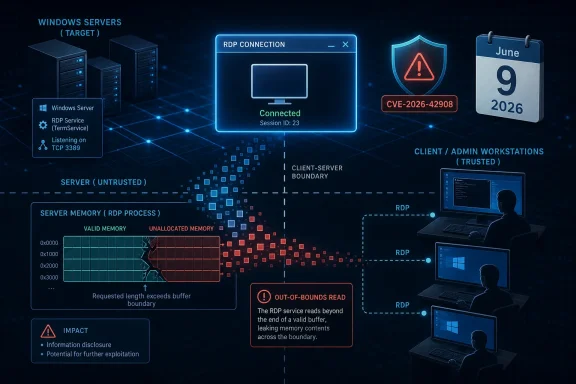 RDP’s New June Bug Is Smaller Than BlueKeep, but It Lives in the Same Dangerous Neighborhood
Remote Desktop Protocol has a reputation problem because it has earned one. For two decades, RDP has been the tool that makes remote administration tolerable and the exposed service that keeps incident responders employed. CVE-2026-42908 is not being described as a wormable remote-code-execution disaster, and Microsoft’s metadata reportedly does not mark it as exploited in the wild at release. That matters.But RDP vulnerabilities do not need to be cinematic to matter. Remote access protocols sit close to authentication flows, session handling, display channels, clipboard plumbing, device redirection, and the messy boundary between client and server. A memory disclosure in that zone is uncomfortable because defenders rarely get to choose what “information” an attacker can see once a parser reads outside the line.
The public description is terse: an out-of-bounds read in Windows RDP allows an unauthorized attacker to disclose information over a network. That sentence does not tell us whether the leaked data is predictable, repeatable, session-specific, or useful for chaining. It does tell us enough to prioritize patching systems where RDP is reachable, where Remote Desktop clients connect to untrusted servers, or where privileged administrators routinely move between tiers.
The right response is not panic. It is also not indifference. CVE-2026-42908 is a reminder that RDP risk is rarely a single-switch problem; it is a topology problem, an identity problem, and a patch-latency problem wrapped in a protocol Windows shops cannot easily live without.
Microsoft’s Sparse Disclosure Leaves Administrators Reading the Shape of the Risk
Microsoft’s Security Update Guide has become both indispensable and maddening. It provides the facts needed for vulnerability management systems to move, but often withholds the narrative that would help humans understand why one bug deserves weekend work and another can wait for the next maintenance window. CVE-2026-42908 lands squarely in that gap.The CVSS vector attached to the vulnerability is doing much of the talking. Network attack vector, low attack complexity, no privileges required, and no user interaction produce a high-severity score even though the listed impact is confidentiality only. In plain terms, Microsoft is saying that exploitation does not require local access, an account, or a user clicking through a prompt.
That does not automatically mean every Windows machine is equally exposed. CVSS describes technical exploit conditions, not your firewall rules, VPN design, conditional access policies, segmentation, or RDP gateway architecture. A workstation with Remote Desktop disabled is in a different risk class from a server reachable from a partner network, which is in a different class again from a cloud VM listening on TCP 3389 to the Internet because someone “just needed to get in for five minutes.”
The vulnerability also appears to affect a broad span of currently supported and extended-support Windows versions, including Windows 10, Windows 11, Windows Server releases, and the Windows App client for Windows desktop. That breadth is less surprising than it sounds. RDP is a shared platform feature, and shared platform bugs have a habit of turning one CVE into a fleet-wide patching exercise.
What administrators lack at disclosure time is the detail that changes triage from severity scoring to operational judgment. We do not yet know from Microsoft’s public advisory exactly which RDP role is most relevant, whether the vulnerable code is in the client, server, or shared components, or what categories of data might be disclosed. That uncertainty should not be filled with folklore. It should be managed as uncertainty.
“Information Disclosure” Is the Most Underestimated Label in the Patch Notes
Security teams have been trained, not always wrongly, to sort vulnerabilities into emotional buckets. Remote code execution gets urgency. Elevation of privilege gets urgency when paired with a foothold. Denial of service gets negotiated with operations. Information disclosure too often gets filed under “interesting, but probably not this week.”That habit is increasingly obsolete. Information disclosure vulnerabilities are not all equal, but the category can include memory leaks, credential exposure, token leakage, cryptographic material exposure, or data that helps defeat mitigations such as address-space layout randomization. Even when the first-order impact is “read only,” the second-order impact may be bypass, impersonation, lateral movement, or exploit reliability.
An out-of-bounds read is especially context-dependent. Sometimes it produces garbage. Sometimes it produces a crash. Sometimes it reveals adjacent memory that was never meant to leave the process. In a remote protocol implementation, the difference between useless bytes and operationally useful secrets can depend on timing, heap layout, session state, and how often an attacker can repeat the request.
That is why the “high confidentiality impact” field is more important than the subdued category name. Microsoft is not saying this is a harmless metadata leak. The scoring indicates that the vulnerability could have a serious confidentiality consequence if successfully exploited.
This is also where RDP’s role in administration raises the stakes. Remote Desktop sessions frequently involve privileged users, help-desk workflows, domain administration, server management, and access to line-of-business systems. A disclosure primitive that would be merely awkward in a consumer app can become materially useful when it sits near the machinery of enterprise remote access.
The June Patch Wave Makes This Bug Easier to Miss
CVE-2026-42908 arrived as part of an unusually large June 2026 security release. Independent patch-watchers counted more than 200 Microsoft CVEs for the month, with dozens rated critical and at least one listed as exploited in the wild. In that crowd, a high-severity information disclosure bug in RDP can look like background noise.That is the operational trap. Patch Tuesday is not just a release event; it is an attention allocation problem. When the same month includes critical remote-code-execution bugs, exploited Defender issues, kernel networking concerns, Office flaws, Azure fixes, Hyper-V vulnerabilities, and a cluster of Remote Desktop Client RCEs, defenders naturally chase the loudest alarms first.
They should. A CVSS 9.8 unauthenticated RCE deserves faster action than a 7.5 information disclosure issue, all else equal. But “all else equal” is rarely true in production. A high-value jump host with RDP exposed to a broad internal network may deserve attention before a critical flaw on a product you do not run or a service disabled by default in your estate.
The other danger is regression fear. The larger the monthly patch bundle, the more administrators worry about quality, compatibility, and the hidden cost of rebooting systems that support real work. That worry is rational. It also creates a backlog where less dramatic CVEs age into chronic exposure.
For CVE-2026-42908, the best framing is not “drop everything.” It is “do not let this disappear under the bigger numbers.” If you already have an emergency track for the most severe June bugs, this RDP disclosure issue belongs in the next tier of validation, especially for systems that broker, host, or initiate privileged RDP sessions.
The Client-Server Boundary Is Where RDP Keeps Getting Weird
RDP is often discussed as if the risk always points one way: an attacker connects to a vulnerable server. That model is useful, but incomplete. The past several years have repeatedly shown that Remote Desktop clients can be just as interesting to attackers as Remote Desktop hosts.A malicious or compromised RDP server can be a trap for administrators. If a client-side parser mishandles a server response, the person doing the connecting becomes the target. That scenario is not theoretical in the broader RDP ecosystem; it is exactly why “only connect to trusted hosts” has become more than a help-desk platitude.
CVE-2026-42908’s title names Windows RDP rather than only Remote Desktop Services or only Remote Desktop Client, and public mirrors list affected Windows client and server products along with the Windows App client for Windows desktop. Without fuller Microsoft prose, the safest operational assumption is that both directions of RDP exposure deserve review: machines accepting RDP and machines used to initiate RDP into less trusted environments.
This distinction matters for IT pros. A domain admin connecting from a hardened admin workstation to a neglected server in a branch office may believe the risk lies entirely on the server. But RDP is an interactive protocol, and both sides parse structured data. If the wrong side is vulnerable, the administrative act of “checking the box” can become the exposure.
Modern Windows estates complicate this further with RDP gateways, Azure-hosted workloads, vendor support sessions, cloud PCs, virtual desktop infrastructure, and the newer Windows App experience. The clean old mental model of “a Windows box with port 3389 open” no longer covers the surface. RDP is a family of workflows, not just a port number.
Attackers Love Protocol Bugs Because Protocols Are Automation-Friendly
Information disclosure vulnerabilities in network protocols are attractive because they can often be tested, fuzzed, and iterated at machine speed. Attackers do not need a user interface if the vulnerable behavior can be stimulated through crafted packets or session negotiation. That does not mean exploitation is easy in this case; it means the research surface is convenient.Out-of-bounds reads are also a favorite class for exploit developers because they can serve as reconnaissance primitives. A leak may reveal memory layout, implementation behavior, software version details, or fragments of sensitive state. Even if the leak is not independently catastrophic, it can turn a flaky exploit chain into a reliable one.
This is where CVE-2026-42908 intersects with the rest of June’s RDP activity. The same release includes multiple Remote Desktop Client remote-code-execution vulnerabilities. Public advisories do not prove those bugs can be chained with this one, and responsible reporting should not imply a connection that has not been demonstrated. But defenders should recognize why attackers study clusters: related patches can illuminate related code paths.
Patch diffing is part of the modern vulnerability economy. Once Microsoft ships a fix, researchers and adversaries compare old and new binaries to infer the vulnerable logic. Sparse advisories slow casual understanding, but they do not prevent determined reverse engineering. In a protocol as widely deployed as RDP, useful discoveries travel quickly.
That is why “no known exploitation” should be read as a timestamp, not a guarantee. On June 9, 2026, there may have been no public evidence of active exploitation. On June 20, after enough people have inspected the patch, the practical risk may look different. Vulnerability management is a moving target, and RDP bugs move faster than most.
Exposure Is a Business Decision Masquerading as a Firewall Rule
The enduring RDP lesson is brutally simple: if it is reachable, it is part of your attack surface. That does not mean RDP must be banned. It means every exposed path to RDP needs a reason, an owner, a control set, and a retirement date if it was created as an exception.For home users and small businesses, the first question is whether Remote Desktop is enabled at all. Many Windows editions do not host Remote Desktop sessions by default, and many users never need inbound RDP. If the feature is unnecessary, disabling it is better than hoping the monthly cumulative update solved every future problem.
For enterprises, the picture is more complex. RDP is embedded in server administration, emergency access, vendor support, VDI, lab environments, OT-adjacent systems, and cloud migrations that never quite finished hardening. Blocking it everywhere is rarely realistic. Governing it everywhere is the job.
Good RDP posture starts with reducing direct exposure. Internet-facing RDP remains one of the clearest signs that an environment has accumulated risk faster than it has accumulated discipline. Gateways, VPNs, just-in-time access, conditional access policies, network-level authentication, privileged access workstations, and segmentation all reduce the number of systems that can even try to reach the vulnerable code.
But controls are not substitutes for patches. They are layers. CVE-2026-42908’s low attack complexity and no-authentication scoring mean defenders should assume that a reachable vulnerable endpoint is worth an attacker’s time. The safest endpoint is patched, not merely hidden behind a policy someone forgot to test after the last network change.
The Affected-Version Spread Turns Inventory Into the Real First Patch
The public affected-product lists for CVE-2026-42908 are broad enough to make asset inventory the first serious task. Windows 10 and Windows 11 are implicated. Windows Server 2012, 2012 R2, 2016, 2019, 2022, and 2025 appear in public tracking. Server Core installations are included for several server releases. The Windows App client for Windows desktop is also listed.That spread has practical consequences. Server teams may patch Windows Server through one process, desktop teams may handle Windows 10 and 11 through another, and EUC or VDI teams may own the Windows App client through yet another channel. A vulnerability that touches all three can fall between ownership boundaries.
Build numbers matter here because the fix is delivered through platform updates, not a standalone “RDP patch” most administrators will install by name. If your reporting can show CVE compliance directly, use it. If it cannot, validate that the relevant June 2026 cumulative updates or fixed Windows App versions are deployed across the systems that matter.
Older server releases deserve special scrutiny. Windows Server 2012 and 2012 R2 live in extended-security-update arrangements for organizations that paid to keep them alive, and their presence often correlates with legacy applications that are hard to patch, hard to reboot, and hard to replace. That is exactly why they deserve extra attention: old systems tend to be both business-critical and operationally brittle.
The Windows App client angle is equally important. Microsoft has been consolidating remote access experiences across Windows 365, Azure Virtual Desktop, Dev Box, Remote Desktop Services, and related scenarios. If the client is vulnerable, patching servers alone is not enough. Admin workstations and support endpoints become part of the remediation plan.
Confidence Is High Enough to Act, Even If Technical Detail Is Low
The user-facing text attached to this CVE highlights a subtle but important vulnerability-management concept: confidence. Security teams need to know not only severity, but how certain the industry is that a vulnerability exists and how much useful detail is available. In this case, the vulnerability is acknowledged through Microsoft’s own advisory process and appears in third-party mirrors with consistent metadata. That is enough to treat it as real.What is not high is public exploit detail. We do not have a public proof of concept, a packet trace, a root-cause write-up, or a vendor blog post walking through the vulnerable code path. For defenders, that is frustrating. For attackers, it is an invitation to reverse engineer.
This asymmetry is normal. Vendors often keep advisories sparse to reduce exploit acceleration, while defenders ask for more detail to prioritize properly. Both instincts are understandable. The result is a recurring enterprise ritual in which administrators must make risk decisions with less information than they would like.
The correct response is to separate what is known from what is inferred. Known: Microsoft assigned a CVE, the impact is information disclosure, the weakness is out-of-bounds read, the attack vector is network, exploitation requires neither privileges nor user interaction, and the affected product set is broad. Inferred: systems with reachable RDP roles or high-value RDP clients are the most important places to move quickly.
That is enough for action. Waiting for exploit details before patching a network-reachable RDP flaw is not prudence; it is letting the adversary define your maintenance calendar.
The Patch Is Necessary, but RDP Hygiene Determines the Blast Radius
Patching closes the known hole. RDP hygiene decides how much damage the next unknown hole can do. CVE-2026-42908 is therefore best used as a forcing function to revisit a few old decisions.Start with exposure mapping. Security teams should know where RDP is enabled, which systems accept connections, which clients initiate privileged sessions, and which paths cross trust boundaries. If that inventory depends on tribal knowledge, the vulnerability is doing you a favor by revealing a process problem.
Next, examine identity. RDP protected only by passwords is a relic of a more innocent time. Multifactor authentication, network-level authentication, restricted admin modes where appropriate, tiered admin accounts, and just-in-time elevation all make exploitation less useful even when protocol bugs exist.
Then look at segmentation. The internal network should not be a flat field where every workstation can attempt RDP to every server. Lateral movement loves convenience. Administrators do too, and security architecture is often the art of making the safe path more convenient than the dangerous one.
Finally, review logging and detection. RDP connection attempts, gateway events, failed logons, unusual source networks, and administrative session patterns should be visible. Information disclosure exploitation may not produce a clean signature, but the surrounding behavior often leaves traces. If a protocol bug becomes part of a chain, telemetry around the chain is what gives defenders a chance.
June’s RDP Lesson Fits on One Admin Workbench
CVE-2026-42908 is not the vulnerability that should dominate every June 2026 patch meeting, but it is the one that usefully tests whether a Windows environment understands its own remote-access risk. Treat it as a high-severity confidentiality bug in a high-value protocol, not as a trivia item buried beneath flashier RCEs.- Microsoft disclosed CVE-2026-42908 on June 9, 2026, as a Windows RDP information disclosure vulnerability tied to an out-of-bounds read.
- The vulnerability carries a high CVSS 3.1 score of 7.5 because it is network-reachable, low-complexity, requires no privileges, and requires no user interaction.
- The public record does not currently establish active exploitation or a public proof of concept, so administrators should prioritize it through exposure and asset value rather than hype.
- Affected products span Windows client releases, Windows Server releases, Server Core installations, and the Windows App client for Windows desktop.
- Systems that host RDP, broker RDP, or initiate privileged RDP sessions into less trusted environments deserve faster validation and patch deployment.
- The longer-term fix is not only applying the June updates, but reducing direct RDP exposure, tightening identity controls, segmenting administrative paths, and improving Remote Desktop telemetry.
References
- Primary source: MSRC
Published: 2026-06-09T07:00:00-07:00
Security Update Guide - Microsoft Security Response Center
 msrc.microsoft.com
- Related coverage: sentinelone.com
CVE-2025-27487: Remote Desktop Client RCE Vulnerability
CVE-2025-27487 is a remote code execution vulnerability in Microsoft Remote Desktop Client. Learn about its impact, affected versions, and mitigation methods.www.sentinelone.com
- Related coverage: media.boschsecurity.com
Security Advisory
</rdf:Alt> </dc:description> <dc:creator> <rdf:Seq> <rdf:li>[email protected]media.boschsecurity.com
- Related coverage: cert.gov.to
- Related coverage: aha.org
intelligence briefing remote desktop protocol exploitation tlp white 11 21 2019
PDF documentwww.aha.org
