

Microsoft disclosed CVE-2026-42972 on June 9, 2026, as a Windows Hyper-V information disclosure vulnerability affecting supported Windows client and server releases, with public tracking pages describing a medium-severity flaw that requires local authorized access rather than remote unauthenticated exploitation. The important part is not that this is the loudest bug in June’s Patch Tuesday pile. It is that Hyper-V remains a privileged boundary where “just information disclosure” can still matter a great deal. For administrators, the right response is neither panic nor dismissal: patch the hosts, understand the boundary at stake, and treat sparse vendor detail as part of the risk model.
June 2026’s Patch Tuesday is already memorable for its size. Microsoft’s monthly security release landed with roughly two hundred fixes, multiple publicly known issues, and the usual rush of third-party severity dashboards trying to turn a sprawling matrix into a prioritized work queue. In that crowd, CVE-2026-42972 can look almost modest.
That is the trap. Hyper-V vulnerabilities do not need dramatic remote-code-execution language to deserve attention, because the hypervisor sits at a place in the Windows stack where a small leak can have consequences larger than its CVSS label suggests. Hyper-V is not a browser plugin or a forgotten utility. It is the isolation layer for virtual machines, development sandboxes, test labs, Windows security features, and production workloads.
The public description is terse: an information disclosure issue in Windows Hyper-V that allows an authorized attacker to disclose information locally. The CVSS 3.1 score being reported by vulnerability trackers is 5.5, which puts it in medium territory. The attack is described as not remotely exploitable, and the affected product families span Windows 10, Windows 11, Windows Server 2012-era systems, Windows Server 2016, 2019, 2022, and Windows Server 2025.
That combination tells us something useful. This is not a wormable internet-facing vulnerability. It is also not a theoretical footnote. It is a host-adjacent issue in a component whose entire purpose is to enforce separation between more-trusted and less-trusted execution environments.
A local requirement means an attacker needs some foothold first. On a single-user desktop, that may mean malware already running as the user. On a server, it may mean a compromised account, a malicious insider, a vulnerable service, or a guest workload controlled by someone other than the host administrator. In virtualized environments, “local” can be a slippery word because the attacker’s local vantage point may be inside a VM, on a host, or in a management context adjacent to both.
Microsoft’s public wording does not provide enough technical detail to state exactly what data could be exposed in CVE-2026-42972. That uncertainty matters. It prevents defenders from building a neat detector around a known file, handle, registry path, memory structure, or hypercall sequence. It also forces administrators to reason from the component, not the exploit.
In Hyper-V, information disclosure can be more than the accidental exposure of a benign string. Historically, leaks in low-level components can reveal memory addresses, kernel object layout, fragments of privileged data, or other details that make a later privilege escalation or sandbox escape more reliable. Attackers often do not need the entire secret. They need the missing piece that turns a fragile exploit into a dependable one.
That is why a medium score should not become an excuse for slow-walking the update on hosts that run untrusted or semi-trusted workloads. Severity scores are averages. Your environment supplies the multiplier.
On servers, the role is obvious. Hyper-V hosts run domain workloads, application servers, VDI pools, build systems, test farms, and disaster-recovery replicas. On desktops, Hyper-V may be present because developers use local VMs, because security teams rely on isolated analysis environments, or because Windows features such as virtualization-based security, Windows Sandbox, Credential Guard, and related platform protections depend on virtualization primitives.
This creates an awkward operational reality. The machines most likely to expose useful attack surfaces are not always labeled “hypervisor” in inventory. A developer workstation running containers, WSL-related virtualization plumbing, Android emulators, sandboxing tools, and local test VMs may carry more practical Hyper-V exposure than a carefully managed server host. A security analyst’s lab box may regularly run hostile samples inside VMs, which is exactly the situation where a virtualization boundary leak deserves more respect.
The advisory’s broad affected-version footprint reinforces that point. CVE-2026-42972 is not presented as a niche flaw in a single old server SKU. It spans the long tail of Windows client and server editions that enterprises still have to manage. That breadth is common for Windows component bugs, but for Hyper-V it means administrators should not limit review to data-center clusters.
The smart inventory question is not simply, “Which servers have the Hyper-V role installed?” It is, “Where do we rely on Microsoft’s virtualization boundary to keep less-trusted code away from more-trusted state?”
CVE-2026-42972’s public record does not currently read like a richly documented vulnerability. There is no widely publicized exploit chain, no vendor blog walking through root cause, no proof-of-concept repository dominating search results, and no clear claim of in-the-wild exploitation attached to this specific CVE. The available data points instead describe a confirmed vendor-tracked flaw, medium severity, local authorized exploitation, and information disclosure impact.
That sparse record should lower panic, not priority. The absence of public exploit details is not the same as absence of exploitability. It means the defender’s job is to patch based on exposed role and business consequence rather than based on whether someone has already turned the vulnerability into a GitHub trophy.
This is especially true in the first days after Patch Tuesday. Attackers and researchers routinely diff patches, inspect changed binaries, and compare pre-update and post-update behavior. A thin advisory can become much less thin once the update itself is available for reverse engineering. The clock does not start when a proof of concept appears; it starts when the patch lands.
But exploit development often depends on exactly that kind of primitive. Modern operating systems rely on layers of mitigation: address space layout randomization, kernel protections, privilege boundaries, handle isolation, code integrity, and increasingly virtualization-backed trust levels. Those mitigations force attackers to know things they are not supposed to know. An information disclosure bug can supply that knowledge.
In a hypervisor context, the stakes are sharper because the isolation model is the product. Hyper-V’s job is to separate guests from the host and from one another, while still allowing controlled communication through virtual devices, integration services, storage paths, networking, and management channels. Any flaw that exposes data across an intended boundary chips away at the model, even if it does not immediately hand an attacker a shell.
This does not mean CVE-2026-42972 should be described as a guest-to-host escape unless Microsoft or credible research establishes that specific path. It means administrators should understand why security teams dislike boundary-adjacent leaks. A leak that looks minor in a standalone context may be valuable when paired with a separate memory corruption bug, privilege escalation flaw, or misconfiguration.
The June release also arrives in a year when Hyper-V has already shown up in other Microsoft security advisories, including information disclosure and code execution classes. That pattern does not prove a common root cause. It does show that attackers and researchers continue to find value in the virtualization layer, and Microsoft continues to service it as a live attack surface rather than a solved foundation.
The reported affected builds include old enterprise stalwarts and current Windows 11 branches. Server 2012 and 2012 R2 remain visible in vulnerability data because some organizations still operate them under extended servicing arrangements or in constrained environments. Windows Server 2016 and 2019 remain common in production. Server 2022 and 2025 are the modern backbone for many Hyper-V deployments.
Client versions deserve equal attention. Windows 11 23H2, 24H2, 25H2, and early 26H1 references appear in public version listings, along with Windows 10 21H2 and 22H2-era builds. Even if an organization does not run Hyper-V as a visible desktop feature, virtualization support may be enabled for development, security, compatibility, or subsystem use cases.
This is where vulnerability management often stumbles. Asset systems may know the OS version but not whether Hyper-V is active. Endpoint tools may know whether virtualization-based security is enabled but not whether local users can create or run VMs. Server teams may patch clusters on a deliberate cadence while developer workstations drift behind because they are treated like ordinary clients.
For CVE-2026-42972, exposure mapping should follow function, not naming. Hyper-V hosts, Windows Sandbox machines, developer endpoints with local virtualization, lab systems that ingest untrusted images, and servers hosting tenants or semi-trusted workloads all belong in the first review pass.
Production virtualization hosts should be patched during the earliest safe maintenance window. That includes failover clusters, standalone hosts, and any server where VM isolation is a security assumption rather than a convenience. If live migration and clustering are available, administrators should use them to reduce downtime while still moving quickly. If they are not available, the lack of redundancy is a business risk that this kind of vulnerability makes harder to ignore.
Developer and security lab systems deserve attention because they often run less trusted code by design. A malware-analysis VM, a customer-supplied test image, or a developer’s downloaded appliance may not be hostile in intent, but it is not equivalent to a fully trusted enterprise workload. The more often a host runs outside code, the less comfort “authorized local attacker” should provide.
For ordinary consumer machines, the advice is simpler: install the June security update through Windows Update. Most home users are unlikely to be targeted through a Hyper-V information disclosure chain. But Windows features increasingly blur the boundary between “consumer desktop” and “virtualization host,” and automatic updating remains the correct baseline.
The harder cases are servers that cannot reboot quickly. There is no public workaround listed in the available summaries, and information disclosure flaws in core components rarely lend themselves to clean mitigations from the outside. If a host cannot be patched promptly, administrators should reduce exposure by limiting who can create, import, start, and manage VMs; reviewing local administrative membership; tightening remote management paths; and avoiding untrusted guest workloads until the update is in place.
For CVE-2026-42972, the confidence in existence is high because Microsoft has assigned and published the vulnerability as part of its update process. The confidence in detailed exploit mechanics is lower because the public record does not explain the vulnerable function, data type, object boundary, or exact information disclosed. Those are different forms of confidence, and conflating them leads to bad decisions.
A lack of detail should not be interpreted as a lack of seriousness. It should be interpreted as a reason to avoid overclaiming. We should not state that attackers can read host kernel memory, steal credentials, or escape a guest unless that becomes public and verified. We can state that an authorized local attacker can disclose information through Windows Hyper-V, that Microsoft issued fixes, and that Hyper-V’s role makes boundary leaks operationally relevant.
That distinction matters for WindowsForum readers because good security writing should resist both vendor-speak and fear marketing. The vendor’s terse phrasing may understate practical concern for complex environments. Security marketing may overstate it into a guaranteed compromise. The truth sits in the middle: confirmed vulnerability, limited public detail, meaningful component, patch available.
A mature inventory should answer which Windows systems have the Hyper-V role installed, which clients have optional virtualization features enabled, which machines host untrusted workloads, which clusters require coordinated reboot sequencing, and which systems are stuck on extended servicing paths. Many organizations can answer some of those questions. Fewer can answer all of them before the next maintenance window.
The reason is that Hyper-V is both a product and a platform capability. It appears in Server Manager, Windows Features, PowerShell, device security settings, virtualization-based security reports, developer tooling, and cloud-adjacent management stacks. A single CMDB field rarely captures that full picture.
This is where defenders should treat CVE-2026-42972 as a forcing function. The patch is the immediate action, but the longer-term improvement is better classification of systems that depend on virtualization boundaries. If a future Hyper-V bug is rated critical or publicly exploited, the organization should not be discovering its Hyper-V footprint for the first time.
There is also a policy angle. Users who can create or import VMs may be able to introduce attack inputs that host administrators did not anticipate. Local admin sprawl on developer workstations and lab systems turns “authorized local” into a much larger population. Hyper-V security is not just about the hypervisor binary; it is about who is allowed to feed it work.
That is where Windows cumulative updates are both helpful and painful. Helpful, because the fix for CVE-2026-42972 is bundled into the monthly servicing model rather than requiring administrators to hunt for a one-off package. Painful, because cumulative updates also carry the normal regression anxiety, especially on virtualization hosts where a bad update can affect many workloads at once.
The correct response is disciplined urgency. Test representative hosts quickly, check known issues for the relevant Windows version, validate backup and rollback plans, drain clustered workloads where possible, patch in waves, and monitor. That sounds mundane because it is the everyday craft of Windows administration. It is also the difference between responsible risk reduction and update roulette.
For smaller shops, the guidance is less ceremonial but just as direct. Do not let the medium severity rating become a reason to defer until next month. If Hyper-V is enabled, install the June security update as soon as operationally feasible. If Hyper-V is not enabled and the machine is a normal endpoint, stay on the standard Windows Update cadence.
Attackers understand the economics. The guest may contain one workload; the host may contain many. The guest may have limited credentials; the host may have management reach. The guest may be monitored as a hostile environment; the host may be trusted infrastructure. Even an information leak that improves the odds of attacking the host is therefore worth attention.
This is especially true in mixed-trust environments. Hosting internal workloads from different teams is not the same as public cloud multi-tenancy, but it still creates boundaries between administrators, developers, services, and data. Lab environments often run snapshots and old images. Build systems may execute unreviewed code. Training environments may give users local control over VMs. Each of those scenarios makes a Hyper-V flaw more interesting than its base score.
The enterprise security lesson is simple: do not evaluate Hyper-V bugs only by exploit vector. Evaluate them by what the host represents. If compromising the host would collapse multiple security zones, then a host-boundary information disclosure bug is not just another medium CVE.
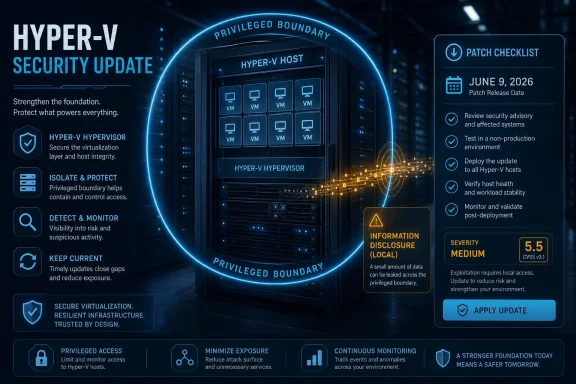 Microsoft’s Quiet Hyper-V Bug Lands Inside a Very Loud Patch Tuesday
June 2026’s Patch Tuesday is already memorable for its size. Microsoft’s monthly security release landed with roughly two hundred fixes, multiple publicly known issues, and the usual rush of third-party severity dashboards trying to turn a sprawling matrix into a prioritized work queue. In that crowd, CVE-2026-42972 can look almost modest.That is the trap. Hyper-V vulnerabilities do not need dramatic remote-code-execution language to deserve attention, because the hypervisor sits at a place in the Windows stack where a small leak can have consequences larger than its CVSS label suggests. Hyper-V is not a browser plugin or a forgotten utility. It is the isolation layer for virtual machines, development sandboxes, test labs, Windows security features, and production workloads.
The public description is terse: an information disclosure issue in Windows Hyper-V that allows an authorized attacker to disclose information locally. The CVSS 3.1 score being reported by vulnerability trackers is 5.5, which puts it in medium territory. The attack is described as not remotely exploitable, and the affected product families span Windows 10, Windows 11, Windows Server 2012-era systems, Windows Server 2016, 2019, 2022, and Windows Server 2025.
That combination tells us something useful. This is not a wormable internet-facing vulnerability. It is also not a theoretical footnote. It is a host-adjacent issue in a component whose entire purpose is to enforce separation between more-trusted and less-trusted execution environments.
The Word “Local” Does Less Comforting Work Than It Used To
Security advisories often lean on a hierarchy of fear. Remote unauthenticated code execution sits at the top; local information disclosure sits somewhere down the page, below the fold, competing with printer drivers and edge-case spoofing bugs. That hierarchy is useful for triage, but it is not the same as impact.A local requirement means an attacker needs some foothold first. On a single-user desktop, that may mean malware already running as the user. On a server, it may mean a compromised account, a malicious insider, a vulnerable service, or a guest workload controlled by someone other than the host administrator. In virtualized environments, “local” can be a slippery word because the attacker’s local vantage point may be inside a VM, on a host, or in a management context adjacent to both.
Microsoft’s public wording does not provide enough technical detail to state exactly what data could be exposed in CVE-2026-42972. That uncertainty matters. It prevents defenders from building a neat detector around a known file, handle, registry path, memory structure, or hypercall sequence. It also forces administrators to reason from the component, not the exploit.
In Hyper-V, information disclosure can be more than the accidental exposure of a benign string. Historically, leaks in low-level components can reveal memory addresses, kernel object layout, fragments of privileged data, or other details that make a later privilege escalation or sandbox escape more reliable. Attackers often do not need the entire secret. They need the missing piece that turns a fragile exploit into a dependable one.
That is why a medium score should not become an excuse for slow-walking the update on hosts that run untrusted or semi-trusted workloads. Severity scores are averages. Your environment supplies the multiplier.
Hyper-V Is No Longer Just a Server Role in the Corner
There was a time when Hyper-V risk mostly meant “the virtualization team should patch the cluster.” That world is gone. Hyper-V underpins far more of modern Windows than the visible Hyper-V Manager console implies.On servers, the role is obvious. Hyper-V hosts run domain workloads, application servers, VDI pools, build systems, test farms, and disaster-recovery replicas. On desktops, Hyper-V may be present because developers use local VMs, because security teams rely on isolated analysis environments, or because Windows features such as virtualization-based security, Windows Sandbox, Credential Guard, and related platform protections depend on virtualization primitives.
This creates an awkward operational reality. The machines most likely to expose useful attack surfaces are not always labeled “hypervisor” in inventory. A developer workstation running containers, WSL-related virtualization plumbing, Android emulators, sandboxing tools, and local test VMs may carry more practical Hyper-V exposure than a carefully managed server host. A security analyst’s lab box may regularly run hostile samples inside VMs, which is exactly the situation where a virtualization boundary leak deserves more respect.
The advisory’s broad affected-version footprint reinforces that point. CVE-2026-42972 is not presented as a niche flaw in a single old server SKU. It spans the long tail of Windows client and server editions that enterprises still have to manage. That breadth is common for Windows component bugs, but for Hyper-V it means administrators should not limit review to data-center clusters.
The smart inventory question is not simply, “Which servers have the Hyper-V role installed?” It is, “Where do we rely on Microsoft’s virtualization boundary to keep less-trusted code away from more-trusted state?”
Microsoft Gives Defenders a Patch, Not a Story
The public advisory model is doing what it usually does: it tells customers enough to identify the issue, map affected products, and apply updates, while withholding exploit-level technical detail. That restraint is defensible. Detailed writeups can accelerate attacker work before enterprises have deployed patches. But it also creates a familiar gap for defenders who need to explain urgency to change boards.CVE-2026-42972’s public record does not currently read like a richly documented vulnerability. There is no widely publicized exploit chain, no vendor blog walking through root cause, no proof-of-concept repository dominating search results, and no clear claim of in-the-wild exploitation attached to this specific CVE. The available data points instead describe a confirmed vendor-tracked flaw, medium severity, local authorized exploitation, and information disclosure impact.
That sparse record should lower panic, not priority. The absence of public exploit details is not the same as absence of exploitability. It means the defender’s job is to patch based on exposed role and business consequence rather than based on whether someone has already turned the vulnerability into a GitHub trophy.
This is especially true in the first days after Patch Tuesday. Attackers and researchers routinely diff patches, inspect changed binaries, and compare pre-update and post-update behavior. A thin advisory can become much less thin once the update itself is available for reverse engineering. The clock does not start when a proof of concept appears; it starts when the patch lands.
Information Disclosure Is the Exploit Chain’s Favorite Supporting Actor
Information disclosure vulnerabilities suffer from a branding problem. They sound passive, even bureaucratic. Nobody wants to call an emergency meeting because an attacker might “disclose information locally.”But exploit development often depends on exactly that kind of primitive. Modern operating systems rely on layers of mitigation: address space layout randomization, kernel protections, privilege boundaries, handle isolation, code integrity, and increasingly virtualization-backed trust levels. Those mitigations force attackers to know things they are not supposed to know. An information disclosure bug can supply that knowledge.
In a hypervisor context, the stakes are sharper because the isolation model is the product. Hyper-V’s job is to separate guests from the host and from one another, while still allowing controlled communication through virtual devices, integration services, storage paths, networking, and management channels. Any flaw that exposes data across an intended boundary chips away at the model, even if it does not immediately hand an attacker a shell.
This does not mean CVE-2026-42972 should be described as a guest-to-host escape unless Microsoft or credible research establishes that specific path. It means administrators should understand why security teams dislike boundary-adjacent leaks. A leak that looks minor in a standalone context may be valuable when paired with a separate memory corruption bug, privilege escalation flaw, or misconfiguration.
The June release also arrives in a year when Hyper-V has already shown up in other Microsoft security advisories, including information disclosure and code execution classes. That pattern does not prove a common root cause. It does show that attackers and researchers continue to find value in the virtualization layer, and Microsoft continues to service it as a live attack surface rather than a solved foundation.
The Affected Estate Is Broader Than the Severity Score Suggests
Public vulnerability trackers list affected products across Windows 10, Windows 11, and multiple Windows Server generations, including Server Core installations. That breadth matters for two reasons. First, it means the fix will travel through many different patching channels and maintenance windows. Second, it means organizations cannot assume newer platforms are automatically outside the blast radius.The reported affected builds include old enterprise stalwarts and current Windows 11 branches. Server 2012 and 2012 R2 remain visible in vulnerability data because some organizations still operate them under extended servicing arrangements or in constrained environments. Windows Server 2016 and 2019 remain common in production. Server 2022 and 2025 are the modern backbone for many Hyper-V deployments.
Client versions deserve equal attention. Windows 11 23H2, 24H2, 25H2, and early 26H1 references appear in public version listings, along with Windows 10 21H2 and 22H2-era builds. Even if an organization does not run Hyper-V as a visible desktop feature, virtualization support may be enabled for development, security, compatibility, or subsystem use cases.
This is where vulnerability management often stumbles. Asset systems may know the OS version but not whether Hyper-V is active. Endpoint tools may know whether virtualization-based security is enabled but not whether local users can create or run VMs. Server teams may patch clusters on a deliberate cadence while developer workstations drift behind because they are treated like ordinary clients.
For CVE-2026-42972, exposure mapping should follow function, not naming. Hyper-V hosts, Windows Sandbox machines, developer endpoints with local virtualization, lab systems that ingest untrusted images, and servers hosting tenants or semi-trusted workloads all belong in the first review pass.
Patch Priority Belongs to the Boundary, Not the Buzz
The practical patching order is straightforward. Internet-facing remote code execution bugs with public exploitation remain the first fire. Actively exploited zero-days outrank a medium local disclosure flaw in most environments. But once those are accounted for, Hyper-V hosts should move up the queue faster than the raw score implies.Production virtualization hosts should be patched during the earliest safe maintenance window. That includes failover clusters, standalone hosts, and any server where VM isolation is a security assumption rather than a convenience. If live migration and clustering are available, administrators should use them to reduce downtime while still moving quickly. If they are not available, the lack of redundancy is a business risk that this kind of vulnerability makes harder to ignore.
Developer and security lab systems deserve attention because they often run less trusted code by design. A malware-analysis VM, a customer-supplied test image, or a developer’s downloaded appliance may not be hostile in intent, but it is not equivalent to a fully trusted enterprise workload. The more often a host runs outside code, the less comfort “authorized local attacker” should provide.
For ordinary consumer machines, the advice is simpler: install the June security update through Windows Update. Most home users are unlikely to be targeted through a Hyper-V information disclosure chain. But Windows features increasingly blur the boundary between “consumer desktop” and “virtualization host,” and automatic updating remains the correct baseline.
The harder cases are servers that cannot reboot quickly. There is no public workaround listed in the available summaries, and information disclosure flaws in core components rarely lend themselves to clean mitigations from the outside. If a host cannot be patched promptly, administrators should reduce exposure by limiting who can create, import, start, and manage VMs; reviewing local administrative membership; tightening remote management paths; and avoiding untrusted guest workloads until the update is in place.
The Missing Details Are Themselves a Security Signal
The user-supplied CVSS metric text about confidence is worth dwelling on because it captures a recurring Patch Tuesday problem. Vulnerability records often tell us that a bug exists and that the vendor has acknowledged it, while withholding the root cause, affected code path, and exploit mechanics. That can frustrate technical teams accustomed to precise risk explanations.For CVE-2026-42972, the confidence in existence is high because Microsoft has assigned and published the vulnerability as part of its update process. The confidence in detailed exploit mechanics is lower because the public record does not explain the vulnerable function, data type, object boundary, or exact information disclosed. Those are different forms of confidence, and conflating them leads to bad decisions.
A lack of detail should not be interpreted as a lack of seriousness. It should be interpreted as a reason to avoid overclaiming. We should not state that attackers can read host kernel memory, steal credentials, or escape a guest unless that becomes public and verified. We can state that an authorized local attacker can disclose information through Windows Hyper-V, that Microsoft issued fixes, and that Hyper-V’s role makes boundary leaks operationally relevant.
That distinction matters for WindowsForum readers because good security writing should resist both vendor-speak and fear marketing. The vendor’s terse phrasing may understate practical concern for complex environments. Security marketing may overstate it into a guaranteed compromise. The truth sits in the middle: confirmed vulnerability, limited public detail, meaningful component, patch available.
Hyper-V Risk Is Also an Inventory Problem
Every Patch Tuesday teaches the same lesson in a slightly different accent: organizations cannot patch what they do not understand. CVE-2026-42972 is a useful test of whether Windows estates can identify virtualization dependency quickly enough to prioritize intelligently.A mature inventory should answer which Windows systems have the Hyper-V role installed, which clients have optional virtualization features enabled, which machines host untrusted workloads, which clusters require coordinated reboot sequencing, and which systems are stuck on extended servicing paths. Many organizations can answer some of those questions. Fewer can answer all of them before the next maintenance window.
The reason is that Hyper-V is both a product and a platform capability. It appears in Server Manager, Windows Features, PowerShell, device security settings, virtualization-based security reports, developer tooling, and cloud-adjacent management stacks. A single CMDB field rarely captures that full picture.
This is where defenders should treat CVE-2026-42972 as a forcing function. The patch is the immediate action, but the longer-term improvement is better classification of systems that depend on virtualization boundaries. If a future Hyper-V bug is rated critical or publicly exploited, the organization should not be discovering its Hyper-V footprint for the first time.
There is also a policy angle. Users who can create or import VMs may be able to introduce attack inputs that host administrators did not anticipate. Local admin sprawl on developer workstations and lab systems turns “authorized local” into a much larger population. Hyper-V security is not just about the hypervisor binary; it is about who is allowed to feed it work.
The June Update Is a Maintenance Window With a Message
CVE-2026-42972 is not the only reason to take the June update seriously. The broader Patch Tuesday release is unusually large, with reporting from security firms and news outlets counting around two hundred Microsoft fixes and several publicly known issues. In that environment, defenders are not choosing whether to patch one Hyper-V bug. They are deciding how to stage a large cumulative risk reduction without breaking the estate.That is where Windows cumulative updates are both helpful and painful. Helpful, because the fix for CVE-2026-42972 is bundled into the monthly servicing model rather than requiring administrators to hunt for a one-off package. Painful, because cumulative updates also carry the normal regression anxiety, especially on virtualization hosts where a bad update can affect many workloads at once.
The correct response is disciplined urgency. Test representative hosts quickly, check known issues for the relevant Windows version, validate backup and rollback plans, drain clustered workloads where possible, patch in waves, and monitor. That sounds mundane because it is the everyday craft of Windows administration. It is also the difference between responsible risk reduction and update roulette.
For smaller shops, the guidance is less ceremonial but just as direct. Do not let the medium severity rating become a reason to defer until next month. If Hyper-V is enabled, install the June security update as soon as operationally feasible. If Hyper-V is not enabled and the machine is a normal endpoint, stay on the standard Windows Update cadence.
The Host Is the Asset Attackers Want
Virtualization can create a false sense of containment. A compromised guest feels boxed in. A test VM feels disposable. A sandbox feels isolated from the system that launched it. Those assumptions are useful only as long as the boundary holds.Attackers understand the economics. The guest may contain one workload; the host may contain many. The guest may have limited credentials; the host may have management reach. The guest may be monitored as a hostile environment; the host may be trusted infrastructure. Even an information leak that improves the odds of attacking the host is therefore worth attention.
This is especially true in mixed-trust environments. Hosting internal workloads from different teams is not the same as public cloud multi-tenancy, but it still creates boundaries between administrators, developers, services, and data. Lab environments often run snapshots and old images. Build systems may execute unreviewed code. Training environments may give users local control over VMs. Each of those scenarios makes a Hyper-V flaw more interesting than its base score.
The enterprise security lesson is simple: do not evaluate Hyper-V bugs only by exploit vector. Evaluate them by what the host represents. If compromising the host would collapse multiple security zones, then a host-boundary information disclosure bug is not just another medium CVE.
June’s Hyper-V Advisory Leaves Administrators With a Short, Uncomfortable List
The facts around CVE-2026-42972 are limited, but they are sufficient for action. Microsoft has published the issue, updates are available through the normal servicing channel, and the affected platform range is broad enough that most Windows estates should assume they have something to check. The absence of public exploit detail should shape language, not delay remediation.- CVE-2026-42972 is a Windows Hyper-V information disclosure vulnerability disclosed on June 9, 2026, as part of Microsoft’s June security updates.
- Public vulnerability data describes the flaw as medium severity with a CVSS 3.1 score of 5.5 and local authorized exploitation rather than remote unauthenticated exploitation.
- The affected product range spans Windows client and server releases, including modern Windows 11 and Windows Server versions as well as older supported or extended-servicing platforms.
- Hyper-V hosts, developer machines, security labs, sandbox systems, and servers running semi-trusted workloads should be patched earlier than ordinary low-risk endpoints.
- Public details do not currently justify claims of a specific guest-to-host escape or credential theft path, but the Hyper-V boundary makes even information disclosure operationally meaningful.
- Where immediate patching is not possible, administrators should reduce exposure by limiting VM management rights, avoiding untrusted guest workloads, and tightening local administrative access until updates are deployed.
References
- Primary source: MSRC
Published: 2026-06-09T07:00:00-07:00
Security Update Guide - Microsoft Security Response Center
 msrc.microsoft.com
- Related coverage: windowsforum.com
CVE-2026-20825: Hyper-V Information Disclosure Patch and Hardening | Windows Forum
Microsoft has recorded CVE-2026-20825 — an improper access control vulnerability in Windows Hyper‑V that, according to the vendor summary, permits an...windowsforum.com - Related coverage: sentinelone.com
CVE-2026-20825: Windows Hyper-V Information Disclosure
CVE-2026-20825 is an information disclosure vulnerability in Windows Hyper-V. Learn about its impact, affected versions, and mitigation methods.www.sentinelone.com
- Related coverage: bleepingcomputer.com
- Related coverage: rapid7.com
Rapid7 Vulnerability Database
Rapid7's VulnDB is curated repository of vetted computer software exploits and exploitable vulnerabilities.www.rapid7.com - Related coverage: thewindowsupdate.com

- Related coverage: computerweekly.com
Microsoft smashes record for biggest ever Patch Tuesday update | Computer Weekly
Microsoft has not only broken but obliterated the record for the largest ever Patch Tuesday drop, with its June 2026 update addressing approximately 200 flaws, and three zero-days.www.computerweekly.com - Related coverage: absolute.com
Patch Tuesday June 2026: 211 Fixes, Critical CVEs | Absolute Security Blog
Microsoft Patch Tuesday June 2026 delivers 211 fixes and 37 critical vulnerabilities. Learn key risks, CVEs, and how to prioritize enterprise patching.www.absolute.com - Related coverage: cyberscoop.com
Microsoft breaks Patch Tuesday record with 206 vulnerabilities | CyberScoop
Fears and warnings about a roaring flood of error-riddled software have materialized. And the disease is spreading.cyberscoop.com - Related coverage: thurrott.com
Microsoft Releases June 2026 Patch Tuesday Updates
The June 2026 Patch Tuesday updates for Windows 11 bring support for shared audio over Bluetooth LE, multi-app camera usage, and there's also a speed boost for app launches and core shell experiences.www.thurrott.com - Official source: support.microsoft.com
June 9, 2026—Baseline - Microsoft Support
 support.microsoft.com
- Related coverage: scworld.com
Patch Tuesday: No zero days among 137 Microsoft CVEs, 4 Word RCEs | news | SC Media
The May 2026 Microsoft security update included no zero days for the first time since June 2024.www.scworld.com - Related coverage: techradar.com
Microsoft confirms two major Defender security issues — so update now or face possible attack | TechRadar
CISA confirms two bugs being actively exploited in the wildwww.techradar.com - Related coverage: sra.io
