CVE-2026-42991 is a Microsoft-confirmed Windows Push Notifications elevation-of-privilege vulnerability disclosed on June 9, 2026, affecting supported Windows client and server releases and allowing a local authenticated attacker to gain higher privileges through a race-condition-style flaw. The useful answer is not that “push notifications are dangerous,” because that is too crude. The more important story is that a background Windows service many administrators barely think about has again become part of the privilege-escalation map. In a Patch Tuesday cycle crowded with louder remote-code-execution bugs, CVE-2026-42991 is the kind of local flaw that matters after the first foothold has already happened.
Windows Push Notifications sounds like consumer plumbing: toast banners, app alerts, background delivery, and the small conveniences that make modern Windows feel less like a static desktop and more like a connected operating system. That description is not wrong, but it is incomplete. On a managed Windows estate, notification infrastructure is also part of the ambient operating system: always present, deeply integrated, and often running with more trust than the user processes that trigger it.
That is why elevation-of-privilege bugs in components like this deserve more attention than their marketing names suggest. A local privilege escalation does not usually get the theatrical treatment reserved for wormable network bugs, but it is a staple of real intrusions. Attackers who land through phishing, browser exploitation, exposed credentials, malicious documents, or a vulnerable third-party app still need to turn “code running as a user” into “control over the box.”
CVE-2026-42991 fits that second-stage pattern. Microsoft’s description places the bug in Windows Push Notifications and attributes it to concurrent execution over a shared resource with improper synchronization — in plainer English, a race condition. The attacker needs local access and some level of authorization, but no user interaction is required once the exploit path is available.
That last clause is easy to underrate. “Local” does not mean “unimportant,” and “authenticated” does not mean “safe.” In the post-compromise phase of an intrusion, attackers are authenticated all the time — often as the lowest-privileged user on the machine they just compromised.
That distinction matters. A vulnerability may be rumored, observed indirectly, described by a third party, or fully acknowledged by the vendor. Each stage changes how defenders should interpret urgency. A local privilege escalation described only in vague terms is different from one acknowledged by Microsoft, assigned a CVE, mapped to weakness categories, and shipped with a security update.
For CVE-2026-42991, the confidence signal is strong because the vulnerability is vendor-published in Microsoft’s Security Update Guide and mirrored in the broader CVE ecosystem. The technical details remain intentionally sparse, as they usually are for freshly patched Windows internals bugs, but the existence of the flaw is not speculative. Microsoft is not saying “there may be an issue”; it is saying Windows Push Notifications contains an elevation-of-privilege vulnerability that has been addressed.
That does not mean defenders have exploit code in hand, nor does it mean criminal exploitation is underway. It means the vulnerability is real enough to patch, categorize, and score. In enterprise triage, that is the difference between a rumor in the noise and a ticket in the queue.
CVE-2026-42991 is associated with improper synchronization and use-after-free weakness categories. That combination should make Windows internals people sit up. A use-after-free means software continues to use memory or an object after it should no longer be valid. In the right context, that can become a path to corrupt state, redirect execution, or trick a privileged service into performing an operation on the attacker’s terms.
Microsoft’s public language does not expose the exploit recipe, and that restraint is appropriate. But the class of bug is familiar enough. Local privilege escalation often relies on winning a narrow timing window: create, delete, replace, reparse, signal, or race a privileged component until it acts on attacker-controlled state.
The worrying part is not that every race condition is trivial to exploit. Many are fragile, build-specific, or dependent on system load. The worrying part is that once a patch lands, researchers and attackers can diff the changed binaries, identify what Microsoft synchronized or hardened, and work backward toward the vulnerable path.
That is the practical meaning of this bug. It is not the thing that usually gets an attacker into a network from the internet. It is the thing that can make the initial foothold much worse.
For home users, the difference may feel academic. If malware is already running under your account, you already have a problem. But privilege level determines whether that malware can tamper with security tools, dump credentials from protected areas, install persistent services, read other users’ data, or burrow into places ordinary user processes cannot reach.
For enterprises, the distinction is even sharper. Many endpoint security strategies assume compromise will happen but try to contain the blast radius with least privilege, application control, tamper protection, and monitoring. A reliable elevation-of-privilege exploit is an attack on that containment model. It turns “a user clicked something” into “the endpoint is now a platform.”
This is the uncomfortable reality of modern patch management. Microsoft can publish a security fix, assign a severity, and provide the update path. It cannot give every enterprise the time, staging capacity, regression-testing coverage, maintenance windows, and business permission needed to deploy everything immediately.
In that environment, bugs like CVE-2026-42991 risk falling into the middle. They are not the top-line wormable RCE. They are not necessarily known exploited at release. They may not have a flashy brand name, a logo, or a proof-of-concept video on social media. But attackers do not prioritize according to press coverage; they prioritize according to utility.
A local privilege escalation in a default Windows component has utility. It can be chained. It can be used after a phishing campaign, after abuse of a VPN account, after exploitation of a browser, or after code execution through a business application. The patching priority should reflect that role.
That breadth is one reason a vulnerability in the notification stack can matter across client and server SKUs. Even servers that do not look like notification-heavy consumer machines can carry shared Windows components for compatibility, management, or platform consistency. Administrators sometimes assume that if a feature is not visibly used, its attack surface is irrelevant. Windows rarely rewards that assumption.
The affected-product picture for CVE-2026-42991 includes Windows 10, Windows 11, Windows Server 2019, Windows Server 2022, and Windows Server 2025 families. That is a wide enough footprint to make asset owners check build numbers rather than rely on intuition. In mixed estates, especially those still carrying older long-term Windows 10 and Server releases, the same vulnerability class may appear across very different operational roles.
The lesson is not that notifications should be disabled everywhere, even where that is possible. The lesson is that background services become security dependencies whether or not users see them. The modern Windows platform is less a collection of visible applications than a mesh of brokers, services, identity boundaries, and event-driven plumbing.
In real incidents, local access is not rare. It is the default state after the opening move. A malicious attachment gives the attacker code running as the user. A stolen password gives the attacker a session. A compromised help-desk tool, browser process, developer workstation, or remote access appliance gives the attacker local execution somewhere.
Once that happens, privilege escalation determines what the attacker can do next. Can they disable endpoint protection? Can they steal credentials? Can they persist beyond reboot? Can they pivot using secrets that were never supposed to be visible to the compromised account? Those questions are where CVE-2026-42991 belongs.
This is also why vulnerability management programs that sort purely by “remote versus local” miss the operational point. A local privilege escalation on every workstation can be more useful to an attacker than a remote bug on a niche service. Attack chains are built out of ordinary parts.
But no known exploitation is not a guarantee of no exploitation. It can mean defenders have not seen it. It can mean Microsoft has not disclosed it. It can mean exploit development is still underway. It can also mean the bug is difficult enough that it will never become a widely used commodity exploit.
The honest position is uncertainty. The vulnerability’s report confidence is high because the vendor has confirmed it. The exploit maturity picture is less dramatic because public exploitation is not the story. Those two statements can coexist.
For administrators, that means CVE-2026-42991 should be handled as a credible, high-impact local privilege escalation rather than as an emergency on the level of a wormable remote code execution flaw. The difference is sequencing, not dismissal.
Attackers and researchers get the same update, plus the vulnerable binaries from before the patch and the fixed binaries after it. From there, patch diffing begins. Changed functions, new locks, altered reference counting, object lifetime fixes, permission checks, and synchronization primitives all become clues.
This dynamic is why patch latency matters. The public may not have a proof of concept on day one. By day seven or day fourteen, the technical picture can be much clearer to people with reverse-engineering skills. By day thirty, if the bug is useful and reliable, it may be integrated into private tooling even if it never shows up in a noisy public repository.
The “technical knowledge available to would-be attackers” is therefore not static. It increases after the patch ships. Report confidence tells us the bug exists; the patch itself helps others learn where.
For servers, the risk model is different. A local privilege escalation on a domain controller, file server, jump host, remote desktop server, build server, or management box is much more consequential than the same bug on a lightly used kiosk. The attacker does not need a notification toast to care about the component. They need the vulnerable code path to be reachable.
That is where testing and inventory matter. Some organizations patch servers more slowly because uptime requirements are stricter. Others patch workstations more slowly because the estate is larger and harder to control. CVE-2026-42991 gives neither side a free pass.
If an organization has tier-zero or tier-one Windows systems, the question should not be whether users receive notifications on them. The question should be whether the vulnerable build is present and whether the June security update, or the relevant cumulative update level, has been deployed.
That may sound underwhelming, but it is the point. Local privilege escalation bugs often punish systems that are otherwise “mostly fine” but lag a month or two behind. The exploit does not need to be the first infection vector. It needs only to upgrade the attacker’s position after something else goes wrong.
Windows 10 users deserve special mention because the platform’s mainstream consumer story has been winding down, while enterprise and extended-support realities remain messy. The longer an estate stretches across Windows 10, Windows 11, and multiple server releases, the more important it becomes to know exact build levels rather than simply knowing product names.
The same goes for enthusiasts who run Insider, preview, or mixed-channel machines. Security update status is not just a line in Settings; it is the boundary between “this bug is in my theoretical threat model” and “this bug is still in my running code.”
That classification changes what teams should ask. Instead of “Can this be exploited remotely from the internet?” the better question is “What happens if an attacker with ordinary user execution on a workstation can reliably become more privileged?” In many environments, the answer is uncomfortable.
Privilege escalation interacts with endpoint detection, least privilege, credential protection, and lateral movement. If local admin rights are already broadly granted, the incremental damage of a new EoP may be smaller because the environment is already weak. If least privilege is enforced, the bug becomes more important because it attacks a control the organization actually relies on.
Security teams should also watch for post-patch telemetry. Attempts to interact with notification services in unusual ways, crashes in related components, suspicious handle or object behavior, and low-privilege processes probing privileged service boundaries may become more interesting after public disclosure. The best detections often emerge after researchers understand the fixed path.
For a vulnerability like CVE-2026-42991, partial compliance can be misleading. A system may report that an update is installed but remain pending reboot. A laptop may be asleep during the maintenance window. A server may be excluded for application-owner convenience. A VDI image may be patched while persistent endpoints are not. A golden image may be updated while existing machines drift.
Attackers do not care that the patch dashboard looks better than last week. They care whether the vulnerable binary is still loaded on the machine they reached.
This is why security teams increasingly need patch validation that goes beyond “update approved.” Build numbers, reboot state, vulnerable-file versions, and actual endpoint telemetry matter. In a month with an overwhelming number of Microsoft fixes, process fidelity becomes as important as the advisory text.
For CVE-2026-42991, the “how sure” answer is relatively strong: Microsoft has acknowledged the issue, assigned and published the CVE, and shipped the fix. The “how bad” answer is more contextual: high severity, local authenticated exploitation, no user interaction, high impact if successful, but not the kind of bug that starts as a remote unauthenticated internet worm.
That combination argues for disciplined urgency. Patch it promptly, especially on endpoints and high-value servers. Do not shove it below every remote-code-execution issue forever. Do not oversell it as the only June vulnerability that matters. Do not wait for exploit code to appear before deciding it is real.
Report confidence is a guardrail against both complacency and hype. It says the foundation of the claim is solid, even if the exploit details remain incomplete.
The right middle ground is risk-aware automation. Workstations should move quickly through rings unless telemetry shows breakage. Servers should be prioritized by role and exposure to interactive logons. Privileged access workstations, RDP hosts, developer machines, help-desk systems, and admin jump boxes should be near the front of the line because local privilege escalation on those systems pays higher dividends.
Organizations that already use exploitability scoring, asset criticality, and known-exploited feeds should add another lens: chain value. A vulnerability does not need to be the first link to be dangerous. Sometimes the second link is what turns an incident into a breach.
CVE-2026-42991 is a classic second-link vulnerability. That is not a downgrade. It is the reason it matters.
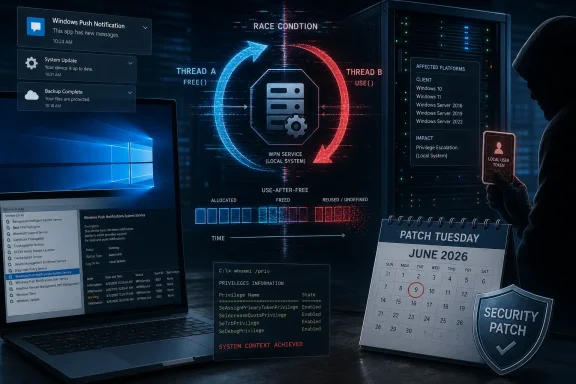 The Quiet Windows Component Is the One Attackers Actually Use
Windows Push Notifications sounds like consumer plumbing: toast banners, app alerts, background delivery, and the small conveniences that make modern Windows feel less like a static desktop and more like a connected operating system. That description is not wrong, but it is incomplete. On a managed Windows estate, notification infrastructure is also part of the ambient operating system: always present, deeply integrated, and often running with more trust than the user processes that trigger it.That is why elevation-of-privilege bugs in components like this deserve more attention than their marketing names suggest. A local privilege escalation does not usually get the theatrical treatment reserved for wormable network bugs, but it is a staple of real intrusions. Attackers who land through phishing, browser exploitation, exposed credentials, malicious documents, or a vulnerable third-party app still need to turn “code running as a user” into “control over the box.”
CVE-2026-42991 fits that second-stage pattern. Microsoft’s description places the bug in Windows Push Notifications and attributes it to concurrent execution over a shared resource with improper synchronization — in plainer English, a race condition. The attacker needs local access and some level of authorization, but no user interaction is required once the exploit path is available.
That last clause is easy to underrate. “Local” does not mean “unimportant,” and “authenticated” does not mean “safe.” In the post-compromise phase of an intrusion, attackers are authenticated all the time — often as the lowest-privileged user on the machine they just compromised.
Report Confidence Is the Least Flashy Metric and One of the Most Useful
The user-supplied MSRC text describes report confidence, a CVSS environmental metric that measures how much trust defenders should place in the existence and technical description of a vulnerability. It is not a measure of exploitability by itself. It is a measure of how solid the ground is under the claim.That distinction matters. A vulnerability may be rumored, observed indirectly, described by a third party, or fully acknowledged by the vendor. Each stage changes how defenders should interpret urgency. A local privilege escalation described only in vague terms is different from one acknowledged by Microsoft, assigned a CVE, mapped to weakness categories, and shipped with a security update.
For CVE-2026-42991, the confidence signal is strong because the vulnerability is vendor-published in Microsoft’s Security Update Guide and mirrored in the broader CVE ecosystem. The technical details remain intentionally sparse, as they usually are for freshly patched Windows internals bugs, but the existence of the flaw is not speculative. Microsoft is not saying “there may be an issue”; it is saying Windows Push Notifications contains an elevation-of-privilege vulnerability that has been addressed.
That does not mean defenders have exploit code in hand, nor does it mean criminal exploitation is underway. It means the vulnerability is real enough to patch, categorize, and score. In enterprise triage, that is the difference between a rumor in the noise and a ticket in the queue.
A Race Condition Is Not a Footnote, It Is the Mechanism
Race conditions are among the most frustrating vulnerability classes because they live in timing, not just in bad input. When two execution paths touch the same resource without proper synchronization, an attacker may be able to force the program into a state its designers assumed could not happen. In Windows components that broker work between user sessions, services, tokens, files, handles, and background tasks, those assumptions are security boundaries by another name.CVE-2026-42991 is associated with improper synchronization and use-after-free weakness categories. That combination should make Windows internals people sit up. A use-after-free means software continues to use memory or an object after it should no longer be valid. In the right context, that can become a path to corrupt state, redirect execution, or trick a privileged service into performing an operation on the attacker’s terms.
Microsoft’s public language does not expose the exploit recipe, and that restraint is appropriate. But the class of bug is familiar enough. Local privilege escalation often relies on winning a narrow timing window: create, delete, replace, reparse, signal, or race a privileged component until it acts on attacker-controlled state.
The worrying part is not that every race condition is trivial to exploit. Many are fragile, build-specific, or dependent on system load. The worrying part is that once a patch lands, researchers and attackers can diff the changed binaries, identify what Microsoft synchronized or hardened, and work backward toward the vulnerable path.
The CVSS Score Says “High,” but the Shape Says “Post-Compromise”
CVE-2026-42991 is rated high severity with a CVSS 3.1 base score of 7.8. The broad outline is familiar: local attack vector, low privileges required, no user interaction, changed scope, and high impact to confidentiality, integrity, and availability. The exploit path is not remote, but the payoff can be broad if the attacker crosses into a more privileged context.That is the practical meaning of this bug. It is not the thing that usually gets an attacker into a network from the internet. It is the thing that can make the initial foothold much worse.
For home users, the difference may feel academic. If malware is already running under your account, you already have a problem. But privilege level determines whether that malware can tamper with security tools, dump credentials from protected areas, install persistent services, read other users’ data, or burrow into places ordinary user processes cannot reach.
For enterprises, the distinction is even sharper. Many endpoint security strategies assume compromise will happen but try to contain the blast radius with least privilege, application control, tamper protection, and monitoring. A reliable elevation-of-privilege exploit is an attack on that containment model. It turns “a user clicked something” into “the endpoint is now a platform.”
Microsoft’s June Patch Volume Makes Triage Harder, Not Easier
CVE-2026-42991 landed in a June 2026 Patch Tuesday cycle that security researchers described as unusually large, with more than 200 Microsoft CVEs counted by outside analysts and hundreds more when third-party Chromium and related fixes are included. That volume changes how vulnerabilities are experienced by administrators. A single high-severity local privilege escalation is not evaluated in isolation; it competes with remote code execution bugs, exploited zero-days, browser updates, Office flaws, Azure issues, Defender fixes, and server-side exposures.This is the uncomfortable reality of modern patch management. Microsoft can publish a security fix, assign a severity, and provide the update path. It cannot give every enterprise the time, staging capacity, regression-testing coverage, maintenance windows, and business permission needed to deploy everything immediately.
In that environment, bugs like CVE-2026-42991 risk falling into the middle. They are not the top-line wormable RCE. They are not necessarily known exploited at release. They may not have a flashy brand name, a logo, or a proof-of-concept video on social media. But attackers do not prioritize according to press coverage; they prioritize according to utility.
A local privilege escalation in a default Windows component has utility. It can be chained. It can be used after a phishing campaign, after abuse of a VPN account, after exploitation of a browser, or after code execution through a business application. The patching priority should reflect that role.
Windows Push Notifications Is Broader Than Its Name Implies
The phrase “Push Notifications” invites a mental model borrowed from phones: an app wants to tell you something, the cloud passes along an alert, and a banner appears. Windows implements a richer and messier version of that idea. It has to handle user sessions, app identities, background delivery, service mediation, and interactions between modern app frameworks and the classic desktop world.That breadth is one reason a vulnerability in the notification stack can matter across client and server SKUs. Even servers that do not look like notification-heavy consumer machines can carry shared Windows components for compatibility, management, or platform consistency. Administrators sometimes assume that if a feature is not visibly used, its attack surface is irrelevant. Windows rarely rewards that assumption.
The affected-product picture for CVE-2026-42991 includes Windows 10, Windows 11, Windows Server 2019, Windows Server 2022, and Windows Server 2025 families. That is a wide enough footprint to make asset owners check build numbers rather than rely on intuition. In mixed estates, especially those still carrying older long-term Windows 10 and Server releases, the same vulnerability class may appear across very different operational roles.
The lesson is not that notifications should be disabled everywhere, even where that is possible. The lesson is that background services become security dependencies whether or not users see them. The modern Windows platform is less a collection of visible applications than a mesh of brokers, services, identity boundaries, and event-driven plumbing.
The “Local Attacker” Caveat Is a Comfort Blanket
Security advisories often use “local attacker” as a narrowing phrase, and it is technically meaningful. It says the exploit is not fired unauthenticated over the network from across the internet. It says the adversary must already have code execution or an account on the target system. That should lower panic, but it should not lower discipline.In real incidents, local access is not rare. It is the default state after the opening move. A malicious attachment gives the attacker code running as the user. A stolen password gives the attacker a session. A compromised help-desk tool, browser process, developer workstation, or remote access appliance gives the attacker local execution somewhere.
Once that happens, privilege escalation determines what the attacker can do next. Can they disable endpoint protection? Can they steal credentials? Can they persist beyond reboot? Can they pivot using secrets that were never supposed to be visible to the compromised account? Those questions are where CVE-2026-42991 belongs.
This is also why vulnerability management programs that sort purely by “remote versus local” miss the operational point. A local privilege escalation on every workstation can be more useful to an attacker than a remote bug on a niche service. Attack chains are built out of ordinary parts.
The Absence of Public Exploitation Is Not the Same as Safety
At disclosure, CVE-2026-42991 does not appear to be the headline exploited zero-day of the month. That matters, and it should affect prioritization. Known-exploited vulnerabilities deserve immediate attention because they have crossed from theoretical risk into observed attacker behavior.But no known exploitation is not a guarantee of no exploitation. It can mean defenders have not seen it. It can mean Microsoft has not disclosed it. It can mean exploit development is still underway. It can also mean the bug is difficult enough that it will never become a widely used commodity exploit.
The honest position is uncertainty. The vulnerability’s report confidence is high because the vendor has confirmed it. The exploit maturity picture is less dramatic because public exploitation is not the story. Those two statements can coexist.
For administrators, that means CVE-2026-42991 should be handled as a credible, high-impact local privilege escalation rather than as an emergency on the level of a wormable remote code execution flaw. The difference is sequencing, not dismissal.
Patch Diffing Turns Sparse Advisories Into Roadmaps
Microsoft’s restrained advisory language is not a failure of transparency so much as a function of security reality. If the company publishes the exact vulnerable code path on Patch Tuesday, it also publishes a recipe for attackers targeting unpatched systems. So defenders get a short description, a CVSS vector, affected products, and update guidance.Attackers and researchers get the same update, plus the vulnerable binaries from before the patch and the fixed binaries after it. From there, patch diffing begins. Changed functions, new locks, altered reference counting, object lifetime fixes, permission checks, and synchronization primitives all become clues.
This dynamic is why patch latency matters. The public may not have a proof of concept on day one. By day seven or day fourteen, the technical picture can be much clearer to people with reverse-engineering skills. By day thirty, if the bug is useful and reliable, it may be integrated into private tooling even if it never shows up in a noisy public repository.
The “technical knowledge available to would-be attackers” is therefore not static. It increases after the patch ships. Report confidence tells us the bug exists; the patch itself helps others learn where.
The Server Angle Is Awkward but Real
Windows Push Notifications sounds client-heavy, yet the affected list includes server platforms. That creates a familiar administrative shrug: “We do not use that on servers.” Maybe not visibly. But Windows Server inherits broad swaths of Windows platform code, and vulnerabilities in shared services can still be present even when the user-facing scenario is absent.For servers, the risk model is different. A local privilege escalation on a domain controller, file server, jump host, remote desktop server, build server, or management box is much more consequential than the same bug on a lightly used kiosk. The attacker does not need a notification toast to care about the component. They need the vulnerable code path to be reachable.
That is where testing and inventory matter. Some organizations patch servers more slowly because uptime requirements are stricter. Others patch workstations more slowly because the estate is larger and harder to control. CVE-2026-42991 gives neither side a free pass.
If an organization has tier-zero or tier-one Windows systems, the question should not be whether users receive notifications on them. The question should be whether the vulnerable build is present and whether the June security update, or the relevant cumulative update level, has been deployed.
Home Users Should Let Windows Update Do Its Boring Job
For individual Windows users, the practical advice is less exotic than the vulnerability mechanics. Install the cumulative update. Do not pause security updates indefinitely. Reboot when required. Keep Microsoft Defender or equivalent endpoint protection current. Avoid running unknown software, because local privilege escalation requires an initial local foothold.That may sound underwhelming, but it is the point. Local privilege escalation bugs often punish systems that are otherwise “mostly fine” but lag a month or two behind. The exploit does not need to be the first infection vector. It needs only to upgrade the attacker’s position after something else goes wrong.
Windows 10 users deserve special mention because the platform’s mainstream consumer story has been winding down, while enterprise and extended-support realities remain messy. The longer an estate stretches across Windows 10, Windows 11, and multiple server releases, the more important it becomes to know exact build levels rather than simply knowing product names.
The same goes for enthusiasts who run Insider, preview, or mixed-channel machines. Security update status is not just a line in Settings; it is the boundary between “this bug is in my theoretical threat model” and “this bug is still in my running code.”
Enterprises Should Treat This as an Attack-Chain Patch
The best enterprise response to CVE-2026-42991 is to classify it correctly. It is not primarily an internet-edge panic item. It is an attack-chain hardening patch. That means it belongs in the same mental bucket as kernel elevation bugs, service hardening fixes, token boundary flaws, and broker vulnerabilities.That classification changes what teams should ask. Instead of “Can this be exploited remotely from the internet?” the better question is “What happens if an attacker with ordinary user execution on a workstation can reliably become more privileged?” In many environments, the answer is uncomfortable.
Privilege escalation interacts with endpoint detection, least privilege, credential protection, and lateral movement. If local admin rights are already broadly granted, the incremental damage of a new EoP may be smaller because the environment is already weak. If least privilege is enforced, the bug becomes more important because it attacks a control the organization actually relies on.
Security teams should also watch for post-patch telemetry. Attempts to interact with notification services in unusual ways, crashes in related components, suspicious handle or object behavior, and low-privilege processes probing privileged service boundaries may become more interesting after public disclosure. The best detections often emerge after researchers understand the fixed path.
The Reboot Is Still the Most Underrated Security Control
Windows cumulative updates are mechanically simple in concept and operationally annoying in practice. Download, stage, install, reboot. The reboot is where many patch programs lose their nerve.For a vulnerability like CVE-2026-42991, partial compliance can be misleading. A system may report that an update is installed but remain pending reboot. A laptop may be asleep during the maintenance window. A server may be excluded for application-owner convenience. A VDI image may be patched while persistent endpoints are not. A golden image may be updated while existing machines drift.
Attackers do not care that the patch dashboard looks better than last week. They care whether the vulnerable binary is still loaded on the machine they reached.
This is why security teams increasingly need patch validation that goes beyond “update approved.” Build numbers, reboot state, vulnerable-file versions, and actual endpoint telemetry matter. In a month with an overwhelming number of Microsoft fixes, process fidelity becomes as important as the advisory text.
The Confidence Metric Should Change the Conversation
The user-provided description of report confidence is easy to read as generic CVSS documentation, but it points to a deeper problem in vulnerability triage. Teams often ask, “How bad is it?” before they ask, “How sure are we?” Those are different axes.For CVE-2026-42991, the “how sure” answer is relatively strong: Microsoft has acknowledged the issue, assigned and published the CVE, and shipped the fix. The “how bad” answer is more contextual: high severity, local authenticated exploitation, no user interaction, high impact if successful, but not the kind of bug that starts as a remote unauthenticated internet worm.
That combination argues for disciplined urgency. Patch it promptly, especially on endpoints and high-value servers. Do not shove it below every remote-code-execution issue forever. Do not oversell it as the only June vulnerability that matters. Do not wait for exploit code to appear before deciding it is real.
Report confidence is a guardrail against both complacency and hype. It says the foundation of the claim is solid, even if the exploit details remain incomplete.
The Patch Queue Needs a Place for This Specific Kind of Windows Bug
CVE-2026-42991 should force a more mature patching conversation than “high means patch fast.” High-severity Windows EoP bugs are common enough that treating each as a unique emergency burns teams out. They are also useful enough to attackers that treating them as background noise is negligent.The right middle ground is risk-aware automation. Workstations should move quickly through rings unless telemetry shows breakage. Servers should be prioritized by role and exposure to interactive logons. Privileged access workstations, RDP hosts, developer machines, help-desk systems, and admin jump boxes should be near the front of the line because local privilege escalation on those systems pays higher dividends.
Organizations that already use exploitability scoring, asset criticality, and known-exploited feeds should add another lens: chain value. A vulnerability does not need to be the first link to be dangerous. Sometimes the second link is what turns an incident into a breach.
CVE-2026-42991 is a classic second-link vulnerability. That is not a downgrade. It is the reason it matters.
The June Signal Buried in the Notification Stack
CVE-2026-42991 is not the loudest June 2026 Microsoft vulnerability, but it is a useful test of whether a Windows patch program understands real attack paths. The concrete lessons are narrower than the Patch Tuesday avalanche, and that is what makes them useful.- CVE-2026-42991 is a confirmed Windows Push Notifications local elevation-of-privilege vulnerability disclosed by Microsoft on June 9, 2026.
- The vulnerability is tied to a race condition and related memory-lifetime weakness, which makes patch diffing especially relevant after release.
- The bug requires local authenticated access, so it is best understood as a post-compromise privilege-escalation tool rather than an initial internet-facing entry point.
- The affected footprint spans Windows client and server families, so administrators should verify build and cumulative update status instead of relying on assumptions about whether notifications are used.
- The absence of public exploitation at disclosure lowers emergency pressure but does not justify deferral on high-value endpoints and servers.
- The report-confidence signal is strong because the vendor has acknowledged the flaw and shipped a security update, even though detailed exploit mechanics remain intentionally limited.
References
- Primary source: MSRC
Published: 2026-06-09T07:00:00-07:00
Security Update Guide - Microsoft Security Response Center
 msrc.microsoft.com
- Related coverage: aha.org
- Related coverage: rapid7.com
Rapid7 Vulnerability Database
Rapid7's VulnDB is curated repository of vetted computer software exploits and exploitable vulnerabilities.www.rapid7.com - Related coverage: thewindowsupdate.com
- Related coverage: bleepingcomputer.com
- Related coverage: sentinelone.com
CVE-2026-26172: Windows Push Notifications Privilege Escalation
CVE-2026-26172 is a privilege escalation vulnerability in Windows Push Notifications. Learn about its impact, affected versions, and mitigation methods.www.sentinelone.com