

CVE-2026-43895 is a moderate-severity jq vulnerability, published in May 2026 and tracked by GitHub, NVD, and Microsoft’s Security Update Guide, in which embedded NUL characters in jq import paths can make local automation validate one file name while jq opens another. That sounds narrow, and in one sense it is: this is not a remote-code-execution bug, not a wormable Windows flaw, and not the sort of vulnerability that should send desktop users racing to unplug Ethernet. But it lands in a place modern IT often underestimates: the glue code between policy and publishing. The uncomfortable lesson is that a tiny parsing mismatch in a humble JSON tool can quietly defeat the redaction assumptions behind build artifacts, reports, manifests, and release pipelines.
jq has always occupied an odd place in the software stack. It is not a platform in the way Windows, Linux, Kubernetes, or Azure are platforms, yet it sits inside the scripts that feed all of them. It is the quick filter in a CI job, the JSON scalpel in a release script, the one-liner in a PowerShell wrapper, and the quiet dependency in tools that need to transform structured data before humans or machines consume it.
That makes CVE-2026-43895 more interesting than its CVSS score suggests. The advisory describes a local attack requiring low privileges and no user interaction, with low confidentiality and integrity impact. Those words are accurate as far as scoring goes, but they flatten the operational reality: local automation is where many organizations now make security decisions.
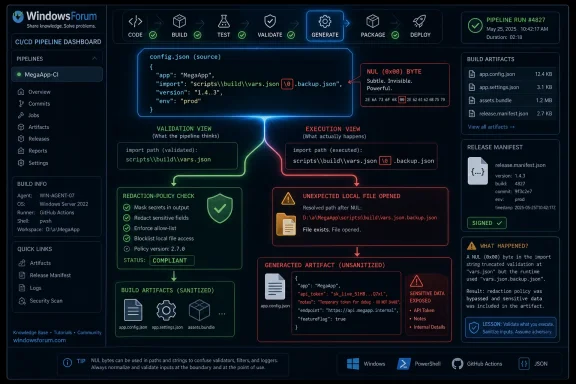
The bug affects jq 1.8.1 and earlier, according to the published advisory data. The core issue is that jq can accept an import path containing an embedded NUL character at the jq-language level, while later filesystem resolution passes through C-style string behavior, where the NUL terminates the path. One layer sees the whole logical string; another layer acts on only the prefix.
That split is the vulnerability. A wrapper or policy checker may inspect an import such as a supposedly approved public ruleset, while jq resolves the path as a different local file. In the proof-of-concept described by the advisory, a publishing workflow expected a redaction policy to remove sensitive fields, but jq loaded a non-public rules file instead, preserving fields such as an API token and internal notes in the generated artifact.
In older web-security lore, NUL byte bugs often showed up as upload bypasses, filename confusion, or extension checks that saw one thing while the filesystem saw another. CVE-2026-43895 is a modern cousin of that family, transplanted into a DevOps and data-publishing workflow. The same conceptual failure is present: validation and execution do not agree on the identity of an object.
That is why the advisory’s redaction example matters. The failure is not simply that jq opens an unexpected file. The failure is that a human or automated control believes it has enforced a publishing rule, and the tool underneath has silently executed a different dependency graph.
For Windows admins, this may sound like a Linux-flavored concern, because jq is often associated with Unix shells. That would be a mistake. jq is widely used on Windows through Git for Windows, package managers, WSL, CI runners, container images, developer workstations, and cross-platform scripts. The path may be local, but the operational surface is not confined to one operating system culture.
Microsoft’s tracking still matters. The Security Update Guide has become a central index for vulnerability awareness across Microsoft’s ecosystem, including third-party components and dependencies that may matter to customers. When a tool like jq is used inside Microsoft-adjacent workflows, developer environments, security tooling, or cloud automation, it becomes relevant to the administrators who live in Microsoft’s orbit.
The better way to read Microsoft’s entry is as part of a broader supply-chain signal. Modern Windows estates do not consist solely of Microsoft binaries. They include open-source utilities, language runtimes, container base images, GitHub Actions, Azure DevOps tasks, package-manager installs, and private scripts copied from one repository to another. jq is exactly the kind of small dependency that slips below the asset-management waterline.
The disclaimer language should not distract from the practical issue. The important question is not whether Microsoft owns jq. The important question is whether jq sits inside a workflow that transforms confidential input into supposedly safe output.
But CVSS is weakest when the vulnerable component is a policy hinge. jq may not hold domain-admin credentials, but it may decide what gets published, redacted, signed, archived, or sent to a customer. If a pipeline uses jq to enforce a data boundary, then the impact depends less on jq itself and more on the sensitivity of the data passing through it.
That is the difference between a vulnerability in a service and a vulnerability in an assumption. In many shops, the assumption is that a local script’s preflight validation and the tool it invokes will agree on import names. CVE-2026-43895 says that assumption can be false.
This is why “local attacker” should not be read as “low relevance.” A local attacker in a pipeline may be a pull request author, a plugin contributor, a build-template maintainer, an insider with limited repository access, or a compromised developer account that can alter a filter but not production secrets directly. In that model, influencing the redaction logic may be enough.
The proof-of-concept scenario is powerful precisely because nothing dramatic happens. The policy check passes. jq runs. The output file is created. The release script appears to do its job. The only problem is that sensitive fields remain in the published output.
That kind of failure can sit undiscovered until someone notices a token in an artifact, a customer reports internal notes in an export, or a repository scan finds secrets after the fact. By then the breach may not be a technical exploit anymore; it may be a disclosure incident.
This is where the industry’s fondness for “shift left” collides with the messiness of actual toolchains. Moving security into development pipelines only works if the pipeline’s enforcement mechanisms are semantically reliable. If the checker and the executor parse the same string differently, the control is decorative.
The import mechanism is central to this vulnerability. If jq were only reading standard input and applying a literal one-liner, the affected surface would be smaller. But once filters can import local modules or JSON data files, import names become part of the trust model.
The advisory identifies the affected component as the linker path handling, where jq strings meet C string APIs. jq strings are length-aware, meaning they can represent embedded NUL characters. C filesystem routines, by contrast, typically interpret NUL as the end of the string.
That mismatch turns import resolution into a parser differential. The jq-language representation, the policy checker’s representation, the path-normalization logic, and the filesystem open call can diverge. Security bugs often hide in exactly those seams.
Windows-centric environments should check PowerShell scripts, Azure DevOps pipelines, GitHub Actions workflows, container build steps, internal release tools, and WSL-based developer instructions. jq may arrive through Chocolatey, Scoop, winget, Git Bash, MSYS2, Cygwin, a container image, or a vendored binary. It may also be baked into a larger tool that shells out to jq without making that dependency obvious.
The most sensitive workflows are the ones that publish outward. Customer exports, anonymized telemetry, software bills of materials, incident reports, support bundles, configuration snapshots, and static-site data builds all deserve scrutiny. If jq participates in removing fields before release, this CVE deserves more attention than the word “moderate” normally receives.
The same applies to internal artifacts that later become external by accident. A “temporary” JSON file written to a build directory can end up in a package, a log bundle, a public symbol archive, or a support upload. Redaction policies fail most painfully when nobody remembers where the intermediate files went.
This is where IT teams need to distinguish between vulnerability tracking and remediation reality. A CVE entry tells you the issue exists. It does not guarantee a fixed binary is available in every channel you use. jq installed by an operating-system package manager, jq bundled in a container image, and jq downloaded as a standalone executable may each follow different timelines.
Until a fixed release or vendor-patched package is available in a given environment, mitigation is about constraining input and removing ambiguity. Workflows should reject embedded NUL characters before jq runs. More importantly, policy checks should not rely on source-text inspection alone when the executor’s path resolution can differ.
The safest design is to make untrusted filters boring or impossible. If less-trusted users can influence jq code, do not let that code select arbitrary import paths. Treat jq filters as executable policy, not as inert configuration.
That is still a supply-chain issue because build and publishing chains are made of interpretations. A repository says one thing. A policy scanner reads it. A runtime executes it. A package is produced. A customer consumes it. If those interpretations drift, the chain has a weak link even without a malicious upstream package.
The lesson is especially relevant for organizations that have built sophisticated governance around source review but less around runtime verification. A code review might see an import that appears to satisfy a naming convention. A preflight script might agree. The runtime, however, may open a different file.
That makes this bug a reminder that naming conventions are not security boundaries. Suffixes such as
But the broader fix is semantic consistency across trust boundaries. If a workflow validates a dependency, the exact object validated must be the exact object executed or opened. That sounds simple, yet the history of security bugs is full of systems where parsers, normalizers, encoders, decoders, and runtime APIs each held a slightly different view of the same input.
For jq maintainers, the issue sits in path validation and library/data-file resolution. For downstream users, the issue sits in workflow design. Both matter. A fixed jq reduces the primitive; a better pipeline reduces the damage when some future primitive appears in another tool.
This is why administrators should avoid responding with a narrow grep for one CVE and nothing else. The same class of failure can appear wherever a higher-level policy engine feeds a lower-level file API, shell, compiler, interpreter, archive tool, or package manager. CVE-2026-43895 is the incident name; parser agreement is the principle.
The first few weeks after a vulnerability disclosure are when teams decide whether an issue becomes a tracked remediation item or vanishes into backlog fog. Medium-severity bugs in small tools are particularly vulnerable to neglect. They do not have the executive urgency of a zero-day, and they do not always map cleanly to asset inventories.
Security teams should resist that drift. The right response is not panic; it is inventory and prioritization. Find where jq is used for redaction, sanitization, release generation, or policy-gated imports. Those workflows move to the top. A developer’s private one-liner for formatting JSON can wait.
For WindowsForum readers, the practical message is that this belongs in the same mental bucket as PowerShell execution policy bypasses, archive extraction weirdness, and YAML parser surprises. The bug is small, but it lives in automation. Automation is where small bugs scale.
 A Small Bug in a Very Large Blast Radius
jq has always occupied an odd place in the software stack. It is not a platform in the way Windows, Linux, Kubernetes, or Azure are platforms, yet it sits inside the scripts that feed all of them. It is the quick filter in a CI job, the JSON scalpel in a release script, the one-liner in a PowerShell wrapper, and the quiet dependency in tools that need to transform structured data before humans or machines consume it.That makes CVE-2026-43895 more interesting than its CVSS score suggests. The advisory describes a local attack requiring low privileges and no user interaction, with low confidentiality and integrity impact. Those words are accurate as far as scoring goes, but they flatten the operational reality: local automation is where many organizations now make security decisions.
The bug affects jq 1.8.1 and earlier, according to the published advisory data. The core issue is that jq can accept an import path containing an embedded NUL character at the jq-language level, while later filesystem resolution passes through C-style string behavior, where the NUL terminates the path. One layer sees the whole logical string; another layer acts on only the prefix.
That split is the vulnerability. A wrapper or policy checker may inspect an import such as a supposedly approved public ruleset, while jq resolves the path as a different local file. In the proof-of-concept described by the advisory, a publishing workflow expected a redaction policy to remove sensitive fields, but jq loaded a non-public rules file instead, preserving fields such as an API token and internal notes in the generated artifact.
The NUL Byte Is Old, but the Pipeline Is New
Security people have been wary of NUL byte truncation for decades. C strings end at\0, while higher-level languages often carry explicit string lengths and therefore allow characters that older APIs treat as terminators. The bug class is not new; what is new is where the consequences now appear.In older web-security lore, NUL byte bugs often showed up as upload bypasses, filename confusion, or extension checks that saw one thing while the filesystem saw another. CVE-2026-43895 is a modern cousin of that family, transplanted into a DevOps and data-publishing workflow. The same conceptual failure is present: validation and execution do not agree on the identity of an object.
That is why the advisory’s redaction example matters. The failure is not simply that jq opens an unexpected file. The failure is that a human or automated control believes it has enforced a publishing rule, and the tool underneath has silently executed a different dependency graph.
For Windows admins, this may sound like a Linux-flavored concern, because jq is often associated with Unix shells. That would be a mistake. jq is widely used on Windows through Git for Windows, package managers, WSL, CI runners, container images, developer workstations, and cross-platform scripts. The path may be local, but the operational surface is not confined to one operating system culture.
Microsoft’s Appearance Is a Signal, Not the Center of the Story
The user-facing source for this item is Microsoft’s Security Update Guide entry, wrapped in the familiar Microsoft Knowledge Base disclaimer language. That can create a misleading first impression. This is not a Windows kernel vulnerability, not an Office exploit chain, and not a flaw in Microsoft-authored code in the usual Patch Tuesday sense.Microsoft’s tracking still matters. The Security Update Guide has become a central index for vulnerability awareness across Microsoft’s ecosystem, including third-party components and dependencies that may matter to customers. When a tool like jq is used inside Microsoft-adjacent workflows, developer environments, security tooling, or cloud automation, it becomes relevant to the administrators who live in Microsoft’s orbit.
The better way to read Microsoft’s entry is as part of a broader supply-chain signal. Modern Windows estates do not consist solely of Microsoft binaries. They include open-source utilities, language runtimes, container base images, GitHub Actions, Azure DevOps tasks, package-manager installs, and private scripts copied from one repository to another. jq is exactly the kind of small dependency that slips below the asset-management waterline.
The disclaimer language should not distract from the practical issue. The important question is not whether Microsoft owns jq. The important question is whether jq sits inside a workflow that transforms confidential input into supposedly safe output.
The Severity Score Understates the Trust Boundary
A CVSS base score of 4.4 makes this a medium vulnerability, and that is defensible. Exploitation is local. The attacker needs the ability to influence a jq filter or workflow input. There is no availability impact in the published vector, and the described confidentiality and integrity impacts are low.But CVSS is weakest when the vulnerable component is a policy hinge. jq may not hold domain-admin credentials, but it may decide what gets published, redacted, signed, archived, or sent to a customer. If a pipeline uses jq to enforce a data boundary, then the impact depends less on jq itself and more on the sensitivity of the data passing through it.
That is the difference between a vulnerability in a service and a vulnerability in an assumption. In many shops, the assumption is that a local script’s preflight validation and the tool it invokes will agree on import names. CVE-2026-43895 says that assumption can be false.
This is why “local attacker” should not be read as “low relevance.” A local attacker in a pipeline may be a pull request author, a plugin contributor, a build-template maintainer, an insider with limited repository access, or a compromised developer account that can alter a filter but not production secrets directly. In that model, influencing the redaction logic may be enough.
Redaction Failures Are Worse Than Crashes
Administrators know how to respond to a crash. A job fails, a log turns red, a dashboard complains, and somebody gets paged. Redaction failures are more treacherous because the pipeline can complete successfully.The proof-of-concept scenario is powerful precisely because nothing dramatic happens. The policy check passes. jq runs. The output file is created. The release script appears to do its job. The only problem is that sensitive fields remain in the published output.
That kind of failure can sit undiscovered until someone notices a token in an artifact, a customer reports internal notes in an export, or a repository scan finds secrets after the fact. By then the breach may not be a technical exploit anymore; it may be a disclosure incident.
This is where the industry’s fondness for “shift left” collides with the messiness of actual toolchains. Moving security into development pipelines only works if the pipeline’s enforcement mechanisms are semantically reliable. If the checker and the executor parse the same string differently, the control is decorative.
jq’s Strength Became Part of the Risk
jq is popular because it is expressive. It can import modules and data files, apply reusable filters, and turn complex JSON into precisely shaped output. Those features are why teams embed it in real workflows rather than treating it as a disposable command-line toy.The import mechanism is central to this vulnerability. If jq were only reading standard input and applying a literal one-liner, the affected surface would be smaller. But once filters can import local modules or JSON data files, import names become part of the trust model.
The advisory identifies the affected component as the linker path handling, where jq strings meet C string APIs. jq strings are length-aware, meaning they can represent embedded NUL characters. C filesystem routines, by contrast, typically interpret NUL as the end of the string.
That mismatch turns import resolution into a parser differential. The jq-language representation, the policy checker’s representation, the path-normalization logic, and the filesystem open call can diverge. Security bugs often hide in exactly those seams.
Windows Shops Should Look in the Boring Places First
The practical hunt for exposure should start with scripts, not servers. Look for jq invocations that use-L, import modules, import JSON data, or run filters supplied by repositories, plugins, templates, or users. The danger is not ordinary local use; it is jq embedded in a workflow that makes a promise about sanitization or dependency control.Windows-centric environments should check PowerShell scripts, Azure DevOps pipelines, GitHub Actions workflows, container build steps, internal release tools, and WSL-based developer instructions. jq may arrive through Chocolatey, Scoop, winget, Git Bash, MSYS2, Cygwin, a container image, or a vendored binary. It may also be baked into a larger tool that shells out to jq without making that dependency obvious.
The most sensitive workflows are the ones that publish outward. Customer exports, anonymized telemetry, software bills of materials, incident reports, support bundles, configuration snapshots, and static-site data builds all deserve scrutiny. If jq participates in removing fields before release, this CVE deserves more attention than the word “moderate” normally receives.
The same applies to internal artifacts that later become external by accident. A “temporary” JSON file written to a build directory can end up in a package, a log bundle, a public symbol archive, or a support upload. Redaction policies fail most painfully when nobody remembers where the intermediate files went.
The Patch Story Is Less Comforting Than Usual
One detail in the GitHub advisory is awkward: the published advisory page lists affected versions as 1.8.1 and earlier, while showing no patched version at the time of publication. That does not mean no mitigation exists forever, and downstream distributions may make their own packaging decisions, but it does mean administrators should not assume that a routine package upgrade has already solved the problem.This is where IT teams need to distinguish between vulnerability tracking and remediation reality. A CVE entry tells you the issue exists. It does not guarantee a fixed binary is available in every channel you use. jq installed by an operating-system package manager, jq bundled in a container image, and jq downloaded as a standalone executable may each follow different timelines.
Until a fixed release or vendor-patched package is available in a given environment, mitigation is about constraining input and removing ambiguity. Workflows should reject embedded NUL characters before jq runs. More importantly, policy checks should not rely on source-text inspection alone when the executor’s path resolution can differ.
The safest design is to make untrusted filters boring or impossible. If less-trusted users can influence jq code, do not let that code select arbitrary import paths. Treat jq filters as executable policy, not as inert configuration.
This Is a Supply-Chain Bug Without the Usual Drama
The software supply-chain conversation often fixates on malicious packages, typosquatting, dependency confusion, and compromised maintainers. Those threats are real, but CVE-2026-43895 belongs to a quieter class: a legitimate tool gives different answers to adjacent layers of the same workflow.That is still a supply-chain issue because build and publishing chains are made of interpretations. A repository says one thing. A policy scanner reads it. A runtime executes it. A package is produced. A customer consumes it. If those interpretations drift, the chain has a weak link even without a malicious upstream package.
The lesson is especially relevant for organizations that have built sophisticated governance around source review but less around runtime verification. A code review might see an import that appears to satisfy a naming convention. A preflight script might agree. The runtime, however, may open a different file.
That makes this bug a reminder that naming conventions are not security boundaries. Suffixes such as
_public, _safe, or _redacted are useful signals, but only if the toolchain binds the approved name to the actual file consumed. Otherwise, the convention becomes a theater prop.The Real Fix Is Semantic Consistency
The obvious technical fix is to reject embedded NUL characters in import paths before conversion to C strings. That is also the cleanest fix. There is rarely a legitimate reason for a filesystem import path in a tool like jq to contain an embedded NUL, and rejecting such input aligns the language layer with the operating system layer.But the broader fix is semantic consistency across trust boundaries. If a workflow validates a dependency, the exact object validated must be the exact object executed or opened. That sounds simple, yet the history of security bugs is full of systems where parsers, normalizers, encoders, decoders, and runtime APIs each held a slightly different view of the same input.
For jq maintainers, the issue sits in path validation and library/data-file resolution. For downstream users, the issue sits in workflow design. Both matter. A fixed jq reduces the primitive; a better pipeline reduces the damage when some future primitive appears in another tool.
This is why administrators should avoid responding with a narrow grep for one CVE and nothing else. The same class of failure can appear wherever a higher-level policy engine feeds a lower-level file API, shell, compiler, interpreter, archive tool, or package manager. CVE-2026-43895 is the incident name; parser agreement is the principle.
The Calendar Gives Defenders a Narrow Window
Because the CVE was published in May 2026, organizations are still in the early triage phase. That is good news if they use the moment well. Most attackers will not care about this bug on ordinary desktops, but targeted abuse in development and publishing environments is more plausible than the score alone implies.The first few weeks after a vulnerability disclosure are when teams decide whether an issue becomes a tracked remediation item or vanishes into backlog fog. Medium-severity bugs in small tools are particularly vulnerable to neglect. They do not have the executive urgency of a zero-day, and they do not always map cleanly to asset inventories.
Security teams should resist that drift. The right response is not panic; it is inventory and prioritization. Find where jq is used for redaction, sanitization, release generation, or policy-gated imports. Those workflows move to the top. A developer’s private one-liner for formatting JSON can wait.
For WindowsForum readers, the practical message is that this belongs in the same mental bucket as PowerShell execution policy bypasses, archive extraction weirdness, and YAML parser surprises. The bug is small, but it lives in automation. Automation is where small bugs scale.
The Lessons Hidden in the Import Path
The concrete action items are not glamorous, but they are measurable. Teams that treat jq as infrastructure should document where it comes from, how it is updated, and whether untrusted users can influence filters or imports. Teams that treat jq as a disposable helper should still check the pipelines that publish data outside the organization.- Organizations should identify jq installations and bundled jq binaries, especially in CI runners, developer images, WSL environments, containers, and release tooling.
- Workflows that use jq imports for redaction, sanitization, or publishing should reject embedded NUL characters before invoking jq.
- Teams should not rely solely on source-level import-name checks when jq is allowed to resolve local modules or data files at runtime.
- Pipelines that produce external artifacts should be tested with malicious or malformed filter inputs, not only with expected filters.
- Administrators should watch their package sources for fixed jq builds and verify the actual binary version used by automation, not just the version installed on a workstation.
- Security reviewers should treat jq filters that import modules or data as executable workflow logic rather than harmless configuration text.
References
- Primary source: MSRC
Published: 2026-06-03T01:49:56-07:00
Security Update Guide - Microsoft Security Response Center
 msrc.microsoft.com
- Related coverage: sentinelone.com
CVE-2026-43895: Jqlang Jq Path Traversal Vulnerability
CVE-2026-43895 is a path traversal vulnerability in Jqlang Jq. Learn about its impact, affected versions, and mitigation methods.www.sentinelone.com
- Related coverage: cert.gov.vu
Advisory 118 CVE 2026 21509 Microsoft Office Security Feature Bypass Vulnerability
PDF documentcert.gov.vu
- Related coverage: evs.com
