

Microsoft’s Security Update Guide lists CVE-2026-43896 as a jq denial-of-service vulnerability disclosed in May 2026, affecting jq 1.8.1 and earlier when recursive object merges can trigger unbounded recursion and crash the process. That sounds narrow until you remember where jq lives: in shell scripts, CI pipelines, container images, packaging workflows, monitoring jobs, and the glue code nobody wants to inventory. The flaw is not a glamorous remote-code-execution headline, but it is a useful reminder that availability bugs in small utilities can have outsized operational blast radius. For Windows admins increasingly managing Linux containers, WSL tooling, GitHub Actions runners, and cross-platform automation, jq is not “some Unix thing” anymore; it is part of the modern Windows estate.
jq earned its place because it solved a real problem with almost no ceremony. JSON became the lingua franca of cloud APIs, package manifests, build metadata, identity tokens, Kubernetes output, and telemetry feeds; jq gave admins and developers a way to interrogate that JSON without writing a throwaway program every time.
That convenience is precisely why a crash in jq matters. It is often embedded not as a carefully modeled dependency but as an assumed primitive, the way teams once assumed
On Windows, the story has become more complicated over the last decade. PowerShell has strong native object handling, but many cross-platform instructions still reach for jq because the examples are portable across Linux, macOS, WSL, containers, and CI runners. A Windows shop may not “deploy jq” as a first-class application and still rely on it through developer workstations, DevOps templates, vendor scripts, or containerized tooling.
That is the quiet significance of CVE-2026-43896. It lands in a component that is small enough to overlook and common enough to interrupt real work.
The vulnerable area is jq’s recursive object merge behavior. In jq, the
The reported problem is unbounded recursion in
There is no confidentiality impact here, and there is no claim that an attacker can modify output or execute code through this bug. The impact is availability. But availability is not a consolation prize when the affected process sits in a build gate, deployment job, webhook processor, monitoring collector, or configuration generator.
The less reassuring reading is that modern automation constantly ingests JSON from places it does not fully control. Webhook payloads, issue trackers, cloud APIs, artifact metadata, software bills of materials, container manifests, package registries, and user-supplied configuration can all feed jq directly or indirectly. The attacker does not need to “log in to the server” in the traditional sense if the service helpfully hands their JSON to a vulnerable pipeline.
The boundary depends on the script. A local-only helper that merges two trusted files on an admin’s desktop is low risk. A server-side hook that accepts JSON from customers and invokes jq during validation is a much more interesting target. A CI workflow that processes pull-request-controlled files can fall somewhere in between, especially if the crash blocks builds, releases, or security checks.
This is the uncomfortable part of command-line tooling in production: the same one-liner can be harmless in one setting and load-bearing in another. CVE scoring compresses that nuance into a vector string, but administrators have to map it against their actual trust boundaries.
jq’s recursive object merge makes that pattern compact. A script can slurp two JSON files and combine them without bringing in a full programming language runtime or a bespoke parser. For infrastructure teams, that is attractive: fewer moving parts, less code, easier debugging.
But recursive merge is also one of those operations that hides complexity under a tidy operator. The moment a program descends through nested structures, it has to decide what happens at pathological depth. Does it impose a maximum? Does it convert recursion into an explicit stack? Does it fail gracefully? Does it trust that inputs will be reasonable because JSON produced by normal systems usually is?
Security bugs often appear where “reasonable” becomes an attacker-controlled assumption. A structure that no human would write by hand can be trivial for a fuzzer, script, or hostile client to generate. Deep nesting is especially effective because it attacks the shape of computation rather than a particular value.
In this case, the stack overflow is not the same thing as a classic stack-smashing exploit in which an attacker overwrites return addresses to seize control. The public descriptions point to denial of service: recursive calls consume stack until the operating system stops the process. That distinction matters, because it separates a crash bug from a code-execution catastrophe.
Still, process death is a security property when the process is part of a service. If a web application shells out to jq for request processing, the individual jq process may die while the parent survives. If the parent treats repeated jq failures poorly, queues can back up, retries can multiply, and a narrow crash can become a service-level incident. If a CI system uses jq in a required job, a small JSON payload can become a release blocker.
This is why availability findings deserve more respect in operational environments than they often receive in vulnerability triage meetings. A bug does not have to leak secrets to ruin your Tuesday.
The risk is not that Windows itself suddenly depends on jq. The risk is that the Windows organization does. A build runner on Windows may invoke a container image with jq inside it. A PowerShell script may call jq because a copied vendor example did. A security team may use jq to normalize JSON from Defender, Entra, GitHub, AWS, or Kubernetes exports. A developer laptop may have several jq binaries scattered across package managers and tool bundles.
That makes inventory awkward. The copy in
For WindowsForum readers, the lesson is not to replace every jq invocation with PowerShell tomorrow. It is to stop treating cross-platform helper binaries as invisible. If a workflow depends on a tool, that tool is part of the security surface, whether or not it appears in the Windows Apps list.
A medium-severity crash in a developer convenience tool may sit comfortably behind other work. A medium-severity crash in a deployment path that ships production hotfixes deserves faster attention. The same CVE can be trivial, annoying, or urgent depending on where jq appears in the chain.
This is one of the recurring failures of enterprise patch management. Teams ask, “What is the severity?” when the better question is, “What business process stops if this component stops?” If the answer is “nothing important,” the patch can follow the normal cycle. If the answer is “release engineering,” “customer onboarding,” “billing import,” or “security alert enrichment,” the conversation changes.
jq’s ubiquity makes that mapping more important. It is not enough to know whether a host has jq installed. Administrators need to know whether jq handles untrusted or semi-trusted JSON, and whether a jq failure causes graceful rejection, noisy failure, or cascading outage.
The problem is that many images are not disciplined. jq often appears in utility layers, debug images, build stages, and general-purpose administrative containers. It may be installed by a Dockerfile line written years ago and never revisited. It may live in an image that is not internet-facing but still processes data from untrusted sources during CI or operations.
There is also a difference between patching runtime images and patching build images. A vulnerable jq in a production web container may be easy to spot through scanning. A vulnerable jq in a build container can be just as disruptive if it crashes during artifact generation or security validation, but it may receive less attention because it does not ship to customers.
The right response is boring and effective: rebuild images, refresh base layers, and scan not only what runs in production but also what builds production. The more an organization has embraced infrastructure as code, the more it should treat its build tooling as production-adjacent.
That evidence is useful but reactive. A better approach is to look for vulnerable jq versions and risky invocation patterns. Scripts that use recursive object merge with the
Version inventory also needs nuance. Running
The audit should also include failure behavior. If jq crashes, does the surrounding script stop safely? Does it retry forever? Does it partially write configuration? Does it skip a validation step and continue? Availability bugs are easier to manage when failure is explicit and contained.
Where immediate patching is not possible, mitigation should focus on reducing exposure. Do not feed attacker-controlled JSON into recursive object merge. Put size and depth limits in front of jq when processing external data. Avoid accepting arbitrary jq filters from users. Treat JSON shape as input that needs validation, not just syntax that needs parsing.
It is tempting to respond with a clever jq rewrite, but that can miss the point. If the workflow accepts untrusted, arbitrarily nested objects and performs deep operations on them, the risk may simply move from one function to another. The safer pattern is to constrain the input before it reaches the fragile operation.
Windows-heavy teams have an additional option in some scripts: use PowerShell’s JSON handling or an application-language parser where depth limits, exceptions, and error handling are easier to control. That is not a universal replacement for jq, and PowerShell has its own quirks around JSON depth. But for administrative scripts already written in PowerShell, avoiding an external process can simplify both patching and failure handling.
jq is successful because it is lightweight, portable, expressive, and easy to compose. Those qualities are exactly why it appears in so many places. Security teams should not punish usefulness; they should account for it.
The deeper issue is dependency visibility. Organizations have improved at tracking libraries inside applications, but command-line tools used by automation often sit outside that model. They are not always in a package manifest. They are not always owned by an application team. They may be installed in a runner image maintained by platform engineering and used by dozens of teams who barely know it exists.
CVE-2026-43896 is a small case study in that governance gap. The vulnerable component is not obscure, the failure mode is understandable, and the mitigation path is conceptually straightforward. If an organization still cannot answer where jq is used, that is the more important finding.
CVE-2026-43896 is not the end of the world. It is a stack-exhaustion flaw in a recursive merge path of a command-line JSON processor. Yet the reason it deserves attention is exactly its ordinariness: jq is the sort of tool that disappears into the floorboards of modern operations.
For Windows administrators, the larger trend is unmistakable. The Windows estate now includes Linux utilities, open-source package ecosystems, cloud-native build pipelines, and container layers that do not respect old platform boundaries. Vulnerability management has to follow the workflow, not the logo on the operating system.
The next jq-class bug may land in a YAML parser, a CLI authentication helper, a compression utility, or a tiny binary embedded in a runner image. The organizations that handle it well will be the ones that already know where their automation depends on small tools, how those tools fail, and who owns the patch path when the advisory arrives.
 The Tiny JSON Tool Has Become Production Infrastructure
jq earned its place because it solved a real problem with almost no ceremony. JSON became the lingua franca of cloud APIs, package manifests, build metadata, identity tokens, Kubernetes output, and telemetry feeds; jq gave admins and developers a way to interrogate that JSON without writing a throwaway program every time.That convenience is precisely why a crash in jq matters. It is often embedded not as a carefully modeled dependency but as an assumed primitive, the way teams once assumed
grep, sed, or awk would simply be there. When a tool occupies that layer, its failure mode is rarely isolated to a single command prompt.On Windows, the story has become more complicated over the last decade. PowerShell has strong native object handling, but many cross-platform instructions still reach for jq because the examples are portable across Linux, macOS, WSL, containers, and CI runners. A Windows shop may not “deploy jq” as a first-class application and still rely on it through developer workstations, DevOps templates, vendor scripts, or containerized tooling.
That is the quiet significance of CVE-2026-43896. It lands in a component that is small enough to overlook and common enough to interrupt real work.
Microsoft’s Advisory Is a Signpost, Not the Whole Story
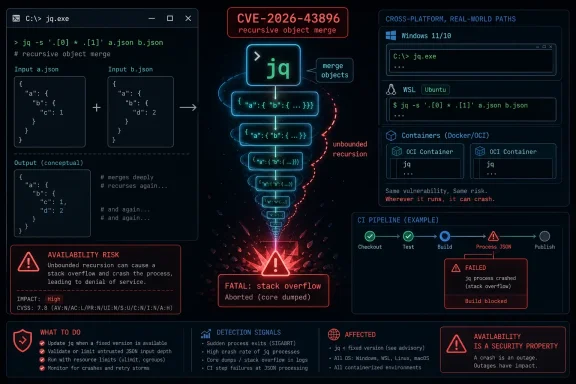
The MSRC entry frames the issue in availability terms: an attacker can deny access to resources in the impacted component, either while continuing to deliver the attack or by causing a condition that persists after the attack ends. In the case of jq, the practical version is simpler: a crafted jq program can force the process into a stack overflow and terminate it.The vulnerable area is jq’s recursive object merge behavior. In jq, the
* operator does more than arithmetic; when both operands are objects, it recursively merges them. That is a useful feature, and it is common in real scripts that combine defaults, environment-specific overrides, API responses, or generated configuration fragments.The reported problem is unbounded recursion in
jv_object_merge_recursive(). If jq is asked to merge object structures nested deeply enough, the function can keep calling itself until the native process stack is exhausted. At that point the program crashes, typically with a segmentation fault on Unix-like systems.There is no confidentiality impact here, and there is no claim that an attacker can modify output or execute code through this bug. The impact is availability. But availability is not a consolation prize when the affected process sits in a build gate, deployment job, webhook processor, monitoring collector, or configuration generator.
The Attack Surface Is Wherever Scripts Trust JSON Too Much
The most reassuring reading of this vulnerability is that an attacker needs influence over jq input or jq program text. That is not the same as a wormable network bug. It does not mean every machine with jq installed is waiting to fall over on the open internet.The less reassuring reading is that modern automation constantly ingests JSON from places it does not fully control. Webhook payloads, issue trackers, cloud APIs, artifact metadata, software bills of materials, container manifests, package registries, and user-supplied configuration can all feed jq directly or indirectly. The attacker does not need to “log in to the server” in the traditional sense if the service helpfully hands their JSON to a vulnerable pipeline.
The boundary depends on the script. A local-only helper that merges two trusted files on an admin’s desktop is low risk. A server-side hook that accepts JSON from customers and invokes jq during validation is a much more interesting target. A CI workflow that processes pull-request-controlled files can fall somewhere in between, especially if the crash blocks builds, releases, or security checks.
This is the uncomfortable part of command-line tooling in production: the same one-liner can be harmless in one setting and load-bearing in another. CVE scoring compresses that nuance into a vector string, but administrators have to map it against their actual trust boundaries.
Recursive Merge Is Convenient Because Configuration Is Messy
The vulnerability sits in a feature people use for an understandable reason. Configuration is layered. Defaults get merged with site policy; site policy gets merged with environment overrides; environment overrides get merged with developer or tenant-specific values.jq’s recursive object merge makes that pattern compact. A script can slurp two JSON files and combine them without bringing in a full programming language runtime or a bespoke parser. For infrastructure teams, that is attractive: fewer moving parts, less code, easier debugging.
But recursive merge is also one of those operations that hides complexity under a tidy operator. The moment a program descends through nested structures, it has to decide what happens at pathological depth. Does it impose a maximum? Does it convert recursion into an explicit stack? Does it fail gracefully? Does it trust that inputs will be reasonable because JSON produced by normal systems usually is?
Security bugs often appear where “reasonable” becomes an attacker-controlled assumption. A structure that no human would write by hand can be trivial for a fuzzer, script, or hostile client to generate. Deep nesting is especially effective because it attacks the shape of computation rather than a particular value.
Stack Overflows Still Matter in an Era Obsessed With Memory Safety
The phrase “stack overflow” can sound old-fashioned, almost quaint, beside today’s supply-chain compromises and identity-token theft. It should not. Exhausting the call stack remains one of the most reliable ways to turn unbounded recursion into process death.In this case, the stack overflow is not the same thing as a classic stack-smashing exploit in which an attacker overwrites return addresses to seize control. The public descriptions point to denial of service: recursive calls consume stack until the operating system stops the process. That distinction matters, because it separates a crash bug from a code-execution catastrophe.
Still, process death is a security property when the process is part of a service. If a web application shells out to jq for request processing, the individual jq process may die while the parent survives. If the parent treats repeated jq failures poorly, queues can back up, retries can multiply, and a narrow crash can become a service-level incident. If a CI system uses jq in a required job, a small JSON payload can become a release blocker.
This is why availability findings deserve more respect in operational environments than they often receive in vulnerability triage meetings. A bug does not have to leak secrets to ruin your Tuesday.
Windows Shops Inherit the Risk Through the Linux-First Toolchain
A decade ago, many Windows administrators could have ignored a jq advisory without much consequence. Today, that is less true. Windows environments routinely contain Linux containers, WSL instances, Git Bash installs, MSYS2 environments, cross-platform developer tooling, and cloud automation templates written by vendors who assume jq is available.The risk is not that Windows itself suddenly depends on jq. The risk is that the Windows organization does. A build runner on Windows may invoke a container image with jq inside it. A PowerShell script may call jq because a copied vendor example did. A security team may use jq to normalize JSON from Defender, Entra, GitHub, AWS, or Kubernetes exports. A developer laptop may have several jq binaries scattered across package managers and tool bundles.
That makes inventory awkward. The copy in
Program Files is the easy one. The copies baked into containers, downloaded by CI jobs, installed inside WSL distributions, bundled into portable toolchains, or pulled into vendor appliances are the ones that create blind spots.For WindowsForum readers, the lesson is not to replace every jq invocation with PowerShell tomorrow. It is to stop treating cross-platform helper binaries as invisible. If a workflow depends on a tool, that tool is part of the security surface, whether or not it appears in the Windows Apps list.
The CVSS Number Should Not Be the Decision Maker
The public scoring around CVE-2026-43896 places it in the medium range, with the key impact being high availability loss and no confidentiality or integrity loss. That is a fair characterization for the vulnerability in the abstract. It is also an incomplete guide to priority.A medium-severity crash in a developer convenience tool may sit comfortably behind other work. A medium-severity crash in a deployment path that ships production hotfixes deserves faster attention. The same CVE can be trivial, annoying, or urgent depending on where jq appears in the chain.
This is one of the recurring failures of enterprise patch management. Teams ask, “What is the severity?” when the better question is, “What business process stops if this component stops?” If the answer is “nothing important,” the patch can follow the normal cycle. If the answer is “release engineering,” “customer onboarding,” “billing import,” or “security alert enrichment,” the conversation changes.
jq’s ubiquity makes that mapping more important. It is not enough to know whether a host has jq installed. Administrators need to know whether jq handles untrusted or semi-trusted JSON, and whether a jq failure causes graceful rejection, noisy failure, or cascading outage.
Containers Make the Patch Story Both Easier and Worse
Containerized environments should make a jq vulnerability easier to remediate. Rebuild the image with a fixed package, redeploy, and the fleet moves forward. In a disciplined environment with pinned base images, SBOMs, and automated rebuilds, that is exactly how it should work.The problem is that many images are not disciplined. jq often appears in utility layers, debug images, build stages, and general-purpose administrative containers. It may be installed by a Dockerfile line written years ago and never revisited. It may live in an image that is not internet-facing but still processes data from untrusted sources during CI or operations.
There is also a difference between patching runtime images and patching build images. A vulnerable jq in a production web container may be easy to spot through scanning. A vulnerable jq in a build container can be just as disruptive if it crashes during artifact generation or security validation, but it may receive less attention because it does not ship to customers.
The right response is boring and effective: rebuild images, refresh base layers, and scan not only what runs in production but also what builds production. The more an organization has embraced infrastructure as code, the more it should treat its build tooling as production-adjacent.
Detection Starts With Crashes, But It Should Not End There
The most obvious signal is a jq process crashing unexpectedly. On Linux systems, administrators may see segmentation faults in system logs, container logs, kernel messages, or CI job output. In a Windows-hosted environment, the evidence may be buried inside WSL logs, Docker Desktop output, GitHub Actions logs, Azure DevOps pipeline steps, or vendor tool logs.That evidence is useful but reactive. A better approach is to look for vulnerable jq versions and risky invocation patterns. Scripts that use recursive object merge with the
* operator deserve special attention when their inputs are user-controlled, externally supplied, or derived from repositories that untrusted contributors can modify.Version inventory also needs nuance. Running
jq --version on a shell tells you about the jq first in that shell’s path. It does not tell you what is inside every container, every WSL distribution, every portable Git environment, or every build image. For many organizations, the real task is not one command but a short audit campaign.The audit should also include failure behavior. If jq crashes, does the surrounding script stop safely? Does it retry forever? Does it partially write configuration? Does it skip a validation step and continue? Availability bugs are easier to manage when failure is explicit and contained.
Workarounds Are About Trust Boundaries, Not Clever Filters
The cleanest fix is to move to a patched jq build when one is available through the relevant distribution, package manager, or upstream release channel. That answer is simple in principle and messy in practice because downstream ecosystems do not update at the same speed. Debian, Ubuntu, container base images, Windows package managers, and vendor bundles can all lag or differ in status.Where immediate patching is not possible, mitigation should focus on reducing exposure. Do not feed attacker-controlled JSON into recursive object merge. Put size and depth limits in front of jq when processing external data. Avoid accepting arbitrary jq filters from users. Treat JSON shape as input that needs validation, not just syntax that needs parsing.
It is tempting to respond with a clever jq rewrite, but that can miss the point. If the workflow accepts untrusted, arbitrarily nested objects and performs deep operations on them, the risk may simply move from one function to another. The safer pattern is to constrain the input before it reaches the fragile operation.
Windows-heavy teams have an additional option in some scripts: use PowerShell’s JSON handling or an application-language parser where depth limits, exceptions, and error handling are easier to control. That is not a universal replacement for jq, and PowerShell has its own quirks around JSON depth. But for administrative scripts already written in PowerShell, avoiding an external process can simplify both patching and failure handling.
The Open-Source Maintenance Lesson Is Not “Stop Using jq”
Every vulnerability in a popular open-source utility invites the wrong conclusion from somebody. The wrong conclusion here is that jq is unsafe and should be banished. The better conclusion is that widely used infrastructure deserves the same lifecycle treatment as the larger platforms it supports.jq is successful because it is lightweight, portable, expressive, and easy to compose. Those qualities are exactly why it appears in so many places. Security teams should not punish usefulness; they should account for it.
The deeper issue is dependency visibility. Organizations have improved at tracking libraries inside applications, but command-line tools used by automation often sit outside that model. They are not always in a package manifest. They are not always owned by an application team. They may be installed in a runner image maintained by platform engineering and used by dozens of teams who barely know it exists.
CVE-2026-43896 is a small case study in that governance gap. The vulnerable component is not obscure, the failure mode is understandable, and the mitigation path is conceptually straightforward. If an organization still cannot answer where jq is used, that is the more important finding.
The Merge Bug Draws a Map of the Real Estate
The practical response to CVE-2026-43896 is less dramatic than the advisory language may suggest, but it is still worth doing. Treat this as a chance to find the jq copies that matter, patch what can be patched, and harden the workflows that process untrusted JSON.- Organizations should identify jq 1.8.1 and earlier across hosts, WSL distributions, containers, build images, CI runners, and portable developer toolchains.
- Administrators should prioritize workflows where jq processes untrusted or semi-trusted JSON, especially when recursive object merge is used.
- Pipeline owners should verify that jq crashes fail closed, stop the job cleanly, and do not trigger uncontrolled retries or partial configuration writes.
- Teams should rebuild container images and refresh base layers rather than assuming the host package manager tells the whole story.
- Scripts that accept user-supplied jq filters or deeply nested JSON should be treated as higher risk than scripts that merge trusted local configuration files.
- Windows environments should include cross-platform tools such as jq in software inventory and vulnerability management, even when those tools live outside traditional Windows application paths.
Availability Is the Security Property Everyone Notices Too Late
The industry tends to rank vulnerabilities by how cinematic the exploit sounds. Remote code execution gets immediate attention; local denial of service gets parked in the queue. That instinct is understandable, but it is also how brittle automation becomes accepted as normal.CVE-2026-43896 is not the end of the world. It is a stack-exhaustion flaw in a recursive merge path of a command-line JSON processor. Yet the reason it deserves attention is exactly its ordinariness: jq is the sort of tool that disappears into the floorboards of modern operations.
For Windows administrators, the larger trend is unmistakable. The Windows estate now includes Linux utilities, open-source package ecosystems, cloud-native build pipelines, and container layers that do not respect old platform boundaries. Vulnerability management has to follow the workflow, not the logo on the operating system.
The next jq-class bug may land in a YAML parser, a CLI authentication helper, a compression utility, or a tiny binary embedded in a runner image. The organizations that handle it well will be the ones that already know where their automation depends on small tools, how those tools fail, and who owns the patch path when the advisory arrives.
References
- Primary source: MSRC
Published: 2026-06-03T01:49:50-07:00
Security Update Guide - Microsoft Security Response Center
 msrc.microsoft.com
- Related coverage: datacomm.com
- Related coverage: sentinelone.com
CVE-2026-43896: Jqlang Jq DOS Vulnerability
CVE-2026-43896 is a denial of service vulnerability in Jqlang Jq. Learn about its impact, affected versions, and mitigation methods.www.sentinelone.com
- Related coverage: stackoverflow.com
json - jq: recursively merge objects and concatenate arrays - Stack Overflow
I have two json files, orig.json and patch.json, which have similar formats.

orig.json:

{
 "a": {
 "a1": "original a1",
 "a2": "original a2",
 ...stackoverflow.com
- Related coverage: hs-44635071.f.hubspotemail.net
- Related coverage: mikefarah.gitbook.io
Multiply (Merge) | yq
mikefarah.gitbook.io
- Related coverage: jqforhumans.com
- Related coverage: how.wtf
