Microsoft disclosed CVE-2026-45594 on June 9, 2026, as an Important-rated Windows Application Identity information disclosure vulnerability in the AppID subsystem that can let an authorized local attacker expose sensitive information on affected Windows systems. The flaw is not the sort of headline-grabbing remote-code-execution bug that usually dominates Patch Tuesday coverage. But it lands in a part of Windows that administrators often associate with application control, policy enforcement, and trust decisions — which makes the “information disclosure” label feel smaller than the operational question it raises.
The useful way to read CVE-2026-45594 is not as a standalone panic item. It is a reminder that modern Windows security increasingly depends on composition: App Control, Managed Installer, identity, policy, signing, telemetry, and servicing all leaning on one another. When one of those layers leaks information, the immediate impact may be confidentiality rather than compromise, but the longer-term risk is that attackers learn more about how to move inside a hardened estate.
Application Identity, or AppID, is not a household Windows component, even among power users. It sits behind features that decide what software is allowed to run and under what trust assumptions. In enterprise environments, it is tied conceptually to the machinery around AppLocker, application control, and managed installation workflows — the quiet plumbing that helps distinguish expected software from everything else.
That is why CVE-2026-45594 deserves a more careful reading than its medium severity score invites. Microsoft describes the issue as exposure of sensitive information to an unauthorized actor in the Windows Application Identity subsystem, exploitable locally by an authorized attacker. That means the attacker is not coming in cold from the internet, and the bug is not advertised as a direct path to code execution.
But local information disclosure vulnerabilities are often not the opening move. They are the second or third move, the bit of visibility that helps an attacker understand how the machine is configured, which controls are in place, or which assumptions a defender has made. In a workstation fleet built around layered security, that context can matter.
The label “authorized attacker” also needs translation. It usually means the attacker already has some ability to run code or interact with the system under a valid account. In other words, this is less about the initial phish and more about what happens after a user session, service account, or low-privilege foothold has already been obtained.
CVE-2026-45594 sits closer to the confirmed-but-thinly-described end of that spectrum. Microsoft has acknowledged the vulnerability through its Security Update Guide and issued updates as part of the June 2026 Patch Tuesday cycle. That gives defenders high confidence that the flaw exists and that Microsoft has shipped a fix for supported affected platforms.
What is missing, at least from the public advisory material, is the kind of technical narrative that would let defenders model exact exploit behavior. There is no public walkthrough of the vulnerable code path, no obvious exploitation recipe, and no Microsoft statement indicating active exploitation in the wild. That limits the confidence defenders can place in any highly specific claim about how an attacker would weaponize the bug.
This distinction matters because vulnerability management tools often flatten uncertainty. A scanner sees a missing KB and reports exposure. A dashboard sees a CVSS score and ranks it. A patch team sees “Information Disclosure” and may defer it. The confidence metric asks a better question: how much do we actually know, and who knows it?
But “information disclosure” covers a wide range of outcomes. At the low end, it can mean leaking data that is interesting but not operationally decisive. At the high end, it can mean exposing secrets, memory contents, configuration state, file paths, tokens, hashes, policy metadata, or other material that makes a later attack easier.
Microsoft’s public wording for CVE-2026-45594 does not specify which kind of sensitive information is exposed. That absence should prevent overstatement, but it should not justify dismissal. In Windows security, information leaks often become useful when chained with other primitives: a local foothold, a sandbox escape, a misconfiguration, or a separate privilege escalation.
The more locked-down the environment, the more attackers value reconnaissance. If AppID-related data helps reveal application-control rules, installer trust state, policy enforcement boundaries, or service behavior, even indirectly, it could assist in bypass planning. That is not a claim that CVE-2026-45594 does all of those things; it is the reason defenders should avoid treating the category as cosmetic.
Application control has become more important as attackers increasingly rely on legitimate tools, signed binaries, script hosts, and “living off the land” techniques. Defenders respond by narrowing what can execute, enforcing trust rules, and monitoring deviations. AppID and related services are part of that defensive architecture.
A vulnerability in this neighborhood does not automatically mean application control is bypassed. CVE-2026-45594 is not described as a security feature bypass, and Microsoft classifies it as information disclosure. Still, bugs in trust-adjacent components deserve attention because the data they expose may be more valuable on managed systems than on unmanaged ones.
This is the uncomfortable asymmetry of enterprise hardening. The more policy-rich a Windows deployment becomes, the more metadata exists about what the organization trusts. Attackers do not always need to break the policy first; sometimes they need to understand it.
The danger is not that every medium CVE must jump to the front of the line. The danger is that patch prioritization becomes too dependent on severity labels and too detached from asset context. A local information disclosure flaw on a kiosk machine may not matter much. The same class of flaw on a developer workstation, jump host, VDI image, domain-admin workstation, or application-control pilot ring deserves more scrutiny.
Patch Tuesday has also become a data-processing problem. Microsoft can publish hundreds of CVEs in a single cycle, while defenders must map them to real assets, maintenance windows, business risk, and compensating controls. That is exactly where confidence metrics help: they separate “we know this is fixed and vendor-confirmed” from “we know little about exploitability beyond the category.”
For CVE-2026-45594, the practical result is straightforward. Treat the vulnerability as confirmed, patch through the June cumulative updates for supported Windows versions, and avoid inventing exploit details that Microsoft has not published. The uncertainty is not whether administrators should patch; it is how urgently this particular item should displace more exposed vulnerabilities.
But local vulnerabilities are the bread and butter of post-compromise tradecraft. Once an attacker has a foothold, the question becomes what they can learn, where they can move, and how quietly they can do it. Local information disclosure bugs can be useful in that phase, especially if they reduce guesswork.
This is why the “authorized attacker” phrasing should not comfort administrators too much. Modern intrusions frequently begin with some form of authorization: stolen credentials, malicious OAuth grants, compromised VPN sessions, abused helpdesk workflows, or commodity malware running under a real user account. The fact that a bug is post-authentication does not make it irrelevant; it places it later in the kill chain.
The right operational posture is neither alarmist nor complacent. CVE-2026-45594 should not trigger emergency weekend maintenance on its own unless it intersects with particularly sensitive assets. It should, however, be included in the normal June security update deployment rather than postponed indefinitely because the word “disclosure” sounds mild.
For CVE-2026-45594, the lack of public exploit detail means there is no responsible basis for claiming an easy weaponization path. No public advisory language indicates active exploitation. No public proof-of-concept appears to have become the center of the story. That should keep risk statements disciplined.
At the same time, attackers can reverse patches. Once updates ship, adversaries can compare changed binaries, inspect code paths, and infer the vulnerable condition. The public may not have technical details on day one, but sufficiently capable actors can sometimes derive them after the fix is available.
That is the paradox of monthly patching. The patch reduces risk for systems that receive it, while simultaneously giving researchers and attackers a diff to study. Administrators who delay updates for weeks or months are not merely waiting in a static threat environment; they are waiting while the vulnerability becomes easier to understand.
A consumer laptop and a domain-joined workstation running strict application-control policy do not have the same risk profile. A lab VM and a privileged admin workstation do not have the same blast radius. A server role that rarely sees interactive logons and a shared engineering machine with local build tools do not expose the same attack surface.
Good vulnerability management is increasingly about asset-specific interpretation. The same CVE may be routine for one population and urgent for another. CVE-2026-45594 is exactly the kind of issue that should be routed through that lens rather than blindly accepted as “medium equals later.”
This is also where endpoint telemetry matters. If an organization has suspicious local activity, recent credential theft, application-control bypass attempts, or unusual AppID-related service behavior, a local disclosure flaw becomes more interesting. Vulnerability severity is static; environmental risk is not.
Managed Installer is important in Windows Defender Application Control deployments because it can help mark software installed by trusted deployment systems. That trust signal can become part of how Windows decides whether software is allowed to run. Any vulnerability touching that neighborhood naturally draws the attention of administrators who rely on application control as a compensating control against malware and unauthorized tooling.
The key is not to overclaim. CVE-2026-45594 is not advertised as a WDAC bypass, and the public record does not say it reveals WDAC policy secrets. Still, when multiple information disclosure issues appear around AppID and managed installation in the same release cycle, enterprise defenders should test updates carefully and review whether their application-control assumptions depend on components that just received security fixes.
Security architecture is not only about blocking execution. It is also about preserving the confidentiality and integrity of the signals used to make execution decisions. If those signals leak, attackers gain a map.
For small businesses, the calculus is similar but the stakes are higher. Shared desktops, local administrator habits, remote access tools, and inconsistent patching can turn local vulnerabilities into practical problems. If a machine is already exposed through weak credentials or remote-control software, local post-compromise bugs matter more.
Enterprises should handle the update through normal rings: pilot, validation, broad deployment, and exception management. The difference is that AppID-heavy environments should include application-control testing in the validation ring. If you rely on AppLocker, WDAC, Managed Installer, or software deployment trust rules, make sure the cumulative update does not break the workflows that keep users productive.
The patching goal is not merely to remove the CVE from a scanner report. It is to preserve trust in the enforcement layer without causing administrators to disable that layer because an update surprised them.
Still, terse advisories shift interpretive labor onto defenders. “Exposure of sensitive information” is a broad phrase. “Authorized attacker” is precise in CVSS terms but easy to underweight in real-world intrusion scenarios. “Important” is useful but not enough to decide maintenance order across thousands of assets.
This is where community analysis matters. Windows administrators need translation from vendor fields into operational meaning: where the component lives, who can reach it, what adjacent controls might depend on it, and how the vulnerability might fit into a chain. The answer is rarely “drop everything,” but it is also rarely “ignore it because it is not critical.”
CVE-2026-45594 is a good example of the middle category that fills patch backlogs. It is confirmed enough to patch, underspecified enough to avoid sensationalism, and context-dependent enough to punish lazy prioritization.
The more strategic lesson is that information disclosure bugs in trust infrastructure should get a second look. Not every leak is a breach. But in hardened Windows environments, knowledge about policy, identity, configuration, and enforcement paths can be useful to an attacker precisely because those controls are meant to stop the obvious routes.
Administrators should also resist the temptation to let public exploit availability drive every decision. By the time a proof of concept appears, the defensive window has already narrowed. Vendor-confirmed, patched vulnerabilities in security-sensitive components deserve routine but timely remediation even when exploit details are sparse.
That is particularly true for organizations that maintain gold images, VDI pools, privileged access workstations, and developer endpoints. These systems are often where local post-compromise flaws offer the greatest leverage.
The useful way to read CVE-2026-45594 is not as a standalone panic item. It is a reminder that modern Windows security increasingly depends on composition: App Control, Managed Installer, identity, policy, signing, telemetry, and servicing all leaning on one another. When one of those layers leaks information, the immediate impact may be confidentiality rather than compromise, but the longer-term risk is that attackers learn more about how to move inside a hardened estate.
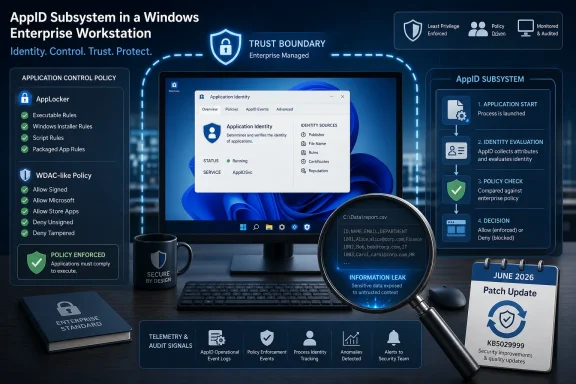 Microsoft’s Small AppID Bug Sits in a Big Trust Boundary
Application Identity, or AppID, is not a household Windows component, even among power users. It sits behind features that decide what software is allowed to run and under what trust assumptions. In enterprise environments, it is tied conceptually to the machinery around AppLocker, application control, and managed installation workflows — the quiet plumbing that helps distinguish expected software from everything else.That is why CVE-2026-45594 deserves a more careful reading than its medium severity score invites. Microsoft describes the issue as exposure of sensitive information to an unauthorized actor in the Windows Application Identity subsystem, exploitable locally by an authorized attacker. That means the attacker is not coming in cold from the internet, and the bug is not advertised as a direct path to code execution.
But local information disclosure vulnerabilities are often not the opening move. They are the second or third move, the bit of visibility that helps an attacker understand how the machine is configured, which controls are in place, or which assumptions a defender has made. In a workstation fleet built around layered security, that context can matter.
The label “authorized attacker” also needs translation. It usually means the attacker already has some ability to run code or interact with the system under a valid account. In other words, this is less about the initial phish and more about what happens after a user session, service account, or low-privilege foothold has already been obtained.
The Confidence Metric Is the Story Behind the Score
The user-supplied metric definition — confidence in the existence of the vulnerability and the credibility of known technical details — is the right lens here. CVE entries are not all equal. Some arrive with vendor confirmation, clear root-cause language, exploitation guidance, and public proof-of-concept code. Others arrive with little more than a name, an affected product, and a servicing instruction.CVE-2026-45594 sits closer to the confirmed-but-thinly-described end of that spectrum. Microsoft has acknowledged the vulnerability through its Security Update Guide and issued updates as part of the June 2026 Patch Tuesday cycle. That gives defenders high confidence that the flaw exists and that Microsoft has shipped a fix for supported affected platforms.
What is missing, at least from the public advisory material, is the kind of technical narrative that would let defenders model exact exploit behavior. There is no public walkthrough of the vulnerable code path, no obvious exploitation recipe, and no Microsoft statement indicating active exploitation in the wild. That limits the confidence defenders can place in any highly specific claim about how an attacker would weaponize the bug.
This distinction matters because vulnerability management tools often flatten uncertainty. A scanner sees a missing KB and reports exposure. A dashboard sees a CVSS score and ranks it. A patch team sees “Information Disclosure” and may defer it. The confidence metric asks a better question: how much do we actually know, and who knows it?
Information Disclosure Is Not Synonymous With Harmless
Windows administrators have been trained, partly by necessity, to prioritize remote code execution, elevation of privilege, and exploited-in-the-wild zero-days. That is rational. A remotely reachable RCE on a server role is usually more urgent than a local disclosure bug in a subsystem most users never knowingly touch.But “information disclosure” covers a wide range of outcomes. At the low end, it can mean leaking data that is interesting but not operationally decisive. At the high end, it can mean exposing secrets, memory contents, configuration state, file paths, tokens, hashes, policy metadata, or other material that makes a later attack easier.
Microsoft’s public wording for CVE-2026-45594 does not specify which kind of sensitive information is exposed. That absence should prevent overstatement, but it should not justify dismissal. In Windows security, information leaks often become useful when chained with other primitives: a local foothold, a sandbox escape, a misconfiguration, or a separate privilege escalation.
The more locked-down the environment, the more attackers value reconnaissance. If AppID-related data helps reveal application-control rules, installer trust state, policy enforcement boundaries, or service behavior, even indirectly, it could assist in bypass planning. That is not a claim that CVE-2026-45594 does all of those things; it is the reason defenders should avoid treating the category as cosmetic.
AppID’s Enterprise Role Makes the Bug More Interesting Than Its CVSS
For home users, AppID is mostly invisible. For enterprise admins, it lives near some of the most consequential decisions Windows makes about software trust. That context changes the risk conversation.Application control has become more important as attackers increasingly rely on legitimate tools, signed binaries, script hosts, and “living off the land” techniques. Defenders respond by narrowing what can execute, enforcing trust rules, and monitoring deviations. AppID and related services are part of that defensive architecture.
A vulnerability in this neighborhood does not automatically mean application control is bypassed. CVE-2026-45594 is not described as a security feature bypass, and Microsoft classifies it as information disclosure. Still, bugs in trust-adjacent components deserve attention because the data they expose may be more valuable on managed systems than on unmanaged ones.
This is the uncomfortable asymmetry of enterprise hardening. The more policy-rich a Windows deployment becomes, the more metadata exists about what the organization trusts. Attackers do not always need to break the policy first; sometimes they need to understand it.
June 2026 Patch Tuesday Was Too Large for Single-CVE Thinking
CVE-2026-45594 arrived during a large June 2026 Patch Tuesday release that also included publicly disclosed zero-days and a broad spread of Windows, Office, Azure, browser, and server-side fixes. In that crowd, a medium-severity AppID information disclosure flaw is easy to miss. That is how many useful attacker primitives survive inside enterprise backlogs.The danger is not that every medium CVE must jump to the front of the line. The danger is that patch prioritization becomes too dependent on severity labels and too detached from asset context. A local information disclosure flaw on a kiosk machine may not matter much. The same class of flaw on a developer workstation, jump host, VDI image, domain-admin workstation, or application-control pilot ring deserves more scrutiny.
Patch Tuesday has also become a data-processing problem. Microsoft can publish hundreds of CVEs in a single cycle, while defenders must map them to real assets, maintenance windows, business risk, and compensating controls. That is exactly where confidence metrics help: they separate “we know this is fixed and vendor-confirmed” from “we know little about exploitability beyond the category.”
For CVE-2026-45594, the practical result is straightforward. Treat the vulnerability as confirmed, patch through the June cumulative updates for supported Windows versions, and avoid inventing exploit details that Microsoft has not published. The uncertainty is not whether administrators should patch; it is how urgently this particular item should displace more exposed vulnerabilities.
Local Attack Requirements Lower the Heat, Not the Obligation
The local attack requirement is meaningful. A vulnerability that requires prior local access usually cannot be sprayed across the internet in the same way as a network-facing RCE. That lowers immediate mass-exploitation risk and gives administrators more room to stage updates responsibly.But local vulnerabilities are the bread and butter of post-compromise tradecraft. Once an attacker has a foothold, the question becomes what they can learn, where they can move, and how quietly they can do it. Local information disclosure bugs can be useful in that phase, especially if they reduce guesswork.
This is why the “authorized attacker” phrasing should not comfort administrators too much. Modern intrusions frequently begin with some form of authorization: stolen credentials, malicious OAuth grants, compromised VPN sessions, abused helpdesk workflows, or commodity malware running under a real user account. The fact that a bug is post-authentication does not make it irrelevant; it places it later in the kill chain.
The right operational posture is neither alarmist nor complacent. CVE-2026-45594 should not trigger emergency weekend maintenance on its own unless it intersects with particularly sensitive assets. It should, however, be included in the normal June security update deployment rather than postponed indefinitely because the word “disclosure” sounds mild.
The Missing Exploit Details Cut Both Ways
Microsoft’s limited public technical detail is normal for many Windows CVEs. Vendors often avoid publishing exploit-enabling specifics before customers have had time to patch. That restraint protects defenders, but it also forces them to work with incomplete information.For CVE-2026-45594, the lack of public exploit detail means there is no responsible basis for claiming an easy weaponization path. No public advisory language indicates active exploitation. No public proof-of-concept appears to have become the center of the story. That should keep risk statements disciplined.
At the same time, attackers can reverse patches. Once updates ship, adversaries can compare changed binaries, inspect code paths, and infer the vulnerable condition. The public may not have technical details on day one, but sufficiently capable actors can sometimes derive them after the fix is available.
That is the paradox of monthly patching. The patch reduces risk for systems that receive it, while simultaneously giving researchers and attackers a diff to study. Administrators who delay updates for weeks or months are not merely waiting in a static threat environment; they are waiting while the vulnerability becomes easier to understand.
Vulnerability Management Needs More Than a CVSS Sort
CVE-2026-45594 carries a medium score in third-party vulnerability listings and an Important severity label from Microsoft. Those are useful inputs, but they are not a decision. The decision depends on where AppID matters in your estate.A consumer laptop and a domain-joined workstation running strict application-control policy do not have the same risk profile. A lab VM and a privileged admin workstation do not have the same blast radius. A server role that rarely sees interactive logons and a shared engineering machine with local build tools do not expose the same attack surface.
Good vulnerability management is increasingly about asset-specific interpretation. The same CVE may be routine for one population and urgent for another. CVE-2026-45594 is exactly the kind of issue that should be routed through that lens rather than blindly accepted as “medium equals later.”
This is also where endpoint telemetry matters. If an organization has suspicious local activity, recent credential theft, application-control bypass attempts, or unusual AppID-related service behavior, a local disclosure flaw becomes more interesting. Vulnerability severity is static; environmental risk is not.
The AppID Pairing With Managed Installer Should Make Admins Look Twice
June’s update set also included another AppID-adjacent issue: a Windows Managed Installer information disclosure vulnerability. That does not prove a shared root cause, and it would be irresponsible to suggest a direct relationship without Microsoft saying so. But the pairing is notable because Managed Installer sits in the same broad trust ecosystem.Managed Installer is important in Windows Defender Application Control deployments because it can help mark software installed by trusted deployment systems. That trust signal can become part of how Windows decides whether software is allowed to run. Any vulnerability touching that neighborhood naturally draws the attention of administrators who rely on application control as a compensating control against malware and unauthorized tooling.
The key is not to overclaim. CVE-2026-45594 is not advertised as a WDAC bypass, and the public record does not say it reveals WDAC policy secrets. Still, when multiple information disclosure issues appear around AppID and managed installation in the same release cycle, enterprise defenders should test updates carefully and review whether their application-control assumptions depend on components that just received security fixes.
Security architecture is not only about blocking execution. It is also about preserving the confidentiality and integrity of the signals used to make execution decisions. If those signals leak, attackers gain a map.
Home Users Should Patch; Enterprises Should Segment the Rollout
For most home users, the recommendation is simple: install the June 2026 Windows security updates through Windows Update. CVE-2026-45594 is not a reason to panic, and there is no public indication that criminals are actively exploiting it at scale. But the fix is part of the cumulative update stream, so skipping it generally means skipping a much larger security payload.For small businesses, the calculus is similar but the stakes are higher. Shared desktops, local administrator habits, remote access tools, and inconsistent patching can turn local vulnerabilities into practical problems. If a machine is already exposed through weak credentials or remote-control software, local post-compromise bugs matter more.
Enterprises should handle the update through normal rings: pilot, validation, broad deployment, and exception management. The difference is that AppID-heavy environments should include application-control testing in the validation ring. If you rely on AppLocker, WDAC, Managed Installer, or software deployment trust rules, make sure the cumulative update does not break the workflows that keep users productive.
The patching goal is not merely to remove the CVE from a scanner report. It is to preserve trust in the enforcement layer without causing administrators to disable that layer because an update surprised them.
Microsoft’s Advisory Minimalism Leaves Defenders Doing the Translation
Microsoft’s Security Update Guide has become the canonical source for Windows CVEs, but it is often terse. That terseness is understandable at Microsoft’s scale. The company is publishing for consumers, enterprises, researchers, governments, and attackers simultaneously.Still, terse advisories shift interpretive labor onto defenders. “Exposure of sensitive information” is a broad phrase. “Authorized attacker” is precise in CVSS terms but easy to underweight in real-world intrusion scenarios. “Important” is useful but not enough to decide maintenance order across thousands of assets.
This is where community analysis matters. Windows administrators need translation from vendor fields into operational meaning: where the component lives, who can reach it, what adjacent controls might depend on it, and how the vulnerability might fit into a chain. The answer is rarely “drop everything,” but it is also rarely “ignore it because it is not critical.”
CVE-2026-45594 is a good example of the middle category that fills patch backlogs. It is confirmed enough to patch, underspecified enough to avoid sensationalism, and context-dependent enough to punish lazy prioritization.
The Patch Is Routine; the Lesson Is Not
The most concrete action is boring, which is usually a good sign. Apply the June 2026 cumulative security updates for affected supported Windows versions. Verify deployment success. Watch for known issues in the relevant Windows release notes. Re-test application-control and managed installer workflows where they are business-critical.The more strategic lesson is that information disclosure bugs in trust infrastructure should get a second look. Not every leak is a breach. But in hardened Windows environments, knowledge about policy, identity, configuration, and enforcement paths can be useful to an attacker precisely because those controls are meant to stop the obvious routes.
Administrators should also resist the temptation to let public exploit availability drive every decision. By the time a proof of concept appears, the defensive window has already narrowed. Vendor-confirmed, patched vulnerabilities in security-sensitive components deserve routine but timely remediation even when exploit details are sparse.
That is particularly true for organizations that maintain gold images, VDI pools, privileged access workstations, and developer endpoints. These systems are often where local post-compromise flaws offer the greatest leverage.
The June AppID Fix Belongs in the “Do Not Let This Linger” Pile
CVE-2026-45594 is not the loudest Microsoft vulnerability of June 2026, but it is concrete enough to act on and close enough to Windows trust machinery to deserve attention. The right response is disciplined remediation, not drama.- Microsoft disclosed CVE-2026-45594 on June 9, 2026, as an Important Windows Application Identity information disclosure vulnerability.
- The flaw requires an authorized local attacker, which lowers internet-scale risk but keeps it relevant after an initial compromise.
- Public technical details are limited, so defenders should avoid assuming a specific exploit path while still treating the vendor-confirmed issue as real.
- Environments using AppLocker, Windows Defender Application Control, Managed Installer, or strict software deployment controls should prioritize validation on representative systems.
- Home users and small businesses should install the June 2026 cumulative updates through normal Windows Update channels rather than trying to handle this CVE separately.
- Vulnerability teams should rank the issue by asset context, especially on privileged workstations, developer machines, jump hosts, and managed endpoints where application-control metadata may matter.
References
- Primary source: MSRC
Published: 2026-06-09T07:00:00-07:00
Security Update Guide - Microsoft Security Response Center
 msrc.microsoft.com
- Related coverage: sentinelone.com
CVE-2026-31594: Linux Kernel PCI Endpoint Vulnerability
CVE-2026-31594 is a resource teardown vulnerability in Linux Kernel's PCI endpoint. Learn about its impact, affected versions, and mitigation methods.www.sentinelone.com
- Related coverage: rapid7.com
Rapid7 Vulnerability Database
Rapid7's VulnDB is curated repository of vetted computer software exploits and exploitable vulnerabilities.www.rapid7.com - Official source: microsoft.com
MSRC - Microsoft Security Response Center
The Microsoft Security Response Center is part of the defender community and on the front line of security response evolution. For over twenty years, we have been engaged with security researchers working to protect customers and the broader ecosystem.www.microsoft.com
- Related coverage: bleepingcomputer.com
- Related coverage: thehackerwire.com
CVE-2026-34343 - High Vulnerability - TheHackerWire
TheHackerWire - Your daily source for cybersecurity news, CVE alerts, hacking tutorials, and security tool reviews. Stay ahead of cyber threats.www.thehackerwire.com
- Related coverage: datacomm.com
- Related coverage: cert.gov.vu
Advisory 117 CVE 2026 20805 Microsoft Windows Information Disclosure Vulnerability
PDF documentcert.gov.vu
- Related coverage: stack.watch
- Related coverage: elevenforum.com
Microsoft June / July 2026 Security Updates | Windows 11 Forum
June 2026 Security Updates This release consists of the following 206 Microsoft CVEs: Tag CVE Base Score CVSS Vector Exploitability FAQs? Workarounds...www.elevenforum.com - Related coverage: service.securitm.ru
CWE-552 - CWE уязвимости - SECURITM
Files or Directories Accessible to External Partiesservice.securitm.ru
- Related coverage: studylib.net
Deep Security 20 On-Premises Installation Guide
Deep Security 20 guide for on-premises installations. Includes release notes, updates, and component details. IT security guide.studylib.net - Related coverage: first.org
The National Vulnerability Database Ms. Tanya Brewer NVD Program Manager June 2024
PDF documentwww.first.org
- Related coverage: helpcenter.threatq.com