

Microsoft disclosed CVE-2026-45634 on June 9, 2026, as an Important-rated Windows DHCP Client information disclosure vulnerability affecting supported Windows client and server releases, with official fixes issued through the June security updates and no public disclosure or exploitation reported at publication. The bug is not a headline-grabbing remote-code-execution emergency, and that is exactly why it deserves attention. It sits in one of Windows’ most ordinary networking paths, the machinery that quietly gets machines onto networks before users and administrators think about anything higher up the stack. Microsoft’s own scoring says the exploit is local, low-complexity, authenticated, and unlikely for now — but the confirmed out-of-bounds read is a reminder that “Important” Windows plumbing flaws can still become useful parts of an attacker’s chain.
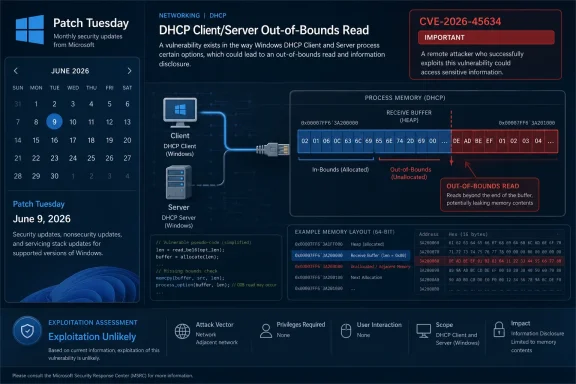
CVE-2026-45634 is classified as an information disclosure vulnerability tied to an out-of-bounds read. In plain English, that means Windows may read data beyond the intended boundary of a memory buffer and expose a limited amount of information from the affected system’s memory. Microsoft says the scope of disclosed data is restricted and is not expected to reveal large volumes of sensitive information.
That limitation matters. This is not a DHCP-flavored repeat of the great Windows network worms of old, and Microsoft’s vector string does not describe a network-reachable unauthenticated path. The advisory gives it a CVSS 3.1 base score of 5.5, with local attack vector, low attack complexity, low privileges required, no user interaction, high confidentiality impact, and no integrity or availability impact.
The oddity is in the naming. The title says Windows DHCP Client, while Microsoft’s executive summary describes an out-of-bounds read in Windows DHCP Server. The affected product table spans both Windows client releases and Windows Server editions, which makes the practical point clearer than the label: the vulnerable code path is part of Windows’ DHCP-related stack, and administrators should treat the June updates as the authoritative remediation rather than trying to infer exposure from the product name alone.
The exploitability assessment is also restrained. Microsoft marks the vulnerability as not publicly disclosed, not exploited, and “Exploitation Unlikely” at the time of original publication. That is not the same as “ignore it.” It is Microsoft telling defenders that the patch is available before the public playbook is.
That requirement sharply changes the risk model. A vulnerability that requires low privileges is less useful for initial compromise than a remote unauthenticated flaw, but it can still matter after phishing, stolen credentials, malware execution, exposed RDP, or a compromised helpdesk account. Modern intrusions are rarely a single exploit from outside to domain admin; they are chains, and information disclosure bugs often live in the middle of those chains.
The advisory’s confidentiality rating is high, even though Microsoft’s FAQ says only a limited amount of memory may be read. Those two statements are not necessarily contradictory. CVSS measures the potential security impact of the type of exposure, while vendor prose often frames expected practical leakage. In real environments, a small memory disclosure may be trivial — or it may expose a token, pointer, configuration value, heap layout clue, or other artifact that makes the next step easier.
That is why information disclosure bugs can be underrated by patch calendars that chase only remote code execution and elevation of privilege. They often do not break in loudly. They assist quietly, turning a fragile exploit into a reliable one or giving an attacker a glimpse of data that Windows was not meant to disclose.
Report confidence is easy to overlook because it sounds bureaucratic. In practice, it is a signal about uncertainty. A confirmed vulnerability gives defenders a stronger basis to prioritize remediation than a loosely described report circulating through third-party databases or social media.
It also tells attackers something. The same field that reassures defenders also confirms that the affected code exists and that the defect is real. Microsoft’s “Exploitation Unlikely” rating softens that risk, but the technical breadcrumbs — out-of-bounds read, DHCP-related Windows component, local authenticated path, high confidentiality impact — are enough to attract reverse engineers once patches are available.
That is the uncomfortable symmetry of Patch Tuesday. The act of fixing a bug also publishes a map of what changed. Organizations that patch quickly benefit from the vendor’s timing; organizations that delay become the test population for anyone comparing pre- and post-update binaries.
That ubiquity is why DHCP-related defects deserve more respect than their branding usually receives. A flaw in a niche optional feature may have narrow exposure. A flaw in basic network plumbing may touch an enormous number of machines, even if exploitation requires a specific local condition.
For administrators, the affected product list is broad enough to remove any temptation to treat this as a single-version corner case. Microsoft lists fixes across modern Windows 11 and Windows 10 releases, Windows Server 2016 through Windows Server 2025, Server Core installations, and older extended-support server platforms such as Windows Server 2012 and 2012 R2. The fix path is the ordinary monthly security update path, which is good news for operations teams and bad news for anyone hoping to solve this with a clever checkbox.
The presence of Server Core entries is worth noting. Server Core is often deployed precisely because it reduces GUI attack surface and operational clutter. But it is still Windows, still networked, and still dependent on the same security update discipline as full desktop experience installations.
That long tail is not automatically negligent. Enterprises do not replace domain controllers, line-of-business application servers, manufacturing systems, or remote-site infrastructure simply because a new Windows logo exists. But the longer the estate, the more patch management becomes archaeology: which release is supported, which servicing channel applies, which KB is relevant, which system is isolated, and which “temporary exception” has become permanent infrastructure.
The affected update rows show exactly that sprawl. Windows 10 21H2 and 22H2, Windows 11 23H2, 24H2, 25H2, and 26H1, Windows Server 2019, 2022, and 2025, and legacy server releases all receive their respective fixes. The vulnerability may be singular, but remediation is not; it becomes a fleet-management exercise.
For home users, the answer is simpler: install the June cumulative update when it is offered. For IT pros, the answer is to make sure update compliance reporting covers the systems that are easiest to forget — Server Core boxes, branch-office servers, golden images, offline VMs, and old Windows 10 builds kept alive for one stubborn application.
But “unlikely” is a temporal claim, not a permanent property. It describes Microsoft’s assessment at the time of original publication, before broad reverse engineering of the patch and before attackers have had time to test whether the bug can be turned into a dependable primitive. A local authenticated information disclosure flaw is not a fire alarm, but it is still combustible material.
The lack of public disclosure and known exploitation lowers immediate pressure. The official fix lowers it further. The confirmed nature of the bug raises confidence that the patch addresses a real defect. Taken together, the right response is measured urgency: deploy through normal security update channels, verify coverage, and resist both panic and procrastination.
Security teams should also be wary of vulnerability databases that inflate every CVE into a crisis. The technical facts here do not support emergency internet-wide scanning or dramatic claims of unauthenticated compromise. They support disciplined patching and a sober understanding that Windows memory-safety bugs continue to appear in old, essential subsystems.
That is especially true for servers with maintenance windows measured in quarters, not weeks. DHCP-related vulnerability or not, the affected systems include platforms that often sit behind change-control gates: domain services, application servers, file servers, jump boxes, and management infrastructure. The more critical the server, the more likely it is to have a patch exception — and the more valuable it becomes after an attacker has a foothold.
For endpoint fleets, the issue folds into the larger Windows servicing conversation. Windows 10 systems that remain in scope need current cumulative updates. Windows 11 versions need their corresponding builds. ARM64 devices should not be overlooked, particularly in executive, developer, and remote-work populations where hardware diversity has grown.
The build numbers Microsoft publishes are useful because they give defenders something concrete to validate. A vulnerability scanner may say “fixed,” but a build inventory can prove whether the expected patched baseline is actually present. In 2026, that kind of mundane verification is still one of the strongest controls most organizations have.
What makes it interesting is where it appears. DHCP is not a shiny AI feature, a new Copilot surface, or an optional Store app. It is part of the plumbing that underpins how Windows participates in networks. Vulnerabilities in such areas are reminders that the attack surface of an operating system is not only what users click; it is also what the OS must do automatically to function.
Microsoft has spent years hardening Windows, adding exploit mitigations, sandboxing, virtualization-based security, kernel protections, and more aggressive update mechanics. Those investments matter. But memory-safety bugs in foundational components keep appearing because legacy code, protocol handling, parsing logic, and compatibility requirements remain hard to eliminate.
The forward-looking question is not whether Microsoft can patch individual bugs like this. It can, and it has. The larger question is how quickly Windows’ core components can move away from classes of defects that modern memory-safe languages and stricter engineering patterns are designed to prevent.
The credited acknowledgement of Brandon Fisher and Microsoft also suggests coordinated handling rather than a chaotic public drop. Coordinated disclosure is not glamorous, but it is one of the reasons defenders sometimes get a head start. When it works, the first public artifact is the patch, not the exploit.
Still, the head start has a shelf life. Patch diffing is routine. Security researchers and adversaries alike can compare updated Windows components with prior builds, identify changed code paths, and infer the shape of the vulnerability. The harder a bug is to exploit, the longer defenders may have; but that window is not a strategy by itself.
For most organizations, the right response is to put CVE-2026-45634 into the June Windows update wave, not a special crisis lane. But it should stay visible enough that deferred Windows systems are not allowed to disappear from the compliance report.
 Microsoft’s Quiet DHCP Bug Is a Memory Leak, Not a Worm
CVE-2026-45634 is classified as an information disclosure vulnerability tied to an out-of-bounds read. In plain English, that means Windows may read data beyond the intended boundary of a memory buffer and expose a limited amount of information from the affected system’s memory. Microsoft says the scope of disclosed data is restricted and is not expected to reveal large volumes of sensitive information.That limitation matters. This is not a DHCP-flavored repeat of the great Windows network worms of old, and Microsoft’s vector string does not describe a network-reachable unauthenticated path. The advisory gives it a CVSS 3.1 base score of 5.5, with local attack vector, low attack complexity, low privileges required, no user interaction, high confidentiality impact, and no integrity or availability impact.
The oddity is in the naming. The title says Windows DHCP Client, while Microsoft’s executive summary describes an out-of-bounds read in Windows DHCP Server. The affected product table spans both Windows client releases and Windows Server editions, which makes the practical point clearer than the label: the vulnerable code path is part of Windows’ DHCP-related stack, and administrators should treat the June updates as the authoritative remediation rather than trying to infer exposure from the product name alone.
The exploitability assessment is also restrained. Microsoft marks the vulnerability as not publicly disclosed, not exploited, and “Exploitation Unlikely” at the time of original publication. That is not the same as “ignore it.” It is Microsoft telling defenders that the patch is available before the public playbook is.
The Score Looks Moderate Because the Attacker Is Already Inside
The most important field in this advisory is not the 5.5 score. It is Attack Vector: Local. A local attack vector means the attacker’s path is not simply “send packet from the internet and win.” The attacker needs some foothold or authenticated capability on the target system before the bug becomes useful.That requirement sharply changes the risk model. A vulnerability that requires low privileges is less useful for initial compromise than a remote unauthenticated flaw, but it can still matter after phishing, stolen credentials, malware execution, exposed RDP, or a compromised helpdesk account. Modern intrusions are rarely a single exploit from outside to domain admin; they are chains, and information disclosure bugs often live in the middle of those chains.
The advisory’s confidentiality rating is high, even though Microsoft’s FAQ says only a limited amount of memory may be read. Those two statements are not necessarily contradictory. CVSS measures the potential security impact of the type of exposure, while vendor prose often frames expected practical leakage. In real environments, a small memory disclosure may be trivial — or it may expose a token, pointer, configuration value, heap layout clue, or other artifact that makes the next step easier.
That is why information disclosure bugs can be underrated by patch calendars that chase only remote code execution and elevation of privilege. They often do not break in loudly. They assist quietly, turning a fragile exploit into a reliable one or giving an attacker a glimpse of data that Windows was not meant to disclose.
“Report Confidence: Confirmed” Is the Line That Should End the Guesswork
The user-supplied text zeroes in on the CVSS report confidence metric, and for this CVE the value is Confirmed. That matters because it separates a speculative issue from a vendor-acknowledged vulnerability. Microsoft is not saying only that something vaguely undesirable might happen; it is publishing a CVE, assigning a weakness class, scoring the issue, crediting discovery, and shipping fixes.Report confidence is easy to overlook because it sounds bureaucratic. In practice, it is a signal about uncertainty. A confirmed vulnerability gives defenders a stronger basis to prioritize remediation than a loosely described report circulating through third-party databases or social media.
It also tells attackers something. The same field that reassures defenders also confirms that the affected code exists and that the defect is real. Microsoft’s “Exploitation Unlikely” rating softens that risk, but the technical breadcrumbs — out-of-bounds read, DHCP-related Windows component, local authenticated path, high confidentiality impact — are enough to attract reverse engineers once patches are available.
That is the uncomfortable symmetry of Patch Tuesday. The act of fixing a bug also publishes a map of what changed. Organizations that patch quickly benefit from the vendor’s timing; organizations that delay become the test population for anyone comparing pre- and post-update binaries.
DHCP Is Boring Until It Becomes an Attack Surface
DHCP is one of the least glamorous parts of a Windows network. It hands out addresses, options, routes, DNS settings, and other configuration details so machines can participate in the network without manual setup. It is also present everywhere: client endpoints, servers, domain-joined systems, lab machines, kiosks, virtual desktops, and cloud-adjacent Windows workloads.That ubiquity is why DHCP-related defects deserve more respect than their branding usually receives. A flaw in a niche optional feature may have narrow exposure. A flaw in basic network plumbing may touch an enormous number of machines, even if exploitation requires a specific local condition.
For administrators, the affected product list is broad enough to remove any temptation to treat this as a single-version corner case. Microsoft lists fixes across modern Windows 11 and Windows 10 releases, Windows Server 2016 through Windows Server 2025, Server Core installations, and older extended-support server platforms such as Windows Server 2012 and 2012 R2. The fix path is the ordinary monthly security update path, which is good news for operations teams and bad news for anyone hoping to solve this with a clever checkbox.
The presence of Server Core entries is worth noting. Server Core is often deployed precisely because it reduces GUI attack surface and operational clutter. But it is still Windows, still networked, and still dependent on the same security update discipline as full desktop experience installations.
The Windows 10 and Server Tail Still Matters
CVE-2026-45634 lands at an awkward moment for Windows estates that still straddle old and new platforms. Windows 11 is now well into its multi-version cadence, Windows Server 2025 is in the field, and yet many organizations continue to run Windows 10 22H2, Windows Server 2019, Windows Server 2016, and older server builds for compatibility, licensing, application certification, or sheer inertia.That long tail is not automatically negligent. Enterprises do not replace domain controllers, line-of-business application servers, manufacturing systems, or remote-site infrastructure simply because a new Windows logo exists. But the longer the estate, the more patch management becomes archaeology: which release is supported, which servicing channel applies, which KB is relevant, which system is isolated, and which “temporary exception” has become permanent infrastructure.
The affected update rows show exactly that sprawl. Windows 10 21H2 and 22H2, Windows 11 23H2, 24H2, 25H2, and 26H1, Windows Server 2019, 2022, and 2025, and legacy server releases all receive their respective fixes. The vulnerability may be singular, but remediation is not; it becomes a fleet-management exercise.
For home users, the answer is simpler: install the June cumulative update when it is offered. For IT pros, the answer is to make sure update compliance reporting covers the systems that are easiest to forget — Server Core boxes, branch-office servers, golden images, offline VMs, and old Windows 10 builds kept alive for one stubborn application.
Exploitation Unlikely Does Not Mean Exploitation Irrelevant
Microsoft’s exploitability assessment says exploitation is unlikely. That is a useful signal, especially when security teams are triaging dozens of Patch Tuesday items at once. It means this should not automatically outrank actively exploited browser, kernel, or identity vulnerabilities.But “unlikely” is a temporal claim, not a permanent property. It describes Microsoft’s assessment at the time of original publication, before broad reverse engineering of the patch and before attackers have had time to test whether the bug can be turned into a dependable primitive. A local authenticated information disclosure flaw is not a fire alarm, but it is still combustible material.
The lack of public disclosure and known exploitation lowers immediate pressure. The official fix lowers it further. The confirmed nature of the bug raises confidence that the patch addresses a real defect. Taken together, the right response is measured urgency: deploy through normal security update channels, verify coverage, and resist both panic and procrastination.
Security teams should also be wary of vulnerability databases that inflate every CVE into a crisis. The technical facts here do not support emergency internet-wide scanning or dramatic claims of unauthenticated compromise. They support disciplined patching and a sober understanding that Windows memory-safety bugs continue to appear in old, essential subsystems.
Patch Tuesday’s Real Burden Is Operational, Not Theoretical
The practical work begins after the advisory is read. Administrators need to map the KBs to their supported Windows versions, confirm that WSUS, Windows Update for Business, Intune, Configuration Manager, or third-party patching tools are offering the expected June payloads, and watch for installation failures. The risk is not that nobody knows how to fix CVE-2026-45634; the risk is that some machines never receive the fix.That is especially true for servers with maintenance windows measured in quarters, not weeks. DHCP-related vulnerability or not, the affected systems include platforms that often sit behind change-control gates: domain services, application servers, file servers, jump boxes, and management infrastructure. The more critical the server, the more likely it is to have a patch exception — and the more valuable it becomes after an attacker has a foothold.
For endpoint fleets, the issue folds into the larger Windows servicing conversation. Windows 10 systems that remain in scope need current cumulative updates. Windows 11 versions need their corresponding builds. ARM64 devices should not be overlooked, particularly in executive, developer, and remote-work populations where hardware diversity has grown.
The build numbers Microsoft publishes are useful because they give defenders something concrete to validate. A vulnerability scanner may say “fixed,” but a build inventory can prove whether the expected patched baseline is actually present. In 2026, that kind of mundane verification is still one of the strongest controls most organizations have.
Memory-Safety Debt Keeps Showing Up in Windows Plumbing
The weakness classification for CVE-2026-45634 is CWE-125, an out-of-bounds read. This is one of the classic memory-safety failure modes: software reads beyond the bounds of a buffer and exposes data it should not touch. It is not new, not exotic, and not limited to Windows.What makes it interesting is where it appears. DHCP is not a shiny AI feature, a new Copilot surface, or an optional Store app. It is part of the plumbing that underpins how Windows participates in networks. Vulnerabilities in such areas are reminders that the attack surface of an operating system is not only what users click; it is also what the OS must do automatically to function.
Microsoft has spent years hardening Windows, adding exploit mitigations, sandboxing, virtualization-based security, kernel protections, and more aggressive update mechanics. Those investments matter. But memory-safety bugs in foundational components keep appearing because legacy code, protocol handling, parsing logic, and compatibility requirements remain hard to eliminate.
The forward-looking question is not whether Microsoft can patch individual bugs like this. It can, and it has. The larger question is how quickly Windows’ core components can move away from classes of defects that modern memory-safe languages and stricter engineering patterns are designed to prevent.
The Defender’s Advantage Is That the Patch Arrived Before the Proof-of-Concept
There is an advantage here, and it should not be wasted. Microsoft published the advisory with no known exploitation, no public disclosure, and an official fix available. That is the best version of vulnerability management: defenders get time before exploit code or reliable abuse patterns become common knowledge.The credited acknowledgement of Brandon Fisher and Microsoft also suggests coordinated handling rather than a chaotic public drop. Coordinated disclosure is not glamorous, but it is one of the reasons defenders sometimes get a head start. When it works, the first public artifact is the patch, not the exploit.
Still, the head start has a shelf life. Patch diffing is routine. Security researchers and adversaries alike can compare updated Windows components with prior builds, identify changed code paths, and infer the shape of the vulnerability. The harder a bug is to exploit, the longer defenders may have; but that window is not a strategy by itself.
For most organizations, the right response is to put CVE-2026-45634 into the June Windows update wave, not a special crisis lane. But it should stay visible enough that deferred Windows systems are not allowed to disappear from the compliance report.
The June Fix Is Mundane, Which Is Why It Has to Be Verified
The lesson of CVE-2026-45634 is not that DHCP suddenly became terrifying. It is that a confirmed Windows memory disclosure bug with a local attack path can still matter in real intrusions, especially when patching gaps create avoidable exposure. The fix is routine; the discipline is not.- Microsoft released CVE-2026-45634 on June 9, 2026, as an Important information disclosure vulnerability in Windows DHCP-related code.
- The vulnerability is an out-of-bounds read with a CVSS 3.1 base score of 5.5 and a temporal score of 4.8.
- Exploitation requires low privileges and local access, does not require user interaction, and affects confidentiality rather than integrity or availability.
- Microsoft says the issue was not publicly disclosed or exploited at publication and assesses exploitation as unlikely.
- The affected product list spans Windows 10, Windows 11, Windows Server releases, Server Core installations, and older supported server platforms, so update compliance needs to be checked across the whole fleet.
- Successful exploitation is expected to disclose only a limited amount of system memory, but even small information leaks can be useful in chained attacks.
References
- Primary source: MSRC
Published: 2026-06-09T07:00:00-07:00
Security Update Guide - Microsoft Security Response Center
 msrc.microsoft.com
