

Microsoft’s CVE-2026-45642 is a spoofing vulnerability disclosed for Microsoft Azure Attestation service and Device Health Attestation Service in the June 2026 Security Update Guide, affecting the trust signals Windows and Azure environments use to prove device or platform health. The flaw is not just another cloud CVE in a long Patch Tuesday ledger. It lands in the machinery that tells higher-level systems, “yes, this device, VM, enclave, or boot chain is what it claims to be.”
That makes the most important word in the advisory not spoofing, but attestation. Microsoft has spent years pushing Windows, Azure, Intune, Defender for Cloud, confidential computing, and TPM-backed device compliance toward a model where machines prove their state rather than merely assert it. A vulnerability in that proof layer deserves a different kind of reading: less panic over imaginary exploit chains, more scrutiny of how much organizational trust now depends on opaque cloud verifiers.
Azure Attestation exists to do a deceptively simple job: receive evidence from a platform, validate that evidence against policy, and produce signed claims that another system can trust. In practice, that makes it a broker between hardware roots of trust and software decisions. A confidential VM may need attestation before secrets are released. A TPM-backed Windows device may need health claims before compliance policy treats it as trustworthy. A security system may use those claims to distinguish a clean boot chain from something more suspicious.
Device Health Attestation plays a related role on the Windows side. It gives management systems a way to evaluate security-relevant boot and device state, historically tied to features such as Secure Boot, BitLocker, code integrity, and TPM-backed measurements. For administrators, the value is not academic: if an endpoint can cryptographically report that it booted in an expected configuration, policy engines can make better decisions than they could by trusting a local registry value or a user-mode agent.
That is why a spoofing vulnerability here is uncomfortable. Spoofing is often treated as the soft cousin of remote code execution — less theatrical, less immediately catastrophic, and easier to bury in a monthly update table. But spoofing in an attestation service attacks meaning itself. It risks making a relying party believe a security claim that should not have been believed.
Microsoft’s own framing matters. The issue is in Microsoft services, not a traditional Windows component that an admin patches with an MSI, reboots, and closes a ticket. Cloud-service CVEs often mean Microsoft has remediated the affected backend or service path, with customer action either limited or indirect. That does not make the bug irrelevant to customers; it means customers must understand whether their security architecture assumes the service always tells the truth.
That does not mean every technical detail is public. In fact, cloud and identity-adjacent vulnerabilities often arrive with deliberately sparse descriptions. Vendors have strong reasons not to publish a working exploit recipe, especially when the vulnerable path involves authentication, token issuance, attestation claims, or service-to-service trust. The tradeoff is familiar: defenders get confirmation and a product boundary, but not always the root cause, exploit primitives, or concrete detection logic they would prefer.
This is where report confidence differs from exploitability. A vulnerability can be highly credible without being easy to exploit. It can be fully acknowledged without being publicly weaponized. It can be fixed in Microsoft’s service fabric while still requiring customers to review logs, conditional access assumptions, compliance policies, and any compensating controls that depended on the affected trust path.
For IT teams, the practical reading is this: the vulnerability’s existence should be treated as confirmed, while the attack mechanics should be treated as constrained by public uncertainty. That is not a contradiction. It is the normal operating condition of modern cloud security advisories.
The shift has been gradual enough to miss. Secure Boot became a baseline expectation. TPM 2.0 became a Windows 11 requirement. BitLocker recovery and device encryption became routine operational concerns. Intune compliance policies increasingly became the connective tissue between a device’s measured state and a user’s access to corporate resources. Azure confidential computing pushed similar ideas into the datacenter: workloads should not merely run in the cloud; they should be able to prove something about the environment they run in.
Azure Attestation sits at the intersection of those ideas. It supports multiple trust scenarios, including TPM-backed attestation, trusted launch for Azure VMs, confidential VMs, confidential containers, and enclave-based workloads. In those scenarios, the attestation service receives evidence, evaluates it, and issues a token or claim that other systems consume.
That means CVE-2026-45642 is not interesting because every Windows user is suddenly at risk from a browser drive-by. It is interesting because Microsoft’s platform strategy increasingly asks customers to delegate trust decisions to cloud-backed proof services. When one of those services has a spoofing vulnerability, the correct question is not “can someone own my laptop?” The correct question is “what did my environment believe because this service said it was true?”
That does not require imagining the worst possible outcome. A false health claim could be enough to undermine a policy. A misleading attestation result could influence secret release. A spoofed assertion could affect whether a workload is treated as running in a trusted environment. In security architecture, lies do not need admin rights to matter; they only need to be believed by something that makes a consequential decision.
The advisory title names both Microsoft Azure Attestation service and Device Health Attestation Service, which broadens the audience beyond confidential-computing specialists. Azure administrators should care because Azure Attestation is part of the trust story for protected workloads and trusted launch scenarios. Endpoint administrators should care because Device Health Attestation has long been part of the Windows device-compliance and health-reporting ecosystem.
This is also why severity scores, while useful, rarely tell the whole story for attestation bugs. A medium-severity spoofing flaw in a system of record can have higher architectural significance than a louder bug in a less trusted component. The vulnerability’s value to an attacker depends on what the victim connected to the attestation result.
For WindowsForum readers, the danger is complacency disguised as efficiency. “No customer action required” is not the same as “no customer impact possible.” A cloud-side mitigation can close the vulnerable door while leaving unanswered whether anyone tried it, whether downstream systems accepted questionable claims, or whether policies were too trusting in the first place.
Enterprises using Azure Attestation directly should review how attestation tokens are validated and consumed. Relying parties should verify issuer, signature, policy expectations, token freshness, and the binding between the attested evidence and the action being authorized. That is not exotic advice; it is the cloud version of not treating a signed object as meaningful unless the whole chain and context are checked.
Endpoint teams should take a parallel approach. If device health signals feed compliance state, conditional access, or security posture dashboards, admins should confirm that a single attestation signal is not carrying more weight than it should. Healthy device state is strongest when corroborated by multiple controls: management enrollment, Defender signals, configuration baselines, patch level, identity risk, and recent telemetry.
That makes the blast radius uneven. A home Windows user may never notice. A small business using basic Microsoft 365 management may have limited exposure. A regulated enterprise using compliance policies, device health checks, confidential VMs, trusted launch, and automated key release workflows has a more interesting set of questions to ask.
This unevenness is not a weakness of the advisory; it is a feature of modern platform security. The same Microsoft service can be background plumbing for one customer and a critical trust anchor for another. Security teams therefore need to map the advisory to their own dependency graph rather than treating it as a generic Patch Tuesday item.
The uncomfortable lesson is that attestation centralizes confidence. That is its entire purpose. But when confidence is centralized, any spoofing flaw in the confidence broker deserves scrutiny out of proportion to the number of public exploit details.
But the promise only works if customers can trust not just the cryptography, but the implementation, lifecycle, and disclosure model around the services that operationalize it. A signed attestation token is only as valuable as the policy that produced it, the evidence it represents, the service that issued it, and the verifier that consumes it. Break any one of those links and the elegant theory becomes another brittle integration.
Microsoft deserves credit for assigning and publishing CVEs for cloud-service issues that might previously have disappeared into silent backend fixes. That visibility helps defenders inventory risk, pressure vendors for clarity, and treat cloud platforms as software with vulnerabilities rather than magic infrastructure. At the same time, sparse advisories leave customers doing interpretive labor that would be unnecessary if service dependencies and customer impact were more explicit.
This is the central tension in Microsoft’s cloud security posture. The company can patch faster than almost anyone, but customers still need enough information to reason about trust. In attestation, reasoning about trust is the product.
The endpoint side deserves the same treatment. If Device Health Attestation contributes to compliance status, admins should review whether policy outcomes depend too heavily on a single health claim. A mature conditional access posture should not collapse because one signal is wrong. It should degrade, corroborate, and challenge.
This is especially important in environments where compliance equals access. Many organizations now use device compliance as a condition for email, file access, SaaS login, VPN replacement, or privileged administrative workflows. If device health attestation is part of that decision path, it becomes a security boundary in practice, even if product documentation avoids calling it one.
Security teams should also avoid inventing certainty where Microsoft has not provided it. Without public technical details, defenders should not assume a specific token-forgery primitive, tenant-boundary bypass, replay condition, or policy-evaluation flaw. They should instead work from the confirmed boundary: a spoofing vulnerability affected Microsoft Azure Attestation service and Device Health Attestation Service, and systems relying on those services should be reviewed accordingly.
But anchors are not invulnerable. TPMs can have firmware issues. Secure Boot can be misconfigured. Measurement chains can be misunderstood. Cloud services that evaluate evidence can have implementation flaws. Management platforms can over-trust a green compliance check. The existence of CVE-2026-45642 is a reminder that “hardware-backed” does not mean “risk-free”; it means the failure modes move into different layers.
For Windows enthusiasts, this is also a reminder to be careful with security theater. A device can show reassuring UI, pass a basic checklist, and still depend on remote services and policies the user never sees. The modern Windows security stack is no longer a single machine defending itself. It is a distributed system involving firmware, TPMs, cloud verifiers, identity providers, management agents, and policy engines.
Distributed systems fail in distributed ways. A spoofing flaw in an attestation service is exactly the sort of issue that does not fit old mental models of patching a DLL and moving on.
Security teams should ask whether attestation is used directly by application code, indirectly through Azure services, or operationally through management and compliance tooling. They should also ask who owns those decisions. In many companies, endpoint engineering owns device compliance, cloud platform teams own confidential computing, security operations owns Defender alerts, and application teams own token validation. A vulnerability like this cuts across all four.
The best organizations will treat the advisory as a tabletop prompt. If an attestation service produced a false positive health claim, what would grant access? If a confidential workload attestation were misleading, what secrets could be released? If a device-health signal were spoofed, what compensating telemetry would catch the mismatch? These are not dramatic breach assumptions. They are basic design questions for any architecture that relies on claims.
The irony is that attestation exists to reduce blind trust. CVE-2026-45642 shows how easily organizations can reintroduce blind trust one layer up, by assuming the attestation pipeline itself does not need routine review.
That makes the most important word in the advisory not spoofing, but attestation. Microsoft has spent years pushing Windows, Azure, Intune, Defender for Cloud, confidential computing, and TPM-backed device compliance toward a model where machines prove their state rather than merely assert it. A vulnerability in that proof layer deserves a different kind of reading: less panic over imaginary exploit chains, more scrutiny of how much organizational trust now depends on opaque cloud verifiers.
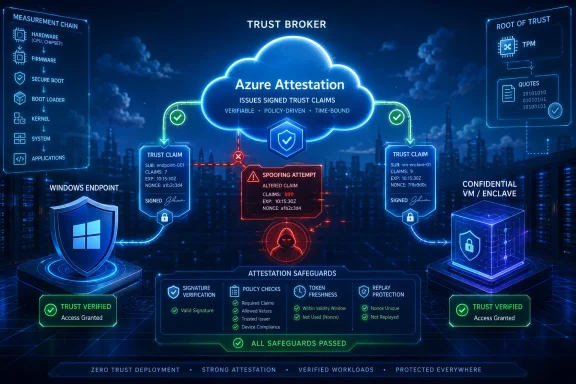 Microsoft’s Trust Broker Gets Its Own Trust Problem
Azure Attestation exists to do a deceptively simple job: receive evidence from a platform, validate that evidence against policy, and produce signed claims that another system can trust. In practice, that makes it a broker between hardware roots of trust and software decisions. A confidential VM may need attestation before secrets are released. A TPM-backed Windows device may need health claims before compliance policy treats it as trustworthy. A security system may use those claims to distinguish a clean boot chain from something more suspicious.Device Health Attestation plays a related role on the Windows side. It gives management systems a way to evaluate security-relevant boot and device state, historically tied to features such as Secure Boot, BitLocker, code integrity, and TPM-backed measurements. For administrators, the value is not academic: if an endpoint can cryptographically report that it booted in an expected configuration, policy engines can make better decisions than they could by trusting a local registry value or a user-mode agent.
That is why a spoofing vulnerability here is uncomfortable. Spoofing is often treated as the soft cousin of remote code execution — less theatrical, less immediately catastrophic, and easier to bury in a monthly update table. But spoofing in an attestation service attacks meaning itself. It risks making a relying party believe a security claim that should not have been believed.
Microsoft’s own framing matters. The issue is in Microsoft services, not a traditional Windows component that an admin patches with an MSI, reboots, and closes a ticket. Cloud-service CVEs often mean Microsoft has remediated the affected backend or service path, with customer action either limited or indirect. That does not make the bug irrelevant to customers; it means customers must understand whether their security architecture assumes the service always tells the truth.
Report Confidence Is the Quiet Metric That Changes the Room
The user-provided description of the report-confidence metric gets at a subtle but important point: not every CVE carries the same evidentiary weight. Some vulnerabilities are whispered into existence by third-party research, some are inferred from vague vendor language, and some are confirmed by the vendor that owns the affected technology. CVE-2026-45642 falls into the category that deserves operational attention because it is published through Microsoft’s own Security Update Guide for Microsoft services.That does not mean every technical detail is public. In fact, cloud and identity-adjacent vulnerabilities often arrive with deliberately sparse descriptions. Vendors have strong reasons not to publish a working exploit recipe, especially when the vulnerable path involves authentication, token issuance, attestation claims, or service-to-service trust. The tradeoff is familiar: defenders get confirmation and a product boundary, but not always the root cause, exploit primitives, or concrete detection logic they would prefer.
This is where report confidence differs from exploitability. A vulnerability can be highly credible without being easy to exploit. It can be fully acknowledged without being publicly weaponized. It can be fixed in Microsoft’s service fabric while still requiring customers to review logs, conditional access assumptions, compliance policies, and any compensating controls that depended on the affected trust path.
For IT teams, the practical reading is this: the vulnerability’s existence should be treated as confirmed, while the attack mechanics should be treated as constrained by public uncertainty. That is not a contradiction. It is the normal operating condition of modern cloud security advisories.
Attestation Has Moved From Niche Crypto to Everyday Administration
A decade ago, remote attestation was easy to dismiss as a specialist topic for researchers, high-assurance environments, and people who enjoy reading TPM specifications over coffee. That era is over. Windows 11’s hardware security posture, enterprise compliance tooling, Azure confidential computing, and cloud-managed endpoint fleets have dragged attestation into the mainstream admin workflow.The shift has been gradual enough to miss. Secure Boot became a baseline expectation. TPM 2.0 became a Windows 11 requirement. BitLocker recovery and device encryption became routine operational concerns. Intune compliance policies increasingly became the connective tissue between a device’s measured state and a user’s access to corporate resources. Azure confidential computing pushed similar ideas into the datacenter: workloads should not merely run in the cloud; they should be able to prove something about the environment they run in.
Azure Attestation sits at the intersection of those ideas. It supports multiple trust scenarios, including TPM-backed attestation, trusted launch for Azure VMs, confidential VMs, confidential containers, and enclave-based workloads. In those scenarios, the attestation service receives evidence, evaluates it, and issues a token or claim that other systems consume.
That means CVE-2026-45642 is not interesting because every Windows user is suddenly at risk from a browser drive-by. It is interesting because Microsoft’s platform strategy increasingly asks customers to delegate trust decisions to cloud-backed proof services. When one of those services has a spoofing vulnerability, the correct question is not “can someone own my laptop?” The correct question is “what did my environment believe because this service said it was true?”
Spoofing Is Dangerous When the Lie Becomes a Security Decision
The term spoofing can sound annoyingly vague. In Microsoft advisories, it can cover everything from user-interface deception to token or identity misrepresentation. In the context of attestation, however, the plausible concern is that an attacker could cause a relying component to accept a claim, status, or identity assertion that does not faithfully represent the underlying platform state.That does not require imagining the worst possible outcome. A false health claim could be enough to undermine a policy. A misleading attestation result could influence secret release. A spoofed assertion could affect whether a workload is treated as running in a trusted environment. In security architecture, lies do not need admin rights to matter; they only need to be believed by something that makes a consequential decision.
The advisory title names both Microsoft Azure Attestation service and Device Health Attestation Service, which broadens the audience beyond confidential-computing specialists. Azure administrators should care because Azure Attestation is part of the trust story for protected workloads and trusted launch scenarios. Endpoint administrators should care because Device Health Attestation has long been part of the Windows device-compliance and health-reporting ecosystem.
This is also why severity scores, while useful, rarely tell the whole story for attestation bugs. A medium-severity spoofing flaw in a system of record can have higher architectural significance than a louder bug in a less trusted component. The vulnerability’s value to an attacker depends on what the victim connected to the attestation result.
Cloud Fixes Still Leave Enterprise Work Behind
If Microsoft remediates the vulnerable service path centrally, many customers will not have a patch to deploy in the traditional sense. That is one of the benefits of cloud services: the vendor can fix a backend faster than enterprises can test and deploy client updates across a global fleet. It is also one of the frustrations: customers may not see the exact change, may not know whether their tenant was exposed to suspicious activity, and may not receive enough detail to write precise detections.For WindowsForum readers, the danger is complacency disguised as efficiency. “No customer action required” is not the same as “no customer impact possible.” A cloud-side mitigation can close the vulnerable door while leaving unanswered whether anyone tried it, whether downstream systems accepted questionable claims, or whether policies were too trusting in the first place.
Enterprises using Azure Attestation directly should review how attestation tokens are validated and consumed. Relying parties should verify issuer, signature, policy expectations, token freshness, and the binding between the attested evidence and the action being authorized. That is not exotic advice; it is the cloud version of not treating a signed object as meaningful unless the whole chain and context are checked.
Endpoint teams should take a parallel approach. If device health signals feed compliance state, conditional access, or security posture dashboards, admins should confirm that a single attestation signal is not carrying more weight than it should. Healthy device state is strongest when corroborated by multiple controls: management enrollment, Defender signals, configuration baselines, patch level, identity risk, and recent telemetry.
The Real Blast Radius Is Architectural, Not Universal
The most misleading way to discuss CVE-2026-45642 would be to imply that every Windows 11 PC is suddenly compromised by virtue of having a TPM. The more accurate reading is narrower and more useful. The affected services matter most where organizations have built workflows that consume Microsoft attestation results as a gate for access, trust, or secret release.That makes the blast radius uneven. A home Windows user may never notice. A small business using basic Microsoft 365 management may have limited exposure. A regulated enterprise using compliance policies, device health checks, confidential VMs, trusted launch, and automated key release workflows has a more interesting set of questions to ask.
This unevenness is not a weakness of the advisory; it is a feature of modern platform security. The same Microsoft service can be background plumbing for one customer and a critical trust anchor for another. Security teams therefore need to map the advisory to their own dependency graph rather than treating it as a generic Patch Tuesday item.
The uncomfortable lesson is that attestation centralizes confidence. That is its entire purpose. But when confidence is centralized, any spoofing flaw in the confidence broker deserves scrutiny out of proportion to the number of public exploit details.
Microsoft’s Security Future Depends on Verifiable Claims
CVE-2026-45642 also arrives in the shadow of Microsoft’s broader security reset. The company has spent recent years talking up secure-by-design engineering, identity hardening, cloud security transparency, and its Secure Future Initiative. Attestation fits neatly into that story because it promises a more robust foundation than passwords, local agents, and best-effort configuration reporting.But the promise only works if customers can trust not just the cryptography, but the implementation, lifecycle, and disclosure model around the services that operationalize it. A signed attestation token is only as valuable as the policy that produced it, the evidence it represents, the service that issued it, and the verifier that consumes it. Break any one of those links and the elegant theory becomes another brittle integration.
Microsoft deserves credit for assigning and publishing CVEs for cloud-service issues that might previously have disappeared into silent backend fixes. That visibility helps defenders inventory risk, pressure vendors for clarity, and treat cloud platforms as software with vulnerabilities rather than magic infrastructure. At the same time, sparse advisories leave customers doing interpretive labor that would be unnecessary if service dependencies and customer impact were more explicit.
This is the central tension in Microsoft’s cloud security posture. The company can patch faster than almost anyone, but customers still need enough information to reason about trust. In attestation, reasoning about trust is the product.
The Admin’s Job Is to Audit Belief, Not Just Patch Code
For most organizations, the response to CVE-2026-45642 should begin with dependency mapping. Where is Azure Attestation used? Which workloads rely on it? Are confidential VM or trusted launch results feeding Defender for Cloud recommendations, key-release workflows, or internal policy engines? Are developers validating attestation tokens locally, or are they assuming that receipt of a token is enough?The endpoint side deserves the same treatment. If Device Health Attestation contributes to compliance status, admins should review whether policy outcomes depend too heavily on a single health claim. A mature conditional access posture should not collapse because one signal is wrong. It should degrade, corroborate, and challenge.
This is especially important in environments where compliance equals access. Many organizations now use device compliance as a condition for email, file access, SaaS login, VPN replacement, or privileged administrative workflows. If device health attestation is part of that decision path, it becomes a security boundary in practice, even if product documentation avoids calling it one.
Security teams should also avoid inventing certainty where Microsoft has not provided it. Without public technical details, defenders should not assume a specific token-forgery primitive, tenant-boundary bypass, replay condition, or policy-evaluation flaw. They should instead work from the confirmed boundary: a spoofing vulnerability affected Microsoft Azure Attestation service and Device Health Attestation Service, and systems relying on those services should be reviewed accordingly.
The Windows Angle Is Bigger Than This One CVE
Windows has been moving toward hardware-backed trust for years, and Windows 11 accelerated that migration by making TPM 2.0, Secure Boot-capable systems, virtualization-based security features, and modern silicon assumptions part of the mainstream conversation. That strategy is broadly sensible. Attackers have become good at living above the OS, stealing tokens, abusing legitimate tools, and evading traditional endpoint controls. Hardware-rooted state gives defenders another anchor.But anchors are not invulnerable. TPMs can have firmware issues. Secure Boot can be misconfigured. Measurement chains can be misunderstood. Cloud services that evaluate evidence can have implementation flaws. Management platforms can over-trust a green compliance check. The existence of CVE-2026-45642 is a reminder that “hardware-backed” does not mean “risk-free”; it means the failure modes move into different layers.
For Windows enthusiasts, this is also a reminder to be careful with security theater. A device can show reassuring UI, pass a basic checklist, and still depend on remote services and policies the user never sees. The modern Windows security stack is no longer a single machine defending itself. It is a distributed system involving firmware, TPMs, cloud verifiers, identity providers, management agents, and policy engines.
Distributed systems fail in distributed ways. A spoofing flaw in an attestation service is exactly the sort of issue that does not fit old mental models of patching a DLL and moving on.
The June Advisory Turns Attestation Into an Inventory Item
The concrete lesson from CVE-2026-45642 is that attestation should be inventoried like identity, certificates, and secrets. If your organization cannot say where attestation results are consumed, it cannot say what a spoofing vulnerability in attestation might mean. That is not a Microsoft-only problem; it is a maturity problem in how enterprises adopt cloud trust primitives.Security teams should ask whether attestation is used directly by application code, indirectly through Azure services, or operationally through management and compliance tooling. They should also ask who owns those decisions. In many companies, endpoint engineering owns device compliance, cloud platform teams own confidential computing, security operations owns Defender alerts, and application teams own token validation. A vulnerability like this cuts across all four.
The best organizations will treat the advisory as a tabletop prompt. If an attestation service produced a false positive health claim, what would grant access? If a confidential workload attestation were misleading, what secrets could be released? If a device-health signal were spoofed, what compensating telemetry would catch the mismatch? These are not dramatic breach assumptions. They are basic design questions for any architecture that relies on claims.
The irony is that attestation exists to reduce blind trust. CVE-2026-45642 shows how easily organizations can reintroduce blind trust one layer up, by assuming the attestation pipeline itself does not need routine review.
The Practical Reading for Windows and Azure Shops
CVE-2026-45642 is a confirmed Microsoft advisory for a spoofing vulnerability in trust-signaling services, not a public proof-of-concept event with fully documented exploitation steps. That makes the response less about emergency workstation patching and more about validating how much authority your environment gives to attestation claims.- Organizations using Azure Attestation should review which workloads, key-release flows, confidential-computing deployments, and trusted launch scenarios consume attestation results.
- Endpoint teams should confirm whether Device Health Attestation contributes to Intune, Configuration Manager, compliance, or conditional-access decisions in their environment.
- Developers and platform engineers should verify that attestation tokens are checked for issuer, signature, freshness, policy expectations, and appropriate binding to the workload or device being trusted.
- Security teams should look for downstream decisions that treat a single health claim as sufficient proof, especially for privileged access or secret release.
- Administrators should separate Microsoft’s likely cloud-side remediation from their own responsibility to audit logs, assumptions, and policy design.
- Home users and unmanaged Windows PCs are unlikely to have the same exposure profile as enterprises that actively rely on attestation-backed access or workload trust.
References
- Primary source: MSRC
Published: 2026-06-09T07:00:00-07:00
Security Update Guide - Microsoft Security Response Center
 msrc.microsoft.com
- Official source: microsoft.com
MSRC - Microsoft Security Response Center
The Microsoft Security Response Center is part of the defender community and on the front line of security response evolution. For over twenty years, we have been engaged with security researchers working to protect customers and the broader ecosystem.www.microsoft.com
- Related coverage: api.urlscan.io

api.msrc.microsoft.com - urlscan.io
urlscan.io - Website scanner for suspicious and malicious URLs
api.urlscan.io
- Related coverage: deepwiki.com
MSRC API Reference | microsoft/MSRC-Microsoft-Security-Updates-API | DeepWiki
This document provides technical reference information for the Microsoft Security Response Center (MSRC) CVRF API that underlies the MsrcSecurityUpdates PowerShell module. This covers the REST API enddeepwiki.com - Related coverage: sra.io
