

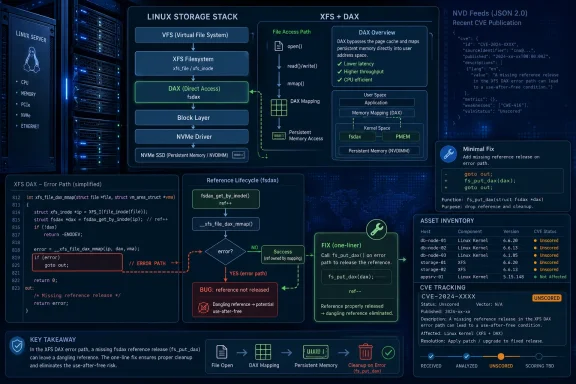
xfs_alloc_buftarg() where an error path failed to release a DAX device reference. The patch is tiny, but the lesson is not. This is the kind of kernel bug that reminds administrators that “low drama” does not mean “irrelevant,” especially when storage, persistent memory, and long-lived server workloads meet. The security story here is less about panic than about how modern vulnerability tracking has turned routine correctness fixes into operational inventory events.
 A One-Line Fix Lands in the Most Serious Part of the Stack
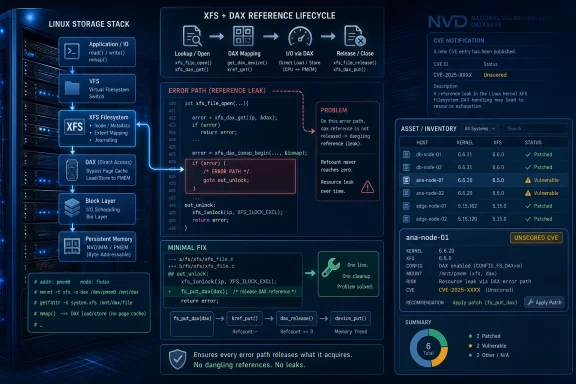
The change behind CVE-2026-46005 is almost comically small: on an error path in XFS buffer-target allocation, the kernel now calls fs_put_dax() before freeing the buffer target structure. In plain English, XFS had taken a reference to a DAX device and, under a failure condition, did not drop it before unwinding. That is a resource leak, not a remote-code-execution spectacular.
But kernel bugs do not need theatrics to matter. A missed reference release in filesystem code can be boring in the way that a hairline crack in a bridge support is boring: it is not evidence of collapse, but it is exactly the sort of defect serious operators do not like to leave sitting in production indefinitely. XFS is used where people care about throughput, scale, and reliability, and DAX is used where storage is close enough to memory that the usual assumptions about I/O layers start to shift.
The fix was posted to the kernel lists in early April 2026 and later appeared in stable review patches for maintained kernel branches. NVD’s entry arrived later, on May 27, with no CVSS score yet and with the familiar “awaiting enrichment” language. That sequencing matters because it shows the modern Linux CVE pipeline at work: the code fix can exist before the vulnerability database has finished turning it into a fully annotated security object.
For WindowsForum readers, this is not just a Linux sidebar. Windows shops increasingly run Linux in WSL, Hyper-V guests, Kubernetes nodes, appliances, developer workstations, and storage-heavy backend infrastructure. A Linux kernel CVE in XFS may not touch a Windows desktop directly, but it can absolutely touch the systems that Windows administrators are now expected to understand.
The CVE Machine Is Now Catching Maintenance Bugs at Production Speed
The first mistake is to read “CVE” and immediately assume exploitability. The second mistake is to read “resource leak” and assume harmlessness. CVE-2026-46005 sits in the uncomfortable space between those reflexes.
Since the Linux kernel project became a CVE Numbering Authority, a larger share of kernel fixes can receive CVE identifiers directly from the upstream ecosystem. That has benefits: fixes become easier to track across distributions, security scanners can match packages to known upstream commits, and administrators get a common language for risk discussions. It also creates noise, because not every CVE lands with an exploit chain, a proof of concept, a marketing name, or even a severity score on day one.
This record is a good example. NVD had not provided CVSS v4, v3, or v2 metrics at the time of publication. There was no NVD weakness classification filled in, no vendor severity guidance in the entry, and no exploitation narrative. What existed was a terse kernel description, a set of stable commit references, and a code-level statement of the defect.
That does not make the CVE meaningless. It means the first operational question should not be “how scary is the badge?” but “where do we run affected kernel code, and how quickly will our vendor ship the fixed kernel?” For organizations with automated vulnerability management, that distinction is more than academic. A scanner may raise a ticket before Red Hat, Canonical, SUSE, Debian, Oracle, Amazon, or another downstream vendor has mapped the issue into its own advisory system.
The result is a familiar 2026 pattern: upstream knows the bug, stable trees have the patch, NVD has the shell of the record, and enterprise patch channels may still be in different stages of classification. Administrators are left to reconcile a security label with incomplete severity data. That is now part of Linux operations, not an exception to it.
XFS and DAX Put This Bug in a Narrow but Important Lane
XFS is not a niche filesystem in the enterprise sense. It is a mature, high-performance filesystem with a long history in large storage deployments, and it has been a default or common choice across major Linux distributions in server contexts. It is designed for big filesystems, parallelism, and workloads where metadata behavior matters.
DAX, by contrast, narrows the practical exposure. Direct Access allows filesystems to bypass parts of the traditional page cache path and map persistent memory or certain block devices more directly into the CPU’s address space. That makes DAX interesting for specialized performance-sensitive systems and persistent-memory deployments, but it is not something most casual Linux users enable by accident.
The vulnerable code path is therefore not “every Linux box with XFS is instantly in trouble.” It is more precise than that. The issue concerns XFS buffer target allocation in a path involving DAX device references, and the leak occurs on an error path. That combination points toward configurations using XFS with DAX-capable storage where the relevant allocation fails after a DAX reference has been acquired.
That specificity is exactly why severity is hard to infer from the CVE title alone. A local kernel resource leak might be practically unreachable in many ordinary deployments, or it might become relevant in a storage service that repeatedly exercises the failure path under constrained resources. The difference between those realities is not visible from the CVE number. It lives in the kernel configuration, mount options, storage hardware, workload, and failure conditions.
This is why administrators should resist both extremes. There is no public basis here for treating CVE-2026-46005 like an emergency remote compromise. There is also no good reason to ignore it if you maintain Linux hosts with XFS and DAX in production. Filesystem bugs are not where prudent operators gamble.
The Error Path Is Where Kernel Confidence Goes to Die
The bug is in an error path, and that detail is doing a lot of work. Happy-path kernel code gets exercised constantly. Error paths are less glamorous, less frequently hit, and more likely to hide mismatched cleanup logic. Developers allocate several resources, one later step fails, and the unwinding path must release exactly what has already been acquired — no more, no less.
In CVE-2026-46005, the missing cleanup step is the DAX device reference. The patch adds the corresponding release call before freeing the XFS buffer target structure. That is ordinary kernel hygiene, but ordinary kernel hygiene is the difference between a system that can survive years of production oddities and one that gradually accumulates state it should have dropped.
Resource leaks are also deceptive because they rarely announce themselves like memory corruption bugs. They do not necessarily crash a test VM on first boot. They may require repeated mount attempts, storage errors, allocation failures, or unusual device states. In a lab, they can look theoretical. In a long-lived storage node with real failure modes, they become part of the messy physics of uptime.
There is a reason kernel maintainers routinely backport small cleanup fixes to stable trees. The cost of carrying a known reference leak is not just the leak itself; it is the diagnostic confusion it can create later. When a system starts behaving strangely under pressure, nobody wants to discover that an already-fixed filesystem reference bug is still present because the patch cycle treated it as too small to matter.
The patch’s size is therefore almost beside the point. One line can be the right fix because the bug is a bookkeeping error. The deeper issue is whether your operational process can distinguish “small patch” from “small consequence.”
Stable Trees Tell the Real Story Before NVD Does
The NVD entry for CVE-2026-46005 lists several kernel.org stable commit references, and stable review postings show the fix moving through maintained kernel lines such as 7.0 and 6.12. That is the signal administrators should care about. The vulnerability database is useful, but for Linux kernel exposure, the stable tree and downstream distro kernels are where remediation becomes real.
Upstream commit identifiers are precise, but most organizations do not run vanilla upstream kernels. They run distribution kernels with backports, vendor patches, configuration choices, and support lifecycles. A system might report an older version number while already carrying the fix, or it might run a seemingly newer custom kernel that lacks a specific stable patch. Version-string reasoning is dangerous in both directions.
This is especially true for enterprise Linux. Vendors frequently backport fixes without rebasing the kernel to the latest upstream release. That means “kernel 6.12” or “kernel 7.0” is only a starting clue. The authoritative answer is the distro advisory, changelog, package build, or vendor CVE tracker.
The lag between upstream fix, stable review, NVD enrichment, and vendor packaging is not a scandal. It is the normal supply chain. But it does mean scanner output should be treated as an investigative lead, not a final verdict. A good vulnerability management program maps CVEs to actual packages, not just to upstream code names.
For smaller shops, that can feel like extra work. For larger shops, it is unavoidable. Linux kernel vulnerabilities are no longer rare events that can be handled by heroic manual review. They are continuous maintenance inputs, and CVE-2026-46005 is a compact example of why process beats drama.
Windows Administrators Are Already Linux Administrators Now
A decade ago, a Windows-focused community could plausibly treat an XFS CVE as outside its lane. That argument is much harder in 2026. Windows environments now routinely contain Linux workloads in developer tooling, cloud infrastructure, virtualization platforms, CI/CD systems, containers, and appliance-like services that administrators inherit whether they asked for them or not.
WSL is the obvious bridge for developers, but it is not the main operational concern here. Most WSL instances will not be using XFS with DAX-backed storage in any ordinary configuration. The more relevant environments are Hyper-V guests, Linux file servers, backup appliances, Kubernetes worker nodes, cloud instances, and high-performance storage systems that coexist with Windows identity, monitoring, backup, and incident response programs.
That hybrid reality changes how Windows teams should read Linux CVEs. The question is not “does this affect Windows?” in the narrow desktop sense. The better question is “does this affect any Linux kernel we are responsible for because it supports a Windows-facing service?” A Samba server, a backup target, a virtualization host, a database node, or an internal artifact repository may be more important to the Windows estate than a random desktop.
XFS also shows up in places where administrators may not think about filesystems daily. Images are built years earlier, appliances hide the underlying distro, and cloud templates inherit defaults. An organization may know it runs Linux but not know where it runs XFS, whether DAX is enabled, or whether persistent-memory features are present. A small CVE becomes useful if it forces that inventory conversation.
This is not an argument for Windows admins to become full-time kernel engineers. It is an argument for not outsourcing Linux awareness to the word “not Windows.” In modern infrastructure, the boundary between Windows and Linux is often an org chart fiction.
The Absence of a Score Is Not the Absence of Risk
NVD’s lack of a CVSS score at publication is one of the most important facts about CVE-2026-46005. It means administrators cannot lean on a single number to prioritize remediation. That is inconvenient, but it may also be healthy.
CVSS scores are useful shorthand, not operational truth. They struggle with kernel bugs that depend on specific configurations, local reachability, storage hardware, and failure modes. A resource leak in a filesystem path may be low urgency for a laptop fleet and higher urgency for a specialized storage cluster. A universal score cannot fully encode that distinction.
The right temporary classification is therefore contextual. If an organization does not use XFS with DAX-capable storage, the practical risk is likely limited. If it does, especially on long-running systems where mount, recovery, or failure paths may be exercised under pressure, the fix deserves normal kernel patch priority. If the host is internet-facing, multi-tenant, or part of a regulated workload, the patch should be folded into the next maintenance window with fewer excuses.
The missing score also exposes a weakness in compliance-driven vulnerability handling. Many programs treat severity as a number handed down from a database. When the number is absent, tickets stall. A more mature program can still act: identify affected assets, check vendor status, determine compensating factors, and schedule updates according to business impact.
CVE-2026-46005 is not asking for heroics. It is asking whether your patch process can move without a fully decorated NVD record.
The Real Risk Is Operational Drift, Not Internet Panic
There is no evidence from the available public record that CVE-2026-46005 is being exploited in the wild. There is no public proof-of-concept exploit in the core record, no named campaign, and no indication that an attacker can remotely trigger a simple path to privilege escalation. That should temper the tone.
But operational drift is a quieter adversary. Systems miss maintenance windows. Kernel updates get deferred because reboot coordination is annoying. Storage hosts become “too important to patch” until they are too fragile to touch. Appliances fall between vendor responsibility and customer responsibility. The next thing anyone knows, a one-line stable fix from spring is still missing in winter.
Filesystem and storage bugs are particularly vulnerable to this drift because teams fear rebooting or touching them. The irony is that those are exactly the systems where correctness fixes matter most. If a host is important enough to avoid patching casually, it is important enough to patch deliberately.
A resource leak also intersects with availability more naturally than confidentiality. Security teams sometimes discount availability issues unless a CVSS score forces their hand. Infrastructure teams know better. A leak that appears only during failure handling is still relevant because failure handling is when you most need the system to behave cleanly.
This is where the article practically lands: do not sound the alarm as if CVE-2026-46005 is the next branded Linux apocalypse, but do not let “awaiting enrichment” become a synonym for “ignore.” Track it, map it, patch it through the normal kernel-update path, and document why systems are or are not affected.
Scanner Culture Has Made Small Kernel Fixes Feel Larger Than They Are
One reason CVE-2026-46005 will attract attention is that scanners do not communicate nuance well. A vulnerability dashboard sees a CVE, an affected product family, and an unscored record. It may not understand that the issue requires XFS and a DAX-relevant path. It may not know that a vendor backport has already fixed the package. It may not distinguish between a developer VM and a storage node.
The human response is often frustration. Administrators see low-detail CVEs and complain about noise. Security teams see unremediated kernel issues and complain about patch latency. Both sides are partly right, and both can be wrong if they stop at the dashboard.
The fix is not to dismiss scanner output. The fix is to enrich it locally. Asset inventory should know filesystems, kernel packages, virtualization roles, and storage classes. Configuration management should know whether DAX is in use. Patch management should know which vendor kernels include the relevant fix. Without that context, every kernel CVE becomes either a fire drill or a shrug.
This is also where Linux’s upstream transparency cuts both ways. The public can see the patch, the mailing-list discussion, the stable review, and the CVE. That is good engineering culture. It also means administrators are exposed to raw upstream signal before enterprise packaging has turned it into a neat advisory. The mess is not new; we are just seeing more of it.
In that sense, CVE-2026-46005 is a useful test of security maturity precisely because it is not spectacular. Anyone can prioritize a wormable remote exploit. The harder work is building a system that handles small, real kernel fixes proportionately.
The Patch Is Simple; The Inventory Is Not
The obvious remediation is to run a kernel that includes the fix. The less obvious task is proving where that matters. For many organizations, the hard part will not be applying a vendor kernel update during the next reboot cycle. It will be answering basic questions about exposure.
Start with filesystem usage. Which Linux hosts use XFS? Among those, which use DAX? Which are attached to persistent memory, pmem devices, or DAX-capable block devices? Which are long-lived servers rather than disposable build workers? Which are backed by vendors that have already issued patched kernels?
Then look at operational constraints. If the affected hosts are clustered, can they be patched node by node? If they are storage appliances, is the kernel managed by the appliance vendor? If they are cloud instances, is the fix part of the image pipeline or merely present in newer packages? These questions determine whether the CVE is a quick ticket close or a small project.
There is also a testing angle. Kernel updates in storage-heavy environments should not be applied blindly, but neither should they be postponed indefinitely in the name of caution. A sane path is to validate the vendor kernel in staging, confirm that XFS mounts and workloads behave normally, and roll through production with rollback plans. That is boring work. Boring work is what keeps kernel maintenance from becoming incident response.
The one thing administrators should not do is cherry-pick a single upstream commit into a production kernel unless they already operate at that level of kernel engineering. For most shops, the supported vendor kernel is the security boundary. Use it.
DAX Remains a Performance Feature With Sharp Operational Edges
DAX is attractive because it removes layers. That is also why it makes administrators nervous. When storage gets closer to memory semantics, bugs in reference handling, failure notification, and filesystem coordination become more consequential. CVE-2026-46005 is not an indictment of DAX, but it is a reminder that advanced storage paths need advanced operational discipline.
Persistent memory itself has had a complicated few years. Enthusiasm for byte-addressable persistent storage has met the realities of platform support, hardware availability, workload fit, and management complexity. Still, DAX remains relevant in specialized deployments and in the kernel’s storage architecture. The people using it are often precisely the people running systems where uptime and data integrity matter.
The XFS fix references an earlier change implementing failure notification for XFS. That is an important clue: this code lives near the machinery that helps filesystems respond to lower-level device failure events. In storage systems, failure paths are not theoretical decoration. They are part of the product.
That makes the missing fs_put_dax() call more than a trivia item. Reference counting is one of the kernel’s core trust mechanisms. If a subsystem takes a reference, it must release it under every correct exit path. Leaks are not always exploitable in the classic sense, but they are violations of the rules that make long-running systems predictable.
The takeaway for DAX users is not to disable the feature out of fear. It is to treat DAX hosts as specialized assets. They should be inventoried, tested, patched, and monitored as such.
Linux Security Is Becoming More Like Patch Tuesday, But Without the Calendar
Windows administrators understand Patch Tuesday because it imposes rhythm. Microsoft publishes, enterprises test, deployment rings advance, exceptions are documented, and the next month arrives. Linux kernel security has rhythm too, but it is less centralized. Upstream fixes, stable releases, distro advisories, cloud images, container hosts, and appliance updates all move on related but different clocks.
CVE-2026-46005 illustrates that decentralized rhythm. The upstream patch appeared before NVD publication. Stable review carried it into maintained lines. NVD published the CVE while enrichment was still incomplete. Downstream vendors then become the practical source of truth for most users. There is no single Tuesday that settles the matter.
This frustrates organizations that want one authoritative answer. But Linux’s model also has strengths. Fixes can move quickly, publicly, and across multiple maintained branches. Administrators can see exactly what changed. Distribution vendors can backport without forcing disruptive major-version jumps. The price is that someone has to connect the dots.
For Windows-heavy shops, the operational answer is to build Linux into the same governance model without pretending it behaves identically. Kernel updates need maintenance windows. Reboots need coordination. Vulnerability exceptions need expiration dates. Asset data needs to include OS family, kernel package, filesystem, and workload role.
The worst model is the hybrid blind spot: Windows is managed with mature patch rings, Linux is treated as “the app team’s problem,” and scanners become the first time central IT hears about a kernel issue. CVE-2026-46005 is small enough to fix calmly, which makes it an ideal excuse to close that gap before a larger kernel CVE forces the issue.
The Unscored XFS CVE Leaves a Practical Paper Trail
CVE-2026-46005 does not need mystique. The public facts are sparse but sufficient for a working response: it is an XFS resource leak in xfs_alloc_buftarg(), it involves dropping a DAX device reference on the error path, it was fixed by adding fs_put_dax(), it has upstream and stable kernel references, and NVD had not assigned a severity score at publication.
Those facts lead to concrete action, not panic. The key is to separate the presence of a CVE from the presence of practical exposure. A developer laptop running an ext4 root filesystem is a different risk profile from a Linux storage server running XFS with DAX. A vendor-patched enterprise kernel is different from an unmanaged custom build.
Administrators should also remember that the CVE record’s lack of enrichment is temporary. NVD may later add scoring, weakness mapping, configuration data, or additional references. Vendors may classify the issue differently according to their supported products. The correct response today should leave room for updates tomorrow.
That is another reason to document the decision. If you determine that your environment is not exposed because you do not use DAX, write that down. If you are waiting for a vendor kernel, track the advisory. If you apply the update, record the package version. Future you, future auditors, and future incident responders will all appreciate the paper trail.
The Five Checks That Keep This From Becoming Noise
The useful response to CVE-2026-46005 is narrow, calm, and evidence-based. Treat it as a kernel maintenance item with storage-specific relevance, not as a headline exploit and not as disposable scanner clutter.
- Identify Linux systems using XFS, and do not assume filesystem choices are obvious from the server’s business name or owner.
- Determine whether any XFS systems use DAX, persistent memory, or DAX-capable storage paths where the affected code is more likely to matter.
- Check your distribution or appliance vendor’s kernel advisory and changelog rather than relying only on upstream version numbers.
- Prioritize patched kernels for long-lived storage hosts, clustered systems, and infrastructure that supports Windows-facing services.
- Document non-exposure decisions, especially where scanners report the CVE but the host does not use the relevant filesystem or DAX configuration.
- Revisit the record after NVD enrichment or vendor advisories appear, because severity and affected-package mappings may change after the initial publication.
CVE-2026-46005 is the kind of vulnerability that will not be remembered for a logo, a breach, or a dramatic exploit chain. It will be remembered, if at all, as another small upstream kernel fix that tested whether organizations can manage Linux with the same seriousness they bring to Windows. That is where the future is heading: not toward fewer kernel CVEs, but toward more visible ones, and the winners will be the teams that can turn that visibility into disciplined maintenance instead of dashboard anxiety.
Attachments
References
- CVE-2026-46005 xfs: fix a resource leak in xfs_alloc_buftarg() NVD / Linux Kernel · 2026-05-28T01:02:35-07:00