

CVE-2026-46291 is a newly published Linux kernel vulnerability, added to NVD on June 8, 2026, in which the CAAM cryptographic accelerator driver could expose sensitive HMAC key bytes through debug hex dumps when dynamic debugging was enabled. The fix is small, but the lesson is not. This is the kind of flaw that rarely produces a Hollywood exploit chain, yet still matters because it sits at the intersection of kernel diagnostics, embedded hardware, and secrets that were never supposed to become log output. For WindowsForum readers, the point is not that Windows desktops are suddenly at risk; it is that modern estates increasingly include Linux appliances, WSL-adjacent workflows, edge devices, and vendor images where “debug only” can become “production observable” faster than anyone admits.
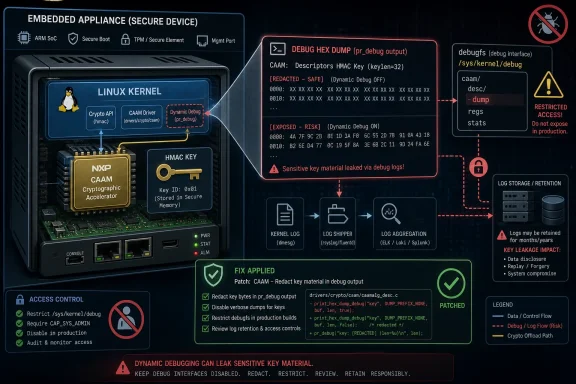
At first glance, CVE-2026-46291 appears almost comically narrow. The vulnerable code lives in the Linux kernel’s crypto subsystem, specifically in the CAAM driver used with NXP’s Cryptographic Acceleration and Assurance Module hardware. The patch changes how HMAC key material is dumped during a helper path named
That is not the sort of description that triggers panic dashboards. NVD had not assigned a CVSS score at publication time, and the record’s text is terse: the driver used the wrong kind of hex dump for sensitive HMAC key bytes when
But security history is littered with bugs that began with a shrug because they were “just logs.” Log files are where secrets go to die slowly: API tokens, bearer credentials, passwords, session cookies, private keys, and in this case potentially HMAC key bytes. If a secret reaches a log buffer, it has already escaped the trust boundary the code thought it was enforcing.
The interesting part of CVE-2026-46291 is not the size of the patch. It is the fact that a kernel crypto driver had a path where secret material could be printed at all under the right debugging conditions. That reveals a tension Linux has never fully escaped: the same low-level visibility that makes the kernel debuggable can become a liability when production systems carry debug plumbing into sensitive code.
That is immensely useful when debugging hardware drivers. A cryptographic accelerator, a DMA path, or a hash offload engine can fail in ways that are hard to reproduce and harder still to understand from user space. Debug statements placed near descriptor construction, key handling, or hardware submission can turn a black box into a traceable sequence of events.
The problem is that kernel code does not become less privileged when it is printing for convenience. A diagnostic dump of a buffer is still a dump of a buffer, and if that buffer contains key material, the debug channel becomes a data exfiltration channel. Dynamic debug does not make the data sensitive; it merely supplies a switch that can cause sensitive data to be rendered into text.
That is the center of the CVE. The CAAM code path used a debug hex-dump helper in a place where the bytes being dumped could include HMAC key material. When dynamic debug was enabled and the relevant call site was activated, those bytes could be exposed at runtime. The fix uses
The distinction sounds academic, but it is not. A debug line compiled into a kernel can be inert, conditionally compiled, dynamically switchable, or development-only depending on the helper and configuration. CVE-2026-46291 is a reminder that the choice of logging primitive is itself a security decision.
That context cuts both ways. On one hand, the affected population is narrower than a generic Linux kernel bug present on all x86 machines. On the other hand, embedded and appliance systems are precisely where kernel configuration, vendor patch cadence, and operational transparency tend to be uneven. A vulnerability that requires a particular hardware driver and debug configuration may be rare in the datacenter, but quite relevant in a fleet of long-lived network appliances.
Crypto acceleration is also attractive in the places where secrets matter. HMAC is widely used for message authentication, protocol integrity, storage authentication, and internal service trust. If a hardware crypto driver handles HMAC key material, leaking those bytes can undermine the integrity guarantees the algorithm is meant to provide.
The public description does not claim that keys are leaked by default on every affected system. The condition is important:
For administrators, the right mental model is “conditional secret exposure,” not “universal compromise.” The presence of CAAM hardware, an affected kernel, enabled dynamic debug infrastructure, and access to activate or read the debug output are all part of the practical exploitability story. A fleet owner should investigate those conditions rather than simply reacting to the CVE identifier.
That still matters. In many real breaches, the attacker does not begin with root; they climb through weaker accounts, misconfigured containers, exposed management panels, overly broad log access, and forgotten support tooling. A secret dumped into kernel logs can become valuable even if the person reading the log is not supposed to have cryptographic authority.
There is also a supply-chain angle. Appliance vendors often request verbose diagnostic bundles from customers. Field engineers may enable debug options temporarily. Managed service providers may centralize logs from thousands of devices into search platforms. Each of those workflows can accidentally widen access to data that developers assumed would remain local, ephemeral, or visible only to trusted kernel engineers.
The vulnerability therefore lives in the gap between kernel theory and operational reality. In theory, dynamic debug is a controlled diagnostic interface. In practice, debug settings are changed under pressure, logs are copied into tickets, and “temporary” verbosity can survive longer than intended. Once raw key bytes enter that pipeline, revocation and rotation become the only real cleanup.
This is why dismissing the CVE because it requires debug enablement misses the point. Debug conditions are not mythical. They exist in labs, factories, support sessions, staging environments, and sometimes production. The modern attack surface includes not just sockets and syscalls, but observability systems and the people who turn them on.
This is security engineering at its least glamorous and most necessary. No algorithm was broken. No HMAC primitive failed. No hardware root of trust was magically bypassed. The flaw was in the surrounding code that handled key material while trying to be helpful to developers.
That is often where real-world crypto failures live. The math can be sound while implementation details leak the inputs. A key can be generated correctly, stored correctly, and passed to hardware correctly, only to be written to a debug trace in a moment of troubleshooting convenience.
The CVE record links the issue to stable kernel commits, which signals that maintainers considered it suitable for backporting rather than leaving it as a mainline-only cleanup. The original patch discussion, reported on Linux kernel mailing list archives, framed the issue as guarding sensitive HMAC key hex dumps and noted that the second revision kept the debug capability under a more appropriate guard rather than deleting it entirely. That compromise is revealing: developers still need instrumentation, but instrumentation should not be dynamically activatable in ways that violate secrecy.
For users and administrators, the patch’s smallness should be reassuring but not dismissive. Small patches can close high-value leaks. They are also easy for vendors to miss if their kernel trees are heavily modified or frozen around long-term support releases.
CVE-2026-46291 is unlikely to affect WSL in the ordinary desktop sense because WSL kernels and commodity x86 machines do not generally revolve around NXP CAAM hardware. But the larger WindowsForum audience includes people responsible for networks, labs, edge devices, and hybrid environments. Those environments often contain Linux systems nobody thinks about until firmware update day.
The most likely affected systems are not office PCs. They are appliances and embedded platforms using NXP SoCs with CAAM support and Linux kernels carrying the vulnerable driver code. That includes the kinds of devices Windows administrators may manage indirectly: VPN boxes, gateways, NAS units, industrial controllers, custom IoT hardware, and vendor-provided Linux images attached to Windows-centric networks.
This is the uncomfortable part of modern IT ownership. You may not administer Linux as your primary platform, but you may still be accountable for Linux behavior inside products that sit on your network. A CVE like this will not show up in Windows Update. It will be addressed through kernel packages, firmware updates, vendor advisories, board support package refreshes, or not at all unless someone asks.
The practical consequence is inventory discipline. If your organization has NXP-based appliances or custom boards, the question is not “Do we use Linux?” but “Which Linux kernels are inside the products we depend on, and who is responsible for updating them?” CVE-2026-46291 is one more example of why that question cannot be postponed until after an incident.
A missing score means the scoring work has not been completed or published by that source. It does not mean the bug has no security impact. In this case, the impact depends heavily on configuration, hardware, privilege boundaries, and log access. Those are precisely the factors that generic scoring often struggles to capture.
If an affected device never enables dynamic debug, restricts debugfs, prevents unprivileged log access, and has no operational habit of collecting verbose kernel logs, the immediate risk may be low. If a vendor ships debug-heavy kernels, grants broad support access, or forwards kernel logs to multi-tenant systems, the risk changes. The same CVE can be nearly inert in one deployment and genuinely concerning in another.
This is where security teams need to be more adult than their dashboards. A CVSS number is a useful sorting tool, not a substitute for understanding exposure. For CVE-2026-46291, the scoring conversation should begin with asset context: CAAM hardware, affected kernel lineage, dynamic debug configuration, debugfs exposure, log retention, and key rotation procedures.
The absence of a score may actually force a better conversation. Instead of asking whether a database says the number is red, teams have to ask whether their systems could ever print HMAC key bytes into a place more people can read than should know the key. That is the right question.
On a well-hardened system, access to debugfs and kernel logs should be tightly controlled. On a hurried embedded product, a lab image, or an appliance with support tooling, those assumptions may fail. The dangerous pattern is not that every user can necessarily enable dynamic debug; it is that operational shortcuts often normalize privileged visibility.
Once debugfs is mounted and accessible to a privileged support process, container escape context, overly permissive service, or field diagnostic user, the difference between “root-only” and “attacker-readable” may become thin. Many compromises are post-exploitation events, and post-exploitation is exactly when secret leakage through logs becomes useful.
There is a broader lesson here for Windows administrators managing Linux systems by policy rather than habit. Linux exposes a rich set of pseudo-filesystems and diagnostic interfaces: procfs, sysfs, debugfs, tracefs, eBPF-related hooks, and performance tracing surfaces. They are not all equivalent, and they should not all be mounted casually inside containers or exposed to management agents.
CVE-2026-46291 gives security teams a concrete reason to review debugfs posture. If dynamic debug can be enabled on sensitive systems, who can enable it? Who can read the resulting output? Are kernel logs forwarded into a SIEM where dozens of analysts and service accounts have access? Are support bundles scrubbed before leaving the organization? Those controls matter even after this specific patch lands.
Engineering organizations often have firm rules about not logging passwords, tokens, and private keys at the application layer. Those rules get fuzzier in lower-level systems code, where buffers are opaque, debug output is sparse, and the pressure to see “what the hardware is doing” is intense. Kernel developers may know they are handling key material, but the codebase’s diagnostic conventions may not make that sensitivity sufficiently explicit.
The safest pattern is not merely “do not log secrets.” It is to make secret-bearing types, buffers, and code paths difficult to log accidentally. That can mean stronger helper naming, linting, review checklists, compile-time guards, sensitive-memory annotations, and test cases that look for secret strings in output. The Linux kernel is enormous and necessarily pragmatic, but the principle applies to vendors building on top of it.
This vulnerability also demonstrates the limits of relying on deployment configuration as a security control. Yes, dynamic debug may be disabled or inaccessible in many production systems. But secure design should avoid placing raw secrets behind optional runtime switches in the first place. Defense in depth means the log statement should be safe even if someone later changes a kernel config, mounts a filesystem, or enables a diagnostic mode.
The patch’s move toward
A stable commit landing upstream is the beginning of remediation, not the end. Downstream maintainers have to pull it, resolve conflicts, test it against their trees, ship packages or firmware, and convince customers to install them. In embedded markets, some devices are supported for years; others become effectively frozen the moment they leave the factory.
This is why CVE-2026-46291 may remain relevant long after it leaves the front page of vulnerability feeds. The affected code can persist in appliances whose users never see a kernel package name. A router or industrial gateway may advertise firmware version numbers while hiding the underlying kernel lineage. The only visible signal may be a vendor security advisory, if one appears.
Enterprises should resist the urge to wait for a perfect public affected-products list. Instead, they should ask vendors direct questions: Does the product use NXP CAAM? Is the Linux kernel built with
Those questions are not overkill. They are how you turn an abstract kernel CVE into an asset-specific decision. For some products, the answer will be “not affected.” For others, the answer may be “affected but low exposure.” For the most concerning cases, the answer will be a firmware update plus key rotation if logs may have captured secrets.
HMAC keys are not harmless once old. Depending on what they protect, they may remain valid until explicitly rotated. If they authenticate firmware payloads, internal messages, VPN components, storage metadata, or service-to-service traffic, exposure can have consequences beyond the moment of logging. The response plan must therefore include the possibility that historical logs contain sensitive bytes.
This does not mean every organization should panic-rotate every key associated with every NXP-based device. It means teams should answer a sequence of practical questions. Was dynamic debug enabled for the CAAM driver? Were the affected call sites activated? Were kernel logs retained? Were logs forwarded off-device? Who could access them? Were they included in support bundles or tickets?
The hard part is that many organizations will not know. Log pipelines are often designed for availability and troubleshooting first, secrecy second. They may retain raw kernel output longer than expected, replicate it to multiple regions, index it in search systems, and expose it to broad roles. A key that appears once in
CVE-2026-46291 should therefore prompt a retention review as much as a patch review. Sensitive infrastructure logs need access control, minimization, redaction, expiration, and incident workflows. The safest log is the one that never contains a secret, but once a secret appears, governance determines how far it travels.
The center is easy to see. A remote code execution bug in a widely deployed Windows service, a browser zero-day, or a cloud identity bypass gets immediate attention. The edge is quieter: a crypto accelerator in an appliance, a debug helper in a driver, a vendor kernel branch, a support log that outlives the diagnostic session. Attackers do not care whether the path is glamorous if it leads to useful secrets.
For Windows-heavy organizations, this is part of the same convergence story we have been living for years. Windows, Linux, firmware, cloud agents, management planes, and observability tools now form one operational fabric. A weakness in a Linux driver can matter to a Windows shop because the device sits in the same network, protects the same data, or feeds the same logs into the same security platform.
The best response is not alarmism. It is disciplined curiosity. Find the devices, understand the kernel configuration, patch where applicable, restrict debug interfaces, and treat logs as sensitive systems rather than harmless exhaust. CVE-2026-46291 may be a small fix in a specialized driver, but it points toward a larger truth: in a world where every platform is someone else’s dependency, secrets are only as safe as the least careful debug statement that can print them.
 A Kernel Bug That Looks Boring Until You Notice the Word “Key”
At first glance, CVE-2026-46291 appears almost comically narrow. The vulnerable code lives in the Linux kernel’s crypto subsystem, specifically in the CAAM driver used with NXP’s Cryptographic Acceleration and Assurance Module hardware. The patch changes how HMAC key material is dumped during a helper path named hash_digest_key, replacing a debug hex-dump path with one intended for development-only output.That is not the sort of description that triggers panic dashboards. NVD had not assigned a CVSS score at publication time, and the record’s text is terse: the driver used the wrong kind of hex dump for sensitive HMAC key bytes when
CONFIG_DYNAMIC_DEBUG was enabled. There is no remote unauthenticated takeover in the public description, no wormable port, no default Windows exposure, and no flashy exploit primitive.But security history is littered with bugs that began with a shrug because they were “just logs.” Log files are where secrets go to die slowly: API tokens, bearer credentials, passwords, session cookies, private keys, and in this case potentially HMAC key bytes. If a secret reaches a log buffer, it has already escaped the trust boundary the code thought it was enforcing.
The interesting part of CVE-2026-46291 is not the size of the patch. It is the fact that a kernel crypto driver had a path where secret material could be printed at all under the right debugging conditions. That reveals a tension Linux has never fully escaped: the same low-level visibility that makes the kernel debuggable can become a liability when production systems carry debug plumbing into sensitive code.
Dynamic Debug Turns Dormant Print Statements Into Runtime Behavior
Linux’s dynamic debug facility exists for a good reason. Kernel developers and administrators need ways to selectively enable diagnostic output without recompiling a kernel, rebooting into a special image, or drowning the system in unrelated messages. WhenCONFIG_DYNAMIC_DEBUG is enabled, calls such as pr_debug, dev_dbg, and certain hex-dump helpers can be switched on per call site at runtime.That is immensely useful when debugging hardware drivers. A cryptographic accelerator, a DMA path, or a hash offload engine can fail in ways that are hard to reproduce and harder still to understand from user space. Debug statements placed near descriptor construction, key handling, or hardware submission can turn a black box into a traceable sequence of events.
The problem is that kernel code does not become less privileged when it is printing for convenience. A diagnostic dump of a buffer is still a dump of a buffer, and if that buffer contains key material, the debug channel becomes a data exfiltration channel. Dynamic debug does not make the data sensitive; it merely supplies a switch that can cause sensitive data to be rendered into text.
That is the center of the CVE. The CAAM code path used a debug hex-dump helper in a place where the bytes being dumped could include HMAC key material. When dynamic debug was enabled and the relevant call site was activated, those bytes could be exposed at runtime. The fix uses
print_hex_dump_devel, a development-oriented helper intended to avoid creating a dynamically controllable leak in deployed kernels.The distinction sounds academic, but it is not. A debug line compiled into a kernel can be inert, conditionally compiled, dynamically switchable, or development-only depending on the helper and configuration. CVE-2026-46291 is a reminder that the choice of logging primitive is itself a security decision.
CAAM Puts This Bug in the Embedded and Appliance World
The CAAM driver is not a random desktop feature most Windows users will encounter directly. CAAM refers to NXP’s hardware crypto acceleration block, common in certain embedded and networking-oriented systems. It is the sort of component found in routers, industrial equipment, gateways, storage appliances, and custom boards rather than in a typical gaming PC.That context cuts both ways. On one hand, the affected population is narrower than a generic Linux kernel bug present on all x86 machines. On the other hand, embedded and appliance systems are precisely where kernel configuration, vendor patch cadence, and operational transparency tend to be uneven. A vulnerability that requires a particular hardware driver and debug configuration may be rare in the datacenter, but quite relevant in a fleet of long-lived network appliances.
Crypto acceleration is also attractive in the places where secrets matter. HMAC is widely used for message authentication, protocol integrity, storage authentication, and internal service trust. If a hardware crypto driver handles HMAC key material, leaking those bytes can undermine the integrity guarantees the algorithm is meant to provide.
The public description does not claim that keys are leaked by default on every affected system. The condition is important:
CONFIG_DYNAMIC_DEBUG must be enabled, and the relevant debugging output must be reachable. That narrows the risk profile. But it does not eliminate the risk, because some vendor kernels ship with extensive debug capabilities, and debugfs access policies vary across products.For administrators, the right mental model is “conditional secret exposure,” not “universal compromise.” The presence of CAAM hardware, an affected kernel, enabled dynamic debug infrastructure, and access to activate or read the debug output are all part of the practical exploitability story. A fleet owner should investigate those conditions rather than simply reacting to the CVE identifier.
The Real Attack Surface Is Operational Access, Not the Internet
CVE-2026-46291 is not best understood as an internet-facing remote exploit. The public record describes a runtime leak through debug output. That means an attacker generally needs a path to influence dynamic debug settings, read kernel logs, access debugfs, or benefit from an operational environment where verbose logs are collected centrally.That still matters. In many real breaches, the attacker does not begin with root; they climb through weaker accounts, misconfigured containers, exposed management panels, overly broad log access, and forgotten support tooling. A secret dumped into kernel logs can become valuable even if the person reading the log is not supposed to have cryptographic authority.
There is also a supply-chain angle. Appliance vendors often request verbose diagnostic bundles from customers. Field engineers may enable debug options temporarily. Managed service providers may centralize logs from thousands of devices into search platforms. Each of those workflows can accidentally widen access to data that developers assumed would remain local, ephemeral, or visible only to trusted kernel engineers.
The vulnerability therefore lives in the gap between kernel theory and operational reality. In theory, dynamic debug is a controlled diagnostic interface. In practice, debug settings are changed under pressure, logs are copied into tickets, and “temporary” verbosity can survive longer than intended. Once raw key bytes enter that pipeline, revocation and rotation become the only real cleanup.
This is why dismissing the CVE because it requires debug enablement misses the point. Debug conditions are not mythical. They exist in labs, factories, support sessions, staging environments, and sometimes production. The modern attack surface includes not just sockets and syscalls, but observability systems and the people who turn them on.
The Patch Is a Hygiene Fix With Security Consequences
The kernel fix is conceptually simple: do not use a dynamically controllable debug hex dump for sensitive HMAC key bytes. Use a development-only dumping helper instead. That preserves developer visibility where appropriate while preventing runtime dynamic debug from becoming a switchable secret printer.This is security engineering at its least glamorous and most necessary. No algorithm was broken. No HMAC primitive failed. No hardware root of trust was magically bypassed. The flaw was in the surrounding code that handled key material while trying to be helpful to developers.
That is often where real-world crypto failures live. The math can be sound while implementation details leak the inputs. A key can be generated correctly, stored correctly, and passed to hardware correctly, only to be written to a debug trace in a moment of troubleshooting convenience.
The CVE record links the issue to stable kernel commits, which signals that maintainers considered it suitable for backporting rather than leaving it as a mainline-only cleanup. The original patch discussion, reported on Linux kernel mailing list archives, framed the issue as guarding sensitive HMAC key hex dumps and noted that the second revision kept the debug capability under a more appropriate guard rather than deleting it entirely. That compromise is revealing: developers still need instrumentation, but instrumentation should not be dynamically activatable in ways that violate secrecy.
For users and administrators, the patch’s smallness should be reassuring but not dismissive. Small patches can close high-value leaks. They are also easy for vendors to miss if their kernel trees are heavily modified or frozen around long-term support releases.
Windows Shops Should Care Because Their Linux Is No Longer Somewhere Else
A decade ago, many Windows administrators could reasonably treat Linux kernel CVEs as somebody else’s weekend. That world is gone. Windows-heavy organizations run Linux in hypervisors, containers, appliances, storage controllers, firewalls, CI systems, Kubernetes nodes, developer laptops, and cloud images. Even Microsoft’s own ecosystem has normalized mixed Windows and Linux operations through Azure, WSL, Defender for Endpoint coverage, and cross-platform management.CVE-2026-46291 is unlikely to affect WSL in the ordinary desktop sense because WSL kernels and commodity x86 machines do not generally revolve around NXP CAAM hardware. But the larger WindowsForum audience includes people responsible for networks, labs, edge devices, and hybrid environments. Those environments often contain Linux systems nobody thinks about until firmware update day.
The most likely affected systems are not office PCs. They are appliances and embedded platforms using NXP SoCs with CAAM support and Linux kernels carrying the vulnerable driver code. That includes the kinds of devices Windows administrators may manage indirectly: VPN boxes, gateways, NAS units, industrial controllers, custom IoT hardware, and vendor-provided Linux images attached to Windows-centric networks.
This is the uncomfortable part of modern IT ownership. You may not administer Linux as your primary platform, but you may still be accountable for Linux behavior inside products that sit on your network. A CVE like this will not show up in Windows Update. It will be addressed through kernel packages, firmware updates, vendor advisories, board support package refreshes, or not at all unless someone asks.
The practical consequence is inventory discipline. If your organization has NXP-based appliances or custom boards, the question is not “Do we use Linux?” but “Which Linux kernels are inside the products we depend on, and who is responsible for updating them?” CVE-2026-46291 is one more example of why that question cannot be postponed until after an incident.
The Missing CVSS Score Is Not a Permission Slip
NVD’s initial record listed no CVSS score at the time the CVE was received. That is normal for freshly published kernel CVEs, especially when enrichment lags behind the upstream disclosure. It is also dangerous when vulnerability management programs treat “N/A” as a synonym for “not important.”A missing score means the scoring work has not been completed or published by that source. It does not mean the bug has no security impact. In this case, the impact depends heavily on configuration, hardware, privilege boundaries, and log access. Those are precisely the factors that generic scoring often struggles to capture.
If an affected device never enables dynamic debug, restricts debugfs, prevents unprivileged log access, and has no operational habit of collecting verbose kernel logs, the immediate risk may be low. If a vendor ships debug-heavy kernels, grants broad support access, or forwards kernel logs to multi-tenant systems, the risk changes. The same CVE can be nearly inert in one deployment and genuinely concerning in another.
This is where security teams need to be more adult than their dashboards. A CVSS number is a useful sorting tool, not a substitute for understanding exposure. For CVE-2026-46291, the scoring conversation should begin with asset context: CAAM hardware, affected kernel lineage, dynamic debug configuration, debugfs exposure, log retention, and key rotation procedures.
The absence of a score may actually force a better conversation. Instead of asking whether a database says the number is red, teams have to ask whether their systems could ever print HMAC key bytes into a place more people can read than should know the key. That is the right question.
Debugfs Is a Security Boundary Only If You Treat It Like One
Dynamic debug is typically controlled through debugfs, commonly mounted at/sys/kernel/debug. The name should be a warning, but in practice debugfs often lives in the awkward zone between developer convenience and production hardening. It exposes powerful diagnostic interfaces that are not meant to be treated like ordinary application configuration.On a well-hardened system, access to debugfs and kernel logs should be tightly controlled. On a hurried embedded product, a lab image, or an appliance with support tooling, those assumptions may fail. The dangerous pattern is not that every user can necessarily enable dynamic debug; it is that operational shortcuts often normalize privileged visibility.
Once debugfs is mounted and accessible to a privileged support process, container escape context, overly permissive service, or field diagnostic user, the difference between “root-only” and “attacker-readable” may become thin. Many compromises are post-exploitation events, and post-exploitation is exactly when secret leakage through logs becomes useful.
There is a broader lesson here for Windows administrators managing Linux systems by policy rather than habit. Linux exposes a rich set of pseudo-filesystems and diagnostic interfaces: procfs, sysfs, debugfs, tracefs, eBPF-related hooks, and performance tracing surfaces. They are not all equivalent, and they should not all be mounted casually inside containers or exposed to management agents.
CVE-2026-46291 gives security teams a concrete reason to review debugfs posture. If dynamic debug can be enabled on sensitive systems, who can enable it? Who can read the resulting output? Are kernel logs forwarded into a SIEM where dozens of analysts and service accounts have access? Are support bundles scrubbed before leaving the organization? Those controls matter even after this specific patch lands.
Secret Leakage Bugs Are Usually Governance Failures in Disguise
It is tempting to view this CVE as a one-line coding mistake: the wrong hex-dump helper was used in a crypto driver. That is true in the narrow sense. But the broader failure mode is governance around secret-bearing data.Engineering organizations often have firm rules about not logging passwords, tokens, and private keys at the application layer. Those rules get fuzzier in lower-level systems code, where buffers are opaque, debug output is sparse, and the pressure to see “what the hardware is doing” is intense. Kernel developers may know they are handling key material, but the codebase’s diagnostic conventions may not make that sensitivity sufficiently explicit.
The safest pattern is not merely “do not log secrets.” It is to make secret-bearing types, buffers, and code paths difficult to log accidentally. That can mean stronger helper naming, linting, review checklists, compile-time guards, sensitive-memory annotations, and test cases that look for secret strings in output. The Linux kernel is enormous and necessarily pragmatic, but the principle applies to vendors building on top of it.
This vulnerability also demonstrates the limits of relying on deployment configuration as a security control. Yes, dynamic debug may be disabled or inaccessible in many production systems. But secure design should avoid placing raw secrets behind optional runtime switches in the first place. Defense in depth means the log statement should be safe even if someone later changes a kernel config, mounts a filesystem, or enables a diagnostic mode.
The patch’s move toward
print_hex_dump_devel aligns with that philosophy. Development-time introspection remains possible, but production runtime toggles should not be able to expose HMAC key bytes. That is the balance kernel code needs more often: debug visibility without latent secret exfiltration.Vendor Kernels Will Decide the Real Blast Radius
The upstream Linux kernel can fix a bug quickly, but users do not run upstream in the abstract. They run distribution kernels, Android-derived kernels, vendor board support packages, appliance firmware, and long-term support trees with local patches. For CAAM, that vendor-kernel reality is especially important because the hardware is common in embedded and specialized systems.A stable commit landing upstream is the beginning of remediation, not the end. Downstream maintainers have to pull it, resolve conflicts, test it against their trees, ship packages or firmware, and convince customers to install them. In embedded markets, some devices are supported for years; others become effectively frozen the moment they leave the factory.
This is why CVE-2026-46291 may remain relevant long after it leaves the front page of vulnerability feeds. The affected code can persist in appliances whose users never see a kernel package name. A router or industrial gateway may advertise firmware version numbers while hiding the underlying kernel lineage. The only visible signal may be a vendor security advisory, if one appears.
Enterprises should resist the urge to wait for a perfect public affected-products list. Instead, they should ask vendors direct questions: Does the product use NXP CAAM? Is the Linux kernel built with
CONFIG_DYNAMIC_DEBUG? Is the vulnerable CAAM HMAC path present? Has the upstream fix been applied to the supported firmware branch? Are diagnostic bundles scrubbed for cryptographic material?Those questions are not overkill. They are how you turn an abstract kernel CVE into an asset-specific decision. For some products, the answer will be “not affected.” For others, the answer may be “affected but low exposure.” For the most concerning cases, the answer will be a firmware update plus key rotation if logs may have captured secrets.
Log Retention Can Turn a Short Bug Into a Long Incident
If a system was vulnerable and dynamic debug was enabled, patching the kernel stops future leakage. It does not erase past logs. That is the uncomfortable operational tail of any secret-in-log vulnerability.HMAC keys are not harmless once old. Depending on what they protect, they may remain valid until explicitly rotated. If they authenticate firmware payloads, internal messages, VPN components, storage metadata, or service-to-service traffic, exposure can have consequences beyond the moment of logging. The response plan must therefore include the possibility that historical logs contain sensitive bytes.
This does not mean every organization should panic-rotate every key associated with every NXP-based device. It means teams should answer a sequence of practical questions. Was dynamic debug enabled for the CAAM driver? Were the affected call sites activated? Were kernel logs retained? Were logs forwarded off-device? Who could access them? Were they included in support bundles or tickets?
The hard part is that many organizations will not know. Log pipelines are often designed for availability and troubleshooting first, secrecy second. They may retain raw kernel output longer than expected, replicate it to multiple regions, index it in search systems, and expose it to broad roles. A key that appears once in
dmesg may become a durable record in half a dozen tools.CVE-2026-46291 should therefore prompt a retention review as much as a patch review. Sensitive infrastructure logs need access control, minimization, redaction, expiration, and incident workflows. The safest log is the one that never contains a secret, but once a secret appears, governance determines how far it travels.
The Small CAAM Fix Carries a Bigger Operating Manual
The practical response to this CVE is not complicated, but it does require looking beyond the headline. The key is to identify whether your systems combine the affected driver, relevant hardware, risky debug configuration, and accessible logs. Most ordinary Windows desktops will not. Some embedded Linux fleets absolutely might.- Organizations should inventory devices that use NXP SoCs or expose the Linux CAAM crypto driver, especially appliances, gateways, industrial systems, and custom embedded platforms.
- Administrators should verify whether affected kernels include the upstream stable fix or a vendor backport that changes the CAAM HMAC key dump behavior.
- Security teams should review whether
CONFIG_DYNAMIC_DEBUGis enabled and whether debugfs is mounted or accessible on production systems. - Operations teams should determine whether CAAM-related dynamic debug output was ever enabled and whether kernel logs were retained, forwarded, or attached to support cases.
- If there is evidence that HMAC key bytes were logged, teams should treat the affected keys as exposed and rotate them according to the systems they protect.
- Vendors should document their exposure clearly, because customers cannot evaluate a hardware-specific kernel bug from firmware version numbers alone.
The Kernel’s Security Story Is Increasingly About the Edges
CVE-2026-46291 will probably not become a household vulnerability name. It is too specific, too conditional, and too embedded in the plumbing of kernel crypto drivers. But that is precisely why it is useful: it shows how modern security risk increasingly accumulates at the edges rather than in the obvious center.The center is easy to see. A remote code execution bug in a widely deployed Windows service, a browser zero-day, or a cloud identity bypass gets immediate attention. The edge is quieter: a crypto accelerator in an appliance, a debug helper in a driver, a vendor kernel branch, a support log that outlives the diagnostic session. Attackers do not care whether the path is glamorous if it leads to useful secrets.
For Windows-heavy organizations, this is part of the same convergence story we have been living for years. Windows, Linux, firmware, cloud agents, management planes, and observability tools now form one operational fabric. A weakness in a Linux driver can matter to a Windows shop because the device sits in the same network, protects the same data, or feeds the same logs into the same security platform.
The best response is not alarmism. It is disciplined curiosity. Find the devices, understand the kernel configuration, patch where applicable, restrict debug interfaces, and treat logs as sensitive systems rather than harmless exhaust. CVE-2026-46291 may be a small fix in a specialized driver, but it points toward a larger truth: in a world where every platform is someone else’s dependency, secrets are only as safe as the least careful debug statement that can print them.
References
- Primary source: NVD / Linux Kernel
Published: 2026-06-10T01:04:30-07:00
NVD - CVE-2026-46291
 nvd.nist.gov
- Security advisory: MSRC
Published: 2026-06-10T01:04:30-07:00
Original feed URL
Security Update Guide - Microsoft Security Response Center
 msrc.microsoft.com
- Related coverage: infradead.org
- Related coverage: kernel-internals.org

Dynamic Debug - Linux Kernel Internals
Documentation about Linux kernel internals, design decisions, and the journey of contributing
kernel-internals.org
- Related coverage: linux-kernel-labs.github.io
- Related coverage: cregit.linuxsources.org
drivers/crypto/caam · cregit-Linux
cregit.linuxsources.org
- Related coverage: kernel.googlesource.com
- Related coverage: sdfd.gitbooks.io
Debugging by printing / Printk | Embedded Linux Wiki
sdfd.gitbooks.io
- Related coverage: lishiwen4.github.io
- Related coverage: kernel.org
