

CVE-2026-46031 is a Linux kernel networking flaw published by NVD on May 27, 2026, affecting the Micrel/Kendin KS8851 Ethernet driver, where interrupt handling can re-enter transmit processing and deadlock the kernel under specific timing and configuration conditions. It is not the kind of vulnerability that will light up consumer desktops overnight. But it is exactly the sort of bug that reminds embedded Linux vendors, appliance builders, and real-time systems engineers that “just a driver fix” can be the difference between a reliable device and a field failure that looks like a random freeze.
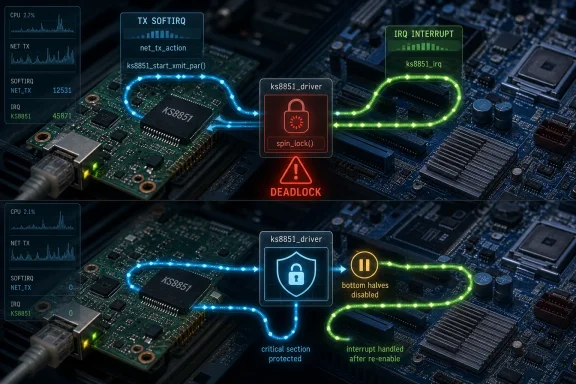
The short version is brutally kernel-ish: the KS8851 driver woke the transmit queue while still holding a lock, bottom halves were allowed to run, and the networking softirq path could circle back into the same driver and try to take the same lock again. The fix reinstates bottom-half disabling around critical sections, including the IRQ handler, so deferred transmit work waits until the handler has finished doing the fragile part. That may sound like plumbing, but in Linux networking, plumbing is where uptime lives.
The KS8851 is not a headline-grabbing component. It is a compact Ethernet controller used in embedded boards and industrial-style systems where wired networking is needed but the main system-on-chip does not provide the exact interface the design requires. The Linux driver supports variants of the hardware, including SPI and parallel-connected forms, and it has accumulated the sort of maintenance history that old peripheral drivers often do: functional fixes, locking changes, interrupt behavior tweaks, and regressions that only appear when timing lines up just so.
That context matters because CVE-2026-46031 is not a browser sandbox escape, not a wormable remote execution bug, and not a cloud-scale cryptographic disaster. It is a denial-of-service class kernel deadlock in a specific network driver. But dismissing it as obscure would miss the point. In embedded and operational technology environments, “specific network driver” often means “the only network port the device has.”
The bug was received into the CVE ecosystem from kernel.org and, at the time of publication, NVD had marked the record as awaiting enrichment. That means the public record existed, the technical description was available, and references to stable kernel commits had been attached, but NVD had not yet supplied its own CVSS scoring or weakness classification. For administrators, that creates a familiar gap: the engineering facts are clearer than the dashboard severity.
The engineering facts are enough to act on. If a system uses the KS8851 driver and can receive traffic while transmitting, the failure mode is a kernel-level deadlock. Whether an attacker can reliably trigger it depends on the hardware, kernel configuration, traffic path, and workload. Whether a product owner should patch it depends on something simpler: whether that Ethernet controller is in the device and whether a frozen network stack is acceptable.
The vulnerable path begins in
The trouble starts when the handler is still in a critical section. If packet receive processing also happens,
Now the kernel has stepped on its own shoelace. The transmit callback attempts to lock a spinlock already held by the interrupt handler path that led to it. On a real-time kernel configuration, where lock behavior is transformed to support preemption and bounded latency, the failure shows up as a lock wait that cannot resolve. The trace in the CVE record walks straight through
That is why this vulnerability is best understood as a re-entrancy bug. The same driver is re-entered through a deferred networking path before its interrupt handler has safely exited. Nothing exotic has to be smuggled through a frame payload. The failure is in timing, locking, and the kernel’s division of urgent and deferred work.
“Bottom halves” is old kernel terminology, but it remains a useful mental model. The top half acknowledges the hardware event and does the minimum needed to keep the system moving. The bottom half runs later, when the kernel can afford to do more substantial work. Networking depends heavily on this split because packet transmit and receive paths can generate cascades of follow-on processing.
The CVE-2026-46031 fix is about controlling when that “later” is allowed to begin. Disabling bottom halves around a critical section does not mean the kernel forgets about the pending transmit work. It means the kernel defers it until the code that must not be re-entered has finished. Once bottom halves are re-enabled, the softirq can run without trying to grab a lock already held by its own caller’s ancestor.
That distinction is important because the fix is not a broad “turn interrupts off and hope” hammer. The patch reinstates bottom-half exclusion around the critical driver paths, including the IRQ handler wrapper for the affected variant. The goal is precision: prevent
In ordinary user-space terms, this is like preventing an event callback from firing while the object it wants to mutate is halfway through a locked update. In kernel-space terms, the consequences are harsher. A bad callback ordering in a GUI app might freeze a window; a bad callback ordering in a network driver can freeze the system path that administrators rely on to recover the box.
In the failing trace, the kernel winds through
PREEMPT_RT often functions as a stress test for lazy driver assumptions. Code that assumes softirqs will not run at an awkward point, or that a lock will not become sleepable, can behave differently once the real-time patches are in play. That is not an indictment of real-time Linux. It is one of the reasons real-time Linux has become valuable: it forces driver code to state its concurrency assumptions instead of inheriting them from a less preemptible world.
The CVE record also notes that the failure is not limited to PREEMPT_RT in all circumstances. Since an earlier commit intended to fix a deadlock with the SPI chip variant, the deadlock could reportedly be triggered without a received packet in the RX FIFO on non-RT kernels as well. That makes the issue broader than a niche real-time configuration bug, even if real-time systems remain the most obvious place to care deeply.
For WindowsForum readers who mostly live in Microsoft infrastructure, the lesson still translates. Modern operating systems all split urgent interrupt work from deferred processing, and all mature kernels carry decades of driver code whose locking rules were written for earlier assumptions. Whether the deferred work is called a softirq, DPC, work item, or something else, the hard part is the same: preventing code from being called again while it is still inside a critical region.
For a general-purpose Linux laptop or server, the answer is usually “probably not,” because most such systems do not use a KS8851 Ethernet controller. For an embedded gateway, lab instrument, industrial controller, point-of-sale peripheral, or custom board, the answer can be very different. Small Ethernet chips are common precisely in places where the network port is not glamorous enough to be noticed until it stops responding.
The practical attacker model is also constrained. The CVE text describes a deadlock condition involving transmit queue wake-up, receive activity, softirq execution, and driver locking. That does not automatically imply that any remote host can trivially knock over any affected device with a single packet. It does imply that traffic timing can participate in the failure, and that systems exposed to untrusted or noisy networks deserve attention.
Security teams should resist the temptation to treat “no CVSS yet” as “no urgency.” NVD enrichment lag is a workflow artifact, not a safety signal. Kernel.org has already supplied the substantive description and stable references. If your estate includes affected kernels and hardware, the absence of a score should not delay engineering review.
At the same time, this is not a reason for panic across the Linux ecosystem. The vulnerable surface is hardware-specific. The fix is available in stable kernel lines. The right response is targeted inventory and patching, not dramatic firewall theater.
What makes the patch interesting is that it “reinstates” disabling of bottom halves. That word carries history. Kernel driver maintenance is often a sequence of local improvements that look correct in isolation but change timing in ways the original code relied upon. A previous change that removed or refactored bottom-half exclusion may have solved one problem while reopening another.
This is the danger of concurrency fixes in mature drivers. A patch that reduces latency, shortens a critical section, or moves receive processing out of an interrupt path can be objectively well-motivated and still alter the interleaving of TX and RX paths. In networking drivers, TX completion, queue wake-up, RX allocation, and softirq scheduling are not independent chores. They are a choreography.
The trace in the CVE record shows the choreography breaking at the seam between receive allocation and transmit processing.
That is a subtle but important distinction. Many administrators think of driver bugs as either missing locks or bad memory bounds. CVE-2026-46031 is a third category: the lock exists, but the execution context is wrong. The kernel did exactly what it was allowed to do, just at a time the driver could not survive.
A server administrator running a mainstream distribution may get the fix through normal kernel updates if the affected driver is enabled and the relevant stable tree is part of the vendor’s maintenance stream. An embedded product team may need to pull a stable backport into a vendor kernel that is not otherwise close to current. A device owner may have no direct kernel update path at all and must wait for firmware from the manufacturer.
That is why CVEs in drivers like KS8851 often expose a supply-chain problem rather than a pure technical one. The patch may be concise, public, and already backported, but the vulnerable device may be running a heavily customized kernel maintained by a board vendor, an OEM, or an integrator. The people operating the device may not know what Ethernet controller is inside it, let alone which Linux driver is bound to it.
For organizations with a hardware asset inventory, this is a moment to validate how deep that inventory goes. Knowing that a device runs “Linux” is not enough. Knowing the kernel version is better. Knowing the network controller, driver, kernel configuration, and vendor patch channel is what makes a vulnerability like this actionable.
Windows-heavy shops should not tune out here. Many Windows environments also contain Linux appliances: backup targets, VPN concentrators, monitoring probes, NAS devices, KVM-over-IP boxes, industrial gateways, camera systems, and lab equipment. Those devices rarely show up in endpoint management dashboards, but they still sit on the network and still fail in ways that become the Windows admin’s problem at 3 a.m.
The KS8851 driver’s history illustrates the maintenance burden. There have been prior fixes involving deadlocks, IRQ handling, transmit stalls, and receive packet queuing. Some of those changes addressed genuine bugs; some altered assumptions that later had to be revisited. This is not a sign that the driver is uniquely bad. It is a sign that low-level network drivers are difficult software sitting at the intersection of hardware registers, kernel locks, interrupt timing, and packet scheduling.
Embedded systems make this harder because they often freeze kernel versions for years. A board support package may be based on a stable kernel that was current when the product was designed, then patched selectively for security and hardware enablement. Over time, the distance between upstream and the deployed kernel grows, and each backport becomes a judgment call.
That judgment call is especially tricky for concurrency fixes. A memory corruption patch usually has an obvious direction: apply the bounds check or type fix. A locking change may require understanding whether adjacent patches are also needed, whether the driver variant differs from upstream, and whether PREEMPT_RT is enabled. Applying one patch without its context can be risky; not applying it can be riskier.
This is where security operations and kernel engineering need to meet. A vulnerability scanner may identify CVE-2026-46031 by kernel version or package metadata, but it cannot always know whether the KS8851 hardware is present or whether the driver is built and active. Conversely, the embedded engineer may know the board intimately but not see the CVE feed. The fix lives between those two worlds.
If the driver is not present and the hardware is not used, the vulnerability is not practically relevant to that system. If the driver is present but the network interface is disabled or not connected to untrusted networks, the risk changes but does not disappear. If the device uses KS8851 as a production network interface, especially in an embedded or real-time configuration, patch planning should move up the queue.
Administrators should also separate build-time exposure from runtime exposure. A kernel may include the driver as a module without loading it. A device may include the hardware but use a vendor-modified driver. A real-time kernel may make the failure easier to trigger, but the CVE text indicates non-RT paths may also be implicated under certain conditions. The right answer is rarely a single yes-or-no from a scanner.
The operational symptom to watch for is not data theft. It is a hang, deadlock warning, or networking freeze that may require rebooting the device. Logs may show lock traces involving
For high-availability systems, the remediation conversation should include redundancy. Patching is the direct fix, but a device whose only management path is the affected Ethernet port may need maintenance-window planning. If a field device locks up during the wrong traffic pattern, remote recovery may not be available.
For security programs built around NVD fields, that lag creates friction. Dashboards may show “awaiting enrichment,” severity may be blank, and automated prioritization may stall. But kernel maintainers do not wait for NVD to score a driver deadlock before merging a fix. The real source of truth for remediation is the kernel stable process and the downstream vendor update channel.
This mismatch is particularly awkward for Linux kernel CVEs because the kernel is both a product and a component. The same CVE may be irrelevant to one system, critical to another, and unobservable to a third because the driver is not built. A single base score struggles to encode that hardware dependency. Even if NVD later assigns a severity, local context will dominate.
The better vulnerability management model is layered. Use CVE feeds to learn that an issue exists. Use kernel and vendor advisories to identify fixed versions. Use asset inventory to determine whether the affected code can run. Use operational context to decide urgency. CVE-2026-46031 is almost tailor-made to punish teams that skip the middle steps.
It also shows why the kernel’s move toward assigning and publishing more CVEs can feel noisy while still being useful. Many of these records are not internet-wide emergencies. They are precise statements that a real bug was fixed in a real subsystem. For the people running that subsystem, precision beats drama.
For distribution users, normal kernel security updates are the likely path. For embedded vendors, the task is to pull the relevant stable patch into supported firmware releases and test the affected driver under TX/RX load, including PREEMPT_RT configurations where applicable. For organizations buying appliances, the task is to ask vendors whether their products use KS8851 and whether CVE-2026-46031 is fixed in current firmware.
This is also a reminder that “network device” does not always mean rack-mounted switch. A small Ethernet controller can sit inside an access panel, medical peripheral, power controller, print subsystem, sensor gateway, or building-management device. These systems may not be glamorous, but their failure modes are tangible. A deadlocked driver is a denial of service whether or not it earns a high score.
There is no indication from the CVE text that CVE-2026-46031 enables code execution or privilege escalation. Treating it as such would be careless. But there is equally no reason to ignore it if your environment depends on affected hardware. Availability bugs are security bugs when availability is part of the system’s promise.
The cleanest risk statement is this: CVE-2026-46031 is a targeted Linux kernel availability issue in the KS8851 Ethernet driver, fixed by restoring bottom-half exclusion around lock-sensitive interrupt handling. It is narrow, but not trivial. It is technical, but not theoretical.
The short version is brutally kernel-ish: the KS8851 driver woke the transmit queue while still holding a lock, bottom halves were allowed to run, and the networking softirq path could circle back into the same driver and try to take the same lock again. The fix reinstates bottom-half disabling around critical sections, including the IRQ handler, so deferred transmit work waits until the handler has finished doing the fragile part. That may sound like plumbing, but in Linux networking, plumbing is where uptime lives.
 A Small Ethernet Chip Lands in a Big Kernel Lesson
The KS8851 is not a headline-grabbing component. It is a compact Ethernet controller used in embedded boards and industrial-style systems where wired networking is needed but the main system-on-chip does not provide the exact interface the design requires. The Linux driver supports variants of the hardware, including SPI and parallel-connected forms, and it has accumulated the sort of maintenance history that old peripheral drivers often do: functional fixes, locking changes, interrupt behavior tweaks, and regressions that only appear when timing lines up just so.That context matters because CVE-2026-46031 is not a browser sandbox escape, not a wormable remote execution bug, and not a cloud-scale cryptographic disaster. It is a denial-of-service class kernel deadlock in a specific network driver. But dismissing it as obscure would miss the point. In embedded and operational technology environments, “specific network driver” often means “the only network port the device has.”
The bug was received into the CVE ecosystem from kernel.org and, at the time of publication, NVD had marked the record as awaiting enrichment. That means the public record existed, the technical description was available, and references to stable kernel commits had been attached, but NVD had not yet supplied its own CVSS scoring or weakness classification. For administrators, that creates a familiar gap: the engineering facts are clearer than the dashboard severity.
The engineering facts are enough to act on. If a system uses the KS8851 driver and can receive traffic while transmitting, the failure mode is a kernel-level deadlock. Whether an attacker can reliably trigger it depends on the hardware, kernel configuration, traffic path, and workload. Whether a product owner should patch it depends on something simpler: whether that Ethernet controller is in the device and whether a frozen network stack is acceptable.
The Bug Is a Re-Entrancy Trap, Not a Packet Parser Disaster
Many network CVEs involve malformed packets smashing assumptions in protocol parsing code. CVE-2026-46031 is different. The issue is not that the KS8851 driver misreads an Ethernet frame and corrupts memory. The issue is that ordinary kernel work happens in an unsafe order.The vulnerable path begins in
ks8851_irq(), the driver’s interrupt handler. When the device has transmitted a packet, the driver may call netif_wake_queue(), telling the networking stack that the device is ready for more transmit work. That wake-up can schedule the transmit softirq, net_tx_action, which is normal Linux networking machinery.The trouble starts when the handler is still in a critical section. If packet receive processing also happens,
ks8851_rx_pkts() may allocate socket buffers through netdev_alloc_skb_ip_align(). In the described failure, that allocation path eventually enables bottom halves, and enabling bottom halves can process a pending softirq. The transmit softirq can then call into the driver’s transmit callback, ks8851_start_xmit_par().Now the kernel has stepped on its own shoelace. The transmit callback attempts to lock a spinlock already held by the interrupt handler path that led to it. On a real-time kernel configuration, where lock behavior is transformed to support preemption and bounded latency, the failure shows up as a lock wait that cannot resolve. The trace in the CVE record walks straight through
net_tx_action, dev_hard_start_xmit, and into ks8851_start_xmit_par() before it stalls on the driver lock.That is why this vulnerability is best understood as a re-entrancy bug. The same driver is re-entered through a deferred networking path before its interrupt handler has safely exited. Nothing exotic has to be smuggled through a frame payload. The failure is in timing, locking, and the kernel’s division of urgent and deferred work.
Bottom Halves Are the Kernel’s Promise to Finish Later
Linux interrupt handling is built around a practical compromise. Hardware interrupts need to be handled quickly, but much of the work triggered by an interrupt is too expensive, too complex, or too risky to do immediately. So the kernel splits work between immediate interrupt context and deferred mechanisms such as softirqs, tasklets, NAPI polling, and workqueues.“Bottom halves” is old kernel terminology, but it remains a useful mental model. The top half acknowledges the hardware event and does the minimum needed to keep the system moving. The bottom half runs later, when the kernel can afford to do more substantial work. Networking depends heavily on this split because packet transmit and receive paths can generate cascades of follow-on processing.
The CVE-2026-46031 fix is about controlling when that “later” is allowed to begin. Disabling bottom halves around a critical section does not mean the kernel forgets about the pending transmit work. It means the kernel defers it until the code that must not be re-entered has finished. Once bottom halves are re-enabled, the softirq can run without trying to grab a lock already held by its own caller’s ancestor.
That distinction is important because the fix is not a broad “turn interrupts off and hope” hammer. The patch reinstates bottom-half exclusion around the critical driver paths, including the IRQ handler wrapper for the affected variant. The goal is precision: prevent
net_tx_action() from running at the one moment where it can deadlock the driver, then let the networking stack catch up normally.In ordinary user-space terms, this is like preventing an event callback from firing while the object it wants to mutate is halfway through a locked update. In kernel-space terms, the consequences are harsher. A bad callback ordering in a GUI app might freeze a window; a bad callback ordering in a network driver can freeze the system path that administrators rely on to recover the box.
Real-Time Linux Makes the Race Easier to See
The CVE description calls outCONFIG_PREEMPT_RT=y, and that is not incidental. PREEMPT_RT changes Linux’s locking and interrupt behavior to make the kernel more suitable for real-time workloads. It turns many spinlocks into sleepable real-time mutexes and moves more interrupt handling into threaded contexts, improving latency characteristics at the cost of exposing assumptions that non-real-time kernels may have gotten away with.In the failing trace, the kernel winds through
schedule_rtlock, rtlock_slowlock_locked, and rt_spin_lock. That tells a clear story: this is a lock dependency problem manifesting in the real-time locking model. The driver attempts to acquire a lock it already effectively owns through the still-active interrupt path, and the scheduler cannot make progress because progress depends on returning from the path that is now waiting.PREEMPT_RT often functions as a stress test for lazy driver assumptions. Code that assumes softirqs will not run at an awkward point, or that a lock will not become sleepable, can behave differently once the real-time patches are in play. That is not an indictment of real-time Linux. It is one of the reasons real-time Linux has become valuable: it forces driver code to state its concurrency assumptions instead of inheriting them from a less preemptible world.
The CVE record also notes that the failure is not limited to PREEMPT_RT in all circumstances. Since an earlier commit intended to fix a deadlock with the SPI chip variant, the deadlock could reportedly be triggered without a received packet in the RX FIFO on non-RT kernels as well. That makes the issue broader than a niche real-time configuration bug, even if real-time systems remain the most obvious place to care deeply.
For WindowsForum readers who mostly live in Microsoft infrastructure, the lesson still translates. Modern operating systems all split urgent interrupt work from deferred processing, and all mature kernels carry decades of driver code whose locking rules were written for earlier assumptions. Whether the deferred work is called a softirq, DPC, work item, or something else, the hard part is the same: preventing code from being called again while it is still inside a critical region.
The Security Label Is Less Important Than the Failure Mode
NVD had not provided a CVSS score for CVE-2026-46031 when the record appeared. That may frustrate vulnerability management systems that want every finding reduced to a number, but in this case a score would only partially describe the risk. The meaningful question is not whether the bug sounds severe in the abstract. It is whether the affected driver sits on a reachable network interface in a device that must not hang.For a general-purpose Linux laptop or server, the answer is usually “probably not,” because most such systems do not use a KS8851 Ethernet controller. For an embedded gateway, lab instrument, industrial controller, point-of-sale peripheral, or custom board, the answer can be very different. Small Ethernet chips are common precisely in places where the network port is not glamorous enough to be noticed until it stops responding.
The practical attacker model is also constrained. The CVE text describes a deadlock condition involving transmit queue wake-up, receive activity, softirq execution, and driver locking. That does not automatically imply that any remote host can trivially knock over any affected device with a single packet. It does imply that traffic timing can participate in the failure, and that systems exposed to untrusted or noisy networks deserve attention.
Security teams should resist the temptation to treat “no CVSS yet” as “no urgency.” NVD enrichment lag is a workflow artifact, not a safety signal. Kernel.org has already supplied the substantive description and stable references. If your estate includes affected kernels and hardware, the absence of a score should not delay engineering review.
At the same time, this is not a reason for panic across the Linux ecosystem. The vulnerable surface is hardware-specific. The fix is available in stable kernel lines. The right response is targeted inventory and patching, not dramatic firewall theater.
The Patch Reasserts an Old Rule: Do Not Let Deferred Work Re-Enter Locked Driver Code
The fix described in the CVE is conceptually small: disable bottom halves around critical sections, including the IRQ handler, and re-enable them after the handler has completed its other actions. That preventsnet_tx_action() from running while the KS8851 driver is still inside the lock-sensitive region. Once bottom halves are re-enabled, the pending transmit processing can proceed.What makes the patch interesting is that it “reinstates” disabling of bottom halves. That word carries history. Kernel driver maintenance is often a sequence of local improvements that look correct in isolation but change timing in ways the original code relied upon. A previous change that removed or refactored bottom-half exclusion may have solved one problem while reopening another.
This is the danger of concurrency fixes in mature drivers. A patch that reduces latency, shortens a critical section, or moves receive processing out of an interrupt path can be objectively well-motivated and still alter the interleaving of TX and RX paths. In networking drivers, TX completion, queue wake-up, RX allocation, and softirq scheduling are not independent chores. They are a choreography.
The trace in the CVE record shows the choreography breaking at the seam between receive allocation and transmit processing.
__alloc_skb leads into bottom-half enabling, bottom-half enabling leads to softirq handling, softirq handling leads to transmit, and transmit leads back into the driver lock. The driver is not failing because it forgot to lock. It is failing because it locked and then allowed a path that needed the same lock to run too soon.That is a subtle but important distinction. Many administrators think of driver bugs as either missing locks or bad memory bounds. CVE-2026-46031 is a third category: the lock exists, but the execution context is wrong. The kernel did exactly what it was allowed to do, just at a time the driver could not survive.
Stable Kernel Backports Are the Real Remediation Channel
The CVE record points to several stable kernel commits, which is what administrators and vendors should care about more than the upstream patch alone. In Linux, the fix that matters is the one that lands in the kernel stream your distribution, board support package, or appliance firmware actually ships. For embedded Linux, that can be a complicated map.A server administrator running a mainstream distribution may get the fix through normal kernel updates if the affected driver is enabled and the relevant stable tree is part of the vendor’s maintenance stream. An embedded product team may need to pull a stable backport into a vendor kernel that is not otherwise close to current. A device owner may have no direct kernel update path at all and must wait for firmware from the manufacturer.
That is why CVEs in drivers like KS8851 often expose a supply-chain problem rather than a pure technical one. The patch may be concise, public, and already backported, but the vulnerable device may be running a heavily customized kernel maintained by a board vendor, an OEM, or an integrator. The people operating the device may not know what Ethernet controller is inside it, let alone which Linux driver is bound to it.
For organizations with a hardware asset inventory, this is a moment to validate how deep that inventory goes. Knowing that a device runs “Linux” is not enough. Knowing the kernel version is better. Knowing the network controller, driver, kernel configuration, and vendor patch channel is what makes a vulnerability like this actionable.
Windows-heavy shops should not tune out here. Many Windows environments also contain Linux appliances: backup targets, VPN concentrators, monitoring probes, NAS devices, KVM-over-IP boxes, industrial gateways, camera systems, and lab equipment. Those devices rarely show up in endpoint management dashboards, but they still sit on the network and still fail in ways that become the Windows admin’s problem at 3 a.m.
Embedded Linux Carries the Long Tail of Kernel Risk
CVE-2026-46031 is a useful case study because it lives in the long tail. The Linux kernel supports an enormous range of hardware, from flagship servers to tiny boards designed around a single Ethernet controller. That breadth is one of Linux’s strengths. It also means driver bugs can remain dormant until a specific configuration, timing pattern, or hardware variant makes them visible.The KS8851 driver’s history illustrates the maintenance burden. There have been prior fixes involving deadlocks, IRQ handling, transmit stalls, and receive packet queuing. Some of those changes addressed genuine bugs; some altered assumptions that later had to be revisited. This is not a sign that the driver is uniquely bad. It is a sign that low-level network drivers are difficult software sitting at the intersection of hardware registers, kernel locks, interrupt timing, and packet scheduling.
Embedded systems make this harder because they often freeze kernel versions for years. A board support package may be based on a stable kernel that was current when the product was designed, then patched selectively for security and hardware enablement. Over time, the distance between upstream and the deployed kernel grows, and each backport becomes a judgment call.
That judgment call is especially tricky for concurrency fixes. A memory corruption patch usually has an obvious direction: apply the bounds check or type fix. A locking change may require understanding whether adjacent patches are also needed, whether the driver variant differs from upstream, and whether PREEMPT_RT is enabled. Applying one patch without its context can be risky; not applying it can be riskier.
This is where security operations and kernel engineering need to meet. A vulnerability scanner may identify CVE-2026-46031 by kernel version or package metadata, but it cannot always know whether the KS8851 hardware is present or whether the driver is built and active. Conversely, the embedded engineer may know the board intimately but not see the CVE feed. The fix lives between those two worlds.
For Administrators, the First Step Is Hardware Truth
The most useful response to CVE-2026-46031 begins with inventory. Determine whether any Linux systems in your environment use the KS8851 driver. On conventional Linux systems, that may involve checking loaded modules, kernel configuration, device tree entries, PCI/SPI platform data, or boot logs. On appliances, it may require vendor documentation or direct support requests.If the driver is not present and the hardware is not used, the vulnerability is not practically relevant to that system. If the driver is present but the network interface is disabled or not connected to untrusted networks, the risk changes but does not disappear. If the device uses KS8851 as a production network interface, especially in an embedded or real-time configuration, patch planning should move up the queue.
Administrators should also separate build-time exposure from runtime exposure. A kernel may include the driver as a module without loading it. A device may include the hardware but use a vendor-modified driver. A real-time kernel may make the failure easier to trigger, but the CVE text indicates non-RT paths may also be implicated under certain conditions. The right answer is rarely a single yes-or-no from a scanner.
The operational symptom to watch for is not data theft. It is a hang, deadlock warning, or networking freeze that may require rebooting the device. Logs may show lock traces involving
ks8851_start_xmit_par, net_tx_action, softirq handling, and ks8851_irq. In an appliance, those traces may be hidden unless serial console logging or persistent kernel logs are configured.For high-availability systems, the remediation conversation should include redundancy. Patching is the direct fix, but a device whose only management path is the affected Ethernet port may need maintenance-window planning. If a field device locks up during the wrong traffic pattern, remote recovery may not be available.
The CVE Machine Still Struggles With Kernel Reality
There is a broader story here about vulnerability records and kernel development. CVE-2026-46031 arrived with a detailed technical description from kernel.org but without NVD scoring. That is increasingly common in fast-moving open-source ecosystems. The fix and the engineering explanation can exist before the centralized vulnerability database has finished classifying the issue.For security programs built around NVD fields, that lag creates friction. Dashboards may show “awaiting enrichment,” severity may be blank, and automated prioritization may stall. But kernel maintainers do not wait for NVD to score a driver deadlock before merging a fix. The real source of truth for remediation is the kernel stable process and the downstream vendor update channel.
This mismatch is particularly awkward for Linux kernel CVEs because the kernel is both a product and a component. The same CVE may be irrelevant to one system, critical to another, and unobservable to a third because the driver is not built. A single base score struggles to encode that hardware dependency. Even if NVD later assigns a severity, local context will dominate.
The better vulnerability management model is layered. Use CVE feeds to learn that an issue exists. Use kernel and vendor advisories to identify fixed versions. Use asset inventory to determine whether the affected code can run. Use operational context to decide urgency. CVE-2026-46031 is almost tailor-made to punish teams that skip the middle steps.
It also shows why the kernel’s move toward assigning and publishing more CVEs can feel noisy while still being useful. Many of these records are not internet-wide emergencies. They are precise statements that a real bug was fixed in a real subsystem. For the people running that subsystem, precision beats drama.
The Practical Fix Is Small; the Process Fix Is Not
The code-level remediation is straightforward from the outside: run a kernel that includes the stable fix for the KS8851 bottom-half locking issue. The process-level remediation is harder: know which devices need that kernel, know who supplies it, and know how quickly it can be deployed without breaking the product.For distribution users, normal kernel security updates are the likely path. For embedded vendors, the task is to pull the relevant stable patch into supported firmware releases and test the affected driver under TX/RX load, including PREEMPT_RT configurations where applicable. For organizations buying appliances, the task is to ask vendors whether their products use KS8851 and whether CVE-2026-46031 is fixed in current firmware.
This is also a reminder that “network device” does not always mean rack-mounted switch. A small Ethernet controller can sit inside an access panel, medical peripheral, power controller, print subsystem, sensor gateway, or building-management device. These systems may not be glamorous, but their failure modes are tangible. A deadlocked driver is a denial of service whether or not it earns a high score.
There is no indication from the CVE text that CVE-2026-46031 enables code execution or privilege escalation. Treating it as such would be careless. But there is equally no reason to ignore it if your environment depends on affected hardware. Availability bugs are security bugs when availability is part of the system’s promise.
The cleanest risk statement is this: CVE-2026-46031 is a targeted Linux kernel availability issue in the KS8851 Ethernet driver, fixed by restoring bottom-half exclusion around lock-sensitive interrupt handling. It is narrow, but not trivial. It is technical, but not theoretical.
The KS8851 Fix Leaves Administrators With a Very Specific Homework Assignment
The immediate lesson is not that every Linux system is in danger. It is that driver-level CVEs demand asset-level answers. A missing CVSS score should not stop administrators from doing the basic triage, especially when the public description already names the driver, failure path, and fix strategy.- Systems that do not use the KS8851 Ethernet driver are unlikely to be practically affected by CVE-2026-46031.
- Systems that use KS8851 hardware should be checked for a kernel or firmware update containing the stable fix.
- Real-time Linux deployments deserve special attention because the reported deadlock path is closely tied to PREEMPT_RT locking behavior.
- Embedded appliances may require vendor confirmation because the affected driver can be hidden inside customized firmware rather than visible as a normal distribution package.
- The likely impact is denial of service through a kernel deadlock, not remote code execution based on the public description.
- Security teams should track the CVE even before NVD scoring arrives, because enrichment delay does not change whether the buggy code is present.
References
- Primary source: NVD / Linux Kernel
Published: 2026-05-28T01:05:11-07:00
NVD - CVE-2026-46031
 nvd.nist.gov
- Security advisory: MSRC
Published: 2026-05-28T01:05:11-07:00
Original feed URL
Security Update Guide - Microsoft Security Response Center
 msrc.microsoft.com
- Related coverage: spinics.net
[net,PATCH v2] net: ks8851: Reinstate disabling of BHs around IRQ handler — Linux Kernel
Linux Kernel: [net,PATCH v2] net: ks8851: Reinstate disabling of BHs around IRQ handler www.spinics.net
- Related coverage: git.zx2c4.com
- Related coverage: mail-archive.com
[PATCH 4.4 098/266] net: ks8851: Delay requesting IRQ until opened
www.mail-archive.com
- Related coverage: kernelnewbies.org
