

CVE-2026-46038 is a newly published Linux kernel vulnerability, received by NVD from kernel.org on May 27, 2026, involving a QRTR name-service memory leak when a node sends a BYE control packet and the kernel fails to free the departed node. It is not a flashy remote-code-execution bug, and NVD has not yet assigned CVSS scores or enriched the record. But the fix lands in one of the places where Linux often hides operational risk: small lifecycle mistakes in networking-adjacent kernel code that can turn into slow-burn denial-of-service conditions. For WindowsForum readers, the story matters less because a typical Windows desktop is suddenly in danger and more because Linux is now part of the Windows estate through WSL, Hyper-V guests, cloud workloads, Android-derived devices, and mixed-platform infrastructure.
The vulnerable code sits in the Linux kernel’s QRTR name service, part of the Qualcomm IPC Router stack. QRTR is not the network stack most administrators mean when they say “networking,” and that is exactly why this CVE is easy to misread. It is a kernel facility used for communication between processors and services, especially in Qualcomm-oriented environments where application processors, modems, DSPs, and other components need a structured way to discover and talk to one another.
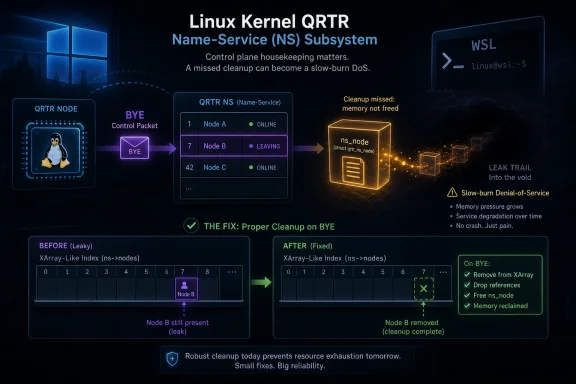
The bug is simple in the way many durable kernel bugs are simple. A node announces that it is going away by sending a BYE packet. The name service should tell observers that the node has disappeared, remove it from its internal tracking structure, and free the memory associated with that node. Instead, according to the vulnerability description, the code processed the BYE but left the node memory behind.
That makes CVE-2026-46038 a memory leak, not a direct privilege escalation and not a data disclosure. There is no public NVD score yet, no NIST vector, and no enriched weakness classification at the time of publication. The record is still in the “awaiting enrichment” state, which is bureaucratic language for a vulnerability that has been assigned and published but not fully interpreted by NVD’s scoring machinery.
The practical question is therefore not “how scary is the CVSS number?” The practical question is whether a reachable code path can be exercised often enough, by the right kind of local or adjacent actor, to degrade system stability. In kernel space, even modest leaks deserve more respect than their short descriptions usually receive.
That does not make the issue fake, inflated, or irrelevant. It means the industry is being asked to metabolize kernel maintenance as security intelligence. A memory leak in a kernel subsystem may never become a practical exploit in a mainstream server fleet, but it is still a defect in privileged code that can consume resources outside the control of normal user-space garbage collection, process termination, or service restarts.
This is where CVSS can be a poor first reader. A still-unscored CVE looks unfinished, and in a narrow compliance dashboard it may appear less urgent than a scored vulnerability with an alarming color band. Yet the absence of a score is not evidence of safety. It is evidence that the record has not yet been fully processed by NVD.
For administrators, the right response is neither panic nor dismissal. Treat CVE-2026-46038 as a kernel maintenance signal. If your systems use affected QRTR code paths, the fix matters. If they do not, the CVE becomes part of the broader kernel update drumbeat rather than an emergency change window.
In distributed systems, teardown paths often receive less glamour than startup paths. Developers test whether services appear, register, answer, and route traffic. The disappearance path can be more chaotic, especially when the departing peer is not guaranteed to behave like a polite process calling an orderly destructor. Kernel code has to assume messy reality: devices vanish, firmware restarts, transports flap, and subsystems receive repeated signals that something is gone.
The QRTR name service exists to keep track of nodes and services. If a node goes down and the name service announces that removal but keeps the node allocation around, the visible state and the internal state diverge. Observers may believe the system has cleaned up, while the kernel retains memory for something that should no longer exist.
That kind of mismatch is often more operationally corrosive than it looks. The first failure may be invisible. The tenth may be unmeasured. The thousandth may show up as memory pressure, unexplained instability, or a reboot blamed on “the kernel” rather than on a specific stale object left behind in a nameserver data structure.
Inside the kernel, however, resource exhaustion is not a minor condition. Kernel memory is finite, privileged, and shared. If a subsystem leaks memory on a reachable path, the cost is not confined to the component that made the mistake. Other allocations can fail, latencies can increase, reclaim behavior can become pathological, and unrelated workloads can become unstable.
The CVE text does not claim arbitrary code execution, privilege escalation, or information disclosure. That restraint matters. The known issue is a leak of node memory after BYE processing, and the known fix is to remove the node from the XArray list and free it in both success and failure paths. Anything beyond that needs evidence.
But denial of service is not just about a single packet crashing a system. Slow denial of service can be more insidious in production because it hides inside normal maintenance events. A node goes down, comes up, goes down again. A subsystem restarts. A test harness cycles through states. A malicious local actor, if positioned to send the relevant control messages, may not need a crash primitive if it can force enough allocations to accumulate.
The phrase memory leak sounds boring until the leaked memory belongs to the kernel and the trigger is part of an ordinary lifecycle message.
That is the first scoping task. A generic cloud VM running a distribution kernel may carry a large amount of kernel code that is not actively used. A mobile or embedded system may rely on QRTR more directly. A developer workstation may encounter it through hardware enablement or testing environments rather than through a production service.
This is why blanket statements about “Linux is vulnerable” are less useful than they sound. The Linux kernel is an enormous codebase shipped in very different forms. A vulnerability in a subsystem can be technically present in a source tree, compiled as a module in one distribution, built into the kernel in another, disabled by configuration in a third, and operationally unreachable in a fourth.
The stable-kernel references attached to the CVE show that maintainers treated the fix as backportable, which is important. Stable inclusion does not prove broad exploitability, but it does tell administrators that the kernel community considered the cleanup bug worth carrying into maintained branches. That is the difference between a theoretical code hygiene note and a fix expected to flow downstream into real kernels.
WSL is the obvious example. Developers run Linux userlands on Windows machines, often with access to source trees, package managers, language ecosystems, and internal services. WSL’s kernel servicing model is not identical to a conventional distribution kernel, but it has trained Windows administrators to think of Linux as a local component rather than a separate server category.
Hyper-V, Azure, containers, build agents, security appliances, network devices, and Android-adjacent management fleets all widen the aperture. A Windows team may own the endpoint, the identity plane, and the patching process while Linux kernels do useful work just beneath or beside the formal Windows boundary. In that world, a Linux kernel CVE is not someone else’s problem; it is a reminder that platform ownership is now layered.
CVE-2026-46038 is not the kind of issue that should send desktop administrators hunting through every Windows laptop for hidden QRTR exposure. It is the kind of issue that should make organizations ask whether their vulnerability management process can distinguish between “Linux present,” “Linux affected,” and “Linux affected in a reachable configuration.” Those are three different states, and treating them as one produces either panic or complacency.
The best Windows admins have already learned this lesson from OpenSSL, container runtimes, firmware updaters, and cross-platform developer tooling. The operating system brand on the login screen no longer describes the whole attack surface.
The XArray detail matters because kernel bookkeeping structures are not passive storage. If an object remains indexed after its useful life is over, or if it is removed from visibility without being freed, the lifecycle contract is broken. In this CVE, the description emphasizes both removal from the XArray list and freeing the node. The object has to disappear logically and physically.
The reference to success and failure cases is also telling. Cleanup bugs often live in uneven paths: the happy path does one thing, the error path another, and a rare branch keeps ownership ambiguous. Robust kernel fixes usually make teardown unconditional at the right point. If the node is leaving, the node should not remain allocated simply because one part of the notification process failed.
This is not glamorous engineering, but it is foundational engineering. Operating systems survive by making millions of small ownership decisions correctly. Who owns the object? Who can see it? Who frees it? What happens if the peer disappears halfway through the transaction? A vulnerability like CVE-2026-46038 is a public reminder that those questions are security questions, not just code-style questions.
The absence of a score should push organizations toward contextual triage. Is QRTR enabled? Is the affected kernel present? Is the system a Qualcomm-based embedded device, mobile-derived platform, developer board, or specialized appliance? Is the code path reachable by unprivileged users, local processes, containers, or only trusted kernel-adjacent components? Those questions do more work than a provisional number.
It is also possible that downstream vendors will classify the issue differently depending on configuration. A distribution that does not enable the relevant module by default may rate exposure lower. A vendor shipping Qualcomm-centric devices may treat it as more operationally relevant. An appliance manufacturer may bury the fix inside a firmware update with no obvious CVE headline at all.
That unevenness is normal, but it is dangerous when asset owners rely solely on central CVE metadata. Kernel vulnerabilities often become actionable only after they are mapped to a product, configuration, and update channel. The NVD record starts the conversation; it does not finish it.
The right interim posture is to track vendor advisories and kernel updates, not to wait passively for enrichment. By the time a score appears, the fix may already be sitting in a stable kernel package or firmware image.
At the same time, minimizing the issue because it is “only a leak” misunderstands how kernel reliability and security overlap. A system that can be pushed into memory pressure by repeated lifecycle operations is less reliable. A less reliable system is easier to disrupt. If the trigger is reachable from a lower-privileged context, the line between bug and denial-of-service vulnerability becomes thin.
The sensible operational answer is to fold CVE-2026-46038 into scheduled kernel maintenance with elevated attention for systems likely to use QRTR. For enterprise Linux servers with no relevant hardware or module exposure, this may be a routine update. For embedded fleets, Qualcomm development platforms, Android-derived systems, and devices where modem or co-processor communication is central, it deserves closer vendor tracking.
Administrators should also remember that kernel updates are often bundled. The patch that fixes this leak may arrive alongside fixes for more severe issues. Deferring a kernel update because this particular CVE lacks a score can accidentally defer a cluster of fixes with broader impact.
That is the unglamorous reality of kernel security in 2026. You rarely patch one CVE. You patch a moving body of maintenance work, then verify that your workloads, drivers, and security controls still behave.
That inventory gap is where modest CVEs become lingering risk. A server team may update its main Linux fleet quickly while embedded devices remain frozen for months. A security team may close the finding for known hosts while vendor-managed appliances keep shipping an affected kernel. A development group may run custom kernels or board-support packages that do not align neatly with distribution advisories.
QRTR makes that problem more pronounced because it is not a headline subsystem like TCP, ext4, or KVM. It is specialized enough to be overlooked and foundational enough in certain environments to matter. The organizations most likely to need the fix are also the organizations most likely to receive it through hardware-vendor channels rather than through the familiar monthly patch routine.
For Windows-heavy shops, this is a governance problem. Who owns Linux components embedded in Windows-adjacent workflows? Who tracks kernel updates for WSL images, lab devices, cross-platform build hosts, and appliances? Who decides whether a CVE in a subsystem like QRTR is relevant or not? If the answer is “the scanner,” the organization is already behind.
Security programs mature when they stop treating platform boundaries as organizational boundaries. CVE-2026-46038 is small enough to expose whether that maturity exists.
When multiple CVEs appear in the same specialized subsystem, defenders should ask whether maintainers are simply cleaning up a long-neglected corner or whether attackers and researchers have begun paying closer attention to it. Often the answer is both. Focus attracts scrutiny, scrutiny finds lifecycle mistakes, and fixes reveal adjacent assumptions that deserve review.
That does not mean QRTR is uniquely broken. It means QRTR is subject to the same rule as every other kernel subsystem: once a path becomes security-relevant, old assumptions are reexamined under harsher light. Code written for constrained device communication may find itself running in broader, more complex, and less trusted environments than its original designers imagined.
The pattern matters for vendors, especially those building products on long-term kernel branches with extensive hardware enablement patches. A single memory leak fix may be easy to backport. A cluster of QRTR hardening changes may require more careful regression testing, particularly where modem, DSP, or co-processor communication is central to device behavior.
For buyers and administrators, the practical lesson is to watch the vendor response, not just the CVE feed. The presence of stable upstream commits is encouraging. The question is how quickly they reach the kernel you actually boot.
That kind of calibrated message is especially important for mixed Windows and Linux environments. Windows administrators are accustomed to Microsoft’s monthly cadence, severity ratings, and relatively centralized servicing model. Linux kernel fixes move through upstream commits, stable branches, distribution kernels, vendor trees, and appliance firmware. The same CVE can have different urgency depending on which of those layers you inhabit.
There is also a cultural difference. Linux kernel CVE descriptions often state the fix in terse engineering language, assuming readers understand the subsystem and can infer the consequence. Enterprise security tooling then tries to turn that sentence into a risk score. Somewhere in the middle, the nuance gets flattened.
CVE-2026-46038 deserves the nuance. It is not a banner exploit. It is not irrelevant housekeeping. It is a kernel memory-management flaw in a specialized name-service path, fixed upstream, awaiting enriched scoring, and important mainly where the affected code is present and reachable.
That may sound less satisfying than a red-alert headline, but it is the truth most administrators can actually use.
The broader lesson is about teardown logic. Security discussions often focus on input validation, authentication, cryptography, and memory corruption. But resource ownership at shutdown is just as important. A component that registers must unregister. A node that departs must be removed. An allocation that outlives its object is a liability.
This is especially true in systems that operate continuously. Phones, routers, gateways, industrial devices, hypervisors, and servers do not get the luxury of a clean process restart for every kernel subsystem. A leak in a frequently exercised path can accumulate across uptime in ways that are hard to reproduce in short tests.
Kernel developers know this, which is why the fix targets the exact lifecycle moment where the object should die. The lesson for operators is to take these small fixes seriously enough to keep current, without pretending that every one of them is a catastrophe.
That changes how we read niche kernel vulnerabilities. A QRTR bug may not affect a standard Windows desktop, but it can matter to the Android device you manage, the Linux build host your developers rely on, the embedded appliance routing traffic, or the WSL environment used for daily engineering work. The correct response starts with scoping, not assumptions.
It also means Windows administrators should push for better visibility into non-Windows kernel components. Endpoint management that cannot see WSL versions, VM kernels, appliance firmware, and developer-board images is incomplete. Vulnerability management that cannot represent “not applicable because subsystem disabled” is noisy. Asset management that cannot map vendor firmware to upstream kernel fixes is blind in precisely the place where embedded Linux risk tends to linger.
CVE-2026-46038 is a good test case because it is not emotionally overpowering. There is no need for a war room. There is a need for a process that can answer calm, specific questions.
That narrowness should make triage easier, but only if organizations can map it to real systems. A laptop with no QRTR exposure is not the same as a Qualcomm-based embedded device. A distribution kernel carrying dormant code is not the same as a product actively using that code. A lab machine rebooted daily is not the same as an edge gateway expected to run for months.
The security industry often compresses all of that into a single vulnerability row. Administrators have to decompress it.
The most defensible approach is practical and boring: follow vendor kernel updates, prioritize systems where QRTR is likely active, and avoid making severity claims that outrun the evidence. If NVD later assigns a score, it will help standardize reporting, but it will not replace environment-specific judgment.
 A Small Leak in a Subsystem Most Admins Never Think About
The vulnerable code sits in the Linux kernel’s QRTR name service, part of the Qualcomm IPC Router stack. QRTR is not the network stack most administrators mean when they say “networking,” and that is exactly why this CVE is easy to misread. It is a kernel facility used for communication between processors and services, especially in Qualcomm-oriented environments where application processors, modems, DSPs, and other components need a structured way to discover and talk to one another.The bug is simple in the way many durable kernel bugs are simple. A node announces that it is going away by sending a BYE packet. The name service should tell observers that the node has disappeared, remove it from its internal tracking structure, and free the memory associated with that node. Instead, according to the vulnerability description, the code processed the BYE but left the node memory behind.
That makes CVE-2026-46038 a memory leak, not a direct privilege escalation and not a data disclosure. There is no public NVD score yet, no NIST vector, and no enriched weakness classification at the time of publication. The record is still in the “awaiting enrichment” state, which is bureaucratic language for a vulnerability that has been assigned and published but not fully interpreted by NVD’s scoring machinery.
The practical question is therefore not “how scary is the CVSS number?” The practical question is whether a reachable code path can be exercised often enough, by the right kind of local or adjacent actor, to degrade system stability. In kernel space, even modest leaks deserve more respect than their short descriptions usually receive.
Kernel CVEs Have Become Patch Notes With Consequences
The Linux kernel project’s modern CVE pipeline has changed the tone of vulnerability reporting. Many kernel CVEs now read less like classic adversarial exploit writeups and more like precise summaries of resolved correctness bugs. CVE-2026-46038 fits that pattern almost perfectly: a lifecycle error was found, a fix was committed, stable references were attached, and the CVE record was populated from kernel.org.That does not make the issue fake, inflated, or irrelevant. It means the industry is being asked to metabolize kernel maintenance as security intelligence. A memory leak in a kernel subsystem may never become a practical exploit in a mainstream server fleet, but it is still a defect in privileged code that can consume resources outside the control of normal user-space garbage collection, process termination, or service restarts.
This is where CVSS can be a poor first reader. A still-unscored CVE looks unfinished, and in a narrow compliance dashboard it may appear less urgent than a scored vulnerability with an alarming color band. Yet the absence of a score is not evidence of safety. It is evidence that the record has not yet been fully processed by NVD.
For administrators, the right response is neither panic nor dismissal. Treat CVE-2026-46038 as a kernel maintenance signal. If your systems use affected QRTR code paths, the fix matters. If they do not, the CVE becomes part of the broader kernel update drumbeat rather than an emergency change window.
The BYE Packet Is the Whole Story
The revealing detail in CVE-2026-46038 is the BYE packet. The node is not being created in some exotic error branch or half-initialized during a rare setup failure. The node is leaving. The control message is part of shutdown, disappearance, teardown, or reconfiguration — the very moments when robust systems are supposed to be most disciplined about cleanup.In distributed systems, teardown paths often receive less glamour than startup paths. Developers test whether services appear, register, answer, and route traffic. The disappearance path can be more chaotic, especially when the departing peer is not guaranteed to behave like a polite process calling an orderly destructor. Kernel code has to assume messy reality: devices vanish, firmware restarts, transports flap, and subsystems receive repeated signals that something is gone.
The QRTR name service exists to keep track of nodes and services. If a node goes down and the name service announces that removal but keeps the node allocation around, the visible state and the internal state diverge. Observers may believe the system has cleaned up, while the kernel retains memory for something that should no longer exist.
That kind of mismatch is often more operationally corrosive than it looks. The first failure may be invisible. The tenth may be unmeasured. The thousandth may show up as memory pressure, unexplained instability, or a reboot blamed on “the kernel” rather than on a specific stale object left behind in a nameserver data structure.
Memory Leaks Are Denial-of-Service Bugs Wearing Work Clothes
Security teams tend to rank vulnerabilities by dramatic capability: remote code execution, sandbox escape, credential theft, kernel privilege escalation. Memory leaks live lower in the hierarchy because they often require repetition and patience. They are not usually the bug that gives an attacker a shell; they are the bug that can make a system slowly less able to do its job.Inside the kernel, however, resource exhaustion is not a minor condition. Kernel memory is finite, privileged, and shared. If a subsystem leaks memory on a reachable path, the cost is not confined to the component that made the mistake. Other allocations can fail, latencies can increase, reclaim behavior can become pathological, and unrelated workloads can become unstable.
The CVE text does not claim arbitrary code execution, privilege escalation, or information disclosure. That restraint matters. The known issue is a leak of node memory after BYE processing, and the known fix is to remove the node from the XArray list and free it in both success and failure paths. Anything beyond that needs evidence.
But denial of service is not just about a single packet crashing a system. Slow denial of service can be more insidious in production because it hides inside normal maintenance events. A node goes down, comes up, goes down again. A subsystem restarts. A test harness cycles through states. A malicious local actor, if positioned to send the relevant control messages, may not need a crash primitive if it can force enough allocations to accumulate.
The phrase memory leak sounds boring until the leaked memory belongs to the kernel and the trigger is part of an ordinary lifecycle message.
Qualcomm Plumbing Has a Wider Footprint Than Its Name Suggests
QRTR’s association with Qualcomm should not tempt administrators into assuming the bug is only a phone problem. Qualcomm-derived plumbing appears in phones, tablets, embedded Linux devices, automotive systems, IoT gateways, development boards, and some laptop-class hardware. The relevant exposure depends on whether the kernel is built with the QRTR name service and whether the code path is reachable in the deployed configuration.That is the first scoping task. A generic cloud VM running a distribution kernel may carry a large amount of kernel code that is not actively used. A mobile or embedded system may rely on QRTR more directly. A developer workstation may encounter it through hardware enablement or testing environments rather than through a production service.
This is why blanket statements about “Linux is vulnerable” are less useful than they sound. The Linux kernel is an enormous codebase shipped in very different forms. A vulnerability in a subsystem can be technically present in a source tree, compiled as a module in one distribution, built into the kernel in another, disabled by configuration in a third, and operationally unreachable in a fourth.
The stable-kernel references attached to the CVE show that maintainers treated the fix as backportable, which is important. Stable inclusion does not prove broad exploitability, but it does tell administrators that the kernel community considered the cleanup bug worth carrying into maintained branches. That is the difference between a theoretical code hygiene note and a fix expected to flow downstream into real kernels.
Windows Shops Are Linux Shops Now, Whether They Admit It or Not
For a Windows-centric audience, the reflexive response to a Linux kernel CVE used to be simple: not our platform, not our problem. That answer no longer works. Windows estates increasingly include Linux in places that do not show up as traditional Linux servers on an asset inventory.WSL is the obvious example. Developers run Linux userlands on Windows machines, often with access to source trees, package managers, language ecosystems, and internal services. WSL’s kernel servicing model is not identical to a conventional distribution kernel, but it has trained Windows administrators to think of Linux as a local component rather than a separate server category.
Hyper-V, Azure, containers, build agents, security appliances, network devices, and Android-adjacent management fleets all widen the aperture. A Windows team may own the endpoint, the identity plane, and the patching process while Linux kernels do useful work just beneath or beside the formal Windows boundary. In that world, a Linux kernel CVE is not someone else’s problem; it is a reminder that platform ownership is now layered.
CVE-2026-46038 is not the kind of issue that should send desktop administrators hunting through every Windows laptop for hidden QRTR exposure. It is the kind of issue that should make organizations ask whether their vulnerability management process can distinguish between “Linux present,” “Linux affected,” and “Linux affected in a reachable configuration.” Those are three different states, and treating them as one produces either panic or complacency.
The best Windows admins have already learned this lesson from OpenSSL, container runtimes, firmware updaters, and cross-platform developer tooling. The operating system brand on the login screen no longer describes the whole attack surface.
The Fix Is Boring, Which Is Exactly the Point
The upstream remedy is not architectural theater. It removes the node from the XArray list and frees the node memory during BYE handling, including both success and failure cases. That is the kind of patch that rarely gets a keynote but often separates stable systems from haunted ones.The XArray detail matters because kernel bookkeeping structures are not passive storage. If an object remains indexed after its useful life is over, or if it is removed from visibility without being freed, the lifecycle contract is broken. In this CVE, the description emphasizes both removal from the XArray list and freeing the node. The object has to disappear logically and physically.
The reference to success and failure cases is also telling. Cleanup bugs often live in uneven paths: the happy path does one thing, the error path another, and a rare branch keeps ownership ambiguous. Robust kernel fixes usually make teardown unconditional at the right point. If the node is leaving, the node should not remain allocated simply because one part of the notification process failed.
This is not glamorous engineering, but it is foundational engineering. Operating systems survive by making millions of small ownership decisions correctly. Who owns the object? Who can see it? Who frees it? What happens if the peer disappears halfway through the transaction? A vulnerability like CVE-2026-46038 is a public reminder that those questions are security questions, not just code-style questions.
NVD’s Empty Scorecard Should Not Become an Empty Risk Assessment
At publication time, NVD lists no CVSS 4.0, 3.x, or 2.0 score for CVE-2026-46038. That leaves security teams in the uncomfortable space between published vulnerability and quantified severity. Some scanners and dashboards handle that gracefully. Others turn an unscored CVE into a workflow pothole.The absence of a score should push organizations toward contextual triage. Is QRTR enabled? Is the affected kernel present? Is the system a Qualcomm-based embedded device, mobile-derived platform, developer board, or specialized appliance? Is the code path reachable by unprivileged users, local processes, containers, or only trusted kernel-adjacent components? Those questions do more work than a provisional number.
It is also possible that downstream vendors will classify the issue differently depending on configuration. A distribution that does not enable the relevant module by default may rate exposure lower. A vendor shipping Qualcomm-centric devices may treat it as more operationally relevant. An appliance manufacturer may bury the fix inside a firmware update with no obvious CVE headline at all.
That unevenness is normal, but it is dangerous when asset owners rely solely on central CVE metadata. Kernel vulnerabilities often become actionable only after they are mapped to a product, configuration, and update channel. The NVD record starts the conversation; it does not finish it.
The right interim posture is to track vendor advisories and kernel updates, not to wait passively for enrichment. By the time a score appears, the fix may already be sitting in a stable kernel package or firmware image.
This Is a Patch-Management Story, Not a Zero-Day Story
Nothing in the current public description indicates active exploitation, public proof-of-concept code, or a remote unauthenticated attack path. That distinction matters. Treating every kernel memory leak as a breaking-news emergency burns credibility and leads to patch fatigue.At the same time, minimizing the issue because it is “only a leak” misunderstands how kernel reliability and security overlap. A system that can be pushed into memory pressure by repeated lifecycle operations is less reliable. A less reliable system is easier to disrupt. If the trigger is reachable from a lower-privileged context, the line between bug and denial-of-service vulnerability becomes thin.
The sensible operational answer is to fold CVE-2026-46038 into scheduled kernel maintenance with elevated attention for systems likely to use QRTR. For enterprise Linux servers with no relevant hardware or module exposure, this may be a routine update. For embedded fleets, Qualcomm development platforms, Android-derived systems, and devices where modem or co-processor communication is central, it deserves closer vendor tracking.
Administrators should also remember that kernel updates are often bundled. The patch that fixes this leak may arrive alongside fixes for more severe issues. Deferring a kernel update because this particular CVE lacks a score can accidentally defer a cluster of fixes with broader impact.
That is the unglamorous reality of kernel security in 2026. You rarely patch one CVE. You patch a moving body of maintenance work, then verify that your workloads, drivers, and security controls still behave.
The Real Exposure Lives in the Inventory Gap
The hardest part of responding to CVE-2026-46038 is not understanding the bug. It is knowing where the affected code exists in your environment. Most organizations can name their Windows build numbers faster than they can name the kernel configurations inside their appliances, dev boards, CI runners, edge gateways, and lab machines.That inventory gap is where modest CVEs become lingering risk. A server team may update its main Linux fleet quickly while embedded devices remain frozen for months. A security team may close the finding for known hosts while vendor-managed appliances keep shipping an affected kernel. A development group may run custom kernels or board-support packages that do not align neatly with distribution advisories.
QRTR makes that problem more pronounced because it is not a headline subsystem like TCP, ext4, or KVM. It is specialized enough to be overlooked and foundational enough in certain environments to matter. The organizations most likely to need the fix are also the organizations most likely to receive it through hardware-vendor channels rather than through the familiar monthly patch routine.
For Windows-heavy shops, this is a governance problem. Who owns Linux components embedded in Windows-adjacent workflows? Who tracks kernel updates for WSL images, lab devices, cross-platform build hosts, and appliances? Who decides whether a CVE in a subsystem like QRTR is relevant or not? If the answer is “the scanner,” the organization is already behind.
Security programs mature when they stop treating platform boundaries as organizational boundaries. CVE-2026-46038 is small enough to expose whether that maturity exists.
Another QRTR CVE Shows a Pattern Worth Watching
CVE-2026-46038 also arrives in a period where QRTR-related kernel issues have been visible in vulnerability feeds. Another recent QRTR name-service issue involved memory exhaustion through uncontrolled server registrations, a more obviously denial-of-service-shaped flaw. The two bugs are not the same, and they should not be conflated, but their proximity is notable.When multiple CVEs appear in the same specialized subsystem, defenders should ask whether maintainers are simply cleaning up a long-neglected corner or whether attackers and researchers have begun paying closer attention to it. Often the answer is both. Focus attracts scrutiny, scrutiny finds lifecycle mistakes, and fixes reveal adjacent assumptions that deserve review.
That does not mean QRTR is uniquely broken. It means QRTR is subject to the same rule as every other kernel subsystem: once a path becomes security-relevant, old assumptions are reexamined under harsher light. Code written for constrained device communication may find itself running in broader, more complex, and less trusted environments than its original designers imagined.
The pattern matters for vendors, especially those building products on long-term kernel branches with extensive hardware enablement patches. A single memory leak fix may be easy to backport. A cluster of QRTR hardening changes may require more careful regression testing, particularly where modem, DSP, or co-processor communication is central to device behavior.
For buyers and administrators, the practical lesson is to watch the vendor response, not just the CVE feed. The presence of stable upstream commits is encouraging. The question is how quickly they reach the kernel you actually boot.
Security Teams Need Better Language for “Low Drama, Real Bug”
The industry’s vulnerability vocabulary is poorly tuned for issues like CVE-2026-46038. If we call it critical without evidence, we distort priorities. If we call it harmless because it lacks a score, we ignore how kernel memory leaks can become operational failures. The right language is more precise: low-drama, real bug, patch when your kernel channel provides the fix, prioritize systems where QRTR is active.That kind of calibrated message is especially important for mixed Windows and Linux environments. Windows administrators are accustomed to Microsoft’s monthly cadence, severity ratings, and relatively centralized servicing model. Linux kernel fixes move through upstream commits, stable branches, distribution kernels, vendor trees, and appliance firmware. The same CVE can have different urgency depending on which of those layers you inhabit.
There is also a cultural difference. Linux kernel CVE descriptions often state the fix in terse engineering language, assuming readers understand the subsystem and can infer the consequence. Enterprise security tooling then tries to turn that sentence into a risk score. Somewhere in the middle, the nuance gets flattened.
CVE-2026-46038 deserves the nuance. It is not a banner exploit. It is not irrelevant housekeeping. It is a kernel memory-management flaw in a specialized name-service path, fixed upstream, awaiting enriched scoring, and important mainly where the affected code is present and reachable.
That may sound less satisfying than a red-alert headline, but it is the truth most administrators can actually use.
The Patch Is Small; the Lesson Is Larger
The concrete response to CVE-2026-46038 is straightforward. Track your distribution, vendor, or device-maker kernel updates. Identify systems where QRTR is enabled or materially relevant. Apply the fixed kernel or firmware through the normal tested path. Monitor for vendor advisories that map the upstream commits to product versions.The broader lesson is about teardown logic. Security discussions often focus on input validation, authentication, cryptography, and memory corruption. But resource ownership at shutdown is just as important. A component that registers must unregister. A node that departs must be removed. An allocation that outlives its object is a liability.
This is especially true in systems that operate continuously. Phones, routers, gateways, industrial devices, hypervisors, and servers do not get the luxury of a clean process restart for every kernel subsystem. A leak in a frequently exercised path can accumulate across uptime in ways that are hard to reproduce in short tests.
Kernel developers know this, which is why the fix targets the exact lifecycle moment where the object should die. The lesson for operators is to take these small fixes seriously enough to keep current, without pretending that every one of them is a catastrophe.
The Practical Reading for WindowsForum Readers
For WindowsForum’s audience, the most useful interpretation is not “Linux has another CVE.” It is that modern infrastructure has become a mesh of kernels, compatibility layers, firmware stacks, and vendor-maintained components. Windows may be the administrative center of gravity, but Linux increasingly sits in the execution path.That changes how we read niche kernel vulnerabilities. A QRTR bug may not affect a standard Windows desktop, but it can matter to the Android device you manage, the Linux build host your developers rely on, the embedded appliance routing traffic, or the WSL environment used for daily engineering work. The correct response starts with scoping, not assumptions.
It also means Windows administrators should push for better visibility into non-Windows kernel components. Endpoint management that cannot see WSL versions, VM kernels, appliance firmware, and developer-board images is incomplete. Vulnerability management that cannot represent “not applicable because subsystem disabled” is noisy. Asset management that cannot map vendor firmware to upstream kernel fixes is blind in precisely the place where embedded Linux risk tends to linger.
CVE-2026-46038 is a good test case because it is not emotionally overpowering. There is no need for a war room. There is a need for a process that can answer calm, specific questions.
The BYE That Should Actually Mean Goodbye
The concrete facts are narrow, which is useful. The vulnerability is in the Linux kernel QRTR name service. It involves a BYE packet from a node that is going down. The bug is that the nameserver did not free the node memory after processing that BYE. The fix removes the node from the XArray list and frees it in both success and failure cases.That narrowness should make triage easier, but only if organizations can map it to real systems. A laptop with no QRTR exposure is not the same as a Qualcomm-based embedded device. A distribution kernel carrying dormant code is not the same as a product actively using that code. A lab machine rebooted daily is not the same as an edge gateway expected to run for months.
The security industry often compresses all of that into a single vulnerability row. Administrators have to decompress it.
The most defensible approach is practical and boring: follow vendor kernel updates, prioritize systems where QRTR is likely active, and avoid making severity claims that outrun the evidence. If NVD later assigns a score, it will help standardize reporting, but it will not replace environment-specific judgment.
A Short Field Guide to This Particular Kernel Leak
CVE-2026-46038 is the kind of vulnerability that rewards disciplined triage rather than dramatic reaction. The published record gives enough detail to understand the bug class and the fix, but not enough to declare broad exploitability across every Linux deployment.- CVE-2026-46038 was published by NVD on May 27, 2026, after being received from kernel.org.
- The affected code is in the Linux kernel’s QRTR name-service handling, specifically the BYE path for departing nodes.
- The known impact is a kernel memory leak caused by failing to free node memory after BYE processing.
- NVD had not assigned CVSS 4.0, 3.x, or 2.0 scores at the time the record was published.
- The upstream fix removes the node from the XArray list and frees the node memory in both success and failure cases.
- The systems most worth prioritizing are those where QRTR is enabled, reachable, and relevant to Qualcomm-oriented, embedded, mobile-derived, or specialized Linux environments.
References
- Primary source: NVD / Linux Kernel
Published: 2026-05-28T01:07:48-07:00
NVD - CVE-2026-46038
 nvd.nist.gov
- Security advisory: MSRC
Published: 2026-05-28T01:07:48-07:00
Original feed URL
Security Update Guide - Microsoft Security Response Center
 msrc.microsoft.com
- Related coverage: windowsforum.com
CVE-2026-43491 Fix: QRTR Kernel DoS With Memory Exhaustion Explained | Windows Forum
CVE-2026-43491 is a newly published Linux kernel vulnerability, added to NVD on May 19, 2026, in the Qualcomm IPC Router name service code, where an...windowsforum.com - Related coverage: windowsnews.ai
Linux Kernel CVE-2026-43491: QRTR Memory Exhaustion DoS Patched - Windows News
CVE-2026-43491 is a critical Linux kernel vulnerability causing denial of service via QRTR memory exhaustion. Learn how it impacts WSL2 and how to apply the...windowsnews.ai - Related coverage: security.snyk.io
Memory Leak in kernel-rt-debug-modules | CVE-2026-23058 | Snyk
Medium severity (5.5) Memory Leak in kernel-rt-debug-modules | CVE-2026-23058security.snyk.io - Related coverage: kernel.googlesource.com
- Related coverage: codebrowser.dev

ns.c source code [linux/net/qrtr/ns.c] - Codebrowser
Source code of linux/net/qrtr/ns.c linux v6.19-r on KDAB Codebrowser
codebrowser.dev
- Related coverage: archives.kernel-recipes.org
- Related coverage: ece.ualberta.ca
