

CVE-2026-46098 is a Linux kernel flaw disclosed by kernel.org and published in the NVD on May 27, 2026, affecting the CAIF networking code where a stale service-layer pointer can be dereferenced during repeated socket teardown after remote shutdown. It is not, on present evidence, the sort of vulnerability that should send every Windows administrator sprinting for the emergency-change calendar. But it is a useful reminder that Linux kernel risk increasingly lives in forgotten protocol corners, optional modules, and long-tail configurations that enterprises still inherit through appliances, embedded platforms, WSL-adjacent workflows, and mixed estates.
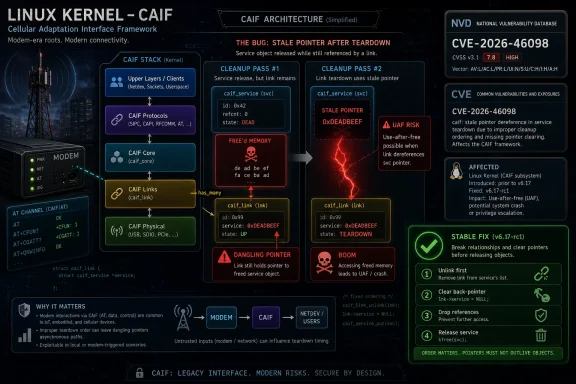
The bug is small in code and large in symbolism. A pointer should have been cleared before an object was released; it was not. The second trip through teardown then found a dangling reference, and the kernel did what kernels do when trusted internal bookkeeping goes bad: it wandered into freed memory.
CAIF, short for Communication CPU to Application CPU Interface, is not a household name even among many Linux users. It was designed for communication between host systems and ST-Ericsson cellular modems, exposing a multiplexed protocol stack that could carry AT channels, datagram traffic, utility channels, and other modem-facing paths. In Linux, it appears as a networking subsystem with socket support, layered protocol objects, and optional physical transports.
That history matters because it immediately narrows the likely blast radius. This is not TCP, IPv6, SMB, eBPF, io_uring, or one of the hot kernel interfaces that attackers and defenders obsess over daily. CAIF support is generally something a kernel must include and a system must actually use or expose before the bug becomes operationally relevant.
But “obscure” is not the same as “irrelevant.” Modern infrastructure is full of Linux kernels that nobody thinks about until a CVE scanner finds them: routers, industrial gateways, Android-derived images, automotive test rigs, lab hardware, virtual appliances, network probes, and old embedded designs whose bill of materials outlived the company that selected it. A vulnerability in a sleepy subsystem can still matter if it lands in the wrong product line.
The NVD entry for CVE-2026-46098 is currently marked as awaiting enrichment, which means the familiar downstream signals — CVSS score, severity label, weakness classification, and vendor mapping — have not yet fully caught up. That is a common early state for kernel CVEs. The raw kernel description often arrives before the scoring ecosystem has decided how loudly to ring the bell.
For administrators, that lag is uncomfortable. Security tooling wants a number; operations teams want a change window; executives want a sentence. The right answer here is more nuanced: this is a real kernel memory-safety bug with a stable fix, but its practical urgency depends heavily on whether CAIF is present, reachable, and usable on the systems you own.
Later, when the socket is destroyed,
The upstream fix is direct and telling. Before releasing the service object, the patch stores the service-layer pointer, clears the downward link from the client, clears the upward link from the service layer, and only then calls the service release method. In plain English, the kernel now breaks the relationship before disposing of one side of it.
That sounds almost banal, but teardown bugs are rarely glamorous. They are the plumbing leaks of systems programming: a reference count drops at the wrong time, a pointer survives one function too long, an error path repeats a cleanup step that was assumed to be single-use. The exploitability can vary wildly, but the underlying lesson is consistent. The hardest memory bugs often live not in the mainline happy path, but in the place where code tries to recover from something unusual.
This one also illustrates why C remains both powerful and unforgiving inside the kernel. The CAIF stack represents protocol layers as linked structures with upward and downward pointers. That is efficient and idiomatic for kernel networking code. It also means the code must be ruthlessly disciplined about ownership, invalidation, and repeatability.
A destructor being called twice should not be exciting. In robust systems, cleanup functions are often expected to be idempotent, or at least guarded well enough that repeated teardown does not become a crash path. CVE-2026-46098 is a case where that expectation failed.
That is frustrating, but not necessarily evidence of chaos. Kernel security fixes move through upstream and stable trees constantly, and CVE assignment has become broader and more systematic. The result is a stream of records for bugs that range from catastrophic to highly conditional. A CVE number is now a starting point for triage, not a verdict.
For WindowsForum readers, this is a useful distinction. Windows administrators are accustomed to Microsoft Patch Tuesday packaging, where severity, affected products, mitigations, and update channels tend to arrive in a coordinated bundle. Linux kernel CVEs often feel more like a parts manifest: commit IDs, subsystem names, stable backports, and a terse explanation written for maintainers.
That difference creates real operational friction in mixed environments. A vulnerability scanner may flag a Linux kernel CVE on a backup appliance or hypervisor host before the vendor has published an advisory. The scanner may not know whether
The right response is not to ignore unscored CVEs. It is to resist treating unscored as automatically critical. CVE-2026-46098 should trigger inventory, exposure assessment, and vendor tracking. It should not automatically trigger a production outage on every Linux node in sight.
That gap matters because kernel configurations vary. A general-purpose distribution may ship a subsystem as a module. An embedded vendor may compile it in. An appliance vendor may carry a customized kernel that loosely follows upstream stable patches while hiding the actual configuration from customers. A container host may be fully patched while a storage controller in the same rack quietly runs an older kernel branch with an unusual module set.
CVE-2026-46098 is not a story about mass internet exploitation. There is no evidence in the supplied record of active exploitation, public exploit code, or remote unauthenticated compromise across default Linux installations. The more plausible story is narrower: a local or adjacent path involving systems where CAIF support is enabled and usable, potentially leading to denial of service or a more serious memory-corruption outcome depending on context.
The phrase “depending on context” does a lot of work here. Kernel use-after-free conditions can sometimes be massaged into privilege escalation, especially when attackers can influence allocation patterns. Other times they collapse into a kernel crash under very specific timing. Without a completed severity assessment or exploit analysis, it would be irresponsible to claim certainty in either direction.
Still, security teams should not let the narrowness lull them. The past decade has shown that “we do not use that feature” is often a belief, not an inventory fact. If a module can be loaded, if an address family can be reached, if a device node exists, or if a vendor image quietly includes legacy protocol support, the real attack surface may be wider than the architecture diagram says.
The immediate question for a Windows-heavy organization is not “Are our Windows PCs vulnerable?” They are not vulnerable to a Linux kernel CAIF bug simply by running Windows. The better question is whether the organization owns Linux kernels indirectly and whether its asset program can see them.
WSL deserves a separate mention because it often becomes the mental bridge between Windows and Linux risk. WSL uses a Microsoft-provided Linux kernel, and Microsoft services that kernel through its own distribution mechanisms. Whether a specific upstream Linux CVE applies to WSL depends on kernel version, configuration, and whether the affected subsystem is enabled. Administrators should verify against Microsoft’s WSL kernel releases and enterprise update controls rather than assuming every upstream Linux CVE maps one-to-one.
Cloud estates add another layer. Azure Linux VMs, self-managed images, marketplace appliances, and container hosts may all report kernel CVEs differently. Some will inherit distribution patches quickly. Others will wait for vendor rebuilds. Appliances may expose only a firmware version while burying the underlying kernel entirely.
That is why CVE-2026-46098 is best read as an inventory test. If your tooling can answer which systems include CAIF support, which kernel builds contain the fix, and which vendors have shipped patched firmware, this is a routine cleanup item. If your tooling cannot answer those questions, the vulnerability is less important than the visibility failure it exposes.
This is how Linux security often works at its best. A maintainer accepts a small, targeted fix. The stable team backports it across supported branches. Distributions and vendors then decide how to package and ship it. The public CVE record becomes one part of a larger patch pipeline rather than the first moment anyone noticed the bug.
The patch itself is also pleasingly conservative. It does not redesign CAIF. It does not remove the protocol. It does not add a sprawling state machine. It simply makes teardown safer by clearing the links that would otherwise point back into freed memory.
That restraint matters for stable kernels. Enterprise operators want fixes that reduce risk without creating regressions in distant subsystems. A surgical change to
The tradeoff is that users rarely see this machinery directly. They see a distribution kernel update, a firmware release note, or a scanner result. Between upstream commit and production remediation sits a chain of packagers, vendors, maintenance branches, and reboot policies. CVE-2026-46098 is a reminder that the patch exists is not the same as the fleet is fixed.
If CAIF support is not built, not available as a loadable module, and not reachable by untrusted users, the practical risk is low. If CAIF is present on a device that uses modem communication paths and exposes relevant socket operations, the risk deserves more attention. If unprivileged local users can exercise the affected path, the operational concern rises again.
This is one place where Linux differs sharply from monolithic product thinking. The kernel is not one uniform artifact. Distribution builds, embedded builds, Android-derived kernels, vendor long-term kernels, and cloud images can carry different options and backports. Two systems may report similar kernel versions while having different exposure to a subsystem like CAIF.
Security teams should also remember that module presence is only part of the story. A module that is absent cannot be exploited. A module that is present but unloadable by policy has a different risk profile. A subsystem compiled into the kernel is harder to dismiss. Device access controls, namespace behavior, LSM policy, and container boundaries can all influence whether a theoretical path becomes reachable.
The safest practical stance is to treat the CVE as a targeted patching and verification task. Update kernels through normal vendor channels, prioritize systems known to include CAIF or cellular modem integration, and confirm after reboot that the running kernel is the patched one. The boring part — reboot discipline — is still where many kernel fixes fail in real fleets.
For IT pros, the challenge is to build a process that can absorb this stream without either panicking or tuning it out. CVE-2026-46098 is a perfect example because it sits in the middle. It is a real memory-safety bug in kernel networking code. It has stable fixes. It currently lacks NVD scoring. It affects a niche protocol that many systems will not use. None of those facts cancels the others.
The temptation is to wait for someone else to decide. That may be reasonable for severity scoring, but it is not enough for exposure. NVD cannot know your kernel configuration. Your Linux distribution may not know your appliance inventory. Your appliance vendor may not know your compensating controls. The local truth lives in your estate.
This also argues for more precise vulnerability management language. “Affected by CVE-2026-46098” should not mean the same thing as “running an upstream version range that once contained the bug.” A mature program distinguishes vulnerable code present, vulnerable code reachable, fixed code installed, and fixed kernel actually running. Those are different states with different urgency.
For WindowsForum’s mixed-platform readership, that precision is especially valuable. The Windows world has spent years improving update observability: build numbers, cumulative update history, servicing stack behavior, and endpoint management reporting. Linux and appliance ecosystems need the same operational rigor, even if the packaging models differ.
The most important practical move is to identify whether CAIF exists in your environment. On conventional Linux systems, that means checking kernel configuration, module availability, loaded modules, and vendor kernel changelogs. On appliances, it means reading firmware advisories and pressing vendors for specificity when they publish vague “kernel security fixes” language.
Administrators should also pay attention to systems that cannot be rebooted quickly. Kernel fixes are famously easy to install and easy to leave dormant. A package manager can report success while the machine continues running the old vulnerable kernel until the next restart. Live patching may help in some environments, but not every subsystem fix will be covered by every live-patch vendor.
For vulnerability managers, the absence of a CVSS score should be handled explicitly. Put the CVE into a monitored state, attach the known subsystem and patch status, and revisit when NVD enrichment or vendor advisories arrive. Do not let “N/A” become a synonym for “not real.”
For developers and kernel-adjacent engineers, the lesson is more elemental. Cleanup paths need the same adversarial review as packet parsers and syscall handlers. Any teardown sequence that can run after partial failure, remote shutdown, or repeated destruction must be safe when called more than once.
In that sense, a stale pointer in a modem-era Linux protocol is exactly the kind of vulnerability modern IT needs to take seriously without sensationalizing. The future of infrastructure security will be less about reacting to every CVE with equal force and more about knowing, quickly and defensibly, which forgotten pieces of code still exist inside the systems we depend on.
The bug is small in code and large in symbolism. A pointer should have been cleared before an object was released; it was not. The second trip through teardown then found a dangling reference, and the kernel did what kernels do when trusted internal bookkeeping goes bad: it wandered into freed memory.
 A Modem-Era Protocol Becomes a 2026 Security Record
CAIF, short for Communication CPU to Application CPU Interface, is not a household name even among many Linux users. It was designed for communication between host systems and ST-Ericsson cellular modems, exposing a multiplexed protocol stack that could carry AT channels, datagram traffic, utility channels, and other modem-facing paths. In Linux, it appears as a networking subsystem with socket support, layered protocol objects, and optional physical transports.That history matters because it immediately narrows the likely blast radius. This is not TCP, IPv6, SMB, eBPF, io_uring, or one of the hot kernel interfaces that attackers and defenders obsess over daily. CAIF support is generally something a kernel must include and a system must actually use or expose before the bug becomes operationally relevant.
But “obscure” is not the same as “irrelevant.” Modern infrastructure is full of Linux kernels that nobody thinks about until a CVE scanner finds them: routers, industrial gateways, Android-derived images, automotive test rigs, lab hardware, virtual appliances, network probes, and old embedded designs whose bill of materials outlived the company that selected it. A vulnerability in a sleepy subsystem can still matter if it lands in the wrong product line.
The NVD entry for CVE-2026-46098 is currently marked as awaiting enrichment, which means the familiar downstream signals — CVSS score, severity label, weakness classification, and vendor mapping — have not yet fully caught up. That is a common early state for kernel CVEs. The raw kernel description often arrives before the scoring ecosystem has decided how loudly to ring the bell.
For administrators, that lag is uncomfortable. Security tooling wants a number; operations teams want a change window; executives want a sentence. The right answer here is more nuanced: this is a real kernel memory-safety bug with a stable fix, but its practical urgency depends heavily on whether CAIF is present, reachable, and usable on the systems you own.
The Bug Is a Teardown Error, Not a Protocol Breakthrough
The vulnerability sits in a classic danger zone: cleanup after failure, remote shutdown, and object lifetime management. In the affected path,caif_connect() can tear down an existing client after a remote shutdown by calling caif_disconnect_client() and then caif_free_client(). The problem is that caif_free_client() releases the service layer referenced by adap_layer->dn but leaves that pointer in place.Later, when the socket is destroyed,
caif_sock_destructor() calls caif_free_client() again. The stale pointer now points at an object that has already been released. Dereferencing it creates a use-after-free style condition: the kernel is consulting memory it no longer owns.The upstream fix is direct and telling. Before releasing the service object, the patch stores the service-layer pointer, clears the downward link from the client, clears the upward link from the service layer, and only then calls the service release method. In plain English, the kernel now breaks the relationship before disposing of one side of it.
That sounds almost banal, but teardown bugs are rarely glamorous. They are the plumbing leaks of systems programming: a reference count drops at the wrong time, a pointer survives one function too long, an error path repeats a cleanup step that was assumed to be single-use. The exploitability can vary wildly, but the underlying lesson is consistent. The hardest memory bugs often live not in the mainline happy path, but in the place where code tries to recover from something unusual.
This one also illustrates why C remains both powerful and unforgiving inside the kernel. The CAIF stack represents protocol layers as linked structures with upward and downward pointers. That is efficient and idiomatic for kernel networking code. It also means the code must be ruthlessly disciplined about ownership, invalidation, and repeatability.
A destructor being called twice should not be exciting. In robust systems, cleanup functions are often expected to be idempotent, or at least guarded well enough that repeated teardown does not become a crash path. CVE-2026-46098 is a case where that expectation failed.
Kernel CVEs Now Arrive Before the Severity Story Does
The oddest part of many modern Linux kernel CVEs is not the bug itself but the publication rhythm around it. Here, the CVE entry records the issue, references several stable-tree commits, and leaves the NVD severity fields empty at first publication. That puts defenders in the familiar position of seeing a named vulnerability before seeing an official NVD score.That is frustrating, but not necessarily evidence of chaos. Kernel security fixes move through upstream and stable trees constantly, and CVE assignment has become broader and more systematic. The result is a stream of records for bugs that range from catastrophic to highly conditional. A CVE number is now a starting point for triage, not a verdict.
For WindowsForum readers, this is a useful distinction. Windows administrators are accustomed to Microsoft Patch Tuesday packaging, where severity, affected products, mitigations, and update channels tend to arrive in a coordinated bundle. Linux kernel CVEs often feel more like a parts manifest: commit IDs, subsystem names, stable backports, and a terse explanation written for maintainers.
That difference creates real operational friction in mixed environments. A vulnerability scanner may flag a Linux kernel CVE on a backup appliance or hypervisor host before the vendor has published an advisory. The scanner may not know whether
CONFIG_CAIF is enabled, whether the module is present, or whether any CAIF socket can be opened. The administrator is then left to reconcile upstream truth with product reality.The right response is not to ignore unscored CVEs. It is to resist treating unscored as automatically critical. CVE-2026-46098 should trigger inventory, exposure assessment, and vendor tracking. It should not automatically trigger a production outage on every Linux node in sight.
The Long Tail Is Where Enterprise Risk Gets Weird
CAIF’s obscurity is exactly why this bug is interesting. Enterprise security programs are good at caring about famous components. They track OpenSSL, Exchange, Chrome, VMware, Windows Server, Kubernetes, and the Linux kernel in the abstract. They are much worse at knowing which kernel subsystems exist inside the things they bought five years ago.That gap matters because kernel configurations vary. A general-purpose distribution may ship a subsystem as a module. An embedded vendor may compile it in. An appliance vendor may carry a customized kernel that loosely follows upstream stable patches while hiding the actual configuration from customers. A container host may be fully patched while a storage controller in the same rack quietly runs an older kernel branch with an unusual module set.
CVE-2026-46098 is not a story about mass internet exploitation. There is no evidence in the supplied record of active exploitation, public exploit code, or remote unauthenticated compromise across default Linux installations. The more plausible story is narrower: a local or adjacent path involving systems where CAIF support is enabled and usable, potentially leading to denial of service or a more serious memory-corruption outcome depending on context.
The phrase “depending on context” does a lot of work here. Kernel use-after-free conditions can sometimes be massaged into privilege escalation, especially when attackers can influence allocation patterns. Other times they collapse into a kernel crash under very specific timing. Without a completed severity assessment or exploit analysis, it would be irresponsible to claim certainty in either direction.
Still, security teams should not let the narrowness lull them. The past decade has shown that “we do not use that feature” is often a belief, not an inventory fact. If a module can be loaded, if an address family can be reached, if a device node exists, or if a vendor image quietly includes legacy protocol support, the real attack surface may be wider than the architecture diagram says.
Windows Shops Are Not Outside the Blast Radius
A Linux kernel CVE may sound off-topic for a Windows community, but that line has been obsolete for years. Windows environments routinely depend on Linux: WSL on developer workstations, Linux containers in CI pipelines, Ubuntu or Debian build hosts in Azure, network appliances in branch offices, Android-based rugged devices, Kubernetes nodes, backup platforms, NAS appliances, and security tools that ship as hardened Linux boxes.The immediate question for a Windows-heavy organization is not “Are our Windows PCs vulnerable?” They are not vulnerable to a Linux kernel CAIF bug simply by running Windows. The better question is whether the organization owns Linux kernels indirectly and whether its asset program can see them.
WSL deserves a separate mention because it often becomes the mental bridge between Windows and Linux risk. WSL uses a Microsoft-provided Linux kernel, and Microsoft services that kernel through its own distribution mechanisms. Whether a specific upstream Linux CVE applies to WSL depends on kernel version, configuration, and whether the affected subsystem is enabled. Administrators should verify against Microsoft’s WSL kernel releases and enterprise update controls rather than assuming every upstream Linux CVE maps one-to-one.
Cloud estates add another layer. Azure Linux VMs, self-managed images, marketplace appliances, and container hosts may all report kernel CVEs differently. Some will inherit distribution patches quickly. Others will wait for vendor rebuilds. Appliances may expose only a firmware version while burying the underlying kernel entirely.
That is why CVE-2026-46098 is best read as an inventory test. If your tooling can answer which systems include CAIF support, which kernel builds contain the fix, and which vendors have shipped patched firmware, this is a routine cleanup item. If your tooling cannot answer those questions, the vulnerability is less important than the visibility failure it exposes.
Stable Backports Are the Quiet Center of the Story
The supplied CVE record references multiple stable commits, and the stable mailing list patch shows the fix being reviewed for the 7.0 stable series in early May 2026. That timing is important. The fix did not appear as a theoretical mitigation after the CVE record; it was already in the kernel maintenance machinery before the NVD entry surfaced.This is how Linux security often works at its best. A maintainer accepts a small, targeted fix. The stable team backports it across supported branches. Distributions and vendors then decide how to package and ship it. The public CVE record becomes one part of a larger patch pipeline rather than the first moment anyone noticed the bug.
The patch itself is also pleasingly conservative. It does not redesign CAIF. It does not remove the protocol. It does not add a sprawling state machine. It simply makes teardown safer by clearing the links that would otherwise point back into freed memory.
That restraint matters for stable kernels. Enterprise operators want fixes that reduce risk without creating regressions in distant subsystems. A surgical change to
net/caif/cfsrvl.c is easier to reason about than a broad refactor. It also makes vendor backporting more realistic.The tradeoff is that users rarely see this machinery directly. They see a distribution kernel update, a firmware release note, or a scanner result. Between upstream commit and production remediation sits a chain of packagers, vendors, maintenance branches, and reboot policies. CVE-2026-46098 is a reminder that the patch exists is not the same as the fleet is fixed.
Severity Will Depend on Configuration More Than Branding
When NVD enrichment lands, CVE-2026-46098 may receive a severity score that looks either alarming or mundane. The score will matter for dashboards, service-level agreements, and vulnerability management queues. But for this bug, the most meaningful severity factor is not the brand name “Linux kernel.” It is configuration.If CAIF support is not built, not available as a loadable module, and not reachable by untrusted users, the practical risk is low. If CAIF is present on a device that uses modem communication paths and exposes relevant socket operations, the risk deserves more attention. If unprivileged local users can exercise the affected path, the operational concern rises again.
This is one place where Linux differs sharply from monolithic product thinking. The kernel is not one uniform artifact. Distribution builds, embedded builds, Android-derived kernels, vendor long-term kernels, and cloud images can carry different options and backports. Two systems may report similar kernel versions while having different exposure to a subsystem like CAIF.
Security teams should also remember that module presence is only part of the story. A module that is absent cannot be exploited. A module that is present but unloadable by policy has a different risk profile. A subsystem compiled into the kernel is harder to dismiss. Device access controls, namespace behavior, LSM policy, and container boundaries can all influence whether a theoretical path becomes reachable.
The safest practical stance is to treat the CVE as a targeted patching and verification task. Update kernels through normal vendor channels, prioritize systems known to include CAIF or cellular modem integration, and confirm after reboot that the running kernel is the patched one. The boring part — reboot discipline — is still where many kernel fixes fail in real fleets.
The CVE Feed Is Becoming a Kernel Changelog With Consequences
There is a broader editorial point here: Linux kernel CVEs are increasingly functioning as a security-indexed changelog. That is good for transparency and automation, but it creates noise. Not every CVE is a crisis. Not every terse commit message gives defenders enough context. Not every scanner finding maps neatly to actual exposure.For IT pros, the challenge is to build a process that can absorb this stream without either panicking or tuning it out. CVE-2026-46098 is a perfect example because it sits in the middle. It is a real memory-safety bug in kernel networking code. It has stable fixes. It currently lacks NVD scoring. It affects a niche protocol that many systems will not use. None of those facts cancels the others.
The temptation is to wait for someone else to decide. That may be reasonable for severity scoring, but it is not enough for exposure. NVD cannot know your kernel configuration. Your Linux distribution may not know your appliance inventory. Your appliance vendor may not know your compensating controls. The local truth lives in your estate.
This also argues for more precise vulnerability management language. “Affected by CVE-2026-46098” should not mean the same thing as “running an upstream version range that once contained the bug.” A mature program distinguishes vulnerable code present, vulnerable code reachable, fixed code installed, and fixed kernel actually running. Those are different states with different urgency.
For WindowsForum’s mixed-platform readership, that precision is especially valuable. The Windows world has spent years improving update observability: build numbers, cumulative update history, servicing stack behavior, and endpoint management reporting. Linux and appliance ecosystems need the same operational rigor, even if the packaging models differ.
The Practical Read Is Narrow, But Not Dismissive
For most desktop users, CVE-2026-46098 is unlikely to be a household emergency. For most server administrators, it is a kernel update item to fold into established maintenance. For teams responsible for embedded, telecom, industrial, automotive, or modem-adjacent Linux deployments, it deserves a closer look.The most important practical move is to identify whether CAIF exists in your environment. On conventional Linux systems, that means checking kernel configuration, module availability, loaded modules, and vendor kernel changelogs. On appliances, it means reading firmware advisories and pressing vendors for specificity when they publish vague “kernel security fixes” language.
Administrators should also pay attention to systems that cannot be rebooted quickly. Kernel fixes are famously easy to install and easy to leave dormant. A package manager can report success while the machine continues running the old vulnerable kernel until the next restart. Live patching may help in some environments, but not every subsystem fix will be covered by every live-patch vendor.
For vulnerability managers, the absence of a CVSS score should be handled explicitly. Put the CVE into a monitored state, attach the known subsystem and patch status, and revisit when NVD enrichment or vendor advisories arrive. Do not let “N/A” become a synonym for “not real.”
For developers and kernel-adjacent engineers, the lesson is more elemental. Cleanup paths need the same adversarial review as packet parsers and syscall handlers. Any teardown sequence that can run after partial failure, remote shutdown, or repeated destruction must be safe when called more than once.
The Small CAIF Patch Leaves Five Jobs for Real Fleets
The right response to CVE-2026-46098 is measured, but it is not passive. The record is young, the scoring is incomplete, and the affected protocol is niche; that combination calls for verification rather than theater.- Organizations should determine whether their Linux kernels include CAIF support before assigning broad emergency severity to this CVE.
- Systems using cellular modem integrations, embedded Linux images, or vendor kernels deserve higher priority than ordinary desktops with no CAIF module present.
- Kernel updates should be tracked through the running kernel version after reboot, not merely through package installation status.
- Appliance vendors should be asked whether their firmware includes the affected CAIF code and whether the stable fix has been backported.
- Security teams should revisit the CVE after NVD enrichment and distribution advisories fill in severity, affected-version, and mitigation details.
In that sense, a stale pointer in a modem-era Linux protocol is exactly the kind of vulnerability modern IT needs to take seriously without sensationalizing. The future of infrastructure security will be less about reacting to every CVE with equal force and more about knowing, quickly and defensibly, which forgotten pieces of code still exist inside the systems we depend on.
References
- Primary source: NVD / Linux Kernel
Published: 2026-05-28T01:09:57-07:00
NVD - CVE-2026-46098
 nvd.nist.gov
- Security advisory: MSRC
Published: 2026-05-28T01:09:57-07:00
Original feed URL
Security Update Guide - Microsoft Security Response Center
 msrc.microsoft.com
- Related coverage: docs.kernel.org
- Related coverage: cateee.net
- Related coverage: dri.freedesktop.org
- Related coverage: kernel.googlesource.com

- Related coverage: codebrowser.dev

caif_dev.h source code [linux/include/net/caif/caif_dev.h] - Codebrowser
Source code of linux/include/net/caif/caif_dev.h linux v6.19-r on KDAB Codebrowser
codebrowser.dev
- Related coverage: korg.docs.kernel.org
- Related coverage: kernel.org
- Related coverage: spinics.net
[PATCH v2 03/13] net: Include appropriate header file in caif/cfsrvl.c — Linux Kernel
Linux Kernel: [PATCH v2 03/13] net: Include appropriate header file in caif/cfsrvl.cwww.spinics.net - Related coverage: labs.cloudsecurityalliance.org
CSA research note linux copy fail CVE 2026 31431 20260503 csa styled
PDF documentlabs.cloudsecurityalliance.org
- Related coverage: archives.kernel-recipes.org
- Related coverage: mchehab.fedorapeople.org
- Related coverage: infineon.com
