

CVE-2026-46123 is a newly published Linux kernel vulnerability, received by NVD from kernel.org on May 28, 2026, that fixes unsafe receive-length handling in the virtio Bluetooth driver used by virtualized Linux systems. The bug is not a garden-variety desktop Bluetooth scare; it lives at the boundary between a guest kernel and the virtual device backend it is asked to trust. That makes it more interesting than its still-unscored NVD entry suggests. The lesson is familiar but uncomfortable: in virtualization, “the device said so” is not a security boundary.
The vulnerable code path sits in
On paper, that sounds like a narrow bookkeeping bug. In kernel networking code, however, bookkeeping is security. An
The CVE description is unusually explicit about the mismatch. The receive buffer is exposed to virtio as exactly 1000 bytes, but checking against
That is the subtlety that turns this from “bounds check missing” into a virtualization hardening issue. The driver was not simply forgetting that buffers have limits. It was checking the wrong limit.
The old behavior let the backend report a
There is also a zero-length edge case. If the backend reported
The fix rejects both cases: oversized completions and zero-length completions. It also uses rate-limited Bluetooth device logging so an untrusted backend cannot turn the validation path into a kernel log spammer. That last detail matters because defensive code is often reachable precisely when something hostile or broken is hammering the system.
The realistic exposure is in environments where a Linux guest uses virtio Bluetooth and the backend is compromised, malicious, experimental, or simply wrong. That puts the bug closer to the world of QEMU/KVM, virtual appliances, sandboxed systems, cloud host-guest boundaries, and specialized virtualization setups than to consumer Bluetooth usage.
That distinction does not make the vulnerability irrelevant. It makes it more specific. Kernel bugs at virtual device boundaries are important because modern infrastructure routinely treats guests and device backends as different trust zones, even when they are operated by the same organization. When those boundaries blur, “local” bugs become cross-layer security problems.
The NVD entry is still awaiting enrichment, and no CVSS score has been assigned by NIST at the time of publication. That should not be read as a declaration of low severity. It means the scoring and classification process has not caught up with the kernel.org disclosure.
In physical hardware, a malicious device is a familiar threat model for anyone who follows USB security. A peripheral can claim capabilities, sizes, and transfer results that do not match reality. In virtualization, the same logic applies, except the device may be implemented in software, running in a host process, hypervisor component, emulator, or service stack.
Virtio is designed to be efficient and general-purpose, not magical. It provides a common framework for paravirtualized devices, but the guest driver still has to validate what comes back. If the backend says it used a buffer, the guest must verify that the reported length is plausible for the buffer that was actually posted.
That is where CVE-2026-46123 fits into the larger pattern. It is not an exotic cryptographic failure or a dramatic remote-code-execution chain. It is a failure to keep the guest’s own accounting authoritative.
The zero-length path is uglier in a different way. Reading a packet type byte from an empty skb means the driver is making a control-flow decision based on uninitialized memory. Bugs like that can be hard to exploit reliably, but they are also hard to reason about safely. The kernel is not supposed to interpret whatever happened to be sitting in memory as a Bluetooth packet type.
The phrase “malicious or buggy backend” is doing important work here. Security advisories often focus on hostile actors, but in virtualization stacks, backend bugs can be just as disruptive. A bad emulator update, fuzzing harness, custom virtio implementation, or compromised host-side component could trigger behavior the guest driver was not prepared to reject.
What the public record does not yet establish is a complete exploit chain, practical privilege boundary, or real-world exploitation. That matters. The existence of uninitialized memory exposure does not automatically mean an attacker can steal secrets on demand, escape a VM, or execute code in the guest kernel. But it does mean the kernel maintainers judged the behavior unsafe enough to fix across stable trees.
For sysadmins, the immediate question is not whether every Linux machine with Bluetooth is exposed. It is whether any Linux guests in your environment load
The Linux ecosystem complicates that check because kernel version numbers alone do not tell the whole story. Enterprise distributions frequently backport security fixes without moving to the upstream kernel version where the fix first appeared. Conversely, a self-built or vendor-customized kernel may carry a version string that looks safe while missing a particular patch.
That is why this kind of CVE is best handled through distribution advisories and package changelogs. Ubuntu, Debian, Red Hat, SUSE, Arch, Fedora, Android-derived projects, embedded vendors, and hypervisor appliance makers may all surface the fix differently. The right answer is less “install kernel X.Y.Z” than “confirm your kernel package includes the virtio Bluetooth length validation patch.”
The operational lesson crosses operating-system boundaries. Virtual devices are part of the attack surface. They sit below applications and above hypervisors, in a layer that many administrators treat as plumbing until a security bug reminds them it is executable, stateful, and exposed to untrusted data.
For Windows administrators managing Linux guests, the practical response is familiar. Inventory the affected component, check whether it is enabled, confirm vendor patch status, and prioritize systems where trust boundaries matter. A disposable local VM used by one developer is different from a multi-tenant virtualization platform or a lab environment that runs untrusted guest images.
There is also a broader Windows analogy. Microsoft’s own virtualization stack has had to harden synthetic devices, integration services, and host-guest interfaces over time. The names differ, but the design problem is the same: a guest and its virtual devices exchange structured data at high speed, and every length field becomes a promise that needs verification.
This is why kernel hardening often advances through small, surgical patches rather than sweeping rewrites. A single size constant reduces the chance that future edits will update one side of the contract but not another. A single gate before
The rate-limited error path also reflects mature defensive engineering. Rejecting bad input is necessary; rejecting it in a way that creates a denial-of-service side channel through logs is better. Kernel logging is not free, and an attacker who controls repeated malformed completions should not be given an easy way to flood storage or obscure other diagnostics.
The most important part, though, is conceptual. The patch makes the guest driver reassert ownership over its own buffer boundary. That is the right default in any driver, but it is especially critical when the “device” may be software controlled by a different trust domain.
The exploitability depends heavily on deployment. A system that does not include or load
The likely impact also needs discipline. The public description supports concern about uninitialized memory exposure and unsafe packet handling. It does not, by itself, prove a practical VM escape, remote Bluetooth attack, or universal Linux kernel compromise. Security teams should resist both minimization and theatrics.
That middle ground is where good patch management lives. A kernel bug in a specialized driver may not warrant an emergency maintenance window across every fleet. But it absolutely warrants tracking, especially if your infrastructure relies on virtio devices in threat models where the backend is not fully trusted.
That class appears repeatedly because it lives at a performance-sensitive seam. Virtual I/O wants to move data with minimal overhead. Drivers want to avoid redundant checks. Backends are expected to behave. But when a guest kernel treats cooperative protocol assumptions as security guarantees, the smallest mismatch can become a vulnerability.
The fact that the patch was discussed and revised on public kernel lists before appearing in stable trees is also a reminder of how kernel security often works in practice. Many Linux CVEs are not born as splashy embargoed advisories. They emerge as hardening patches, bug fixes, and stable backports, later receiving CVE identifiers as the vulnerability-management ecosystem catches up.
For defenders, that means CVE feeds are necessary but incomplete. Watching vendor kernel updates, stable mailing lists, and distribution advisories can surface practical risk earlier than waiting for enriched NVD records. CVE-2026-46123 is a textbook example: the technical substance is already clear even while the database metadata remains unfinished.
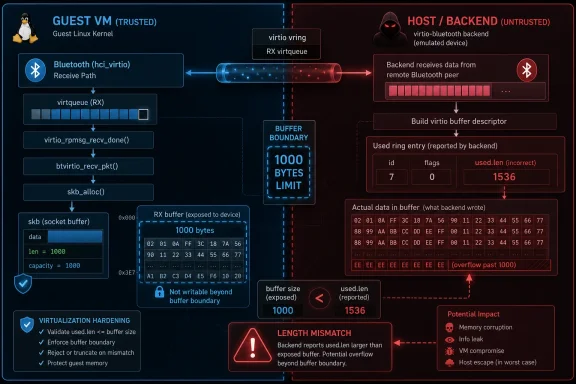 A Small Bluetooth Patch Exposes a Larger Virtio Assumption
The vulnerable code path sits in virtio_bt, the Linux kernel driver that lets a guest system talk to a Bluetooth controller through the virtio device model. In the reported flaw, virtbt_rx_work() accepted a receive length returned by virtqueue_get_buf() and passed it into skb_put() without validating that the length matched the buffer size actually made available to the device.On paper, that sounds like a narrow bookkeeping bug. In kernel networking code, however, bookkeeping is security. An
skb, or socket buffer, is not merely a byte array; it is the kernel’s packet container, with pointers and length fields that tell later code what data is valid. If a driver expands an skb to include bytes the device never wrote, later processing may consume stale kernel heap contents as if they were legitimate packet data.The CVE description is unusually explicit about the mismatch. The receive buffer is exposed to virtio as exactly 1000 bytes, but checking against
skb_tailroom() is not enough because the allocated skb may have more space available than the driver actually advertised to the backend. A malicious or buggy backend can therefore claim that it filled more than 1000 bytes while still staying within the skb’s broader tailroom.That is the subtlety that turns this from “bounds check missing” into a virtualization hardening issue. The driver was not simply forgetting that buffers have limits. It was checking the wrong limit.
The Backend Is Not Supposed to Get a Vote on Kernel Memory
The patch fixes the bug by defining a singleVIRTBT_RX_BUF_SIZE constant and using that value consistently for allocation, scatter-gather setup, and receive validation. That sounds almost mundane, but it is the heart of the fix. The only trustworthy bound is the one the guest kernel itself chose when it handed a buffer to the device.The old behavior let the backend report a
used.len value above the 1000 bytes exposed through sg_init_one(). If that value was still less than or equal to skb_tailroom(), the driver could accept it and make the skb appear longer than the bytes actually written by the virtual device. The result was a packet buffer containing a mixture of real device data and uninitialized heap data.There is also a zero-length edge case. If the backend reported
len == 0, the driver could leave the skb empty and still pass it along to virtbt_rx_handle(), which reads the packet type byte from skb->data. That means even an empty completion could push the driver into consuming uninitialized memory.The fix rejects both cases: oversized completions and zero-length completions. It also uses rate-limited Bluetooth device logging so an untrusted backend cannot turn the validation path into a kernel log spammer. That last detail matters because defensive code is often reachable precisely when something hostile or broken is hammering the system.
This Is Not a Typical “Turn Off Bluetooth” Story
For WindowsForum readers, the word “Bluetooth” may invite the wrong mental model. This is not a warning that a nearby attacker with a radio can pair with your headset and compromise a Linux box. The affected component is the Linux kernel’s virtio Bluetooth driver, which is about virtualized device plumbing rather than the ordinary Bluetooth stack on a laptop.The realistic exposure is in environments where a Linux guest uses virtio Bluetooth and the backend is compromised, malicious, experimental, or simply wrong. That puts the bug closer to the world of QEMU/KVM, virtual appliances, sandboxed systems, cloud host-guest boundaries, and specialized virtualization setups than to consumer Bluetooth usage.
That distinction does not make the vulnerability irrelevant. It makes it more specific. Kernel bugs at virtual device boundaries are important because modern infrastructure routinely treats guests and device backends as different trust zones, even when they are operated by the same organization. When those boundaries blur, “local” bugs become cross-layer security problems.
The NVD entry is still awaiting enrichment, and no CVSS score has been assigned by NIST at the time of publication. That should not be read as a declaration of low severity. It means the scoring and classification process has not caught up with the kernel.org disclosure.
The Shape of the Bug Is Older Than the CVE
The CVE description compares this issue to an earlier hardening change in the USB 9p transport, where unchecked device-reported lengths were also treated as dangerous. That comparison is telling. Kernel drivers have spent years learning, relearning, and institutionalizing the same rule: devices are inputs, and inputs lie.In physical hardware, a malicious device is a familiar threat model for anyone who follows USB security. A peripheral can claim capabilities, sizes, and transfer results that do not match reality. In virtualization, the same logic applies, except the device may be implemented in software, running in a host process, hypervisor component, emulator, or service stack.
Virtio is designed to be efficient and general-purpose, not magical. It provides a common framework for paravirtualized devices, but the guest driver still has to validate what comes back. If the backend says it used a buffer, the guest must verify that the reported length is plausible for the buffer that was actually posted.
That is where CVE-2026-46123 fits into the larger pattern. It is not an exotic cryptographic failure or a dramatic remote-code-execution chain. It is a failure to keep the guest’s own accounting authoritative.
The Security Impact Is Mostly About Information Exposure and Stability
Based on the public description, the clearest risk is uninitialized kernel memory consumption and potential information disclosure. Ifskb_put() extends the skb into bytes not written by the backend, subsequent code may process stale heap contents. Depending on where those bytes flow next, that can become a kernel memory leak, protocol confusion, or a crash.The zero-length path is uglier in a different way. Reading a packet type byte from an empty skb means the driver is making a control-flow decision based on uninitialized memory. Bugs like that can be hard to exploit reliably, but they are also hard to reason about safely. The kernel is not supposed to interpret whatever happened to be sitting in memory as a Bluetooth packet type.
The phrase “malicious or buggy backend” is doing important work here. Security advisories often focus on hostile actors, but in virtualization stacks, backend bugs can be just as disruptive. A bad emulator update, fuzzing harness, custom virtio implementation, or compromised host-side component could trigger behavior the guest driver was not prepared to reject.
What the public record does not yet establish is a complete exploit chain, practical privilege boundary, or real-world exploitation. That matters. The existence of uninitialized memory exposure does not automatically mean an attacker can steal secrets on demand, escape a VM, or execute code in the guest kernel. But it does mean the kernel maintainers judged the behavior unsafe enough to fix across stable trees.
Stable Backports Are the Signal Administrators Should Watch
The references attached to the CVE include multiple stable kernel commits, which is usually the practical detail administrators care about most. A bug that lands only in a development branch is one thing. A bug that receives stable backports is a maintenance item for distributions, appliance vendors, and anyone carrying custom kernels.For sysadmins, the immediate question is not whether every Linux machine with Bluetooth is exposed. It is whether any Linux guests in your environment load
virtio_bt or are built with support for it, and whether your vendor kernel has incorporated the relevant stable fix. In many production environments, the answer may be “no virtio Bluetooth here,” especially on headless servers. But assumptions should be checked, not guessed.The Linux ecosystem complicates that check because kernel version numbers alone do not tell the whole story. Enterprise distributions frequently backport security fixes without moving to the upstream kernel version where the fix first appeared. Conversely, a self-built or vendor-customized kernel may carry a version string that looks safe while missing a particular patch.
That is why this kind of CVE is best handled through distribution advisories and package changelogs. Ubuntu, Debian, Red Hat, SUSE, Arch, Fedora, Android-derived projects, embedded vendors, and hypervisor appliance makers may all surface the fix differently. The right answer is less “install kernel X.Y.Z” than “confirm your kernel package includes the virtio Bluetooth length validation patch.”
Windows Shops Still Have a Reason to Care
At first glance, a Linux virtio Bluetooth CVE may seem outside the WindowsForum lane. But Windows-heavy organizations increasingly run Linux in places where Windows administrators are still responsible for the platform: Hyper-V labs, developer workstations, WSL-adjacent workflows, KVM-based appliances, CI runners, security tools, container hosts, and mixed virtualization clusters.The operational lesson crosses operating-system boundaries. Virtual devices are part of the attack surface. They sit below applications and above hypervisors, in a layer that many administrators treat as plumbing until a security bug reminds them it is executable, stateful, and exposed to untrusted data.
For Windows administrators managing Linux guests, the practical response is familiar. Inventory the affected component, check whether it is enabled, confirm vendor patch status, and prioritize systems where trust boundaries matter. A disposable local VM used by one developer is different from a multi-tenant virtualization platform or a lab environment that runs untrusted guest images.
There is also a broader Windows analogy. Microsoft’s own virtualization stack has had to harden synthetic devices, integration services, and host-guest interfaces over time. The names differ, but the design problem is the same: a guest and its virtual devices exchange structured data at high speed, and every length field becomes a promise that needs verification.
The Patch Is a Case Study in Boring Correctness
The fix does not appear to introduce a new subsystem, redesign Bluetooth virtualization, or bolt on a complex mitigation. It aligns allocation size, exposed buffer size, and receive validation around one constant. That is the sort of change that looks obvious after the fact and still manages to evade review in real code.This is why kernel hardening often advances through small, surgical patches rather than sweeping rewrites. A single size constant reduces the chance that future edits will update one side of the contract but not another. A single gate before
skb_put() ensures that packet metadata cannot outrun the data actually supplied by the backend.The rate-limited error path also reflects mature defensive engineering. Rejecting bad input is necessary; rejecting it in a way that creates a denial-of-service side channel through logs is better. Kernel logging is not free, and an attacker who controls repeated malformed completions should not be given an easy way to flood storage or obscure other diagnostics.
The most important part, though, is conceptual. The patch makes the guest driver reassert ownership over its own buffer boundary. That is the right default in any driver, but it is especially critical when the “device” may be software controlled by a different trust domain.
The Unscored CVE Should Not Be Ignored or Overhyped
NVD’s “awaiting enrichment” status leaves a vacuum that security dashboards are not always good at handling. Some tools will treat the CVE as informational until a CVSS vector arrives. Others will flag it loudly simply because it is new and kernel-related. Neither response is especially intelligent without context.The exploitability depends heavily on deployment. A system that does not include or load
virtio_bt is not meaningfully exposed through this path. A guest using virtio Bluetooth with an untrusted or potentially compromised backend has a more serious concern. Environments that fuzz virtual devices or run experimental hypervisor components should treat the fix as more urgent.The likely impact also needs discipline. The public description supports concern about uninitialized memory exposure and unsafe packet handling. It does not, by itself, prove a practical VM escape, remote Bluetooth attack, or universal Linux kernel compromise. Security teams should resist both minimization and theatrics.
That middle ground is where good patch management lives. A kernel bug in a specialized driver may not warrant an emergency maintenance window across every fleet. But it absolutely warrants tracking, especially if your infrastructure relies on virtio devices in threat models where the backend is not fully trusted.
The Fix Belongs in the Virtualization Hardening File
There is a useful way to think about CVE-2026-46123: not as a Bluetooth story, but as another entry in the virtualization hardening file. The affected subsystem happens to be Bluetooth, but the vulnerability class is broader. It is about accepting a producer-reported length without tying it back to the consumer-owned buffer contract.That class appears repeatedly because it lives at a performance-sensitive seam. Virtual I/O wants to move data with minimal overhead. Drivers want to avoid redundant checks. Backends are expected to behave. But when a guest kernel treats cooperative protocol assumptions as security guarantees, the smallest mismatch can become a vulnerability.
The fact that the patch was discussed and revised on public kernel lists before appearing in stable trees is also a reminder of how kernel security often works in practice. Many Linux CVEs are not born as splashy embargoed advisories. They emerge as hardening patches, bug fixes, and stable backports, later receiving CVE identifiers as the vulnerability-management ecosystem catches up.
For defenders, that means CVE feeds are necessary but incomplete. Watching vendor kernel updates, stable mailing lists, and distribution advisories can surface practical risk earlier than waiting for enriched NVD records. CVE-2026-46123 is a textbook example: the technical substance is already clear even while the database metadata remains unfinished.
The Concrete Read for CVE-2026-46123
The useful response is narrow, testable, and not especially dramatic. This is not a reason to panic about every Bluetooth adapter. It is a reason to verify whether virtual Bluetooth is present in your Linux guests and whether your kernel includes the stable fix.- CVE-2026-46123 affects the Linux kernel’s virtio Bluetooth receive path, not ordinary Bluetooth radio pairing by itself.
- The bug allowed a virtio backend to report a receive length larger than the 1000-byte buffer actually exposed to it, potentially causing the guest kernel to include uninitialized heap bytes in an skb.
- The same path also accepted zero-length completions, allowing later Bluetooth receive handling to read a packet type byte from uninitialized memory.
- The upstream fix defines and reuses one receive-buffer-size constant, rejects zero-length and oversized completions, and rate-limits error logging from untrusted backend input.
- Administrators should prioritize systems that actually use
virtio_bt, especially virtualized or test environments where the backend cannot be treated as fully trusted. - Kernel package changelogs and distribution advisories matter more than raw upstream version numbers because vendors often backport fixes into older supported kernels.
References
- Primary source: NVD / Linux Kernel
Published: 2026-05-29T01:06:43-07:00
NVD - CVE-2026-46123
 nvd.nist.gov
- Security advisory: MSRC
Published: 2026-05-29T01:06:43-07:00
Original feed URL
Security Update Guide - Microsoft Security Response Center
 msrc.microsoft.com
- Related coverage: spinics.net
[PATCH v3 1/2] Bluetooth: virtio_bt: clamp rx length before skb_put — Linux Kernel
Linux Kernel: [PATCH v3 1/2] Bluetooth: virtio_bt: clamp rx length before skb_put www.spinics.net
- Related coverage: mail-archive.com
[PATCH] Bluetooth: virtio_bt: clamp rx length before skb_put
www.mail-archive.com
- Related coverage: kernel.googlesource.com
- Related coverage: lists.openwall.net
- Related coverage: lore-kernel.gnuweeb.org
- Related coverage: patchew.org
- Related coverage: prototype-kernel.readthedocs.io
- Related coverage: docs.redhat.com
