

CVE-2026-46146 is a Linux kernel vulnerability published by NVD on May 28, 2026, covering an ALSA USB-audio bug in
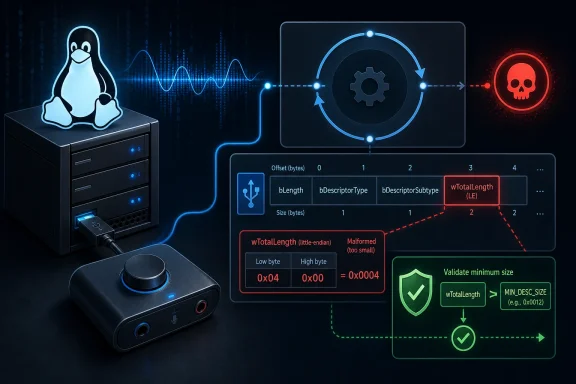
The reported flaw sits in ALSA, the Advanced Linux Sound Architecture, specifically in the USB audio driver path that parses channel-map information for USB Audio Class 3 devices. The vulnerable function walked through descriptors using a length value supplied by the descriptor itself. The bug was simple: the loop checked some boundaries, but failed to validate that
That distinction matters. A parser can look careful and still be unsafe if it trusts a length field that can be zero or smaller than the structure it is meant to describe. In that case, a loop can stop being a traversal and become a trap.
The upstream patch adds a size check that breaks out when the converted segment length is smaller than the descriptor header. In practical terms, the kernel now refuses to keep walking a malformed descriptor that cannot possibly describe a valid next object. It is the kind of change that looks almost embarrassingly obvious after the fact, which is usually how mature parser bugs look.
There is no NVD CVSS score yet, and that absence is important. At publication time, the CVE record is marked as awaiting enrichment, with NVD metrics still listed as not available. That means defenders should resist both extremes: this is neither proven catastrophic nor safe to ignore.
Descriptors are supposed to be the boring self-description layer of USB. They tell the host what a device is, what interfaces it exposes, what formats it supports, and how software should talk to it. But from a security perspective, a descriptor is not documentation; it is untrusted input.
That is the uncomfortable point behind CVE-2026-46146. The data structure at issue is not an audio stream full of samples. It is metadata used while the kernel is figuring out how to represent the device’s audio channels. A malicious or simply malformed USB device can put hostile values in that metadata before any user application opens a microphone or plays a sound.
The immediate failure mode described here is an endless loop, not memory corruption. That points toward denial of service rather than code execution. But in kernel work, denial of service can still be serious, because a stuck kernel path can tie up CPU time, block hardware initialization, or create reliability failures that are difficult for users to diagnose.
USB is also one of the few attack surfaces that still crosses clean network boundaries. Firewalls do not inspect a headset. EDR tools do not always model a USB DAC as potentially hostile. A sysadmin who would never expose SSH to the internet may casually plug in a conference-room speakerphone that has been passed around three departments and a trade show booth.
That does not mean CVE-2026-46146 is suddenly a “BadUSB apocalypse.” The record does not establish active exploitation, and the public description does not claim privilege escalation or arbitrary code execution. The plausible impact is narrower: a malformed USB audio descriptor can drive kernel code into a loop that should have been impossible.
Still, the operational lesson is real. Physical-adjacent attack surfaces matter because they are often governed by weaker policy than network services. In many organizations, USB storage is controlled, but USB audio is not. Headsets are treated as ergonomic accessories, not as devices that can feed data into privileged parsing code.
Many parsers check only the first half. They confirm that a claimed length does not run past the end of the buffer, then use it to move forward. But if the length is zero, one, or otherwise smaller than the minimum valid structure size, the parser may not advance at all. That is how code that looks bounds-aware can still produce an infinite loop.
The ALSA fix is a textbook guardrail: after reading the descriptor length, check whether it is smaller than the descriptor structure, and break if it is. That is not a workaround. It is the missing invariant.
The kernel’s hard problem is that it must be permissive enough to support imperfect hardware while strict enough to avoid being manipulated by malicious hardware. USB audio is full of devices that are technically odd, inconsistently implemented, or dependent on quirks. A too-strict parser can break real gear. A too-lenient parser can become an attack surface.
That matters because many production Linux systems do not run the newest kernel. They run distribution kernels, enterprise kernels, long-term-support kernels, hypervisor kernels, or vendor-customized builds. The security question is not “has Linus’s tree changed?” but “has the kernel I deploy received the backport?”
For rolling distributions, the answer may arrive quickly through normal package updates. For enterprise distributions, the patch will travel through vendor advisories, regression testing, and kernel errata. For appliances, the answer may be slower and less visible, especially when the vendor’s update cadence is measured in quarters.
This is where CVE records can create a false sense of simplicity. A CVE gives the industry a name. It does not guarantee that every affected kernel has the same patch status, the same exposure, or the same operational urgency. Administrators still need to map the vulnerability to actual kernels and actual hardware policy.
Score-first vulnerability management works poorly for kernel driver bugs. The exploitability of this issue depends on factors that a single base score may flatten: whether USB audio devices can be attached, whether physical access is plausible, whether untrusted users can pass USB devices through to virtual machines, whether the machine is headless, and whether the affected driver is present and loaded.
A developer workstation with unrestricted USB ports is not the same risk as a cloud VM. A kiosk in a public space is not the same risk as a locked rack server. A lab machine used to test random peripherals is not the same risk as a hardened production database node.
The absence of a score should push teams toward context, not complacency. If a Linux endpoint accepts arbitrary USB devices, this CVE belongs in the next normal kernel update cycle. If a system is physically exposed or routinely used with untrusted peripherals, the argument for faster patching is stronger.
Every major operating system has had bugs in USB, Bluetooth, Wi-Fi, graphics, printer, font, and media parsers because those components translate messy external input into privileged internal structures. The names change. The risk model does not. Peripheral metadata has always been more dangerous than users assume.
The Windows angle is especially relevant in mixed estates. Many organizations now run Windows clients, Linux developer machines, Linux build servers, WSL-adjacent workflows, container hosts, NAS appliances, and hypervisors side by side. Security teams cannot afford to think of endpoint risk as belonging to one OS family.
There is also a virtualization wrinkle. USB passthrough can move hardware parsing responsibilities into guest systems, sometimes in ways administrators do not document well. If a Linux guest receives a passed-through USB audio device, its kernel and driver stack become part of the risk equation, even if the host is something else entirely.
That explosion of commodity audio hardware has made generic driver support more valuable and more exposed. Users expect plug-and-play behavior. IT departments expect hardware interchangeability. Vendors expect the operating system to accommodate devices that sometimes take liberties with specifications.
ALSA’s USB audio driver lives in that compromise. It has to support polished devices from major vendors and strange implementations from the long tail of the hardware market. That breadth is useful until a malformed descriptor forces the parser into a state it should have rejected immediately.
The lesson is not that USB audio is uniquely dangerous. The lesson is that modern peripherals are computers at the edge of your trust boundary. Some are well engineered. Some are barely compliant. Some may be malicious. The kernel cannot assume the difference.
But boring defensive programming is exactly what keeps kernel subsystems resilient. A loop that consumes externally influenced descriptors should have three properties: it should never read beyond the buffer, it should never accept an impossible object, and it should always make forward progress. Miss any one of those, and the code becomes fragile.
This patch addresses forward progress. By refusing a descriptor length smaller than the descriptor itself, the loop avoids trusting malformed data as an iterator. That is basic, and basic is good.
The more interesting question is how many similar parser paths still depend on implicit assumptions about descriptor lengths. Kernel maintainers have spent years tightening these areas, often one bug report and one fuzzing discovery at a time. The security posture improves not through one grand redesign, but through hundreds of small checks that make bad input boring again.
Administrators should ask where USB audio devices are allowed and who controls them. Developer laptops, shared workstations, classrooms, labs, conference rooms, and public kiosks often have looser peripheral practices than servers. Those are the machines where a malformed-device denial-of-service bug is more than theoretical.
For servers, the risk is usually lower because USB audio is uncommon and physical access is restricted. But “usually” is doing work there. Some rack systems have crash carts, KVM devices, internal USB headers, or appliance-style configurations that do not resemble a clean cloud instance. Inventory beats assumption.
There is a simple operational hierarchy here. Patch kernels through normal channels. Restrict untrusted USB devices where feasible. Review USB passthrough policies for virtualization. Avoid panic, but do not let the lack of a CVSS score turn into a reason for indefinite deferral.
convert_chmap_v3() where a malformed USB Audio Class 3 descriptor could trigger a potential endless loop during channel-map parsing. The fix is tiny, but the lesson is not: kernel security is often won or lost in the dull arithmetic of length fields. This is not the kind of flaw that gives attackers instant drama or defenders a clean dashboard priority. It is the kind that reminds administrators that “just a peripheral parser” is still privileged code sitting inside the operating system’s most trusted layer.
 A Two-Line Patch Lands in the Kernel’s Most Unforgiving Neighborhood
The reported flaw sits in ALSA, the Advanced Linux Sound Architecture, specifically in the USB audio driver path that parses channel-map information for USB Audio Class 3 devices. The vulnerable function walked through descriptors using a length value supplied by the descriptor itself. The bug was simple: the loop checked some boundaries, but failed to validate that cs_desc->wLength was large enough to make forward progress.That distinction matters. A parser can look careful and still be unsafe if it trusts a length field that can be zero or smaller than the structure it is meant to describe. In that case, a loop can stop being a traversal and become a trap.
The upstream patch adds a size check that breaks out when the converted segment length is smaller than the descriptor header. In practical terms, the kernel now refuses to keep walking a malformed descriptor that cannot possibly describe a valid next object. It is the kind of change that looks almost embarrassingly obvious after the fact, which is usually how mature parser bugs look.
There is no NVD CVSS score yet, and that absence is important. At publication time, the CVE record is marked as awaiting enrichment, with NVD metrics still listed as not available. That means defenders should resist both extremes: this is neither proven catastrophic nor safe to ignore.
USB Audio Is Boring Until It Becomes Kernel Input
USB audio devices feel mundane because users treat them as commodities: headsets, webcams with microphones, DACs, conference bars, capture boxes, docks, and monitor audio endpoints. On Linux, many of those devices are handled by the genericsnd-usb-audio driver rather than by a vendor-specific blob. That generic model is one of Linux’s strengths, but it also means the kernel must parse a wide variety of device-provided descriptors.Descriptors are supposed to be the boring self-description layer of USB. They tell the host what a device is, what interfaces it exposes, what formats it supports, and how software should talk to it. But from a security perspective, a descriptor is not documentation; it is untrusted input.
That is the uncomfortable point behind CVE-2026-46146. The data structure at issue is not an audio stream full of samples. It is metadata used while the kernel is figuring out how to represent the device’s audio channels. A malicious or simply malformed USB device can put hostile values in that metadata before any user application opens a microphone or plays a sound.
The immediate failure mode described here is an endless loop, not memory corruption. That points toward denial of service rather than code execution. But in kernel work, denial of service can still be serious, because a stuck kernel path can tie up CPU time, block hardware initialization, or create reliability failures that are difficult for users to diagnose.
The Real Attack Surface Is the Desk, the Dock, and the Lab Bench
For WindowsForum readers, a Linux ALSA CVE may seem like somebody else’s patch Tuesday. That would be too narrow a reading. Linux is no longer just the server in the closet or the laptop running a tiling window manager. It is inside developer workstations, lab machines, Proxmox hosts, storage appliances, embedded controllers, kiosks, audio production boxes, conference-room gear, and the increasingly messy estate of “small systems nobody owns until they break.”USB is also one of the few attack surfaces that still crosses clean network boundaries. Firewalls do not inspect a headset. EDR tools do not always model a USB DAC as potentially hostile. A sysadmin who would never expose SSH to the internet may casually plug in a conference-room speakerphone that has been passed around three departments and a trade show booth.
That does not mean CVE-2026-46146 is suddenly a “BadUSB apocalypse.” The record does not establish active exploitation, and the public description does not claim privilege escalation or arbitrary code execution. The plausible impact is narrower: a malformed USB audio descriptor can drive kernel code into a loop that should have been impossible.
Still, the operational lesson is real. Physical-adjacent attack surfaces matter because they are often governed by weaker policy than network services. In many organizations, USB storage is controlled, but USB audio is not. Headsets are treated as ergonomic accessories, not as devices that can feed data into privileged parsing code.
The Vulnerability Class Is Older Than the CVE Number
The specific CVE is new, but the bug pattern is ancient. Length-prefixed structures are everywhere in systems programming, and every parser has to answer the same question: does this declared length both fit inside the remaining buffer and advance the cursor?Many parsers check only the first half. They confirm that a claimed length does not run past the end of the buffer, then use it to move forward. But if the length is zero, one, or otherwise smaller than the minimum valid structure size, the parser may not advance at all. That is how code that looks bounds-aware can still produce an infinite loop.
The ALSA fix is a textbook guardrail: after reading the descriptor length, check whether it is smaller than the descriptor structure, and break if it is. That is not a workaround. It is the missing invariant.
The kernel’s hard problem is that it must be permissive enough to support imperfect hardware while strict enough to avoid being manipulated by malicious hardware. USB audio is full of devices that are technically odd, inconsistently implemented, or dependent on quirks. A too-strict parser can break real gear. A too-lenient parser can become an attack surface.
Stable Backports Tell Us This Was Not Treated as Cosmetic
The CVE record lists multiple stable kernel references, which is usually the signal administrators should care about more than the size of the diff. A small patch going into stable trees means maintainers judged it worth carrying into supported kernels, not merely cleaning up mainline code.That matters because many production Linux systems do not run the newest kernel. They run distribution kernels, enterprise kernels, long-term-support kernels, hypervisor kernels, or vendor-customized builds. The security question is not “has Linus’s tree changed?” but “has the kernel I deploy received the backport?”
For rolling distributions, the answer may arrive quickly through normal package updates. For enterprise distributions, the patch will travel through vendor advisories, regression testing, and kernel errata. For appliances, the answer may be slower and less visible, especially when the vendor’s update cadence is measured in quarters.
This is where CVE records can create a false sense of simplicity. A CVE gives the industry a name. It does not guarantee that every affected kernel has the same patch status, the same exposure, or the same operational urgency. Administrators still need to map the vulnerability to actual kernels and actual hardware policy.
The Missing Score Is a Warning Against Dashboard Thinking
NVD has not yet assigned CVSS 4.0, CVSS 3.x, or CVSS 2.0 metrics for this vulnerability. That makes the record look unfinished, because it is. But the more interesting problem is how many patch programs still treat a missing score as a reason to wait.Score-first vulnerability management works poorly for kernel driver bugs. The exploitability of this issue depends on factors that a single base score may flatten: whether USB audio devices can be attached, whether physical access is plausible, whether untrusted users can pass USB devices through to virtual machines, whether the machine is headless, and whether the affected driver is present and loaded.
A developer workstation with unrestricted USB ports is not the same risk as a cloud VM. A kiosk in a public space is not the same risk as a locked rack server. A lab machine used to test random peripherals is not the same risk as a hardened production database node.
The absence of a score should push teams toward context, not complacency. If a Linux endpoint accepts arbitrary USB devices, this CVE belongs in the next normal kernel update cycle. If a system is physically exposed or routinely used with untrusted peripherals, the argument for faster patching is stronger.
This Is a Linux Bug, but Windows Admins Should Still Recognize the Pattern
Windows administrators may be tempted to file this under Linux housekeeping. That is fair at the product level; ALSA is not a Windows subsystem. But the driver-parser pattern is platform-agnostic, and it is one Windows veterans know well.Every major operating system has had bugs in USB, Bluetooth, Wi-Fi, graphics, printer, font, and media parsers because those components translate messy external input into privileged internal structures. The names change. The risk model does not. Peripheral metadata has always been more dangerous than users assume.
The Windows angle is especially relevant in mixed estates. Many organizations now run Windows clients, Linux developer machines, Linux build servers, WSL-adjacent workflows, container hosts, NAS appliances, and hypervisors side by side. Security teams cannot afford to think of endpoint risk as belonging to one OS family.
There is also a virtualization wrinkle. USB passthrough can move hardware parsing responsibilities into guest systems, sometimes in ways administrators do not document well. If a Linux guest receives a passed-through USB audio device, its kernel and driver stack become part of the risk equation, even if the host is something else entirely.
Audio Hardware Has Become Infrastructure
A decade ago, USB audio security would have sounded niche. Today, it sits inside the daily workflow of hybrid work. Conference-room bars, USB-C docks, headsets, capture cards, microphones, podcasting interfaces, HDMI audio adapters, and monitor hubs all advertise themselves through layers of USB descriptors.That explosion of commodity audio hardware has made generic driver support more valuable and more exposed. Users expect plug-and-play behavior. IT departments expect hardware interchangeability. Vendors expect the operating system to accommodate devices that sometimes take liberties with specifications.
ALSA’s USB audio driver lives in that compromise. It has to support polished devices from major vendors and strange implementations from the long tail of the hardware market. That breadth is useful until a malformed descriptor forces the parser into a state it should have rejected immediately.
The lesson is not that USB audio is uniquely dangerous. The lesson is that modern peripherals are computers at the edge of your trust boundary. Some are well engineered. Some are barely compliant. Some may be malicious. The kernel cannot assume the difference.
The Fix Shows the Value of Boring Defensive Programming
There is a tendency in security coverage to reward spectacular bugs: remote code execution, sandbox escapes, supply-chain compromises, and branded vulnerabilities with logos. CVE-2026-46146 is not that. It is a validation bug fixed by adding a minimum-size check.But boring defensive programming is exactly what keeps kernel subsystems resilient. A loop that consumes externally influenced descriptors should have three properties: it should never read beyond the buffer, it should never accept an impossible object, and it should always make forward progress. Miss any one of those, and the code becomes fragile.
This patch addresses forward progress. By refusing a descriptor length smaller than the descriptor itself, the loop avoids trusting malformed data as an iterator. That is basic, and basic is good.
The more interesting question is how many similar parser paths still depend on implicit assumptions about descriptor lengths. Kernel maintainers have spent years tightening these areas, often one bug report and one fuzzing discovery at a time. The security posture improves not through one grand redesign, but through hundreds of small checks that make bad input boring again.
Practical Exposure Depends on Hardware Policy More Than Headlines
For most Linux users, the practical advice is straightforward: take the next kernel update from your distribution. There is no evidence in the public record that this is being exploited in the wild, and there is no need to rip out audio support in ordinary desktop environments. But systems that accept untrusted USB peripherals deserve more attention.Administrators should ask where USB audio devices are allowed and who controls them. Developer laptops, shared workstations, classrooms, labs, conference rooms, and public kiosks often have looser peripheral practices than servers. Those are the machines where a malformed-device denial-of-service bug is more than theoretical.
For servers, the risk is usually lower because USB audio is uncommon and physical access is restricted. But “usually” is doing work there. Some rack systems have crash carts, KVM devices, internal USB headers, or appliance-style configurations that do not resemble a clean cloud instance. Inventory beats assumption.
There is a simple operational hierarchy here. Patch kernels through normal channels. Restrict untrusted USB devices where feasible. Review USB passthrough policies for virtualization. Avoid panic, but do not let the lack of a CVSS score turn into a reason for indefinite deferral.
The Small ALSA Fix That Should Change Patch Triage
The useful way to read CVE-2026-46146 is not as a blockbuster vulnerability, but as a reminder that kernel-facing peripheral parsers deserve steady patch discipline. The concrete facts are limited, and that is part of the point: defenders often have to act before enrichment databases finish converting engineering reality into tidy severity fields.- CVE-2026-46146 affects the Linux kernel’s ALSA USB-audio handling in
convert_chmap_v3(), where malformed descriptor length data could lead to a potential endless loop. - The upstream fix adds a minimum-size validation check so the parser stops when a descriptor cannot be large enough to advance safely.
- NVD published the record on May 28, 2026, but had not yet assigned CVSS metrics at the time of publication.
- The most plausible impact from the public description is denial of service through malformed USB audio descriptor handling, not a confirmed code-execution path.
- Linux systems that allow untrusted or loosely controlled USB audio devices should treat the fix as more urgent than systems with no practical USB exposure.
- Administrators should track distribution kernel updates and stable backports rather than relying on the mainline patch alone.
References
- Primary source: NVD / Linux Kernel
Published: 2026-05-29T01:07:15-07:00
NVD - CVE-2026-46146
 nvd.nist.gov
- Security advisory: MSRC
Published: 2026-05-29T01:07:15-07:00
Original feed URL
Security Update Guide - Microsoft Security Response Center
 msrc.microsoft.com
- Related coverage: spinics.net

[PATCH] ALSA: usb-audio: Avoid potential endless loop in convert_chmap_v3() — Linux Kernel
Linux Kernel: [PATCH] ALSA: usb-audio: Avoid potential endless loop in convert_chmap_v3()
www.spinics.net
- Related coverage: git.sceen.net
- Related coverage: mirror.iscas.ac.cn
- Related coverage: cve.mitre.org
- Related coverage: lkml.indiana.edu
- Related coverage: gitlab.com
CVE-2025-39757: ALSA: usb-audio: Validate UAC3 cluster segment descriptors (!7340) · Merge requests · Red Hat / centos-stream / src / kernel / centos-stream-9 · GitLab
JIRA: https://issues.redhat.com/browse/RHEL-114687 CVE: CVE-2025-39757 commit ecfd41166b72b67d3bdeb88d224ff445f6163869gitlab.com - Related coverage: lists.openwall.net
- Related coverage: mail-archive.com
- Related coverage: gitea.basealt.ru
Making sure you're not a bot!
In snd_usb_get_audioformat_uac3(), a structure for channel maps 'chmap' is allocated through kzalloc() before the execution goto 'found_clock'. However, this structure is not deallocated if the memory allocation for 'pd' fails, leading to a memory leak bug. To fix the...gitea.basealt.ru - Related coverage: docs.redhat.com
- Related coverage: support.bull.com
- Related coverage: kernel.org
