

CVE-2026-46225, published by NVD on May 28, 2026, is a newly assigned Linux kernel vulnerability in the Renesas RSPI/QSPI SPI controller driver, fixed by changing driver teardown so the SPI controller is deregistered before DMA and other backing resources are released. The vulnerability is still awaiting NVD enrichment, which means there is no official NVD CVSS score, severity label, or CWE mapping yet. That absence should not be mistaken for absence of risk. This is the kind of low-level kernel lifecycle bug that rarely makes mainstream security headlines, but matters deeply to embedded Linux vendors, industrial device maintainers, and anyone responsible for long-lived hardware running kernels far from the desktop spotlight.
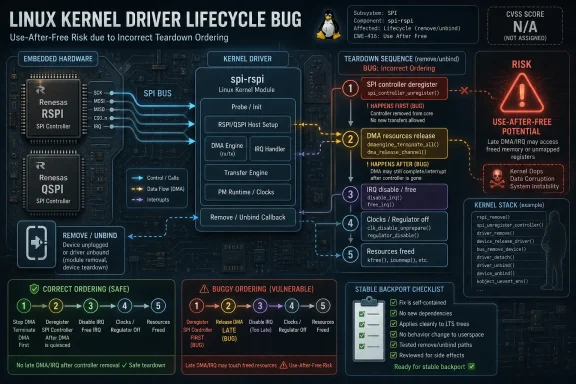
The fix for CVE-2026-46225 is almost comically small: stop using the managed SPI controller registration path, explicitly unregister the controller in the driver’s remove path, and only then release DMA resources and disable runtime power management. In code-review terms, this is not a spectacular patch. In operational terms, it is a reminder that kernel security often turns on mundane sequencing.
The vulnerable area is the
The bug class is a teardown-order problem. A driver can appear to be going away while the kernel still believes its SPI controller is registered and usable. If the controller remains visible after its underlying DMA resources have already been released, a transfer or cleanup path can stumble into memory and state that no longer exist.
That is why the patch’s short description matters: deregister the controller before releasing underlying resources like DMA during driver unbind. It is not glamorous, but it is exactly the sort of invariant kernel code must preserve. Public interfaces should disappear before their machinery is dismantled.
But dismissing it because it is hardware-specific would be equally wrong. Embedded Linux security is full of vulnerabilities whose practical risk depends on platform details that asset databases often fail to capture. A fleet owner may know the product name, OS image, and vendor BSP version, but not whether
The most plausible impact is local denial of service or kernel instability rather than internet-scale compromise. A device unbind operation at the wrong time could leave the kernel dereferencing invalid state, producing a crash, hang, or corrupted driver behavior. Whether that becomes exploitable beyond denial of service depends on details not yet established publicly, including timing, memory reuse, and platform configuration.
That uncertainty is exactly why early CVE records can be frustrating. NVD has published the entry but has not assigned its own CVSS vector or CWE. Administrators looking for a clean “critical/high/medium/low” answer will not find one yet. The better first question is more practical: do you ship or operate Linux systems using Renesas RSPI/QSPI hardware, and can those systems accept the stable kernel fix?
The Linux kernel’s
That is what makes this CVE part of a broader pattern, not an isolated typo. Several SPI driver fixes in recent kernel cycles have dealt with controller deregistration order, DMA teardown, and managed-resource cleanup. The common theme is not that SPI is uniquely fragile. The common theme is that kernel subsystems expose registered objects to other code, and those objects need to vanish before their private hardware scaffolding is dismantled.
In this case, the driver previously registered the controller through the managed API and then released DMA in its remove path. The fix makes controller unregistration explicit, takes a reference while doing so, and only releases DMA afterward. The ordering is the security boundary.
That ubiquity makes SPI bugs operationally awkward. The same bus can sit behind boot flash, touch controllers, sensors, TPM-like devices, displays, power-management components, and vendor-specific peripherals. On a desktop, SPI may be invisible to the user. On an embedded product, it may be part of the product’s nervous system.
Renesas controllers are especially relevant to industrial and embedded designs, where Linux kernels often come through vendor board support packages rather than a vanilla distribution release. These systems may run for years with kernels that are periodically patched but rarely rebased. That creates a familiar dilemma: the fix may be upstream and backported to stable branches, while deployed devices remain dependent on a vendor’s willingness and ability to integrate it.
The unbind path also matters more in embedded environments than some desktop administrators assume. Driver unbinding can be used in testing, recovery, hotplug-like workflows, power management experiments, and field diagnostics. Even when normal users cannot trigger it, privileged management software or service scripts may be able to. Bugs in those paths become reliability risks first and security risks second.
This lag is now part of the normal rhythm of Linux kernel CVEs. Since the kernel project became a CVE Numbering Authority, many fixes that would once have appeared only as stable patches now receive CVE identifiers. That has improved visibility, but it has also exposed a mismatch between kernel development speed and vulnerability-management tooling.
Security dashboards tend to treat “no score” as a temporary data-quality problem. Engineering teams should treat it as a prompt to perform their own triage. A no-score kernel CVE affecting irrelevant hardware can be safely deprioritized. A no-score kernel CVE affecting a shipping industrial controller may need immediate validation.
This is where WindowsForum readers who mostly manage Windows estates should still pay attention. Modern IT environments are mixed even when the help desk is not. Linux runs in storage appliances, hyperconverged nodes, network devices, IoT gateways, lab instruments, Kubernetes workers, WSL-adjacent development workflows, and vendor-managed black boxes. Kernel CVEs that look irrelevant on a Windows patch calendar can still affect the infrastructure Windows depends on.
The original patch carries a stable tag reaching back to older kernels, reflecting that the underlying driver behavior has existed for a long time. The driver itself has supported Renesas RSPI/QSPI hardware across many kernel generations. In other words, the affected code is not necessarily new, even though the CVE is.
For administrators, this means version number alone may not answer the question. A vendor kernel based on an older long-term branch may already have the patch. A newer custom kernel may not. A distribution may backport the fix without changing to a visibly new major kernel version. The only reliable answer is to inspect the vendor advisory, kernel changelog, or patched source.
That is especially true for appliance vendors. Customers may not have shell access, kernel config visibility, or module inventory. They may only receive a firmware version and a statement that security fixes were applied. In those cases, procurement and risk teams should ask the boring but necessary question: does the firmware include the
But privilege boundaries in embedded systems are often messier than on general-purpose servers. Maintenance daemons may run as root because the product was designed around appliance assumptions. Web management interfaces may invoke privileged helper scripts. Update systems may manipulate drivers during firmware staging, diagnostics, or recovery. A bug requiring “local privileged access” can still become part of a larger exploit chain if another flaw grants that foothold.
There is also a reliability angle that should not be minimized. A kernel crash in a server is bad; a kernel crash in an industrial gateway, medical peripheral, transport device, or remote monitoring system can be worse. Availability is a security property when physical processes depend on the machine staying alive.
The likely risk profile, then, is not mass exploitation. It is targeted or accidental triggering in a narrow hardware population, with consequences ranging from system instability to denial of service. That makes the fix less urgent for the average laptop and more urgent for the teams least likely to have perfect patch telemetry.
SPI controller registration is not just a private allocation. It tells the kernel that a controller exists and can be used by SPI devices. DMA resources are not just internal buffers. They are part of how the controller performs work. If the latter disappears while the former is still advertised, the system has entered a contradiction.
The fix resolves that contradiction by making the lifetime explicit. Register the controller explicitly. Unregister it explicitly. Release DMA only after the SPI core no longer sees the controller as available. The code becomes slightly less automatic and significantly more honest.
This is the sort of change that rarely attracts attention outside maintainers’ mailing lists, but it is exactly how kernel hardening often proceeds. Not every vulnerability is a spectacular memory-corruption primitive with a branded logo. Many are corrections to the state machine: make the impossible state impossible, or at least much harder to reach.
A file server may depend on a Linux storage array. A Windows industrial workstation may communicate with a Linux gateway. A Hyper-V or Azure Stack environment may include Linux-based management components. Developers may test against embedded boards from Windows laptops while the production device runs a vendor kernel. The estate is Windows-facing, but the dependency chain is not Windows-only.
This is also where CVE noise becomes dangerous. If every low-level Linux bug is treated as equally urgent, teams tune out. If every hardware-specific driver bug is ignored, teams miss the handful that affect their products. CVE-2026-46225 is a useful example because it demands asset-aware triage rather than reflexive panic.
The right posture is neither alarm nor indifference. It is inventory. Do you have Renesas-based boards? Do you run kernels with
That lag is where vulnerabilities like this accumulate. The public CVE record gives security teams something to track, but it does not guarantee that the fix has reached the firmware image installed in the field. Long-lived devices may only receive quarterly or annual maintenance releases. Some may be effectively abandoned.
This is also why stable backports matter. When a fix lands across multiple supported kernel lines, vendors have fewer excuses for waiting on a major kernel upgrade. They can pull the targeted patch, test the affected driver, and ship a focused update. For customers, the existence of stable commits strengthens the case for asking vendors for a precise remediation statement.
In the enterprise, that conversation should be contractual as much as technical. If an appliance vendor cannot say whether CVE-2026-46225 applies, that is itself useful risk information. Security operations depends not only on patched code, but on vendors who can map public vulnerabilities to shipped products.
That dual nature can cause misprioritization. Security teams may wait for a high CVSS score that never arrives or arrives late. Operations teams may see “driver unbind crash” and treat it as a lab-only nuisance. Product teams may assume customers will never trigger the path. Each assumption may be reasonable in isolation, and still wrong in a real deployment.
A better model is to ask what the system is supposed to guarantee during driver teardown. If a privileged management operation can crash the kernel because the driver releases DMA before deregistering its controller, the system has violated a basic robustness expectation. Security scoring can refine urgency, but it does not create the underlying obligation to fix.
The strongest argument for patching is not that this CVE is known to be catastrophic. It is that the fix restores sane lifetime ordering in a kernel driver that may sit inside devices expected to run unattended for years.
 A Small Ordering Bug Exposes a Larger Kernel Habit
The fix for CVE-2026-46225 is almost comically small: stop using the managed SPI controller registration path, explicitly unregister the controller in the driver’s remove path, and only then release DMA resources and disable runtime power management. In code-review terms, this is not a spectacular patch. In operational terms, it is a reminder that kernel security often turns on mundane sequencing.The vulnerable area is the
spi-rspi driver, which supports Renesas RSPI and QSPI controller blocks. These are not consumer PC components in the way a GPU driver or Wi-Fi stack might be. They live in the embedded and industrial world: boards, controllers, appliances, and systems where SPI is often the quiet bus connecting flash storage, sensors, management controllers, or custom peripherals.The bug class is a teardown-order problem. A driver can appear to be going away while the kernel still believes its SPI controller is registered and usable. If the controller remains visible after its underlying DMA resources have already been released, a transfer or cleanup path can stumble into memory and state that no longer exist.
That is why the patch’s short description matters: deregister the controller before releasing underlying resources like DMA during driver unbind. It is not glamorous, but it is exactly the sort of invariant kernel code must preserve. Public interfaces should disappear before their machinery is dismantled.
The Exploit Story Is Narrow, but the Failure Mode Is Real
CVE-2026-46225 should not be read as a remote-code-execution panic button for every Linux system. The affected driver is hardware-specific, and an attacker generally needs a way to trigger driver unbind or otherwise exercise the teardown path on a system where the Renesas controller is present and enabled. For many servers, laptops, and cloud workloads, that combination will simply not exist.But dismissing it because it is hardware-specific would be equally wrong. Embedded Linux security is full of vulnerabilities whose practical risk depends on platform details that asset databases often fail to capture. A fleet owner may know the product name, OS image, and vendor BSP version, but not whether
CONFIG_SPI_RSPI is built in, loaded as a module, or reachable through a board-specific device tree.The most plausible impact is local denial of service or kernel instability rather than internet-scale compromise. A device unbind operation at the wrong time could leave the kernel dereferencing invalid state, producing a crash, hang, or corrupted driver behavior. Whether that becomes exploitable beyond denial of service depends on details not yet established publicly, including timing, memory reuse, and platform configuration.
That uncertainty is exactly why early CVE records can be frustrating. NVD has published the entry but has not assigned its own CVSS vector or CWE. Administrators looking for a clean “critical/high/medium/low” answer will not find one yet. The better first question is more practical: do you ship or operate Linux systems using Renesas RSPI/QSPI hardware, and can those systems accept the stable kernel fix?
The Patch Says More Than the CVE Record
The upstream patch changes the driver fromdevm_spi_register_controller() to explicit spi_register_controller() registration, then calls spi_unregister_controller() during removal before releasing DMA. That distinction may sound like internal kernel bookkeeping, but it is the heart of the issue.The Linux kernel’s
devm_ APIs are designed to simplify driver cleanup by tying resource lifetime to device lifetime. Used correctly, they reduce error paths and make drivers easier to maintain. Used in the wrong lifetime relationship, they can hide a dangerous delay: cleanup may occur after the driver’s own remove function has already torn down resources that registered subsystems still expect to use.That is what makes this CVE part of a broader pattern, not an isolated typo. Several SPI driver fixes in recent kernel cycles have dealt with controller deregistration order, DMA teardown, and managed-resource cleanup. The common theme is not that SPI is uniquely fragile. The common theme is that kernel subsystems expose registered objects to other code, and those objects need to vanish before their private hardware scaffolding is dismantled.
In this case, the driver previously registered the controller through the managed API and then released DMA in its remove path. The fix makes controller unregistration explicit, takes a reference while doing so, and only releases DMA afterward. The ordering is the security boundary.
SPI Is the Bus Everyone Forgets Until It Breaks
Serial Peripheral Interface is not a fashionable attack surface. It does not have the name recognition of Bluetooth, Wi-Fi, USB, or TCP/IP. Yet SPI is everywhere in embedded systems because it is simple, fast, and well suited to board-level communication.That ubiquity makes SPI bugs operationally awkward. The same bus can sit behind boot flash, touch controllers, sensors, TPM-like devices, displays, power-management components, and vendor-specific peripherals. On a desktop, SPI may be invisible to the user. On an embedded product, it may be part of the product’s nervous system.
Renesas controllers are especially relevant to industrial and embedded designs, where Linux kernels often come through vendor board support packages rather than a vanilla distribution release. These systems may run for years with kernels that are periodically patched but rarely rebased. That creates a familiar dilemma: the fix may be upstream and backported to stable branches, while deployed devices remain dependent on a vendor’s willingness and ability to integrate it.
The unbind path also matters more in embedded environments than some desktop administrators assume. Driver unbinding can be used in testing, recovery, hotplug-like workflows, power management experiments, and field diagnostics. Even when normal users cannot trigger it, privileged management software or service scripts may be able to. Bugs in those paths become reliability risks first and security risks second.
NVD’s Empty Scoreboard Is Not a Safety Signal
At publication, NVD lists CVE-2026-46225 as awaiting enrichment. That means the federal vulnerability database has received the record from kernel.org but has not yet attached its own severity score, weakness classification, or vector string. The record exists; the scoring apparatus is still catching up.This lag is now part of the normal rhythm of Linux kernel CVEs. Since the kernel project became a CVE Numbering Authority, many fixes that would once have appeared only as stable patches now receive CVE identifiers. That has improved visibility, but it has also exposed a mismatch between kernel development speed and vulnerability-management tooling.
Security dashboards tend to treat “no score” as a temporary data-quality problem. Engineering teams should treat it as a prompt to perform their own triage. A no-score kernel CVE affecting irrelevant hardware can be safely deprioritized. A no-score kernel CVE affecting a shipping industrial controller may need immediate validation.
This is where WindowsForum readers who mostly manage Windows estates should still pay attention. Modern IT environments are mixed even when the help desk is not. Linux runs in storage appliances, hyperconverged nodes, network devices, IoT gateways, lab instruments, Kubernetes workers, WSL-adjacent development workflows, and vendor-managed black boxes. Kernel CVEs that look irrelevant on a Windows patch calendar can still affect the infrastructure Windows depends on.
Stable Backports Are the Real Mitigation Story
The CVE record points to multiple stable kernel commits, which indicates that the fix is not limited to a single development branch. That is important because few affected embedded deployments are likely to move directly to a bleeding-edge kernel. They will consume the repair through stable branches, vendor BSP updates, distribution kernels, or product firmware releases.The original patch carries a stable tag reaching back to older kernels, reflecting that the underlying driver behavior has existed for a long time. The driver itself has supported Renesas RSPI/QSPI hardware across many kernel generations. In other words, the affected code is not necessarily new, even though the CVE is.
For administrators, this means version number alone may not answer the question. A vendor kernel based on an older long-term branch may already have the patch. A newer custom kernel may not. A distribution may backport the fix without changing to a visibly new major kernel version. The only reliable answer is to inspect the vendor advisory, kernel changelog, or patched source.
That is especially true for appliance vendors. Customers may not have shell access, kernel config visibility, or module inventory. They may only receive a firmware version and a statement that security fixes were applied. In those cases, procurement and risk teams should ask the boring but necessary question: does the firmware include the
spi-rspi controller deregistration fix associated with CVE-2026-46225?The Practical Risk Lives in Privilege Boundaries
Most Linux users cannot casually unbind platform drivers. Writing to sysfs driver bind and unbind controls typically requires elevated privileges. That limits the bug’s direct exposure to local privileged users, management agents, test harnesses, or compromised services already running with significant rights.But privilege boundaries in embedded systems are often messier than on general-purpose servers. Maintenance daemons may run as root because the product was designed around appliance assumptions. Web management interfaces may invoke privileged helper scripts. Update systems may manipulate drivers during firmware staging, diagnostics, or recovery. A bug requiring “local privileged access” can still become part of a larger exploit chain if another flaw grants that foothold.
There is also a reliability angle that should not be minimized. A kernel crash in a server is bad; a kernel crash in an industrial gateway, medical peripheral, transport device, or remote monitoring system can be worse. Availability is a security property when physical processes depend on the machine staying alive.
The likely risk profile, then, is not mass exploitation. It is targeted or accidental triggering in a narrow hardware population, with consequences ranging from system instability to denial of service. That makes the fix less urgent for the average laptop and more urgent for the teams least likely to have perfect patch telemetry.
The Kernel’s Managed-Resource Convenience Has a Cost
The deeper lesson in CVE-2026-46225 is about abstraction. Managed cleanup APIs are valuable because kernel drivers are full of failure paths, hardware quirks, and lifetime complexity. But every abstraction encodes assumptions about ordering. When those assumptions do not match subsystem visibility, convenience can become a trap.SPI controller registration is not just a private allocation. It tells the kernel that a controller exists and can be used by SPI devices. DMA resources are not just internal buffers. They are part of how the controller performs work. If the latter disappears while the former is still advertised, the system has entered a contradiction.
The fix resolves that contradiction by making the lifetime explicit. Register the controller explicitly. Unregister it explicitly. Release DMA only after the SPI core no longer sees the controller as available. The code becomes slightly less automatic and significantly more honest.
This is the sort of change that rarely attracts attention outside maintainers’ mailing lists, but it is exactly how kernel hardening often proceeds. Not every vulnerability is a spectacular memory-corruption primitive with a branded logo. Many are corrections to the state machine: make the impossible state impossible, or at least much harder to reach.
Why Windows Shops Should Still Read Linux Kernel CVEs
A Windows-focused community might reasonably ask why a Renesas Linux SPI driver deserves attention here. The answer is that enterprise infrastructure no longer maps cleanly to operating-system loyalties. The Windows desktop, Active Directory domain, and Microsoft 365 tenant often sit on top of networks filled with Linux-based controllers and appliances.A file server may depend on a Linux storage array. A Windows industrial workstation may communicate with a Linux gateway. A Hyper-V or Azure Stack environment may include Linux-based management components. Developers may test against embedded boards from Windows laptops while the production device runs a vendor kernel. The estate is Windows-facing, but the dependency chain is not Windows-only.
This is also where CVE noise becomes dangerous. If every low-level Linux bug is treated as equally urgent, teams tune out. If every hardware-specific driver bug is ignored, teams miss the handful that affect their products. CVE-2026-46225 is a useful example because it demands asset-aware triage rather than reflexive panic.
The right posture is neither alarm nor indifference. It is inventory. Do you have Renesas-based boards? Do you run kernels with
spi-rspi enabled? Do your vendors ship affected BSPs? Are driver unbind paths reachable by privileged services or diagnostic interfaces? Those questions matter more than the missing CVSS score.The Vendor Lag Is Where Exposure Accumulates
Upstream Linux can fix a bug quickly and still leave users exposed for months. The reason is not always negligence. Embedded vendors often carry board-specific patches, old toolchains, custom device trees, and certification requirements that make kernel updates slow. A one-line upstream principle may become a multi-week product validation cycle.That lag is where vulnerabilities like this accumulate. The public CVE record gives security teams something to track, but it does not guarantee that the fix has reached the firmware image installed in the field. Long-lived devices may only receive quarterly or annual maintenance releases. Some may be effectively abandoned.
This is also why stable backports matter. When a fix lands across multiple supported kernel lines, vendors have fewer excuses for waiting on a major kernel upgrade. They can pull the targeted patch, test the affected driver, and ship a focused update. For customers, the existence of stable commits strengthens the case for asking vendors for a precise remediation statement.
In the enterprise, that conversation should be contractual as much as technical. If an appliance vendor cannot say whether CVE-2026-46225 applies, that is itself useful risk information. Security operations depends not only on patched code, but on vendors who can map public vulnerabilities to shipped products.
This Is a Security Bug Wearing a Reliability Jacket
Some kernel CVEs occupy an uncomfortable middle ground. They are security issues because they can be triggered across a privilege boundary or corrupt kernel state. They are reliability issues because their most visible outcome is a crash. CVE-2026-46225 appears to live in that space.That dual nature can cause misprioritization. Security teams may wait for a high CVSS score that never arrives or arrives late. Operations teams may see “driver unbind crash” and treat it as a lab-only nuisance. Product teams may assume customers will never trigger the path. Each assumption may be reasonable in isolation, and still wrong in a real deployment.
A better model is to ask what the system is supposed to guarantee during driver teardown. If a privileged management operation can crash the kernel because the driver releases DMA before deregistering its controller, the system has violated a basic robustness expectation. Security scoring can refine urgency, but it does not create the underlying obligation to fix.
The strongest argument for patching is not that this CVE is known to be catastrophic. It is that the fix restores sane lifetime ordering in a kernel driver that may sit inside devices expected to run unattended for years.
The Renesas SPI Fix Belongs on the Asset Register, Not the Panic Board
The operational response to CVE-2026-46225 should be concrete and scoped. Treat it as a hardware-specific Linux kernel issue that matters most to embedded, industrial, and appliance environments using Renesas RSPI/QSPI controllers. Do not burn cycles hunting for it across unrelated Windows desktops, but do not let it vanish into the “Linux noise” bucket either.- Systems that do not include Renesas RSPI/QSPI hardware or the
spi-rspidriver are unlikely to be affected in any practical way. - Systems that use vendor BSP kernels should be checked through vendor advisories or source-level changelogs, because visible kernel version numbers may not reveal backported fixes.
- The absence of an NVD CVSS score as of May 29, 2026, means teams must perform their own triage instead of waiting for a dashboard severity.
- The most likely practical impact is local denial of service or kernel instability during driver unbind or teardown, not broad remote exploitation.
- Embedded and industrial fleets should prioritize validation because SPI controller drivers often sit below product features that ordinary asset tools do not enumerate.
- Vendors should be expected to confirm whether their firmware includes the controller deregistration fix, not merely state that they track Linux kernel CVEs.
References
- Primary source: NVD / Linux Kernel
Published: 2026-05-29T01:05:37-07:00
NVD - CVE-2026-46225
 nvd.nist.gov
- Security advisory: MSRC
Published: 2026-05-29T01:05:37-07:00
Original feed URL
Security Update Guide - Microsoft Security Response Center
 msrc.microsoft.com
- Related coverage: mail-archive.com
[PATCH 5.7 084/163] spi: bcm2835: Fix controller unregister order
www.mail-archive.com
- Related coverage: windowsforum.com
CVE-2026-45996 Linux spi-imx Use-After-Free: Why Windows Teams Should Care | Windows Forum
CVE-2026-45996, published by NVD on May 27, 2026, is a Linux kernel vulnerability in the i.MX SPI controller driver where unbinding the device could leave...windowsforum.com - Related coverage: cateee.net
- Related coverage: spinics.net
[PATCH 10/26] spi: rspi: fix controller deregistration — Linux SPI
Linux SPI: [PATCH 10/26] spi: rspi: fix controller deregistrationwww.spinics.net

- Related coverage: opennet.ru
- Related coverage: lists.openwall.net
- Related coverage: renesas.com
- Related coverage: st.com
