

CVE-2026-46301 is a newly published Linux kernel vulnerability, added to NVD on June 8, 2026, affecting the
The short version is almost deceptively mundane: the Topcliff PCH SPI driver could free DMA buffers too early during driver unbind. If queued SPI work still referenced those buffers, the kernel could later touch memory it had already released. That is the classic shape of a use-after-free, and in kernel space it is never something to wave away casually.
The fix is small. In the patch, the DMA buffer release is moved until after the driver has attempted to flush pending messages and unwind the device more safely. In prose, that means the driver now gets a chance to finish with the memory before the memory is handed back.
That modest diff is exactly why this CVE is interesting. Many kernel flaws are not sprawling design failures; they are ordering mistakes. The driver does all the expected cleanup work, but it performs one piece of that cleanup too soon.
The affected driver is not part of the average desktop user’s mental model of Linux.
No public CVSS score does not mean “safe.” It means “not fully classified yet.” In practice, the risk depends heavily on whether the driver is present, whether the hardware exists, whether an attacker can trigger unbind or related teardown behavior, and whether the kernel build exposes the module in a useful way.
For most mainstream WindowsForum readers who run Linux in WSL, on servers, or as a desktop OS on commodity PCs, this is unlikely to be the vulnerability that changes their week. For organizations with older embedded x86 systems, field devices, industrial controllers, ruggedized appliances, or vendor-maintained Linux images, the calculus is different. Those systems are precisely where obscure drivers can remain enabled for years because nobody wants to touch a stable build.
The first mistake would be to inflate the bug into a universal Linux crisis. The second mistake would be to ignore it because it is obscure. Kernel attack surface does not need to be fashionable to be real.
When a driver is removed, unbound, or torn down during power management, hotplug, test automation, module unloading, or error recovery, it must stop new work, drain old work, quiesce interrupts, release DMA resources, and only then let memory and controller state go away. If that order is wrong, the system may behave perfectly under normal operation and fail only during shutdown, suspend, unplug, rebind, or recovery.
That is why teardown bugs can survive for so long. The regular data path gets exercised constantly. The cleanup path often gets exercised only by maintainers, distro test suites, hotplug-heavy deployments, or the unlucky operator rebooting a fragile machine at 2 a.m.
The patch series that included this fix was not a one-off panic commit. It was part of a broader effort to correct explicit SPI controller deregistration in several drivers. The maintainer discussion described a class of teardown-ordering problems capable of causing system errors, null-pointer dereferences, hangs, or failed I/O during deregistration.
That context is important. CVE-2026-46301 is not only a single driver bug. It is one tile in a larger mosaic of Linux kernel maintenance: old drivers, complex lifecycle rules, and subsystems that must keep working across hardware nobody is excited to buy in 2026 but somebody still depends on.
But vulnerability class is not the same as exploitability. A use-after-free in a network stack reachable by untrusted packets is a very different beast from one in a hardware-specific SPI driver that may require local administrative action to unbind a device. The former invites broad scanning and weaponization. The latter may be mostly relevant to local attackers, physical access scenarios, malicious maintenance workflows, or reliability hardening.
That distinction should guide response, not excuse delay. Security teams should not treat all kernel CVEs as equal, but neither should they wait for perfect exploit intelligence before patching old driver bugs in systems that cannot tolerate kernel memory corruption. The right move is inventory first, panic never, patch when available.
The lack of an NVD score also leaves room for distro-specific treatment. Enterprise Linux vendors may rate the issue lower if the driver is not built, not shipped, not loaded by default, or reachable only under privileged conditions. Embedded vendors may take it more seriously if the driver sits on a platform they actively deploy.
The headline therefore is not “Linux has another catastrophic flaw.” The headline is that kernel cleanup paths remain a meaningful security boundary, especially in systems where module loading, device rebinding, and hardware control are part of normal operations.
Yet older embedded platforms are often where Linux security gets hardest. The systems may be physically remote, vendor-owned, lightly documented, or locked to a kernel branch that only receives selective backports. They may run in factories, transportation equipment, medical-adjacent appliances, retail systems, network gear, kiosks, or lab instruments.
That does not mean every Topcliff-era device is vulnerable or exposed. It means the vulnerable population is likely to be discovered through configuration management rather than intuition. Administrators need to know whether
This is where Windows-centric IT shops that also inherit Linux appliances can get caught. The Linux estate may not look like a fleet of general-purpose servers. It may look like “the box that runs the scanner,” “the controller in the cabinet,” or “the appliance the vendor told us not to update.” Those are exactly the places where a low-glamour kernel CVE can linger.
The fix also appears to have been marked for stable backporting as far back as the kernel line where the DMA support originated. That is a signal that maintainers consider the ordering bug worth correcting across long-supported branches, not merely in the latest development tree.
In many enterprise and embedded environments, administrators also use bind and unbind deliberately. They may reassign devices, reset troublesome controllers, test driver behavior, recover from failed peripherals, or perform maintenance without a full reboot. In virtualization-heavy contexts, device binding and unbinding are part of the daily vocabulary, even if this particular driver is not a typical passthrough target.
The security question is therefore not only “Can an unprivileged attacker directly trigger this?” It is also “Can a local attacker influence conditions around teardown?” and “Can an attacker with partial administrative access turn a reliability bug into a privilege or persistence problem?” Those are harder questions, and they are why kernel teams fix this class of issue even when exploitability is not obvious.
For administrators, the immediate practical risk may be reliability rather than compromise. A use-after-free in a hardware driver can present as a crash, hang, failed I/O, corrupted transaction, or difficult-to-reproduce instability during shutdown or reconfiguration. In industrial settings, reliability and security are often not separate categories; a system that falls over at the wrong time is already a security concern.
The most responsible reading is conservative: this is a memory-safety bug in privileged code, reachable through a specialized driver lifecycle path, and fixed by a small ordering change. That makes it patch-worthy, not panic-worthy.
This is uncomfortable but not necessarily bad. More identifiers make it easier to track fixes, backports, and vendor advisories. They also make it easier for vulnerability management tools to drown administrators in findings that require hardware and configuration context the scanner does not have.
CVE-2026-46301 sits squarely in that tension. A scanner may flag the kernel package. The NVD page may lack a score. The commit message may be only a few lines. The operational question, however, is specific: do you run a kernel with this driver enabled on hardware that uses it, and can the affected teardown path be triggered in your environment?
That is a better question than “Is Linux vulnerable?” Modern operating systems are too broad for that framing. A kernel is not one surface; it is thousands of surfaces, many compiled out, many dormant, many hardware-gated, and some unexpectedly reachable.
For WindowsForum readers, the analogy to Windows driver servicing is obvious. Not every vulnerable driver matters to every endpoint. But old, signed, privileged code in the wrong place can become a very real problem. The Linux difference is that the source and fix are visible earlier, while the burden of mapping that fix to deployed reality often falls on the operator.
On a typical Linux server fleet, this may end quickly: no hardware, no module, no meaningful exposure. On embedded fleets, it may not. That is where asset inventory, vendor firmware notes, and kernel configuration records become more useful than the CVE page itself.
If the driver is present but not needed, disabling or blacklisting it may be reasonable, provided doing so does not break a vendor-supported configuration. If the driver is needed, the better answer is to apply a kernel containing the fix and reboot into it. Kernel package installation without reboot does not remove exposure from the running kernel.
Organizations should also be careful about module-management permissions. If unprivileged users cannot load, unload, bind, or unbind drivers, the exploit surface is narrower. That is not a substitute for patching, but it is part of sane kernel hardening.
The mature response is more boring and more effective. Treat the CVE as a prompt to validate exposure. If exposed, patch through the normal kernel update channel. If not exposed, document why and move on.
That documentation matters. Six months from now, the same finding may reappear in a scanner, audit, or customer questionnaire. “Not applicable because
The deeper lesson is that kernel memory safety is not only about the hot path. The shutdown path, unbind path, suspend path, and error path all carry privilege. Attackers love neglected surfaces because defenders often build their mental models around normal operation.
The practical read is narrower than a generic kernel emergency and broader than a harmless footnote.
spi-topcliff-pch driver when it is unbound before its SPI message queue has finished using DMA buffers. The bug is narrow, hardware-specific, and not yet scored by NVD, but it is a useful reminder that kernel security is often won or lost in teardown paths nobody thinks about until they fail. This is not the week’s most dramatic Linux vulnerability. It is, however, the kind of bug that tells administrators whether their patch process is built for reality or only for headlines.
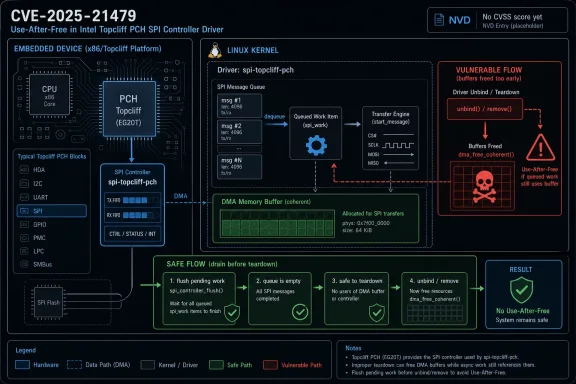 The Bug Lives Where Hardware Meets Housekeeping
The short version is almost deceptively mundane: the Topcliff PCH SPI driver could free DMA buffers too early during driver unbind. If queued SPI work still referenced those buffers, the kernel could later touch memory it had already released. That is the classic shape of a use-after-free, and in kernel space it is never something to wave away casually.The fix is small. In the patch, the DMA buffer release is moved until after the driver has attempted to flush pending messages and unwind the device more safely. In prose, that means the driver now gets a chance to finish with the memory before the memory is handed back.
That modest diff is exactly why this CVE is interesting. Many kernel flaws are not sprawling design failures; they are ordering mistakes. The driver does all the expected cleanup work, but it performs one piece of that cleanup too soon.
The affected driver is not part of the average desktop user’s mental model of Linux.
spi-topcliff-pch supports SPI controllers associated with Intel’s EG20T Platform Controller Hub and related LAPIS or OKI Semiconductor companion chips used in some embedded x86 and Atom-era systems. That makes this more of an embedded, industrial, appliance, and long-tail hardware issue than a universal laptop panic.NVD Has a Record, But Not Yet a Verdict
NVD currently lists CVE-2026-46301 as received and recently published, with no CVSS 4.0, 3.x, or 2.0 score assigned by NIST. That absence matters. It means defenders should resist the ritual of ranking the bug before the vulnerability database has finished its enrichment work.No public CVSS score does not mean “safe.” It means “not fully classified yet.” In practice, the risk depends heavily on whether the driver is present, whether the hardware exists, whether an attacker can trigger unbind or related teardown behavior, and whether the kernel build exposes the module in a useful way.
For most mainstream WindowsForum readers who run Linux in WSL, on servers, or as a desktop OS on commodity PCs, this is unlikely to be the vulnerability that changes their week. For organizations with older embedded x86 systems, field devices, industrial controllers, ruggedized appliances, or vendor-maintained Linux images, the calculus is different. Those systems are precisely where obscure drivers can remain enabled for years because nobody wants to touch a stable build.
The first mistake would be to inflate the bug into a universal Linux crisis. The second mistake would be to ignore it because it is obscure. Kernel attack surface does not need to be fashionable to be real.
The Patch Says More Than the CVE Blurb
The upstream patch text is terse: give the driver a chance to flush its queue before releasing DMA buffers on unbind. But packed inside that line is a familiar kernel engineering problem. Devices do not disappear politely.When a driver is removed, unbound, or torn down during power management, hotplug, test automation, module unloading, or error recovery, it must stop new work, drain old work, quiesce interrupts, release DMA resources, and only then let memory and controller state go away. If that order is wrong, the system may behave perfectly under normal operation and fail only during shutdown, suspend, unplug, rebind, or recovery.
That is why teardown bugs can survive for so long. The regular data path gets exercised constantly. The cleanup path often gets exercised only by maintainers, distro test suites, hotplug-heavy deployments, or the unlucky operator rebooting a fragile machine at 2 a.m.
The patch series that included this fix was not a one-off panic commit. It was part of a broader effort to correct explicit SPI controller deregistration in several drivers. The maintainer discussion described a class of teardown-ordering problems capable of causing system errors, null-pointer dereferences, hangs, or failed I/O during deregistration.
That context is important. CVE-2026-46301 is not only a single driver bug. It is one tile in a larger mosaic of Linux kernel maintenance: old drivers, complex lifecycle rules, and subsystems that must keep working across hardware nobody is excited to buy in 2026 but somebody still depends on.
Use-After-Free Is a Class, Not a Prediction
The phrase use-after-free tends to trigger security muscle memory, and for good reason. In user space, it can lead to crashes or code execution. In kernel space, it can be worse, because the kernel owns the address space, device access, and privilege boundary.But vulnerability class is not the same as exploitability. A use-after-free in a network stack reachable by untrusted packets is a very different beast from one in a hardware-specific SPI driver that may require local administrative action to unbind a device. The former invites broad scanning and weaponization. The latter may be mostly relevant to local attackers, physical access scenarios, malicious maintenance workflows, or reliability hardening.
That distinction should guide response, not excuse delay. Security teams should not treat all kernel CVEs as equal, but neither should they wait for perfect exploit intelligence before patching old driver bugs in systems that cannot tolerate kernel memory corruption. The right move is inventory first, panic never, patch when available.
The lack of an NVD score also leaves room for distro-specific treatment. Enterprise Linux vendors may rate the issue lower if the driver is not built, not shipped, not loaded by default, or reachable only under privileged conditions. Embedded vendors may take it more seriously if the driver sits on a platform they actively deploy.
The headline therefore is not “Linux has another catastrophic flaw.” The headline is that kernel cleanup paths remain a meaningful security boundary, especially in systems where module loading, device rebinding, and hardware control are part of normal operations.
The Hardware Specificity Is the Point
Topcliff PCH is not the center of today’s consumer PC universe. It belongs to an older embedded world, associated with Atom E6xx-era designs and companion chips that exposed SPI and other platform functions. That makes CVE-2026-46301 easy to overlook in a cloud dashboard filled with OpenSSL, browser, VPN, and Windows servicing alerts.Yet older embedded platforms are often where Linux security gets hardest. The systems may be physically remote, vendor-owned, lightly documented, or locked to a kernel branch that only receives selective backports. They may run in factories, transportation equipment, medical-adjacent appliances, retail systems, network gear, kiosks, or lab instruments.
That does not mean every Topcliff-era device is vulnerable or exposed. It means the vulnerable population is likely to be discovered through configuration management rather than intuition. Administrators need to know whether
CONFIG_SPI_TOPCLIFF_PCH is enabled, whether the module exists, whether it is loaded, and whether the hardware is present.This is where Windows-centric IT shops that also inherit Linux appliances can get caught. The Linux estate may not look like a fleet of general-purpose servers. It may look like “the box that runs the scanner,” “the controller in the cabinet,” or “the appliance the vendor told us not to update.” Those are exactly the places where a low-glamour kernel CVE can linger.
The fix also appears to have been marked for stable backporting as far back as the kernel line where the DMA support originated. That is a signal that maintainers consider the ordering bug worth correcting across long-supported branches, not merely in the latest development tree.
Unbind Is Not an Exotic Operation in the Real World
It is tempting to read “on unbind” and assume the bug is irrelevant because ordinary users do not unbind SPI controllers. That is too narrow. Driver unbind can happen during manual sysfs operations, module removal, hotplug workflows, device power transitions, test harnesses, and error handling.In many enterprise and embedded environments, administrators also use bind and unbind deliberately. They may reassign devices, reset troublesome controllers, test driver behavior, recover from failed peripherals, or perform maintenance without a full reboot. In virtualization-heavy contexts, device binding and unbinding are part of the daily vocabulary, even if this particular driver is not a typical passthrough target.
The security question is therefore not only “Can an unprivileged attacker directly trigger this?” It is also “Can a local attacker influence conditions around teardown?” and “Can an attacker with partial administrative access turn a reliability bug into a privilege or persistence problem?” Those are harder questions, and they are why kernel teams fix this class of issue even when exploitability is not obvious.
For administrators, the immediate practical risk may be reliability rather than compromise. A use-after-free in a hardware driver can present as a crash, hang, failed I/O, corrupted transaction, or difficult-to-reproduce instability during shutdown or reconfiguration. In industrial settings, reliability and security are often not separate categories; a system that falls over at the wrong time is already a security concern.
The most responsible reading is conservative: this is a memory-safety bug in privileged code, reachable through a specialized driver lifecycle path, and fixed by a small ordering change. That makes it patch-worthy, not panic-worthy.
The Kernel’s CVE Firehose Is Changing How Defenders Read Risk
Linux kernel CVEs have become more numerous as maintainers and CNA processes increasingly assign identifiers to many resolved bugs. That has made vulnerability feeds noisier. A kernel CVE today may describe anything from a broadly exploitable privilege escalation to a niche device-driver teardown bug with no known practical exploit path.This is uncomfortable but not necessarily bad. More identifiers make it easier to track fixes, backports, and vendor advisories. They also make it easier for vulnerability management tools to drown administrators in findings that require hardware and configuration context the scanner does not have.
CVE-2026-46301 sits squarely in that tension. A scanner may flag the kernel package. The NVD page may lack a score. The commit message may be only a few lines. The operational question, however, is specific: do you run a kernel with this driver enabled on hardware that uses it, and can the affected teardown path be triggered in your environment?
That is a better question than “Is Linux vulnerable?” Modern operating systems are too broad for that framing. A kernel is not one surface; it is thousands of surfaces, many compiled out, many dormant, many hardware-gated, and some unexpectedly reachable.
For WindowsForum readers, the analogy to Windows driver servicing is obvious. Not every vulnerable driver matters to every endpoint. But old, signed, privileged code in the wrong place can become a very real problem. The Linux difference is that the source and fix are visible earlier, while the burden of mapping that fix to deployed reality often falls on the operator.
What Administrators Should Actually Do
The immediate playbook is refreshingly practical. First, determine whether your distributions have shipped a kernel update containing the stable backport. Second, check whether the Topcliff PCH SPI driver is built or loadable in your kernel. Third, identify whether any systems actually use the relevant Intel EG20T or compatible LAPIS/OKI hardware.On a typical Linux server fleet, this may end quickly: no hardware, no module, no meaningful exposure. On embedded fleets, it may not. That is where asset inventory, vendor firmware notes, and kernel configuration records become more useful than the CVE page itself.
If the driver is present but not needed, disabling or blacklisting it may be reasonable, provided doing so does not break a vendor-supported configuration. If the driver is needed, the better answer is to apply a kernel containing the fix and reboot into it. Kernel package installation without reboot does not remove exposure from the running kernel.
Organizations should also be careful about module-management permissions. If unprivileged users cannot load, unload, bind, or unbind drivers, the exploit surface is narrower. That is not a substitute for patching, but it is part of sane kernel hardening.
Small Driver Bugs Become Big Process Tests
CVE-2026-46301 is the kind of vulnerability that exposes whether a vulnerability management program is merely score-driven. There is no NVD score yet, so a purely numerical workflow may stall. There is no splashy exploit report, so a headline-driven workflow may miss it. There is no universal hardware footprint, so a generic “patch everything immediately” workflow may waste effort.The mature response is more boring and more effective. Treat the CVE as a prompt to validate exposure. If exposed, patch through the normal kernel update channel. If not exposed, document why and move on.
That documentation matters. Six months from now, the same finding may reappear in a scanner, audit, or customer questionnaire. “Not applicable because
spi-topcliff-pch is not built or not present on deployed hardware” is a stronger answer than “low priority because it sounded obscure.”The deeper lesson is that kernel memory safety is not only about the hot path. The shutdown path, unbind path, suspend path, and error path all carry privilege. Attackers love neglected surfaces because defenders often build their mental models around normal operation.
The Topcliff Fix Belongs in the Patch Queue, Not the Panic Queue
This CVE does not demand drama, but it does deserve a clean operational response. The facts are concrete enough to act on even before NVD assigns a score: the issue is in the Linux kernel’s Topcliff PCH SPI driver, the flaw involves DMA buffers being released before queued work is safely flushed, and upstream stable references are already attached to the record.The practical read is narrower than a generic kernel emergency and broader than a harmless footnote.
- Administrators should verify whether their kernels include or load the
spi-topcliff-pchdriver before assigning urgency. - Embedded and industrial Linux deployments deserve closer attention than ordinary desktop or cloud systems for this particular CVE.
- Systems that do not have the relevant hardware or driver support are unlikely to face meaningful exposure from this bug.
- Systems that do use the driver should take the stable kernel update and reboot into the fixed kernel rather than relying on package installation alone.
- Security teams should record configuration-based non-applicability decisions, because scanner findings without hardware context tend to return.
- Driver unbind and teardown paths should be treated as privileged attack surface, not merely cleanup code.
References
- Primary source: NVD / Linux Kernel
Published: 2026-06-10T01:04:24-07:00
NVD - CVE-2026-46301
 nvd.nist.gov
- Security advisory: MSRC
Published: 2026-06-10T01:04:24-07:00
Original feed URL
Security Update Guide - Microsoft Security Response Center
 msrc.microsoft.com
- Related coverage: spinics.net

[PATCH 8/8] spi: topcliff-pch: fix use-after-free on unbind — Linux Kernel
Linux Kernel: [PATCH 8/8] spi: topcliff-pch: fix use-after-free on unbind
www.spinics.net
- Related coverage: opennet.ru
- Related coverage: techradar.com
Another major Linux security issue uncovered - new Fragnesia flaw allows attackers to run malicious code as root | TechRadar
The flaw is in the same family as Dirty Fragwww.techradar.com - Related coverage: kernel.googlesource.com
- Related coverage: cateee.net

