

Microsoft disclosed CVE-2026-47654 on June 9, 2026, as a Critical remote code execution flaw in the Remote Desktop Client affecting supported Windows Server releases from 2016 through 2025, with updates issued through the June security release and no reported public disclosure or exploitation at publication. The uncomfortable part is not that Remote Desktop is again in the security news; it is that the client side of the connection is the exposed party. In Microsoft’s description, a malicious Remote Desktop server can attack the machine of a user who connects to it. That flips the usual RDP risk model on its head, and it should change how administrators think about “safe” outbound remote access.
For years, Remote Desktop security advice has been built around a simple image: a Windows server listening on the internet, port 3389 exposed, attackers hammering credentials or protocol bugs until something gives. That picture is still useful, but CVE-2026-47654 is a reminder that it is incomplete. Here, the vulnerable component is the Remote Desktop Client, not the server receiving inbound sessions.
Microsoft describes the issue as a heap-based buffer overflow that can allow an unauthorized attacker to execute code over a network. The CVSS vector says the attack can be launched over the network, requires no privileges, but does require user interaction. In plain English, the victim has to connect to a hostile or attacker-controlled Remote Desktop server.
That detail matters because it moves the threat from perimeter exposure to trust decisions. A firewall rule cannot fully protect a user who voluntarily opens an RDP session to the wrong host. The security boundary becomes the client’s choice of destination, the trustworthiness of connection files, and the habits of administrators who routinely jump between machines under pressure.
This is why the vulnerability deserves attention even though Microsoft marks exploitation as unlikely at original publication. “Unlikely” is not “irrelevant,” especially in a protocol family used by help desks, managed service providers, lab operators, contractors, and administrators who are trained to connect first and troubleshoot later.
The maximum impact metrics are severe. Microsoft scores confidentiality, integrity, and availability impact as high. If exploitation succeeds, the attacker is not merely crashing the client or causing a nuisance; the intended outcome is code execution on the victim’s machine.
The dampening factors are equally important. Attack complexity is high, user interaction is required, and Microsoft’s exploitability assessment says exploitation is unlikely. The FAQ states that successful exploitation requires winning a race condition, which is the kind of phrase that usually means reliability is not guaranteed and exploit development is nontrivial.
But the report confidence metric is Confirmed. That is the part highlighted in the prompt, and it is the part administrators should not overlook. Microsoft is not saying, “We have heard rumors of a bug.” It is saying the vulnerability exists, the technical details are credible enough to score, and the vendor has acknowledged the issue.
A Confirmed rating means the existence of the vulnerability is not in serious doubt. It also implies that enough technical information exists for Microsoft to understand the class of flaw, assign a weakness, issue updates, and describe an attack scenario. That does not mean exploit code is public. It does mean defenders should stop treating the item as theoretical.
This distinction matters in patch prioritization meetings. Security teams often triage vulnerabilities by asking three questions: Is it real, is it reachable, and is it being exploited? CVE-2026-47654 answers the first two with enough force to deserve action, even while the third remains negative at publication.
The lack of known exploitation buys time, not immunity. The lack of public exploit code lowers urgency, but it does not erase the problem. Once a vendor ships a patch, attackers can compare old and new binaries, reason about the fixed code path, and decide whether the race condition is worth chasing.
That comparison is useful because the Remote Desktop Client is, in effect, a specialized parser for complex network-delivered content. It negotiates capabilities, handles graphical updates, processes virtual channels, manages clipboard and device redirection, and translates remote host behavior into local client actions. Complexity is the tax paid for making a remote machine feel local.
When the server is trusted, that complexity is invisible. When the server is malicious, every parser and feature becomes part of the attack surface. A heap-based buffer overflow in that context is exactly the kind of memory safety bug that can turn a routine connection into a compromise path.
This does not mean every RDP connection is suddenly suspect. It means organizations need to treat outbound RDP destinations with the same suspicion they already apply to downloaded executables, browser links, and remote support invitations. The act of connecting is an act of trust.
The lesson is not that every Server Core deployment is equally likely to be used as an RDP client. The lesson is that components and libraries can be present in places where the operational use case is uncommon. Server Core reduces surface area, but it is not a magic eraser for every client-side component that may be serviced as part of Windows.
For administrators, the practical question is simpler than the product matrix. If the system is in support and receives one of the June 2026 cumulative updates tied to this CVE, patch it through the normal servicing channel. Do not assume that a server role, installation mode, or lack of daily interactive use makes the update irrelevant.
The build numbers tell the story of a conventional Windows servicing fix: Windows Server 2016 moves to build 10.0.14393.9234, Windows Server 2019 to 10.0.17763.8880, Windows Server 2022 to 10.0.20348.5256, and Windows Server 2025 to 10.0.26100.32995. That is the patch trail administrators should verify after deployment.
The harder answer is to examine how users and administrators reach remote systems. RDP is often treated as plumbing: a connection method, not a risk decision. That attitude is increasingly outdated.
A malicious RDP server could be part of a phishing campaign, a compromised vendor host, a fake lab system, or a staging box an attacker persuades an administrator to inspect. The required user interaction is not a major barrier if the target population already expects to connect to unfamiliar machines as part of its job.
This is where training and policy should become more specific. “Do not click suspicious links” is too generic for administrators. “Do not open unsolicited RDP files, do not connect to unverified RDP hosts, and do not use privileged workstations for untrusted remote sessions” is closer to the real risk.
The phrase “exploitation unlikely” should be read as a point-in-time assessment. It reflects what Microsoft believed at publication, not a permanent law of physics. If researchers or attackers later publish a reliable technique, the risk picture changes.
There is also a difference between mass exploitation and targeted exploitation. A finicky race condition may be unattractive for broad automated campaigns, but still useful against a high-value administrator who can be induced to connect more than once. Attackers do not always need elegance; sometimes persistence and a plausible pretext are enough.
That is why organizations should resist the temptation to rank this below every vulnerability with a louder score. A Critical RCE in an administrative toolchain has a different kind of gravity. Even when the exploit path requires a user to participate, the likely users are often the people with the most useful access.
That history creates a challenge for communication. Overhyping every RDP-related bug dulls attention and encourages patch fatigue. Underplaying client-side RCE because there is no known exploitation invites complacency in exactly the environments where remote administration is most routine.
The right framing is narrower and more useful: this is a confirmed client-side remote code execution vulnerability in Microsoft’s Remote Desktop Client, reachable through a malicious server, with high attack complexity and no known exploitation at release. That sentence is less dramatic than “new RDP apocalypse,” but it gives defenders the information they need.
It also points to the right mitigations. Patch the client. Control where administrators connect. Treat unsolicited connection artifacts as hostile. Reduce unnecessary redirection features where possible. Keep privileged administration away from general-purpose browsing and ad hoc remote sessions.
A Remote Desktop Client sits at a privileged intersection. It touches credentials, brokers access to systems, renders untrusted remote output, and often runs on machines used by administrators. If that client can be compromised by a hostile server, then outbound administrative traffic becomes a path inward.
This is especially relevant for managed service providers and IT teams that support many customer environments. Their workflows frequently involve connecting from one administrative workstation to many remote systems across organizational boundaries. A malicious or compromised customer-side host could become a staging point for attacking the support operator’s machine.
The same concern applies to developers and lab users. Test environments often have weaker controls, reused credentials, and experimental images. If a user connects from a production workstation to a questionable RDP endpoint in a lab, the trust boundary has already been crossed.
That sounds mundane because it is. Most successful enterprise security is mundane. The problem is not that administrators lack a theory of patching; it is that change windows, maintenance freezes, legacy dependencies, and fear of regressions turn straightforward fixes into calendar negotiations.
For this vulnerability, deferral should be justified rather than automatic. The absence of known exploitation supports measured rollout, not indefinite delay. Test the June cumulative update, prioritize systems used for administrative access, and confirm that servers capable of initiating RDP sessions are not forgotten simply because they are “servers.”
Security teams should also ask whether their asset inventory can answer a basic question: which systems regularly use the Remote Desktop Client to connect outward? If the answer is “we don’t know,” the vulnerability has exposed a visibility gap larger than this single CVE.
CVE-2026-47654 is unlikely to be remembered as the loudest Windows vulnerability of the year unless exploitability changes, but it is a useful warning shot. Microsoft has patched a confirmed Critical flaw in the Remote Desktop Client, and the responsible response is to install the update while tightening the assumptions around who connects to what. The next phase of Windows remote-access security will be less about a single port and more about the trust chain behind every administrative session.
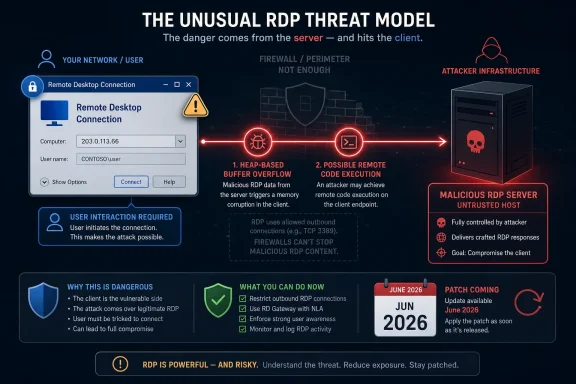 The Dangerous Side of RDP Is Not Always the Open Port
For years, Remote Desktop security advice has been built around a simple image: a Windows server listening on the internet, port 3389 exposed, attackers hammering credentials or protocol bugs until something gives. That picture is still useful, but CVE-2026-47654 is a reminder that it is incomplete. Here, the vulnerable component is the Remote Desktop Client, not the server receiving inbound sessions.Microsoft describes the issue as a heap-based buffer overflow that can allow an unauthorized attacker to execute code over a network. The CVSS vector says the attack can be launched over the network, requires no privileges, but does require user interaction. In plain English, the victim has to connect to a hostile or attacker-controlled Remote Desktop server.
That detail matters because it moves the threat from perimeter exposure to trust decisions. A firewall rule cannot fully protect a user who voluntarily opens an RDP session to the wrong host. The security boundary becomes the client’s choice of destination, the trustworthiness of connection files, and the habits of administrators who routinely jump between machines under pressure.
This is why the vulnerability deserves attention even though Microsoft marks exploitation as unlikely at original publication. “Unlikely” is not “irrelevant,” especially in a protocol family used by help desks, managed service providers, lab operators, contractors, and administrators who are trained to connect first and troubleshoot later.
Microsoft’s Score Tells a More Nuanced Story Than “Critical”
The headline severity is Critical, but the CVSS base score is 7.5, with a temporal score of 6.6. That apparent mismatch will make some readers pause. In Microsoft’s world, severity labels and CVSS numbers often live adjacent lives: the CVSS score expresses a standardized model of exploit characteristics, while the vendor severity reflects product impact and customer risk.The maximum impact metrics are severe. Microsoft scores confidentiality, integrity, and availability impact as high. If exploitation succeeds, the attacker is not merely crashing the client or causing a nuisance; the intended outcome is code execution on the victim’s machine.
The dampening factors are equally important. Attack complexity is high, user interaction is required, and Microsoft’s exploitability assessment says exploitation is unlikely. The FAQ states that successful exploitation requires winning a race condition, which is the kind of phrase that usually means reliability is not guaranteed and exploit development is nontrivial.
But the report confidence metric is Confirmed. That is the part highlighted in the prompt, and it is the part administrators should not overlook. Microsoft is not saying, “We have heard rumors of a bug.” It is saying the vulnerability exists, the technical details are credible enough to score, and the vendor has acknowledged the issue.
Report Confidence Is the Quiet Metric That Changes Priorities
Report Confidence is not the sexiest CVSS field. It does not have the drama of attack vector or the instant fear of remote code execution. Yet in this case, it is the metric that separates a speculative advisory from a real engineering problem.A Confirmed rating means the existence of the vulnerability is not in serious doubt. It also implies that enough technical information exists for Microsoft to understand the class of flaw, assign a weakness, issue updates, and describe an attack scenario. That does not mean exploit code is public. It does mean defenders should stop treating the item as theoretical.
This distinction matters in patch prioritization meetings. Security teams often triage vulnerabilities by asking three questions: Is it real, is it reachable, and is it being exploited? CVE-2026-47654 answers the first two with enough force to deserve action, even while the third remains negative at publication.
The lack of known exploitation buys time, not immunity. The lack of public exploit code lowers urgency, but it does not erase the problem. Once a vendor ships a patch, attackers can compare old and new binaries, reason about the fixed code path, and decide whether the race condition is worth chasing.
The Malicious Server Scenario Cuts Against Admin Muscle Memory
The most important sentence in Microsoft’s advisory is the one explaining how exploitation could happen: an attacker who controls a Remote Desktop Server could trigger remote code execution on a machine when a victim connects with the vulnerable client. That is not the everyday “server gets popped” model. It is closer to the logic of a malicious website attacking a browser.That comparison is useful because the Remote Desktop Client is, in effect, a specialized parser for complex network-delivered content. It negotiates capabilities, handles graphical updates, processes virtual channels, manages clipboard and device redirection, and translates remote host behavior into local client actions. Complexity is the tax paid for making a remote machine feel local.
When the server is trusted, that complexity is invisible. When the server is malicious, every parser and feature becomes part of the attack surface. A heap-based buffer overflow in that context is exactly the kind of memory safety bug that can turn a routine connection into a compromise path.
This does not mean every RDP connection is suddenly suspect. It means organizations need to treat outbound RDP destinations with the same suspicion they already apply to downloaded executables, browser links, and remote support invitations. The act of connecting is an act of trust.
Server Core Appearing in the Affected List Is a Reminder, Not a Contradiction
The affected product list includes Windows Server 2016, Windows Server 2019, Windows Server 2022, and Windows Server 2025, including Server Core installations. That may surprise people who think of Server Core as a stripped-down environment far removed from interactive Remote Desktop client usage.The lesson is not that every Server Core deployment is equally likely to be used as an RDP client. The lesson is that components and libraries can be present in places where the operational use case is uncommon. Server Core reduces surface area, but it is not a magic eraser for every client-side component that may be serviced as part of Windows.
For administrators, the practical question is simpler than the product matrix. If the system is in support and receives one of the June 2026 cumulative updates tied to this CVE, patch it through the normal servicing channel. Do not assume that a server role, installation mode, or lack of daily interactive use makes the update irrelevant.
The build numbers tell the story of a conventional Windows servicing fix: Windows Server 2016 moves to build 10.0.14393.9234, Windows Server 2019 to 10.0.17763.8880, Windows Server 2022 to 10.0.20348.5256, and Windows Server 2025 to 10.0.26100.32995. That is the patch trail administrators should verify after deployment.
The Patch Is Simple; The Trust Model Is Not
The easiest operational answer is to install the relevant June 2026 security update. For most managed environments, that means approving the cumulative update through Windows Update for Business, WSUS, Configuration Manager, Intune, or the organization’s patching platform. The vulnerability is not a reason to improvise outside the normal servicing model unless the environment has a specific exposure pattern that demands acceleration.The harder answer is to examine how users and administrators reach remote systems. RDP is often treated as plumbing: a connection method, not a risk decision. That attitude is increasingly outdated.
A malicious RDP server could be part of a phishing campaign, a compromised vendor host, a fake lab system, or a staging box an attacker persuades an administrator to inspect. The required user interaction is not a major barrier if the target population already expects to connect to unfamiliar machines as part of its job.
This is where training and policy should become more specific. “Do not click suspicious links” is too generic for administrators. “Do not open unsolicited RDP files, do not connect to unverified RDP hosts, and do not use privileged workstations for untrusted remote sessions” is closer to the real risk.
High Attack Complexity Should Not Become an Excuse
Microsoft says exploitation requires winning a race condition. That is good news, but it is not a force field. Race conditions can be difficult to exploit reliably, but history is full of difficult bugs that became practical after enough attention, enough target knowledge, or enough patience.The phrase “exploitation unlikely” should be read as a point-in-time assessment. It reflects what Microsoft believed at publication, not a permanent law of physics. If researchers or attackers later publish a reliable technique, the risk picture changes.
There is also a difference between mass exploitation and targeted exploitation. A finicky race condition may be unattractive for broad automated campaigns, but still useful against a high-value administrator who can be induced to connect more than once. Attackers do not always need elegance; sometimes persistence and a plausible pretext are enough.
That is why organizations should resist the temptation to rank this below every vulnerability with a louder score. A Critical RCE in an administrative toolchain has a different kind of gravity. Even when the exploit path requires a user to participate, the likely users are often the people with the most useful access.
RDP’s Long Shadow Still Shapes Every Advisory
Remote Desktop carries institutional memory. BlueKeep, CredSSP flaws, brute-force campaigns, exposed gateways, stolen credentials, and ransomware playbooks have all trained defenders to treat RDP as a recurring source of bad days. CVE-2026-47654 is not BlueKeep, and it should not be described as a wormable server-side disaster. But it lands in the same emotional and operational neighborhood.That history creates a challenge for communication. Overhyping every RDP-related bug dulls attention and encourages patch fatigue. Underplaying client-side RCE because there is no known exploitation invites complacency in exactly the environments where remote administration is most routine.
The right framing is narrower and more useful: this is a confirmed client-side remote code execution vulnerability in Microsoft’s Remote Desktop Client, reachable through a malicious server, with high attack complexity and no known exploitation at release. That sentence is less dramatic than “new RDP apocalypse,” but it gives defenders the information they need.
It also points to the right mitigations. Patch the client. Control where administrators connect. Treat unsolicited connection artifacts as hostile. Reduce unnecessary redirection features where possible. Keep privileged administration away from general-purpose browsing and ad hoc remote sessions.
The Client Is Part of the Perimeter Now
Enterprise security has spent years learning that the perimeter is not just the firewall. Identity became a perimeter. The browser became a perimeter. Endpoint posture became a perimeter. CVE-2026-47654 adds another reminder: remote administration clients are perimeter software too.A Remote Desktop Client sits at a privileged intersection. It touches credentials, brokers access to systems, renders untrusted remote output, and often runs on machines used by administrators. If that client can be compromised by a hostile server, then outbound administrative traffic becomes a path inward.
This is especially relevant for managed service providers and IT teams that support many customer environments. Their workflows frequently involve connecting from one administrative workstation to many remote systems across organizational boundaries. A malicious or compromised customer-side host could become a staging point for attacking the support operator’s machine.
The same concern applies to developers and lab users. Test environments often have weaker controls, reused credentials, and experimental images. If a user connects from a production workstation to a questionable RDP endpoint in a lab, the trust boundary has already been crossed.
Windows Servicing Does Its Job, But Only If You Let It
There is no exotic mitigation story here. Microsoft has issued security updates for the affected supported Windows Server versions. The primary defense is to deploy them and verify the resulting build numbers.That sounds mundane because it is. Most successful enterprise security is mundane. The problem is not that administrators lack a theory of patching; it is that change windows, maintenance freezes, legacy dependencies, and fear of regressions turn straightforward fixes into calendar negotiations.
For this vulnerability, deferral should be justified rather than automatic. The absence of known exploitation supports measured rollout, not indefinite delay. Test the June cumulative update, prioritize systems used for administrative access, and confirm that servers capable of initiating RDP sessions are not forgotten simply because they are “servers.”
Security teams should also ask whether their asset inventory can answer a basic question: which systems regularly use the Remote Desktop Client to connect outward? If the answer is “we don’t know,” the vulnerability has exposed a visibility gap larger than this single CVE.
The June RDP Client Fix Rewards Teams That Already Know Their Jump Paths
The concrete work is not complicated, but it is easy to misdirect. Treat this as both a patching item and a remote-access hygiene check.- Organizations should deploy the June 9, 2026 security updates for affected Windows Server releases and verify the fixed build numbers after installation.
- Administrators should treat RDP connections to unknown, unsolicited, or weakly verified servers as potentially dangerous, not merely unproductive.
- Security teams should prioritize machines used for administration, support, lab access, and cross-tenant remote work because those users are more likely to connect outward.
- The absence of public disclosure or known exploitation at release lowers emergency pressure, but Microsoft’s Confirmed report confidence means the vulnerability should not be dismissed.
- Policies around RDP files, saved connection profiles, clipboard redirection, drive redirection, and privileged workstation use deserve review alongside patch deployment.
CVE-2026-47654 is unlikely to be remembered as the loudest Windows vulnerability of the year unless exploitability changes, but it is a useful warning shot. Microsoft has patched a confirmed Critical flaw in the Remote Desktop Client, and the responsible response is to install the update while tightening the assumptions around who connects to what. The next phase of Windows remote-access security will be less about a single port and more about the trust chain behind every administrative session.
References
- Primary source: MSRC
Published: 2026-06-09T07:00:00-07:00
Security Update Guide - Microsoft Security Response Center
 msrc.microsoft.com
